
Research article · 2025 · Full text
International Journal of Horticulture and Food ScienceEffect of Pusa hydrogel and plant growth regulators on growth, yield and quality parameters of strawberry (Fragaria x ananassa Dutch.) cv. Chandler
Volume 7(1) · Pages 109–112 · DOI: 10.33545/26631067.2025.v7.i1b.253 ↗
Research areasBotanical Research and ApplicationsPlant Growth Enhancement TechniquesPolymer-Based Agricultural Enhancements
Abstract
Author-writtenThe present study\r\nwas carried out in the year 2021-22 in Central Research farm, Department of Horticulture,\r\nShri Durga Ji Post Graduate College, Chandeshwar, Azamgarh, Uttar Pradesh. The\r\nexperiment was conducted in Randomized Block Design with 27 treatments\r\nreplicated thrice. The treatments were T0 (Control), T1 (Pusa\r\nhydrogel-30 gram), T2 (Pusa hydrogel -60 gram), T3 (Cycocel (600 ppm)), T4 (Cycocel (1200 ppm)), T5 (Triacontanol (120\r\nppm)), T6 (Triacontanol (170 ppm)), T7 (Cycocel (600 ppm) + Pusa hydrogel-30 gram), T8 (Cycocel (600 ppm) + Pusa hydrogel -60 gram), T9 (Cycocel (1200 ppm) + Pusa hydrogel-30 gram), T10 (Cycocel (1200 ppm)+ Pusa hydrogel -60 gram), T11 (Triacontanol (120 ppm) + Pusa hydrogel -30 gram), On the basis of our\r\nfinding it was found that treatment T11 (Triacontanol (120 ppm) + Pusa hydrogel -30 gram) was found to be best in\r\nthe terms of Plant height, no. of leaves, plant spread, petiole length, leaf\r\nlength, leaf width, leaf area, chlorophyll content, leaf nutrient, days taken\r\nto first flower, flowers per plant, days taken to first fruit, fruit length,\r\nfruit width, fruit set %, fruit yield/plant.
Summary
Source-checkedPlain-language reading of the full paper, prepared with AI and checked against the text. Each point links to the authors' own words.
Why it matters
- Strawberry is considered one of the most fascinating fruits globally. View evidence ↗
- PUSA Hydrogel is a cellulose-based super absorbent polymer that can absorb water up to 300 times its own size. View evidence ↗
- Triacontanol is used to increase chlorophyll levels in leaves, which improves photosynthesis and the rate of cell growth. View evidence ↗
The question
- The study aimed to identify the most effective treatment for improving the growth, yield, and quality of strawberries, as well as the economic viability of these treatments. View evidence ↗
What they did
- The research was conducted during 2021-22 at the Central Research farm in Azamgarh, Uttar Pradesh. View evidence ↗
- The study used a Randomized Block Design featuring 27 treatments, each replicated three times. View evidence ↗
- Treatments included a control (T0), various doses of Pusa hydrogel (30g, 60g), Cycocel (600ppm, 1200ppm), Triacontanol (120ppm, 170ppm), and combinations of these. View evidence ↗
What they found
- Treatment T11 (Triacontanol 120 ppm + Pusa hydrogel 30g) produced the maximum plant height of 18.22 cm, which was significantly higher than the control's 16.66 cm. View evidence ↗
- The widest plant spread (22.19 cm) was achieved with treatment T11, compared to 20.74 cm in the control group. View evidence ↗
- Treatment T11 resulted in the longest fruits (5.36 cm), significantly exceeding the control's 3.36 cm. View evidence ↗
- The highest fruit set percentage was 67.82% in treatment T11, compared to 41.37% in the control. View evidence ↗
- Treatment T11 achieved the highest yield per plant at 196.35 g, nearly double the control yield of 108.52 g. View evidence ↗
- The heaviest individual fruits (21.35 g) were found in treatment T11, compared to 10.91 g in the control. View evidence ↗
What it means
- The authors concluded that the combination of Triacontanol (120 ppm) and Pusa hydrogel (30g) is the best treatment for improving vegetative growth, earliness, flowering, fruiting, quality, and economics. View evidence ↗
Visual summary
2 visualsIllustrations explain the paper; charts are replotted from the paper's own table values.
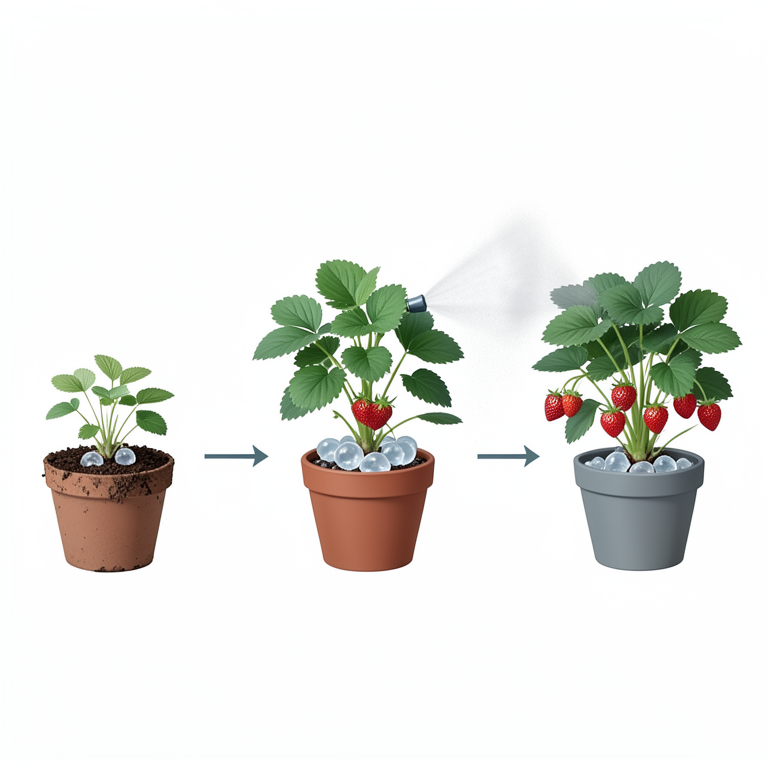
Experimental Treatment Matrix
AI-generated conceptual illustration (strawberry plants (Fragaria x ananassa cv. Chandler)). It explains the idea and does not show study data.
View source evidence ↗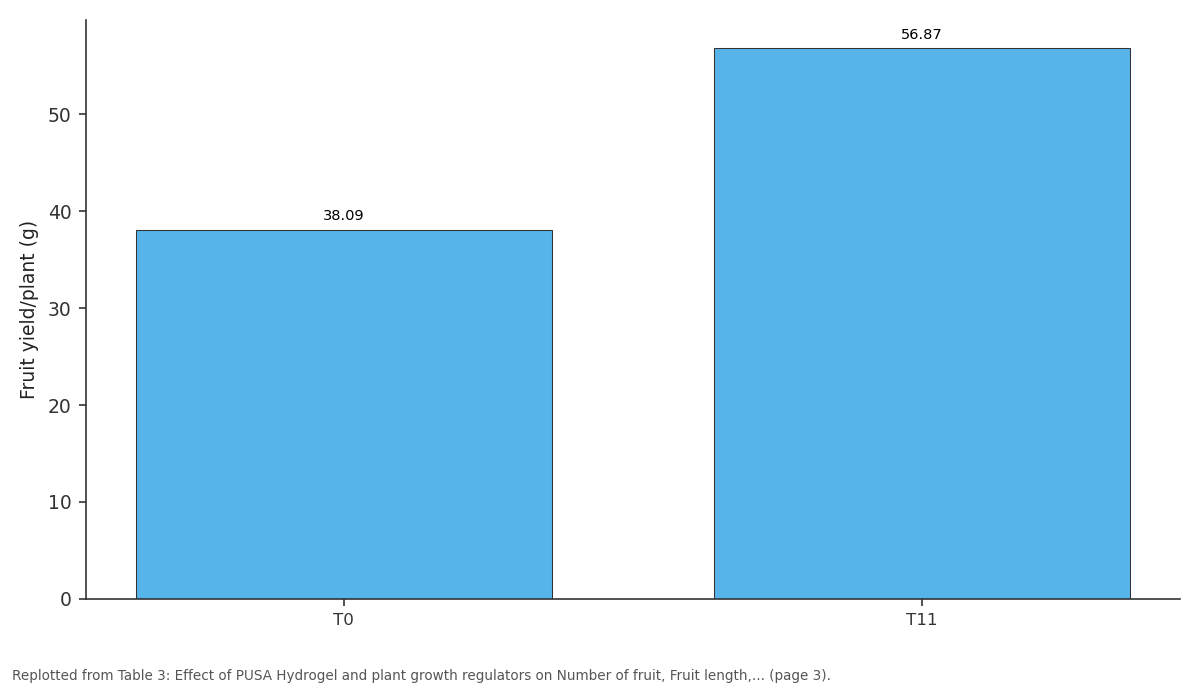
Fruit set %: T0 vs T11
Replotted from Table 3 (page 3) of the original paper. Every bar is the paper's own table value.
View source evidence ↗Figures & tables
From the original paper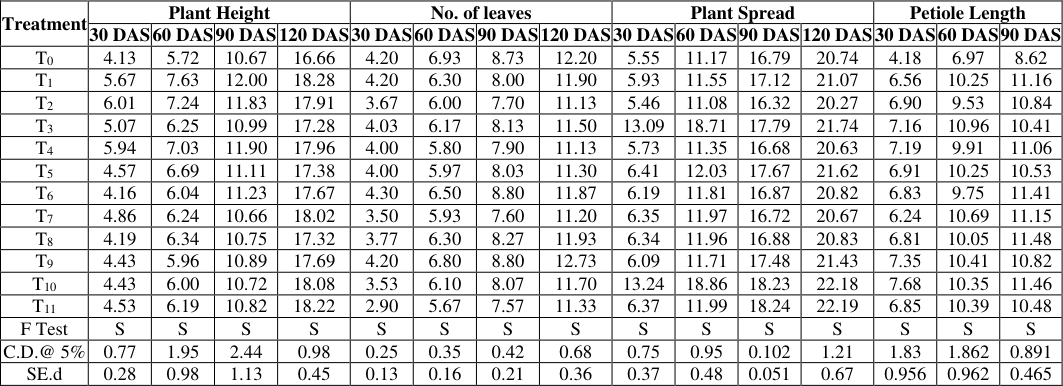 Table 1
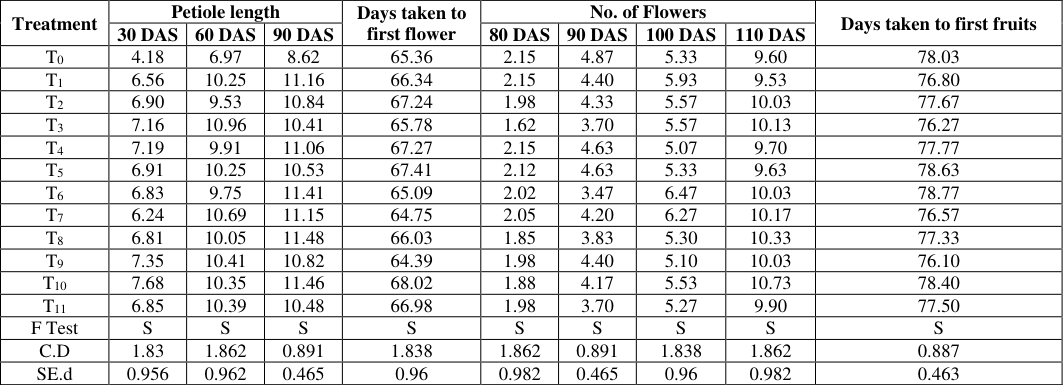 Table 2
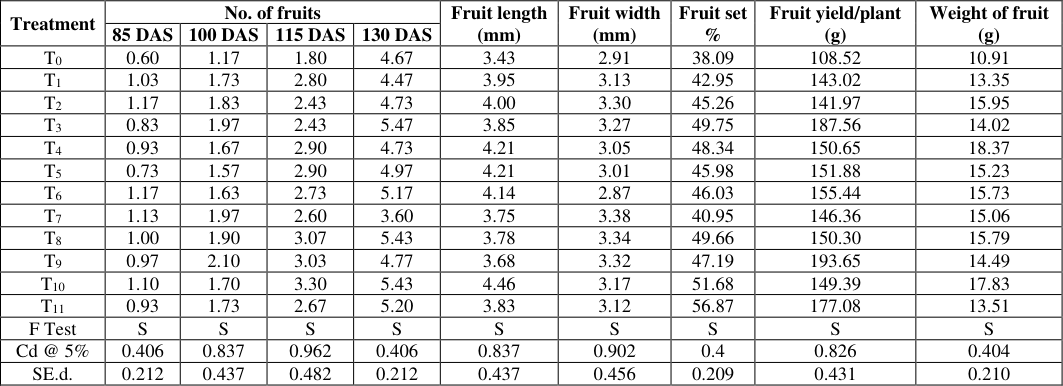 Table 3
Introduction
Strawberry (Fragaria x ananassa Duch.) is one of the most fascinating fruits of the world. It is a cross between two species of American wild strawberry: a large fruited species, Fragaria chiloensis, originally from Chile and Fragaria virginiana, originally from Virginia, USA. The chromosome no. in strawberry is 2n=2x= 56. Strawberry belongs to the family Rosaceae. The commercially cultivated strawberry is an octaploid species. It is a short-lived (3-5 yrs.), perennial, vigorous, stoloniferous herb growing to 10-20 cm height with a spread of about 0.3-1.0 m. Leaves are trifoliate, on stalks which grow out from a central crown (a compacted stem, where many leaves are formed very close together; leaflets are oval-egg shaped, deep green with coarse serrations. Flowers are white, 1-2 cm wide, bisexual with approximately 30 stamens and approximately 300 pistils on a swollen, conical, yellowish receptacle. The first flower opens at the top and centre of the crown and produce the bigger fruits; flowers that open later produce the small fruits. The true fruit of the strawberry is an achene, which is a small, dry seed loosely attached to the swollen ovary wall (receptacle). The flesh of the strawberry is, in fact, the ovary wall with many fruits/seeds on its surface. The roots are shallow so plants need regular moisture but not water logging. Cycocel is a plant growth regulator for ornamentals, including bedding plants and herbaceous crops. Cycocel enhances the crop's aesthetic appeal and improves durability during post production shipping and handling. Treated crops are more compact with shorter internodes, stronger stems, and greener leaves. PUSA Hydrogel is a super absorbent polymer developed by Indian Agriculture Research Institute, New Delhi which has been commercialized by CUMI. PUSA Hydrogel a Cellulose based Hydrogel which absorbs water 300 times its own size. Its recommended to be applied under the soil and near the root zone. 1-Triacontanol is a fatty alcohol of the general formula C₃₀H₆₂O, also known as melissyl alcohol or myricyl alcohol. It is found in plant cuticle waxes and in beeswax. Triacontanol significantly increases the amount of chlorophyll in leaves, thereby improving the rate of photosynthesis. It increases the rate of cell growth and multiplication.
Materials and Methods
The area of Azamgarh district comes under subtropical belt in the North east of Uttar Pradesh, which experience extremely hot summer and extremely cold winter. The maximum temperature of the location reaches up to 42 °C-45 °C and seldom falls as low as 4 °C -5 °C. The relative humidity ranges between 20 to 94%. The average rainfall in this area is around 1013.4 mm annually. However, occasional precipitation is also not uncommon during winter months. The experiment was conducted with an objective to find out the best treatment for growth, yield and quality of strawberry along with economics of the different treatment. The Treatments were T 0 (Control), T 1 (Pusa hydrogel-30 gram), T 2 (Pusa hydrogel -60 gram), T 3 (Cycocel (600 ppm)), T 4 (Cycocel (1200 ppm)), T 5 (Triacontanol (120 ppm)), T 6 (Triacontanol (170 ppm)), T 7 (Cycocel (600 ppm) + Pusa hydrogel-30 gram), T 8 (Cycocel (600 ppm) + Pusa hydrogel -60 gram), T 9 (Cycocel (1200 ppm) + Pusa hydrogel-30 gram), T 10 (Cycocel (1200 ppm)+ Pusa hydrogel -60 gram), T 11 (Triacontanol (120 ppm) + Pusa hydrogel -30 gram).
Results and Finding 1. Vegetative Parameters
The maximum plant height was observed in the treatment T 11 (Triacontanol (120 ppm) + Pusa hydrogel -30 gram) with 18.22 cm followed by T 10 (Cycocel (1200 ppm) + Pusa hydrogel 60 gram) with 18.08 cm which was significantly superior to T 0 (Control) with 16.66 cm. The maximum number of leaves was observed in the treatment T 11 (Triacontanol (120 ppm) + Pusa hydrogel -30 gram) with 11.70 followed by T 10 (Cycocel (1200 ppm) + Pusa hydrogel 60 gram) with 11.33 which was significantly superior to T 0 (Control) with 12.20. The maximum plant spread was observed in the treatment T 11 (Triacontanol (120 ppm) + Pusa hydrogel -30 gram) with 22.19 cm followed by T 10 (Cycocel (1200 ppm) + Pusa hydrogel 60 gram) with 22.18 cm which was significantly superior to T 0 (Control) with 20.74 cm. The maximum petiole length was observed in the treatment T 11 (Triacontanol (120 ppm) + Pusa hydrogel -30 gram) with 12.14 cm followed by T 10 (Cycocel (1200 ppm) + Pusa hydrogel 60 gram) with 12.04 cm which was significantly superior to T 0 (Control) with 8.62 cm. The maximum number of flowers was observed in the treatment T 11 (Triacontanol (120 ppm) + Pusa hydrogel -30 gram) with 10.73 followed by T 10 (Cycocel (1200 ppm) + Pusa hydrogel 60 gram) with 10.41 which was significantly superior to T 0 (Control) with 9.60.
Earliness Parameter
The minimum days taken to first flowering was observed in the treatment T 11 (Triacontanol (120 ppm) + Pusa hydrogel -30 gram) with 63.58 days followed by T 10 (Cycocel (1200 ppm) + Pusa hydrogel 60 gram) with 64.05 days which was significantly superior to T 0 (Control) with 65.36 days. The minimum days taken to first fruiting was observed in the treatment T 11 (Triacontanol (120 ppm) + Pusa hydrogel -30 gram) with 75.41 days followed by T 10 (Cycocel (1200 ppm) + Pusa hydrogel 60 gram) with 75.92 days which was significantly superior to T 0 (Control) with 78.03 days.
Fruiting Parameter
The maximum number of fruit was observed in the treatment T 11 (Triacontanol (120 ppm) + Pusa hydrogel -30 gram) with 5.87 followed by T 10 (Cycocel (1200 ppm) + Pusa hydrogel 60 gram) with 5.70 which was significantly superior to T 0 (Control) with 4.67. The maximum fruit length was observed in the treatment T 11 (Triacontanol (120 ppm) + Pusa hydrogel -30 gram) with 5.36 cm followed by T 10 (Cycocel (1200 ppm) + Pusa hydrogel 60 gram) with 4.52 cm which was significantly superior to T 0 (Control) with 3.36 cm. The maximum fruit width was observed in the treatment T 11 (Triacontanol (120 ppm) + Pusa hydrogel -30 gram) with 3.52 cm followed by T 10 (Cycocel (1200 ppm) + Pusa hydrogel 60 gram) with 3.42 cm which was significantly superior to T 0 (Control) with 2.71 cm. The maximum fruit set % was observed in the treatment T 11 (Triacontanol (120 ppm) + Pusa hydrogel -30 gram) with 67.82% followed by T 10 (Cycocel (1200 ppm) + Pusa hydrogel 60 gram) with 66.19% which was significantly superior to T 0 (Control) with 41.37%.
Yield parameters
The maximum fruit yield per plant was observed in the treatment T 11 (Triacontanol (120 ppm) + Pusa hydrogel -30 gram) with 196.35 g followed by T 10 (Cycocel (1200 ppm) + Pusa hydrogel 60 gram) with 193.14 g which was significantly superior to T 0 (Control) with 108.52 g. The maximum weight of fruit was observed in the treatment T 11 (Triacontanol (120 ppm) + Pusa hydrogel -30 gram) with 21.35 g followed by T 10 (Cycocel (1200 ppm) + Pusa hydrogel 60 gram) with 19.68 g which was significantly superior to T 0 (Control) with 10.91 g.
Discussion
Vegetative Parameters Tucker (1926) [15] reported that the application of stable nutrients increased vegetative growth which was observed by production of more runners and their branching had direct relation to the amounts of nutrients applied. The stable nutrients also increased vegetative growth in strawberry. the application of hydrogel minimizes the irrigation requirements of several crops by improving the water-holding capacity of the soil (Yang and Gress 1990) [16] and it also enhances somatic cell division which leads to the vegetative growth of the strawberry. Plant growth regulators also helpful in the similar way by enhancing cell division, cell multiplication and cell elongation Macphail 1980 [4] .
Earliness and Fruiting Parameters
The minimum number of days taken to flowering, and fruiting might be due to ample supply of the nutrients through hydrogel and plant growth regulators which leads to meiosis that is sex cell which leads to cell division and cell elongation because of which they have positive impact on earliness parameters. Similar findings were also reported by Clark et al. 2003 Verma et al. 2013 Johnson and Woodhouse and Khunte et al. 1990 [1,13,5] .
Yield Parameters
Nutrients play an important role in improving productivity and quality of Strawberry. Added dose of hydrogel and plant growth regulators and other essential nutrients increased the vigor of plants, assimilating area, size of fruit, thereby resulting into higher weight of fruit. These results are in close conformity with the findings of Shinde et al., 2008 Ghora et al. 2000 and Pant and Kumar 2004 [12,2,10] .
Conclusion
On the basis of our experimental finding it was concluded that the treatment T 11 (Triacontanol (120 ppm) + Pusa hydrogel -30 gram) was found to be best in the terms of Vegetative parameters, earliness parameters, flowering and fruiting parameters, quality parameters and economics of the treatment.
Future Scope
Strawberry (Fragaria x ananassa) is a popular fruit crop, having gained significant interest in the past several decades, thus increasing demand for specialty crops. Depending on the cropping system used, strawberry production can be either annual or perennial and many improvements in management practices, breeding, and new systems have helped to support the commercial strawberry industry. Pusa hydrogel' which is first indigenous semisynthetic superabsorbent technology for conserving water and enhancing crop productivity and thereby increases the water use efficiency.
Figures and tables from the paper
| Treatment | Plant Height | — | — | — | No. of leaves | — | — | — | Plant Spread | — | — | — | Petiole Length | — | — |
|---|---|---|---|---|---|---|---|---|---|---|---|---|---|---|---|
| 30 DAS | 60 DAS | 90 DAS | 120 DAS | 30 DAS | 60 DAS | 90 DAS | 120 DAS | 30 DAS | 60 DAS | 90 DAS | 120 DAS | 30 DAS | 60 DAS | 90 DAS | |
| T0 | 4.13 | 5.72 | 10.67 | 16.66 | 4.20 | 6.93 | 8.73 | 12.20 | 5.55 | 11.17 | 16.79 | 20.74 | 4.18 | 6.97 | 8.62 |
| T1 | 5.67 | 7.63 | 12.00 | 18.28 | 4.20 | 6.30 | 8.00 | 11.90 | 5.93 | 11.55 | 17.12 | 21.07 | 6.56 | 10.25 | 11.16 |
| T2 | 6.01 | 7.24 | 11.83 | 17.91 | 3.67 | 6.00 | 7.70 | 11.13 | 5.46 | 11.08 | 16.32 | 20.27 | 6.90 | 9.53 | 10.84 |
| T3 | 5.07 | 6.25 | 10.99 | 17.28 | 4.03 | 6.17 | 8.13 | 11.50 | 13.09 | 18.71 | 17.79 | 21.74 | 7.16 | 10.96 | 10.41 |
| T4 | 5.94 | 7.03 | 11.90 | 17.96 | 4.00 | 5.80 | 7.90 | 11.13 | 5.73 | 11.35 | 16.68 | 20.63 | 7.19 | 9.91 | 11.06 |
| T5 | 4.57 | 6.69 | 11.11 | 17.38 | 4.00 | 5.97 | 8.03 | 11.30 | 6.41 | 12.03 | 17.67 | 21.62 | 6.91 | 10.25 | 10.53 |
| T6 | 4.16 | 6.04 | 11.23 | 17.67 | 4.30 | 6.50 | 8.80 | 11.87 | 6.19 | 11.81 | 16.87 | 20.82 | 6.83 | 9.75 | 11.41 |
| T7 | 4.86 | 6.24 | 10.66 | 18.02 | 3.50 | 5.93 | 7.60 | 11.20 | 6.35 | 11.97 | 16.72 | 20.67 | 6.24 | 10.69 | 11.15 |
| T8 | 4.19 | 6.34 | 10.75 | 17.32 | 3.77 | 6.30 | 8.27 | 11.93 | 6.34 | 11.96 | 16.88 | 20.83 | 6.81 | 10.05 | 11.48 |
| T9 | 4.43 | 5.96 | 10.89 | 17.69 | 4.20 | 6.80 | 8.80 | 12.73 | 6.09 | 11.71 | 17.48 | 21.43 | 7.35 | 10.41 | 10.82 |
| T10 | 4.43 | 6.00 | 10.72 | 18.08 | 3.53 | 6.10 | 8.07 | 11.70 | 13.24 | 18.86 | 18.23 | 22.18 | 7.68 | 10.35 | 11.46 |
| T11 | 4.53 | 6.19 | 10.82 | 18.22 | 2.90 | 5.67 | 7.57 | 11.33 | 6.37 | 11.99 | 18.24 | 22.19 | 6.85 | 10.39 | 10.48 |
| F Test | S | S | S | S | S | S | S | S | S | S | S | S | S | S | S |
| C.D.@ 5% | 0.77 | 1.95 | 2.44 | 0.98 | 0.25 | 0.35 | 0.42 | 0.68 | 0.75 | 0.95 | 0.102 | 1.21 | 1.83 | 1.862 | 0.891 |
| SE.d | 0.28 | 0.98 | 1.13 | 0.45 | 0.13 | 0.16 | 0.21 | 0.36 | 0.37 | 0.48 | 0.051 | 0.67 | 0.956 | 0.962 | 0.465 |
Table text extracted from the original PDF; superscript letters are shown inline. The original table image is below.
View original table image
| Treatment | Petiole length | — | — | Days taken to first flower | No. of Flowers | — | — | — | Days taken to first fruits |
|---|---|---|---|---|---|---|---|---|---|
| 30 DAS | 60 DAS | 90 DAS | 80 DAS | 90 DAS | 100 DAS | 110 DAS | |||
| T0 | 4.18 | 6.97 | 8.62 | 65.36 | 2.15 | 4.87 | 5.33 | 9.60 | 78.03 |
| T1 | 6.56 | 10.25 | 11.16 | 66.34 | 2.15 | 4.40 | 5.93 | 9.53 | 76.80 |
| T2 | 6.90 | 9.53 | 10.84 | 67.24 | 1.98 | 4.33 | 5.57 | 10.03 | 77.67 |
| T3 | 7.16 | 10.96 | 10.41 | 65.78 | 1.62 | 3.70 | 5.57 | 10.13 | 76.27 |
| T4 | 7.19 | 9.91 | 11.06 | 67.27 | 2.15 | 4.63 | 5.07 | 9.70 | 77.77 |
| T5 | 6.91 | 10.25 | 10.53 | 67.41 | 2.12 | 4.63 | 5.33 | 9.63 | 78.63 |
| T6 | 6.83 | 9.75 | 11.41 | 65.09 | 2.02 | 3.47 | 6.47 | 10.03 | 78.77 |
| T7 | 6.24 | 10.69 | 11.15 | 64.75 | 2.05 | 4.20 | 6.27 | 10.17 | 76.57 |
| T8 | 6.81 | 10.05 | 11.48 | 66.03 | 1.85 | 3.83 | 5.30 | 10.33 | 77.33 |
| T9 | 7.35 | 10.41 | 10.82 | 64.39 | 1.98 | 4.40 | 5.10 | 10.03 | 76.10 |
| T10 | 7.68 | 10.35 | 11.46 | 68.02 | 1.88 | 4.17 | 5.53 | 10.73 | 78.40 |
| T11 | 6.85 | 10.39 | 10.48 | 66.98 | 1.98 | 3.70 | 5.27 | 9.90 | 77.50 |
| F Test | S | S | S | S | S | S | S | S | S |
| C.D | 1.83 | 1.862 | 0.891 | 1.838 | 1.862 | 0.891 | 1.838 | 1.862 | 0.887 |
| SE.d | 0.956 | 0.962 | 0.465 | 0.96 | 0.982 | 0.465 | 0.96 | 0.982 | 0.463 |
Table text extracted from the original PDF; superscript letters are shown inline. The original table image is below.
View original table image
| Treatment | No. of fruits | — | — | — | Fruit length (mm) | Fruit width (mm) | Fruit set % | Fruit yield/plant (g) | Weight of fruit (g) |
|---|---|---|---|---|---|---|---|---|---|
| 85 DAS | 100 DAS | 115 DAS | 130 DAS | ||||||
| T0 | 0.60 | 1.17 | 1.80 | 4.67 | 3.43 | 2.91 | 38.09 | 108.52 | 10.91 |
| T1 | 1.03 | 1.73 | 2.80 | 4.47 | 3.95 | 3.13 | 42.95 | 143.02 | 13.35 |
| T2 | 1.17 | 1.83 | 2.43 | 4.73 | 4.00 | 3.30 | 45.26 | 141.97 | 15.95 |
| T3 | 0.83 | 1.97 | 2.43 | 5.47 | 3.85 | 3.27 | 49.75 | 187.56 | 14.02 |
| T4 | 0.93 | 1.67 | 2.90 | 4.73 | 4.21 | 3.05 | 48.34 | 150.65 | 18.37 |
| T5 | 0.73 | 1.57 | 2.90 | 4.97 | 4.21 | 3.01 | 45.98 | 151.88 | 15.23 |
| T6 | 1.17 | 1.63 | 2.73 | 5.17 | 4.14 | 2.87 | 46.03 | 155.44 | 15.73 |
| T7 | 1.13 | 1.97 | 2.60 | 3.60 | 3.75 | 3.38 | 40.95 | 146.36 | 15.06 |
| T8 | 1.00 | 1.90 | 3.07 | 5.43 | 3.78 | 3.34 | 49.66 | 150.30 | 15.79 |
| T9 | 0.97 | 2.10 | 3.03 | 4.77 | 3.68 | 3.32 | 47.19 | 193.65 | 14.49 |
| T10 | 1.10 | 1.70 | 3.30 | 5.43 | 4.46 | 3.17 | 51.68 | 149.39 | 17.83 |
| T11 | 0.93 | 1.73 | 2.67 | 5.20 | 3.83 | 3.12 | 56.87 | 177.08 | 13.51 |
| F Test | S | S | S | S | S | S | S | S | S |
| Cd @ 5% | 0.406 | 0.837 | 0.962 | 0.406 | 0.837 | 0.902 | 0.4 | 0.826 | 0.404 |
| SE.d. | 0.212 | 0.437 | 0.482 | 0.212 | 0.437 | 0.456 | 0.209 | 0.431 | 0.210 |
Table text extracted from the original PDF; superscript letters are shown inline. The original table image is below.
View original table image
References
16 in the original paper- Clark LJ, Whalley WR, Baraclough PB. How do roots penetrate strong soil? Plant and Soil. 2003;255:93-104.
- Ghora Y, Vasilakakis M, Stavroulakis G. Effect of growth retardants (CCC, daminozide & Paclobutrazol) on growth and development of red raspberries cv. 'Autumn Bliss' cultivated under plastic greenhouse condition in China-Crete, Greece. Acta Horticulturae. 2000;513:453-458.
- Tomášková M, Svatoš J, Macků et al. Effect of different soil treatments with hydrogel on the performance of drought-sensitive and tolerant tree species in a semi-arid region. Forests. 2020;11(2):273.
- MacPhail JM, Emens JL, Harney PM, Tsujita MJ. Effect of Viterra 2 hydrogel on germination, seedling growth and sod establishment of Kentucky bluegrass. Can J Plant Sci. 1980;60(2):665-668.
- Johnson MS, Woodhouse J. Effect of superabsorbent polymers on survival and growth of crop seedlings. Agric Water Manag. 1990;20:63-70.
- Taylor KC, Halfacre RG. Hydrophilic polymer effect on nutrient and water availability to Ligustrum lucidum 'compactum' grown in pinebark medium. Hortic Sci. 1986;18:76-77.
- Khunte SD, Kumar A, Kumar V, Singh S, Saravanan S. Effect of plant growth regulators and organic manure on physico-chemical properties of strawberry (Fragaria × ananassa Duch.) cv. Chandler. Int J Sci Res Educ. 2014;2(7):1424-1435.
- Kumar NS, Ahirwar K, Khare AK, Mishra US, Singh D, Jatav R. Effect of micronutrients and bio-fertilizers on yield and yield attributes of tomato. Int J Agric Sci. 2017;8(38):1780-1782.
- Pandiyan R, Sathyamurthy VA, Pugalenthi L. Effect of foliar application of micronutrients on growth, and quality of tomato. Int J Trend Sci Res Dev. 2018;2(4):1988-1992.
- Pant N, Kumar R. Effect of paclobutrazol and chlormequat on growth, flowering, yield and quality of 'Red Delicious' apple. Prog Hortic. 2004;36(1):167-170.
- Sathyamurthy VA, Shanmugasundaram T, Rajasree V, Arumugam T. Effect of foliar application of micronutrients on growth, yield and economics of tomato (Lycopersicon esculentum Mill.). Madras Agric J. 2017;104(4-6):188-193.
- Shinde BN, Pawer BR, Kalalbandi DBBM. Effect of chemicals and growth regulators on physical characters of Parbhani-Bhushan mango. Karnataka J Agric Sci. 2008;21(2):318-319.
- Verma AK, Sindhu SS, Janakiram T, Singh MC, Singh A, Singh B, et al. Influence of vermi-products and pusa hydrogel in growth and flowering of landscape gerbera under greenhouse condition. Int J Agric Environ Biotech. 2013;6(1):109-115.
- Wang YT, Gregg LL. Hydrophilic polymers-their response to soil amendments and effect on properties of a soilless potting mix. J Am Soc Hortic Sci. 1990;115(6):943-948.
- Tucker SH. LXXIV.-Iodination in the carbazole series. Journal of the Chemical Society (Resumed). 1926;129:546-553.
- Munitic I, Williams JA, Yang Y, Dong B, Lucas PJ, Gress RE. Dynamic regulation of IL-7 receptor expression is required for normal thymopoiesis. Blood. 2004 Dec 15;104(13):4165-4172.