
Research article · 2025 · Full text
International Journal of Horticulture and Food ScienceMicrobiological quality of Shrikhand during refrigerated storage (5 2°C)
Volume 7(1) · Pages 89–92 · DOI: 10.33545/26631067.2025.v7.i1b.247 ↗
Research areasFood Science and Nutritional StudiesFood Safety and HygienePostharvest Quality and Shelf Life Management
Abstract
Author-writtenShrikhand was prepared from the base material\r\nchakka and its storage study was done for refrigerated condition (5\r\n±20C)\r\nusing two types of cultures Lactococcus lactis sub sp. cremoris R6\r\n(S1) and Lactobacillus bulgaricus W + Streptococcus\r\nthermophilus H (S5). It was observed that the standard plate\r\ncount of shrikhand showed increasing trend upto 20 days for the samples stored\r\nat refrigerated temperature. Yeast and mould counts exhibited the same type of\r\nobservation. No coliform was found in the shrikhand samples. The thermophilic,\r\nthermoduric and psychrotrophic counts of shrikhand prepared by S1\r\nand S5 cultures\r\nseparately, increase significantly as the storage days proceeds in the storage\r\nat refrigerated condition. Shrikhand stored at refrigerated condition showed\r\nsignificant increase in acidity upto 50 days but it was\r\nnot organoleptically acceptable after 50 days of storage.
Summary
Source-checkedPlain-language reading of the full paper, prepared with AI and checked against the text. Each point links to the authors' own words.
Why it matters
- Milk is highly perishable, leading to the widespread use of fermentation as a preservation method in Indian households. View evidence ↗
- Shrikhand is a popular, sweetened, lactic fermented milk product consumed primarily in Maharashtra, Gujarat, and parts of Karnataka. View evidence ↗
- The base material for shrikhand, called chakka, is made by draining whey from dahi (curd). View evidence ↗
The question
- The study aimed to improve the quality of laboratory-prepared chakka and shrikhand and compare their shelf lives by selecting optimal lactic acid bacteria strains. View evidence ↗
What they did
- Two starter cultures were selected based on acid development and organoleptic tests: Lactococcus lactis sub sp. cremoris R6 (S1) and a combination of Lactobacillus bulgaricus W and Streptococcus thermophilus H (S5). View evidence ↗
What they found
- Chakka samples stored at refrigerated temperatures showed a significant increase in acidity up to 20 days, with S1 increasing from 0.896% to 2.63% lactic acid. View evidence ↗
- While shrikhand remained stable for 50 days, it became organoleptically unacceptable after this period. View evidence ↗
What it means
- The authors conclude that selecting specific starter cultures (S1 or S5) is essential for optimizing the acidity, microbial quality, and shelf life of shrikhand. View evidence ↗
Visual summary
2 visualsIllustrations explain the paper; charts are replotted from the paper's own table values.
0: SPC 106/g vs Yeast and Mould count ...
Replotted from Table 1 (page 3) of the original paper. Every bar is the paper's own table value.
View source evidence ↗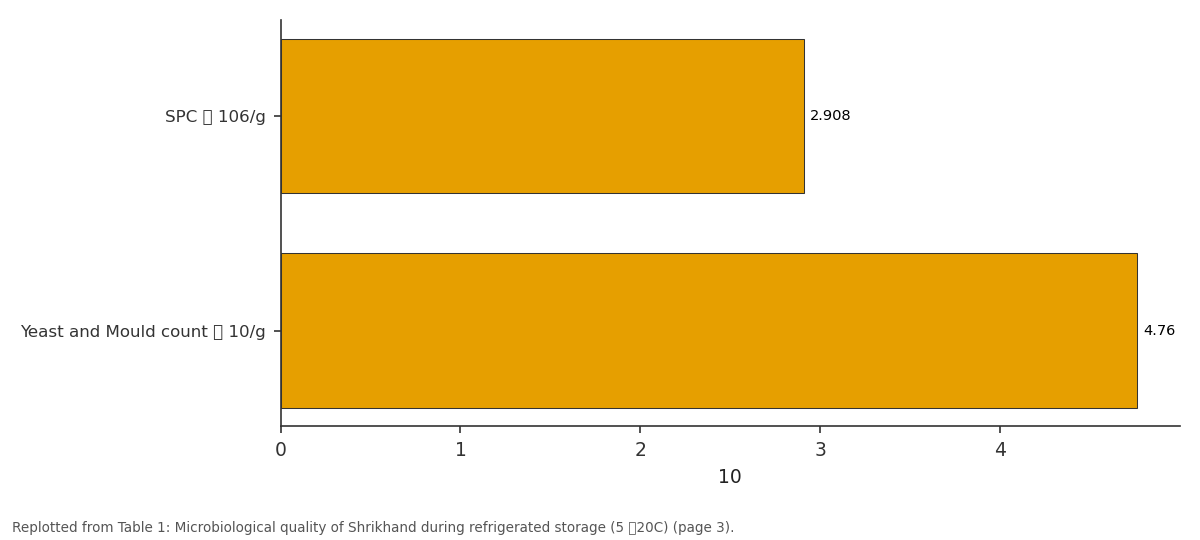
10: SPC 106/g vs Yeast and Mould count ...
Replotted from Table 1 (page 3) of the original paper. Every bar is the paper's own table value.
View source evidence ↗Figures & tables
From the original paper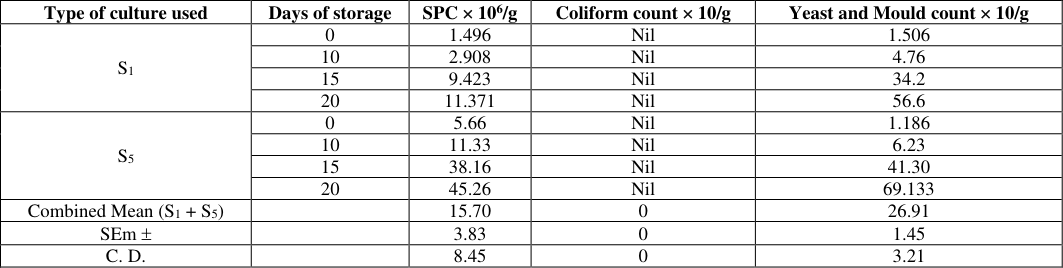 Table 1
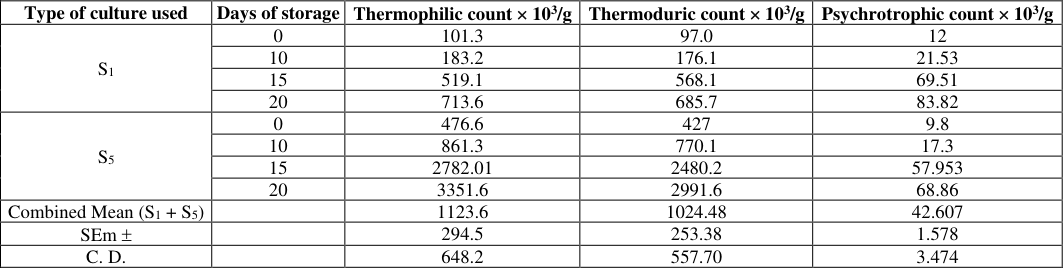 Table 2
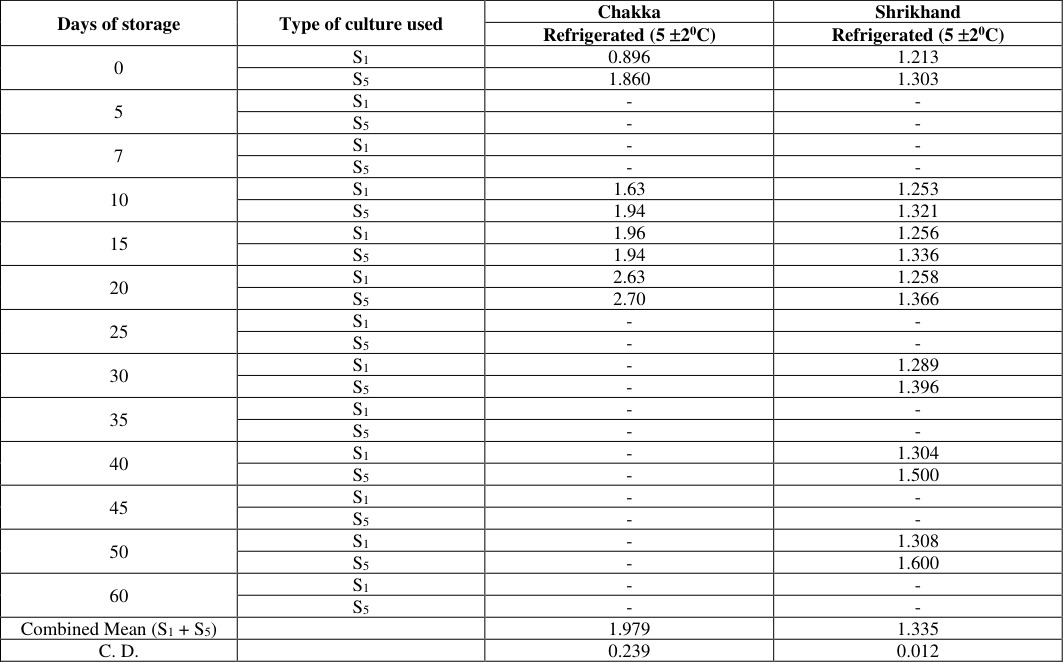 Table 3
Introduction
Since, milk is a highly perishable article of food, various methods of preserving it have been adopted. The practice of preserving milk by fermentation is a common household technology in India. Fermented milks are mild to strongly acidic in taste with pleasant aroma. Today, the practice of preserving milk by fermentation has become a facile household technology and is an important item of the diet in this sub-continent. Fermented milk products have been curative effect against gastro-intestinal disorders (Singh et al., 1979; Renner, 1974) [9,7] and have been utilized by many civilizations. Shrikhand is an indigenous, concentrated, sweetened and lactic fermented milk product popularly and widely consumed as sweet dish in Maharashtra, Gujarat and part of Karnataka States. Chakka, a base material for shrikhand is prepared from dahi by isolating a major portion of milk-solids through staining and hanging the curd for draining of whey. Chakka may be kneaded with sugar and colour and flavouring materials may be added to it to get a well-accepted shrikhand for the consumers. The solid mass chakka contains an average of 63.2 percent moisture, 14.7 percent fat and 0.8 percent lactic acid (De, 1980) [6] . Shrikhand is also being manufactured on an industrial scale. Incorporation of modern technology and radical innovations in the traditional practices have made possible, the manufacture of safe, uniform, high quality product on an industrial scale and expand the market segment and improve its financial performance. As a major enterprise, the market for fermented milk products industry is growing in India. As per market potential is considered National Dairy Development Board (NDDB) has taken all out efforts to improve upon the marketability of milk and milk products. Shrikhand has become popular among various sections of people due to its taste, energy content, higher nutritive value (Atreja and Deodhar, 1987; Choudhary and Atreja, 1985) [2,5] , flavour etc. The present study has been undertaken with a view to obtain better quality chakka and shrikhand prepared in laboratory and comparison of shelf life of these products by selection of suitable strains of lactic acid bacteria for the preparation of shrikhand. The best starter culture has been selected on the basis of lower setting time of curd and higher acidity produced with different lactic acid bacteria either singly or in combination. The final product was analysed chemically and microbiologically to study the shelf life of the products to increase their acceptability by the consumers and the dairy industry.
Materials and
Materials and
c) Sources of sugar
Fine crystalline cane sugar was purchased from the local market situated in Kancharapara, W.B.
d) Sources of skim milk powder
Skim milk powder commercial 'SAGAR' brand was purchased from local market.
e) Selection of starter cultures
Five different combinations of starter cultures were used for the preparation of shrikhand. From among the different starter cultures, used for the preliminary trials in the preparation of dahi, intended for shrikhand manufacture. Finally a two starter culture Lactococcus lactis sub sp. cremoris R6 (S1) and combination of Lactobacillus bulgaricus W and Streptococcus thermophilus H (S5) were selected for the further use in the preparation of dahi on the basis of their superiority with the rate of acid development as well as good organoleptic tests.
f) Flow Diagram of Preparation of Shrikhand
Dahi (acidity 0.7-0.8% LA) → Drainage of whey (hanging in muslin cloth for 12 hr) → Chakka → Addition of sugar @ 40% of chakka → Kneading → Uniform mixing → Addition of flavour (cardamom @ 1%) → Shrikhand → Filling → Storage (below 5 0 C)
g) Analytical methods
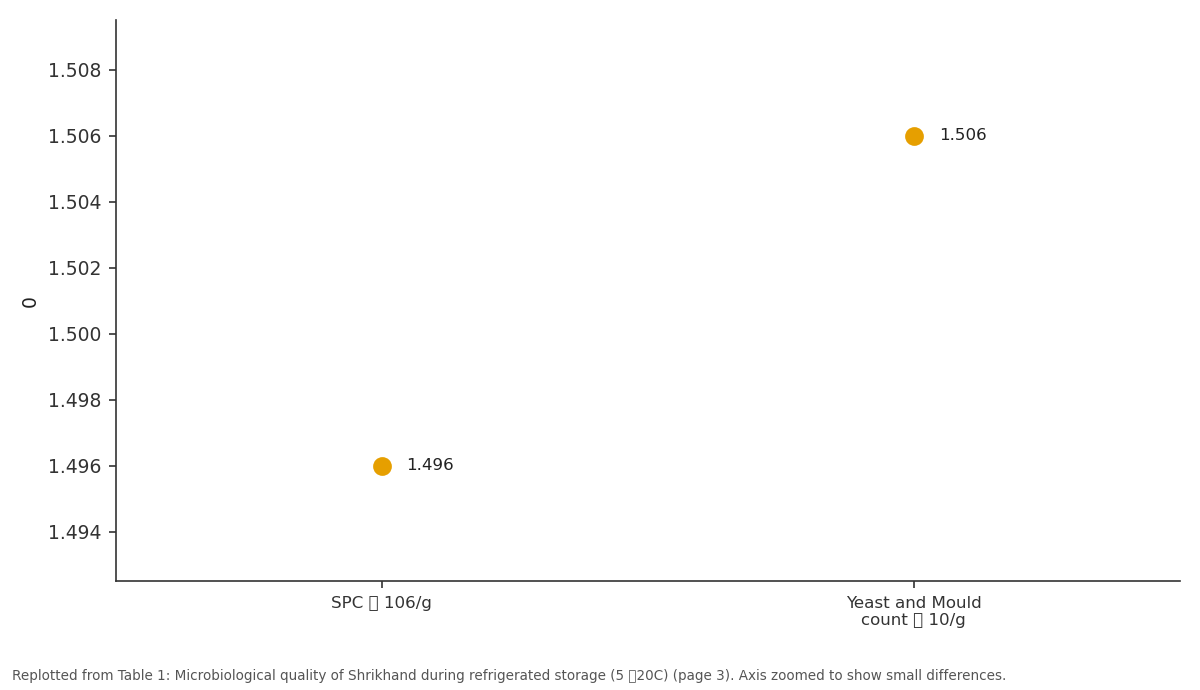
For the estimation of various microbial populations in the samples of shrikhand stored at 5 2 0 C, the microbiological examinations mentioned below along with testing of titratable acidity have been carried out till the quality of samples remained good in terms of: Results and Discussion a) Microbiological quality of Shrikhand during refrigerated storage (5 2 0 C) It is revealed from the Table-1, that the average microbiological quality of shrikhand prepared by using Lactococcus lactis sub sp. cremoris R6 (S1) were found to be standard plate count, coliform count and yeast and mould count as 1.496 -11.37 10 6 /g, 0.0-0.0 10/g and 1.506-56.6 10/g respectively. Similarly, the counts were obtained for shrikhand samples prepared by using Lactobacillus bulgaricus W + Streptococcus thermophilus H (S5) culture as 5.66-45.26 10 6 spc/g, 0.0-0.0 10 coliform count/g and 1.816-69.13 10 yeast and mould count/g. Both the results, for shrikhand samples were not similar to the results reported by Sharma and Zariwala (1980) [8] . The standard plate count showed a significant increase in counts. No coliform count found in shrikhand samples. Upadhyay et al. (1975) [10] reported that there is wide variation in the viable count of market samples of shrikhand (24,500 to 16,50,000/g) due to variation in the level of contamination, types of contaminations, acidic pH of the product, sugar concentration and storage temperature and time. An increase in yeast and mould count of shrikhand samples upto 20 days was observed. Results of the present investigation in the count of yeast and mould were in conformity to those reported by Upadhyay et al. (1975) [10] . b) Group count profile study of Shrikhand during refrigerated storage (5 2 0 C) From the Table-2, it was evident that the group count profile study of shrikhand samples increased progressively. Shrikhand samples prepared from Lactococcus lactis sub sp. cremoris R6 (S1) showed thermophilic, thermoduric and psychrotrophic counts in the range of 101.3-713.6 10 3 /g, 97.0-685.7 10 3 /g and 12.0-83.82 10 3 /g respectively. Similarly, the counts were obtained for shrikhand samples prepared by using Lactobacillus bulgaricus W + Streptococcus thermophilus H (S5) culture showed in the range of 476.6-3351.6 10 3 /g, 427.0-2991.6 10 3 /g and 9.83-68.86 10 3 /g respectively. It is observed that there is significant increase in group counts during refrigerated storage. The results obtained for the shrikhand samples varies significantly between the shrikhand samples prepared by using two different cultures, which may be due to the effect of cultures on the different groups under study.
c) Development of Acidity for Chakka and Shrikhand in terms of % lactic acid during refrigerated storage (5 2 0 C)
The development of acid in terms of lactic acid % is expressed in Table-3 for chakka and shrikhand stored in refrigerated condition. The chakka samples were stored upto 20 days for samples at refrigeration condition. The chakka samples showed significant increase of acidity at refrigerated storage upto 20 days after which they were rejected organoleptically. From Table-3, it is observed that shrikhand prepared from both the cultures showed significant increase of acidity upto 50 days but they were not organoleptically accepted at 50 days of storage.
Conclusion
The study highlights the effectiveness of fermentation techniques in the preservation of milk, particularly for producing shrikhand, a popular fermented milk product. The selection of suitable starter cultures, such as Lactococcus lactis sub sp. cremoris R6 and a combination of Lactobacillus bulgaricus W with Streptococcus thermophilus H, proved essential for improving the product's acidity development, microbial quality, and shelf life. The findings suggest that modern technological applications can enhance both the safety and marketability of shrikhand, ensuring its widespread acceptance and consumption, while also supporting the growing fermented milk industry in India.
Figures and tables from the paper
| Type of culture used | Days of storage | SPC 106/g | Coliform count 10/g | Yeast and Mould count 10/g |
|---|---|---|---|---|
| S1 | 0 | 1.496 | Nil | 1.506 |
| 10 | 2.908 | Nil | 4.76 | |
| 15 | 9.423 | Nil | 34.2 | |
| 20 | 11.371 | Nil | 56.6 | |
| S5 | 0 | 5.66 | Nil | 1.186 |
| 10 | 11.33 | Nil | 6.23 | |
| 15 | 38.16 | Nil | 41.30 | |
| 20 | 45.26 | Nil | 69.133 | |
| Combined Mean (S1 + S5) | 15.70 | 0 | 26.91 | |
| SEm | 3.83 | 0 | 1.45 | |
| C. D. | 8.45 | 0 | 3.21 |
Table text extracted from the original PDF; superscript letters are shown inline. The original table image is below.
View original table image
| Type of culture used | Days of storage | Thermophilic count 103/g | Thermoduric count 103/g | Psychrotrophic count 103/g |
|---|---|---|---|---|
| S1 | 0 | 101.3 | 97.0 | 12 |
| 10 | 183.2 | 176.1 | 21.53 | |
| 15 | 519.1 | 568.1 | 69.51 | |
| 20 | 713.6 | 685.7 | 83.82 | |
| S5 | 0 | 476.6 | 427 | 9.8 |
| 10 | 861.3 | 770.1 | 17.3 | |
| 15 | 2782.01 | 2480.2 | 57.953 | |
| 20 | 3351.6 | 2991.6 | 68.86 | |
| Combined Mean (S1 + S5) | 1123.6 | 1024.48 | 42.607 | |
| SEm | 294.5 | 253.38 | 1.578 | |
| C. D. | 648.2 | 557.70 | 3.474 |
Table text extracted from the original PDF; superscript letters are shown inline. The original table image is below.
View original table image
| Days of storage | Type of culture used | Chakka | Shrikhand |
|---|---|---|---|
| Refrigerated (5 20C) | Refrigerated (5 20C) | ||
| 0 | S1 | 0.896 | 1.213 |
| S5 | 1.860 | 1.303 | |
| 5 | S1 | - | - |
| S5 | - | - | |
| 7 | S1 | - | - |
| S5 | - | - | |
| 10 | S1 | 1.63 | 1.253 |
| S5 | 1.94 | 1.321 | |
| 15 | S1 | 1.96 | 1.256 |
| S5 | 1.94 | 1.336 | |
| 20 | S1 | 2.63 | 1.258 |
| S5 | 2.70 | 1.366 | |
| 25 | S1 | - | - |
| S5 | - | - | |
| 30 | S1 | - | 1.289 |
| S5 | - | 1.396 | |
| 35 | S1 | - | - |
| S5 | - | - | |
| 40 | S1 | - | 1.304 |
| S5 | - | 1.500 | |
| 45 | S1 | - | - |
| S5 | - | - | |
| 50 | S1 | - | 1.308 |
| S5 | - | 1.600 | |
| 60 | S1 | - | - |
| S5 | - | - | |
| Combined Mean (S1 + S5) | 1.979 | 1.335 | |
| C. D. | 0.239 | 0.012 |
Table text extracted from the original PDF; superscript letters are shown inline. The original table image is below.
View original table image
References
7 in the original paper- Arteja SK, Deodhar AD. Nutrient status during shrikhand making. J Food Sci Technol. 1987;4(5):266267.
- Chaudhary A, Arteja SK. Nutritional quality of proteins of shrikhand. J Food Sci Technol. 1985;22:411-414.
- De S. Outlines of Dairy Technology. Oxford University Press. 1980;94:404-408.
- Renner E. Milch and Milchprodukte in der Ernahrung des Menschen. Kempten: Volksw Verlag; 1974. Cited from IDF Bulletin; c1983.
- Sharma UP, Zariwala IT. Deterioration of shrikhand during storage. Indian J Dairy Sci. 1980;33(2):223-231.
- Singh J, Khanna A, Srinivasan RA. Antibacterial activity of lactobacilli in fermented dairy products. Indian Dairyman. 1979;31:867.
- Upadhyay KG, Vayas SH, Dave JM, Thaker PN. Some microbiological observations on the market samples of shrikhand in Gujarat. Indian J Dairy Sci. 1975;28:147149.