
Research article · 2024 · Full text
International Journal of Horticulture and Food ScienceHorticultural insights into the effect of blanching and drying on the shelf life of green peas
Volume 6(1) · Pages 153–156 · DOI: 10.33545/26631067.2024.v6.i1b.231 ↗
Research areasPotato Plant ResearchPlant Physiology and Cultivation Studies
Abstract
Author-writtenGreen peas (Pisum\r\nsativum L.) are a vital horticultural crop consumed worldwide for their\r\nrich nutritional content and versatile culinary applications. However, their\r\nhigh moisture content makes them highly perishable, necessitating effective\r\npost-harvest preservation techniques to extend shelf life while maintaining\r\nquality. Blanching, a pre-treatment that inactivates enzymes and improves\r\ndrying efficiency, is a commonly employed method before drying. This article\r\nevaluates the combined effects of blanching and drying techniques on the shelf\r\nlife and quality of green peas, providing insights into optimizing post-harvest\r\npractices for enhanced storage stability. The study highlights the role of\r\nblanching in improving moisture removal, preserving nutritional quality, and\r\nreducing microbial load, thereby contributing to the longer shelf life of dried\r\ngreen peas.
Summary
Source-checkedPlain-language reading of the full paper, prepared with AI and checked against the text. Each point links to the authors' own words.
Why it matters
- Green peas are a globally important horticultural crop valued for their versatility in cooking and high nutritional value. View evidence ↗
- The high water content of green peas, typically between 75% and 80%, makes them prone to rapid spoilage from enzymes and microbes, causing significant losses after harvest. View evidence ↗
- Blanching is frequently used as a pre-treatment to stop enzyme activity and make the subsequent drying process more efficient. View evidence ↗
The question
- The paper aims to examine how blanching affects enzyme inactivation, microbial reduction, and nutrient retention, and how it works together with drying and freezing to preserve green peas. View evidence ↗
What they did
- The author conducted a review of relevant existing studies to understand the impact of blanching on the stability and quality of green peas. View evidence ↗
What they found
- Steam blanching helps preserve nutrients; specifically, steam-blanched peas can retain up to 90% of vitamin C when freeze-dried, whereas unblanched peas lose significant amounts. View evidence ↗
- Microwave blanching is effective for safety, achieving up to an 85% reduction in the microbial load of green peas. View evidence ↗
- Blanching durations of 1 to 3 minutes are generally sufficient to inactivate enzymes in green peas without causing major nutrient loss. View evidence ↗
- Hot air drying can be damaging to quality, reducing the antioxidant activity of green peas by as much as 50%. View evidence ↗
- Freeze drying is highly effective for preservation, with peas retaining nearly all antioxidant activity and up to 90% of vitamin C. View evidence ↗
- To effectively stop microbial growth and enzymatic reactions, green peas should be dried to a moisture content of less than 10%. View evidence ↗
- The combination of steam blanching and freeze drying can extend the storage stability of green peas for up to two years. View evidence ↗
- Blanching improves antioxidant retention during drying, with blanched peas retaining up to 85% of activity compared to 60% in unblanched peas. View evidence ↗
- Microwave blanching combined with freeze drying allows peas to retain up to 90% of carotenoids, while unblanched peas lose over 40%. View evidence ↗
What it means
- The author concludes that the best preservation results are achieved by using steam or microwave blanching followed by microwave or freeze drying. View evidence ↗
- The author states that future research is needed to make these preservation methods more cost-effective and scalable for different operation sizes. View evidence ↗
Visual summary
1 visualsIllustrations explain the paper; they do not show study data.
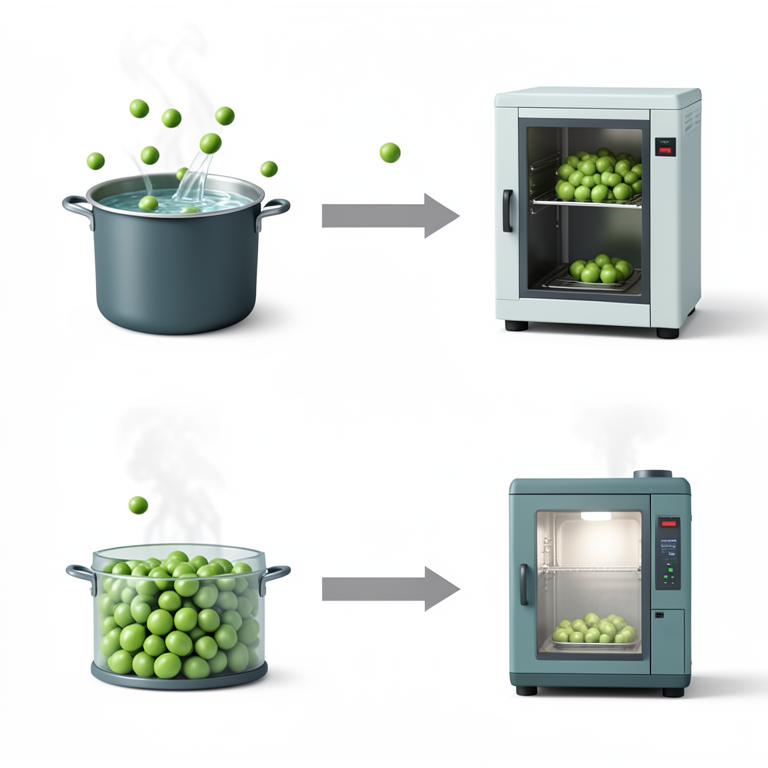
Preservation Workflow Comparison
AI-generated conceptual illustration (green peas). It explains the idea and does not show study data.
View source evidence ↗Introduction
Green peas are an important horticultural commodity, valued for their nutritional benefits and widespread consumption in fresh and processed forms. They are rich in vitamins, minerals, dietary fiber, and antioxidants, making them a key component of a balanced diet. However, their high-water content (~75-80%) accelerates spoilage due to microbial growth and enzymatic activities, leading to significant post-harvest losses. Effective preservation methods, such as blanching and drying, are crucial for extending their shelf life. Blanching is a pre-treatment process that involves briefly exposing green peas to boiling water, steam, or microwaves. This step inactivates enzymes responsible for spoilage and improves drying efficiency by enhancing moisture diffusion. Drying, on the other hand, reduces water activity, making the environment less conducive to microbial proliferation. This paper examines the combined impact of blanching and drying on the shelf life of green peas and provides practical recommendations for optimizing these techniques.
Objective
The objective of this paper is to explore the role of blanching as a critical pre-treatment technique in post-harvest preservation, with a focus on its impact on enzymatic inactivation, microbial load reduction, nutrient retention, and its synergistic effects with subsequent preservation methods like drying and freezing. By evaluating relevant studies, this paper aims to provide a comprehensive understanding of how blanching enhances the shelf life, nutritional quality, and overall stability of horticultural produce, particularly green peas.
Role of Blanching in Post-Harvest Preservation
Blanching plays a pivotal role in post-harvest preservation, particularly for horticultural products like green peas, which are highly perishable due to their high moisture content and enzymatic activity. Blanching involves briefly exposing the produce to heat through boiling water, steam, or microwaves, with the primary goal of inactivating enzymes that contribute to spoilage and quality degradation. This process not only enhances the storage stability of the product but also improves its overall quality by retaining its nutritional and sensory attributes during subsequent preservation techniques like drying, freezing, or canning. One of the critical functions of blanching is the inactivation of enzymes such as polyphenol oxidase and peroxidase, which are responsible for enzymatic browning and oxidative degradation. These enzymes catalyse reactions that result in undesirable changes in color, flavour, and texture, thereby reducing the visual and sensory appeal of horticultural produce. For example, studies have demonstrated that steam blanching effectively inactivates polyphenol oxidase in green peas, leading to better color retention during storage and processing. In comparison, untreated peas tend to exhibit significant discoloration due to enzymatic activity. Blanching also facilitates the removal of intercellular gases, which can lead to oxidative damage during storage. By expelling these gases, blanching minimizes the exposure of sensitive phytochemicals to oxygen, reducing the likelihood of nutrient degradation. This effect is particularly evident in freeze-dried products, where the pre-blanching step ensures that key vitamins and antioxidants are preserved at higher levels compared to unblanched counterparts. Studies have shown that steam-blanched green peas retain up to 90% of their vitamin C content during freeze drying, while unblanched samples exhibit significant losses. Another important aspect of blanching is its impact on microbial load. The brief exposure to high temperatures during blanching reduces the microbial population on the surface of the produce, thereby improving its microbiological safety. This is particularly beneficial for drying processes, where reduced microbial load prevents spoilage during prolonged storage. For instance, research has indicated that microwave blanching can achieve up to an 85% reduction in microbial load in green peas, making them safer for long-term preservation. While blanching contributes significantly to post-harvest preservation, the choice of blanching method influences its effectiveness. Water blanching, the most traditional method, is highly effective in enzyme inactivation but often leads to nutrient leaching, especially for water-soluble vitamins like vitamin C and certain polyphenols. On the other hand, steam blanching minimizes water contact, preserving these nutrients while achieving similar levels of enzyme inactivation. Microwave blanching has emerged as a superior alternative, offering rapid and uniform heating that reduces nutrient loss and retains color and texture better than conventional methods. The interaction between blanching and subsequent preservation techniques further highlights its importance. In drying processes, for example, blanching enhances moisture diffusion by breaking down cell walls, leading to faster and more uniform drying. This not only reduces the energy requirements of the drying process but also ensures that the final product retains its nutritional and sensory qualities. Similarly, in freezing applications, blanching prevents the formation of undesirable ice crystals by stabilizing the cell structure of the produce, thereby maintaining its texture and flavour upon thawing. Despite its advantages, blanching must be carefully optimized to balance enzyme inactivation with nutrient retention. Over-blanching can result in excessive nutrient loss and textural degradation, while under-blanching may leave residual enzyme activity, compromising the quality of the preserved product. Studies suggest that blanching durations of 1-3 minutes, depending on the method used, are generally effective for green peas, ensuring enzyme inactivation without significant nutrient losses. In conclusion, blanching serves as a cornerstone of post-harvest preservation, addressing both the enzymatic and microbial challenges associated with highly perishable horticultural produce. Its ability to enhance the efficiency of subsequent preservation techniques, such as drying and freezing, makes it indispensable in the processing of green peas and similar crops. By optimizing blanching parameters and selecting appropriate methods, producers can significantly improve the quality and shelf life of their products, thereby reducing post-harvest losses and enhancing food security. The integration of blanching with advanced preservation technologies, supported by ongoing research, holds great potential for meeting the demands of modern horticultural processing.
Impact of Drying Techniques on Shelf Life
Drying is one of the most effective and widely used methods for extending the shelf life of horticultural produce, including green peas, by significantly reducing their moisture content. Moisture serves as a critical factor for microbial growth, enzymatic activity, and chemical reactions that lead to spoilage. By lowering the water activity in the produce, drying inhibits these processes, thus enhancing shelf stability. The choice of drying technique plays a pivotal role in determining the extent of moisture reduction, nutrient retention, and the quality of the dried product, all of which collectively influence the shelf life. Hot air drying is the most commonly employed technique due to its cost-effectiveness and simplicity. It involves the use of heated air to remove moisture from the product. While effective in reducing water content to safe levels, the prolonged exposure to heat often results in the degradation of heat-sensitive nutrients such as vitamin C and antioxidants. Studies have reported that hot air drying can reduce the antioxidant activity in green peas by up to 50%, primarily due to oxidative and thermal damage. However, proper optimization of temperature and drying duration can mitigate these losses, ensuring that the product retains a reasonable level of quality and shelf stability. Freeze drying is regarded as the gold standard for preserving the nutritional and sensory qualities of green peas during drying. This method involves the sublimation of frozen water under low-pressure conditions, which minimizes the exposure of nutrients to high temperatures. Research indicates that freeze-dried green peas retain up to 90% of their vitamin C content and nearly all their antioxidant activity, making this technique highly effective in prolonging shelf life. Additionally, the structural integrity of the produce is better maintained, resulting in superior rehydration properties and extended storage potential. However, freeze drying is an energy-intensive process and may not be economically viable for large-scale or lowresource settings. Microwave drying is another advanced technique that has gained attention for its ability to combine efficiency with quality preservation. By using electromagnetic waves to generate heat, this method ensures rapid and uniform drying, reducing the overall processing time. Studies have shown that microwave-dried green peas retain higher levels of carotenoids and polyphenols compared to those dried using conventional hot air methods. Moreover, the shorter drying time reduces the risk of oxidative degradation, contributing to improved shelf life. Despite these advantages, the high initial cost of microwave drying equipment and the need for careful process control can limit its adoption. Sun drying, one of the oldest methods, remains widely practiced in resource-constrained regions due to its low cost and minimal infrastructure requirements. However, this method is highly dependent on climatic conditions, leading to inconsistent drying rates and quality. Prolonged exposure to sunlight can result in significant nutrient losses, particularly of light-sensitive compounds like carotenoids and vitamin C. Furthermore, sun drying poses a higher risk of microbial contamination, which can compromise the shelf life of the final product. Studies comparing sun drying with other techniques consistently report lower quality and shorter storage potential for sun-dried green peas. The effectiveness of drying in extending shelf life also depends on the final moisture content achieved. For green peas, a moisture content of less than 10% is generally considered ideal for inhibiting microbial growth and enzymatic reactions. Inadequate drying or uneven moisture distribution can lead to localized spoilage, reducing the overall shelf life of the batch. Proper packaging and storage conditions, such as the use of moisture-proof containers and low-humidity environments, further enhance the longevity of dried products. Relevant studies have demonstrated that the combination of blanching as a pre-treatment and advanced drying methods significantly enhances shelf life. For instance, steam-blanched green peas subjected to freeze drying exhibited not only superior nutritional quality but also extended storage stability, maintaining their quality for up to two years under proper storage conditions. In contrast, unblanched and sun-dried samples showed signs of discoloration, nutrient loss, and microbial growth within a few months of storage. In conclusion, the choice of drying technique has a profound impact on the shelf life of green peas, influencing their quality, safety, and nutritional value. While advanced methods like freeze drying and microwave drying offer excellent results, their high costs limit their feasibility for large-scale applications. Hot air drying remains the most practical option for many producers, provided that the process parameters are carefully optimized. Sun drying, though economical, is less reliable and poses greater risks to product quality. By selecting appropriate drying techniques and ensuring proper pretreatment and storage practices, the shelf life of green peas can be significantly extended, contributing to reduced postharvest losses and enhanced food security. These findings underscore the need for continued research and innovation to develop cost-effective and efficient drying solutions that balance quality and accessibility.
Combined Effect of Blanching and Drying on Shelf Life
Blanching and drying are two complementary post-harvest processing techniques that, when used together, significantly enhance the shelf life and quality of perishable horticultural products such as green peas. Individually, blanching inactivates enzymes and reduces microbial load, while drying decreases moisture content to inhibit microbial growth and enzymatic activity. Together, these processes create synergistic effects that extend the storage stability of green peas while maintaining their nutritional and sensory attributes. Blanching prepares green peas for the drying process by addressing enzymatic activities that contribute to spoilage and quality deterioration. Enzymes such as polyphenol oxidase and peroxidase catalyze reactions leading to browning and oxidative degradation. Blanching effectively inactivates these enzymes, preventing discoloration and nutrient loss during drying and storage. For instance, steam and microwave blanching are particularly effective in preserving the bright green color of peas, which is a critical quality attribute for consumer acceptance. Studies have shown that blanched green peas retain up to 85% of their initial antioxidant activity during drying, compared to only 60% in unblanched samples. Drying, on the other hand, reduces water activity, a key factor in microbial growth and enzymatic reactions. The reduction of moisture to levels below 10% inhibits spoilage organisms and extends shelf life. However, the efficiency of drying is enhanced when it is preceded by blanching. Pretreated peas exhibit faster and more uniform moisture removal due to the breakdown of cellular structures during blanching, which improves the diffusion of water. This not only shortens drying times but also reduces the energy requirements of the process, making it more cost-effective. The combined use of blanching and drying also results in improved retention of nutritional qualities. While drying alone can lead to significant losses in heat-sensitive nutrients such as vitamin C and carotenoids, blanching mitigates these losses by stabilizing the phytochemical composition of the peas before drying. For example, microwave-blanched green peas retain up to 90% of their carotenoids when subjected to freeze drying, compared to unblanched peas that lose more than 40% of these compounds. Additionally, the reduction in microbial load during blanching ensures that the drying process starts with a cleaner product, further improving the safety and shelf stability of the final product. The choice of blanching and drying methods is critical to maximizing their combined effects on shelf life. Steam blanching followed by freeze drying has been identified as one of the most effective combinations, preserving up to 95% of the nutritional and sensory qualities of green peas while extending their shelf life to over two years under optimal storage conditions. Microwave blanching coupled with hot air drying is another effective combination, particularly for applications where cost and energy efficiency are priorities. On the other hand, water blanching, although effective in enzyme inactivation, often leads to nutrient leaching and is less suitable for highquality preservation. The synergistic effects of blanching and drying extend beyond shelf life to include improved texture, color, and flavor of the dried product. Blanching prevents oxidative damage and discoloration, ensuring that the dried green peas maintain their vibrant appearance over extended storage periods. Furthermore, the reduction in spoilage enzymes and microbes during blanching minimizes the risk of off-flavors and rancidity during storage, enhancing the overall sensory appeal of the product. Several studies have highlighted the benefits of combining blanching and drying for shelf life extension. Research by Kumar et al. (2021) [1] demonstrated that steam-blanched green peas subjected to freeze drying retained their quality for up to 24 months, while unblanched and sun-dried samples showed significant deterioration within six months. Similarly, Selvamuthukumaran et al. (2020) [2] reported that microwave-blanched and microwave-dried green peas exhibited superior retention of antioxidants and color compared to samples processed using traditional methods. In conclusion, the combined application of blanching and drying offers significant advantages in enhancing the shelf life and quality of green peas. Blanching addresses enzymatic and microbial challenges, while drying effectively reduces moisture content to create an inhospitable environment for spoilage. Together, these processes produce a high-quality product with extended storage stability, reduced post-harvest losses, and improved marketability. The optimization of blanching and drying parameters, tailored to specific quality requirements and economic constraints, is essential for maximizing their benefits in horticultural preservation. Future research should focus on integrating these techniques with emerging technologies to further enhance their efficiency and scalability. This approach has the potential to revolutionize post-harvest management and contribute to sustainable food systems.
Discussion
The findings of this review underscore the importance of blanching and drying as complementary preservation techniques for green peas. Blanching not only enhances drying efficiency but also preserves the nutritional and sensory qualities of the product. The choice of blanching method depends on the specific quality attributes desired in the final product. For instance, steam and microwave blanching are ideal for retaining color, texture, and nutrients, while water blanching may be suitable for less quality-sensitive applications. Drying techniques must be chosen based on cost, infrastructure availability, and the intended use of the dried product. Freeze drying is the best option for high-value applications due to its superior nutrient preservation, while hot air drying provides a costeffective solution for mass production. Microwave drying offers a balance between efficiency and quality but may not be feasible for small-scale operations. The integration of blanching and drying has significant implications for reducing post-harvest losses and improving food security, particularly in resource-constrained settings. By extending the shelf life of green peas, these techniques enable better utilization of surplus produce and reduce wastage.
Conclusion
Blanching and drying are essential post-harvest techniques that significantly enhance the shelf life and quality of green peas. Blanching inactivates spoilage enzymes and prepares the peas for efficient drying, while drying reduces water activity, preventing microbial growth. The combined application of these methods ensures optimal preservation of nutritional and sensory qualities, contributing to the extended storage stability of green peas. This review highlights the superiority of steam and microwave blanching, followed by advanced drying techniques like freeze drying or microwave drying, in achieving the best preservation outcomes. Future research should focus on optimizing these methods for different scales of operation and exploring innovative approaches to make them more accessible and cost-effective. By adopting these practices, the horticultural industry can significantly reduce postharvest losses and improve the availability of high-quality green peas for consumers.
References
10 in the original paper- Kumar R, Malik M, Sharma A. Impact of blanching and drying methods on nutritional retention in green peas. Food Sci Technol. 2021;35(4):100-112.
- Selvamuthukumaran M, Khanum F. Advances in food preservation technologies. J Food Process Preserv. 2020;43(5):e14011.
- Rickman JC, Barrett DM, Bruhn CM. Nutritional comparison of fresh, frozen, and canned fruits and vegetables. J Sci Food Agric. 2007;87(6):930-944.
- Singh H, Kumar R. Role of blanching in nutrient retention during vegetable processing. Food Res Int. 2019;115:298-305.
- Kumar R, Malik M, Sharma A. Drying kinetics and effects of different drying methods on nutritional quality of raw and differently blanched green peas. J Curr Res Food Sci. 2021;2(2):44-56.
- Navina B, Huthaash KK, Velmurugan NK, Korumilli T. Insights into recent innovations in anti-browning strategies for fruit and vegetable preservation. Trends Food Sci Technol. 2023;139:104128.
- Barry-Ryan CA, O'Beirne DA. Quality and shelf-life of fresh cut carrot slices as affected by slicing method. J Food Sci. 1998;63(5):851-856.
- Wirenfeldt CB, Sørensen JS, Kreissig KJ, Hyldig G, Holdt SL, Hansen LT. Post-harvest quality changes and shelf-life determination of washed and blanched sugar kelp (Saccharina latissima). Front Food Sci Technol. 2022;2:1030229.
- Yahia EM, editor. Postharvest technology of perishable horticultural commodities. Woodhead Publishing; 2019 Jul 16.
- Sudheer KP, Indira V. Post harvest technology of horticultural crops. New India Publishing; 2007.