
Research article · 2024 · Full text
International Journal of Agriculture and NutritionIntegrating pollinator-friendly practices in modern farming: Balancing crop productivity and biodiversity
Volume 6(2) · Pages 78–83 · DOI: 10.33545/26646064.2024.v6.i2b.184 ↗
Research areasAgricultural Innovations and PracticesPlant and animal studiesOrganic Food and Agriculture
Abstract
Author-writtenModern farming faces the dual challenge of maximizing crop productivity while preserving biodiversity, particularly in the context of declining pollinator populations. Pollinators play a crucial role in enhancing agricultural yields and maintaining ecosystem health, but intensive farming practices often undermine their habitats and well-being. This paper explores strategies for integrating pollinator-friendly practices into contemporary agricultural systems, aiming to balance economic viability with ecological sustainability. Key practices include the establishment of diverse floral resources, habitat corridors, and reduced pesticide use, which collectively support pollinator health and biodiversity. The paper evaluates the effectiveness of these practices in different agricultural settings, such as monocultures and mixed farming systems, and discusses their impact on crop productivity. Additionally, the economic and environmental trade-offs of adopting pollinator-friendly practices are analyzed to provide a comprehensive understanding of their role in sustainable agriculture. By highlighting practical approaches and real-world examples, this paper aims to guide farmers and policymakers in creating agricultural landscapes that support both productive farming and vibrant pollinator communities.
Summary
Source-checkedPlain-language reading of the full paper, prepared with AI and checked against the text. Each point links to the authors' own words.
Why it matters
- Pollinators are essential for global food security, as they are necessary for the reproduction of over 75% of flowering plants and more than one-third of the world's crop production. View evidence ↗
- Global pollinator populations are declining due to several critical factors, including climate change, monocropping, pesticide use, and the loss of habitat. View evidence ↗
- Beyond agriculture, healthy pollinator populations provide vital ecosystem services, including water regulation, soil health, and carbon sequestration. View evidence ↗
The question
- The paper aims to explore how pollinator-friendly practices can be integrated into modern farming to balance ecological sustainability with economic viability. View evidence ↗
What they did
- The authors evaluate the impact of pollinator-friendly practices on crop productivity across various settings, specifically mixed farming systems and monocultures. View evidence ↗
- The analysis includes an examination of the environmental and economic trade-offs associated with adopting these practices. View evidence ↗
What they found
- Pollinators are responsible for the reproduction of approximately 87% of all flowering plants on a global scale. View evidence ↗
- Certain high-value crops, including coffee, almonds, apples, and tomatoes, are dependent on animal pollination for production. View evidence ↗
- Systemic insecticides, such as neonicotinoids, are toxic to pollinators even when administered in sub-lethal doses. View evidence ↗
- Planting flowering cover crops like mustard, alfalfa, or clover through intercropping provides pollinators with continuous foraging resources. View evidence ↗
- The use of Integrated Pest Management (IPM) reduces the harm caused to pollinators by minimizing the application of chemical pesticides. View evidence ↗
- Precision agriculture tools, such as drones with cameras and sensors, can be used to identify specific farm areas that require the planting or maintenance of pollinator-friendly vegetation. View evidence ↗
- CRISPR and other gene-editing technologies are being investigated to improve disease resistance in pollinators, specifically honeybees. View evidence ↗
- Experimental robotic drones are being developed to mimic natural bees by transporting pollen between plants. View evidence ↗
What it means
- The authors conclude that enhancing ecological resilience and crop yields can be achieved by reducing pesticide use, restoring habitats, and planting diverse cover crops. View evidence ↗
- The authors note that the successful integration of these practices is limited by the need for further research, farmer education, and policy support. View evidence ↗
Visual summary
1 visualsIllustrations explain the paper; they do not show study data.
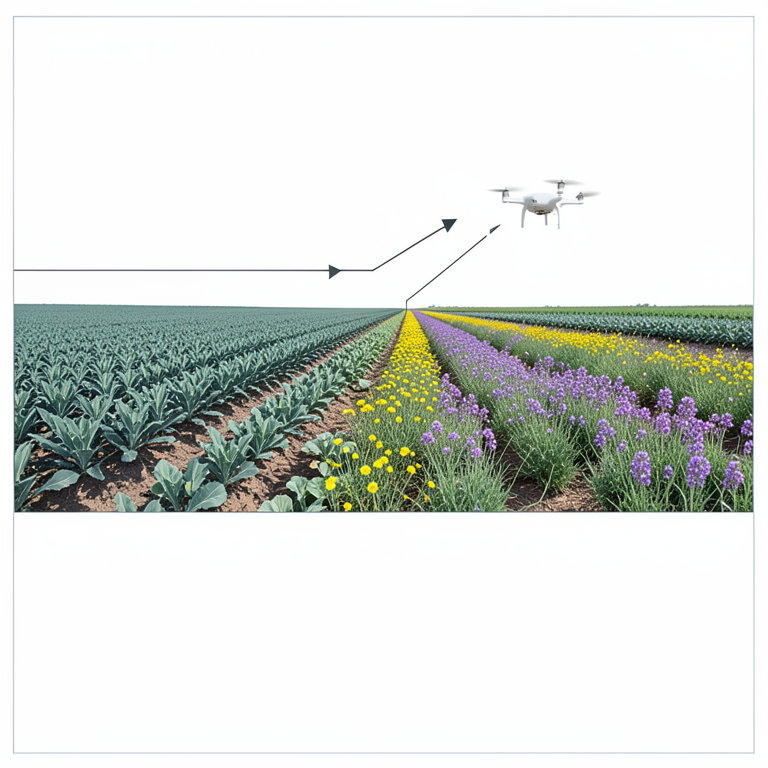
Pollinator-Friendly Farm Integration
AI-generated conceptual illustration (a modern agricultural field with flowering cover crops and a monitoring drone). It explains the idea and does not show study data.
View source evidence ↗Introduction
Pollinators are vital to global food security and biodiversity, serving as indispensable agents in the reproduction of more than 75% of flowering plants and over a third of global crop production. However, modern agricultural practices, often focused on maximizing yield, have inadvertently posed significant threats to pollinators (Kalpana et al., 2024; Abrol, 2012) [10, 1] . Habitat loss, pesticide use, monocropping, and climate change are some of the critical factors contributing to the decline of pollinator populations worldwide. This decline has profound implications not only for ecosystems but also for the agricultural systems that depend on pollinators to sustain crop yields and quality. Integrating pollinator-friendly practices into modern farming is emerging as a sustainable strategy to reconcile the seemingly conflicting goals of high crop productivity and biodiversity conservation (Suso et al., 2016) [21] . These practices include creating habitats for pollinators, reducing pesticide use, adopting Integrated Pest Management (IPM), planting diverse flowering crops, and embracing agroecological approaches like agroforestry. By fostering a farming landscape that supports pollinator health, farmers can improve pollination services, which are essential for the productivity of crops such as fruits, vegetables, nuts, and oilseeds (Jarpla et al., 2024; Chethan et al., 2024) [8,2] . The significance of pollinator-friendly farming extends beyond agriculture. Healthy pollinator populations contribute to ecosystem services such as carbon sequestration, soil health, and water regulation. These services, in turn, enhance the resilience of agricultural landscapes against climate variability and extreme weather events (Imran et al., 2023) [7] . Moreover, promoting pollinator-friendly practices aligns with global commitments to biodiversity conservation, such as the Convention on Biological Diversity (CBD) and the United Nations Sustainable Development Goals (SDGs), particularly those addressing hunger, climate action, and life on land. However, integrating pollinator-friendly practices requires overcoming several challenges. Farmers often face knowledge gaps regarding pollinator biology and the benefits of pollination services (Osterman et al., 2021) [18] . Economic constraints and policy environments that prioritize shortterm yields over long-term sustainability also hinder widespread adoption. Addressing these challenges calls for a multi-stakeholder approach involving farmers, researchers, policymakers, and consumers. Training programs, financial incentives, research on pollinator-friendly crops, and the development of supportive policies are key enablers for scaling up these practices. This article explores the importance of pollinator-friendly practices in modern agriculture, focusing on their role in enhancing crop productivity while preserving biodiversity. It examines the strategies to integrate these practices into farming systems and discusses the challenges and opportunities involved. By promoting an agriculture that values pollinators, humanity can take a vital step toward ensuring food security, ecological balance, and a sustainable future for generations to come.
Pollinators and their ecological role
Pollinators are animals that facilitate the transfer of pollen from the male structures (anthers) of flowers to the female structures (stigmas), enabling fertilization and the production of seeds. This group includes a diverse range of organisms such as bees, butterflies, moths, beetles, flies, birds, and bats. Pollination is a critical ecological process that underpins the reproduction of most flowering plants and plays a vital role in maintaining ecosystem health and agricultural productivity (Abrol, 2012) [1] .
Types of pollinators 1) Insects
Types of pollinators 1) Insects
2) Birds
Species like hummingbirds and sunbirds are important pollinators, especially in tropical regions.
3) Mammals
Bats are key pollinators in certain ecosystems, particularly for nocturnal flowers of tropical and desert plants.
4) Other animals
Small mammals like rodents and even some reptiles can occasionally act as pollinators.
Ecological role of pollinators a) Maintaining biodiversity: Pollinators contribute to the reproduction of approximately 87% of all flowering plants globally. This sustains plant populations and supports ecosystems that depend on these plants for shelter and food.
b) Supporting food webs: By enabling the production of seeds and fruits, pollinators directly support herbivores, omnivores, and carnivores in the food web. c) Ecosystem services: Pollination services are estimated to be worth billions of dollars annually. They underpin the growth of wild plants and crops that provide essential ecosystem services, such as carbon sequestration, soil stabilization, and water regulation. d) Enhancing agricultural productivity: Pollinators improve the yield, quality, and genetic diversity of crops. Crops such as apples, almonds, coffee, and tomatoes rely on animal pollination for their production. e) Promoting genetic diversity: Pollinators facilitate cross-pollination, which increases genetic diversity within plant populations. This diversity is essential for plant resilience to pests, diseases, and environmental changes.
Factors threatening pollinators
Pollinators, including bees, butterflies, birds, bats, and other insects, play a crucial role in maintaining biodiversity and agricultural productivity. However, their populations are declining at an alarming rate due to a combination of factors. Here is a detailed discussion of the major threats to pollinators:
Habitat loss and fragmentation Causes
Urbanization and industrialization: Expansion of cities and industries reduces natural habitats. Agricultural intensification: Conversion of diverse ecosystems into monocultures leads to loss of forage and nesting sites (Nicholson and Egan, 2020) [16] . Deforestation: Clearing of forests for agriculture, logging, or urban expansion destroys habitats.
Impacts
Reduces the availability of floral resources necessary for pollinator survival. Leads to fragmentation, isolating pollinator populations and hindering their movement.
Pesticide use Causes
Insecticides: Neonicotinoids and other systemic insecticides are toxic to pollinators, even in sub-lethal doses (Goulson et al., 2015) [5] . Herbicides: Reduce floral diversity by killing wildflowers and weeds that provide food. Fungicides: Though less toxic, they can interact synergistically with insecticides, increasing toxicity.
Impacts
Causes acute and chronic toxicity in pollinators, leading to mortality or impaired foraging, navigation, and reproduction. Contaminates pollen, nectar, and water resources.
Climate change Causes
Rising temperatures, altered precipitation patterns, and extreme weather events disrupt ecosystems (Kevan and Viana, 2003) [11] .
Changes in blooming times of plants lead to mismatches between flower availability and pollinator activity.
Impacts
Forces pollinators to migrate to new areas where they may struggle to find suitable habitats. Increases vulnerability to diseases and predators in altered environments. [13,5] . Invasive species: Introduction of non-native species can spread new diseases or compete for resources.
Diseases and parasites
Diseases and parasites
Impacts
Weakens individual pollinators and entire colonies. Reduces pollination efficiency and increases mortality.
Monoculture and intensive agriculture Causes
Homogenization of landscapes reduces floral diversity. Lack of crop rotation depletes soil nutrients and diminishes the quality of floral resources.
Impacts
Limits the variety of nectar and pollen available to pollinators. Increases dependence on managed pollinators, which may not thrive in such conditions.
Invasive plant and animal species Causes
Invasive plants often outcompete native species, reducing the availability of suitable nectar and pollen. Non-native predators or competitors can displace or prey on local pollinators (Goulson et al., 2015) [5] .
Impacts
Alters the structure and function of ecosystems. Reduces pollinator abundance and diversity.
Light pollution Causes
Increased artificial lighting in urban and rural areas.
Impacts
Disrupts nocturnal pollinators, such as moths and bats, by altering their activity patterns and navigation. Reduces pollination of nocturnally blooming plants.
Socioeconomic factors Causes
Lack of awareness about the importance of pollinators. Limited policies or enforcement of regulations protecting pollinators.
Economic pressures leading to intensive farming practices.
Impacts
Slows down conservation efforts. Results in inadequate funding for pollinator-friendly research and programs.
Genetic diversity loss
Causes Over-reliance on a few species of managed pollinators (e.g., honeybees) for agricultural purposes. Habitat loss leading to isolated populations.
Impacts
Reduces adaptability of pollinator populations to environmental changes. Increases vulnerability to diseases and environmental stressors.
Pollution Causes
Air pollution affects the scent of flowers, which pollinators rely on for locating food (Duque and Steffan-Dewenter, 2024) [3] . Soil and water pollution from industrial and agricultural runoff.
Impacts
Reduces the quality of habitats and food resources. Can have direct toxic effects on pollinators.
Pollinator-friendly farming practices
Pollinator-friendly farming practices aim to protect and enhance the health of pollinators, which are critical for ecosystem balance and agricultural productivity. Pollinators, including bees, butterflies, birds, bats, and other insects, play a vital role in pollination, aiding in the production of many fruits, vegetables, nuts, and seeds. However, the decline of pollinator populations due to habitat loss, pesticide use, diseases, climate change, and monoculture farming practices has raised concerns. The following are detailed practices that support pollinators in agricultural landscapes:
Planting diverse, pollinator-friendly crops
Incorporating flowering plants: Intercropping or planting flowering cover crops (e.g., clover, alfalfa, mustard) alongside primary crops provides continuous foraging resources (Nicholls and Altieri, 2013; Jarpla et al., 2024) [15,8] .
Crop rotation with pollinator-attractive plants:
Rotating crops with varieties that bloom at different times ensures a year-round supply of nectar and pollen (Sahu et al., 2023) [19] . Integration of native plants: Native flowering plants are particularly beneficial as they are adapted to local pollinators' needs (Scheper et al., 2023) [20] .
Creating and preserving habitats
Wildflower strips: Establishing strips of wildflowers along field margins or within fields creates corridors for pollinators (Mukhtar and Shankar, 2023; Egan et al., 2020) [14,4] . Hedgerows: Planting diverse shrubs and trees around farmland offers shelter, nesting sites, and additional food sources. Undisturbed ground areas: Maintaining uncultivated areas for ground-nesting bees reduces habitat loss. Rotational fallowing: Leaving fields fallow periodically allows wildflowers to grow, benefiting pollinators. [20] . Perennial crops: Including perennials like fruits and nuts creates long-term foraging habitats.
Reducing pesticide use
Reducing pesticide use
Supporting migratory pollinators
Pollinator pathways: Establishing a network of pollinator-friendly habitats along migratory routes ensures safe passage. Seasonal planting: Providing resources tailored to the needs of migratory species during specific times of the year.
Integrated Pest Management (IPM) tools
Biological pest control: Advances in biological pest control are allowing farmers to reduce their reliance on chemical pesticides, which are harmful to pollinators. By using natural predators (e.g., parasitoid wasps) or biopesticides, farmers can control pest populations while reducing harm to beneficial insects. Pheromone traps and biopesticides: Pheromone traps are increasingly used to attract and trap pest insects, limiting the need for chemical sprays. Biopesticides derived from natural materials like plant extracts, bacteria, or fungi offer a more pollinator-friendly option for pest control.
Water resource management
Providing clean water sources: Small ponds, shallow water basins, or damp sand areas benefit pollinators needing hydration. Avoiding water contamination: Preventing pesticide and fertilizer runoff into water bodies protects pollinators from toxic exposure.
Raising awareness and educating farmers
Workshops and training: Educating farmers on the ecological and economic benefits of pollinators encourages pollinator-friendly practices (Kalaman et al., 2020) [9] . Community engagement: Collaborating with local communities and stakeholders to implement and maintain pollinator-friendly initiatives.
Benefits of pollinator-friendly farming
Enhanced crop yields: Improved pollination results in better quality and quantity of fruits and seeds. Biodiversity conservation: Diverse plant and pollinator populations create a resilient ecosystem. Sustainability: Reduced reliance on chemical inputs fosters long-term agricultural sustainability. Economic gains: Pollinator-dependent crops contribute significantly to global agricultural value.
Technological innovations supporting pollinatorfriendly farming
Technological innovations in agriculture are increasingly being developed to support pollinator-friendly farming practices. These innovations aim to address the decline in pollinator populations and ensure that agricultural systems remain productive while preserving biodiversity (Van der Sluijs and Vaage, 2016; Terry et al., 2020)) [23,22] . Here's a detailed look at the key technological innovations supporting pollinator-friendly farming:
Precision agriculture technologies
Drones and remote sensing: Drones equipped with sensors and cameras can map out farm areas and monitor the health of crops. These technologies can help identify areas where pollinator-friendly plants need to be planted or maintained, such as hedgerows, wildflower strips, or flower corridors. Additionally, drones are used for precision spraying, ensuring that pesticides are applied only where necessary, thereby minimizing their impact on pollinators.
GPS and Geographic Information Systems (GIS):
GIS and GPS technologies help farmers precisely manage their land, ensuring that pollinator habitats such as wildflower strips, cover crops, and floral resources are strategically placed. These tools allow for optimized management of agricultural landscapes to enhance pollinator diversity and populations. Variable Rate Technology (VRT): This allows farmers to apply inputs (like fertilizers or pesticides) at different rates depending on the specific needs of the area, minimizing the negative effects of chemicals on pollinators.
Pollinator habitat restoration and management tools
Native plant propagation technologies: Innovations in plant breeding and seed technology are helping farmers to introduce pollinator-friendly plants into agricultural landscapes. These plants, such as wildflowers, are often native species that provide nectar and pollen for pollinators (Kovács-Hostyánszki et al., 2017) [12] .
Technologies for mass propagation of these plants have made it easier and more cost-effective to integrate them into farming systems. Automated seeding systems: Farmers can now use advanced automated seeding systems that can plant pollinator-friendly species (e.g., clover or wildflowers) in between crop rows or on field margins. These systems can plant these species with minimal disturbance to the existing crops, creating pollinator habitats within working agricultural landscapes.
Monitoring and data collection technologies
Pollinator monitoring systems: Advances in monitoring technologies such as bee counters, acoustic sensors, and image recognition software enable farmers to track pollinator activity. These systems can detect the presence and diversity of pollinators, allowing farmers to adjust their practices to create more welcoming environments for pollinators. Mobile apps for pollinator-friendly practices: There are now mobile applications that provide farmers with real-time data and recommendations on how to create and maintain pollinator habitats, manage pesticide use, and understand the needs of different pollinator species. These apps are often tied to local weather patterns, soil conditions, and crop types.
Robotic pollination
Robotic pollinators: Although still in the experimental stage, the development of robotic pollinators is a significant innovation for supporting crop pollination. Researchers are developing small, robotic drones designed to mimic the actions of natural pollinators, such as bees, by carrying pollen from one plant to another. This technology is especially promising for crops that are heavily dependent on pollinators, such as almonds and tomatoes (Ohi et al., 2018) [17] .
Alternative pollination practices
Managed pollinators (e.g., honeybees and bumblebees): Some technological innovations are focused on improving the health and productivity of managed pollinator species. These innovations include advanced beekeeping technologies such as hive monitoring systems that track the health, temperature, humidity, and activity of bee colonies. These systems can alert beekeepers to issues like disease, pest infestation, or environmental stressors, allowing them to act quickly to protect pollinator health. Bumblebee hives for pollination: Technologies are being developed to better maintain and transport bumblebee colonies for use in controlled pollination services. These bees are particularly useful for crops like tomatoes and peppers, where they can provide effective pollination in greenhouse settings.
Gene editing and biotechnology
Bee health and disease resistance: Gene-editing technologies, like CRISPR, are being explored to enhance the disease resistance of pollinators, particularly honeybees. By making bees more resilient to diseases like Nosema or Varroa mite infestations, these innovations help protect pollinator populations. Plant genomics for pollinator benefits: Biotechnology also allows for the development of crops that are more pollinator-friendly by enhancing the availability of nectar or pollen, or by breeding plants with features that attract specific types of pollinators, such as bees or butterflies.
Conclusion
In conclusion, integrating pollinator-friendly practices in modern farming is crucial for maintaining both crop productivity and biodiversity. Pollinators, including bees, butterflies, and other insects, play a vital role in ensuring the successful reproduction of many crops. The decline in pollinator populations due to habitat loss, pesticide use, and monoculture farming practices poses a serious threat to agricultural systems and global food security. Adopting pollinator-friendly practices, such as planting diverse cover crops, reducing pesticide usage, and promoting habitat restoration, can enhance both crop yields and ecological resilience. Sustainable farming practices that prioritize pollinator health not only support biodiversity but also help farmers in the long run by ensuring more reliable and robust crop pollination services. While challenges remain, such as the need for policy support, farmer education, and further research, the integration of these practices represents a promising solution for achieving a harmonious balance between agricultural productivity and biodiversity conservation. By fostering ecosystems that support pollinators, modern agriculture can transition towards more sustainable and ecologically sound practices that benefit both the environment and food production systems.
References
22 in the original paper- Chethan T, Vakayil S, Vijay R, Nandini SN, Khayum A, Chaitra K, KB CK, Venkatesh C. From Pollinators to Pests: The Dual Roles of Insects in Shaping Agricultural Landscapes. Journal of Scientific Research and Reports. 2024;30(7):647-663.
- Duque L, Steffan-Dewenter I. Air pollution: a threat to insect pollination. Frontiers in Ecology and the Environment; 2024.
- Egan PA, Dicks LV, Hokkanen HM, Stenberg JA. Delivering integrated pest and pollinator management (IPPM). Trends in Plant Science. 2020;25(6):577-589.
- Goulson D, Nicholls E, Botías C, Rotheray EL. Bee declines driven by combined stress from parasites, pesticides, and lack of flowers. Science. 2015;347(6229):1255957.
- Hipólito J, Viana BF, Garibaldi LA. The value of pollinator-friendly practices: Synergies between natural and anthropogenic assets. Basic and Applied Ecology. 2016;17(8):659-667.
- Imran M, Sheikh UAA, Rahim J, Nasir M. A Threat to Pollinators: Understanding the Impacts and Solutions: A Review. Planta Animalia. 2023;2(2):79-87.
- Jarpla M, Prasanna M, Bandhavi HL, Keerthi MC, ST AK, Kumari P, et al. Sustaining Pollinator Diversity through Eco-friendly Management Strategies. International Journal of Environment and Climate Change. 2024;14(10):247-260.
- Kalaman H, Knox GW, Wilson SB, Wilber W. A master gardener survey: Promoting pollinator-friendly plants through education and outreach. HortTechnology. 2020;30(2):163-167.
- Kalpana K, Reddy GSV, Chellem SR, Rajalakshmi JM, Indrani K, Lavanya P, et al. The Role of Pollinators in Enhancing Biodiversity and Pollination Mechanisms: A Review. Uttar Pradesh Journal of Zoology. 2024;45(13):226-241.
- Kevan PG, Viana BF. The global decline of pollination services. Biodiversity. 2003;4(4):3-8.
- Kovács-Hostyánszki A, Espíndola A, Vanbergen AJ, Settele J, Kremen C, Dicks LV et al. Ecological intensification to mitigate impacts of conventional intensive land use on pollinators and pollination. Ecology Letters. 2017;20(5):673-689.
- Manley R, Boots M, Wilfert L. Emerging viral disease risk to pollinating insects: ecological, evolutionary and anthropogenic factors. Journal of Applied Ecology. 2015;52(2):331-340.
- Mukhtar Y, Shankar U. Integrated pest and pollinator management in India: A way forward to sustainable agriculture. Indian Journal of Agricultural Sciences. 2023;93(9):939-947.
- Nicholls CI, Altieri MA. Plant biodiversity enhances bees and other insect pollinators in agroecosystems: A review. Agronomy for Sustainable Development. 2013;33:257-274.
- Nicholson CC, Egan PA. Natural hazard threats to pollinators and pollination. Global Change Biology. 2020;26(2):380-391.
- Ohi N, Lassak K, Watson R, Strader J, Du Y, Yang C, et al. Design of an autonomous precision pollination robot. In: 2018 IEEE/RSJ International Conference on Intelligent Robots and Systems (IROS). IEEE; c2018, p. 7711-7718.
- Osterman J, Landaverde-González P, Garratt MP, Gee M, Mandelik Y, Langowska A, et al. On-farm experiences shape farmer knowledge, perceptions of pollinators, and management practices. Global Ecology and Conservation. 2021;32:e01949.
- Sahu D, Sahu JK, Kumar V, Gupta P. Role of Floriculture in Promoting Biodiversity and Enhancing Ecosystems: A Comprehensive Review. International Journal of Environment and Climate Change. 2023;13(9):2077-2084.
- Scheper J, Badenhausser I, Kantelhardt J, Kirchweger S, Bartomeus I, Bretagnolle V, et al. Biodiversity and pollination benefits trade off against profit in an intensive farming system. Proceedings of the National Academy of Sciences. 2023;120(28):e2212124120.
- Suso MJ, Bebeli PJ, Christmann S, Mateus C, Negri V, Pinheiro de Carvalho MA, et al. Enhancing legume ecosystem services through an understanding of plantpollinator interplay. Frontiers in Plant Science. 2016;7:333.
- Terry G, Hausman N, Leon W, Costello MB, Monahan M. State Pollinator-Friendly Solar Initiatives. Clean Energy States Alliance; 2020.
- Van der Sluijs JP, Vaage NS. Pollinators and global food security: the need for holistic global stewardship. Food Ethics. 2016;1:75-91.
Cited by 1
From OpenAlex, OpenCitations and reference lists read by Scinovex
- Pollination Valuation on a Global Scale: A Review ↗
Hirumoni Hazarika, Huidrom Babina Devi, Sabyasachi Dasgupta · HEXAPODA · 2025
Global assessment of ecosystem services is mandatory when formulating various conservation policies. Following the ratification of the Millennium Ecosystem Assessment (MEA), government entities are diligently working to address ever-increasing environmental issues on a global scale. Pollination valuation anticipates the integration of advanced methods linking ecological metrics with valuation, policy frameworks to inform inclusive and evidence-based decision making. Pollination is identified…
❝ 0PDF