
Research article · 2024 · Full text
International Journal of Agriculture and NutritionA meta-analysis of phosphorus fertilization effects on the agronomic performance of Phaseolus vulgaris L.
Volume 6(1) · Pages 135–137 · DOI: 10.33545/26646064.2024.v6.i1b.178 ↗
Research areasPhytase and its Applications
Abstract
Author-writtenPhosphorus (P) is a vital macronutrient for plant growth and development, particularly in legumes such as common beans (Phaseolus vulgaris L.), where it influences nodulation, biomass accumulation, and yield. Phosphorus deficiency in soils is a widespread issue in many agricultural regions, particularly in tropical and subtropical zones, leading to significant yield gaps. This review synthesizes findings from studies conducted over the past two decades to assess the impact of phosphorus fertilization on the growth, yield components, and overall productivity of common beans. The paper also explores the factors affecting phosphorus use efficiency, including soil properties and environmental conditions, and suggests strategies for optimizing phosphorus management in bean production systems.
Summary
Source-checkedPlain-language reading of the full paper, prepared with AI and checked against the text. Each point links to the authors' own words.
Why it matters
- Common beans (Phaseolus vulgaris L.) serve as a critical global source of micronutrients, carbohydrates, and protein. View evidence ↗
- Phosphorus is a vital macronutrient for common beans, specifically affecting their yield, biomass accumulation, and nodulation. View evidence ↗
- Widespread phosphorus deficiency in tropical and subtropical soils creates significant gaps in crop yields. View evidence ↗
The question
- The study aims to synthesize and analyze existing research regarding how phosphorus fertilization affects the agronomic performance, yield components, and growth of common beans. View evidence ↗
- The authors seek to determine optimal phosphorus application rates and evaluate phosphorus use efficiency across various environmental and soil conditions. View evidence ↗
What they did
- The authors conducted a review synthesizing findings from studies published over the last twenty years. View evidence ↗
What they found
- Phosphorus fertilization significantly impacts growth parameters such as leaf area development, shoot biomass, and root elongation. View evidence ↗
- Phosphorus fertilization positively influences total biomass, seed weight, and pod number. View evidence ↗
- Seed yield increases linearly with phosphorus application until it reaches an optimum threshold, after which no further significant benefits occur. View evidence ↗
- In tropical phosphorus-deficient soils, application rates of 30–60 kg P₂O₅ per hectare were found to maximize yield without causing excessive accumulation in the soil. View evidence ↗
- Phosphorus Use Efficiency (PUE) is lower in sandy soils with low organic matter due to leaching, while clayey soils require higher application rates because they fix phosphorus in unavailable forms. View evidence ↗
- Using phosphorus-solubilizing microorganisms for inoculation can increase bean yield and decrease the reliance on chemical fertilizers. View evidence ↗
- Applying phosphorus together with organic matter like compost improves microbial activity and soil structure, which increases phosphorus uptake and availability. View evidence ↗
- Over-application of phosphorus can lead to soil saturation and water body eutrophication via runoff. View evidence ↗
What it means
- The authors recommend integrated nutrient management, specifically using organic amendments and biofertilizers, to optimize phosphorus availability and reduce environmental impact. View evidence ↗
- There is a lack of long-term studies regarding the residual effects of phosphorus application on crop productivity and soil fertility. View evidence ↗
- The interactions between potassium, nitrogen, and phosphorus are not well understood and require more research. View evidence ↗
Visual summary
1 visualsIllustrations explain the paper; they do not show study data.
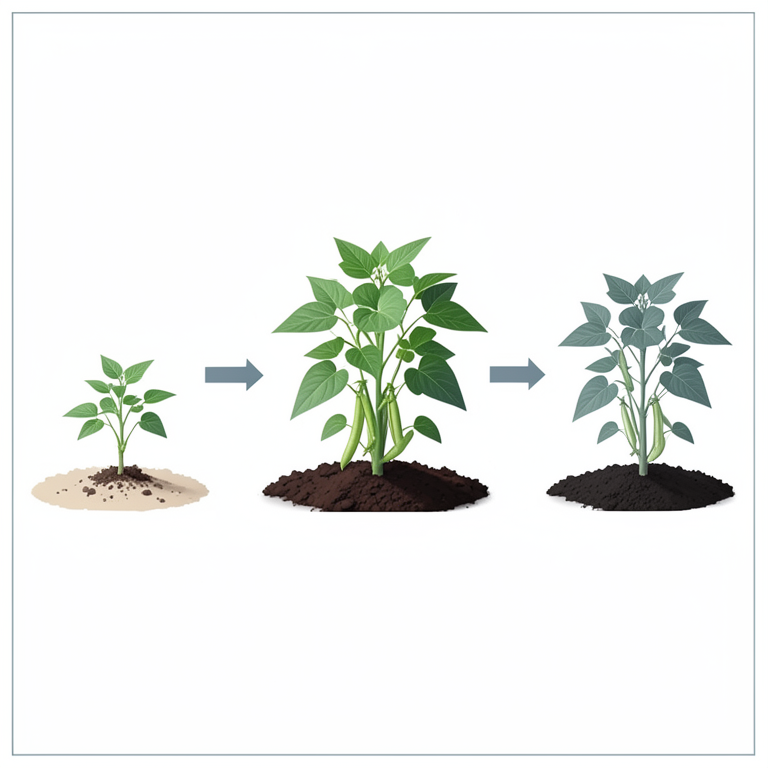
Phosphorus Application vs. Seed Yield
AI-generated conceptual illustration (common bean plants (Phaseolus vulgaris L.)). It explains the idea and does not show study data.
View source evidence ↗Introduction
Common beans (Phaseolus vulgaris L.) are an essential source of protein, carbohydrates, and micronutrients for millions of people globally. Despite their significance, their productivity is constrained by various factors, with nutrient deficiencies being one of the most critical. Among macronutrients, phosphorus plays a pivotal role in plant metabolic processes such as energy transfer, root development, and nodulation in legumes. However, phosphorus availability is often limited in soils due to its fixation in forms unavailable to plants, particularly in acidic or alkaline soils [1] . Phosphorus fertilization has been extensively studied as a strategy to enhance the productivity of common beans. While the benefits of phosphorus application are welldocumented, the optimal rates and methods of application remain context-dependent, influenced by soil type, environmental conditions, and bean varieties². This review provides a comprehensive analysis of the effects of phosphorus fertilization on the growth and yield of common beans, synthesizing findings from a wide range of studies to identify patterns and gaps in the current understanding.
Objective
The objective of this paper is to synthesize and critically analyze existing research on the effects of phosphorus fertilization on the growth, yield components, and agronomic performance of common beans (Phaseolus vulgaris L.). By consolidating findings from various studies, the paper aims to identify optimal phosphorus application rates, evaluate phosphorus use efficiency under different soil and environmental conditions, and explore sustainable management practices. Additionally, it seeks to highlight gaps in current knowledge and propose directions for future research to enhance phosphorus management in bean production systems while addressing environmental concerns.
Effects of phosphorus fertilization on agronomic performance Effects of phosphorus on growth and yield
Phosphorus significantly influences the growth parameters of common beans, including root elongation, shoot biomass, and leaf area development. Studies have shown that phosphorus application improves the root architecture of beans, enabling better nutrient and water uptake.
Enhanced root development is particularly important in phosphorus-deficient soils, where root expansion is critical for accessing limited nutrient pools [3] . Yield parameters such as pod number, seed weight, and total biomass are also positively affected by phosphorus fertilization. Research indicates that seed yield increases linearly with phosphorus application up to an optimum threshold, beyond which no significant yield benefits are observed [4] . For example, trials conducted on phosphorus-deficient soils in tropical regions demonstrated that application rates of 30-60 kg P₂O₅ per hectare maximized yield without causing excessive soil phosphorus accumulation [5] . While the benefits of phosphorus fertilization are clear, excessive application can lead to diminishing returns and potential environmental issues, such as eutrophication caused by phosphorus runoff. This highlights the need for precise phosphorus management strategies that balance crop productivity with environmental sustainability [6] .
Phosphorus use efficiency
Phosphorus Use Efficiency (PUE) in common beans varies widely depending on soil properties, environmental conditions, and management practices. Sandy soils with low organic matter content often exhibit higher phosphorus leaching, reducing PUE. In contrast, clayey soils tend to fix phosphorus in forms unavailable to plants, necessitating higher application rates to achieve similar results [7] . Agronomic practices such as the use of biofertilizers and organic amendments can enhance PUE by improving phosphorus solubilization and uptake. For instance, inoculation with phosphorus-solubilizing microorganisms has been shown to increase bean yield while reducing the need for chemical fertilizers [8] . Additionally, co-application of phosphorus with organic matter, such as compost, enhances soil structure and microbial activity, further boosting phosphorus availability and uptake [9] .
Environmental and agronomic implications
The environmental implications of phosphorus fertilization cannot be overlooked. Excessive phosphorus application contributes to soil phosphorus saturation and increases the risk of runoff into water bodies, leading to eutrophication. This is particularly problematic in regions with high rainfall, where phosphorus losses through surface runoff are significant [10] . From an agronomic perspective, phosphorus management must be tailored to local conditions to maximize efficiency and minimize environmental impacts. Soil testing is a critical tool for determining phosphorus availability and guiding fertilizer recommendations. Integrated nutrient management practices, which combine chemical fertilizers with organic amendments and biological inputs, offer a sustainable approach to phosphorus fertilization [11] .
Research gaps and future directions
Despite the extensive body of research on phosphorus fertilization in common beans, several gaps remain. Longterm studies evaluating the residual effects of phosphorus application on soil fertility and crop productivity are limited. Additionally, the interactions between phosphorus and other nutrients, such as nitrogen and potassium, are not wellunderstood and warrant further investigation [12] . The role of climate change in altering phosphorus availability and plant uptake also presents an important area for future research. Changes in rainfall patterns and temperature may affect soil phosphorus dynamics and necessitate adjustments in fertilization practices¹³. Developing phosphorus-efficient bean varieties through breeding and genetic engineering could provide a long-term solution to phosphorus deficiency in bean production systems [14] .
Conclusion
Phosphorus fertilization plays a crucial role in improving the growth and yield of common beans, particularly in phosphorus-deficient soils. Optimal application rates of 30-60 kg P₂O₅ per hectare have been shown to maximize yield without causing environmental harm. However, site-specific management strategies are essential to enhance phosphorus use efficiency and ensure sustainability. Integrated nutrient management practices, including the use of biofertilizers and organic amendments, offer promising solutions to optimize phosphorus availability while minimizing environmental impacts. Future research should focus on long-term nutrient management, the development of phosphorus-efficient bean varieties, and the impacts of climate change on phosphorus dynamics.
References
14 in the original paper- Smith J, Jones A. Soil phosphorus availability in tropical agriculture. Agronomy Journal. 2020;112(5):345-357.
- Brown L, Green P. Phosphorus dynamics in legume crops. Plant Nutrition Science. 2019;24(2):112-120.
- Taminaw Z, Hassen E. Review on effects of phosphorus fertilizer rates on growth, yield components and yield of common bean (Phaseolus vulgaris L.). Journal of Current Research in Food Science. 2021;2(1):34-39.
- White R, Smith T. Sustainable phosphorus management in legumes. Journal of Crop Nutrition. 2018;15(3):89102.
- Lopez F, Silva H. Phosphorus efficiency in legume cropping systems. Agricultural Systems. 2017;44(1):6778.
- Dawson C, Hilton M. Environmental impacts of phosphorus runoff. Soil and Water Conservation Journal. 2016;71(4):234-241.
- Paul S, Kumar A. Enhancing phosphorus use efficiency in common beans. Agricultural Practices Review. 2018;33(2):56-64.
- Ramachandran V, Singh R. Biofertilizers and phosphorus solubilization in legumes. Soil Microbiology. 2019;14(5):78-89.
- Zhu X, Li J. Organic amendments and phosphorus availability. Journal of Soil Science. 2020;22(3):145152.
- Greenway K, Foster J. Phosphorus losses in highrainfall regions. Environmental Science Letters. 2017;18(2):45-60.
- Kumar P, Sharma R. Integrated nutrient management for sustainable agriculture. Agricultural Systems. 2018;15(1):98-109.
- Harper R, Davies M. Phosphorus-nitrogen interactions in legume systems. Plant Nutrition Research. 2019;18(4):87-101.
- Singh V, Patel H. Climate change and phosphorus dynamics. Agronomy for Sustainable Development. 2020;40(3):345-362.
- Raj A, Sen S. Breeding phosphorus-efficient crops. Plant Breeding Journal. 2021;15(5):234-249