
Research article · 2024 · Full text
International Journal of Agriculture and NutritionMolecular biology and control strategies for plant viruses
Volume 6(2) · Pages 84–88 · DOI: 10.33545/26646064.2024.v6.i2b.185 ↗
Research areasPlant Virus Research StudiesPlant Disease Resistance and GeneticsPlant Parasitism and Resistance
Abstract
Author-writtenPlant viruses are significant pathogens that pose a major threat to global agriculture, causing extensive crop losses and economic damage. Understanding the molecular biology of plant viruses is crucial for developing effective control strategies. Plant viruses are primarily composed of nucleic acids (RNA or DNA) encased in a protein coat, and they rely on host cellular machinery for replication and movement within the plant. Key molecular mechanisms include virus entry, replication, movement, and host-virus interactions, such as the manipulation of host gene expression and suppression of plant defense responses. Molecular techniques have greatly advanced our understanding of these processes. Techniques such as Reverse Transcription Polymerase Chain Reaction (RT-PCR), Next-Generation Sequencing (NGS), and CRISPR-Cas systems enable precise detection, identification, and characterization of plant viruses at the genetic level. These tools also facilitate the study of viral evolution and the development of resistance in plants. Control strategies for plant viruses are multifaceted. Breeding for virus-resistant cultivars is an approach which is often achieved through conventional breeding or genetic engineering. Transgenic plants expressing viral coat protein genes or RNA interference (RNAi) constructs have shown promise in conferring resistance. Additionally, cross-protection, where a mild strain of the virus is used to protect against a more virulent strain, is another effective method. Cultural practices, such as crop rotation, sanitation, and vector control, play essential roles in managing virus spread. Integrated Pest Management (IPM) strategies that combine biological, chemical, and cultural practices are vital for sustainable control.
Summary
Source-checkedPlain-language reading of the full paper, prepared with AI and checked against the text. Each point links to the authors' own words.
Why it matters
- Plant viruses are major agricultural pathogens that cause significant economic damage and extensive crop losses worldwide. View evidence ↗
- In severe instances, plant viruses can reduce crop yields by as much as 90%, leading to annual economic losses in the billions of dollars. View evidence ↗
- Developing effective control strategies for these pathogens requires a deep understanding of their molecular biology. View evidence ↗
The question
- The objective of this review is to provide a comprehensive overview of plant virus molecular biology, covering infection mechanisms, replication, host interactions, detection methods, and management strategies. View evidence ↗
What they did
- Plant viruses are generally structured with a protein coat called a capsid that encloses a nucleic acid genome of either DNA or RNA. View evidence ↗
- The genomes of plant viruses are typically small, generally ranging between 3 and 10 kilobases in size. View evidence ↗
- Unlike animal viruses, plant viruses primarily use vectors like nematodes or insects to move between hosts. View evidence ↗
What they found
- Viruses often produce suppressor proteins to inhibit the plant's RNA silencing pathway, which allows them to evade the immune system and replicate more efficiently. View evidence ↗
- Reverse Transcription Polymerase Chain Reaction (RT-PCR) is highly sensitive, making it capable of detecting low viral loads in asymptomatic plants or during early infection. View evidence ↗
- Next-Generation Sequencing (NGS) allows for the unbiased detection of viral genomes without needing prior knowledge of the specific virus. View evidence ↗
- Genetic engineering using RNA interference (RNAi) constructs or the expression of viral coat protein genes has shown promise in creating virus-resistant plants. View evidence ↗
- Cross-protection involves inoculating plants with a mild viral strain to protect them from more virulent strains of the same or related virus. View evidence ↗
- Cultural practices such as vector control, sanitation, and crop rotation are foundational for reducing the spread of plant viruses. View evidence ↗
- Biological control manages virus spread by using parasitoids, natural predators, or pathogens to reduce the populations of insect vectors. View evidence ↗
What it means
- The authors conclude that sustainable control of plant viruses is best achieved through integrated management strategies that combine cultural practices with resistant cultivars. View evidence ↗
- Continued research into plant-virus molecular interactions is essential to develop resilient crops in the face of climate change. View evidence ↗
Visual summary
1 visualsIllustrations explain the paper; they do not show study data.
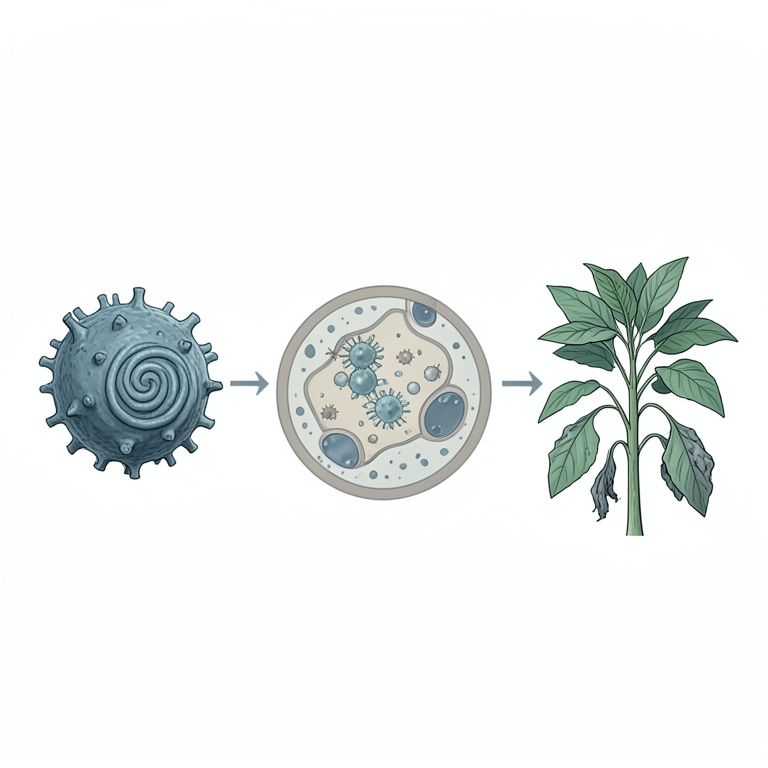
Study overview
AI-generated conceptual illustration (Tobacco plants and plant virus particles). It explains the idea and does not show study data.
View source evidence ↗Introduction
Plant viruses are obligate intracellular parasites that infect a wide range of plant species, leading to significant agricultural losses worldwide. The impact of these pathogens on crop production is profound; they can reduce yields by up to 90% in severe cases, resulting in substantial economic losses estimated at billions of dollars annually (Tatineni and Hein, 2023) [4] . Understanding the molecular biology of plant viruses is essential for developing effective control strategies that can mitigate their impact on agriculture. The structure of plant viruses typically consists of nucleic acids either RNA or DNA encased in a protein coat known as a capsid. Unlike animal viruses, which can utilize various transmission methods, plant viruses primarily rely on vectors such as insects or nematodes for transmission between hosts (Frankel-Conrat, 1986) [2] . Once inside a host plant cell, viruses hijack the cellular machinery to replicate and spread throughout the plant. This review aims to provide a comprehensive overview of the molecular biology of plant viruses, including their mechanisms of infection and replication, host interactions, molecular detection techniques, and management strategies.
The genome size of plant viruses is generally small, typically ranging from 3 to 10 kilobases, and it encodes a limited number of proteins essential for their lifecycle, including replicase proteins, movement proteins, and capsid proteins. The capsid is the protein shell that encloses the viral genome, providing stability and aiding in host infection processes. Despite the simplicity of their structure, plant viruses exhibit various morphologies, including rod-shaped, filamentous, isometric, and bacilliform forms, each suited to the virus's specific mode of transmission and interaction with the host.
Types of
Types of
Mechanisms of infection
The infection cycle of plant viruses is a complex, multi-step process involving entry, replication, movement, and manipulation of host cellular mechanisms. Each step is crucial for the virus to successfully infect, replicate, and spread within the plant. [5] .
Host-virus interactions
Host-virus interactions in plants are intricate and involve a dynamic interplay of molecular mechanisms that viruses exploit to facilitate their infection, replication, and survival within host tissues. Understanding these interactions is critical for advancing agricultural science and developing effective strategies for viral disease management in plants.
One significant aspect of host-virus interaction is gene expression manipulation. When a virus infects a plant cell, it can alter the host's gene expression patterns to create an environment favorable for its own replication and spread. By hijacking the host's cellular machinery, the virus suppresses or activates specific genes to support viral replication. For instance, certain plant viruses can modify the expression of genes involved in cellular metabolism and membrane transport, thereby enhancing the availability of cellular resources and transport pathways for viral particles.
In this way, viruses manipulate host cellular pathways to prioritize their own survival over the normal functions of the plant, often leading to stunted growth or other physiological symptoms in the infected plant.
Another key mechanism is defense suppression. Plants have an innate immune system that recognizes Pathogen-Associated Molecular Patterns (PAMPs) to mount an immune response. However, many plant viruses produce proteins specifically designed to counteract these immune
defenses (Nguyen et al., 2024) [6] . Viral proteins can inhibit host signaling pathways or interfere with the production of defensive molecules such as reactive oxygen species (ROS) that would otherwise help restrict viral spread. For example, some viral suppressor proteins interfere with RNA silencing, a critical antiviral defense mechanism in plants that targets viral RNA for degradation. By inhibiting RNA silencing, viruses can avoid degradation and maintain their presence in the host cells, facilitating ongoing replication and movement through plant tissues. Through these mechanisms, viruses maintain a delicate balance with the host. While they suppress the immune system and exploit host resources, the host also adapts by evolving new defense mechanisms, such as the development of resistance genes that can recognize specific viral proteins. However, viruses often overcome these defenses by mutation, resulting in a continuous arms race between host and pathogen (Jiang and Zhou, 2023) [3] .
Control strategies for plant viruses
Control strategies for plant viruses are essential in maintaining agricultural productivity and food security. Unlike bacterial or fungal pathogens, viruses lack metabolic functions that can be targeted by pesticides, making virus management particularly challenging. Instead, effective virus control requires an integrated approach that combines breeding, cross-protection, cultural practices, and Integrated Pest Management (IPM). Each of these strategies offers distinct advantages, and combining them can lead to more sustainable and comprehensive control of viral diseases in crops.
Breeding resistant cultivars
Breeding virus-resistant cultivars remains one of the most effective and sustainable methods for controlling plant viruses. Resistant cultivars can withstand or reduce the effects of viral infections, decreasing crop losses and the need for other control measures. Two main approaches are employed in developing resistant cultivars: conventional breeding and genetic engineering.
Conventional breeding: Traditional plant breeding methods have been used for centuries to develop crops with desirable traits, including virus resistance. This process involves selecting plants that show natural resistance to specific viruses and crossbreeding them to produce offspring with enhanced resistance. In conventional breeding, resistance genes are introduced into susceptible cultivars by hybridizing them with resistant varieties. These resistance genes can either prevent the virus from entering plant cells or limit its ability to replicate and spread. Examples of crops developed through conventional breeding include tomato varieties resistant to tomato mosaic virus (ToMV) and potato varieties resistant to potato virus Y (PVY).
Genetic engineering: Genetic engineering allows for more precise introduction of resistance genes into plants. Transgenic plants can be developed to express viral coat proteins or RNA interference (RNAi) constructs that confer resistance to specific viruses. In one approach, plants are engineered to express viral coat proteins, which interfere with the virus's ability to infect plant cells. Another method, RNAi, uses small interfering RNAs to target and degrade viral RNA, preventing replication. Genetic engineering can provide resistance to viruses that are difficult to control through conventional breeding, such as Papaya Ringspot Virus (PRSV) in papaya and Squash Mosaic Virus (SqMV) in squash. Although transgenic approaches have shown promise, regulatory and public acceptance challenges remain, influencing their widespread adoption.
Cross-protection
Cross-protection is a strategy where plants are inoculated with a mild or less virulent strain of a virus to protect them against more aggressive strains of the same or related virus. This approach works by priming the plant's immune system or occupying viral replication sites, reducing the chances of infection by more severe strains. Cross-protection has been effectively applied to manage viral diseases in crops such as citrus and tobacco. For example, mild strains of Citrus Tristeza Virus (CTV) are used to protect citrus trees against severe strains that can cause extensive damage. Cross-protection is advantageous because it is relatively low-cost, requires minimal intervention once established, and can provide long-lasting protection. However, this method requires careful strain selection to ensure that the mild strain does not evolve into a more virulent form. Additionally, cross-protection is generally effective only within specific virus species, limiting its applicability to certain crop-virus combinations.
Cultural practices
Cultural practices are foundational in managing plant viruses as they help reduce virus spread and prevent the establishment of viral inoculum in fields. Effective cultural practices include crop rotation, sanitation, and vector control.
Crop rotation: Crop rotation is a practice where crops are alternated in a given field over different growing seasons to disrupt the life cycles of pests and pathogens. This is especially effective in managing viruses that have hostspecific vectors or persistent virus reservoirs. For instance, rotating susceptible crops with non-host crops can help break the virus-vector cycle, as vectors such as aphids and whiteflies are less likely to survive without their preferred host. In cases where viruses persist in the soil or alternative hosts, rotating crops with resistant or non-host varieties can significantly reduce the incidence of viral disease. Chemical control: Chemical insecticides are sometimes necessary to manage high vector populations, especially in cases where viral outbreaks are severe. However, chemical control should be used judiciously to avoid environmental damage and prevent vector resistance. Selective insecticides, such as neonicotinoids and insect growth regulators, target specific vector species while minimizing effects on nontarget organisms. To reduce environmental impact, insecticides can be integrated with other vector control practices, such as crop rotation, sanitation, and biological control, to lower the frequency and quantity of chemical applications. Additionally, applying insecticides during key times, such as early in the growing season or at specific pest lifecycle stages, can enhance their effectiveness.
Sanitation
Sanitation
Conclusion
Plant viruses represent a significant threat to global agriculture due to their ability to cause extensive crop losses and economic damage. Understanding their molecular biology is crucial for developing effective control strategies that can mitigate their impact on food security. Advancements in molecular techniques have greatly enhanced our ability to detect and characterize these pathogens at the genetic level. Moreover, integrated management strategies that combine resistant cultivars with cultural practices offer promising avenues for sustainable control. As climate change continues to alter agricultural landscapes, ongoing research into the molecular mechanisms underlying plant-virus interactions will be essential for developing resilient crops capable of withstanding future challenges posed by these formidable pathogens.
References
5 in the original paper- Adams MJ, et al. 50 years of the International Committee on Taxonomy of Viruses: progress and prospects. Archives of Virology. 2017;162(5):14411446.
- Jiang T, Zhou T. Unraveling the mechanisms of virusinduced symptom development in plants. Plants (Basel). 2023;12(15):2830.
- Tatineni S, Hein GL. Plant viruses of agricultural importance: Current and future perspectives of virus disease management strategies. Phytopathology. 2023;113.
- Wege C, Koch C. From stars to stripes: RNA-directed shaping of plant viral protein templates structural synthetic virology for smart biohybrid nanostructures. WIREs Nanomedicine and Nanobiotechnology. 2020;12:1591.
- Nguyen NH, Nguyen HD, Nguyen T. Roles of phytohormones in regulation of plant immunity against pathogens. South Asian J Agric Sci. 2024;4(1):222-226. doi:10.22271/27889289.2024.v4.i1c.132.