
Research article · 2022 · Full text
International Journal of Geography Geology and EnvironmentClimate change and its impact on biodiversity: A global perspective
Volume 4(2) · Pages 245–249 · DOI: 10.22271/27067483.2022.v4.i2c.300 ↗
Research areasClimate Change Policy and Economics
Abstract
Author-writtenClimate change is one of the most pressing environmental challenges of the 21st century, affecting ecosystems and biodiversity at multiple scales. From shifting species distributions and altered migration patterns to the increased frequency of extreme weather events, the consequences of global warming are profound. This review explores the impacts of climate change on biodiversity, focusing on habitat loss, species extinction, ecosystem disruption, and the role of human activity. It also examines mitigation and adaptation strategies that are crucial for the conservation of biodiversity in the face of a rapidly changing climate. The urgency to understand and address these impacts has never been greater as the world navigates toward a sustainable future.
Summary
Source-checkedPlain-language reading of the full paper, prepared with AI and checked against the text. Each point links to the authors' own words.
Why it matters
- Human activities, including industrial processes and fossil fuel combustion, have caused the Earth's average temperature to increase by about 1.1 °C since the late 19th century. View evidence ↗
- Biodiversity is critical for maintaining essential ecosystem services, including pollination, soil fertility, water filtration, and carbon sequestration. View evidence ↗
- Between 1970 and 2016, vertebrate populations declined by an average of 68%, a trend driven by overexploitation, habitat loss, and climate change. View evidence ↗
The question
- The study aims to assess how climate change directly and indirectly impacts global biodiversity, specifically regarding habitat loss, species extinction, and ecosystem disruption. View evidence ↗
What they did
- The author conducted a review focusing on the roles of human activity, ecosystem disruption, species extinction, and habitat loss in the context of climate change. View evidence ↗
What they found
- Research indicates that approximately 80% of studied species have shifted their geographical ranges toward higher altitudes or the poles. View evidence ↗
- Current extinction rates are estimated to be 1,000 times higher than the natural background rate, suggesting a sixth mass extinction. View evidence ↗
- Amphibians in tropical regions have experienced an estimated population decline of 40% due to temperature sensitivity and habitat loss. View evidence ↗
- Global coral reef populations have seen an estimated decline of 50% resulting from habitat loss and coral bleaching. View evidence ↗
- Polar bear populations in the Arctic have declined by an estimated 30% due to reduced hunting grounds and sea ice loss. View evidence ↗
- Global migratory bird populations have declined by an estimated 20% due to food availability mismatches and phenological shifts. View evidence ↗
- Global marine fish populations have declined by an estimated 25% as they migrate to cooler waters and shift ranges. View evidence ↗
- The Arctic is warming at double the global average rate, causing rapid ice melt and habitat loss for seabirds, seals, and polar bears. View evidence ↗
What it means
- Transitioning to sustainable energy and reducing greenhouse gas emissions are concluded to be essential for preserving biodiversity and limiting future climate impacts. View evidence ↗
Visual summary
1 visualsIllustrations explain the paper; charts are replotted from the paper's own table values.
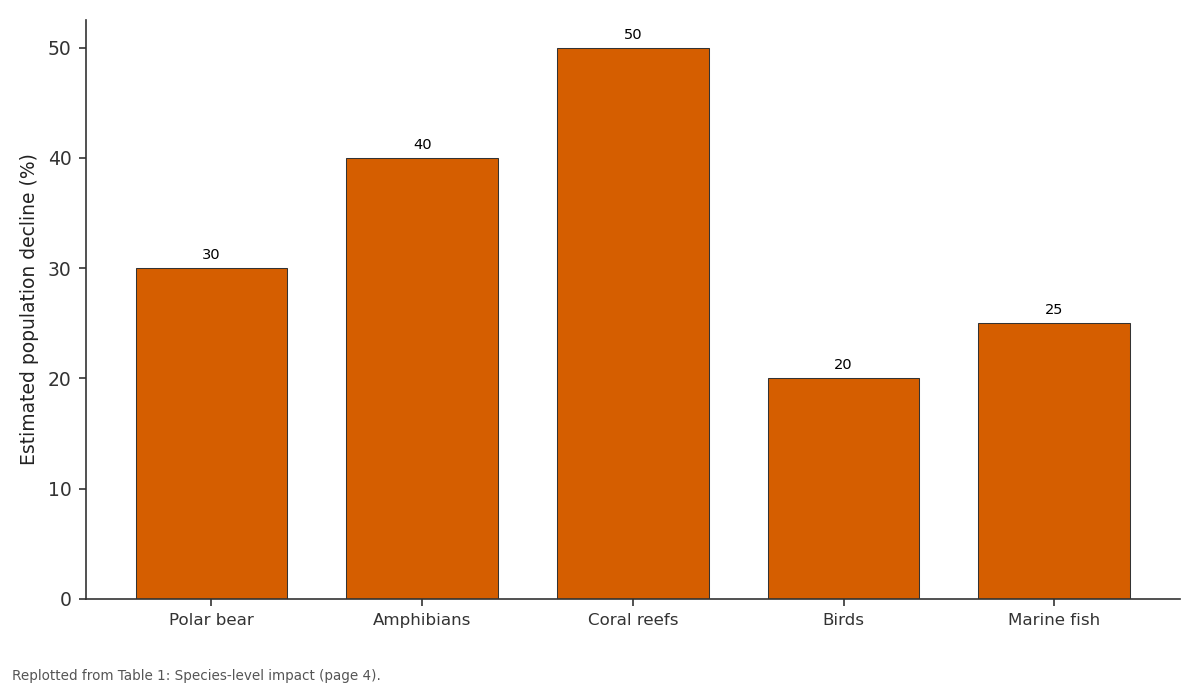
Estimated population decline (%): Polar bear vs Amphibians vs Coral reefs vs Birds vs Marine fish
Replotted from Table 1 (page 4) of the original paper. Every bar is the paper's own table value.
View source evidence ↗Figures & tables
From the original paper Table 1
Introduction
Climate change is increasingly recognized as one of the most critical global challenges of our time, with profound implications for the natural world. The rise in global temperatures, driven by anthropogenic emissions of greenhouse gases (GHGs), is not only altering weather patterns but also fundamentally reshaping ecosystems and threatening biodiversity on a global scale. The Earth's average temperature has risen by approximately 1.1 °C since the late 19 th century, primarily due to human activities such as the burning of fossil fuels, deforestation, and industrial processes. According to the Intergovernmental Panel on Climate Change (IPCC), without substantial reductions in GHG emissions, global temperatures are projected to rise by 2.5 to 4.5 °C by the end of the 21 st century. These changes will have cascading effects on biodiversity, a term that encompasses the variety of life forms on Earth, including genetic diversity, species diversity, and ecosystem diversity. The intricate relationships between organisms and their environments are finely tuned by climate conditions, and any disruption to these conditions can have widespread and often irreversible consequences. Biodiversity plays an essential role in maintaining ecosystem functions and services, such as carbon sequestration, water filtration, soil fertility, and pollination. These services are vital not only for the stability of natural systems but also for human well-being. However, climate change is now pushing many ecosystems beyond their natural limits of tolerance, leading to habitat degradation, species extinctions, and altered ecosystem dynamics. A 2020 report by the World Wildlife Fund (WWF) highlighted that the populations of vertebrate species have declined by an average of 68% between 1970 and 2016, largely driven by habitat loss, overexploitation, and increasingly, climate change. One of the most alarming aspects of climate change's impact on biodiversity is the acceleration of species extinctions. Studies suggest that we are currently experiencing a sixth mass extinction, with extinction rates estimated to be 1,000 times higher than the natural background rate. For example, a study conducted by Thomas et al. (2004) [3] predicted that climate change alone could commit 15-37% of species to extinction by 2050, depending on the severity of warming. Such extinctions are likely to disproportionately affect species with narrow ecological niches, limited dispersal abilities, and specialized habitat requirements. Amphibians, reptiles, and endemic species in biodiversity hotspots are particularly vulnerable, as they often lack the adaptive capacity to cope with rapidly changing environmental conditions.
Climate change affects biodiversity through multiple mechanisms. Rising temperatures, altered precipitation patterns, and the increased frequency of extreme weather events such as droughts, floods, and storms are driving changes in species distribution, phenology, and behavior. In many cases, species are migrating towards higher latitudes or elevations in search of more suitable climatic conditions. A study by Parmesan and Yohe (2003) [2] documented that approximately 80% of species studied showed range shifts towards the poles or higher altitudes, a clear indication of climate change's influence on species' geographical distributions. However, not all species are capable of shifting their ranges at a pace that matches the speed of climate change, leading to population declines and local extinctions. Phenological changes, such as shifts in the timing of breeding, flowering, and migration, are also becoming increasingly evident. For instance, birds are arriving earlier at their breeding grounds, and plants are flowering earlier in spring, as documented by Visser et al. (2004). These changes in timing can lead to mismatches between species and their environments, particularly when the availability of critical resources such as food or pollinators no longer coincides with life cycle events. Such mismatches can have cascading effects throughout ecosystems, potentially disrupting entire food webs. In addition to these direct effects, climate change is exacerbating other threats to biodiversity, such as habitat destruction, overexploitation, and pollution. Deforestation and land-use changes, driven by agricultural expansion, urbanization, and infrastructure development, are already leading to significant habitat loss and fragmentation. Climate change further compounds these threats by altering the suitability of remaining habitats, making it more difficult for species to survive and reproduce. Marine ecosystems are similarly affected by climate change, with rising ocean temperatures, acidification, and deoxygenation posing serious risks to marine biodiversity. Coral reefs, which are among the most biologically diverse ecosystems on the planet, are particularly vulnerable to climate-induced bleaching events. The 2016 bleaching event in the Great Barrier Reef, for instance, led to the loss of more than 50% of the reef's coral cover, as reported by Hughes et al. (2017) [6] . Given the scale and complexity of the challenges posed by climate change, understanding its impacts on biodiversity requires an interdisciplinary approach that combines ecological, climatological, and conservation science. Researchers and policymakers are increasingly recognizing the need for urgent and coordinated action to mitigate the effects of climate change on biodiversity. Mitigation strategies, such as reducing GHG emissions and enhancing carbon sequestration through reforestation, are essential to limit future warming and its associated impacts. At the same time, adaptation strategies are needed to help ecosystems and species cope with the changes that are already underway. These strategies include the creation of protected areas, the establishment of ecological corridors to facilitate species migration, and the implementation of habitat restoration projects. However, as the window for effective action narrows, the urgency of addressing climate change's impacts on biodiversity becomes ever more apparent.
Objectives
The main objectives of this study are 1. To assess the direct and indirect impacts of climate change on global biodiversity, focusing on ecosystem disruption, species extinction, and habitat loss. 2. To evaluate current mitigation and adaptation strategies aimed at conserving biodiversity in response to climate change.
Climate change and biodiversity: An overview
The relationship between climate change and biodiversity is complex and multifaceted, with climate change emerging as one of the most significant threats to global biodiversity in the 21st century. Biodiversity, which encompasses the variety of life forms on Earth, from genetic diversity within species to the richness of entire ecosystems, is crucial for the stability and functioning of the natural world. Ecosystem services such as food production, water purification, climate regulation, and disease control are directly dependent on maintaining this diversity. However, as the planet warms and climate systems become increasingly unstable, the delicate balance that supports biodiversity is under severe threat.
Climate change is primarily driven by human activities, particularly the combustion of fossil fuels, deforestation, and large-scale industrial agriculture, which have collectively increased the concentration of greenhouse gases in the atmosphere. These gases, notably carbon dioxide (CO₂), methane (CH₄), and nitrous oxide (N₂O), trap heat in the Earth's atmosphere, leading to a rise in global temperatures. The Intergovernmental Panel on Climate Change (IPCC) projects that if global temperatures continue to rise at the current rate, we could experience an increase of 1.5 °C as early as 2030, with potentially catastrophic impacts on ecosystems worldwide. Biodiversity loss is one of the most immediate consequences of this warming trend. As climate patterns change, ecosystems are subjected to new environmental conditions that many species are ill-equipped to handle. Rising temperatures, altered precipitation patterns, and the increased frequency of extreme weather events such as droughts, floods, hurricanes, and heatwaves disrupt habitats and ecosystems at every scale. One of the most noticeable effects of climate change on biodiversity is the geographic shift of species. As temperatures rise, many species are moving poleward or to higher elevations in search of suitable habitats. These shifts, documented in numerous studies, are occurring faster than at any time in recorded history. For example, Parmesan and Yohe (2003) [2] found that more than 80% of species showed shifts in their geographic ranges in response to climate change, particularly in temperate regions. [6] . Coral reefs are not only biodiversity hotspots but also provide critical ecosystem services, including coastal protection, food resources, and tourism opportunities. The loss of coral reefs threatens the livelihoods of millions of people who depend on these ecosystems for sustenance and economic activities.
Ocean acidification, a byproduct of increased atmospheric CO₂, poses an additional threat to marine biodiversity. As CO₂ is absorbed by seawater, it reacts to form carbonic acid, lowering the pH of the water. This acidification makes it more difficult for marine organisms such as corals, mollusks, and some plankton species to form calcium carbonate shells and skeletons. The disruption of these foundational species can have ripple effects throughout marine ecosystems, as they play a key role in the food chain. Studies such as those by Doney et al. (2009) [7] highlight the vulnerability of marine biodiversity to the dual threats of warming and acidification, which together are reshaping the structure and function of marine ecosystems worldwide.
The impacts of climate change on biodiversity are not evenly distributed. Certain ecosystems and regions are more vulnerable than others, particularly those that are already experiencing environmental stress. The Arctic, for instance, is warming at twice the global average, leading to rapid ice melt and the loss of habitat for species such as polar bears, seals, and seabirds. Tropical forests, which contain more than half of the world's species, are also at risk due to changing rainfall patterns and increased frequency of droughts. The Amazon rainforest, often referred to as the "lungs of the Earth," plays a vital role in global carbon sequestration, but deforestation and climate-induced droughts are threatening its ability to store carbon, exacerbating global warming.
In addition to these environmental consequences, climate change is also affecting biodiversity through its interactions with other human-induced pressures. Habitat loss due to land-use change, overexploitation of species, pollution, and invasive species are all amplified by climate change. For example, deforestation for agriculture not only reduces available habitat but also increases the vulnerability of species to climate change by eliminating migration corridors and reducing genetic diversity. Invasive species, which thrive in disturbed environments, are expanding their ranges as temperatures rise, outcompeting native species and further reducing biodiversity.
Impacts of climate change on ecosystems
Climate change is altering ecosystems on a global scale, with impacts ranging from subtle shifts in ecosystem composition to dramatic changes in ecosystem structure and function. As ecosystems are exposed to rising temperatures, changing precipitation patterns, and more frequent extreme weather events, their capacity to support diverse life forms is being tested. Terrestrial, marine, and freshwater ecosystems are all experiencing significant stress, with some ecosystems, particularly those in vulnerable regions like the Arctic and coral reefs, already showing signs of collapse. Terrestrial ecosystems are facing increasing pressures as climate zones shift poleward and upward in elevation. Forests, grasslands, and tundras are particularly sensitive to these changes, as they depend on stable climatic conditions for plant growth, species interactions, and nutrient cycling.
In tropical rainforests, which harbor the planet's richest biodiversity, even small changes in temperature and rainfall can have outsized effects. Research shows that increasing drought and fire frequency in the Amazon is not only threatening species survival but also affecting the forest's role as a critical carbon sink, exacerbating global warming.
In marine ecosystems, warming waters, ocean acidification, and deoxygenation are reshaping the distribution and productivity of marine life. Coral reefs are among the most vulnerable ecosystems, with widespread coral bleaching events becoming increasingly common. Coral reefs, which provide habitat for a quarter of all marine species, are under threat from rising sea temperatures. These temperature increases cause corals to expel their symbiotic algae, leading to bleaching and often death if conditions do not improve. As coral ecosystems degrade, species that depend on these habitats, including fish, mollusks, and crustaceans, are also at risk. Additionally, polar ecosystems, particularly in the Arctic, are experiencing accelerated ice melt, affecting not only marine mammals like seals and polar bears but also altering the productivity and structure of plankton communities that form the basis of polar food webs.
Freshwater ecosystems are not immune to these changes. Shifts in precipitation patterns and the increasing frequency of droughts and floods are altering river flows, lake levels, and wetland hydrology. These changes impact freshwater species, from amphibians and fish to aquatic plants and invertebrates. Reduced water availability in some regions, combined with increased demand for agricultural and urban uses, is creating further pressures on freshwater ecosystems, leading to habitat loss and species decline. The cumulative impact of these changes is leading to widespread ecosystem disruption. The resilience of ecosystems their ability to recover from disturbances is being undermined as climate change accelerates.
Ecosystems that were once stable and capable of supporting diverse species are now becoming more fragmented, less productive, and increasingly unable to provide essential services such as carbon storage, water filtration, and climate regulation.
Species-level impacts
At the species level, climate change is driving significant shifts in distribution, behavior, and survival. Many species are migrating to higher altitudes or latitudes in search of suitable conditions, but not all species can adapt to these rapid changes. Those that cannot move or adjust their behavior face the risk of population decline or extinction. Amphibians, reptiles, and plants with limited dispersal abilities or narrow ecological niches are particularly vulnerable. Species are also experiencing changes in the timing of key life events, such as migration, breeding, and flowering, due to warming temperatures and altered seasonal cues. These phenological shifts can disrupt ecological relationships and interactions. For example, migratory birds may arrive at their breeding grounds earlier or later than usual, potentially missing the peak abundance of food resources such as insects or plants. Similarly, plants may bloom before or after the arrival of their pollinators, leading to reduced reproduction rates and population decline. Some species, especially generalists that can tolerate a wide range of conditions, may initially benefit from climate change by expanding their ranges. However, this expansion often comes at the expense of specialist species, leading to reduced biodiversity in ecosystems. The loss of specialized species can result in the simplification of ecosystems, making them more vulnerable to further environmental changes. Moreover, invasive species, which are often better adapted to changing environmental conditions, are expanding their ranges due to climate change. These species can outcompete native species for resources, further contributing to the loss of biodiversity. For example, warmer temperatures have allowed invasive plant and animal species to thrive in regions where they previously could not survive, displacing native species and altering ecosystem dynamics. Species at the top of the food chain, such as large carnivores and apex predators, are also facing increased pressures as their prey species decline or move to new areas. These changes disrupt predator-prey dynamics and can lead to cascading effects throughout the ecosystem. In Polar Regions, for instance, the loss of sea ice is reducing the hunting grounds for polar bears, leading to declines in their populations and altering the structure of Arctic food webs.
Genetic diversity and evolutionary responses
Genetic diversity is the foundation of species' ability to adapt to environmental changes. As climate change accelerates, species with greater genetic diversity are more likely to survive, while those with low genetic variation may struggle to cope with new environmental stresses. The loss of genetic diversity due to habitat fragmentation, population declines, and other factors reduces species' ability to evolve and adapt to changing conditions. In some cases, evolutionary responses to climate change have been observed, with species showing genetic changes that enable them to cope with new environmental pressures.
For example, some populations of birds, insects, and plants have been found to evolve earlier breeding or flowering times in response to warming temperatures. However, the speed at which climate change is occurring may outpace the ability of many species to evolve, leading to increased extinction risks. Phenotypic plasticity, the ability of individuals to alter their behavior, physiology, or development in response to environmental changes, provides some species with a temporary buffer against the impacts of climate change. For instance, some fish species have been observed to alter their reproductive strategies or feeding habits in response to changing water temperatures. However, the capacity for phenotypic plasticity varies widely among species, and in many cases, it may not be sufficient to prevent long-term population declines. The loss of genetic diversity also has implications for ecosystem stability and function. Ecosystems with high genetic diversity are more resilient to environmental changes and disturbances, as diverse genetic traits allow species to adapt to new conditions. Conversely, ecosystems with low genetic diversity are more vulnerable to collapse, as species are less able to cope with the rapid changes associated with climate change.
Conclusion
The impacts of climate change on biodiversity are profound, far-reaching, and accelerating. Ecosystems across the globe, from tropical forests and coral reefs to polar ice caps and freshwater systems, are being transformed by rising temperatures, altered precipitation patterns, and extreme weather events. At the species level, climate change is driving shifts in distribution, behavior, and survival, with many species unable to adapt quickly enough to avoid population declines or extinction. The loss of genetic diversity further compounds these challenges, reducing species' ability to evolve and adapt to rapidly changing environmental conditions. As ecosystems and species struggle to cope with the accelerating pace of climate change, the resilience of the natural world is being tested, with potentially dire consequences for both biodiversity and human well-being. Addressing these challenges requires urgent, coordinated global action to mitigate the causes of climate change and implement adaptation strategies that support biodiversity conservation. Protected areas, habitat corridors, and ecosystem restoration efforts must be expanded and integrated with climate resilience measures to ensure that species have the space and resources they need to survive. Additionally, reducing greenhouse gas emissions and transitioning to sustainable energy sources are essential to limiting future climate impacts and preserving the planet's rich biodiversity for future generations.
In conclusion, while climate change presents an unprecedented challenge to biodiversity, it also offers an opportunity for transformative conservation efforts. By recognizing the interconnectedness of climate and biodiversity, and by taking bold action to address the root causes of environmental degradation, humanity can help safeguard the natural systems that sustain life on Earth.
Figures and tables from the paper
| Species name | Area affected | Impacts | Estimated population decline (%) |
|---|---|---|---|
| Polar bear | Arctic | Loss of sea ice, reduced hunting grounds | 30 |
| Amphibians | Tropical regions | Habitat loss, temperature sensitivity | 40 |
| Coral reefs | Coral Reef Ecosystems (Global) | Coral bleaching, loss of habitat for marine species | 50 |
| Birds | Global (Migratory Species) | Phenological shifts, mismatch with food availability | 20 |
| Marine fish | Oceans (Global) | Range shifts, migration to cooler waters | 25 |
Table text extracted from the original PDF; superscript letters are shown inline. The original table image is below.
View original table image
References
15 in the original paper- IPCC (Intergovernmental Panel on Climate Change). Climate Change 2021: The Physical Science Basis. Contribution of Working Group I to the Sixth Assessment Report of the Intergovernmental Panel on Climate Change. Cambridge University Press; 2021.
- Parmesan C, Yohe G. A globally coherent fingerprint of climate change impacts across natural systems. Nature. 2003;421(6918):37-42. https://doi.org/10.1038/nature01286
- Thomas CD, Cameron A, Green RE, Bakkenes M, Beaumont LJ, Collingham YC, et al. Extinction risk from climate change. Nature. 2004;427(6970):145-148. https://doi.org/10.1038/nature02121
- Urban MC. Accelerating extinction risk from climate change. Science. 2015;348(6234):571-573. https://doi.org/10.1126/science.aaa4984
- Both C, Bouwhuis S, Lessells CM, Visser ME. Climate change and population declines in a long-distance migratory bird. Nature. 2006;441(7089):81-83. https://doi.org/10.1038/nature04539
- Hughes TP, Kerry JT, Alvarez-Noriega M, ÁlvarezRomero JG, Anderson KD, Baird AH, et al. Global warming and recurrent mass bleaching of corals. Nature. 2017;543(7645):373-377. https://doi.org/10.1038/nature21707
- Doney SC, Fabry VJ, Feely RA, Kleypas JA. Ocean acidification: the other CO2 problem. Annu Rev Mar Sci. 2009;1:169-192. https://doi.org/10.1146/annurev.marine.010908.163834
- Malhi Y, Roberts JT, Betts RA, Killeen TJ, Li W, Nobre CA et al. Climate change, deforestation, and the fate of the Amazon. Science. 2008;319(5860):169-172. https://doi.org/10.1126/science.1146961
- Walther GR, Post E, Convey P, Menzel A, Parmesan C, Beebee TJ, et al. Ecological responses to recent climate change. Nature. 2002;416(6879):389-395. https://doi.org/10.1038/416389a
- Visser ME, Both C. Shifts in phenology due to global climate change: the need for a yardstick. Proc Biol Sci. 2005;272(1581):2561-2569. https://doi.org/10.1098/rspb.2005.3356
- Hoffmann AA, Sgrò CM. Climate change and evolutionary adaptation. Nature. 2011;470(7335):479485. https://doi.org/10.1038/nature09670
- Foden WB, Butchart SHM, Stuart SN, Vie JC, Akçakaya HR, Angulo A, et al. Identifying the world's most climate change vulnerable species: A systematic trait-based assessment of all birds, amphibians, and corals. PLoS ONE. 2013;8(6). https://doi.org/10.1371/journal.pone.0065427
- Bradshaw WE, Holzapfel CM. Evolutionary response to rapid climate change. Science. 2006;312(5779):1477-1478. https://doi.org/10.1126/science.1127000
- Stein BA, Staudt A, Cross MS, Dubois NS, Enquist C, Griffis R, et al. Preparing for and managing change: climate adaptation for biodiversity and ecosystems. Front Ecol. Environ. 2013;11(9):502-510. https://doi.org/10.1890/120277
- Pörtner HO, Roberts DC, Masson-Delmotte V, Zhai P, Tignor M, Poloczanska E, et al. IPCC Special Report on the Ocean and Cryosphere in a Changing Climate. Cambridge University Press; 2019.
Cited by 9
From OpenAlex, OpenCitations and reference lists read by Scinovex
- Predicting Range Shifts of Five Alnus (Betulaceae) Species in China Under Future Climate Scenarios ↗
Wenjie Yang, Zhilong Huang, Chenlong Fu, Zhuang Zhao, Xiaoyue Yang, Quanjun Hu et al. · Plants · 2025
Climate change poses significant challenges to forest biodiversity by altering species distributions. This study employed the MaxEnt model to predict the current and potential future suitable habitats of five Alnus species in China under four Shared Socioeconomic Pathways. Model accuracy was high, with temperature seasonality identified as the most influential variable. In addition, predicted range shifts showed species-specific patterns, with…
❝ 3PDF - Forest insect pollination ecosystem services and climate change: A review ↗
Apoorva Indrapal Singh Kataria, Advait Edgaonkar · Journal of Entomology and Zoology Studies · 2023
Global warming has been predicted to cause big changes in terrestrial natural ecosystems and processes. Forests, being a part of terrestrial ecosystems, help in the regulation of biogeochemical processes and functions. Insect pollination is one function that is useful to the forest ecosystem as well as to the associated agroecosystems. Climate change is thought to be a principal factor that
- How Livelihood Capital Shapes Farmers’ Cognition of Natural Forest Conservation Policy: Implications for Sustainable Forest Management ↗
Ranran Wang, Yu Tian, Qing Wang, Chao Hui He · Forests · 2025
Background and Objectives: China’s natural forest conservation policy impacts community livelihoods, with farmers’ policy awareness being a key determinant of conservation effectiveness. However, research gaps remain regarding how this policy shapes farmers’ perceptions of livelihood capital drivers and influences their willingness to participate in sustainable forest management. With this study, we aim to quantify the relationship between livelihood capital and…
❝ 1PDF - Phenological events as indicators of climate change
Sharavan K Senthil · International Journal of Agriculture and Food Science · 2022
Phenology, the study of seasonal biological events, is a critical field for understanding the impacts of climate change on ecosystems. This review paper explores the role of phenological events as indicators of climate change, highlighting the shifts in timing observed across various species and ecosystems. By examining long-term phenological data, we can gain insights into the broader implications of these changes for biodiversity, ecosystem services, and human activities. The review also discusses the methodologies used to monitor phenological changes and the potential for phenology to infor
- Development of tourism in western Rajasthan (Jodhpur, Jaisalmer, Barmer and Bikaner) ↗
Anil Kumar Mittal, Pooran Lal Meena · International Journal of Advanced Academic Studies · 2025
Tourism plays a vital role as a social, cultural, and economic phenomenon that fosters human development and global understanding. This study explores the multifaceted nature of tourism in western Rajasthan, focusing on its evolution, impact, and potential. The region, known for its rich heritage, desert landscapes, and vibrant traditions, offers a diverse tourism experience ranging from ethnic, eco, religious, and
- The impact of climate change on coral reefs ecosystems: Threats and mitigation strategies ↗
Jyoti Arora, Saqib Choudhary · International Journal of Fisheries and Aquatic Studies · 2025
Coral reef ecosystems are among the most fragile and biodiverse habitats on Earth, increasingly threatened by the impacts of global warming and human activities.Recognized as biodiversity "hotspots," these ecosystems host a wide array of marine organisms-including butterflyfish, coralline algae, cnidarians, gastropods, bivalves, echinoderms, crustaceans, polychaetes, sponges, and various reef fish species such as manta rays-each playing critical ecological roles.Rising sea
- Zoological implications of climate change: Adaptation strategies and conservation efforts ↗
Rahul Pratapsing Patil · International Journal of Chemical and Biological Sciences · 2024
This paper explores the intricate relationship between climate change and its impacts on wildlife in India, focusing on the effects of habitat contraction, variations in rainfall patterns, shifts in migration patterns, and the efficacy of conservation efforts. Utilising a comprehensive review of existing literature, government reports, and case studies, the study highlights the profound challenges faced by Indian ecosystems and
- Rainfall variability and jaguar habitat stress in tropical forests ↗
Nidhi Singh, Anju Singh · Acta Entomology and Zoology · 2024
This study examines how increasing rainfall variability intensifies ecological stress on jaguar populations in tropical rainforests. Using climate records, remote-sensing datasets, and cross-ecological comparisons, the research highlights how altered hydrological cycles disrupt forest structure, prey availability, and predator-prey dynamics. Findings show that extreme rainfall events have risen by more than twenty percent since 1980, leading to progressive habitat fragmentation and
- Climate-induced habitat compression in montane ecosystems ↗
Nidhi Singh, Anju Singh · International Journal of Fauna and Biological Studies · 2023
Climate change is reshaping montane ecosystems in ways that critically threaten the survival of high-altitude mammals, particularly the snow leopard (Panthera uncia). This study synthesizes evidence from ecological datasets, climate reports, and comparative case studies to examine how rising temperatures, glacial retreat, and shifting vegetation zones drive severe habitat compression in Himalayan and Central Asian mountain ranges. Results show that