
Research article · 2024 · Full text
International Journal of Agriculture Extension and Social DevelopmentAttitude of Navsari Agricultural University students towards application of distance education
Volume 7(9) · Pages 218–222 · DOI: 10.33545/26180723.2024.v7.i9d.1034 ↗
Research areasTechnology-Enhanced Education StudiesOnline and Blended LearningDigital literacy in education
Abstract
Author-writtenIn India, education is viewed as a pathway to enhance social status. A quality education is perceived as the foundation for achieving a successful career trajectory. Presently, there is a rising trend among adults to seek advanced education to enhance their competitiveness in the workforce. Objectives of the study were to study the profile of post graduate students, to analyse the attitude of post graduate students towards application of distance education in agricultural education and to study the association between profile of the post graduate students and their attitude towards application of distance education in agricultural education. The investigation was carried out in South Gujarat. Navsari Agricultural University was purposively selected. N.M. College of Agriculture was purposively selected by keeping in view availability of the post graduate students at college, limitation of time and funds by the researcher. Ex post facto research design was used. The sample size for the study was 50 post graduate students. From each department 5 post graduate students studying M.Sc. Agriculture were randomly selected. Most of the post graduate students were 1st and 2nd born children, belonged to rural family background, had father’s education up to graduation, and mother’s education between high school to higher secondary school, agriculture, service and business as family occupation, average to low reading habit, high level basic knowledge of internet, annual income of Rs. 1.5 lakhs to 2.5 lakhs, knowledge of 3 or more languages, visited library from twice in a week to once in a fortnight, low to very low self-confidence and favourable to highly favourable attitude. Further, father’s education, family occupation, reading habit and self confidence were found positive and highly significant. Institutions need to be prepared to support distance education. Events like COVID-19 highlighted both the challenges and the need for effective distance learning solutions. Teachers should be trained for remote instruction, and students should be educated on how to engage with distance learning when necessary.
Summary
Source-checkedPlain-language reading of the full paper, prepared with AI and checked against the text. Each point links to the authors' own words.
Why it matters
- In India, quality education is considered essential for improving social status and establishing a successful career. View evidence ↗
- There is an increasing demand for higher education as adults seek advanced qualifications to remain competitive in the job market. View evidence ↗
- Educational institutions are responding to the demand for higher education by creating online distance learning courses using modern technology. View evidence ↗
The question
- The study aimed to profile postgraduate students and analyze their attitudes toward distance education in agriculture, as well as the relationship between their profiles and these attitudes. View evidence ↗
What they did
- The researchers randomly selected 5 postgraduate M.Sc. Agriculture students from each of the 10 departments at N.M. College of Agriculture, NAU, for a total sample of 50 students. View evidence ↗
- Data analysis was performed using frequency, percentage, mean, standard deviation, rank, and linear regression analysis. View evidence ↗
What they found
- A majority (60%) of the postgraduate students expressed a favourable to highly favourable attitude toward the application of distance education in agricultural education. View evidence ↗
- The most supported benefit of distance education in agriculture was its ability to create educational opportunities for those wanting to learn while earning (62%). View evidence ↗
- Father's education, family occupation, reading habits, and self-confidence were all found to be positive and highly significant factors associated with a favourable attitude toward distance education. View evidence ↗
- Family background, mother's education, basic internet knowledge, and family income also showed a positive and significant association with the students' attitudes. View evidence ↗
- Birth order was the only variable found to have a negative and non-significant relationship with the students' attitudes. View evidence ↗
What it means
- The authors conclude that the positive attitude of students should be used to expand distance education in agriculture, recommending the establishment of village-level kiosks and increased information sharing. View evidence ↗
- The authors recommend that both teachers and students receive specific training to effectively implement and access distance education when necessary. View evidence ↗
Visual summary
3 visualsIllustrations explain the paper; charts are replotted from the paper's own table values.

Factors Influencing Attitude Toward Distance Education
AI-generated conceptual illustration (University students in an agricultural setting). It explains the idea and does not show study data.
View source evidence ↗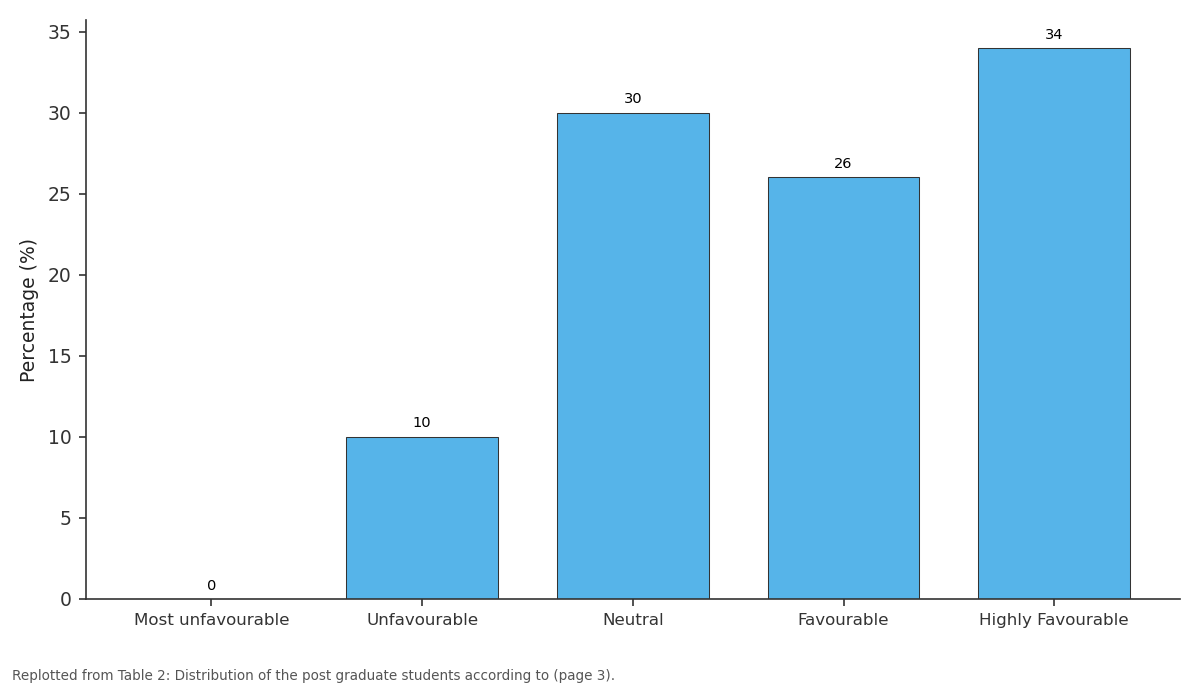
Percentage: Most unfavourable vs Unfavourable vs Neutral vs Favourable vs Highly Favourable
Replotted from Table 2 (page 3) of the original paper. Every bar is the paper's own table value.
View source evidence ↗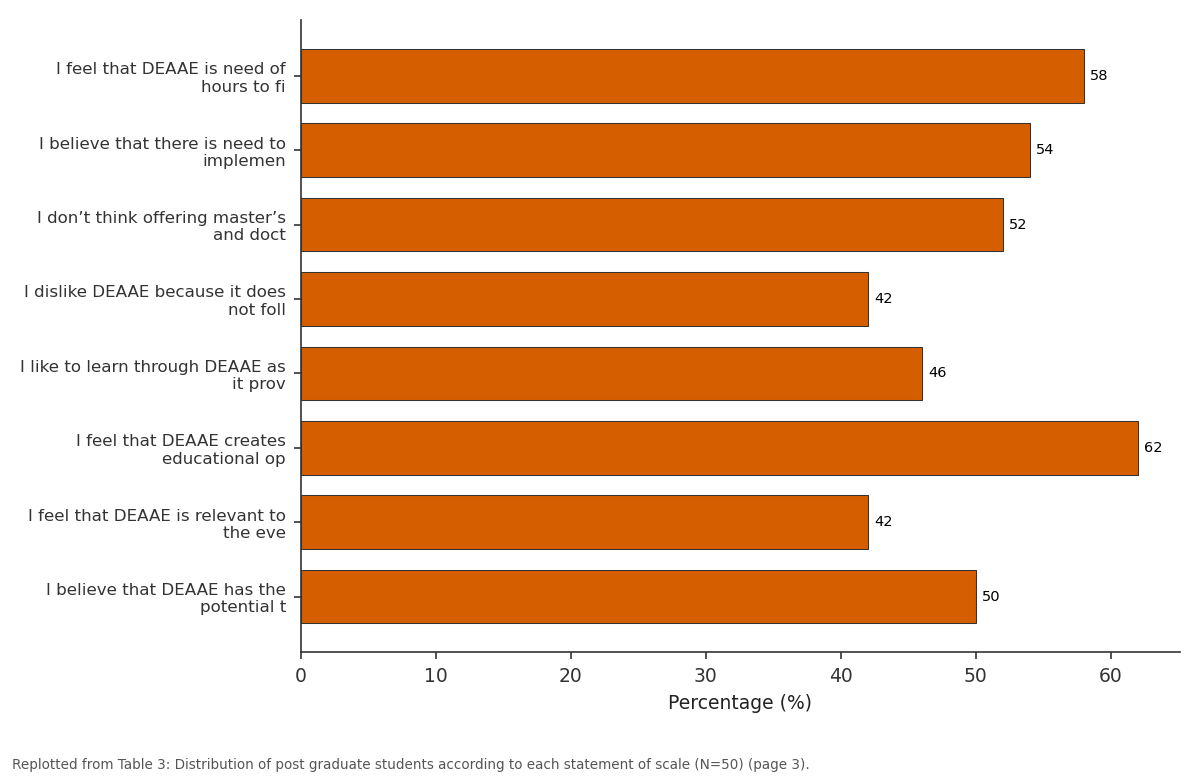
Percentage (%): I feel that DEAAE is... vs I believe that there is... vs I don’t think offering... vs I dislike DEAAE because... vs I like to learn through...
Replotted from Table 3 (page 3) of the original paper. Every bar is the paper's own table value.
View source evidence ↗Figures & tables
From the original paper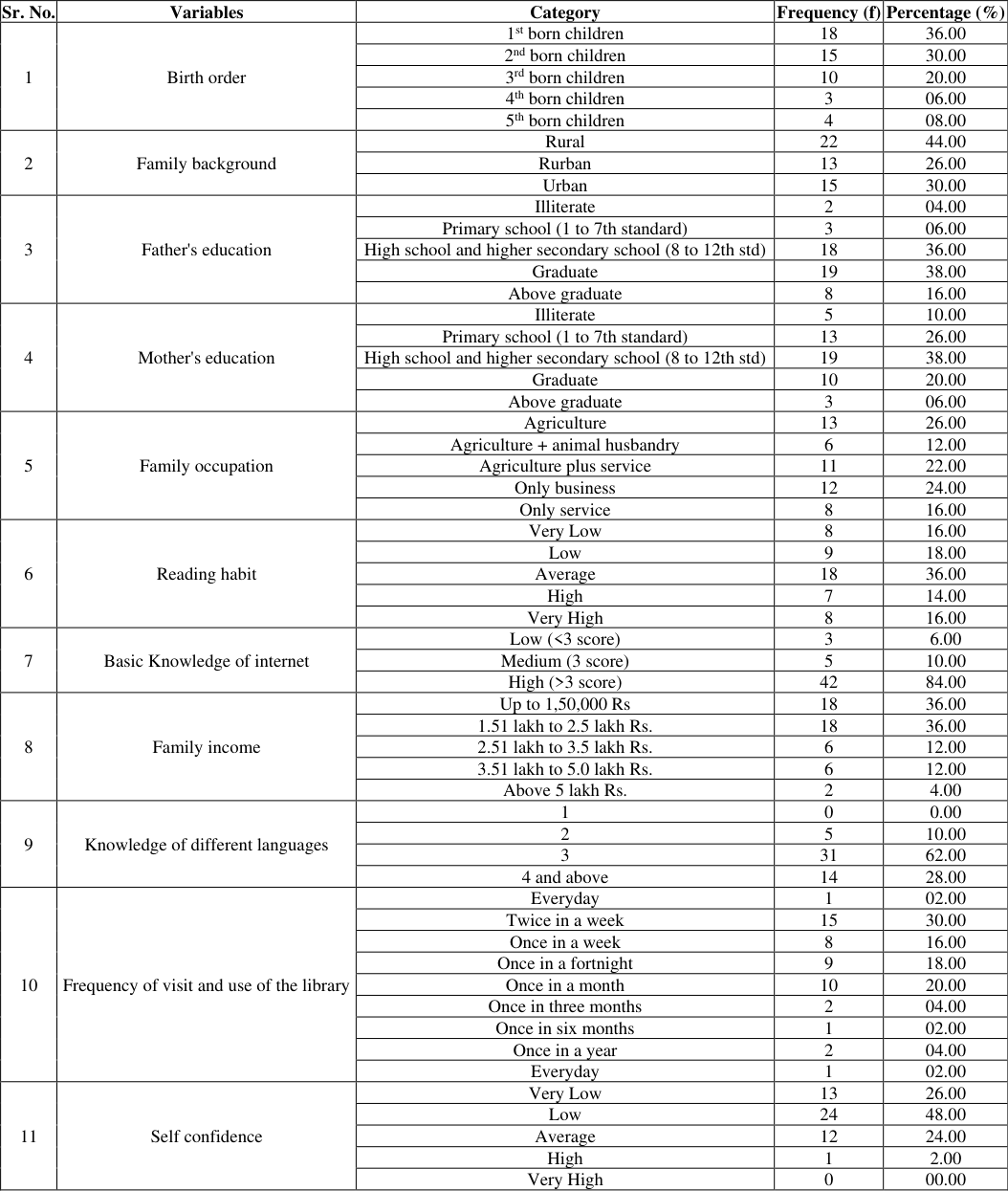 Table 1
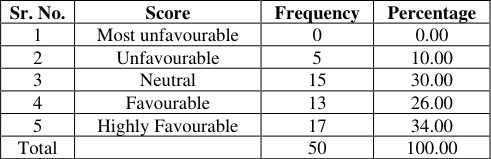 Table 2
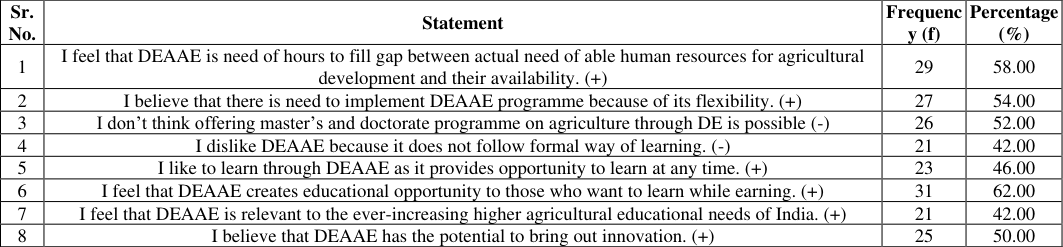 Table 3
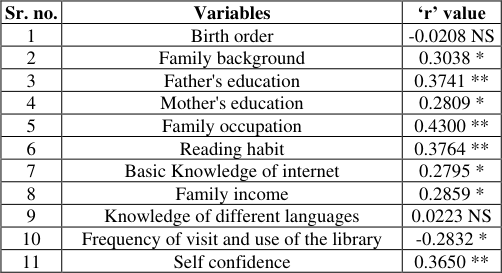 Table 4
Introduction
In India, education is viewed as a pathway to enhance social status. A quality education is perceived as the foundation for achieving a successful career trajectory. Presently, there is a rising trend among adults to seek advanced education to enhance their competitiveness in the workforce. It had led to increase in demand for higher education. The educational institutions are innovating by introducing new programs utilizing modern technologies. Numerous online distance learning courses have been devised to cater to this expanding requirement. The current investigation would provide answers to some questions to like what was the educational, social, psychological background of the student, what were the factors that were influencing the attitude of students and what were the problems perceives by the students in case of distance education. Objectives of the study were to study the profile of post graduate students, to analyse the attitude of post graduate students towards application of distance education in agricultural education and to study the association between profile of the post graduate students and their attitude towards application of distance education in agricultural education. Based on the objectives null hypothesis was formulated as there was no association between profile of the post graduate students and their attitude towards application of distance education in agricultural education.
Methodology
The current study was part of authors PG course completion named "special problem". The investigation was carried out in South Gujarat. Navsari Agricultural University was purposively selected as the author hailed from the university during research period. N.M. College of Agriculture was purposively selected by keeping in view availability of the post graduate students at college, limitation of time and funds by the researcher. Ex post facto research design was used for the current investigation as the factors affecting their attitude were occurred prior to the investigation. The sample size for the study was 50 post graduate students studying M.Sc. Agriculture in various departments of N. M. College of Agriculture, NAU, Navsari. Number of departments in N.M.C.A. were 10. Hence, from each department 5 post graduate students studying M.Sc. Agriculture were randomly selected. The investigation was carried out during 2020. The data was collected with the help of Google form in online mode as the period has gone through COVID and convenience to the researcher. Based on the objectives null hypothesis was formulated as there www.extensionjournal.com was no significant association in between profile of post graduate students and their attitude towards application of distance education in agricultural education. For the present investigation eleven independent variables and one dependent variable was selected. For the independent variable self-confidence, scale developed by Heartheton and Polivy (1991) [5] was used with due modifications. For other ten independent variables schedule developed by Khadayata (2013) [7] was used. For dependent variable attitude scale developed by Patel and Chauhan (2012) [12] was used with minor modifications. The statistics viz., frequency, percentage, mean, arbitrary method of categorization, standard deviation, rank and linear regression analysis were used.
Results
Results
Profile of the post graduate students
From the table 1 it is evident that, slightly more than one third (36.00%) of the post graduate students were first born child, followed by 2nd born children (30.00%), 3rd born children (20.00%), 5th born children (8.00%) and 4th born children (6.00%). Two fifth (44.00%) of the post graduate students belonged to rural background, followed by urban background (30.00%) and rurban background (26.00%).
| Sr. No. | Variables | Category | Frequency (f) | Percentage (%) |
|---|---|---|---|---|
| 1 | Birth order | 1st born children | 18 | 36.00 |
| 2nd born children | 15 | 30.00 | ||
| 3rd born children | 10 | 20.00 | ||
| 4th born children | 3 | 06.00 | ||
| 5th born children | 4 | 08.00 | ||
| 2 | Family background | Rural | 22 | 44.00 |
| Rurban | 13 | 26.00 | ||
| Urban | 15 | 30.00 | ||
| 3 | Father's education | Illiterate | 2 | 04.00 |
| Primary school (1 to 7th standard) | 3 | 06.00 | ||
| High school and higher secondary school (8 to 12th std) | 18 | 36.00 | ||
| Graduate | 19 | 38.00 | ||
| Above graduate | 8 | 16.00 | ||
| 4 | Mother's education | Illiterate | 5 | 10.00 |
| Primary school (1 to 7th standard) | 13 | 26.00 | ||
| High school and higher secondary school (8 to 12th std) | 19 | 38.00 | ||
| Graduate | 10 | 20.00 | ||
| Above graduate | 3 | 06.00 | ||
| 5 | Family occupation | Agriculture | 13 | 26.00 |
| Agriculture + animal husbandry | 6 | 12.00 | ||
| Agriculture plus service | 11 | 22.00 | ||
| Only business | 12 | 24.00 | ||
| Only service | 8 | 16.00 | ||
| 6 | Reading habit | Very Low | 8 | 16.00 |
| Low | 9 | 18.00 | ||
| Average | 18 | 36.00 | ||
| High | 7 | 14.00 | ||
| Very High | 8 | 16.00 | ||
| 7 | Basic Knowledge of internet | Low (<3 score) | 3 | 6.00 |
| Medium (3 score) | 5 | 10.00 | ||
| High (>3 score) | 42 | 84.00 | ||
| 8 | Family income | Up to 1,50,000 Rs | 18 | 36.00 |
| 1.51 lakh to 2.5 lakh Rs. | 18 | 36.00 | ||
| 2.51 lakh to 3.5 lakh Rs. | 6 | 12.00 | ||
| 3.51 lakh to 5.0 lakh Rs. | 6 | 12.00 | ||
| Above 5 lakh Rs. | 2 | 4.00 | ||
| 9 | Knowledge of different languages | 1 | 0 | 0.00 |
| 2 | 5 | 10.00 | ||
| 3 | 31 | 62.00 | ||
| 4 and above | 14 | 28.00 | ||
| 10 | Frequency of visit and use of the library | Everyday | 1 | 02.00 |
| Twice in a week | 15 | 30.00 | ||
| Once in a week | 8 | 16.00 | ||
| Once in a fortnight | 9 | 18.00 | ||
| Once in a month | 10 | 20.00 | ||
| Once in three months | 2 | 04.00 | ||
| Once in six months | 1 | 02.00 | ||
| Once in a year | 2 | 04.00 | ||
| Everyday | 1 | 02.00 | ||
| 11 | Self confidence | Very Low | 13 | 26.00 |
| Low | 24 | 48.00 | ||
| Average | 12 | 24.00 | ||
| High | 1 | 2.00 | ||
| Very High | 0 | 00.00 |
Table text extracted from the original PDF; superscript letters are shown inline. The original table image is below.
View original table image
Nearly two fifth (38.00%) of the students' father's education was up to graduate level, followed by high school and higher secondary school (36.00%), above graduate (16.00%), primary school (6.00%) and illiterate (4.00%).
Nearly two fifth (38.00%) of the students' mother's education was up to high school and higher secondary school, followed by high school and primary school (26.00%), graduate level (20.00%), illiterate (10.00%) and above graduate level (6.00%). Nearly one forth (26.00%) of the students' family had the occupation of agriculture, followed by only business (24.00%), agriculture + service (22.00%), only service (16.00%) and agriculture + animal husbandry (12.00%). More than one third (36.00%) of the students had average level of reading habit, followed by low (18.00%), very low (16.00%). More than one third (36.0%) of the students had average level of reading habit, followed by low (18.00%), very high (16.00%) and very low (16.00%) and high (14.00%) level of reading habit. Majority (84.0%) of the students had very good level of basic knowledge of internet, followed by good level of basic knowledge of internet (10.00%) and low level of basic knowledge of internet (6.00%). One third (36.00%) of the post graduate students' family had income up to Rs 1,50,0000, followed by Rs.1.51 lakh to Rs.2.50 lakh (36.00%), 2.51 lakh to 3.5 lakh Rs. (12.00%), 3.51 lakh to 5.0 lakh Rs. (12.00%) and above 5 lakh Rs. (4.00%). Majority (62.00%) of the post graduate students had knowledge of three languages, followed by knowledge of four and above (28.00%) and knowledge of two languages (10.00%). Less than one third (30.00 per cent) of respondents use library twice in a week, followed by once in a month (20.00%), once in a fortnight (18.00%), once in a week (16.00%), once in three months (4.00%) and once in a year (4.00%), everyday (2.00%) and once in six months (2.00%). Less than half (48.00%) of post graduate students had low level of self-confidence, followed by very low level of self-confidence (26.00%), average (24.00%) level of selfconfidence and high (2.00%) level of self-confidence.
Attitude of post students towards application of distance education in agriculture education
From table 2 it is evident that majority (60.00%) of the post graduate students had favourable to highly favourable attitude towards application of distance education in agriculture education, followed by neutral attitude (30.00%), favourable attitude (26.00%) unfavourable attitude (10.00%) towards application of distance education in agriculture education. From table 3 it is evident that majority (62.00%) of the respondents felt that DEAAE (Distance education application agriculture education) creates educational opportunity to those who want to learn while earning, followed by those who felt that DEAAE is need of hours to fill gap between actual need of able human resources for agricultural development and their availability (58.00%), there is need to implement DEAAE programme because of its flexibility (54.00%), don't think offering master's and doctorate programme on agriculture through DE is possible (52.00%), DEAAE has the potential to bring out innovation (50.00), like to learn through DEAAE as it provides opportunity to learn at any time (46.00%), dislike DEAAE because it does not follow formal way of learning (42.00%) and DEAAE is relevant to the ever-increasing higher agricultural educational needs of India (42.00%).
| Sr. No. | Statement | Frequenc y (f) | Percentage (%) |
|---|---|---|---|
| 1 | I feel that DEAAE is need of hours to fill gap between actual need of able human resources for agricultural development and their availability. (+) | 29 | 58.00 |
| 2 | I believe that there is need to implement DEAAE programme because of its flexibility. (+) | 27 | 54.00 |
| 3 | I don’t think offering master’s and doctorate programme on agriculture through DE is possible (-) | 26 | 52.00 |
| 4 | I dislike DEAAE because it does not follow formal way of learning. (-) | 21 | 42.00 |
| 5 | I like to learn through DEAAE as it provides opportunity to learn at any time. (+) | 23 | 46.00 |
| 6 | I feel that DEAAE creates educational opportunity to those who want to learn while earning. (+) | 31 | 62.00 |
| 7 | I feel that DEAAE is relevant to the ever-increasing higher agricultural educational needs of India. (+) | 21 | 42.00 |
| 8 | I believe that DEAAE has the potential to bring out innovation. (+) | 25 | 50.00 |
Table text extracted from the original PDF; superscript letters are shown inline. The original table image is below.
View original table image
| Sr. No. | Score | Frequency | Percentage |
|---|---|---|---|
| 1 | Most unfavourable | 0 | 0.00 |
| 2 | Unfavourable | 5 | 10.00 |
| 3 | Neutral | 15 | 30.00 |
| 4 | Favourable | 13 | 26.00 |
| 5 | Highly Favourable | 17 | 34.00 |
| Total | 50 | 100.00 |
Table text extracted from the original PDF; superscript letters are shown inline. The original table image is below.
View original table image
Association between profile of the post graduate students and their attitude towards application of distance education in agriculture education
The results in the table 4 indicated that father's education (0.3741 **), family occupation (0.4300 **), reading habit (0.3764 **) and self confidence (0.3650 **) were found positive and highly significant with their attitude towards application of distance education in agriculture education. Moreover, family background (0.3038 *), mother's education (0.2809 *), basic knowledge of internet (0.2795 *) and family income (0.2859 *) were found positive and significant. Whereas, frequency of visit and use of the www.extensionjournal.com library (-0.2832 *) was found negative and significant with their attitude towards application of distance education in agriculture education. Only Birth order was found negative and non-significant with their attitude.
| Sr. no. | Variables | ‘r’ value |
|---|---|---|
| 1 | Birth order | -0.0208 NS |
| 2 | Family background | 0.3038 * |
| 3 | Father's education | 0.3741 ** |
| 4 | Mother's education | 0.2809 * |
| 5 | Family occupation | 0.4300 ** |
| 6 | Reading habit | 0.3764 ** |
| 7 | Basic Knowledge of internet | 0.2795 * |
| 8 | Family income | 0.2859 * |
| 9 | Knowledge of different languages | 0.0223 NS |
| 10 | Frequency of visit and use of the library | -0.2832 * |
| 11 | Self confidence | 0.3650 ** |
Table text extracted from the original PDF; superscript letters are shown inline. The original table image is below.
View original table image
Discussion
Most of the children were found to be 1 st born, 2 nd born and 3 rd born. The probable reason for such result might be the family planning adopted by the families and most of the families having only 2-3 children. Birth order was found negative with their attitude but wasn't found significant. This finding is in line with the finding of Kayzin and Vaghchipawala (2023) [6] . Most of the students had rural and rurban family background and the reason for such result could be the preference of agriculture by students from rural background and urban settled rural background. Those who had urban background have shown favourable attitude towards distance education than those who belonged to rural background. The reason could be the difference in facilities available at the rural and urban areas. This finding is in line with the finding of Sharma (2022) [13] . Most of the students' fathers were educated up to high school and higher secondary school and graduates. As the father's education was better, students had favourable attitude. It could be due to the awareness and environment in which they have been grown up, accessibility to internet of things and their annual income. This finding is in line with the finding of Ahmad et al. (2023) [1] . Most of the students' mothers were educated up to high school and higher secondary school. The reason might that the parents of students were aware about the importance of education hence they gave they were giving the proper education to their children. With higher education of mother's, students' attitude was also found favourable. This finding is not in line with the finding of Alibraheim and Taifour (2023) [2] . Most of the students had family occupation of agriculture, agriculture plus service and only business. It could be due their rural and rurban family background and education level of their parents. In case of family occupation, those whose parents engaged in service/business had favourable attitude than those whose parents were engaged in farming. It could be due to the exposure received by students to digital platforms whose parents were in service/business. This finding is not in line with the finding of Moneva et al. (2019) [9] . Most of the students had average reading habit. It could be due to their busy academic schedule, regular examinations and their engagement in field activities for their master's research work. Most of the students had very low to low selfconfidence. The reason for such result could be the nonparticipation of students in personality development programmes and lack of exposure to external environment. Reading habit and Self-confidence of student could have resulted into development of less dependent nature in the student to learn and his belief in himself to learn in distant mode. These findings are in line with the findings of Yaqoob et al. (2023) [14] and Bhat (2022) [4] . Most of the students had very high level of basic knowledge about the internet. It could be due to their access to mobile phones, laptops and personal computers, availability of the internet at cheaper costs, availability of social media platforms and their surrounding environments. As the basic knowledge about internet has increased, favourable attitude was formed. The knowledge of internet might have helped students in building confidence to learn in distance education mode. This finding is in line with the finding of Paris (2004) [11] . Most of the students had annual income above 1.5 lakh Rs. The reason for the higher income could be their parents' occupation as service along with farming and operating business. Annual income might have played a key role in owning mobile phones/ laptops/ internet, which further led to forming a favourable attitude. This finding is not in line with the finding of Anita (2014) [3] . Most of the students had knowledge of 3-4 languages. The reason for the above result could be their academic programmes having 3 languages during school education and some of the students were from ICAR quota so they might have exposure to different states and languages. Most of the students visited library from twice in a week to once in a fortnight. It could be due to their busy academic schedule, regular examinations and their engagement in field activities for their master's research work. Those who had visited library frequently had shown unfavourable attitude towards distance education. It could be due to their habit of learning in physical mode in the premises of institution. This finding is not in line with the finding of Namugera et al. (2023) [10] . Students had high to very high favourable attitude towards distance education in agriculture education. The reasons for above result could be the advantages of distance education such as it facilitates everyone to get higher education, low cost of the education within reach of rural people and inservice students, plenty of individual learning opportunities, expenditure on education becomes very low, flexibility to the learners and adjustment of time etc. This finding is in line with the finding of Koshy et al. (2023) [8] .
Conclusion
Most of the post graduate students were 1 st and 2 nd born children, belonged to rural family background, had father's education up to graduation, and mother's education between high school to higher secondary school, agriculture, service and business as family occupation, average to low reading habit, high level basic knowledge of internet, annual income of Rs. 1.5 lakhs to 2.5 lakhs, knowledge of 3 or more languages, visited library from twice in a week to once in a fortnight, low to very low self-confidence and favourable to highly favourable attitude. Further, father's education, www.extensionjournal.com family occupation, reading habit, self confidence, family background, mother's education, basic knowledge of internet and family income were found positive and significant. Whereas, frequency of visit and use of the library was found negative and significant. So, it can be concluded that this positive outlook can be leveraged to enhance the implementation of diverse distance education programs in this sector. Village-level kiosks should be established, and additional information about distance learning programs should be made available. Distance education providers could offer vocational courses such as gardening, fruit and vegetable value addition, seed production, and plant protection. The institutions should be equipped and ready to facilitate learning in distance education mode. The situations such as COVID-19 has also significantly affected the learning at that period. But at the same time, it had created opportunity as well as need to facilitate the learning programmes in distance mode. The teachers must be trained to provide education in distant mode as well as the students must be made aware and trained to access the education in distant mode whenever the situation demands.
References
13 in the original paper- Ahmad S, Ajmal F, Hafeez M. Effects of fathers' level of education on their children's English reading performance. Arch Educ Stud. 2023;3(1):79-96.
- Alibraheim EA, Taifour EA. The relationship between mothers' educational levels and their children's academic performance. Pegem J Educ Instr. 2023;13(3):36-40.
- Anita C. Effectiveness of online learning for the variables: father's annual income and mother's annual income. Int J Voc Tech Educ. 2014;3(1):1-8.
- Bhat RI. Self-confidence and its impact on students' academic achievement: An overview. J Emerg Technol Innov Res. 2022;9(2)
- Heartheton TF, Polivy J. Development and valuation of a scale for measuring state self-esteem. J Pers Soc Psychol. 1991;60(6):895-910.
- Kaizyn P, Vaghchipawala. A comparative study of birth-order and personality. Int J Indian Psychol. 2023;11(4):281-321.
- Koshy SM, Balakrishnan D, Varaprasad C, Natarajan K. Attitude of undergraduate students of agriculture towards online mode of learning. J Ext Educ. 2023;35(1):6987-6992.
- Moneva JC, Rozada GG, Sollano AM. Parents' occupation and students' self-esteem. Int J Res - Granthaalayah. 2019;7(12):315-324.
- Namugera L, Bukirwa J, Okello-Obura C. Library users' attitudes towards virtual library and information services in Ugandan public and private universities. Lib Phil Pract. 2023;8036:1-15.
- Paris PG. E-Learning: A study on secondary students' attitudes towards online web assisted learning. Int Educ J. 2004;5(1):98-112.
- Patel MC, Chauhan NB. Attitude towards application of distance education in agriculture and allied field -a scale development. Indian Res J Ext Educ. 2012;12(1):71-72.
- Sharma J. A study of learning environment and attitude towards education of urban and rural students of Gorakhpur district. Int J Res Spec Educ. 2022;2(2):4851.
- Yaqoob M, Ishaq M, Jan SU, Tabassum R. A case study: Relationship between students' reading habits and their academic performance in government post graduate college Nowshera at Bachelor of Sciences (BS) level. Lib Phil Pract. 2023;7969:1-16.