
Research article · 2023 · Full text
International Journal of Geography Geology and EnvironmentDeterminants of health care facilities and patients’ accessibility to PHC in Madurai district
Volume 5(2) · Pages 17–22 · DOI: 10.22271/27067483.2023.v5.i2a.167 ↗
Research areasHealthcare Systems and ReformsPharmaceutical Economics and PolicyGlobal Health and Epidemiology
Abstract
Author-writtenHealth geography as an interdisciplinary field of study concerned with variations of disease incidence as expressed in mortality or morbidity with the demonstration of possible cause and effect relationship with health utilization, elements of physical, biological and socio-cultural environments in space. The study area Madurai district lies between 9° 30′ north to 10° 30′ North latitudes and 77° 30′ east to 78° 30′ East longitudes. The data for the present study was collected from primary and secondary source. The main objectives of the study are; To analyze the identification of spatial distribution of health care centers in Madurai district. To analyze the significance of health care location and its efficiency. To analysis the patient’s perception and satisfaction level who avail these health care services. The two important techniques used in the present study are statistical technique and GIS. The maps are prepared using GIS Software. The relationships and the interdependence nature of different variables are analyzed using the correlation matrix capable of explaining the relationships of one variable with all other variables. Apart from this, the multivariate statistical technique factor analysis is used to find the major associations and interrelationships between PHC diseases among patients, derived by using SPSS 7.5. To identify health service area in Madurai District, spatial analysis techniques were applied. The Study describes about patients’ perception and utilization of travel behaviour pattern among sex and age variation and healthcare planning of PHC’s in Madurai District.
Summary
Source-checkedPlain-language reading of the full paper, prepared with AI and checked against the text. Each point links to the authors' own words.
Why it matters
- Health geography is an interdisciplinary field that examines how disease incidence, mortality, and morbidity relate to health utilization and various environmental factors across different spaces. View evidence ↗
- Transportation barriers are significant obstacles to healthcare access, often resulting in delayed care, missed appointments, and delayed medication use. View evidence ↗
- Limited availability of facilities and perceived low quality of care often force patients to travel further to receive necessary health services. View evidence ↗
The question
- The study aims to analyze the spatial distribution, location significance, and efficiency of healthcare performance in the Madurai district, as well as patient perception and satisfaction. View evidence ↗
What they did
- The research was conducted in the Madurai district of southern Tamil Nadu, India, which covers a total geographical area of 384,680 hectares. View evidence ↗
- Data was gathered from both primary and secondary sources, with the primary survey utilizing stratified area random sampling. View evidence ↗
- The study employed ArcGIS software for spatial mapping and various statistical techniques for data analysis. View evidence ↗
- Factor analysis using SPSS 7.5 was applied to identify major associations and interrelationships regarding primary health care (PHC) diseases among patients. View evidence ↗
What they found
- The factor loading matrix identified 13 major dimensions that together explain 73.40% of the total variance. View evidence ↗
- The primary dimension, 'Patient's access to PHC', had an Eigen value of 4.92, indicating that overall PHC access in the studied areas was good. View evidence ↗
- A negative correlation was found with educational status, suggesting that the majority of people utilizing PHC services have lower education levels. View evidence ↗
- Individuals with higher education and occupational status tend to be more aware of facilities and are more likely to choose private PHCs. View evidence ↗
What it means
- The authors conclude that the accessibility of healthcare facilities in the study area is satisfactory. View evidence ↗
- Disease awareness is low among the poor due to poor health education, which is attributed to vacant health educator positions across 13 blocks. View evidence ↗
- The prevalence of joint families in the area is noted as a factor contributing to morbidity through poor nutrition and body mass index. View evidence ↗
Visual summary
1 visualsIllustrations explain the paper; charts are replotted from the paper's own table values.
Percentage of variable: Patient’s access to PHC vs Socio-Economic... vs Disease and treatment vs Determinants of socio... vs Residence and health...
Replotted from Table 1 (page 3) of the original paper. Every bar is the paper's own table value.
View source evidence ↗Figures & tables
From the original paper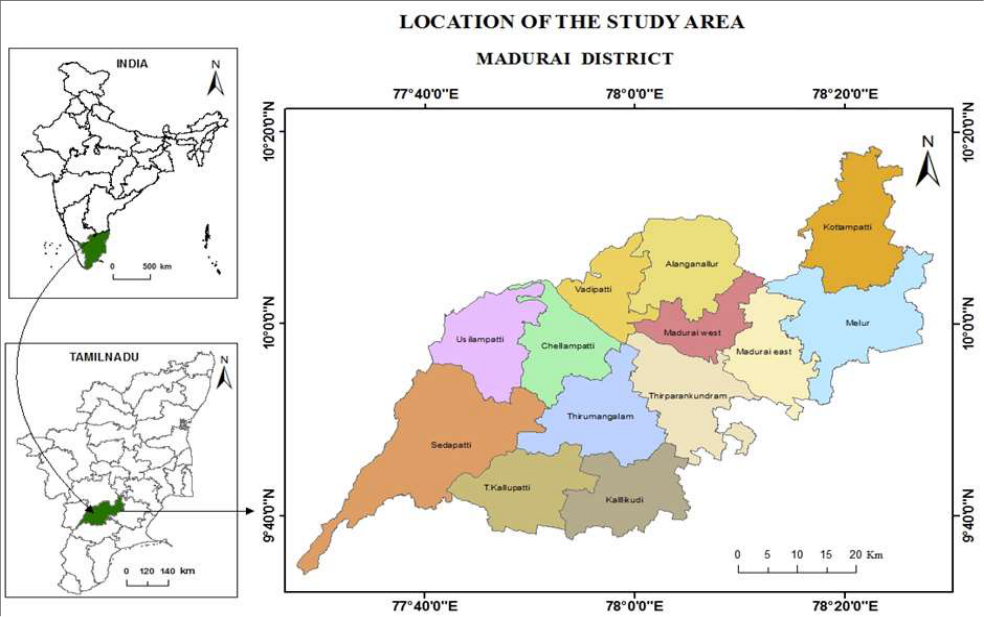 Figure 1
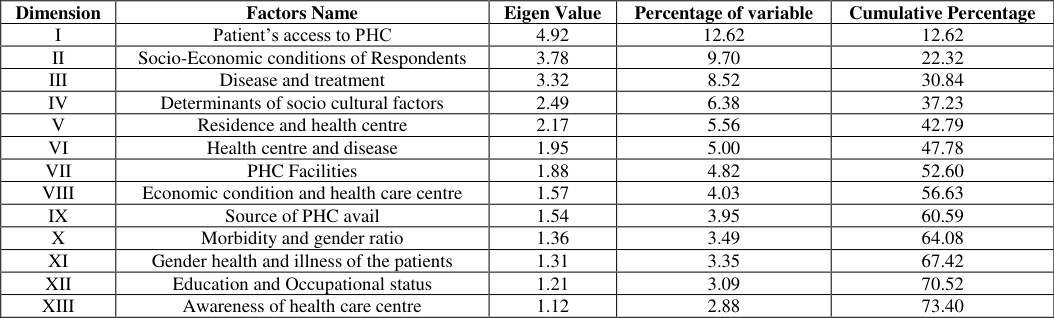 Table 1
Introduction
Primary health care is a comprehensive teamwork between medically qualified physician as well as a wide range of nursing and paramedical personnel [1,2,3] . Quite often, primary health care systems are further subdivided into three levels-the most peripheral level which is in direct contact with the community and is usually managed by one or more members from within the community who are trained and equipped in preventive and Promotive health care as well as in the most basic clinical and emergency care [4,5,6] . The study an attempt is made to understand the patient and satisfaction level on health care delivery system in the Madurai District. For this purpose a primary survey was conducted on the basis of stratified area random sampling of the study area. In this chapter, the characteristics of the patients viz., their economic and social status, health problems and related aspects, perception on treatment and health centers and the satisfaction level of people on the health care system analyzed [7,8,9,10] . Health geography is the application of geographical information, Perspective, and Methods to study of health, Disease, and health care [11,12,13] . The present study attempts to describe the health care system and patients performance for PHC in Madurai district. Emerging disease and accessibility of health facilities, in relation to various social, economic and environmental factors as observed for different PHC centers of Madurai district and also on studying each PHC and its role on environment health relationship in relation to the spatial distribution of PHCs, health care needs of the population [14,15,16] . PHC centres is mainly related to total number of population. Using Remote Sensing and GIS is a very valuable tool for Public Health Practice and Research, for can be helpful for health decision maker to guide them where to direct health policies and better to visualize health problem and it is recommended that, Public Health Practitioners and Researchers to consider the use of remote sensing and GIS [17,18,19,20] . Transportation barriers are often cited as barriers to healthcare access. Transportation barriers lead to rescheduled or missed appointments, delayed care, and missed or delayed medication use.
These consequences may lead to poorer management of chronic illness and thus poorer health outcomes [21,22,23] . The travel medicine provider, tailored risk communication that is cognisant of the unique health beliefs and barriers to travel health for VFR travellers is needed, including enhanced communication through the use of interpreters and supplementary written communication [24,25] . In particular, limited availability of health care facilities and services and perceived low quality of care meant that those in need of health care services frequently had to travel for care. The barrier of geographic distance was worsened by transportation problems. We also observed that where health services were available most people could not afford the cost [26,27,28] . The purpose of this audit is to assess patient waiting time and doctor consultation time in a primary healthcare clinic and to formulate strategies for improvement [29,30] . The results demonstrate that treatment destinations, medical specialties for which treatment was sought, age, gender and travel season are significant factors in understanding overseas travel for medical care [31,32] . This survey study suggest that bypassing the nearest health care facility was common among women in Ghana and that available services at lower levels of primary care are not meeting the needs of a large proportion of women. Among the benefits women perceived from bypassing were clinician competence and availability of supplies [33,34] . Liberating clinicians and administrative team members from other tasks and commitments allows them to focus on the immediate needs. Provision of food, rest breaks, decompression time, and adequate time off may be as important as provision of protocols and protective equipment as days turn into weeks, then months [35,36] .
Study Area
Study Area
Materials and Methods
The two important techniques used in the present study are statistical technique and GIS. The maps are prepared using GIS Software. ArcGIS is one of the important GIS software, which is used to prepare the maps. The relationships and the interdependence nature of different variables are analyzed using the correlation matrix capable of explaining the relationships of one variable with all other variables. Apart from this, the multivariate statistical technique factor analysis is used to find the major associations and interrelationships between PHC diseases among patients [37,38,39] . With the help of correlation matrix, derived by using SPSS 7.5 version.
Analysis and Discussion
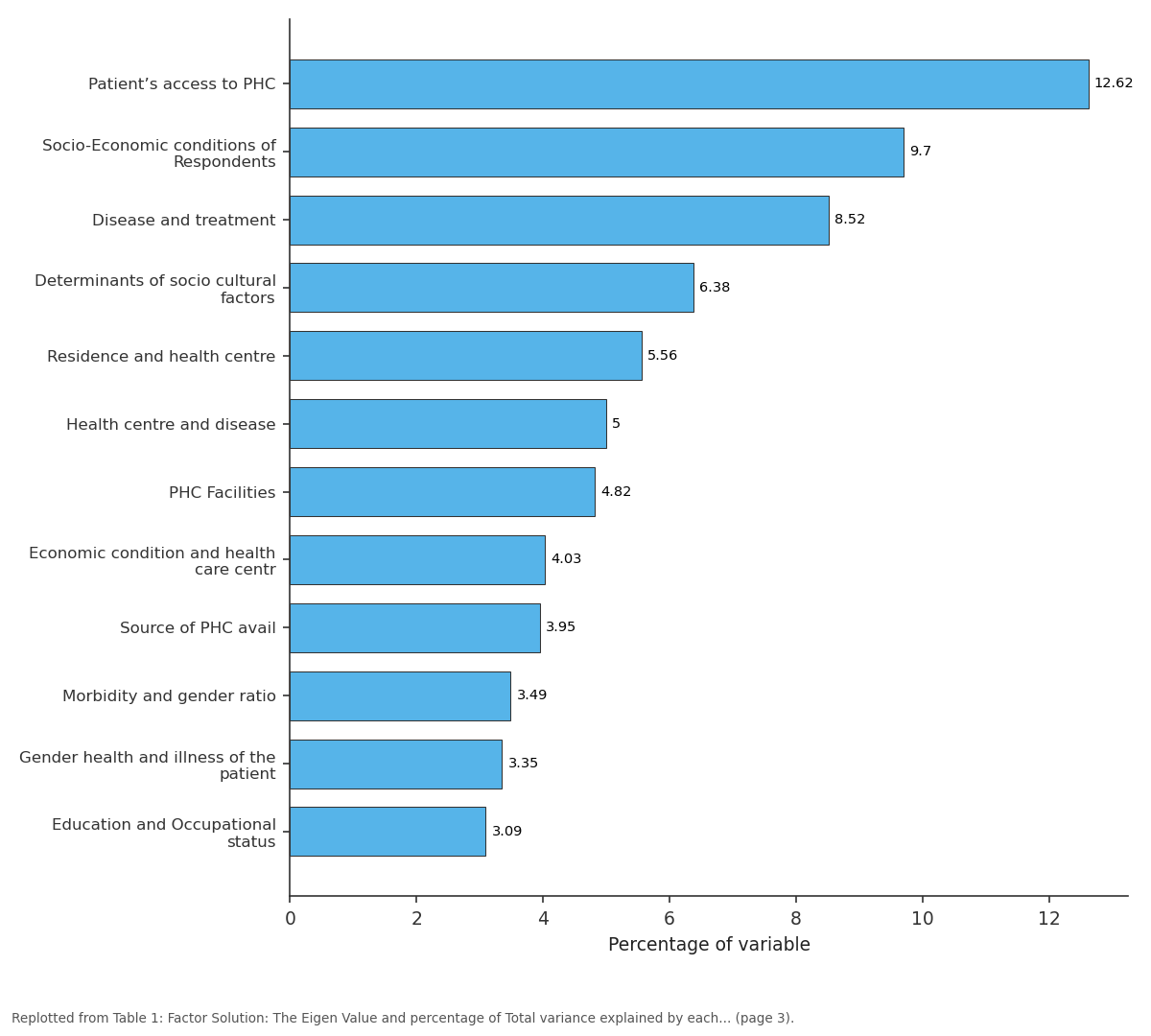
In This factor loading matrix identified 13 major dimensions with a total percentage of 73.40. The first dimension is the patients access to primary health care. That explained a total variance 12.62 with an Eigen value of 4.2 and this is designated as the primary dimension of the study. That first
ten factors explained more than 64.08 percent of total variance the remaining three factors explained only 9.32 percent of the total variance. The second factor with an Eigen value of 3.78 and explained a total variance of 8.52. Factor loading represented in the table show the variable with their respecting loading. The variance is accounted by each parameter with respect to all factor (Table1). The primary dimension and each factor dimension show only the variables significant their respecting factor.
| Dimension | Factors Name | Eigen Value | Percentage of variable | Cumulative Percentage |
|---|---|---|---|---|
| I | Patient’s access to PHC | 4.92 | 12.62 | 12.62 |
| II | Socio-Economic conditions of Respondents | 3.78 | 9.70 | 22.32 |
| III | Disease and treatment | 3.32 | 8.52 | 30.84 |
| IV | Determinants of socio cultural factors | 2.49 | 6.38 | 37.23 |
| V | Residence and health centre | 2.17 | 5.56 | 42.79 |
| VI | Health centre and disease | 1.95 | 5.00 | 47.78 |
| VII | PHC Facilities | 1.88 | 4.82 | 52.60 |
| VIII | Economic condition and health care centre | 1.57 | 4.03 | 56.63 |
| IX | Source of PHC avail | 1.54 | 3.95 | 60.59 |
| X | Morbidity and gender ratio | 1.36 | 3.49 | 64.08 |
| XI | Gender health and illness of the patients | 1.31 | 3.35 | 67.42 |
| XII | Education and Occupational status | 1.21 | 3.09 | 70.52 |
| XIII | Awareness of health care centre | 1.12 | 2.88 | 73.40 |
Table text extracted from the original PDF; superscript letters are shown inline. The original table image is below.
View original table image
Dimension II: Socio-Economic conditions of Respondents
The second dimension explains socio economic conditions of the respondents with an Eigen value of 3.78 percent (Table 6 Diseases affected (-0.51) was low because they good facilities and water sources etc. Gender (-0.32), Mostly respondents are male, habits (-0.32). They have not more bad habits like drinking, smoking etc.
Dimension III: Disease and treatment
The third dimension explains types of family and private hospitals, with an Eigen value of 3.32 (Table ) The high positive factor are, PHC reasons for people's choice for private PHC (0.79%) because, private hospitals have a lots of facilities, cleanness, Individual caring, Infrastructure was good, so they mostly visited private hospitals, and doctor access night time to PHC (0.79) because staff availability was high family size (0.39) They poor are medium incomes families but they choose private hospitals opinion (0.31%), because good infrastructure and individual caring, money spend for the treatment last 3 months (0.31%) for the primary diseases affection, example fever, pregnancy treatment etc. The negative factors are emergency facilities of health care(-0.57) because that's PHC so primary services are only available in this area, mosquito affected (-0.57), That area have a high in water sources, so mosquito mostly available and affected in this area, and other kind of diseases (-0.35), like, malaria, Dengue, other emerging disease. Kind of facilities was (-0.46%), in this area.
Dimension IV: Determinants of socio cultural factors
The fourth dimension explains determinants of socio cultural factors. With an Eigen value of 2.49 to a total variance of 6.38 percent. We find the positive factor loading martial status (0.47) money spend for transport (0.33%), drinking water sources are (0.33%) and doctors relation (0.30%) negative factor loading are Income (-0.43), They are mostly in married but income status was low, communicable diseases affected (-0.42%) Doctor night time access low (-0.42%) because over workload to come to duty delay, and access level low, mother tongue (-0. 38), because Madurai district is highly popular district in India, so many of Indian live in this district, they have lot of languages speech peoples live in that city area Age (-0.34), Religion (-0.32) Madurai district have a so money regions, like Hindu, Muslim and Christian etc. Patients reach to health centre from house (-0.32).
Dimension V: Residence and health centre
The Fifth dimension, residence and healthcare centre, factors with an Eigen value of 2.17. We find to a total variance of 5.56. We find the positive factor loading how get disease, cender (0.41%) and type of family (0.39) like smoking causes cancer etc. Long illness (0.33%) morbidity patients like diabetes, high blood pressure, near diseases, COVID-19, HIV. The negative factors are, mode of transport used to reach. The health centre (-0.41%) male patients mostly used in two wheelers, female are bus, or auto and times recurring to reach the health centers (-0.44) money spend for transport (-0.36), in this area highly accessible so transport cost was low.
Dimension VI: Health centre and disease
The sixth dimension explains, diseases and health centers.
Factors with an Eigen value at 1.95 to a total variance at 5.00. We find the positive factor loading, money spend for transport (0.51%), suffer long illness (0.54%) like high blood pressure COVID-19, nearby PHC to residence (0.35%), Its accessible. Morbidity (0.34%), long illness is called morbidity like, pressure COVID-19, HIV. Negative factors are types of medical system (-0.50%), because it's a PHC, so primary needs only available bed availability (-0.44%), only fever, other primary diseases affect and pregnancy women's available for beds, so it's a minor problem faced by PHC'S.
Dimension VII: PHC Facilities
The seventh dimension explains, primary health care facilities, factors with an Eigen value of 1.88 to a total variance of 4.82. We find the positive factor loading morbidity (0.45%), in last 3 month affected peoples and health care centre facilities opinion ().40%), its an good opinion, because in this area have a good PHC'S availability reason for people preferring private PHC'S (0.40%), because bed availability low. Money spend for the transport (-0.39%), Doctors access to PHC (0.39%), negative factor loading are money spend on transport (-0.30%).
Dimension VIII: Economic condition and health care centre
The Eighth dimension explains Economic conditions and health care centers, factors with an Eigen value of 1.57 to a total variance of 4.30. We find the positive factor loading time required to residence to PHC (0.40%), types of medical system they prepared (0.40%), like bed's availability, opinion more the medical staff etc. waiting time (0.39%), and medical status (0.39%), most of the married women's like to PHC'S. The negative factor loading income level (-0.30%), so most of people visit government PHC'S.
Dimension IX: Source of PHC avail
The Ninth dimension explains, source of PHC avail, factors with an Eigen value of 1.54 to a total variance 3.95. We find the positive factor loading emergence health facility (0.35%), availably in PHC, and mosquito affected diseases (0.35%), night time access (0.30%), available private hospital preparing (0.30%), because doctors availability and other staff availability, Infrastructure was good the negative factor loading bed availability (-0.40%), and opinion PHC was (-0.40%), transport amount spend last 3 months (-0.40%), because PHC availability to access.
Dimension X: Morbidity and gender ratio
The tenth dimension explains, diseases and gender patio, factors with an Eigen value of 1.36 to a total variance of 3.49. We find the positive loading gender (0.34%), and religion (0.34%), in this study area religions district, most of the religions like in this area, different types of festivals, culture, avail that area. The negative factor loading. Educational status (-0.40%), because most PHC receivers are low educated people. Most visited gender are female, morbidity last 3 months (-0.38%), currently affected diseases are COVID-19, but its low affection comparing to other districts health care center near (-0.34%), because its, big area so availability was low.
Dimension XI: Gender health and illness of the patients
The eleventh dimension explains, general health and illness other patients, factors with an Eigen value of 1.31, to a total variance of 3.35. We find the positive factor loading, present general health (0.39%), and kind of diseases affect (0.39%), suffer above illness (0.33%), in this area PHC facilities was good.
Dimension XII: Education and Occupational status
The wealth dimension explains, Education and occupational status. Factors with an Eigen value of 1.21 to a total variance of 3.09. We find the positive factor loading education status (0.52%), occupation (0.34%), martial status (0.34%), The negative factors loading education and occupation was high, so that people more aware to PHC and facilities so they prepare for private PHC'S.
Dimension XIII: Awareness of health care center
The thirteen dimension explains, awareness of health care center factors with an Eigen value of 1.12 to a total variance of 2.88. We find the positive factor loading time require to reach health centre from residence (0.37%), was good most of the female patients near health centre (0.38%), highly accessible to travel PHC in this area. The negative factor loading disposed waste (-0.41%).
Conclusion
In this study reveals the accessibility of health care facility is satisfactory. Awareness of various diseases is low among poor people in the study area who need more health education. Health education is poor in the study area because the post of health educator is vacant in 13 blocks. Full strength of medical personal has impact in this study.
Poor personal hygiene cause more disease. The family size in the study area is that majority are joint family, which lead to poor nutrition, body mass index, etc. and a factor for morbidity. The patients who live nearest to the health center are more likely to use the services in an efficient manner. It the centers are provided with adequate number of health services and infrastructure facility as well as health man power resources and good transportation. Them the PHC are bound to be used in an efficient manner.
Acknowledgment
The authors gratefully acknowledge the RUSA-Phase-II (Rashtriya Uchchatar Shiksha Abiyan). Department of Earth and atmospheric science, Madurai Kamaraj University, Madurai, 625021 for their financial support in carrying out the publishing of this research work.
Ethical approval
Ethical approval not required. This article does not contain any studies with human participants or animals performed by any of the authors.
Conflict of Interest
On behalf of co-authors, the corresponding author states that there is no conflict of interest.
Figures and tables from the paper
References
36 in the original paper- Saravanabavan V, Aneesh P, Babu HM, Harieswari M, Balaji D, Vinothini C. Patient's perception and level of primary health care utilization in east block of Madurai North taluk: A geo-health study. International Journal of Geography, Geology and Environment. 2021;3(1):34-41.
- Sarvanabavan V, Shanmuganandan S. Identification of Health Care Delivery System for Paucibacillary Leprosy in Tamil Nadu. Calcutta. 1997;3(59):216-224.
- Vinothini C, Saravanabavan V, Emayavaramban V. Location Accessibility of PHC and Health care travel performance in Madurai District. International Journal of Innovative Science and Research Technology. 2022;7(12):687-695. ISSN No:-2456-2165.
- Saravanabavan V, Abeesh P. Environmental health status of fishermen in Mahe district. International Journal of Geography, Geology and Environment. 2020;2(2):95-102.
- Eswari S, Saravanabavan V, Balaji D. Structural Equation Modelling Approach to Determine the Mother and Child Health Care in Madurai District, Tamil Nadu. International Journal of Scientific Research in Science and Technology. 2021;8(2):335-344.
- Balaji D, Saravanabavan V. Geo spatial variation of dengue risk zone in Madurai city using autocorrelation techniques. GeoJournal. 2021;86(3):1481-1501.
- Saravanabavan V, Reshma CU, Preethi S. Determinants of reproductive health in working women in Thrissur district, Kerala. GeoJournal. 2021;86(1):239-253.
- Rahamath Nisha R, Saravanabavan V, Balaji D. Knowledge, attitude and practice in dengue endemic areas in Madurai District. International Journal of Contemporary Medical Research. 2020;7(3):1-6.
- Vinnarasi JV, Saravanabavan V. Tuberculosis types and its characteristics in Dindigul District-A Geomedical study using GIS. International Journal of Geomatics and Geosciences. 2017;7(3):262-274.
- Saravanabavan V, Balaji D, Preethi S. Identification of dengue risk zone: A geomedical study on Madurai city. GeoJournal. 2019;84(4):1073-1087.
- Vinothini C, Neethidevi A, Saravanabavan V. Health impact and nine fold classification of land use change in Nilakottai Taluk, Dindigul District, Tamil Nadu. International Journal of Geography, Geology and Environment. 2019;1(1):80-86.
- Eswari S, Saravanabavan V. A Geo Medical analysis of Diarrhoeal diseases among Children in Madurai City, Tamil Nadu, India. International Journal of Current Research. 2020;12(03):10684-10699.
- Saravanabavan V, Sudharsan R, Balaji D, Rahamath Nisha R. Patient's perception and epidemiological characteristics of dengue in Madurai city-using factor analysis. International Journal of Mosquito Research. 2014;1(2):18-24.
- Nisha RR, Saravanabavan V. Dengue vector breeding ecology in Madurai district: Heat map cluster analysis. International Journal of Mosquito Research. 2021;8(1, Part B):95-104.
- Saravanabavan V, Balaji D, Reshma CU, Sheheersha SK, Sudharsan R, Vimala Vinnarasi J, et al. Urban disease ecology and its spatial variation of Chikungunya in Madurai City, Tamil Nadu, India: A geo-medical study. GeoJournal. 2021;86(5):2335-2350.
- Saravanabavan V, Balaji D, Sudharsan R. A GeoMedical Analysis of Chikungunya and Patients Environmental Perception in Madurai City. Journal of JAC Journal of Science, Humanities, and Management. 2014;1(2):111-120.
- Vinothini C, Saravanabavan V. Spatial Distribution of Emerging Diseases in Madurai District: A Geo Medical Study. International Journal of Innovative Science and Research Technology. 2022;7(6):2456-2465. ISSN No: 2456-2165
- Saravanabavan V, Balaji D, Rahamath Nisha R, Preethi S, Vadivel S. Geo-ecological association of dengue disease in Madurai city-using multivariate analysis. International Journal of Mosquito Research. 2020;7(2):37-45.
- Sheheersha SK, Saravanabavan V. Geo-Medical Analysis of Telemedicine Based Mobile TeleOphthalmology Screening For Cataract Cases in Thiruvananthapuram District, Kerala, India. IOSR Journal of Humanities and Social Science (IOSRJHSS). 2021;26(10):01-10. ISSN: 2279-0837, p-ISSN: 22790845.www.iosrjournals
- Saravanabavan V, Aswathilekha CS, Aparna T, Nisha DRR, Balaji KK. Spatio-temporal variation of dengue in Kozhikode District, Kerala: A medico geographical study. International Journal of Mosquito Research. 2021;8(1 Part B):130-140.
- Sheheersha SK, Saravanabavan V. Geo-Medical Analysis of the Detection of Cervical Pre-Cancer Cases Using Telemedicine System in Kerala State, India. IOSR Journal of Dental and Medical Sciences. 2020;10(11):12.
- Saravanabavan V, Shanmuganandan S. Application of Multivariate analysis in the identification of major dimension of multi bacillary leprosy in Tamil Nadu. The Transaction Institute of Indian Geographers. 1995;1(2):75-80.
- Vinothini C, Saravanabavan V, Balaji D. Travel pattern of health utilization to primary health care centres in Madurai district. International Journal of Geography, Geology and Environment. 2021;3(2):144-151.
- Saravanabavan V, Eswari S, Vimala Vinnarasi J, Ganesan J, Sudharsan R. Spatial temporal variation of leptospirosis disease in Madurai city-Medicogeographical analysis. International Journal of Geography, Geology and Environment. 2020;2(1):2127.
- Rahamath Nisha R, Saravanabavan V, Sureshkumar R. Emerging COVID-19 Epidemiology in Tamil Nadu India using GIS. International Journal of Contemporary Medical Research. 2020;7(8):H10-H17.
- Saravanabavan V, Keerthi SP, Anupama A, Vinothini C. Psycho-social characteristics of mental disorder patients in Thiruvananthapuram District: A geo medical study. International Journal of Geography, Geology and Environment 2019;1(2):08-16.
- Saravanabavan V, Emayavaramban V, Thangamani V, Manonmani IK, Suja Rose RS, Balaji D, et al. Spatial variation of COVID-19 morbidity status and identification of risk zone in Tamil Nadu (India) during first wave. GeoJournal. 2023;88(2):1341-1354.
- Fisher R, Lassa J. Interactive, open source, travel time scenario modelling: Tools to facilitate participation in health service access analysis. International Journal of Health Geographics. 2017;16(1):1-15.
- Saravanabavan V, Vinothini C, Balaji D, Alok M, Arya M, Athira R. Geo-spatial approach on COVID-19 mortality in Tamil Nadu. International Journal of Geography, Geology and Environment. 2022;4(1):123131.
- Saravanabavan V. Bicycles and health-a geo medical study of Madurai city. In Velo Australis and Velo-City' 96. In International Bicycle Conference, Fremantle, Western Australia, 1996, 19(1).
- Saravanabavan V. Geo-Medical analysis of Multibacillary Leprosy in Tamil Nadu. The Deccan Geographer. 1997;35(2):179-189.
- Eswari S, Saravanabavan V, Balaji D. Infant neonatal and post neonatal mortality in Madurai district, Tamil Nadu, India: A Geomedical Study. International Journal of Geography, Geology and Environment. 2020;2(2):102-112.
- Saravanabavan V. An analysis of pattern of leprosy and regional classification of Health Care service in Tamil Nadu. Geography Review of India. 2000;62(4):379386.
- Saravanabavan V, Reejo RJ, Neethidevi A, Jayashree R. Travel and health care utilization pattern of patients in Vadippati panchayat union: A micro level study using GIS. Journal of Deccan Geographer. 2006;44(2):97-108.
- Balaji D, Saravanabavan V. A geo medical analysis of dengue cases in Madurai city-Tamil Nadu India. Geo Journal. 2020;85(4):979-994.
- Rahamath Nisha R, Saravanabavan V. Occupational Health: A special reference to Lung disease in Petrochemical, Metal and Building material industrial workers in Melur taluk Madurai District. International journal of Contemporary medical Research. 2020;7(7):GI-G6.
Cited by 4
From OpenAlex, OpenCitations and reference lists read by Scinovex
- Spatial distribution of primary health care centre and socio economic conditions of patients in Madurai district
V. Saravanabavan, C Vinothini, RS Suja Rose · International Journal of Geography Geology and Environment · 2023
Health services are essentially social services. It is one of the many services system that has emerged to facilitate of individual as well as social goals. Health is one of the major dimensions in socio economic development. The main objectives of the study are; To analyse the spatial distribution of primary health care centre in Madurai district. To analyse the socio-economic conditions of patients in Madurai district. To analyze the patient perception and satisfaction level who avail these PHC services. The study area Madurai district lies between 9° 30′ north to 10° 30′ North latitudes and
- Transport accessibility and efficiency of PHC location in Kanyakumari district, Tamil Nadu ↗
V. Saravanabavan, C Vinothini, R. S. SujaRose · International Journal of Science and Research Archive · 2024
Transportation is an essential feature of modern economics. In general terms, as an economy grows and develops, it becomes more dependent on its transport sector. The efficient location of any PHC center mainly depends on the network pattern. The study area, Kanniyakumari, is the southernmost district of Tamil Nadu. Kanyakumari District lies between 77°15’ and 77°36’ of eastern longitude and…
❝ 1PDF - Assessment of primary health care accessibility and patients’ perception in Madurai district: a geo-medical study ↗
C Vinothini, R. S. Suja Rose, V. Saravanabavan · GeoJournal · 2024
❝ 1 - Determinants of healthcare access and patient satisfaction in rural and semi-urban Madurai district, India: A geo-medical analysis using structural equation modeling ↗
C Vinothini, RS Suja Rose, V. Saravanabavan, S Vadivel · Annals of Nursing · 2026
Background: Equitable access to quality healthcare remains a major public health challenge in rural and semi-urban India. Healthcare utilization and patient satisfaction are influenced by socio-economic, demographic, infrastructural, and behavioral factors.Objective: This study examined the determinants of healthcare access and patient satisfaction in rural and semi-urban areas of Madurai District, Tamil Nadu, using Structural Equation Modeling (SEM).Methods: A community-based cross-sectional…
❝ 0PDF