
Research article · 2022 · Full text
International Journal of Advanced Chemistry ResearchThe role of chemical sensors in environmental monitoring
Volume 4(2) · Pages 404–406 · DOI: 10.33545/26646781.2022.v4.i2f.198 ↗
Research areasAdvanced Chemical Sensor Technologies
Abstract
Author-writtenChemical sensors have become indispensable tools in environmental monitoring, providing critical data for assessing and managing environmental quality. These sensors detect and quantify various pollutants and environmental parameters with high sensitivity and specificity. This review provides a comprehensive overview of the types of chemical sensors used in environmental monitoring, their working principles, applications, and recent advancements. The review also discusses the challenges associated with the deployment of chemical sensors in the field and explores future directions for improving their performance and expanding their use.
Summary
Source-checkedPlain-language reading of the full paper, prepared with AI and checked against the text. Each point links to the authors' own words.
Why it matters
- Environmental monitoring is essential for managing environmental quality to protect ecological sustainability and public health. View evidence ↗
- Conventional monitoring methods are often limited by being time-consuming and requiring labor-intensive sampling and lab analysis. View evidence ↗
- Chemical sensors have transformed environmental monitoring by enabling real-time, rapid, and in situ data collection. View evidence ↗
The question
- The review aims to discuss the types, applications, recent advancements, challenges, and future directions of chemical sensors in environmental monitoring. View evidence ↗
What they did
- Chemical sensors utilize several detection mechanisms, including semiconductor, piezoelectric, optical, and electrochemical principles. View evidence ↗
- Potentiometric sensors function by measuring the potential difference between a working and reference electrode based on analyte concentration. View evidence ↗
- Amperometric sensors detect analytes by measuring the electrical current generated by redox reactions at the electrode surface. View evidence ↗
- Optical sensors identify analytes by detecting changes in light polarization, wavelength, or intensity. View evidence ↗
- Piezoelectric sensors operate by detecting changes in the resonant frequency of a material caused by changes in mass or mechanical properties on the surface. View evidence ↗
What they found
- Metal oxide semiconductor (MOS) sensors are commonly used to monitor ozone and nitrogen dioxide to assess industrial and traffic emissions. View evidence ↗
- Potentiometric sensors are used in soil monitoring to detect cadmium and lead, aiding in the identification of polluted sites and remediation tracking. View evidence ↗
- Graphene-based sensors show improved sensitivity over traditional sensors when detecting low concentrations of nitrogen dioxide and ammonia. View evidence ↗
- The integration of IoT allows sensors to transmit real-time data to cloud platforms for big data analysis. View evidence ↗
- Wireless sensor networks (WSNs) use multiple communicating nodes to provide comprehensive monitoring across large or remote areas. View evidence ↗
What it means
- The authors conclude that environmental monitoring will increasingly rely on chemical sensors to better protect public health and environmental quality. View evidence ↗
- Environmental interference from non-target substances can lead to false readings, highlighting the need for improved sensor selectivity. View evidence ↗
Visual summary
1 visualsIllustrations explain the paper; they do not show study data.
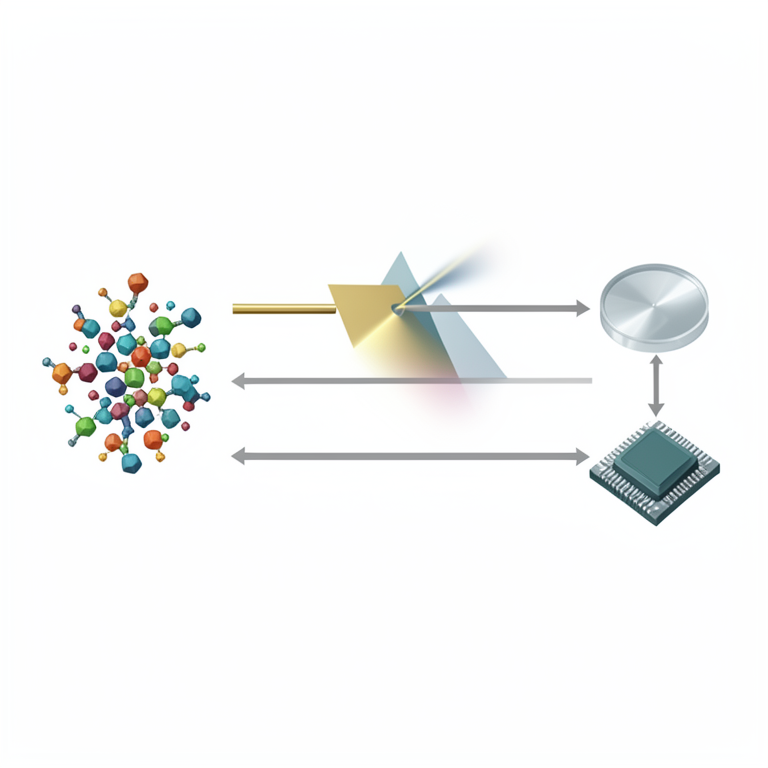
Chemical Sensor Detection Principles
AI-generated conceptual illustration (chemical sensor components and pollutant molecules). It explains the idea and does not show study data.
View source evidence ↗Introduction
Environmental monitoring is crucial for the assessment and management of environmental quality, helping to ensure public health and ecological sustainability. Traditional methods of environmental monitoring often involve labor-intensive and time-consuming sampling and laboratory analysis. The development of chemical sensors has revolutionized this field by providing rapid, real-time, and in situ monitoring capabilities. Chemical sensors can detect a wide range of environmental pollutants, including gases, heavy metals, organic compounds, and biological agents, making them vital for air, water, and soil quality assessment. Chemical sensors operate based on various detection principles, such as electrochemical, optical, piezoelectric, and semiconductor mechanisms. These sensors are designed to be highly sensitive, selective, and capable of operating under diverse environmental conditions. This review aims to provide a detailed discussion of the different types of chemical sensors used in environmental monitoring, their applications, recent technological advancements, and the challenges and future directions in this field.
Types of chemical sensors
Electrochemical sensors are widely used for detecting gaseous and dissolved pollutants. They operate based on the electrochemical reactions that occur when the target analyte interacts with the sensor's electrode surface. These sensors can be further classified into potentiometric, amperometric, and conductometric sensors, depending on the type of electrochemical measurement. Potentiometric sensors measure the potential difference between a reference electrode and a working electrode, which varies with the concentration of the target analyte. Ion-selective electrodes (ISEs) are a common type of potentiometric sensor used for detecting specific ions in water, such as nitrates, ammonium, and heavy metals [1] . Amperometric sensors measure the current produced by the redox reactions of the target analyte at the electrode surface. These sensors are highly sensitive and are often used for detecting gases like oxygen, carbon monoxide, and ozone. The current generated is proportional to the concentration of the analyte, providing quantitative data [2] . Conductometric sensors measure changes in the electrical conductivity of the sensor material caused by the interaction with the target analyte. These sensors are useful for detecting ionic species in water and soil samples. They are simple, robust, and can be miniaturized for portable applications [3] .
Optical sensors detect changes in light properties, such as intensity, wavelength, or polarization, caused by the interaction with the target analyte. These sensors include absorbance, fluorescence, and surface plasmon resonance (SPR) sensors. Absorbance sensors measure the decrease in light intensity as it passes through a sample containing the target analyte. This type of sensor is commonly used for detecting organic pollutants and nutrients in water by measuring their characteristic absorption spectra [4]. Fluorescence sensors detect the emission of light by a fluorophore when excited by a specific wavelength. The intensity of the emitted light is proportional to the concentration of the target analyte. These sensors are highly sensitive and are used for detecting trace levels of pollutants, such as heavy metals and organic compounds [5] . SPR sensors measure changes in the refractive index near the sensor surface caused by the binding of the target analyte. These sensors are highly sensitive and selective, making them suitable for detecting a wide range of pollutants, including biological contaminants and organic compounds [6] . Piezoelectric sensors detect changes in mass or mechanical properties on the sensor surface, which induce changes in the resonant frequency of a piezoelectric material. These sensors include quartz crystal microbalances (QCM) and surface acoustic wave (SAW) sensors. QCM sensors measure changes in the mass of the target analyte adsorbed onto the sensor surface, causing shifts in the resonant frequency of a quartz crystal. These sensors are highly sensitive and can detect very low concentrations of pollutants, including volatile organic compounds (VOCs) and heavy metals [7] . SAW sensors detect changes in the mechanical properties of the sensor surface caused by the adsorption of the target analyte, which alters the velocity of surface acoustic waves. These sensors are used for detecting gaseous pollutants and can be integrated into portable devices for real-time monitoring [8] . Semiconductor sensors detect changes in the electrical properties of semiconductor materials, such as conductivity or resistance, when exposed to the target analyte. These sensors are widely used for detecting gases and VOCs. MOS sensors operate by changing their electrical resistance when the target gas interacts with the metal oxide surface. These sensors are used for detecting gases such as carbon monoxide, nitrogen dioxide, and methane. They are robust, inexpensive, and can be miniaturized for portable applications [9] . Conducting polymer sensors detect changes in the conductivity of a polymer material when it interacts with the target analyte. These sensors are highly sensitive and selective, making them suitable for detecting trace levels of pollutants, such as VOCs and toxic gases [10] .
Applications of chemical sensors in environmental monitoring 1. Air quality monitoring
Chemical sensors play a critical role in monitoring air quality by detecting and quantifying various air pollutants, including carbon monoxide, nitrogen oxides, sulfur dioxide, ozone, and particulate matter. These sensors are deployed in urban areas, industrial sites, and remote locations to provide real-time data on air pollution levels. For example, MOS sensors are widely used in air quality monitoring networks to detect nitrogen dioxide and ozone, providing data that helps in assessing the impact of traffic and industrial emissions on air quality [11] .
Water quality monitoring
Water quality monitoring is essential for protecting public health and the environment. Chemical sensors are used to detect a wide range of water pollutants, including heavy metals, nutrients, pesticides, and pathogens. Electrochemical sensors, such as ISEs and amperometric sensors, are commonly used for monitoring ions and dissolved gases in water. Optical sensors, such as absorbance and fluorescence sensors, are used to detect organic pollutants and nutrients. These sensors are deployed in rivers, lakes, and oceans to provide continuous monitoring of water quality and detect pollution events [12] .
Soil contamination monitoring
Chemical sensors are also used for monitoring soil contamination, detecting pollutants such as heavy metals, pesticides, and organic compounds. Electrochemical and conductometric sensors are used to measure the concentration of ions and other contaminants in soil samples. These sensors provide valuable data for assessing soil health and guiding remediation efforts. For example, potentiometric sensors have been used to detect heavy metals like lead and cadmium in contaminated soils, helping to identify polluted sites and monitor the effectiveness of soil remediation techniques [13] .
Recent advancements in chemical sensors
The development of nanomaterials has led to significant advancements in the performance of chemical sensors. Nanomaterials, such as carbon nanotubes, graphene, and metal nanoparticles, have unique properties that enhance the sensitivity and selectivity of sensors. These materials provide a large surface area for interaction with the target analyte and can be functionalized to improve specificity. For example, graphene-based sensors have been developed for detecting low concentrations of gases like ammonia and nitrogen dioxide, demonstrating improved sensitivity compared to traditional sensors [14] . Advances in wireless and remote sensing technologies have enabled the deployment of chemical sensors in hard-toreach or hazardous environments. Wireless sensor networks (WSNs) consist of multiple sensor nodes that communicate wirelessly to provide comprehensive environmental monitoring. These networks can cover large areas and provide real-time data, making them ideal for monitoring air and water quality in remote locations. Remote sensing technologies, such as satellite-based sensors, offer largescale environmental monitoring capabilities, providing data on atmospheric and surface pollutants from space [15] . The integration of chemical sensors with the Internet of Things (IoT) and big data analytics has revolutionized environmental monitoring. IoT-enabled sensors can transmit data in real-time to cloud-based platforms, where it is processed and analyzed using big data techniques. This integration allows for continuous monitoring, early detection of pollution events, and informed decisionmaking. For example, IoT-based air quality monitoring systems can provide real-time data on pollutant levels, enabling authorities to issue timely warnings and implement mitigation measures [16] .
Challenges and future directions
One of the key challenges in deploying chemical sensors for environmental monitoring is the need for regular calibration and maintenance. Sensors can drift over time, leading to inaccurate measurements. Ensuring the long-term stability and accuracy of sensors in the field requires robust calibration protocols and maintenance procedures. Future research should focus on developing self-calibrating sensors and improving the durability of sensor materials to reduce maintenance requirements [17] . Chemical sensors can be affected by interference from other substances present in the environment, leading to false readings. Enhancing the selectivity of sensors is crucial for accurate detection of target analytes. Advances in sensor materials and the use of molecular recognition elements, such as molecularly imprinted polymers (MIPs), can improve selectivity and reduce interference. Future work should continue to explore new materials and designs to enhance the specificity of chemical sensors [18] . The deployment of large-scale sensor networks generates vast amounts of data, posing challenges in data management and interpretation. Effective data processing, storage, and analysis techniques are needed to handle this data and extract meaningful insights. The development of advanced data analytics and machine learning algorithms can help in managing and interpreting sensor data, enabling more accurate and timely environmental assessments [19] . The cost of chemical sensors and their deployment can be a barrier to widespread use, particularly in developing regions. Reducing the cost of sensor fabrication and deployment is essential for making these technologies accessible to a broader audience. Advances in materials science and manufacturing techniques can help in reducing costs. Additionally, the development of low-cost, portable sensors can enable community-based monitoring and increase public participation in environmental monitoring efforts [20] .
Conclusion
Chemical sensors play a vital role in environmental monitoring, providing rapid, real-time data on various pollutants and environmental parameters. Advances in sensor technology, including the development of nanomaterials-based sensors, wireless and remote sensing technologies, and integration with IoT and big data analytics, have significantly enhanced the capabilities of chemical sensors. Despite the challenges associated with sensor calibration, selectivity, data management, and cost, ongoing research and technological innovations continue to improve the performance and accessibility of chemical sensors. The future of environmental monitoring will likely see even greater reliance on these sensors, enabling more effective management and protection of environmental quality and public health.
References
19 in the original paper- Bakker E, Pretsch E, Bühlmann P. Selectivity of potentiometric ion sensors. Analytical Chemistry. 2000;72(6):1127-1133.
- Hulanicki A, Glab S, Ingman F. Chemical sensors: definitions and classification. Pure and Applied Chemistry. 1991;63(9):1247-1250.
- Grieshaber D, MacKenzie R, Voeroes J, Reimhult E. Electrochemical biosensors -sensor principles and architectures. Sensors. 2008;8(3):1400-1458.
- Wolfbeis OS. Fiber-optic chemical sensors and biosensors. Analytical Chemistry. 2008;80(12):42694283.
- Resch-Genger U, Grabolle M, Cavaliere-Jaricot S, Nitschke R, Nann T. Quantum dots versus organic dyes as fluorescent labels. Nature Methods. 2008;5(9):763775.
- Homola J. Surface plasmon resonance sensors for detection of chemical and biological species. Chemical Reviews. 2008;108(2):462-493.
- Janshoff A, Galla HJ, Steinem C. Piezoelectric masssensing devices as biosensors -an alternative to optical biosensors? Angewandte Chemie International Edition. 2000;39(22):4004-4032.
- Josse F, Shana K, Cernosek RW, Martin SJ. Analysis of sensitivity and mass resolution of surface acoustic wave chemical sensors. Analytical Chemistry. 2001;73(24):5937-5944.
- Korotcenkov G. Metal oxides for solid-state gas sensors: what determines our choice? Materials Science and Engineering B. 2007;139(1):1-23.
- Liao Y, Hutter T, Wijaya A, Sun S, Fichou D, Steiner U, Huang W, Mahajan S. Ultralow-power, flexible and transparent gas sensor based on amorphous-InGaZnO transistors and organic hybrid nanoparticles. ACS Sensors. 2017;2(2):225-232.
- Harrison RM, Yin J. Particulate matter in the atmosphere: which particle properties are important for its effects on health? Science of the Total Environment. 2000;249(1-3):85-101.
- Campbell C, Frymier P. Air pollution monitoring and modeling. In: Environmental Monitoring. ButterworthHeinemann; 2017:157-181.
- Kabata-Pendias A. Trace Elements in Soils and Plants. CRC Press; 2010.
- Novoselov KS, Fal'ko VI, Colombo L, Gellert PR, Schwab MG, Kim K. A roadmap for graphene. Nature. 2012;490(7419):192-200.
- Akyildiz IF, Su W, Sankarasubramaniam Y, Cayirci E. Wireless sensor networks: a survey. Computer Networks. 2002;38(4):393-422.
- Perera C, Zaslavsky A, Christen P, Georgakopoulos D. Context-aware computing for the Internet of Things: a survey. IEEE Communications Surveys & Tutorials. 2014;16(1):414-454.
- Jiang L, Kim J, Lee S, Lee HJ, Park HS, Lee DH, Park KK. Enhanced response characteristics of a wireless SAW chemical sensor towards DMMP by using hydrophobic TiO2 nanoparticles. Sensors and Actuators B: Chemical. 2015;221:936-944.
- Vigneshvar S, Sudhakumari CC, Senthilkumaran B, Prakash H. Recent advances in biosensor technology for potential applications -an overview. Frontiers in Bioengineering and Biotechnology. 2016;4:11.
- Obermeyer F, Klinge U. Big data management in the automotive industry: turning data into smart data. Procedia CIRP. 2017;63:156-161