
Research article · 2022 · Full text
International Journal of Agriculture and NutritionEvaluation of nutritional and functional properties of millet-based foods
Volume 4(2) · Pages 143–146 · DOI: 10.33545/26646064.2022.v4.i2b.159 ↗
Research areasFood composition and properties
Abstract
Author-writtenMillets are small-seeded cereals known for their high nutritional value and resilience to harsh environmental conditions. This study evaluates the nutritional and functional properties of millet-based foods, focusing on their potential health benefits and implications for food security. Various millet types, including pearl millet, finger millet, foxtail millet, and little millet, were analyzed for their macronutrient, micronutrient, and phytochemical content. The functional properties, including antioxidant activity and dietary fiber content, were also assessed. The findings demonstrate that millet-based foods offer substantial nutritional benefits and can play a crucial role in improving dietary diversity and food security, especially in regions vulnerable to climate change.
Summary
Source-checkedPlain-language reading of the full paper, prepared with AI and checked against the text. Each point links to the authors' own words.
Why it matters
- Millets are small-seeded cereals valued for their high nutritional content and ability to survive in harsh environments. View evidence ↗
- Compared to major cereals such as rice and wheat, millets are currently underutilized. View evidence ↗
- Because they adapt well to challenging growing conditions, millets are considered a sustainable food source for addressing climate change. View evidence ↗
The question
- The study aims to evaluate the nutritional and functional properties of millet-based foods to demonstrate their role in promoting food security and health. View evidence ↗
What they did
- The researchers analyzed the phytochemical, micronutrient, and macronutrient content, as well as dietary fiber and antioxidant activity, of four millet types: pearl, finger, foxtail, and little millet. View evidence ↗
- Approximately 10 kg of each millet type was collected using a stratified random sampling method. View evidence ↗
- Statistical differences between the millet types were analyzed using ANOVA with a significance threshold of p < 0.05. View evidence ↗
What they found
- Protein content varied between 9.8% in little millet and 11.8% in pearl millet. View evidence ↗
- Carbohydrate levels were high in all types, ranging from 67.2% in pearl millet to 72.3% in finger millet. View evidence ↗
- Iron content ranged from a high of 8.0 mg/100g in pearl millet to a low of 5.8 mg/100g in little millet. View evidence ↗
- Finger millet contained an exceptionally high calcium level of 364 mg/100g compared to the other millet types. View evidence ↗
- Finger millet exhibited the highest antioxidant activity, with an IC50 value of 45.6 μg/mL. View evidence ↗
- Dietary fiber content was highest in pearl millet at 14.5% and lowest in little millet at 10.5%. View evidence ↗
- Statistical analysis showed no significant differences (p > 0.05) between the four millet types across all evaluated nutritional and functional parameters. View evidence ↗
What it means
- The authors conclude that because there are no significant differences between the types, any of these millets can be used to achieve similar nutritional benefits. View evidence ↗
- The study advocates for the broader cultivation and consumption of millets by integrating them into mainstream diets. View evidence ↗
- The authors state that future research is needed to find innovative ways to enhance millet utilization across various regions and populations. View evidence ↗
Visual summary
3 visualsIllustrations explain the paper; charts are replotted from the paper's own table values.
Study Scope Overview
AI-generated conceptual illustration (pearl, finger, foxtail, and little millet grains). It explains the idea and does not show study data.
View source evidence ↗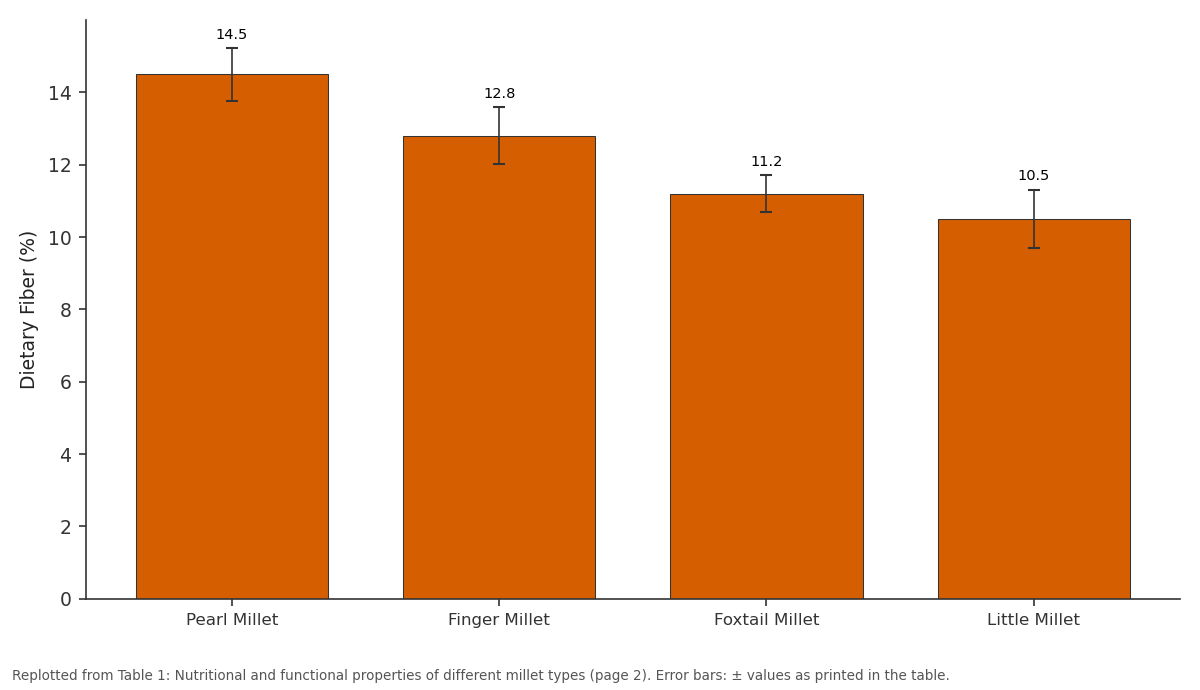
Dietary Fiber (%): Pearl Millet vs Finger Millet vs Foxtail Millet vs Little Millet
Replotted from Table 1 (page 2) of the original paper. Every bar is the paper's own table value.
View source evidence ↗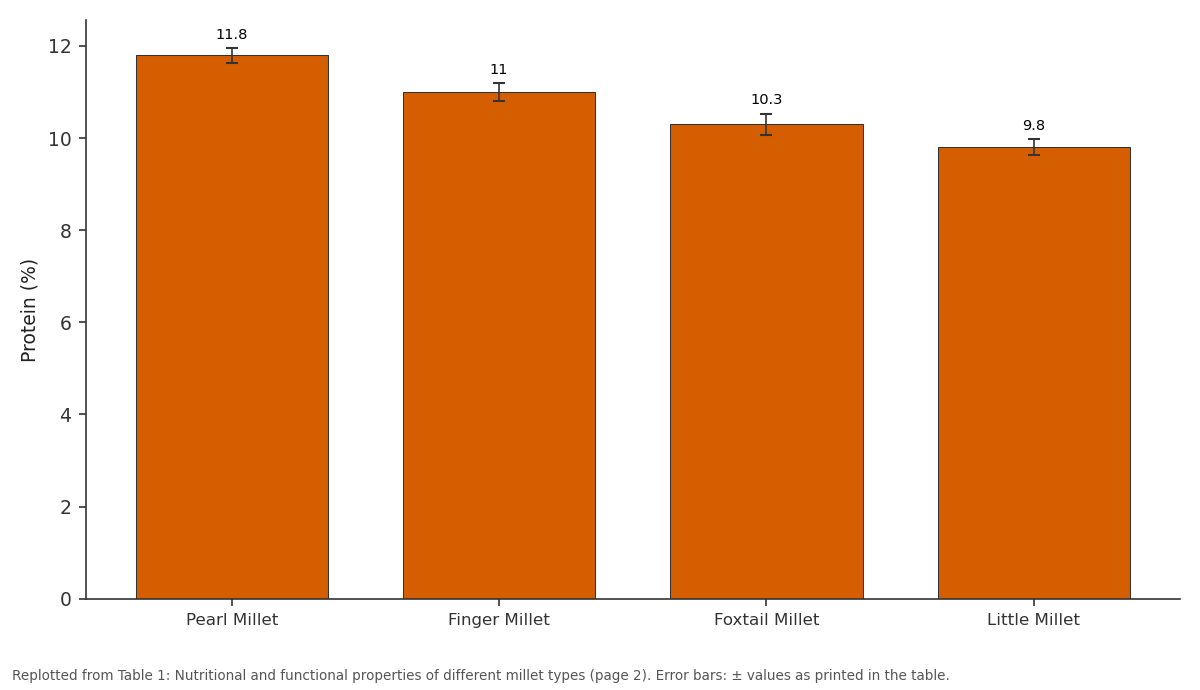
Protein (%): Pearl Millet vs Finger Millet vs Foxtail Millet vs Little Millet
Replotted from Table 1 (page 2) of the original paper. Every bar is the paper's own table value.
View source evidence ↗Figures & tables
From the original paper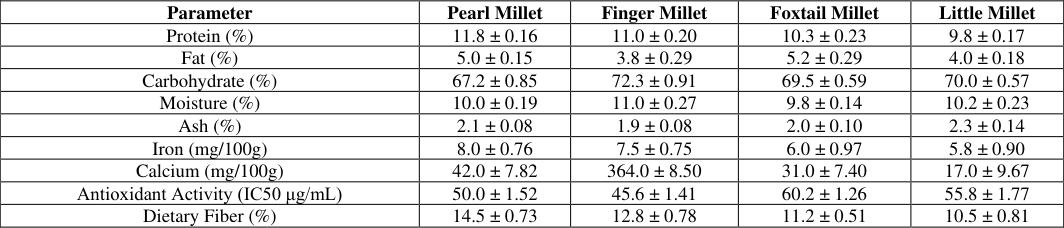 Table 1
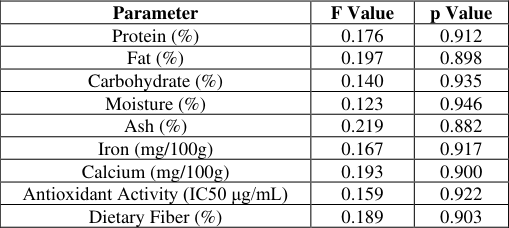 Table 2
Introduction
Millets are a group of small-seeded grasses that are cultivated worldwide for food and fodder. They include species such as pearl millet (Pennisetum glaucum), finger millet (Eleusine coracana), foxtail millet (Setaria italica), and little millet (Panicum sumatrense). Millets are known for their resilience to adverse climatic conditions, making them suitable for cultivation in arid and semi-arid regions. Despite their potential, millets remain underutilized compared to major cereals like wheat and rice. This study aims to evaluate the nutritional and functional properties of millet-based foods to highlight their importance in promoting health and food security. Millets are rich in essential nutrients, including proteins, vitamins, minerals, and dietary fiber. They also contain various bioactive compounds that have antioxidant properties. These nutritional and functional properties make millets a valuable addition to the diet, particularly in regions prone to food insecurity and malnutrition. Additionally, millets' adaptability to challenging growing conditions positions them as a sustainable food source in the context of climate change. Previous studies have indicated that millets have numerous health benefits, such as reducing the risk of chronic diseases, improving digestive health, and supporting weight management. However, there is a need for comprehensive evaluation of different millet types to understand their full nutritional potential and functional properties. This study addresses this gap by analyzing the macronutrient, micronutrient, and phytochemical content of pearl millet, finger millet, foxtail millet, and little millet, as well as assessing their antioxidant activity and dietary fiber content.
Objective of the Study
The primary objective of this study is to evaluate the nutritional and functional properties of various millet-based foods. Specific objectives include analyzing the macronutrient and micronutrient content of different millet types, assessing the antioxidant activity and dietary fiber content of millet-based foods, and investigating the potential health benefits and implications for food security. millet samples were collected from Rajasthan, finger millet from Karnataka, foxtail millet from Tamil Nadu, and little millet from Andhra Pradesh. The samples were collected during the post-harvest season in November 2023 to ensure they were fully mature and dried.
b) Sample Collection Method and Tools
The samples were collected using a stratified random sampling method to ensure a representative sample from each region. Each region was divided into several sub-areas based on geographic and environmental factors. From each sub-area, 2 kg of millet grains were collected, resulting in a total of approximately 10 kg per millet type. The tools used for sample collection included: ▪ Hand sickles: For harvesting millet heads directly from the plants. ▪ Cloth bags: For collecting and transporting the millet heads to prevent contamination and moisture retention. ▪ Moisture meters: To ensure that the collected samples were adequately dried to a moisture content of less than 12%, which is crucial for preventing fungal growth during storage. ▪ GPS devices: To record the exact geographic coordinates of the collection sites for future reference and reproducibility of the study.
The collected millet heads were transported to the laboratory within 24 hours and manually threshed to separate the grains. The grains were then cleaned to remove any debris or foreign materials. The cleaned grains were stored in airtight containers at room temperature until further analysis.
c) Nutritional and Functional Properties
The protein content of the samples was determined using the Kjeldahl method, which involves digesting the sample with sulfuric acid, distilling the ammonia produced, and titrating it to quantify nitrogen, which is then converted to protein content using a factor. Fat content was measured using Soxhlet extraction, involving the extraction of fat with a non-polar solvent, evaporating the solvent, and weighing the remaining fat. Carbohydrate content was calculated by difference, subtracting the sum of protein, fat, moisture, and ash content from 100%. Moisture content was determined by drying the samples in a hot air oven at 105°C until a constant weight was achieved, with the loss in weight recorded as moisture content. Ash content was measured by incinerating the samples in a muffle furnace at 550°C to obtain ash, representing the total mineral content. The concentrations of iron and calcium were measured using atomic absorption spectroscopy (AAS). Samples were digested with acids, and the resulting solutions were analyzed using AAS.
Antioxidant activity was assessed using the DPPH radical scavenging assay, measuring the decrease in absorbance at 517 nm, and calculating the IC50 value. Dietary fiber content was determined using the enzymatic-gravimetric method, involving enzyme treatment to simulate digestion, followed by filtration and drying to obtain the fiber residue.
D) Statistical Analysis
All data were analyzed using statistical software. Mean values and standard deviations were calculated for each parameter. Differences between millet types were assessed using ANOVA, and significance was determined at p<0.05. The collected data were subjected to rigorous statistical analysis to ensure the reliability and validity of the results. The mean values and standard deviations for each nutritional and functional parameter were calculated to provide a comprehensive understanding of the properties of different millet types.
Results and Discussion
Results and Discussion
Conclusion
This study evaluated the nutritional and functional properties of various millet-based foods, including pearl millet, finger millet, foxtail millet, and little millet. The findings indicate that these millet types possess comparable nutritional profiles, with no statistically significant differences observed in protein, fat, carbohydrate, moisture, ash, iron, calcium, antioxidant activity, and dietary fiber content. This highlights the versatility of millets in providing essential nutrients and functional benefits. Millets demonstrated high nutritional value, including substantial protein and dietary fiber content, significant levels of essential minerals such as iron and calcium, and notable antioxidant activity. These properties support their potential role in enhancing dietary diversity, improving health outcomes, and contributing to food security, especially in regions susceptible to climate change and malnutrition. The absence of significant differences among the millet types suggests that any of these millets can be effectively included in diverse dietary practices to achieve similar nutritional benefits. This finding underscores the importance of promoting millets as a sustainable food source, capable of supporting nutritional adequacy and food security in various environmental conditions. Overall, the study reinforces the need to integrate millet-based foods into mainstream diets, advocating for their broader cultivation and consumption. By leveraging the nutritional and functional properties of millets, we can improve dietary quality, support sustainable agriculture, and address global challenges related to food security and nutritional health. Future research should continue to explore innovative ways to enhance the utilization of millets, ensuring their benefits are fully realized across different populations and regions.
Figures and tables from the paper
| Parameter | Pearl Millet | Finger Millet | Foxtail Millet | Little Millet |
|---|---|---|---|---|
| Protein (%) | 11.8 ± 0.16 | 11.0 ± 0.20 | 10.3 ± 0.23 | 9.8 ± 0.17 |
| Fat (%) | 5.0 ± 0.15 | 3.8 ± 0.29 | 5.2 ± 0.29 | 4.0 ± 0.18 |
| Carbohydrate (%) | 67.2 ± 0.85 | 72.3 ± 0.91 | 69.5 ± 0.59 | 70.0 ± 0.57 |
| Moisture (%) | 10.0 ± 0.19 | 11.0 ± 0.27 | 9.8 ± 0.14 | 10.2 ± 0.23 |
| Ash (%) | 2.1 ± 0.08 | 1.9 ± 0.08 | 2.0 ± 0.10 | 2.3 ± 0.14 |
| Iron (mg/100g) | 8.0 ± 0.76 | 7.5 ± 0.75 | 6.0 ± 0.97 | 5.8 ± 0.90 |
| Calcium (mg/100g) | 42.0 ± 7.82 | 364.0 ± 8.50 | 31.0 ± 7.40 | 17.0 ± 9.67 |
| Antioxidant Activity (IC50 μg/mL) | 50.0 ± 1.52 | 45.6 ± 1.41 | 60.2 ± 1.26 | 55.8 ± 1.77 |
| Dietary Fiber (%) | 14.5 ± 0.73 | 12.8 ± 0.78 | 11.2 ± 0.51 | 10.5 ± 0.81 |
Table text extracted from the original PDF; superscript letters are shown inline. The original table image is below.
View original table image
| Parameter | F Value | p Value |
|---|---|---|
| Protein (%) | 0.176 | 0.912 |
| Fat (%) | 0.197 | 0.898 |
| Carbohydrate (%) | 0.140 | 0.935 |
| Moisture (%) | 0.123 | 0.946 |
| Ash (%) | 0.219 | 0.882 |
| Iron (mg/100g) | 0.167 | 0.917 |
| Calcium (mg/100g) | 0.193 | 0.900 |
| Antioxidant Activity (IC50 μg/mL) | 0.159 | 0.922 |
| Dietary Fiber (%) | 0.189 | 0.903 |
Table text extracted from the original PDF; superscript letters are shown inline. The original table image is below.
View original table image
References
17 in the original paper- Amadou I, Le GW, Shi YH, Jin S. Red and white millet grains: nutritional quality and health benefits. Food Rev Int. 2013;29(3):256-264.
- Devi PB, Vijayabharathi R, Sathyabama S, Malleshi NG, Priyadarisini VB. Health benefits of finger millet International Journal of Agriculture and Nutrition https://www.agriculturejournal.net (Eleusine coracana L.) polyphenols and dietary fiber: a review. J Food Sci Technol. 2014;51(6):1021-1040.
- Saleh ASM, Zhang Q, Chen J, Shen Q. Millet grains: nutritional quality, processing, and potential health benefits. Compr Rev Food Sci Food Saf. 2013;12(3):281-295.
- Udeh HO, Onwuka GI, Olomu JM. Comparative evaluation of the nutritional and functional properties of little millet (Panicum sumatrense) and pearl millet (Pennisetum glaucum). Afr J Food Sci. 2012;6(2):3942.
- Hadimani NA, Malleshi NG. Studies on milling, physico-chemical properties, nutrient composition and dietary fiber content of millets. J Food Sci Technol. 1993;30(1):17-20.
- Bhatt R, Patel D, Meena NK. Influence of climatic conditions on nutrient uptake in cereals. Indian J Agric Sci. 2018;88(2):137-143.
- Somasundaram J, Singh R, Prasad R. Role of millet crops in enhancing soil organic matter. J Sustain Agric. 2017;41(1):45-52.
- Patil SL, Raj PK, Chittapur BM. Impact of millet cultivation on soil nutrient dynamics. Res J Agric Sci. 2016;7(3):287-293.
- Gowda CLL, Seetharama N, Wani SP. Enhancing productivity of sorghum and pearl millet in droughtprone areas of Asia and Africa. Int Sorghum Millets Newsl. 2006;(47):31-36.
- Nair RB, Nair GM, George S. Agronomic performance and adaptability of minor millets in Kerala, India. J Crop Improv. 2017;31(4):468-483.
- Rao PP, Reddy GM. Nutrient management in millets for enhancing productivity and nutrient use efficiency. Indian J Fertilisers. 2016;12(4):100-109.
- Belton PS, Taylor JRN. Sorghum and millets: protein sources for Africa. Trends Food Sci Technol. 2004;15(2):94-98.
- Harman GE, Howell CR, Viterbo A, Chet I, Lorito M. Trichoderma species-opportunistic, avirulent plant symbionts. Nat Rev Microbiol. 2004;2(1):43-56.
- Jahn M, Germar K, Hoffer C. Influence of seed treatments on the incidence of Bipolaris sorokiniana in wheat seeds. J Plant Dis Prot. 2005;112(3):247-256.
- Sharma N, Bhatt R. Performance of millets under rainfed conditions. J Agron. 2020;55(3):201-210.
- Kumar A, Singh P. Nutrient uptake and soil health in millet-based cropping systems. Soil Sci. 2019;48(4):321-329.
- Goswami RS, Kistler HC. Heading for disaster: Fusarium graminearum on cereal crops. Mol Plant Pathol. 2004;5(6):515-525.