
Research article · 2024 · Full text
International Journal of Research in AgronomyPhysiochemical characterization of rice genotypes based on gel consistency and alkali digestion under different N levels
Volume 7(6) · Pages 341–344 · DOI: 10.33545/2618060x.2024.v7.i6e.857 ↗
Research areasRice Cultivation and Yield ImprovementFood composition and propertiesPlant Micronutrient Interactions and Effects
Abstract
Author-writtenOne crucial agronomic tool for regulating grain quality is nitrogen fertilizer. However, the impact of nitrogen application on grain quality during heading has not been well studied. Grain quality parameters, such as Gel Consistency (GC) and Alkali Digestion Value (ADV) responses to nitrogen fertilizer were determined in a field experiment. We found that GC and ADV decreased as the nitrogen application level at the heading stage. When considered collectively, our findings showed that GC and ADV increase in Pusa 44 in response to an elevated nitrogen content at the heading.
Summary
Source-checkedPlain-language reading of the full paper, prepared with AI and checked against the text. Each point links to the authors' own words.
Why it matters
- Rice is a critical global food source, providing approximately 23% of daily calories for 57% of the world's population. View evidence ↗
- Grain quality in rice is influenced by genetics, environment, and agricultural practices, with nitrogen fertilization being a key factor. View evidence ↗
- While nitrogen fertilization can increase protein content, excessive protein may reduce cooking quality by making the rice tougher and less sticky. View evidence ↗
The question
- The study aims to address the lack of research regarding how nitrogen application specifically during the heading stage impacts rice grain quality. View evidence ↗
What they did
- The researchers evaluated seven nitrogen-use efficient rice genotypes, including four short-duration (113 days) and three long-duration (130 days) varieties. View evidence ↗
- The study used a split-plot design with nitrogen treatments as main plots and genotypes as subplots, utilizing three 6 m² replicate plots per treatment. View evidence ↗
- Gel consistency (GC) was measured by heating a mixture of rice powder, thymol blue, ethanol, and KOH to 92 °C for 6 minutes, then measuring the resulting gel length. View evidence ↗
What they found
- Among short-duration genotypes, Nidhi and MTU 1010 showed increased gel consistency with higher nitrogen at heading, while N22 and Vandana showed a decrease. View evidence ↗
- For long-duration genotypes, CR Dhan 310 experienced a 25% and 12% reduction in gel consistency at medium (MN) and high (HN) nitrogen levels, while Pusa 44 showed a 16% increase. View evidence ↗
- MTU1010 and Vandana consistently recorded low alkali digestion values across all nitrogen treatment levels. View evidence ↗
- Higher levels of nitrogen application led to increased alkali digestion values in Nidhi, CRDhan310, Rasi, and Pusa44. View evidence ↗
- Long-duration cultivars generally had higher alkali digestion values, which further increased under medium and high nitrogen treatments. View evidence ↗
- Most studied genotypes exhibited soft gel consistency, defined as having a gel length greater than 61 mm. View evidence ↗
What it means
- The authors conclude that applying high nitrogen (60 kg N/ha) at the heading stage improves the grain quality of rice. View evidence ↗
- The study concludes that the level of nitrogen application has a significant effect on the overall grain quality of rice. View evidence ↗
Visual summary
1 visualsIllustrations explain the paper; they do not show study data.
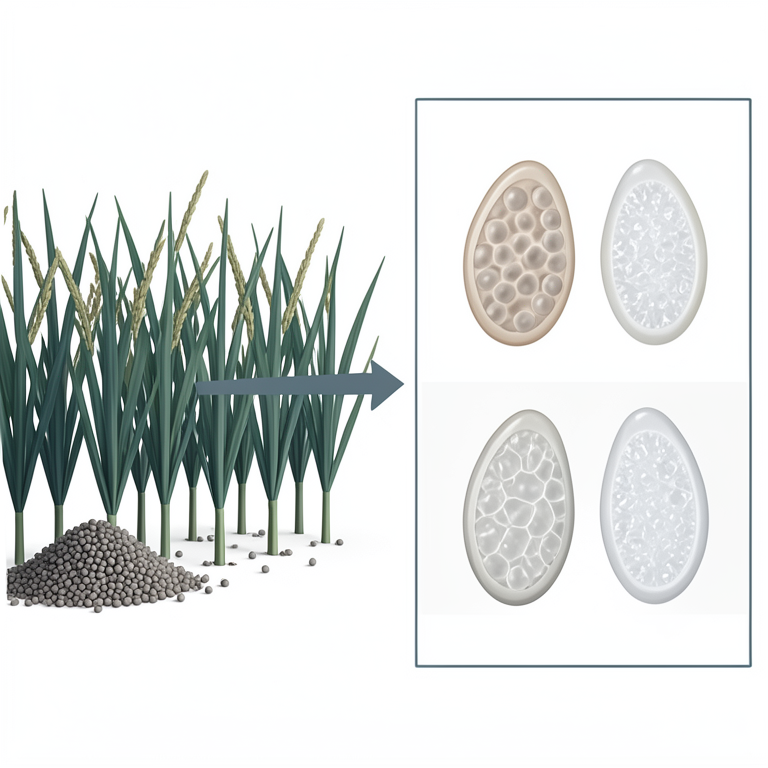
Nitrogen Application and Grain Quality
AI-generated conceptual illustration (Oryza sativa (rice plants) and rice grains). It explains the idea and does not show study data.
View source evidence ↗Figures & tables
From the original paper Table 1
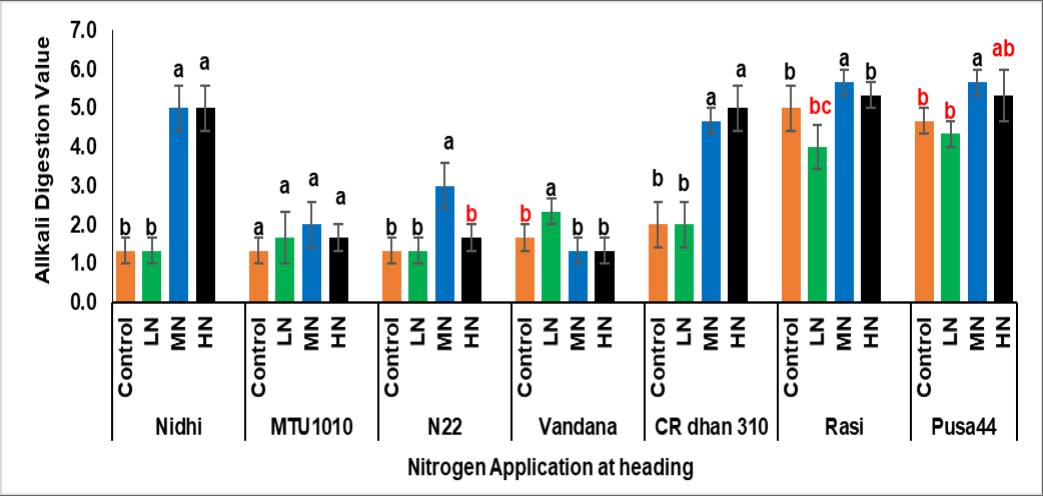 Figure 2
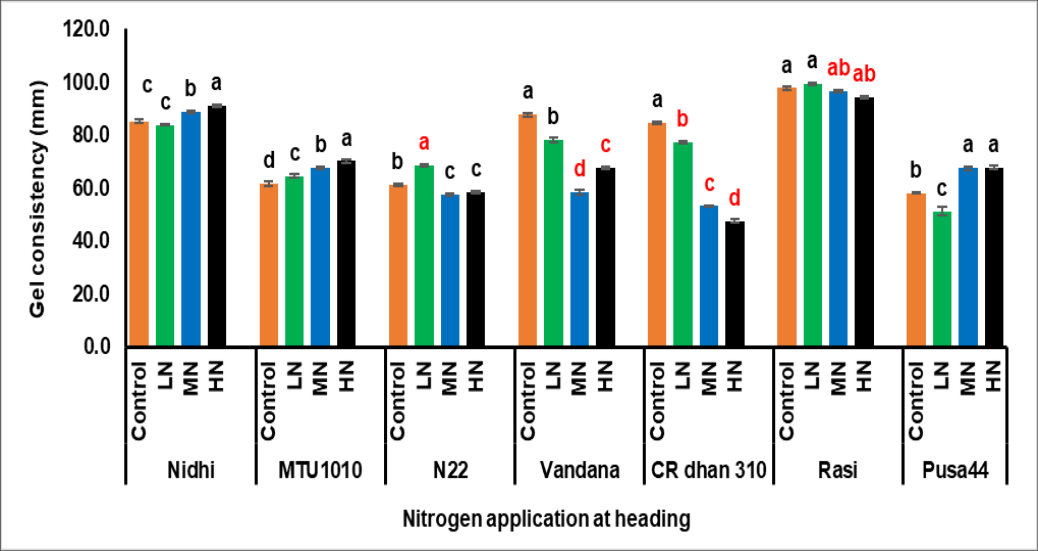 Figure 1
Introduction
Rice (Oryza sativa L.) is a monocotyledonous plant in the genus Oryza and family Gramineae, which is closely related to grass. For nearly 23 percent of the daily calorie requirement, rice is the primary staple food consumed by 57% of the world's population (Vijay et al., 2013) [14] . In rice grain quality is a complex feature that can be affected by several variables, including genetic composition, environmental factors, and agricultural techniques, of which nitrogen (N) fertilization is a key component (Koutroubas et al., 2004) [7] . A vital component of plant growth, nitrogen directly influences the processes of photosynthesis, protein synthesis, and metabolism. These processes in turn affect grain production, size, shape, and nutritional value (Morales et al., 2020) [10] . An essential part of amino acids, which are the building blocks of proteins, is nitrogen. As a result, rice grains with nitrogen fertilization often have higher protein content. On the other hand, a high protein level could negatively impact the cooking quality, resulting in less sticky and tougher rice. The impact of nitrogen (N) application on gelatinization temperature (GT) and gel consistency (GC) in rice genotypes demonstrates the complex interplay between agronomic practices and the physicochemical characteristics of rice grains, which in turn influence cooking and eating quality (Shah et al., 2024) [12] . Critical factors in assessing rice quality are both GC and GT, which have an impact on customer preferences and processing attributes (Saquee, et al., 2023) [11] . Rice's processing and cooking properties can be impacted by nitrogen due to its ability to change the temperature at which starch gels and its gel consistency (Xiong et al., 2022) [16] . While the precise correlation between nitrogen fertilisation and grain index (GI) remains unclear, variations in the levels of amylose and amylopectin resulting from nitrogen fertilization may impact rice GI (Guo et al., 2023) [3] . Optimizing grain quality requires an understanding of genotype-specific responses to nitrogen. Rice varieties with optimal nitrogen usage efficiency are developed and recommended by agronomic procedures and breeding programs to produce high yield and quality with the least amount of negative environmental impact (Aguirrezábal et al., 2015) [1] . Precision agriculture techniques, such as site-specific nitrogen management (SSNM), can help tailor nitrogen application to the specific needs of different rice genotypes, thereby maximizing grain quality and minimizing negative environmental effects (Ali et al., 2020) [2] .
The effect of nitrogen (N) application on gel consistency (GC) and gelatinization temperature (GT) in rice genotypes highlights the intricate relationship between agronomic practices and the physicochemical properties of rice grains, which ultimately affect cooking and eating quality (Lou et al., 2023) [9] . By adjusting nitrogen treatment to the unique requirements of various rice genotypes, precision agricultural techniques like site-specific nitrogen management (SSNM) can assist maximize grain quality and reduce adverse environmental effects (Ali et al., 2020) [2] . The relationship between agronomic practices and the physicochemical properties of rice grains which ultimately affect cooking and eating quality is highlighted by the effect of nitrogen (N) application on gel consistency (GC) and gelatinization temperature (GT) in rice genotypes (Lou et al., 2023) [9] . When assessing the quality of rice, both GC and GT are important factors that affect customer preferences and processing attributes. In conclusion, there is a trade-off between yield, appearance, cooking qualities, and nutritional content in the complicated and genotype-dependent interaction between nitrogen treatments and rice grain quality. Comprehending soil fertility, plant feeding concepts, and rice genetics in great detail is necessary to achieve the ideal equilibrium.
Materials and Methods
Seven nitrogen-use efficient rice genotypes of short duration (113 days) viz. Nidhi, MTU1010, N22, and Vandana. Long duration (130 days) viz, CR Dhan 310, Rasi and Pusa44 selected from a previous study in the Division of Agronomy, ICAR-IARI were evaluated in the field during the Kharif seasons of 2018 and 2019 at the Indian Agricultural Research Institute, New Delhi. All these high nitrogen use efficient genotypes showed a maximum grain yield of more than 0.2 kg/ha of seeds under 120 kg/ha of N.
Crop husbandry
The experiment spanned kharif seasons 2019-20. Seeds were sown on June and 25 days old seedlings of all genotypes with similar growth were selected and transplanted. The experiment followed a split-plot design where Nitrogen (N) treatment was used as the main plot and the genotypes were used as subplots. Three replicate plots of 6 m² were used for each treatment. Urea (120 kg ha⁻¹), single superphosphate (30 kg ha⁻¹), and potash murate (40 kg ha⁻¹) were applied as nitrogen (N), phosphorus (P), and potassium (K), respectively. Potash fertilizer (K 2 O) was applied as a basal dose at active tillering, panicle initiation, and heading stage, detailed treatments given on Table 1. Phosphorus was applied as P2O5 in the form of SSP @ 60 kg ha -1, and potassium was applied as K2O in the form of murate of potash @ 40 kg ha -1 at transplanting. By agricultural and management standards, split doses of nitrogen were administered at the several growth phases listed below (Table 1). Samples of plants and grains were taken at the heading and maturity stages to analyse the Gel consistency (GC) and Alkali Digestive Value (ADV).
| Nitrogen level (120 kg/ha) | — | — | — | — |
|---|---|---|---|---|
| Stages | Control | T1 | T2 | T3 |
| Tillering | 40 kg/ha | 40 kg/ha | 40 kg/ha | 40 kg/ha |
| Panicle initiation | 80 kg/ha | 20 kg/ha | 40 kg/ha | 60 kg/ha |
| Heading | 0 kg/ha | 60 kg/ha | 40 kg/ha | 20 kg/ha |
Table text extracted from the original PDF; superscript letters are shown inline. The original table image is below.
View original table image
Gel consistency
A palm dehusker was used to remove the husks from the rice grains during the dehusking process. An electric mill was then used to ground the dehusked rice grains into rice flour. 500 mg of rice flour, or rice powder was weighed for each rice genotype. The 0.025% thymol blue solution and 0.026 ml of 95% ethanol were mixed and added to the rice powder. The mixture was then added with 2 ml of 0.2 N KOH and the tubes containing the mixtures were then heated to 92 °C for 6 min. After boiling, the glass caps were placed on the tubes and they were allowed to cool for five minutes. After that, the tubes were put in tubes, the tubes were immersed in ice for 15 min. After settling the gel for 30 min, the tubes were set up horizontally on graph paper and the length of the gel was measured in mm from the bottom of the tube to the bottom of the gel.
Gelatinization temperature (Alkali Digestion Value)
Within a Petri plate with 20 ml of 1.7% KOH, twenty-five dehusked grains were evenly distributed in three replicates in each of the four treatments. On a 7-point scale, the grains' spreading and clearing values were noted. Due to the inverse relationship between gelatinization temperature and score, grains with low scores at high temperatures did not completely disintegrate, whereas grains with high scores at low temperatures disintegrated.
Results
The analysis of variance suggested there was a significant effect (P-Value < 0.05) for genotype, treatment, and genotype x treatment interaction for gel consistency. The dose response was more evident in short duration genotypes, though it was not consistent. Nidhi and MTU 1010 exhibited an increase in gel consistency with increasing N application at heading whereas N22 and Vandana showed an opposite trend. Among the long duration genotypes, Rasi did not show any variation with different N doses, while CR Dhan 310 and Pusa 44 displayed an opposite pattern at MN and HN doses compared to control. CR Dhan 310 showed 25 and 12 % reduction at MN and HN respectively whereas Pusa 44 showed higher (16%) increase with MN and HN over control N (Fig 1)
Based on the degree of alkali digestion observed (Figure 2), the rice genotypes were classified into three groups; low, intermediate, and high alkali digestion values. Among all the genotypes with low degrees of alkali digestion value recorded in MTU1010 and Vandana when treated with all different levels of N. Nidhi, CRDhan310, Rasi, and Pusa44 showed higher alkali digestion values with higher levels of N. Lowest alkali digestion were observed in Vandana when grown under the high level of N. Among the N levels high N level showed high alkali digestion value. In general, all the short-duration genotypes showed low alkali digestion value (ADV) with a few exceptions like MN and HN treatments of Nidhi, MN of N22, and LN of Vandana, where ADV increased above the control. ADV values were high for long-duration cultivars and MN and HN treatments increased the ASV values in all three genotypes.
Discussion
Alkali digestion is one of the important indicators of the eating, cooking, and processing quality of rice starch (Zhao et al., 2022) [19] . In this study, the determination of the alkali digestion classified the rice genotypes into three groups namely; low, intermediate, and high alkali digestion. Similar classifications have been reported in НaL rice cultivars (Yin et al., 2007) [17] . In this study, lower alkali digestion values were observed when treated with LN levels indicating that the lower application rate of nitrogen could be attributed to the presence of more long amylopectin chains (B2 and B3) than the short (A and B1) amylopectin chains (Yin et al., 2013) [18] . The activity of the SSIIa is higher in the low alkali digestion cluster than in other classifications which increases the proportion of the short amylopectin chains (Hu et al., 2009) [4] . Given that there is an inversely proportional relationship between the alkali digestion value and the gelatinization temperature, the genotypes with low alkali digestion have a high gelatinization temperature. The rice grains that were highly affected by the alkali solution had a high ADV due to the presence of amylopectin with a high number of short chains (A and B1) and with minimal number of long amylopectin chains. The SSIIa activity is maximal amongst these genotypes since this gene plays a vital role in the elongation of the short amylopectin chains (Zhu et al., 1988) [21] . The same results were observed when treated with an HN level of nitrogen indicating that an increased nitrogen level increases the short chains of amylopectin with minimal long amylopectin chains.
The gel consistency test was developed as an indirect method used in screening cooked rice for its hardness, especially in rice with high amylose content (Wang et al., 2020) [15] . This physicochemical test is used in rice improvement programs to ascertain if high amylose genotypes are soft or hard textured when cooked (Tao et al., 2019). In this study, genotypes were classified into soft, intermediate, and hard GC based on the gel consistency values (Ishimaru et al., 2003) [5] . The three classifications could be a result of different expression levels of the waxy gene and the variations in the Wx gene locus (Zhu et al., 2017). Genotypes with soft GC had a gel length that was more than 61 mm. This physiochemical trait was observed in most of the rice genotypes under study and showed that increased nitrogen level at the heading stage has increased the GC values indicating that hard gel consistency which occur as a result association of starch polymers in the aqueous phase. Amylose polymers leach when the starch granules are heated and they subsequently form networks once the gel cools (Ju et al., 2011; Liang et al., 2015) [6. 8] .
Conclusion
The study revealed nitrogen application level significantly affected the grain quality of rice. In this study, we found that the quality parameters GC and Alkali digestion value increases when the nitrogen application rate with HN level at heading and this also suggested that the High nitrogen application (60kg N/ha) at heading improved grain quality in rice.
Acknowledgement
Acknowledged to Cliamte change lab, Division of plant physiology, IARI, New Delhi.
References
20 in the original paper- Ali AM. Site-specific fertilizer nitrogen management in cereals in South Asia. Sustainable Agriculture Reviews. 2020;39:137-178.
- Guo C, Wuza R, Tao Z, Yuan X, Luo Y, Li F, Ma J. Effects of elevated nitrogen fertilizer on the multi-level structure and thermal properties of rice starch granules and their relationship with chalkiness traits. Journal of the Science of Food and Agriculture. 2023;103(14):7302-7313.
- Hu JM, Jiang LG, Mo RX, Wei SQ, Wang Y, Liu KQ, Zhou JM, Qin HD, Liang TF, Zeng K. Characteristics of PostAnthesis Dry Matter Accumulation, Translocation and Grain Filling of High Quality Indica Rice Varieties Baguixiang and Guihuazhan. Chin. J. Rice Sci. 2009;23:628-632.
- Ishimaru T, Matsuda T, Ohsugi R, Yamagishi T. Morphological Development of Rice Caryopses Located at the Different Positions in a Panicle from Early to Middle Stage of Grain Filling. Funct. Plant Biol. 2003;30:11391149.
- Ju X, Christie P. Calculation of Theoretical Nitrogen Rate for Simple Nitrogen Recommendations in Intensive Cropping Systems: A Case Study on the North China Plain. Field Crop. Res. 2011;124:450-458.
- Koutroubas SD, Mazzini F, Pons B, Ntanos DA. Grain quality variation and relationships with morphophysiological traits in rice (Oryza sativa L.) genetic resources in Europe. Field Crops Research. 2004;86(23):115-130.
- Liang Z, Bao A, Li H, Cai H. The Effect of Nitrogen Level on Rice Growth, Carbon-Nitrogen Metabolism and Gene Expression. Biologia. 2015;70:1340-1350. [CROSSREF]
- Lou G, Bhat MA, Tan X, Wang Y, He Y. Research progress on the relationship between rice protein content and cooking and eating quality and its influencing factors. Seed Biology. 2023;2(1).
- Morales F, Ancín M, Fakhet D, González-Torralba J, Gámez AL, Seminario A, et al. Photosynthetic metabolism under stressful growth conditions as a basis for crop breeding and yield improvement. Plants. 2020;9(1):88.
- Saquee FS, Diakite S, Kavhiza NJ, Pakina E, Zargar M. The efficacy of micronutrient fertilizers on the yield formulation and quality of wheat grains. Agronomy. 2023;13(2):566.
- Shah IH, Jinhui W, Li X, Hameed MK, Manzoor MA, Li P, Chang L. Exploring the role of nitrogen and potassium in photosynthesis implications for sugar: Accumulation and translocation in horticultural crops. Scientia Horticulturae. 2024;327:112832.
- Tao K, Yu W, Prakash S, Gilbert RG. High-Amylose Rice: Starch Molecular Structural Features Controlling Cooked Rice Texture and Preference. Starch-Strke. 2019;219:251260.
- Vijay D, Roy B. Chapter-4 Rice (Oryza Sativa L.). Breeding, Biotechnology and Seed Production of Field Crops. 2013;71-122.
- Wang W, Ge J, Xu K, Gao H, Liu G, Wei H, Zhang H. Differences in Starch Structure, Thermal Properties, and Texture Characteristics of Rice from Main Stem and Tiller Panicles. Food Hydrocoll. 2020;99:105341-105348.
- Xiong R, Tan X, Yang T, Pan X, Zeng Y, Huang S, Zeng Y. Relation of cooked rice texture to starch structure and physicochemical properties under different nitrogen managements. Carbohydrate Polymers. 2022;295:119882.
- Yin CY, Ning HF, Zhao QZ, Chen JR. Effects of Nitrogen Fertilizer Application Amount at the Panicle Stage on Rice Quality and Food Taste along the Yellow River Valley. J. Henan Agr. Sci. 2007;5:18-20.
- Yin CY, Wang SY, Liu HM, Xue YZ, Zhang Y, Wang HL, et al. Effect of Nitrogen Fertilizer Application on Grain Filling Characteristics and Rice Quality of Superior and Inferior Grain in Super Japonica Rice Xindao 18. Chin J Rice Sci. 2013;27:503-510.
- Zhao C, Gao Z, Liu G, Qian Z, Jiang Y, Li G, et al. Optimization of Combining Controlled-Release Urea of Different Release Period and Normal Urea Improved Rice Yield and Nitrogen Use Efficiency. Arch Agron Soil Sci. 2022.
- Zhu DW, Zhang HC, Guo BW, Ke X, Dai QG, Wei HY, et al. Effects of Nitrogen Level on Yield and Quality of Japonica Soft Super Rice. J Integr Agric. 2017;16:10181027.
- Zhu QS, Cao XZ, Luo YQ. Growth Analysis in the Process of Grain Filling in Rice. Acta Agron Sin. 1988;14:182-192.