
Research article · 2024 · Full text
International Journal of Agriculture Extension and Social DevelopmentEngagement and innovation in community science
Volume 7(4) · Pages 350–353 · DOI: 10.33545/26180723.2024.v7.i4e.544 ↗
Research areasBiomedical and Engineering EducationInnovative Approaches in Technology and Social DevelopmentService-Learning and Community Engagement
Abstract
Author-writtenCommunity science plays a major role in conducting and implementing scientific research and innovations at the gross root level. There are two key aspects involved in community science engagement and innovation that enable the creation of new solutions to the problems. Several institutes such as MANAGE, NAARM, NIRD&PR, EEI, NIN, ICMR, and ministries helped the community through different programs. As per the IV Dean’s Committee, the degree program has been changed, and new courses and awareness campaigns were introduced at the village level. Innovations are implemented at the institute level for the sake of students. Community science projects can not only gather valuable data but also foster a sense of shared ownership and excitement within the community.
Summary
Source-checkedPlain-language reading of the full paper, prepared with AI and checked against the text. Each point links to the authors' own words.
Why it matters
- Community science is essential for implementing scientific research and innovations directly at the grassroots level. View evidence ↗
- Engagement and innovation are the primary drivers that allow communities to collaborate and solve their own specific problems. View evidence ↗
- Formerly known as Home Science, community science integrates scientific understanding, social values, and technology to improve quality of life, especially for vulnerable groups. View evidence ↗
The question
- The paper examines how engagement and innovation within community science enable the creation of new solutions to community problems. View evidence ↗
What they did
- The authors review the collaborative approach where community members use scientific research and technological innovation to advance their own priorities. View evidence ↗
- The paper analyzes the shift toward application-oriented education in the 1990s and 2000s to transform students into job providers. View evidence ↗
What they found
- The Experiential Learning Programme (ELP) develops students' entrepreneurial and analytical skills through hands-on project execution. View evidence ↗
- The All India Coordinated Research Projects (AICRP) advance community science through participatory approaches, technology transfer, and capacity building. View evidence ↗
- Community science scientists at Krishi Vigyan Kendras (KVK) serve as critical links to bridge the gap between scientific research and the farming community. View evidence ↗
What it means
- The authors conclude that combining engagement strategies with innovative technology and education fosters community ownership and provides valuable data. View evidence ↗
Visual summary
1 visualsIllustrations explain the paper; they do not show study data.
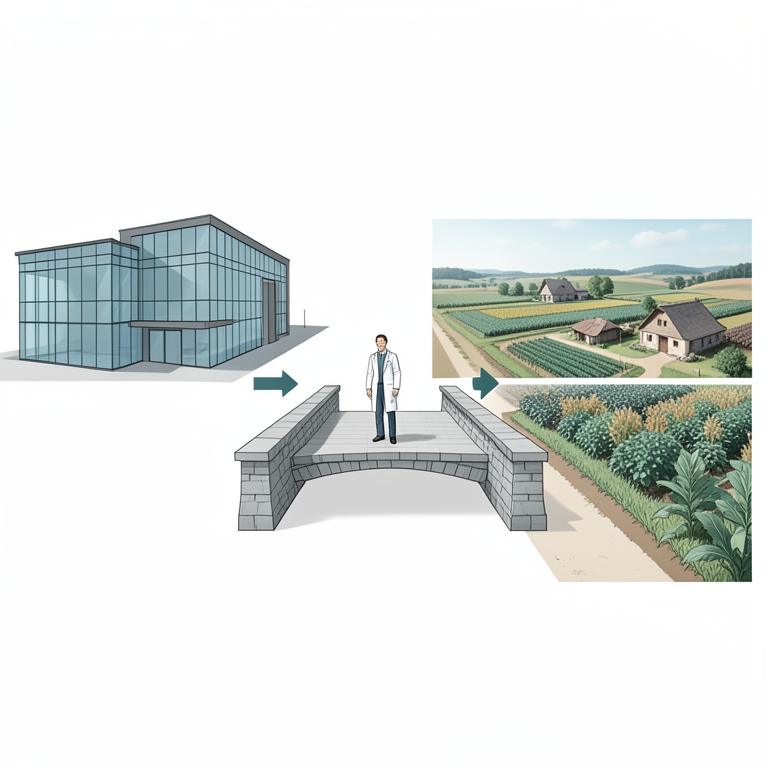
Knowledge Bridge Concept
AI-generated conceptual illustration (A scientific research center and a rural farming community with agricultural fields). It explains the idea and does not show study data.
View source evidence ↗Introduction
Community science is an approach that involves community members in conducting and using scientific research and technological innovation to advance their priorities and benefit from the knowledge and advancements of the science field. Engagement and Innovation are two key aspects of community science that enable communities to collaborate, co-create, and solve problems that matter to them.
Stakeholder's engagement
Stakeholders in community science are groups or individuals who have an interest or influence in the research process and outcomes. It includes community members, and institutions such as local, national, and international governments. Stakeholder engagement is the process of involving stakeholders in community science in a meaningful and respectful way. Stakeholder engagement can have various benefits such as ▪ Enhancing the relevance, quality, and impact of the research. ▪ Building trust, cooperation, and social capital among stakeholders. ▪ Empowering communities to address their own needs and challenges. ▪ Promoting ethical and participatory practices. ▪ Fostering innovation and learning among stakeholders.
There are many institutes that collaborate with community science, which is an approach that involves community members in conducting and using scientific research and technological innovation to advance their own priorities and benefit from the knowledge and advancements in science fields. Some examples of such institutes are:
Internships
An internship is a period of work experience offered by an organization for a limited period of time. It consists of an exchange of services for experience between the intern and the organization. They are typically undertaken by students and graduates looking to gain relevant skills and experience in a particular field. Employers benefit from these placements because they often recruit employees from their best interns, who have known capabilities, thus saving time and money in the long run. Interns may be high school students, college and university students, or postgraduate adults. Internships are used to determine if the interns still have an interest in that field after the real-life experience. In addition, an internship can be used to create a professional network that can assist with letters of recommendation and or lead to future employment opportunities. The benefits of bringing an intern into full-time employment is that they are already familiar with the company, and their position, and they typically need little to no training. Internships provide current college students the ability to participate in a field of choice to receive hands-on learning about a particular time work following graduation.
Objectives
▪ To experience an environment that stimulates and enhances effective learning and communication skills. ▪ To induct hands-on experience for students in professional fields through their experiences by developing their knowledge and skills. ▪ To cultivate capabilities, appropriate to the job scenario. ▪ To develop the attitudes, values, and critical thinking skills that the students need in order to take critical action in appropriate situations, including beyond the classroom environment, when necessary. ▪ To expose the students to professional role mode that will provide the students with support in the early stages of the internship. ▪ To assist the student's development of values skills such as teamwork, communication, and attention in detail. www.extensionjournal.com
Experiential learning programme (ELP)
ELP is for building skills in project development and execution, decision-making, individual and team coordination, approach to problem-solving, accounting, quality control, marketing and resolving conflicts, etc. The program has an end-to-end approach. Carefully calibrated activities move participants to explore and discover their own potential and, in the process, provide analytical skills and business acumen. Both activities and facilitation play a critical role in enhancing team performance. ELP thus provides the students an excellent opportunity to develop analytical and entrepreneurial skills, and knowledge through meaningful hands-on experience, and confidence in their ability to design and execute project work. ELP is of the components under the Student READY Programme that will be undertaken during the VII/ VIII semester. Experiential Learning is an opportunity for students to develop high-quality professional competence, skill development, and confidence to start their enterprise. This is a step towards "Earn while Learn". Experiential Learning aims towards practical work experience in real-life situations among undergraduate students and therefore it helps students become "Job providers rather than job seekers".
All
All
Conclusion
Community science plays a crucial role in bringing scientific research and innovations at the gross root level. By combining effective community engagement strategies with innovative technologies and educational initiatives, community science projects can not only gather valuable data but also foster a sense of shared ownership and excitement within the community.