
Research article · 2024 · Full text
International Journal of Advanced Biochemistry ResearchA study on information sharing behaviour on various categories of agricultural information received by the ICT tool user farmers
Volume 8(3) · Pages 591–594 · DOI: 10.33545/26174693.2024.v8.i3g.790 ↗
Research areasTechnology Adoption and User BehaviourDiverse Educational Innovations Studies
Abstract
Author-writtenICTs play a very crucial role in disseminating the timely farm information and aids in farm-management decisions. The study was conducted in the year 2017-18 in Shivamogga and Chikkamagaluru districts of Karnataka state. Simple random sampling technique was employed to collect the data from the 120 samples. The data was collected with the help of structured interview schedule. It was found that more than half (60.00%) of the ICT tool user farmers inferred that it has saved time in obtaining agricultural information. Further, 73.30 percent of What’s app users used less than 2 ICT sources of information. 76.70 percent of the KMAS user farmers used 2-3 ICT sources to obtain agricultural information. An insight into information sharing behaviour of ICT tool user farmers reveals that about 84.17 percent of the farmers regularly shared the information with friends, followed by 70.80 percent of the respondents occasionally shared the information with their family and peer group peoples.
Summary
Source-checkedPlain-language reading of the full paper, prepared with AI and checked against the text. Each point links to the authors' own words.
Why it matters
- Agricultural production must increase by 60% to meet the food demands of a world population expected to exceed 9 billion by 2050. View evidence ↗
- Because available cultivable land is decreasing, agricultural growth must rely on vertical expansion through improved cultivation practices. View evidence ↗
- Information and Communication Technology (ICT) tools are critical for providing farmers with timely agricultural information to support these improved practices. View evidence ↗
The question
- The study aims to understand the categories of agricultural information received by farmers using ICT tools and their subsequent information-sharing behavior. View evidence ↗
What they did
- The research was carried out during 2017-18 in the Chikkamagaluru and Shivamogga districts of Karnataka state. View evidence ↗
- Data was collected from 120 farmers using a simple random sampling technique and a pretested interview schedule. View evidence ↗
- The study purposively selected specific ICT tools: WhatsApp groups of KSDA and Kissan Call Centre (KCC) in Shivamogga, and the e-Krushika app and KVK Kissan Mobile Agro Advisory Services (KMAS) in Chikkamagaluru. View evidence ↗
- The collected responses were analyzed and tabulated using frequency and percentage techniques. View evidence ↗
What they found
- A majority of farmers (60.00%) believed that the amount of time saved in obtaining information depends on the specific technology or agricultural information involved. View evidence ↗
- Most WhatsApp users (73.30%) utilized fewer than two ICT sources for information. View evidence ↗
- A high percentage of KCC users (88.33%) and e-Krushika app users (60.00%) utilized more than three ICT sources. View evidence ↗
- The majority of KMAS users (76.70%) reported using between two and three ICT sources. View evidence ↗
- KMAS users received information across several categories, most notably in dairy (88.33%), organic farming (58.33%), and medicinal/aromatic crops (43.33%). View evidence ↗
- The majority of e-Krushika app users received information specifically regarding commercial and fruit crops. View evidence ↗
What it means
- The authors conclude that ICT is a primary driver of agricultural transformation, enabling better decision-making through efficient data analysis and weather forecasting. View evidence ↗
- The authors state that adopting ICT helps farmers transition from traditional paper-based tools to advanced automated technology solutions. View evidence ↗
Visual summary
2 visualsIllustrations explain the paper; charts are replotted from the paper's own table values.
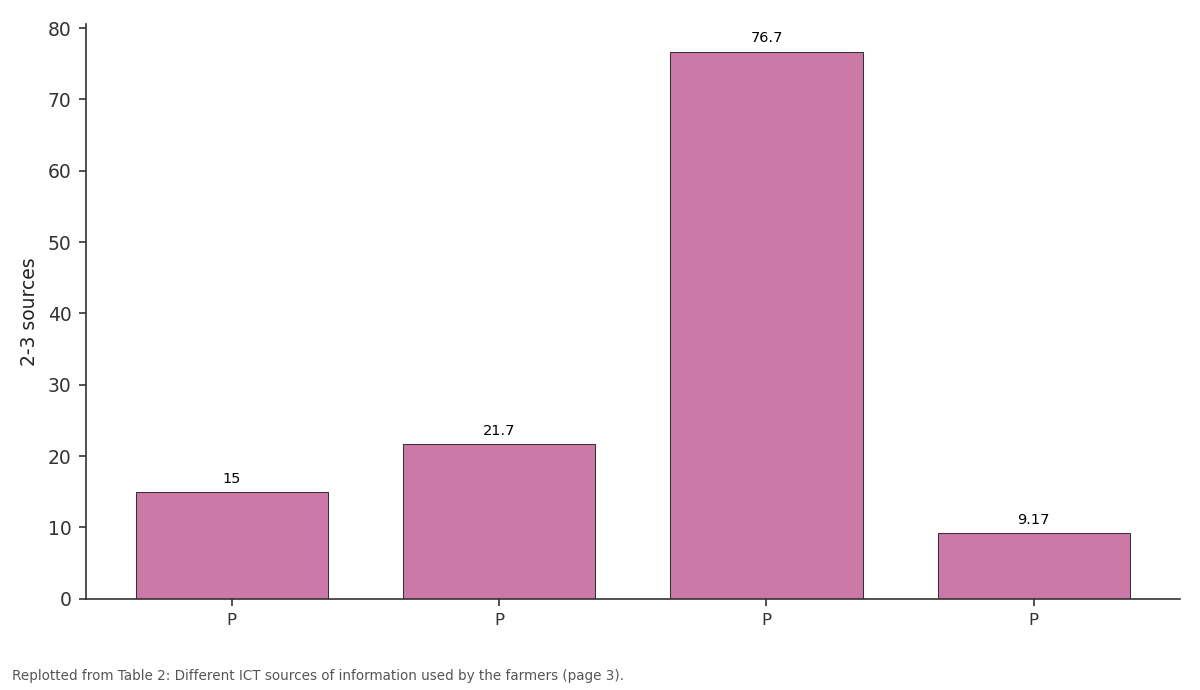
2-3 sources: P vs P vs P vs P
Replotted from Table 2 (page 3) of the original paper. Every bar is the paper's own table value.
View source evidence ↗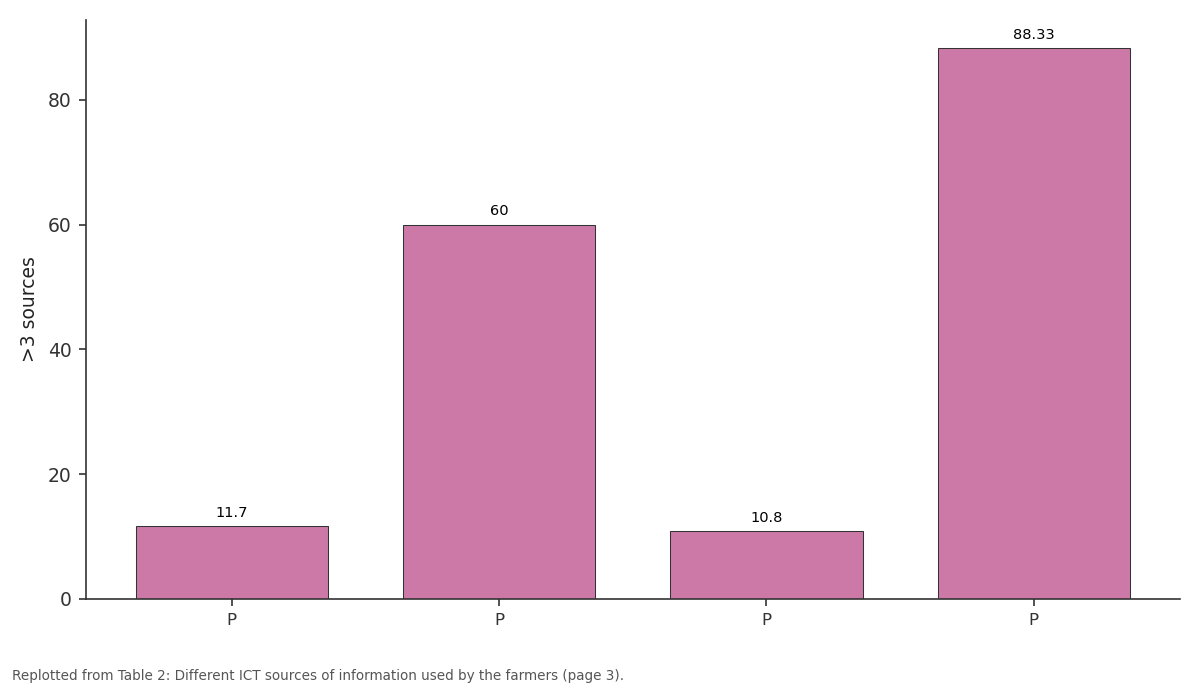
>3 sources: P vs P vs P vs P
Replotted from Table 2 (page 3) of the original paper. Every bar is the paper's own table value.
View source evidence ↗Figures & tables
From the original paper Table 1
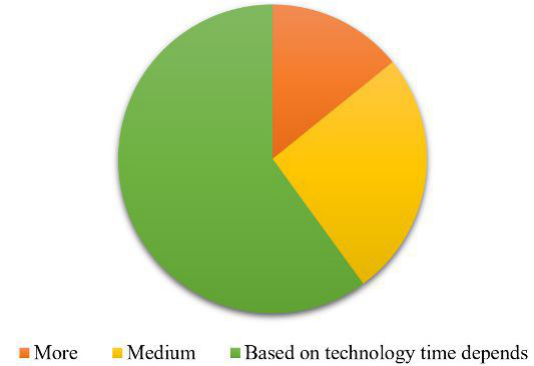 Figure 1
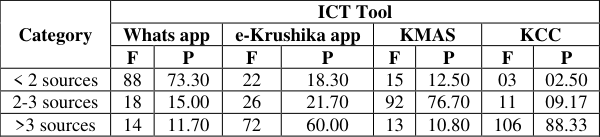 Table 2
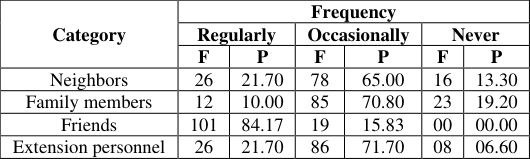 Table 3
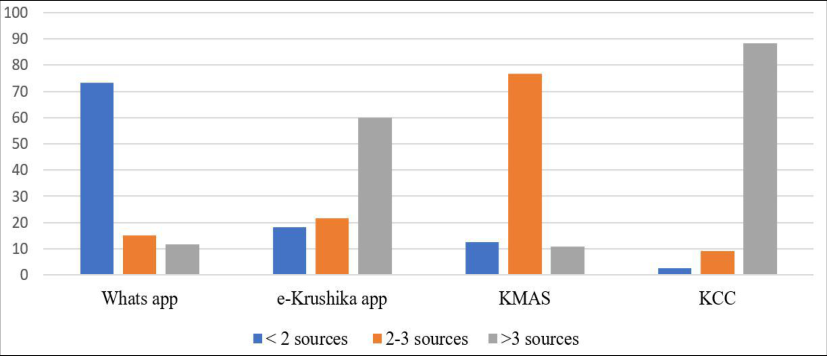 Figure 2
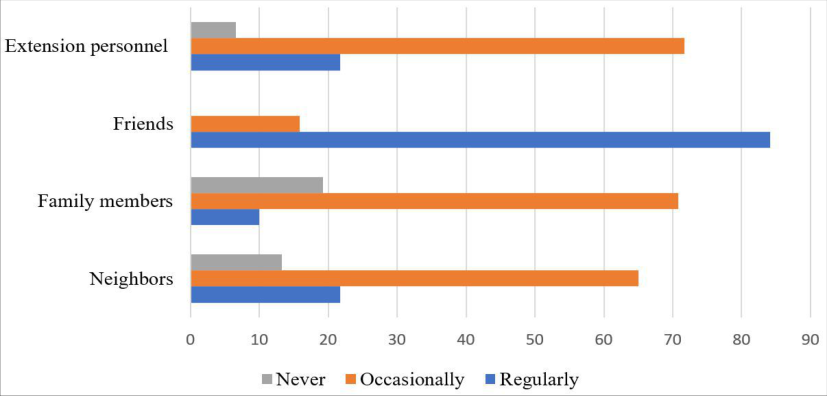 Figure 3
 Table 4
Introduction
The Information technology in recent years witnessed major changes and emerging as a powerful tool to accelerate agricultural growth in the developing country like India. The rapid growth in the IT sector, since the late 1980s and the use of ICT has intensely increased since the 1990s. The penetration so smart phone in the last two decades has increased i.e., 1.2 billion mobile phone users and 600 million smart phone users in India in 2022. World population is expected to exceed the 9 billion by 2050, and agricultural production will need to increase by 60 percent from its current levels to meet this additional food demand (Bansal, 2022) [1] . ICT applications in husbandry creates a significant contribution to meet the future needs. With the increasing population the available cultivable land is decreasing tremendously which restricts the horizontal expansion of the agricultural land (Ghosh, 2022) [4] . Hence vertical expansion is the only way to meet the same by the adoption of improved cultivation practices. Thus, it is essential to reach farmers with the authenticated information timely on various aspects of the farming. Traditional methods of reaching farmers will delay the process of diffusion and adoption of the technology. In this context ICT tools plays an important role by providing the timely information on various aspects of agriculture within no time. The time gap between information development and dissemination has significantly decreased because of technological advancements. Farmers are now better able to handle risks related to the weather, technology, prices, and many other factors. The appropriate use of ICT aids in overcoming hurdles related to time, place, language, and illiteracy. As a result, ICT has become a key driver of the contemporary knowledge-based economy, supporting the nation's socioeconomic development. ICTs helps the farmers by updating the information, further the useful, innovative, cost effective and drudge less technologies become viral and keeps farming community well-informed. Young farming groups escalates the use of mobile phones as they are easy, fast, and convenient means to communicate and get appropriate solutions to their problems. Nowadays, the mobile phone has generated an opportunity for the farmers specially to get the information about marketing and weather.
With the improvement in the technology, farmers are directly in touch with the market personnel and do trading at the reasonable prices. The use of mobile phone also keeps them aware about weather forecast, agriculture input application like fertilizer and pesticides which might be affected by unforeseen seen disasters as communicated by meteorological department. Increased mobile usage, improved network connectivity and various platforms has given new direction and approach to farmers to communicate directly and share about recent advances with each other (Fawole, O. P., and Murty, D. T., 2012) [3] . Considering the use of mobile phones different private organizations, govt. of India and ICAR had developed mobile applications for farmers to avail information about agriculture. Hence, the current study is to comprehend the information sharing behaviour and various categories of agricultural information received by the farmers using ICT tools.
Methodology
The study was conducted in Shivamogga and Chikkamagaluru districts of Karnataka State. In Shivamogga district the what's app group of KSDA and Kissan call centre were selected. Similarly, e-Krushika app and KVK Kissan mobile agro advisory services in Chikkamagaluru district were selected purposively. Under each district two taluks were selected. Under each taluk two villages were selected with a minimum of 5 km and maximum of 15 km radius from the taluk headquarters, where 15 farmers were randomly selected from each village.
Thus, the total sample constituted to 120. The data was collected using pretested interview schedule. The responses were scored, classified, analyzed, and tabulated with the help of frequency and percentage techniques Selection of the population: The farmers using the ICT tools in the Shivamogga and Chikkamagaluru districts were constituted as population of the study.
Selection of respondents:
From each village, fifteen farmers were selected by using simple random sampling technique. Thus 120 ICT user farmers were selected for the study.
Results and Discussion
Time saving in obtaining agricultural information by the ICT tool user farmers Information regarding time saved in obtaining agricultural information is presented in Table 1 and Fig 1 . Majority 60.00 percent of the farmers inferred that based on the technology/ agricultural information time depends. The possible reason may be that the latest technology will take more time to understand. The already used technology which is familiar to farmers will not take much time to understand. Whereas, the unknown/latest information will take more time to understand and adopt for their situations. Thus, farmers opined that the time saved based on previous exposure of the farmer on technology (Pavithra S., 2018 Patel R., 2023) [8,7] .
| Extent of time saving | Frequency | Percentage |
|---|---|---|
| More | 17 | 14.20 |
| Medium | 31 | 25.80 |
| Based on technology time depends | 72 | 60.00 |
Table text extracted from the original PDF; superscript letters are shown inline. The original table image is below.
View original table image
Different ICT sources of information used by the farmers
The data in the Table 2 and Fig. 2 infers the information about different ICT sources used by the farmers. Majority 73.30 percent of the What's app users used less than 2 ICT sources. The reason might be that the What's app tool user farmers were growing the field crops which were grown from the generations and they were satisfied with the information obtained on these crops. Thus, they might feel not required to use more than 2 ICT tools. Majority (60.00%) of the e-Krushika app users and 88.33 percent of the KCC user farmers were used more than 3 ICT sources.
| Category | ICT Tool | — | — | — | — | — | — | — |
|---|---|---|---|---|---|---|---|---|
| Whats app | e-Krushika app | KMAS | KCC | |||||
| F | P | F | P | F | P | F | P | |
| < 2 sources | 88 | 73.30 | 22 | 18.30 | 15 | 12.50 | 03 | 02.50 |
| 2-3 sources | 18 | 15.00 | 26 | 21.70 | 92 | 76.70 | 11 | 09.17 |
| >3 sources | 14 | 11.70 | 72 | 60.00 | 13 | 10.80 | 106 | 88.33 |
Table text extracted from the original PDF; superscript letters are shown inline. The original table image is below.
View original table image
The probable reason may be that majority of the farmers were the coffee and areca planters in addition cultivated other crops like banana, pepper, and cocoa, due to unavailability of information on various aspects in single tool. Hence the farmers might use more than 3 ICT sources. Whereas, 76.70 percent of the KMAS user farmers inferred that they used 2-3 ICT sources, this might be due to that though KMAS provide credible information again farmers might had checked the same information with the other sources (Panda, S., 2019 and Dechamma S., 2020) [6,2] .
Information sharing behaviour of ICT tool user farmers
The findings in the Table 3 and Fig. 3 revealed that about 84.17 percent of the farmers regularly shared the information with friends, followed by 70.80 percent of the respondents occasionally shared the information with their family members. The probable reason for sharing information with the friends was that they play important.
| Category | Frequency | — | — | — | — | — |
|---|---|---|---|---|---|---|
| Regularly | Occasionally | Never | ||||
| F | P | F | P | F | P | |
| Neighbors | 26 | 21.70 | 78 | 65.00 | 16 | 13.30 |
| Family members | 12 | 10.00 | 85 | 70.80 | 23 | 19.20 |
| Friends | 101 | 84.17 | 19 | 15.83 | 00 | 00.00 |
| Extension personnel | 26 | 21.70 | 86 | 71.70 | 08 | 06.60 |
Table text extracted from the original PDF; superscript letters are shown inline. The original table image is below.
View original table image
Categories of agricultural information received by the ICT tool user farmer
The results in Table 4 showed that out of four ICT tools KMAS user respondents inferred they received information on fruit crops (44.17%), flower crop (33.33%), medicinal and aromatic crops category (43.33%), organic farming category (58.33%) and dairy categories (88.33%). Out of seven categories of information farmers received maximum information on afore said categories. The probable reason for this was that KVK's are meant for provides pertinent information on crops growing region which covers all categories of crops (Dechamma S., 2020) [2] . One or other way the information is received by the farmers on these categories. Hence, maximum categories of information received from KMAS tools (Pujar S. S., 2021) [10] . Whereas, of e-Krushika app user farmers received fruit crops and commercial crops categories information, the e-Krushika app was operated in hilly region where majority of the farmers were plantation and fruit crop growers.
| ICT tools | Categories | — | — | — | — | — | — | — | — | — | — | — | — | — |
|---|---|---|---|---|---|---|---|---|---|---|---|---|---|---|
| Field crops | Fruit crops | Flower crops | Commercial crops | Medicinal & Aromatic crops | Organic farming | Dairy | ||||||||
| F | P | F | P | F | P | F | P | F | P | F | P | F | P | |
| Whats app | 27 | 22.50 | 38 | 31.67 | 37 | 30.83 | 20 | 16.67 | 32 | 26.67 | 31 | 25.84 | 12 | 10.00 |
| e-Krushika | 18 | 15.00 | 59 | 49.16 | 31 | 25.84 | 40 | 33.33 | 33 | 27.50 | 14 | 11.66 | 02 | 01.67 |
| KMAS | 53 | 44.17 | 15 | 12.50 | 40 | 33.33 | 27 | 22.50 | 52 | 43.33 | 70 | 58.33 | 106 | 88.33 |
| KCC | 22 | 18.33 | 08 | 06.67 | 12 | 10.00 | 33 | 27.50 | 03 | 02.50 | 05 | 04.17 | 00 | 00.00 |
Table text extracted from the original PDF; superscript letters are shown inline. The original table image is below.
View original table image
Conclusion
Information and Communications Technology, is a key driver of transformation in the agricultural sector. It enables efficient data collection and analysis, remote sensing, weather forecasting, optimized farming techniques, and improved decisions making processes. It is also a key enabler for the increased use of precision agriculture techniques, such as precision seeding, nutrient application and harvesting. ICT can be used to increase yields, reduce risks and improve sustainability. It is fundamental in improving crop production and production efficiency, from soil fertility monitoring to harvest management. Moreover, it helps farmers become more efficient and productive by facilitating timely decisions, enabling better monitoring of the production process, and optimizing the use of resources (Vivek, 2021) [11] . ICT can also help farmers take advantage of automation in the form of farm probes, sensors, and drones, which can be used to monitor crop growth, soil nutrients, and climate conditions. Using ICT in agriculture will help farmers reduce their dependence on traditional paper-based tools and move to more advanced, automated technology solutions.
References
9 in the original paper- Bansal V, Das L, Joshi V, Meena SC. Farmer's Awareness and Use of Different ICT Tools. Asian Journal of Agricultural Extension, Economics & Sociology. 2022;40(10):156-165.
- Dechamma S, Gowda G, Shanabhoga MB. Profile characteristics of the tomato growers with respect to different information and communication technology (ICT) gadgets in Karnataka. Journal of Pharmacognosy and Phytochemistry. 2020;9(1):1244-1251.
- Fawole OP, Olajide BR. Awareness and use of information communication technologies by farmers in Oyo State, Nigeria. Journal of agricultural & food information. 2012;13(4):326-337.
- Ghosh Mithun Kumar, Rafi SM, Iqbal Hasan Mahmud, Mursaleen Zebin Turin. "Assessment of the Farmers' Use of Ict Tools in Farming Practices." European Journal of Applied Sciences. 2022, 10(3).
- Murty DT, Abhinov T. Electronic media in rural agricultural business-A promotional injection. Abhinav National Monthly Refereed Journal of Research in Science & Technology. 2012;1(11):63-68.
- Panda S, Modak S, Devi YL, Das L, Pal PK, Nain MS. Access and usage of Information and Communication Technology (ICT) to accelerate farmers' income, 2019.
- Patel R, Thakkar MG. Awareness, expectations and usage of agricultural apps by farmers in Banaskantha district of Gujarat. The Pharma Innovation Journal. 2023;12(8):670-674.
- Pavithra S, Gracy CP, Saxena R, Patil GG. Innovations in agricultural marketing: a case study of e-tendering system in Karnataka, India. Agricultural Economics Research Review. 2018;31(1):53-64.
- Vivek MC, Sahana S. Socio-economic characteristics of the farmers following e-tendering system for Arecanut in Karnataka. Indian Research Journal of Extension Education. 2021;21:117-125.