
Research article · 2024 · Full text
International Journal of Research in AgronomyStudy of different Nitrogen levels on growth parameters of Kharif Onion (Allium cepa L.) under Malwa region
Volume 7(3) · Pages 113–115 · DOI: 10.33545/2618060x.2024.v7.i3b.393 ↗
Research areasGarlic and Onion StudiesIrrigation Practices and Water Management
Abstract
Author-writtenIn the present study three onion varieties i.e. Agrifound Red, Bhima Shubra Red and Bhima Sweta were grown under five different levels of nitrogen (i.e. 00, 60, 90, 120 and 150 Kg/ha) The effect of different treatments on different growth parameters [plant height (cm), number of leaves per plant, dry weight of shoot per plant (g), dry weight of bulb per plant (g), leaf area per plant (cm2), and days taken to maturity was studied. It was observed that in general growth parameters show positive response on application of nitrogen although among varieties response is varied.
Summary
Source-checkedPlain-language reading of the full paper, prepared with AI and checked against the text. Each point links to the authors' own words.
Why it matters
- Onion is recognized as one of the most important bulb crops grown globally. View evidence ↗
- India is the world's second-largest producer of onions, trailing only China. View evidence ↗
- Onions respond strongly to nutrients, particularly nitrogen, which is a critical component of chlorophyll and protein. View evidence ↗
The question
- The study aimed to investigate how different levels of nitrogen application affect the growth and yield of onion. View evidence ↗
What they did
- The researchers tested three onion varieties (Agrifound Red, Bhima Shubra Red, and Bhima Sweta) across five nitrogen levels: 0, 60, 90, 120, and 150 kg/ha. View evidence ↗
- The experiments took place during the kharif seasons of 2016-17 and 2019-20 in Mhow, Madhya Pradesh. View evidence ↗
- All plots received standard applications of phosphorus at 80 kg/ha and potassium at 60 kg/ha. View evidence ↗
- Growth was measured using five randomly selected plants per plot, tracking height, leaf count, shoot and bulb dry weights, leaf area, and maturity time. View evidence ↗
What they found
- The number of leaves per plant was lowest in the control group (7.71) and highest in Bhima Sweta at 150 kg/ha N (12.75). View evidence ↗
- Shoot dry weight was lowest for Agrifound Red in the control plot (2.23 g) and highest for Bhima Subhra Red at 90 kg/ha N (4.27 g). View evidence ↗
- Leaf area was smallest for Agrifound Dark Red in the control plot (144.53 cm²) and largest for Bhima Sweta at 90 kg/ha N. View evidence ↗
What it means
- The authors concluded that while growth parameters generally respond positively to nitrogen, the extent of this response varies by onion variety. View evidence ↗
Figures & tables
From the original paper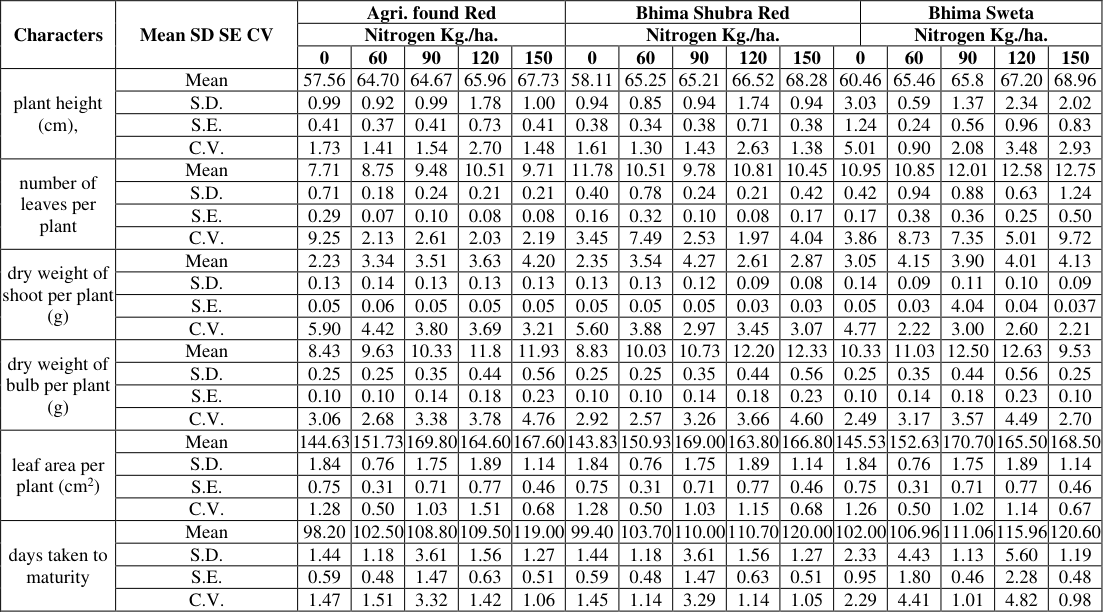 Table 1
Introduction
Onion (Allium cepa L., 2n = 16) is undeniably one of the most vital bulb crops cultivated worldwide. It falls under the botanical family Alliaceae and is believed to have originated in Central Asia, encompassing regions like Iran, Afghanistan, Pakistan, Tadzhikistan, and Uzbekistan. Often referred to as the 'Queen of the kitchen,' the onion holds a prominent place in culinary culture. The world's top four onion-growing countries are China, India, USA, and Turkey. India stands as the second-largest onion-producing nation globally, following China. In India, onion production is widespread across several key states, including Maharashtra, Karnataka, Tamil Nadu, Andhra Pradesh, Gujarat, Punjab, Haryana, Rajasthan, Uttar Pradesh, Bihar, and Madhya Pradesh. Onion holds the distinction of being the second most important vegetable globally, trailing only behind tomatoes in terms of significance. The cultivation of onions in India spans across an impressive 1,434 thousand hectares of land, yielding a substantial production of 26,738 thousand metric tonnes. Several factors influence both the yield and quality of onion seeds. These factors include the choice of cultivars, the weight and spacing of bulbs, the planting date, soil conditions, climate, and fertilizer application. Enhancing onion seed production can be achieved by expanding the cultivation area with high-quality varieties and adopting improved management practices. Onion is a highly nutrient responsive crop. Nitrogen is an essential element in all living systems and a major component of protein and chlorophyll. Under many agricultural settings, nitrogen is the limiting nutrient for high plant growth and yield. High levels of nitrogen nutrition prevent or delay onion bulb initiation under photoperiods which are marginal for bulb development whereas, under longer photoperiods, there is no effect of nitrogen supply. The ratio of bulb weight relative to leaf blade increases as the nitrogen levels in the soil decrease. Late application of nitrogen may delay bulb ripening and give rise to 'thicknecked' onions. On the other hand, nitrogen applied early in crop growth may accelerate maturity in irrigated crops or may have no effect on maturity (Brewster and Butler 1989) [3] . Keeping the above facts in view the present experiment was conducted to study the effect of nitrogen levels on growth and yield of onion.
Materials and Methods
The experiment was conducted during kharif season of 2016-17 and 2019-20 at Research Field, School of Agriculture, Dr. Bhim Rao Ambedkar University of Social Sciences, Mhow, Madhya Pradesh.
The experimental material consists of three varieties of onion viz. Agrifound Dark Red, Bhima Super and Bhima Red and five nitrogen levels i.e. 0 kg/ha, 60 kg/ha, 90 kg/ha,120 kg/ha and 150 kg/ha. The seed of three varieties was purchased from market to raise the seedlings. Raised nursery beds 15 cm height were prepared. The width of nursery bed was kept about be 90 cm and length 3 m. The distance in between two beds was kept about 50 cm. Before sowing, seed was treated with mencozeb @ 2.0 g/kg + carbendazim 1.0 g/kg seed to avoid damage of seedlings from disease. Sowing of seeds was done in line at a spacing 5 cm apart and covered with soil, thereafter, mulched with dry grass. Seed beds were irrigated regularly with the help of water can. Sowing was done on the 20 th July, 2016 and 15 th July 2019. After sowing of seeds, the seedlings were regularly irrigated with the help of water can till the seedling was ready for transplanting. Hand weeding and plant protection measure were taken as and when required. Recommended doses of phosphorus (80 kg/ha) and potassium (60 kg/ha) were applied in each plot. The dose of nitrogen (0, 60, 90, 120 and 150) kg/ha were applied to the respective plot. Observations was recorded for the five randomly selected plants for the traits plant height (cm), number of leaves per plant, dry weight of shoot per plant (g), dry weight of bulb per plant (g), leaf area per plant (cm 2 ), days taken to maturity. Results obtained were analyzed statistically to estimate mean, standard error, critical difference among treatments and coefficient of variation.
Results and Discussion
Observations recorded were analyzed and mean, standard deviation, standard error and coefficient of variation was calculated. Estimates of these parameters are presented in table no. 1. Highly significant variation was observed among all the treatments for all the six characters studied. While analyzing the mean data of both the season lowest plant height was reported in the variety Agrifound Red under control plot (57.56 cm) and highest plant height was observed in the variety Bhima Sweta (68.96) at nitrogen level 150 kg/ha. Minimum number of leaves was reported in control plot (7.71) while maximum number of leaves was recorded in the variety Bhima Sweta (12.75) at nitrogen level 150 kg/ha. Minimum dry weight of shoots was reported in control plot (2.23) for the variety Agri found Red while maximum dry weight of shoot was recorded in the variety Bhima Subhra Red (4.27) at nitrogen level 90 kg/ha. On observing the data of dry weight of bulb it was reported that variety Agrifound dark Red have minimum value (8.43) without application of nitrogen while maximum dry weight (2.63) was observed in the variety Bhima Shweta at nitrogen level 120kg/ha. Leaf area ranged from 144.63 to 170.70 cm 2 . Value of leaf area was least for the variety Agrifound dark Red under control plot (144.53) and highest value of leaf area was recorded for the variety Bhima Shweta at nitrogen level 90 kg/ha. Days to maturity ranged from 98.2 to 120.60. Early maturity was reported in the Agrifound dark Red under control plot (98.2 days) while on application of maximum level of nitrogen i.e. 150 kg/ha. Maturity was delayed. Variety Bhima Shweta take maximum duration i.e. 120.6 days for maturing at nitrogen level 150 kg/ha. Similar findings were also reported by Ahmed and Abdalla (1984) [2] , Brewster and Butler (1989) [3] and Naruka et al. (2005) [8] .
Figures and tables from the paper
| Characters | Mean SD SE CV | Agri. found Red | — | — | — | — | Bhima Shubra Red | — | — | — | — | — | Bhima Sweta | — | — | — | — |
|---|---|---|---|---|---|---|---|---|---|---|---|---|---|---|---|---|---|
| Nitrogen Kg./ha. | Nitrogen Kg./ha. | Nitrogen Kg./ha. | |||||||||||||||
| 0 | 60 | 90 | 120 | 150 | 0 | 60 | 90 | 120 | 150 | 0 | 60 | 90 | 120 | 150 | |||
| plant height (cm), | Mean | 57.56 | 64.70 | 64.67 | 65.96 | 67.73 | 58.11 | 65.25 | 65.21 | 66.52 | 68.28 | 60.46 | 65.46 | 65.8 | 67.20 | 68.96 | |
| S.D. | 0.99 | 0.92 | 0.99 | 1.78 | 1.00 | 0.94 | 0.85 | 0.94 | 1.74 | 0.94 | 3.03 | 0.59 | 1.37 | 2.34 | 2.02 | ||
| S.E. | 0.41 | 0.37 | 0.41 | 0.73 | 0.41 | 0.38 | 0.34 | 0.38 | 0.71 | 0.38 | 1.24 | 0.24 | 0.56 | 0.96 | 0.83 | ||
| C.V. | 1.73 | 1.41 | 1.54 | 2.70 | 1.48 | 1.61 | 1.30 | 1.43 | 2.63 | 1.38 | 5.01 | 0.90 | 2.08 | 3.48 | 2.93 | ||
| number of leaves per plant | Mean | 7.71 | 8.75 | 9.48 | 10.51 | 9.71 | 11.78 | 10.51 | 9.78 | 10.81 | 10.45 | 10.95 | 10.85 | 12.01 | 12.58 | 12.75 | |
| S.D. | 0.71 | 0.18 | 0.24 | 0.21 | 0.21 | 0.40 | 0.78 | 0.24 | 0.21 | 0.42 | 0.42 | 0.94 | 0.88 | 0.63 | 1.24 | ||
| S.E. | 0.29 | 0.07 | 0.10 | 0.08 | 0.08 | 0.16 | 0.32 | 0.10 | 0.08 | 0.17 | 0.17 | 0.38 | 0.36 | 0.25 | 0.50 | ||
| C.V. | 9.25 | 2.13 | 2.61 | 2.03 | 2.19 | 3.45 | 7.49 | 2.53 | 1.97 | 4.04 | 3.86 | 8.73 | 7.35 | 5.01 | 9.72 | ||
| dry weight of shoot per plant (g) | Mean | 2.23 | 3.34 | 3.51 | 3.63 | 4.20 | 2.35 | 3.54 | 4.27 | 2.61 | 2.87 | 3.05 | 4.15 | 3.90 | 4.01 | 4.13 | |
| S.D. | 0.13 | 0.14 | 0.13 | 0.13 | 0.13 | 0.13 | 0.13 | 0.12 | 0.09 | 0.08 | 0.14 | 0.09 | 0.11 | 0.10 | 0.09 | ||
| S.E. | 0.05 | 0.06 | 0.05 | 0.05 | 0.05 | 0.05 | 0.05 | 0.05 | 0.03 | 0.03 | 0.05 | 0.03 | 4.04 | 0.04 | 0.037 | ||
| C.V. | 5.90 | 4.42 | 3.80 | 3.69 | 3.21 | 5.60 | 3.88 | 2.97 | 3.45 | 3.07 | 4.77 | 2.22 | 3.00 | 2.60 | 2.21 | ||
| dry weight of bulb per plant (g) | Mean | 8.43 | 9.63 | 10.33 | 11.8 | 11.93 | 8.83 | 10.03 | 10.73 | 12.20 | 12.33 | 10.33 | 11.03 | 12.50 | 12.63 | 9.53 | |
| S.D. | 0.25 | 0.25 | 0.35 | 0.44 | 0.56 | 0.25 | 0.25 | 0.35 | 0.44 | 0.56 | 0.25 | 0.35 | 0.44 | 0.56 | 0.25 | ||
| S.E. | 0.10 | 0.10 | 0.14 | 0.18 | 0.23 | 0.10 | 0.10 | 0.14 | 0.18 | 0.23 | 0.10 | 0.14 | 0.18 | 0.23 | 0.10 | ||
| C.V. | 3.06 | 2.68 | 3.38 | 3.78 | 4.76 | 2.92 | 2.57 | 3.26 | 3.66 | 4.60 | 2.49 | 3.17 | 3.57 | 4.49 | 2.70 | ||
| leaf area per plant (cm2) | Mean | 144.63 | 151.73 | 169.80 | 164.60 | 167.60 | 143.83 | 150.93 | 169.00 | 163.80 | 166.80 | 145.53 | 152.63 | 170.70 | 165.50 | 168.50 | |
| S.D. | 1.84 | 0.76 | 1.75 | 1.89 | 1.14 | 1.84 | 0.76 | 1.75 | 1.89 | 1.14 | 1.84 | 0.76 | 1.75 | 1.89 | 1.14 | ||
| S.E. | 0.75 | 0.31 | 0.71 | 0.77 | 0.46 | 0.75 | 0.31 | 0.71 | 0.77 | 0.46 | 0.75 | 0.31 | 0.71 | 0.77 | 0.46 | ||
| C.V. | 1.28 | 0.50 | 1.03 | 1.51 | 0.68 | 1.28 | 0.50 | 1.03 | 1.15 | 0.68 | 1.26 | 0.50 | 1.02 | 1.14 | 0.67 | ||
| days taken to maturity | Mean | 98.20 | 102.50 | 108.80 | 109.50 | 119.00 | 99.40 | 103.70 | 110.00 | 110.70 | 120.00 | 102.00 | 106.96 | 111.06 | 115.96 | 120.60 | |
| S.D. | 1.44 | 1.18 | 3.61 | 1.56 | 1.27 | 1.44 | 1.18 | 3.61 | 1.56 | 1.27 | 2.33 | 4.43 | 1.13 | 5.60 | 1.19 | ||
| S.E. | 0.59 | 0.48 | 1.47 | 0.63 | 0.51 | 0.59 | 0.48 | 1.47 | 0.63 | 0.51 | 0.95 | 1.80 | 0.46 | 2.28 | 0.48 | ||
| C.V. | 1.47 | 1.51 | 3.32 | 1.42 | 1.06 | 1.45 | 1.14 | 3.29 | 1.14 | 1.05 | 2.29 | 4.41 | 1.01 | 4.82 | 0.98 |
Table text extracted from the original PDF; superscript letters are shown inline. The original table image is below.
View original table image
References
8 in the original paper- Anonymous, 2019-20. Final Area and Production Estimates for Horticulture Crops for 2009-2010.
- Ahmed IH, Abdalla AA. Nitrogen and phosphorus fertilization in relation to seed production in onion Allium cepa L. Acta Hortic. 1984;143:119-126.
- Brewster JL, Butler HA. Effect of nitrogen supply on bulb development in onion (Allium cepa L.). Journal of Experimental Botany. 1989;40(10):1155-1162.
- Ibrahim NS, AI Abdalla, GH Mohamedali, Khiery NT. Correlation study of physicochemical properties of some Sudanese onion genotypes (Allium cepa L.). Int. J Hortic Food Sci 2022;4(2):194-198.
- Nuru Seid Tehulie, Selamsew Endeg, Amare Hunegnaw, Andualem Kebede. Review on the effect of nitrogen and phosphorus fertilizer rates on seed yield of onion (Allium cepa L.). Int. J Hortic Food Sci. 2021;3(1):13-16.
- Haque MI, Zaman MM, Hasan MK, Mahfuza Begum, Pervin F. Growth and yield of onion as influenced by nitrogen and irrigation. Journal of Agriculture and Rural Development. 2004;2(1):151-153.
- Tiwari RS, Agarwal A, Sengar SC, Agarwal A. Effect of doses and methods of nitrogen application on growth, bulb yield and quality of 'Pusa Red' onion (Allium cepa). Indian Journal of Agricultural Sciences. 2002;72(1):23-25.
- Naruka IS, Singh PP, Rathore SS, Singh M. Influence of nitrogen and sulphur application on growth and yield of onion. In: National Seminar on Agro-technology, Quality, Processing and Export of Spices J.N.K.V.V. Jabalpur, 2005, 52.