
Research article · 2024 · Full text
International Journal of Advanced Biochemistry ResearchStudy on food safety awareness and its correlation with socioeconomic factors of consumers in Nagpur city, Maharashtra
Volume 8(2S) · Pages 445–449 · DOI: 10.33545/26174693.2024.v8.i2sf.632 ↗
Research areasFood Safety and Hygiene
Abstract
Author-writtenA survey (sample size of 400) was conducted using a proportionate random sampling method. A bilingual (Marathi and English) questionnaire comprising questions related to consumer preferences, awareness of consumers regarding the type of meat and hygiene and expenses they incurred on meat and meat products was designed. This study aimed to investigate the actual level of food safety knowledge of consumers and its correlation with socioeconomic factors that are responsible for shaping the food safety mindset of consumers. The majority of the respondents (65.2%) were unaware of the Food Safety and Standards Act (FSSAI) in meat production. The majority of the consumers (80.8%) were unaware of the FSSAI registration or HACCP certification of meat shops from where they purchased meat. The results indicated that most of the respondents (75%) were unaware of animal welfare issues for the slaughter of animals by a humane method.
Summary
Source-checkedPlain-language reading of the full paper, prepared with AI and checked against the text. Each point links to the authors' own words.
Why it matters
- Food contamination is a significant issue because it imposes heavy social and economic burdens on communities and public health systems. View evidence ↗
- A high rate of foodborne illness in home settings may be caused by a lack of awareness regarding proper food hygiene and preparation practices. View evidence ↗
- The way consumers perceive food safety and the factors they consider when choosing products can either reduce or increase the risk of foodborne illness. View evidence ↗
The question
- The study aimed to determine the level of food safety knowledge among consumers and how this knowledge correlates with socioeconomic factors. View evidence ↗
What they did
- Researchers conducted a survey of 400 respondents in Nagpur, Maharashtra, India, using a proportionate random sampling method. View evidence ↗
- Data was collected through structured personal interviews using a bilingual (Marathi and English) questionnaire covering consumer preferences, hygiene awareness, and meat expenses. View evidence ↗
- The collected data were analyzed using Microsoft Excel and IBM SPSS, with results presented as frequencies and percentages. View evidence ↗
What they found
- Most consumers (65.2%) lacked awareness of the Food Safety and Standards Act (FSSAI) as it relates to meat production. View evidence ↗
- A large majority of consumers (80.8%) did not know if the meat shops they frequented were HACCP certified or FSSAI registered. View evidence ↗
- Three-quarters of the respondents (75%) were unaware of animal welfare issues regarding humane slaughter methods. View evidence ↗
- Most participants (77.7%) believed that proper home cooking is sufficient to kill all pathogens in meat. View evidence ↗
- While 42.5% of consumers preferred buying meat from roadside vendors, 77.3% of respondents were dissatisfied with the hygiene at those locations. View evidence ↗
- There is a positive and statistically significant correlation between a consumer's education and income levels and their consumption of hygienically processed meat. View evidence ↗
- Higher education levels are positively and significantly correlated with increased awareness of food safety standards and the Food Safety Act. View evidence ↗
- Interestingly, higher income levels showed a positive and statistically significant correlation with a preference for consuming meat from roadside vendors. View evidence ↗
What it means
- The authors conclude that while consumers are thinking about food safety, significant gaps in knowledge and practice persist, which could lead to foodborne diseases. View evidence ↗
- The authors recommend implementing training and awareness programs to educate consumers on meat hygiene and quality. View evidence ↗
Figures & tables
From the original paper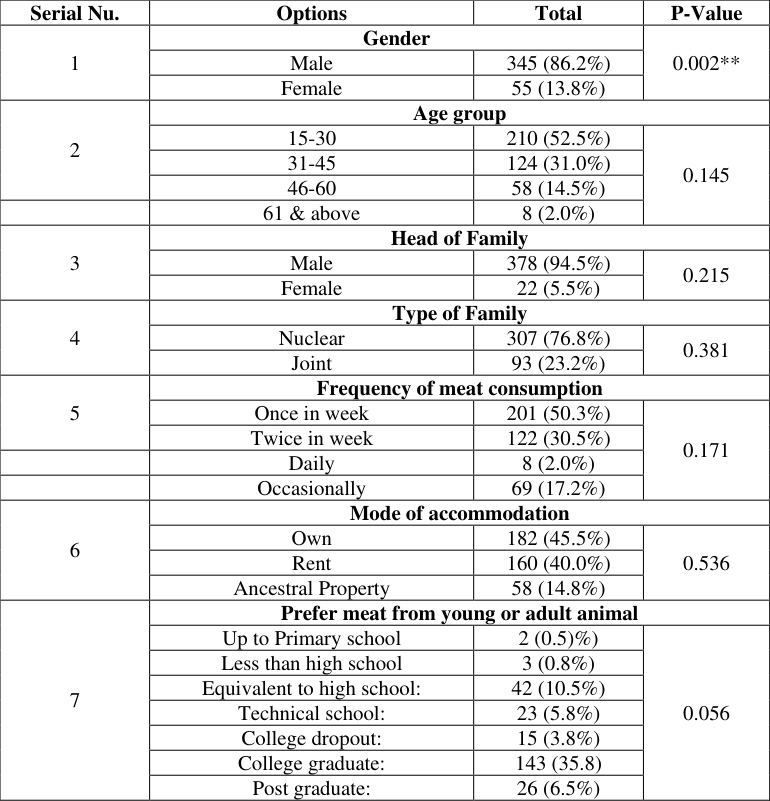 Table 1
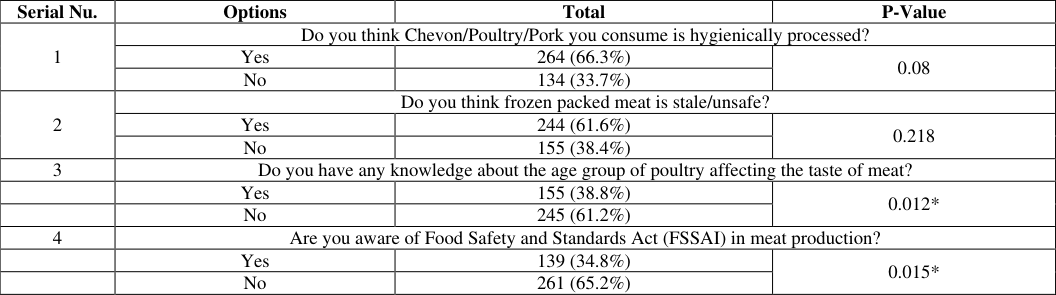 Table 2
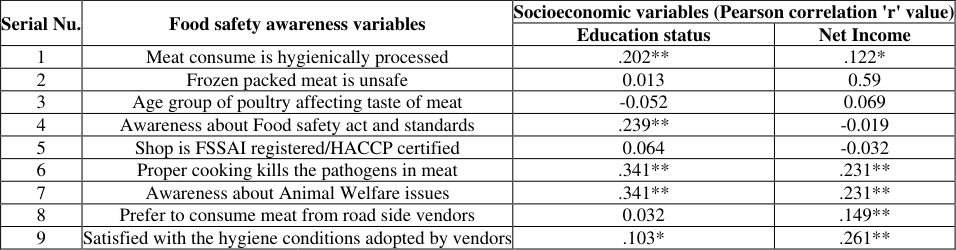 Table 3
Introduction
Consumer decisions and purchasing power drive food systems; thus, consumers play a critical role in any effective food safety system. Consumer demand and preference for meat have increased in metro cities in Maharashtra. The major factors influencing such an increase are economic growth, urbanization, and improved income levels of a growing middle class. Food safety is of crucial importance to the consumer, food industry and economy. Food contamination creates an enormous social and economic burden on communities and their health systems. Food and Agriculture Organization (FAO) and World Health Organization (WHO) provide strict guidelines and regulations, for food processing, handling and consumption. In India Government has its own governing body the Food Safety and Standards Authority of India (FSSAI), which also supervises food safety and provides regulatory standards for food production. Despite many regulations and guidelines, the incidences of food-borne illness continue to prevail. The high prevalence of foodborne illness at home could be attributed to poor food hygiene and preparation due to poor awareness of proper practices. Food safety assurance of meat requires a concerted effort throughout the value chain to ensure microbial contamination and proliferation are adequately restricted by implementing appropriate food control strategies. When food is unsafe, nutritional benefits are lost. More so, unsafe foods resulting in diarrhoeal diseases have additional consequences including nutrient loss, malabsorption, loss of appetite and reduced immunity to other diseases. That includes consumers, who are at the tail end of food value chains. Consumer perception of food safety, and food safety factors considered in choosing food products can either mitigate or increase the risk of foodborne illnesses. Information on consumer food safety behaviour and how these may influence consumer exposure to food safety hazards through meat consumption in Nagpur city is limited. An enhanced understanding of the social, scientific, and technological factors that influence meat safety is important to drive the development of appropriate interventions to support food safety efforts and reduce public health risks from meat consumption.
The present study is being conducted to assess the awareness, knowledge and practice of food safety among the urban population in Nagpur city of Maharashtra state.
Materials and Methods
The study was conducted in Nagpur, the sub-capital city of Maharashtra, India. The city lies on the Deccan Plateau of the Indian subcontinent and has a mean altitude of 310.5 meters above sea level. As of the 2011 census, Nagpur City had a population of 2,405,665. Nagpur is the third largest city and an important economic centre of the Vidarbha region of Maharashtra. The city has shown enhanced industrial development that was augmented by quick urbanization. This resulted in a rise in the number of people earning varied incomes living in these cities. A citizen living in Nagpur city has the combined advantage of having access to different consumer goods and fresh meat and meat products since ample meat and meat products are produced in areas adjoining the city. The survey's sample size of 400 respondents was taken by dividing Nagpur city into four zones, using a proportionate random sampling method. The pertinent data was gathered from the respondents to fulfil the research objectives. A bilingual (Marathi and English) questionnaire/interview schedule comprising questions related to socio-economic and educational particulars of the consumers, meat consumption patterns and factors influencing meat consumption. The researcher personally interviewed the respondents to gather the data by employing a structured interview format. During the interview, the researchers also had an opportunity to evaluate the quality of opinions, knowledge and choices of the respondents about varied meat and meat products. Photography, interviews and questionnaires were the main data collection tools.
Statistical analysis:
The data obtained through survey forms were recorded, tabulated, and analysed statistically using IBM Statistical Package for Social Science (SPSS) and Microsoft Excel. The responses were grouped and presented in the form of frequencies and percentages.
Results and Discussion
Results and Discussion
Socio-economic and educational background
The socioeconomic and educational background of the respondents has been presented in Table 1. The gender of the majority of respondents was male (86.2%), and female respondents were 13.8%. However, there was a highly significant (p<0.05) variation in the gender population in Nagpur city. Similar findings were observed by Waghmare et al. (2021) [15] , who reported that 89.12% of males were consumers in an online survey conducted in Maharashtra. Moreover, Gossard and York, (2003) [6] found that some factors associated with gender, age, place of residence (Urban or Rural), eating habits and social status of consumers affect meat consumption preference and amount of consumption. The age group of the majority of respondents is from the age group 15-30 years (52.5%), followed by 31-45 years (31.0%) and 46-60 years (14.5%). The major advantage of the current study group is that most respondents were from the young (15-30 years) and middle age groups (31-45 years), respectively, which make up a significant group of the population having a huge impact on the consumption and purchase of meat and meat products. Among all respondents, 94.5% of men were heading the family showing male dominance, whereas only 5.5% of female respondents were head of the family. In Indian conditions, majority of females are involved in household work and restricted only to cooking, whereas meat purchasing activities are handled by males (Kiran et al. 2018) [7] . Most respondents in Nagpur city were from the nuclear family (76.8%), while only 23.2% were from joint families. The results were well supported by Talukder et al. (2020) [14] , who reported the presence of nuclear families in most consumers in North Indian cities. Among the respondents, 45% of them own their homes, whereas 40% live in rented houses, and only 14.5% live in ancestral property.
| Serial Nu. | Options | Total | P-Value |
|---|---|---|---|
| 1 | Gender | 0.002** | |
| Male | 345 (86.2%) | ||
| Female | 55 (13.8%) | ||
| 2 | Age group | ||
| 15-30 | 210 (52.5%) | 0.145 | |
| 31-45 | 124 (31.0%) | ||
| 46-60 | 58 (14.5%) | ||
| 61 & above | 8 (2.0%) | ||
| 3 | Head of Family | ||
| Male | 378 (94.5%) | 0.215 | |
| Female | 22 (5.5%) | ||
| 4 | Type of Family | ||
| Nuclear | 307 (76.8%) | 0.381 | |
| Joint | 93 (23.2%) | ||
| 5 | Frequency of meat consumption | ||
| Once in week | 201 (50.3%) | 0.171 | |
| Twice in week | 122 (30.5%) | ||
| Daily | 8 (2.0%) | ||
| Occasionally | 69 (17.2%) | ||
| 6 | Mode of accommodation | ||
| Own | 182 (45.5%) | 0.536 | |
| Rent | 160 (40.0%) | ||
| Ancestral Property | 58 (14.8%) | ||
| 7 | Prefer meat from young or adult animal | ||
| Up to Primary school | 2 (0.5)%) | 0.056 | |
| Less than high school | 3 (0.8%) | ||
| Equivalent to high school: | 42 (10.5%) | ||
| Technical school: | 23 (5.8%) | ||
| College dropout: | 15 (3.8%) | ||
| College graduate: | 143 (35.8) | ||
| Post graduate: | 26 (6.5%) |
Table text extracted from the original PDF; superscript letters are shown inline. The original table image is below.
View original table image
Regarding the educational background of respondents, most were college graduates (35.8%), whereas 34.3% had professional education. In all, only 6.5% of respondents had a postgraduate degree. The findings were parallel with Reddy and Raju (2010) [9] , who reported that the majority of urban consumers (75%) in Hyderabad were either graduates or postgraduates. About 43% of the respondents reported having a family income of more than 6 lakhs, followed by 4-6 lakhs (27.8%), 2-4 lakhs (15.2%) and less than 2 lakhs (14%). However, there was a significant variation (p<0.05) in family income in Nagpur city.
Consumer awareness and hygiene considerations regarding meat
The analysed data on consumer awareness and hygiene considerations regarding meat in and around Nagpur city has been depicted in Table 2. Most respondents (66.3%) reported that the meat (goat/sheep meat/poultry/pork) was purchased from the shop, as against 33.7% of consumers who think the meat was not processed hygienically. The finding was in line with earlier findings of Raju and Suryanarayana (2005) [5] , Singh et al. (2019) [10] and Waghmare et al. (2021) [15] , who reported that nearly 42.78% of consumers were concerned about the meat retail shop's cleanliness and hygienic condition when they buy non-vegetarian products. This shows that consumers are concerned about food safety but unaware of the quality guidelines and standards. In contrast to the present finding, Bafanda et al. (2017) [1] reported that fewer consumers are concerned about the hygienic processing, slaughtering, and dressing of healthy animals in Jammu.
| Serial Nu. | Options | Total | P-Value |
|---|---|---|---|
| 1 | Do you think Chevon/Poultry/Pork you consume is hygienically processed? | ||
| Yes | 264 (66.3%) | 0.08 | |
| No | 134 (33.7%) | ||
| 2 | Do you think frozen packed meat is stale/unsafe? | ||
| Yes | 244 (61.6%) | 0.218 | |
| No | 155 (38.4%) | ||
| 3 | Do you have any knowledge about the age group of poultry affecting the taste of meat? | ||
| Yes | 155 (38.8%) | 0.012* | |
| No | 245 (61.2%) | ||
| 4 | Are you aware of Food Safety and Standards Act (FSSAI) in meat production? | ||
| Yes | 139 (34.8%) | 0.015* | |
| No | 261 (65.2%) |
Table text extracted from the original PDF; superscript letters are shown inline. The original table image is below.
View original table image
Results show that most consumers (61.6%) marked frozen packed food as stale and unsafe. The present findings were in accordance with the findings of Singh et al. (2019) [10] , who reported that 60.0% of consumers thought frozen pack meat was stale/unsafe. Similarly, Chandirasekaran et al.
(2021) [4] reported that out of 120 respondents, no one prefers frozen meat in Madurai.
In the query regarding knowledge that poultry's age affects the meat taste, 61.2% of respondents were unaware of the age group of poultry affecting the taste of meat. However, there was a significant variation in consumers of different zones regarding the awareness effect of the age of poultry on meat taste. The finding agrees with Singh et al. (2019) [10] , who reported that most consumers (58.50-68.0%) were unaware that the age of poultry affects the taste of meat and cannot judge broiler or spent hen meat by tasting it. The majority of the respondents (65.2%) were unaware of the Food Safety and Standards Act (FSSAI) in meat production. It might be due to the fact that most respondents lack knowledge about food safety and quality guidelines for food. The results agreed with the findings of Singh et al.
(2019) [10] , who reported unawareness of 53.5-75% of respondents from the entire four zones in Ludhiana. Kiren et al. (2018) [7] indicated that only 37.7% of respondents were aware of FSSAI and its role in Southern India. The majority of the consumers (80.8%) were unaware of the FSSAI registration or HACCP certification of meat shops from where they purchased meat. This unawareness was in consumers of the entire zone (75% to 84%), with nonsignificant variation among the zones. The findings were in parallel with Kiren et al. (2018) [7] and Waghmare et al. (2021) [15] , who reported that about 85.4% and 85.49% of consumers in Southern India and Maharashtra, respectively, were unaware of whether the meat-selling shops where they buy non-veg were registered with FSSAI or not. Singh et al. (2019) [10] found that 60-84.5% of shops/retail outlets where they purchase meat were not FASSI registered or HACCP certified in Ludhiana city. These findings corroborate with Suresh (2016) [13] , who reported that meat purchases from registered meat shops were relatively low at 22% and 20% in Delhi and Hyderabad, respectively. Bafanda et al. (2017) [1] observed that very few respondents enquired about the license of the shop and meat inspection reports. In the query regarding whether traditional cooking kills all the pathogens in meat, it was observed that 77.7% of participants opined that proper meat cooking at home kills all the pathogens. These findings might be due to mass campaigns and awareness programs conducted by the government and media during an avian flu outbreak. The findings were commensurate with the earlier findings of Kiran et al. (2018) [7] , who reported that traditional cooking practices in India destroy most meat-borne pathogens. Similarly, Singh et al. (2019) [10] reported that 61.0-92.0% of consumers think proper home cooking kills all pathogens. The results indicated that most of the respondents (75%) were unaware of animal welfare issues for the slaughter of animals by a humane method. This unawareness was recorded in the entire zone (73-79%) of Nagpur city with non-significantly (p>0.05) variation. The results were well supported by the earlier finding of Waghamare et al. (2021) [15] , who reported that about 68.59% of consumers preferred chicken carcasses to be slaughtered by any ritual method.
Lower findings than the current study recorded by Singh et al. (2019) [10] , who reported that 46.50%-57.0% of respondents were unaware of the slaughter of animals by a humane method in all four zones of Ludhiana. Contrary to current findings, Suresh (2016) [13] and Chandirasekaran et al. (2021) [4] reported that most respondents (81.91% and 100%, respectively) prefer to buy fresh meat from roadside meat shops. The results indicated that 42.5% of consumers in the city preferred roadside vendors for meat purchases. In all, 57.5% of consumers had a negative preference for meat from roadside vendors. Current findings align with Singh et al. (2019) [10] found negative preference in 81.5-88.5% of consumers for people show for meat from roadside vendors in Ludhiana. In contrast, most respondents (77.3%) were dissatisfied with the hygienic conditions adopted by roadside vendors. These findings were in accordance with the earlier finding of Durmus et al. (2012) [5] , who reported dissatisfaction of 61% of participants since poultry meat production was not inspected adequately in Turkey. Singh et al. (2019) [10] reported that the respondents (68.50-88.50%) from all four zones of Ludhiana were not satisfied with the hygienic conditions adopted by roadside vendors. However, Waghmare et al. (2021) [15] reported that only 42.78 percent of consumers weren't satisfied with the hygienic conditions and cleaning practices adopted by meat shops in Maharashtra. These results were well supported by the findings of Srinivas et al. (2018) [11] and Babu et al. (2010) [3] , who reported the taste as a significant reason for meat consumption in Jagital and Chittoor. Ayman et al. (2021) [2] reported that most consumers were habituated to chevon and mutton as the main reason for meat consumption in Srinagar. Sunitha (2019) [12] also reported that the major reason for meat consumption was its habit (32%) and health benefits (28%) in Vilavancode, Tamil Nadu. The analysed data on the correlation between socioeconomics and food safety awareness has been depicted in Table 3. The correlation between the net income, education status of respondents and the meat they consume hygienically processed is positive and statistically significant. It reveals that the education status of consumers impacts on the consumption of hygienically processed meat. The correlation between the education status of consumers and their awareness of the Food Safety Act and standards was found to be positive and statistically significant. It indicates that the education status of respondents increases awareness about various food safety acts. Similarly, the correlation between the net income and education status of respondents and awareness about proper cooking kills the pathogens in meat is positive and statistically significant. It reveals that educated consumers were aware that proper cooking kills the pathogen and is important for safe meat consumption. The correlation between respondents' net income, education status and awareness about animal welfare issues is positive and statistically significant. Similarly, respondents with higher incomes also prefer to consume meat from roadside vendors as their correlation was found to be positive and statistically significant. Similarly, the correlation between respondent's net income, education status and hygiene conditions adopted by vendors is positive and statistically significant. It reveals that higher education and net income were satisfied with the hygiene conditions adopted by vendors from where they buy meat.
| Serial Nu. | Food safety awareness variables | Socioeconomic variables (Pearson correlation 'r' value) | — |
|---|---|---|---|
| Education status | Net Income | ||
| 1 | Meat consume is hygienically processed | .202** | .122* |
| 2 | Frozen packed meat is unsafe | 0.013 | 0.59 |
| 3 | Age group of poultry affecting taste of meat | -0.052 | 0.069 |
| 4 | Awareness about Food safety act and standards | .239** | -0.019 |
| 5 | Shop is FSSAI registered/HACCP certified | 0.064 | -0.032 |
| 6 | Proper cooking kills the pathogens in meat | .341** | .231** |
| 7 | Awareness about Animal Welfare issues | .341** | .231** |
| 8 | Prefer to consume meat from road side vendors | 0.032 | .149** |
| 9 | Satisfied with the hygiene conditions adopted by vendors | .103* | .261** |
Table text extracted from the original PDF; superscript letters are shown inline. The original table image is below.
View original table image
Conclusion
The results of consumer studies concerning food safety knowledge and practices have shown that consumers are aware of and are thinking about food safety, although there are also many gaps in food safety knowledge and practices that may result in foodborne diseases. There is a great need to educate consumers regarding meat quality and hygiene issues through training and awareness programmes.
Acknowledgement
AcknowledgementsThe authors gratefully acknowledge the authorities of Nagpur Municipal Corporation and Vidarbha Poultry Association, Nagpur for permitting this study.
References
15 in the original paper- Ali J, Bafanda RA, Khandi SA, Kachroo J. An analysis of consumer behaviour towards meat consumption in Jammu. Agric. Sci. Digest Res J. 2017;37(3):216-220.
- Ayman N, Hamdani SA, Rasool S, Fayaz A, Akand AH, Hai A. Cara beef consumption pattern in Srinagar city of Jammu & Kashmir. J Krishi Vigyan. 2020;9(1):35-39.
- Babu AJ, Sundari AR, Triveni G, Indumathi J. Study on meat consumption patterns in rural households of Chittoor district of Andhra Pradesh. Tamil Nadu J Vet Anim Sci. 2010;6(4):183-187.
- Chandirasekaran V, Sureshkumar S, Rathod KS. Preferences for meats and socio-economic status of the consumer in Madurai city of Tamil Nadu. Pharma Innovation J. 2021;10(6):416-419.
- Durmus I, Mızrak C, Kamanl S, Demirtas SE, Kalebas S, Karademir E, et al. Poultry meat consumption and consumer trends in Turkey. Bitlis. Eren. Univ. J Sci. Technol. 2012;2(1):10-14.
- Gossard HM, York R. Social structural influences on meat consumption. Hum Ecol. 2003.
- Kiran M, Prabhu KN, Paramesha SC, Rajshekar T, Praveen MP, Punitkumar C, et al. Consumption pattern, consumer attitude and consumer perception on meat quality and safety in Southern India. Int. Food Res J. 2018;25(3):1026-1030.
- Raju DT, Suryanarayana MVAN. Meat consumption in Prakasam district of Andhra Pradesh: an analysis. The reason. 2005;10:25-30.
- Reddy S, Raju T. Meat Consumption Pattern in Hyderabad City. Agric. Res Commun. Centre. 2010;44(4):248-253.
- Singh S, Mehta N, Chatli MK, Malav OP. Consumer studies on meat consumption and processing pattern through contact surveys in different zones of Ludhiana City. J Anim Res. 2019;9(4):605-611.
- Srinivas G, Preetam V, Bora S. Patterns of chicken meat and egg consumption in rural households of Jagial District of Telangana State. J Res. 2018;46(4):49-51.
- Sunitha W. Consumption Pattern and Consumer Behaviour of Meat Consumption in Rural Consumer Households in Vilavancode Taluk. Think India J. 2019;22(19):105-112.
- Suresh A. Consumers attitude towards meat consumption in India: insights from a survey in two metropolitan cities. Livestock Res Rural Dev. 2016;28(3).
- Talukder S, Mendiratta SK, Kumar RR, Soni A, Bardhan D. Evaluation of meat consumption pattern and meat quality in North Indian cities. J Anim Res. 2020;10(3):365-373.
- Waghamare RN, Popalghat HK, Londhe SV, Deshmukh VV, Khobe VV. An Online survey of consumers of Maharashtra concerning the expected change in the Meat and Meat Product Business. J Anim Res. 2021;11(1):137-141.
Cited by 1
From OpenAlex, OpenCitations and reference lists read by Scinovex
- Consumer awareness of GI tagged Kuttiattoor mango and its associated factors: Evidence from Kerala, India
Varada Arun NV, Manjusha RS, Smitha Baby, A Prema Zahida PM, P. M. Zahida · International Journal of Advanced Biochemistry Research · 2026
This paper examines a highly relevant yet overlooked dimension of Intellectual property rights in agriculture: the gap between legal acquisition of a Geographical Indication (GI) tag and its market recognition. The Kuttiattoor mango is an indigenous cultivar from northern Kerala protected under the GI registry, yet legal protection does not automatically guarantee market recognition. This study analysed consumer awareness of its GI status and identified the factors associated with it. Primary data were collected via multi-stage purposive sampling from 170 consumers across core production (Kann