
Research article · 2024 · Full text
International Journal of Advanced Biochemistry ResearchEffect of nano fertilizer and nano mixed micronutrients for yield and quality of Onion (Allium cepa L.)
Volume 8(2) · Pages 454–457 · DOI: 10.33545/26174693.2024.v8.i2f.599 ↗
Research areasGarlic and Onion Studies
Abstract
Author-writtenThe research work entitled “Effect of nano fertilizer and nano mixed micronutrients for yield and quality of Rabi Onion (Allium cepa L.) variety “Agri found light red” was conducted at SHUATS, Prayagraj during the Rabi seasons of 2021 and 2022. The experimental design employed a Factorial Randomized Block Design (FRBD) with one factor focusing on the application of nano mixed micronutrients and the other on the application of nano fertilizers. The nano mixed micronutrients given were M0-control; M1-0.2 ml/ L of nano mix micronutrient/L of water as foliar application; M2-0.4 ml/L of nano mix micronutrient/ L of water as foliar application; M3-0.6 ml/ L of nano mix micronutrient/L of water as foliar application. The nano-fertilizers treatment given were F0- Control (without fertilizer); F1- 100% RDF as traditional fertilizer; F2-5 ml/ L each of Nano NPK/ L of water as foliar application; F3- 4 ml/L each of Nano NPK/ L of water as foliar application; F4- 3 ml/L each of Nano NPK/ L of water as foliar application. 50% traditional fertilizers were applied in all treatments excluding control. From the experimental findings it was concluded that interaction effect of F2M3 (5 ml/L each of Nano NPK/L of water as foliar application+6 ml/L of Nano mix micronutrients) performed best for Bulb polar diameter (cm) a showed maximum (6.36 cm.). Among showed that the maximum Bulb equatorial diameter (7.41 cm) in term of quality parameters like TSS among the treatment at (14.850Brix) and titrable acidity (%) among the treatment at (0.26%).
Summary
Source-checkedPlain-language reading of the full paper, prepared with AI and checked against the text. Each point links to the authors' own words.
Why it matters
- Onion is a vegetable of high economic importance, ranking second only to the tomato among vegetables. View evidence ↗
- Onions are valued for their nutritional and medicinal properties, serving as remedies for various conditions including fever, malaria, and rheumatic pain. View evidence ↗
The question
- The study aimed to evaluate the combined effects of nano fertilizers and nano mixed micronutrients on the yield and quality of the 'Agrifound light red' onion variety. View evidence ↗
What they did
- The research was conducted at Sam Higginbottom University of Agriculture Science & Technology in Prayagraj over two rabi seasons, from 2021 to 2022. View evidence ↗
- The experiment used a Factorial Randomized Block Design (FRBD) with 19 treatments and three replications. View evidence ↗
- The researchers measured bulb polar and equatorial diameters using Vernier calipers, total soluble solids (TSS) using a refractometer, and titrable acidity via titration with NaOH. View evidence ↗
What they found
- The T12 treatment (5 ml/L Nano NPK + 0.6 ml/L nano mixed micronutrients) resulted in the highest bulb equatorial diameter of 7.41 cm, compared to 5.01 cm for the control. View evidence ↗
- The highest total soluble solids (TSS) were recorded for the T12 treatment at 14.85°Brix, while the control (T1) showed the lowest at 12.01°Brix. View evidence ↗
- Titrable acidity was lowest in the T12 treatment (0.26%) and highest in the control group (0.81%). View evidence ↗
What it means
- The authors concluded that the interaction of 5 ml/L Nano NPK and nano mixed micronutrients (F2M3) was superior for both yield and quality parameters in rabi season onions. View evidence ↗
- The study concludes that nano fertilizers and nano mixed micronutrients play an important role in the growth and development of onions. View evidence ↗
Visual summary
3 visualsIllustrations explain the paper; charts are replotted from the paper's own table values.
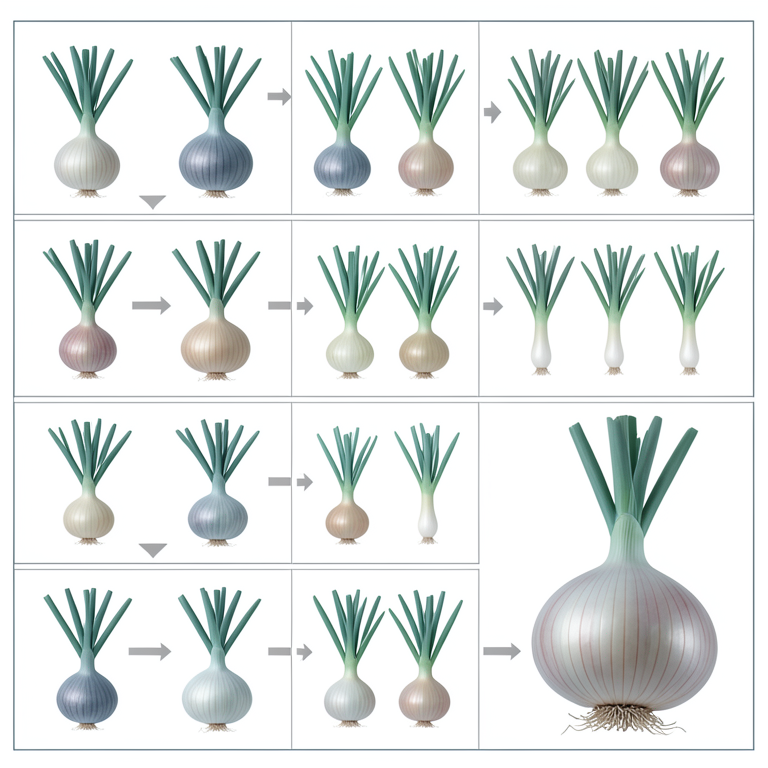
Experimental Treatment Matrix
AI-generated conceptual illustration (Onion plants (Allium cepa L.)). It explains the idea and does not show study data.
View source evidence ↗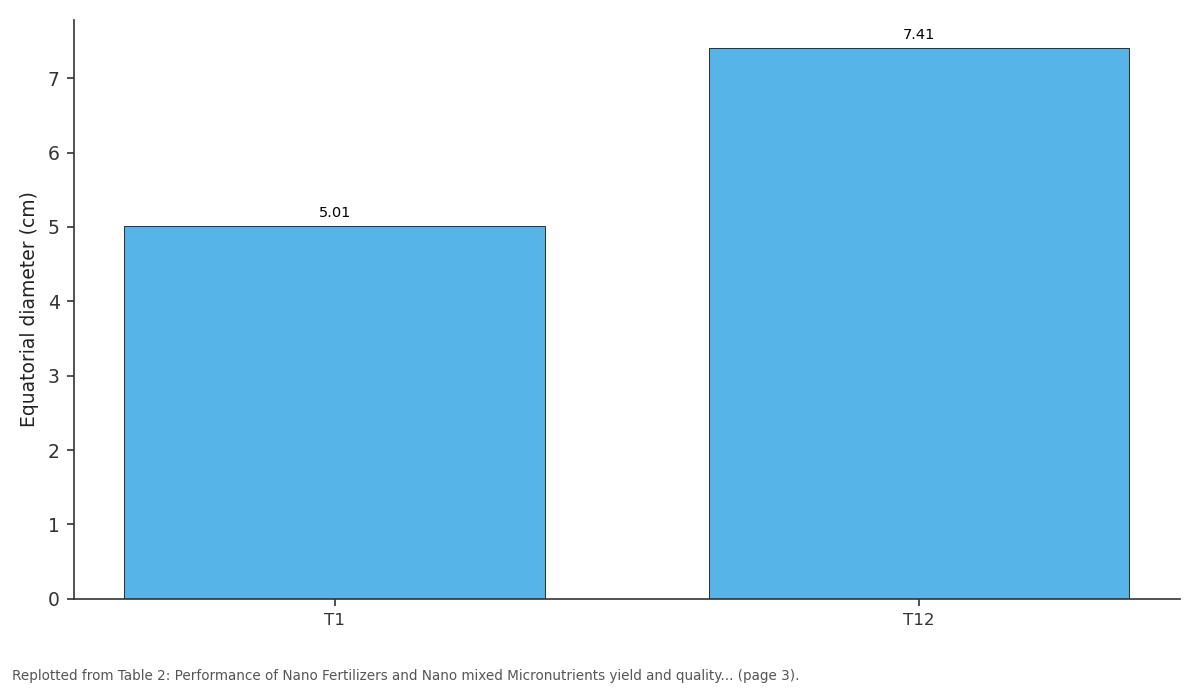
Equatorial diameter (cm) / Pooled: T1 vs T12
Replotted from Table 2 (page 3) of the original paper. Every bar is the paper's own table value.
View source evidence ↗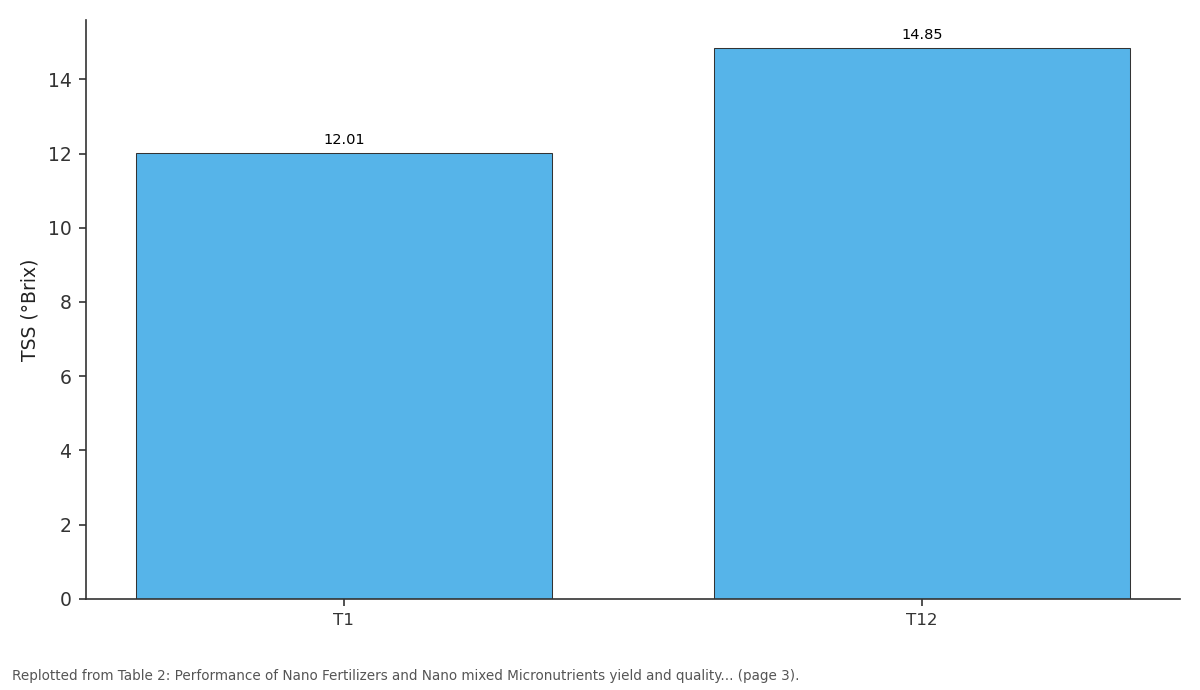
TSS (°Brix) / Pooled: T1 vs T12
Replotted from Table 2 (page 3) of the original paper. Every bar is the paper's own table value.
View source evidence ↗Figures & tables
From the original paper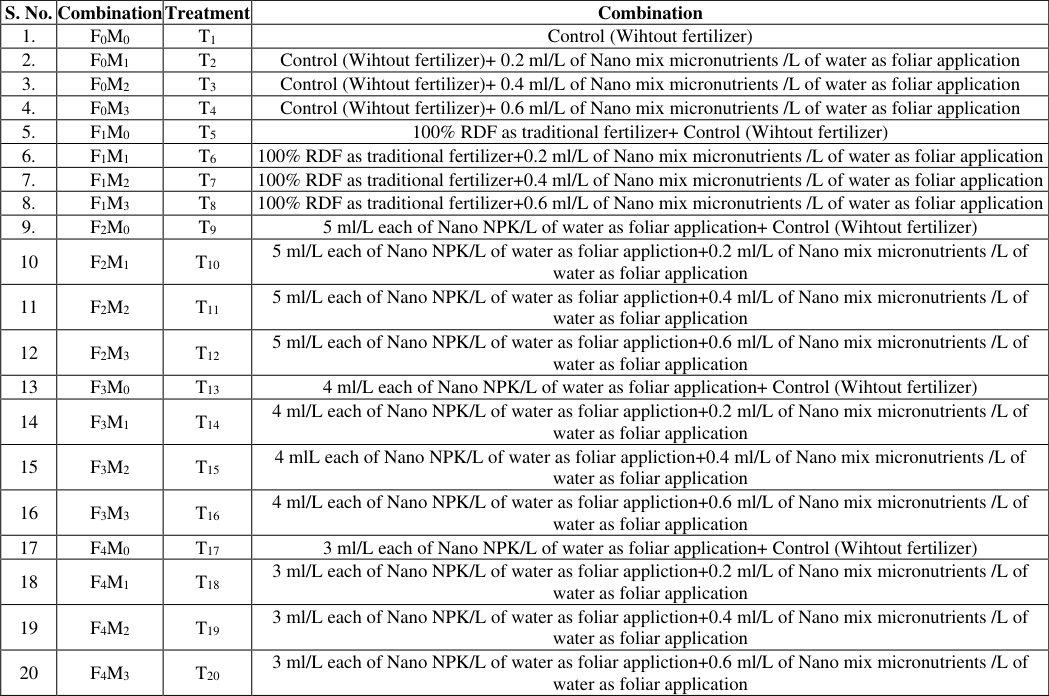 Table 1
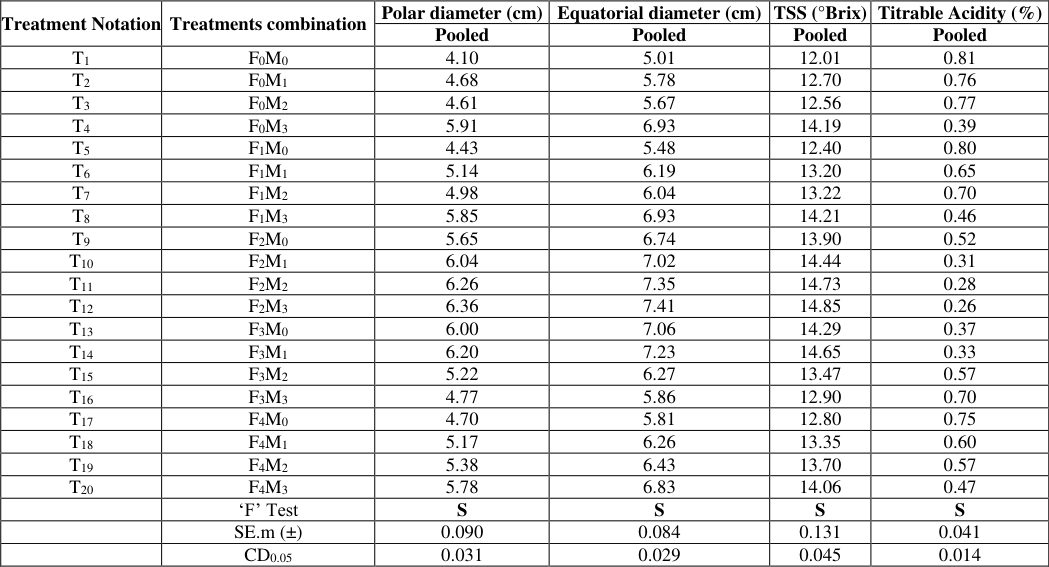 Table 2
Introduction
Onion (Allium cepa L.) is a vegetable bulb crop widely cultivated and known to most cultures. [6,7] . It is a biennial belongs to the family alliaceae and chromosome no. is 2n =16. Onion also possesses nutritional and medicinal importance. The outstanding characteristic of onion is the pungency, which is due to volatile oil known as Allyl-propyl-disulphide, which is Sulphur rich volatile compound. It acts as gastric stimulant and promotes digestion [19] . Onion is an indispensable item in every kitchen as condiment and vegetable, therefore commands an extensive internal market. It is also used by processing industry for dehydration in the form of flakes and powder which are in great demand in the world market [1] . For economic importance among vegetables, the onion ranks second after the tomato [3,13] . Onion is also known to contain photochemical linked to positive nutritional and health impacts [8] . It is used as a remedy for various diseases like dysentery, convulsions, headaches, hysterial fits, rheumatic pain, malaria, fever and as a fine demulcent to give relief in piles [18] . The bulb has variable shapes and colors. [16] . Onion bulb is a rich source of minerals like phosphorus and calcium. It also contains protein and vitamin C, quercetin and flavonoids [17] . It contains 86.6 per cent Moisture, 40 kcal Calories, 1.10 g Protein, 9.34 mg Carbohydrates, 23 mg Calcium, 2 I.U Vitamins A, 7.4 mg Vitamins C, 0.027 mg Riboflavin, 0.0116 mg Niacin per 100 g of fresh edible portion [18] . Production of vegetables is estimated to be 204.84 million tonnes as against 200.45 million tonnes in 2020-21. Production of Onion is estimated to be 31.27 Million Tonnes as against 26.64 Million Tonnes in the year 2020-21 [9] . Micronutrient fertilizers play a pivotal role in crop production by supplying essential trace elements such as iron, zinc, copper, manganese, and boron to plants. The application of nano mixed micronutrient fertilizers, either to the soil or as foliar sprays, helps rectify these deficiencies, resulting in heightened crop vigour, improved photosynthesis, and increased resistance to diseases, and ultimately higher yields [12] .
Materials and Methods
The trial took place at Sam Higginbottom University of Agriculture Science & Technology, Prayagraj (U.P.), stretching across the rabi season of 2021 and spanning two years, concluding in 2022. The experimental setup employed a Factorial Randomized Block Design (FRBD) consisting of 19 treatments and three replications (see Table No.1). With one factor focusing on the application of nano mixed micronutrients, and the other factor addressing the application of nano fertilizers. This design aimed to systematically assess the combined effects of these factors on the specified parameters, providing valuable insights into the potential benefits of using nano mixed micronutrients in the cultivation of onion, particularly the "Agrifound light red" variety.
Table No.1: Treatment Combination
The experimental field was well prepared and standard cultural and plant protection measures were followed to raise a healthy crop. Analysis of variance was carried out as per the procedure.
The diameter at the maximum width of the bulb across the polar length was measured with the help of Vernier Calipers and was expressed in centimeters.
The lengths between two polar ends of the bulb were recorded with the help of Vernier Calipers and mean length was worked out from all the five bulbs in each plot and expressed in centimeters.
The total soluble solids (TSS):
Contents of the bulb were measured with the help of hand refractometer. A drop of juice was placed over the prism of digital refractometer and was noted in per cent.
Acid content of the extracted juice was determined by titrating 5 ml of juice against N/10 NaOH using Phenolphthalein as an indicator. Acidity was expressed in term of anhydrous citric acid (A.O.A.C.1960) per 100 ml of bulb juice.
Results and Discussion
Results and Discussion
Bulb polar diameter (cm) Pooled mean analysis also showed a similar pattern. Since the interaction effect is small compared to the average effect and has been found to be significant, the treatment ranking should not change from year to year. Therefore, it can be excluded. For pooled mean analysis, there were significant differences in the data regarding the bulb polar diameter (cm). Among the different treatment combination, T 12 (5 ml/L each of Nano NPK/L of water as foliar appliction+0.6 ml/L of Nano mix micronutrients /L of water as foliar application) showed maximum Bulb polar diameter (6.36 cm). Minimum bulb polar diameter (cm) was observed in T 1 (Control Without fertilizer) with (4.10 cm) [11,10] .
Bulb equatorial diameter (cm) Pooled mean analysis also showed a similar pattern. Since the interaction effect is small compared to the average effect and has been found to be significant, the treatment ranking should not change from year to year. Therefore, it can be excluded. For pooled mean analysis, there were significant differences in the data regarding the Bulb equatorial diameter (cm). Among the different treatment combination, T 12 (5 ml/L each of Nano NPK/L of water as foliar appliction+0.6 ml/L of Nano mix micronutrients /L of water as foliar application) showed maximum Bulb equatorial diameter (7.41 cm). Minimum Bulb equatorial diameter (cm) was observed in T 1 (Control Without fertilizer) with (5.01 cm) Smilar result were also reported by [11,10] .
B. Quality Parameter 1. TSS (°Brix)
TSS (°Brix) Pooled mean analysis also showed comparable trends. The treatment ranking should not change from year to year because the interaction effect is significant even though it is smaller than the average effect. It is therefore excludable. There were significant differences in the data for the pooled mean analysis when comparing for TSS within a treatment. T 12 (5 ml/L each of Nano NPK/L of water as foliar appliction+0.6 ml/L of Nano mix micronutrients /L of water as foliar application) had the highest TSS among the treatments at (14.85°Brix) and minimum was found to (12.01 0 Brix) T 1 (Control Without fertilizer) was found significantly superior to T 12 (F 2 M 3 ). Thus Nano mix Micronutrient and Nano fertilizer had low TSS (°Brix) than control ones. Similar result also reported that was [14,15] .
Titrable Acidity (%) Pooled mean analysis also showed comparable trends. The treatment ranking should not change from year to year because the interaction effect is significant even though it is smaller than the average effect. It is therefore excludable. There were significant differences in the data for the pooled mean analysis when comparing for Titrable Acidity (%) within a treatment. T 12 (5 ml/L each of Nano NPK/L of water as foliar appliction+0.6 ml/L of Nano mix micronutrients /L of water as foliar application) had the lowest Titrable Acidity (%) among the treatments at (0.26%) and highest was found to (0.81) T 1 (Control Without fertilizer). was found significantly superior to T 12 (F 2 M 3 ). Thus Nano fertilizers & nano mixed Micronutrient and Nano had low Titrable Acidity (%) than control ones. Similar result also reported that was [2,5] .
Figures and tables from the paper
| S. No. | Combination | Treatment | Combination |
|---|---|---|---|
| 1. | F0M0 | T1 | Control (Wihtout fertilizer) |
| 2. | F0M1 | T2 | Control (Wihtout fertilizer)+ 0.2 ml/L of Nano mix micronutrients /L of water as foliar application |
| 3. | F0M2 | T3 | Control (Wihtout fertilizer)+ 0.4 ml/L of Nano mix micronutrients /L of water as foliar application |
| 4. | F0M3 | T4 | Control (Wihtout fertilizer)+ 0.6 ml/L of Nano mix micronutrients /L of water as foliar application |
| 5. | F1M0 | T5 | 100% RDF as traditional fertilizer+ Control (Wihtout fertilizer) |
| 6. | F1M1 | T6 | 100% RDF as traditional fertilizer+0.2 ml/L of Nano mix micronutrients /L of water as foliar application |
| 7. | F1M2 | T7 | 100% RDF as traditional fertilizer+0.4 ml/L of Nano mix micronutrients /L of water as foliar application |
| 8. | F1M3 | T8 | 100% RDF as traditional fertilizer+0.6 ml/L of Nano mix micronutrients /L of water as foliar application |
| 9. | F2M0 | T9 | 5 ml/L each of Nano NPK/L of water as foliar application+ Control (Wihtout fertilizer) |
| 10 | F2M1 | T10 | 5 ml/L each of Nano NPK/L of water as foliar appliction+0.2 ml/L of Nano mix micronutrients /L of water as foliar application |
| 11 | F2M2 | T11 | 5 ml/L each of Nano NPK/L of water as foliar appliction+0.4 ml/L of Nano mix micronutrients /L of water as foliar application |
| 12 | F2M3 | T12 | 5 ml/L each of Nano NPK/L of water as foliar appliction+0.6 ml/L of Nano mix micronutrients /L of water as foliar application |
| 13 | F3M0 | T13 | 4 ml/L each of Nano NPK/L of water as foliar application+ Control (Wihtout fertilizer) |
| 14 | F3M1 | T14 | 4 ml/L each of Nano NPK/L of water as foliar appliction+0.2 ml/L of Nano mix micronutrients /L of water as foliar application |
| 15 | F3M2 | T15 | 4 mlL each of Nano NPK/L of water as foliar appliction+0.4 ml/L of Nano mix micronutrients /L of water as foliar application |
| 16 | F3M3 | T16 | 4 ml/L each of Nano NPK/L of water as foliar appliction+0.6 ml/L of Nano mix micronutrients /L of water as foliar application |
| 17 | F4M0 | T17 | 3 ml/L each of Nano NPK/L of water as foliar application+ Control (Wihtout fertilizer) |
| 18 | F4M1 | T18 | 3 ml/L each of Nano NPK/L of water as foliar appliction+0.2 ml/L of Nano mix micronutrients /L of water as foliar application |
| 19 | F4M2 | T19 | 3 ml/L each of Nano NPK/L of water as foliar appliction+0.4 ml/L of Nano mix micronutrients /L of water as foliar application |
| 20 | F4M3 | T20 | 3 ml/L each of Nano NPK/L of water as foliar appliction+0.6 ml/L of Nano mix micronutrients /L of water as foliar application |
Table text extracted from the original PDF; superscript letters are shown inline. The original table image is below.
View original table image
| Treatment Notation | Treatments combination | Polar diameter (cm) | Equatorial diameter (cm) | TSS (°Brix) | Titrable Acidity (%) |
|---|---|---|---|---|---|
| Pooled | Pooled | Pooled | Pooled | ||
| T1 | F0M0 | 4.10 | 5.01 | 12.01 | 0.81 |
| T2 | F0M1 | 4.68 | 5.78 | 12.70 | 0.76 |
| T3 | F0M2 | 4.61 | 5.67 | 12.56 | 0.77 |
| T4 | F0M3 | 5.91 | 6.93 | 14.19 | 0.39 |
| T5 | F1M0 | 4.43 | 5.48 | 12.40 | 0.80 |
| T6 | F1M1 | 5.14 | 6.19 | 13.20 | 0.65 |
| T7 | F1M2 | 4.98 | 6.04 | 13.22 | 0.70 |
| T8 | F1M3 | 5.85 | 6.93 | 14.21 | 0.46 |
| T9 | F2M0 | 5.65 | 6.74 | 13.90 | 0.52 |
| T10 | F2M1 | 6.04 | 7.02 | 14.44 | 0.31 |
| T11 | F2M2 | 6.26 | 7.35 | 14.73 | 0.28 |
| T12 | F2M3 | 6.36 | 7.41 | 14.85 | 0.26 |
| T13 | F3M0 | 6.00 | 7.06 | 14.29 | 0.37 |
| T14 | F3M1 | 6.20 | 7.23 | 14.65 | 0.33 |
| T15 | F3M2 | 5.22 | 6.27 | 13.47 | 0.57 |
| T16 | F3M3 | 4.77 | 5.86 | 12.90 | 0.70 |
| T17 | F4M0 | 4.70 | 5.81 | 12.80 | 0.75 |
| T18 | F4M1 | 5.17 | 6.26 | 13.35 | 0.60 |
| T19 | F4M2 | 5.38 | 6.43 | 13.70 | 0.57 |
| T20 | F4M3 | 5.78 | 6.83 | 14.06 | 0.47 |
| ‘F’ Test | S | S | S | S | |
| SE.m (±) | 0.090 | 0.084 | 0.131 | 0.041 | |
| CD0.05 | 0.031 | 0.029 | 0.045 | 0.014 |
Table text extracted from the original PDF; superscript letters are shown inline. The original table image is below.
View original table image
References
13 in the original paper- Abdel WM, El-attar AB, Mahmoud AA. Economic evaluation of nano and organic fertilizers as an alternative source to chemical fertilizers on Carum carvi L. plant yield and components. Agriculture (Pol, nohospodarstvo). 2017;63(1):33-49.
- Aboukhadrah SH, El-Alsayed AWAH, Sobhy L, Abdelmasieh W. Response of Onion Yield and Quality To Different Planting Date, Methods and Density. Egypt. J Agron. 2017;39:203-219.
- Al-Burki HAH, Al-Ajeel SAHS. Effect of BioFertilizer and Nano-Elements on Growth and Yield of Two French bean Varieties. Plant Archives. 2021;21(Supplement 1):1191-1194.
- Córcoles JI, Ortega JF, Hernández D, Moreno MA. Estimation of leaf area index in onion (Allium cepa L.) using an unmanned aerial vehicle. Biosyst. Eng. 2013;115:31-42.
- Griffiths G, Trueman L, Crowther T, Thomas B, Smith B. Onions-a global benefit to health. Phytotherapy Research. 2002;16(7):603-615.
- Kumar Y, Tiwari KN, Nayak RK, Rai A, Singh SP, Singh AN, et al. Nano fertilizers for Increasing Nutrient Use Efficiency, Yield and Economic Returns in Important Winter Season Crops of Uttar Pradesh. Indian Journal of Fertilizers. 2020;16(8):772-786.
- Lekshmi JAM, Bahadur V, Abraham RK, Kerketta A. Effect of Nano Fertilizer on Growth, Yield and Quality of Okra (Abelmoschus esculentus). International Journal of Plant and Soil Science. 2022;34(21):61-69.
- Lobanov NS. The role of iron in photosynthesis. J Biochem. 2017;82(4):391-402.
- Mallor C, Balcells M, Mallor F, Sales E. Genetic variation for bulb size, soluble solids content and pungency in the Spanish sweet onion variety Fuentes de Ebro. Response to selection for low pungency. Plant Breed. 2011;130:55-59.
- Mishra B, Sahu GS, Mohanty LK, Swain BC, Hati S. Effect of Nano Fertilizers on Growth, Yield, and Economics of Tomato Variety Arka Rakshak. Indian Journal of Pure and Applied Biosciences. 2020;8(6):200-204.
- Panda J, Nandi A, Mishra SP, Pal AK, Pattnaik AK, Jena NK. Effects of Nano Fertilizer on Yield, Yield Attributes and Economics in Tomato (Solanum lycopersicum L.). International Journal of Current Microbiology and Applied Sciences. 2020;9(5):25832591.
- Scott T. What is the chemical process that causes my eyes to tear when I peel an onion? Ask the expert; Chemistry Scientific American, Retrieved on 8th April, 2007.
- Sharma J, Agarwal S. Impact of organic fertilizers on growth, yield and quality of spinach. Indian J. Plant Sci. 2014;3(3):37-43.