
Research article · 2024 · Full text
International Journal of Agriculture and NutritionCollege-wise correlation analysis of family background and attributes of PG students with utilization of ICT tools in learning activities in RVSKVV, University Gwalior (M.P.)
Volume 6(1) · Pages 31–33 · DOI: 10.33545/26646064.2024.v6.i1a.136 ↗
Research areasGlobal Education Systems and PoliciesOnline and Blended LearningICT in Developing Communities
Abstract
Author-writtenThe recent development of technology has brought out the whole world outside the classroom. Information and Communication Technology plays a vital role in this respect. This paper shows the relationship between family backgrounds of UG students with utilization of ICT tools in learning activities. This research work carried out in Rajmata Vijyaraje Scindiya Krishi Vishwa Vidhyalaya, Gwalior, Madhya Pradesh. The study was conducted using a survey research design. There were total 150 postgraduate students from college-wise prepared list were selected with the help of simple random sampling without replacement under a proportionate scheme. The results of the study regarding relationship between family background PG students specifically their parents' occupation (0.242) and annual income (0.408), had a positive significant relationship with the use of ICT tools. Whereas attributes of students, viz awareness about ICT tools in learning activities (0.421), attitude towards ICT tools in learning activities (0.469), knowledge about ICT tools in learning activities (0.266), innovativeness (0.307), information seeking behaviour (0.325), self-confidence (0.538) and accessibility of ICT tools in learning activities (0.553) were also found strongly and significantly correlated with the utilization of ICT tools and other variables like family size (0.013), area of residence (0.054) and gender (0.063) had a non-significant relationship with the utilization of ICT tools.
Summary
Source-checkedPlain-language reading of the full paper, prepared with AI and checked against the text. Each point links to the authors' own words.
Why it matters
- Information and Communication Technology (ICT) is considered vital for bringing the world outside the classroom to students. View evidence ↗
- The authors state that ICT is the primary means to improve student skills and achieve better national outcomes. View evidence ↗
- Integrating ICT into the curriculum is believed to have a highly productive impact on student achievement, including improved knowledge and practical skills. View evidence ↗
The question
- The study aims to determine the relationship between postgraduate (PG) students' family backgrounds and personal attributes and their use of ICT tools for learning at RVSKVV University. View evidence ↗
What they did
- The study population consisted of postgraduate students from five colleges of RVSKVV Gwalior: Indore, Sehore, Khandwa, Gwalior, and Mandsaur. View evidence ↗
- A total of 150 PG students were selected using simple random sampling without replacement under a proportionate scheme. View evidence ↗
- Researchers collected data personally using a structured interview schedule. View evidence ↗
- The study used correlation coefficients and t-tests to analyze the relationship between family background and ICT tool utilization. View evidence ↗
What they found
- Across the study, parents' occupation (0.242) and annual income (0.408) showed a positive and significant relationship with the use of ICT tools. View evidence ↗
- Student attributes including awareness (0.421), attitude (0.469), knowledge (0.266), innovativeness (0.307), information seeking behavior (0.325), self-confidence (0.538), and accessibility (0.553) were strongly and significantly correlated with ICT tool utilization. View evidence ↗
- Family size (0.013), area of residence (0.054), and gender (0.063) did not have a significant relationship with the utilization of ICT tools. View evidence ↗
- At COA Gwalior, ICT tool utilization was significantly correlated with parents' occupation (0.250, p<0.05) and family annual income (0.376, p<0.01). View evidence ↗
- At COA Indore, parents' occupation (0.432, p<0.05) and family annual income were positively and significantly correlated with ICT tool utilization. View evidence ↗
- At COA Sehore, both parents' occupation (0.360) and family annual income (0.432) were strongly correlated with ICT tool utilization at the 0.05 significance level. View evidence ↗
- At COH Mandsaur, parents' occupation (0.501, p<0.05) and family annual income (0.630, p<0.01) were positively and significantly correlated with ICT tool utilization. View evidence ↗
- At COA Indore, all measured student attributes, awareness (0.722), attitude (0.440), knowledge (0.495), innovativeness (0.450), information seeking behavior (0.440), self-confidence (0.796), and accessibility (0.534), were significantly correlated with ICT utilization at the 0.01 level. View evidence ↗
What it means
- The authors conclude that across all five campuses, parents' occupation, annual income, and various student attributes are significantly related to the utilization of ICT tools. View evidence ↗
- The authors conclude that family size, area of residence, and gender do not significantly influence the utilization of ICT tools. View evidence ↗
Visual summary
3 visualsIllustrations explain the paper; charts are replotted from the paper's own table values.

Factors Influencing ICT Utilization
AI-generated conceptual illustration (Postgraduate students using digital learning devices). It explains the idea and does not show study data.
View source evidence ↗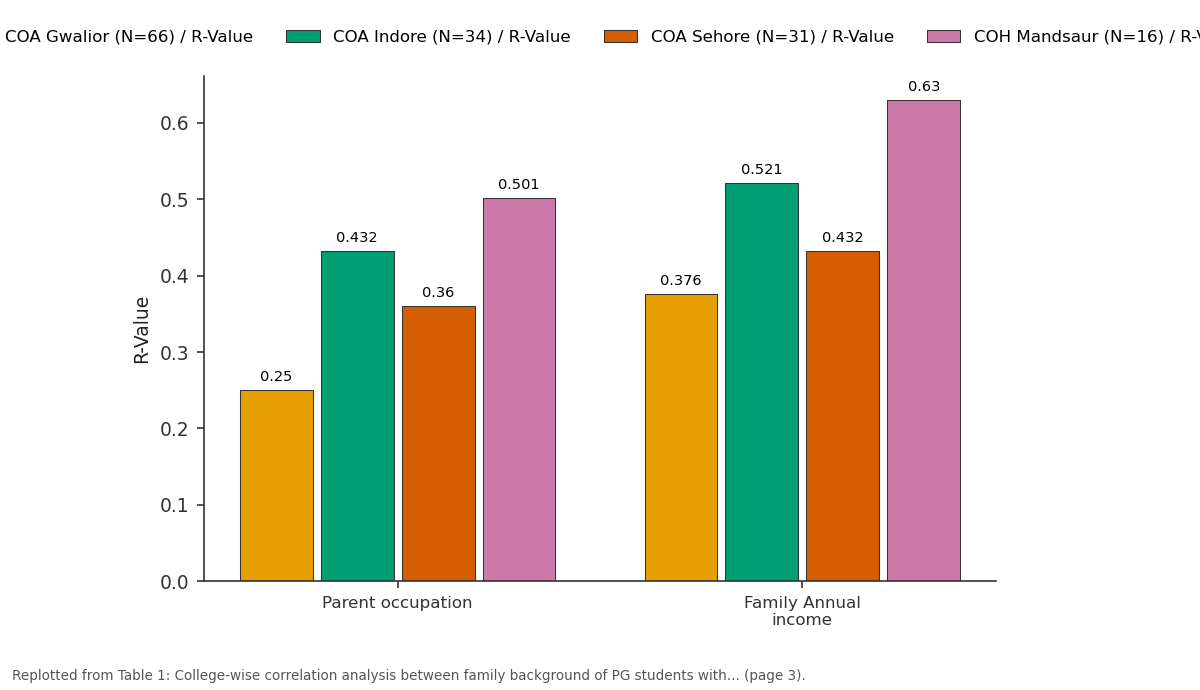
COA Gwalior (N=66) / R-Value and COA Indore (N=34) / R-Value and more: Parent occupation vs Family Annual income
Replotted from Table 1 (page 3) of the original paper. Every bar is the paper's own table value.
View source evidence ↗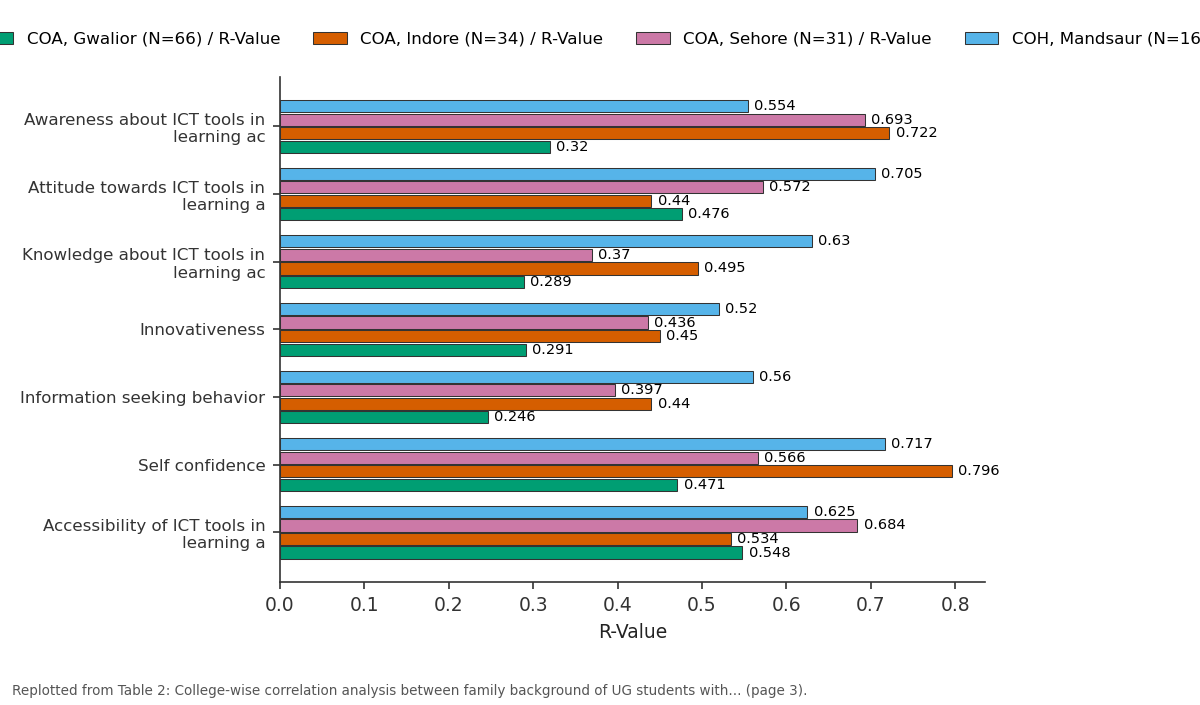
COA, Gwalior (N=66) / R-Value and COA, Indore (N=34) / R-Value and more: Awareness about ICT... vs Attitude towards ICT... vs Knowledge about ICT... vs Innovativeness vs Information seeking...
Replotted from Table 2 (page 3) of the original paper. Every bar is the paper's own table value.
View source evidence ↗Figures & tables
From the original paper Table 1
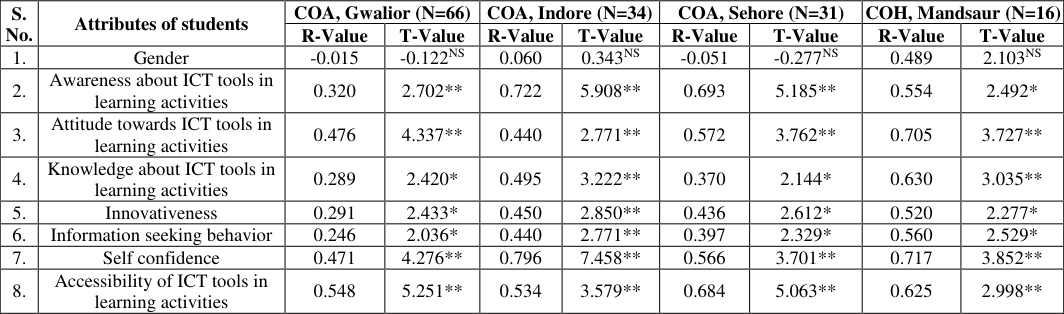 Table 2
Introduction
In today's era, the demand for ICT tools has played a vital role in improving the education system. Various courses like digital signal processing, digital image processing, and digital electronics have been analyzed on various scales. Students' better understanding and learning, their feedback, and their involvement in research with proper impact analysis have been carried out. ICT is the only way to enhance students' skills and get better outcomes for a better nation. You may be aware of the use of different technologies such as radio, television, computers, etc. All these technologies have transformed the teaching and learning process. Computers have been used in schools since the early 1980s, and several scholars suggest that ICT will be an important part of education for the next generation. Dawes (2001) [8] stated that new technologies have the potential to upkeep education across the curriculum and deliver opportunities for efficient student-teacher communication in ways not possible before. ICTs complement, extend, and transform the role of language across the curriculum in learning as the very basis of generic skills or competencies and applied knowledge, as well as more skill or content transmission. Radio, television, and newer digital technologies such as computers and the Internet constitute information and communication technologies. Different ICTs have the potential to expand access to education, strengthen the process of education, and enhance the quality of education. Higher education institutions have heavily invested in Information and Communication Technologies (ICT). Universities have been impacted by ICT in terms of their context, their organization, and their teaching and learning methods.
Information and Communication Technologies (ICTs) are generally known as the technologies that make possible communication, processing, and transmission of communication by electronic means. ICT is an umbrella term that includes a diverse number of technologies like radio, TV, and telephone, which are the old ICTs, and computer, internet, wireless, and satellite technologies, which are the new ICTs. In the global competitive era, technology is the backbone of everything. With the adoption of information and computer technology (ICT), education has become much more effective than in the past. Researchers, academicians, and industry professionals have proven that ICT provides opportunities for all educational participants to learn and excel. Across the world, it has been accepted by educational planners that increased exposure of students to educational ICT through curriculum integration has had a significant and highly productive impact on their achievement. Its exposure improved their knowledge, comprehension, practical skills, presentation skills, and innovative capabilities to a great extent. After seeing the significant contribution of ICT, the study helps in the effective use of ICT tools with the help of an objective: The relationship between family background and attributes of PG students with the utilization of ICT tools in learning activities at RVSKVV, University Gwalior (M.P.).
Materials and Methods
This study was carried out in RVSKVV university, Gwalior (M.P.). Survey research design was used for the study. The population of the study was consist of postgraduate students (PG) from all five colleges (Indore, Sehore, Khandwa Gwalior and Mandsaur) of RVSKVV Gwalior (MP). There were 150 PG students selected from College wise prepared list with the help of simple random sampling without replacement under proportionate scheme. The dependent variable was utilization of ICT tools. Data were collected personally with the help of structured interview schedule. The object of the study was to assess the relationship between family background of PG students with utilization of ICT tools in learning activities, correlation coefficient worked out and to test the significance t-test used.
Results and Discussion
Results and Discussion
College-wise correlation analysis between family background of PG students with utilization of ICT tools in learning activities:
The college wise results are presented in Table 1 regarding the correlation analysis between the family background of PG students with the utilization of ICT tools in learning activities. The value of coefficient of correlation for COA Gwalior furnished in the table clearly shows that the utilization of ICT tools by respondents was positively correlated and significant at 0.05 level of significance with their parents' occupation (0.250) and family annual income (0.376), significant at 0.01 level of significance. Utilization of ICT tools by respondents was non significantly associated with family size (0.020) and area of residence (0.075). COA, Indore, the value of coefficient of correlation shows that the utilization of ICT tools by respondents with their family background viz parents occupation (0.432) was positively correlated and significant at 0.05 level of significance and family annual income was positively correlated and significant at 0.01 level of significance. Whereas utilization of ICT tools by respondents was not significantly correlated with family size (0.184) and area of residence (0.207). As regards COA, Sehore, The value of the coefficient of correlation between family background and utilization of ICT tools of respondents was strongly correlated and significant at the 0.05 level of significance with their parents' occupation (0.360) and family annual income (0.432). Utilization of ICT tools by respondents was nonsignificantly associated with family size and area of residence with concerning COH Mandsaur, the value of the coefficient of correlation observed that parents' occupation (0.501) was positively correlated and significant at a 0.05 level of significance with the utilization of ICT tools and family annual income (0.630) was positively correlated and significant at a 0.01 level of significance. Family size (-0.176) and area of residence (-0.030) were not significantly associated with utilization of ICT tools. 2, disclosed that the value of the correlation coefficient for COA Gwalior indicated that student attributes such as awareness about ICT tools in learning activities (0.320), attitude towards ICT tools in learning activities (0.476), self-confidence (0.471), accessibility of ICT tools in learning activities (0.548) were allied to by the students at a 0.05 level of significance and knowledge about ICT tools in learning activities in learning activities (0.289), innovativeness (0.291), and information seeking behaviour were allied to by the students. Furthermore, there was no significant relationship between gender (-0.015) and the utilization of ICT tools. The value of correlation for COA Indore disclosed that the attributes of students, i.e., awareness about ICT tools in learning activities (0.722), attitude towards ICT tools in learning activities (0.440), knowledge about ICT tools in learning activities (0.495), innovativeness (0.450), information seeking behavior (0.440), self-confidence (0.796), accessibility of ICT tools in learning activities (0.534) were allied to by the students at 0.01 level of significance. There was no significant relationship between gender (0.060) and utilization of ICT tools. The data for COA Sehore, regarding correlation coefficient indicated that the attributes of students, viz., awareness about ICT tools in learning activities (0.693), attitude towards ICT tools in learning activities (0.572), selfconfidence (0.566) and accessibility of ICT tools in learning activities (0.684) were allied to by the students at a 0.05 level of significance and knowledge about ICT tools in learning activities (0.370), innovativeness (0.436) and information seeking behavior (0.397) strongly and correlated at 0.01 level of significance with the utilization of ICT tools. Furthermore, there was no significant relationship between gender (-0.051) and the utilization of ICT tools. In the instance of students of COH Mandsau, it was disclosed that the independent variables viz., attitude towards ICT tools in learning activities (0.705), accessibility of ICT tools in learning activities (0.625) and selfconfidence (0.717) were strongly correlated at a 0.01 level of significance with the utilization of ICT tools. Whereas knowledge about ICT tools in learning activities (0.630), innovativeness (0.520), information seeking behavior (0.560) and awareness about ICT tools in learning activities (0.554), were allied to by the students at a 0.05 level of significance, there was no significant relationship between gender and the utilization of ICT tools.
| S. No. | Family background of students | COA Gwalior (N=66) | — | COA Indore (N=34) | — | COA Sehore (N=31) | — | COH Mandsaur (N=16) | — |
|---|---|---|---|---|---|---|---|---|---|
| R-Value | T-Value | R-Value | T-Value | R-Value | T-Value | R-Value | T-Value | ||
| 1. | Parent occupation | 0.250 | 2.065* | 0.432 | 2.709* | 0.360 | 2.078* | 0.501 | 1.098* |
| 2. | Family Annual income | 0.376 | 3.255** | 0.521 | 3.459** | 0.432 | 2.580* | 0.630 | 1.637** |
| 3. | Family size | 0.020NS | 0.163 | 0.184 | 1.059 | -0.059 | -0.321 | -0.176 | -0.671 |
| 4. | Area of Residence | 0.075NS | 0.606 | 0.207 | 1.201 | -0.104 | -0.566 | -0.030 | -0.112 |
Table text extracted from the original PDF; superscript letters are shown inline. The original table image is below.
View original table image
College-wise correlation analysis between attributes of PG students with utilization of ICT tools in learning activities: Table
College-wise correlation analysis between attributes of PG students with utilization of ICT tools in learning activities: Table
Conclusion
By the study findings the data of all five campuses of the RVSKVV, the relationship of family background like parents' occupation and annual income had a significant relationship with the use of ICT tools Whereas attributes of students, viz awareness about ICT tools in learning activities, attitude towards ICT tools in learning activities, knowledge about ICT tools in learning activities, innovativeness, information seeking behaviour, selfconfidence and accessibility of ICT tools in learning activities were also found strongly and significantly correlated with the utilization of ICT tools and on other hand variables like family size area of residence and gender had a non-significant relationship with the utilization of ICT tools.
Figures and tables from the paper
| S. No. | Attributes of students | COA, Gwalior (N=66) | — | COA, Indore (N=34) | — | COA, Sehore (N=31) | — | COH, Mandsaur (N=16) | — |
|---|---|---|---|---|---|---|---|---|---|
| R-Value | T-Value | R-Value | T-Value | R-Value | T-Value | R-Value | T-Value | ||
| 1. | Gender | -0.015 | -0.122NS | 0.060 | 0.343NS | -0.051 | -0.277NS | 0.489 | 2.103NS |
| 2. | Awareness about ICT tools in learning activities | 0.320 | 2.702** | 0.722 | 5.908** | 0.693 | 5.185** | 0.554 | 2.492* |
| 3. | Attitude towards ICT tools in learning activities | 0.476 | 4.337** | 0.440 | 2.771** | 0.572 | 3.762** | 0.705 | 3.727** |
| 4. | Knowledge about ICT tools in learning activities | 0.289 | 2.420* | 0.495 | 3.222** | 0.370 | 2.144* | 0.630 | 3.035** |
| 5. | Innovativeness | 0.291 | 2.433* | 0.450 | 2.850** | 0.436 | 2.612* | 0.520 | 2.277* |
| 6. | Information seeking behavior | 0.246 | 2.036* | 0.440 | 2.771** | 0.397 | 2.329* | 0.560 | 2.529* |
| 7. | Self confidence | 0.471 | 4.276** | 0.796 | 7.458** | 0.566 | 3.701** | 0.717 | 3.852** |
| 8. | Accessibility of ICT tools in learning activities | 0.548 | 5.251** | 0.534 | 3.579** | 0.684 | 5.063** | 0.625 | 2.998** |
Table text extracted from the original PDF; superscript letters are shown inline. The original table image is below.
View original table image
References
5 in the original paper- Basri WS, Alandejani JA, Almadani FM. ICT adoption impact on students' academic performance: Evidence from Saudi universities. Education Research International. 2018;2018(1):01-09.
- Castells M. Toward a Sociology of the Network Society. Contemporary Sociology. 2000;29(5):693-699.
- Devi R, Madan L, Hemachandran C. Air Quality Monitoring Using Sensing Devices In Urban City. Journal of Critical Reviews. 2020;14(7):1721-1729.
- Mutisya D, Makokha G. The Problem with Affordance. ELearning and Digital Media. 2016;13(3-4):140-157.
- Wilson C, Jumbert MG. Journal of International Humanitarian Action. 2018;3(1):8-10.