
Research article · 2024 · Full text
International Journal of Agriculture and NutritionReview on handling, hygienic practices and microbial qualities of raw milk in Ethiopia
Volume 6(1) · Pages 08–12 · DOI: 10.33545/26646064.2024.v6.i1a.133 ↗
Research areasMilk Quality and Mastitis in Dairy CowsAnimal Diversity and Health StudiesProbiotics and Fermented Foods
Abstract
Author-writtenThis article had reviewed several research papers and collected information and tracked up. The review revealed that most of the dairy men have the perception that bad quality milk affects the health wellbeing of human (consumers). But the main problem concerned with the hygienic practice is that there is no standard (clear cut point) to be followed by the smallholder dairy producers. The producers do right what they perceive correct enough to keep the quality like washing their hand before milking without detergents and sanitizers. This review found also that the smallholder in most parts of the country do no sterilize the milk utensils even they do not wash. But in some cases they use their indigenous knowledge like fumigation and smoking.
Summary
Source-checkedPlain-language reading of the full paper, prepared with AI and checked against the text. Each point links to the authors' own words.
Why it matters
- Among all agricultural yield products, milk is the most perishable. View evidence ↗
The question
- The objective of this review was to examine existing data regarding the microbial properties and physicochemical qualities of fresh milk. View evidence ↗
What they did
- The author conducted a review by collecting and tracking information from several existing research papers. View evidence ↗
What they found
- A primary issue in hygienic practices is the lack of a clear, standardized guideline for smallholder dairy producers to follow. View evidence ↗
- Producers often rely on their own perceptions of quality, such as washing hands before milking without using sanitizers or detergents. View evidence ↗
- In most parts of the country, smallholders often fail to wash or sterilize their milk utensils. View evidence ↗
- In Bahirdar city, a study found that while 85.8% of milk producers wash their hands before milking, only 28.3% clean the milking area, 14.1% wash the udder, and 74.6% do not dry their hands. View evidence ↗
- Hygienic practices vary significantly across studies; for example, Lencho (2018) reported 100% compliance for hand washing, udder washing, and utensil washing, with 54% drying the udder. View evidence ↗
- Plastic containers are the most common choice for handling and transporting milk due to their durability and ease of use. View evidence ↗
- Microbial loads vary by region; for instance, SNNPR Mizan showed a coliform count (CC) of 9.81 log10 cfu/mL, while Gurmesa showed a total bacterial count (TBC) of 8.16 log10 cfu/mL. View evidence ↗
What it means
- The author concludes that the overall hygienic level and quality of milk in Ethiopia are poor, leading to high microbial loads. View evidence ↗
- The author recommends that the dairy sector requires interventions in the form of training and awareness creation, both in the short and long term. View evidence ↗
Visual summary
2 visualsIllustrations explain the paper; charts are replotted from the paper's own table values.
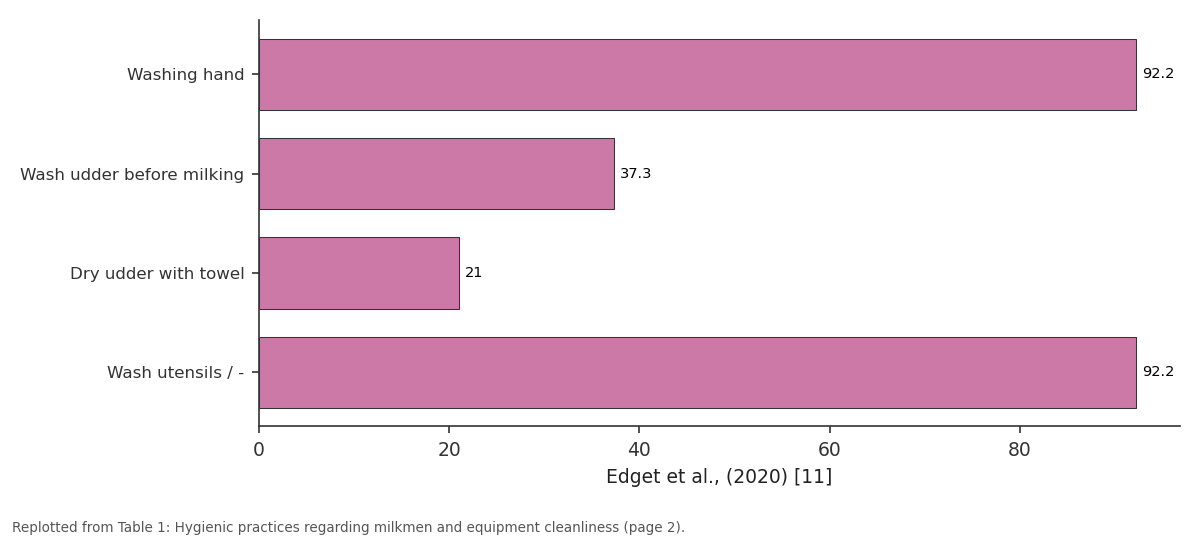
Edget et al., (2020) [11]: Washing hand vs Wash udder before... vs Dry udder with towel vs Wash utensils / -
Replotted from Table 1 (page 2) of the original paper. Every bar is the paper's own table value.
View source evidence ↗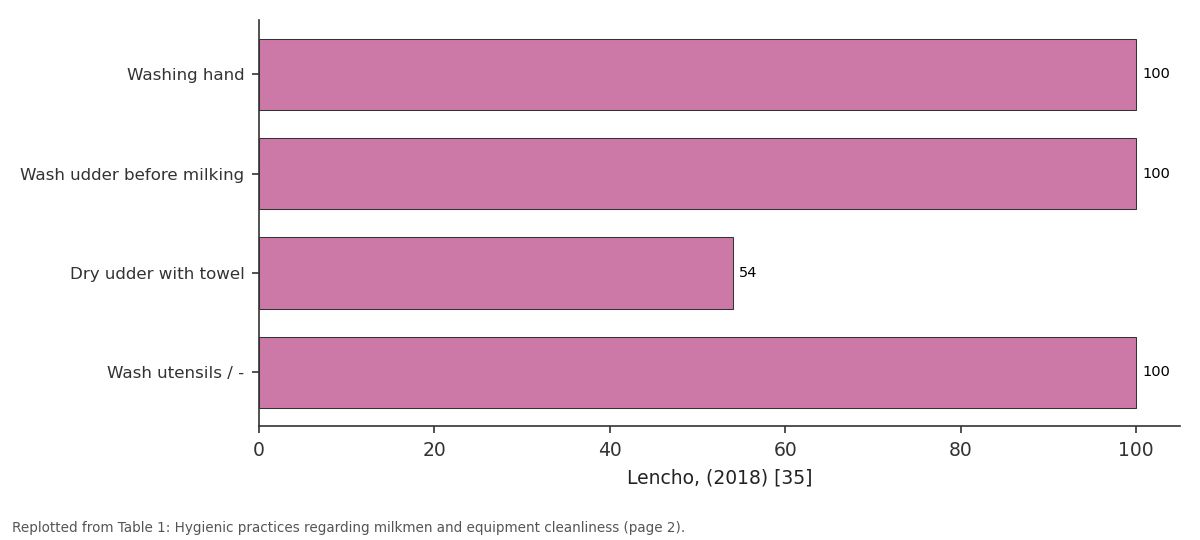
Lencho, (2018) [35]: Washing hand vs Wash udder before... vs Dry udder with towel vs Wash utensils / -
Replotted from Table 1 (page 2) of the original paper. Every bar is the paper's own table value.
View source evidence ↗Figures & tables
From the original paper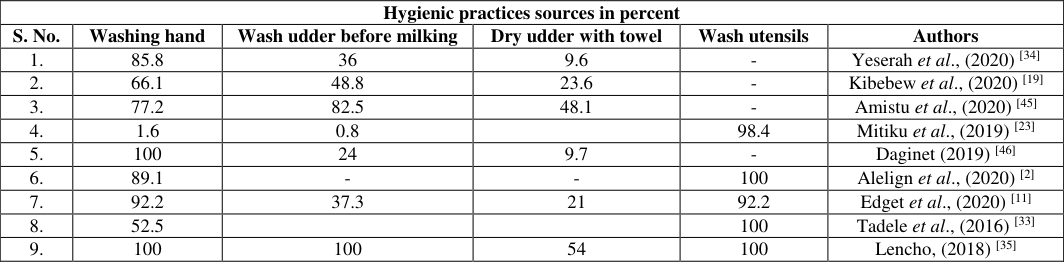 Table 1
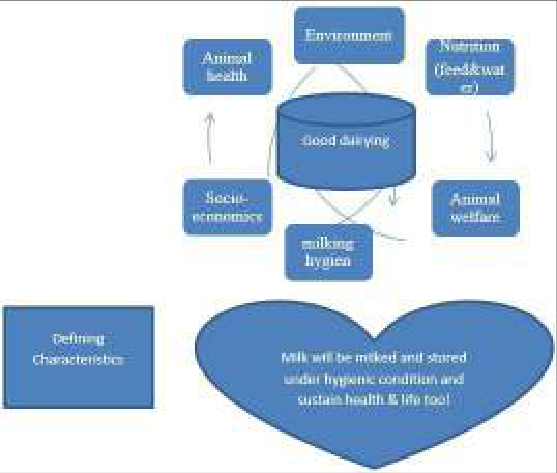 Figure 1
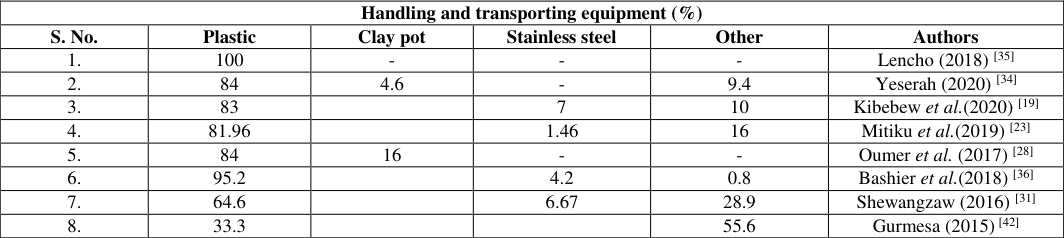 Table 2
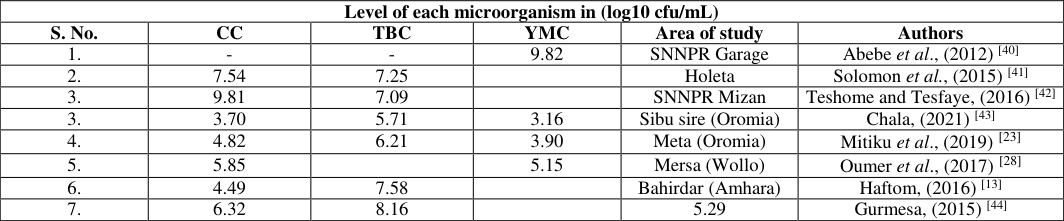 Table 3
Introduction 1.1 Background and justification
Milk as in this article maybe characterized as "The eadable liquid collected from the mammary cells of mammalian creatures. It is exceptionally nutritious and total count calories which is favored to people groups of all age O'Mahony (1988) [26] depicted drain because it is the source vitality, protein, fat, miniaturized scale and large scale minerals in expansion to vitamins as a result of which it is considered as idealize nourishment. Individuals began the utilization of drain amid antiquated time. The aging of bovine drain started with the point of controlling the lactose narrow mindedness by group men (Curry, 2013) [8] . Numerous Creators for case (Alganesh, 2002 and Lemma, 2004) [3,21] summarized that drain conservation utensils in nation side are as a rule arranged from locally accessible materials. To get ready quality aged drain, cultivate sanitation, individual hygiene and schedule exercises need to take into thought. The physicochemical and microbial qualities of drain are moved forward by cleaning cows' nipple and udder, clean draining and milk dealing with from contamination free cultivate. Drain is the foremost perishable of all cultivate yield items. Opposite to other creature root create, drain is persistently collected and expended either new or after aged which is maybe delivered from unhygienic cultivate. In tropics the natural conditions are moreover conducive for drain deterioration. Concurring to Quigley (2013) [29] organisms which can either hurt the drain shopper or utilize in drain handling and normal aging get into drain from a different bases. Swai, 2011 [32] detailed that the choice that communicates whether drain quality is nice or terrible is made based on its chemical constituent and standard of cleanliness at drain parlour, capacity and taking care of offices counting cleanliness of the udder of the person creature. Generation of drain and different drain items beneath unsanitary conditions and destitute generation hones can apply both an open wellbeing and financial imperatives. Drain quality is paramount important for the shopper conjointly for milk preparing plants. It is exceptionally genuine because it has related chance components with the wellbeing of the buyer. There were sufficient ponders done on the microbial and physicochemical properties of drain. At the same time as customers are very sensitive to dairy items it requires overhauled data. Thus this paper was pointed to plug out these crevices.
Objectives
The objective of this review was to inspect information on the physicochemical qualities and microbial properties of fresh milk.
Milking hygienic practices and handling
Sanitation is of foremost critical issue within the segment of creating drain since it straightforwardly concerned with the sound well-being of the dairy item customers. The nonappearance of standard clean condition practiced by makers which likely shift based on generation framework, adjusted hones, encounter and accessibility of assets (Zelalem, 2003) [35] amid drain generation is the essential unhygienic dairy conclusion items. In nearly all parts of the Ethiopia draining takes put by hand. Agreeing to Lencho and Seblewongel (2017) [36] all of the dairy makers within the Bishoftu town, draining is done by hand lion's share of the makers wash their hand with water, draining takes put within the animal dwelling place with the nonattendance of cleaning the barn. The result of the finding of Yeserah (2020) [34] which was conducted in Bahirdar city demonstrated that, almost 85.8% of drain makers wash their hand some time recently draining, 28.3% clean the draining range some time recently draining and as it were 14.1 wash the udder some time recently draining and most of them (74.6%) do not dry their hand.
Kibebew et al., (2020) [19] concluded that about eighty nine percent of the met agriculturists reacted that they utilize moo quality bedding which might influence qualities of drain and its items. Barret & Larkin (1979) [37] had drawn conclusion that, in the event that you wash bovines udder earlier milking you can evacuate grimy materials not microbes existing with cows' outside body. Agriculturists see that nipple can be cleaned by letting suckling. In arrange to preserve tall drain quality, individual cleanliness is must. There ought to be appropriate wearing and individual cleanliness given that they are free of individual to individual transmitting infection (Kurwijila, 2006) [20] . Kebede (2019) [18] found that undesirable drain gathering and no or destitute postharvest innovation influences drain quality at huge and; children in the peaceful zones straightforwardly devour (suckle) from unclean teats as their babies do. In expansion to this they deny bubbling drain as they believe it slaughters drain supplement and for what they call 'dead milk'. This may be summarized with the taking after below diagram.
Milker hygienic practices
According to (Fernandes, 2009) [12] milk is extremely perishable and easily gets spoilage; lose its quality and safety shortly unless preserved hygienically. 1. Hand washing and drying during milking. 2. Washing and sterilizing utensils. 3. Washing and drying udder.
Hand washing and drying
The first step that most dairy cow milking procedure follows is washing hand and drying with towels. Milk easily undergoes perish due to its conducive composition due to this attention should be given both during preservation and transportation (Kurwijila, 2006) [20] . [39] 15. 100 62 Shewangzaw, (2016) [31] From the above Table which collects results of different Authors, there was variation with regards to washing their hand as some of them did not do. There were differences among udder hygienic practices, drying and sterilizing. Most of the respondents use plastic and stainless steel in rare case in areas around cities and towns while traditionally prepared equipment in rural parts of Ethiopia during milking and preservation.
Milk handling utensils and hygiene
Milk handling is the most important factor that determines the qualities of dairy products even after processing. The pre and postharvest hygienic standard of milk preservation determines the degree of contamination of fresh milk with pathogens. Absence of freezing preservation services at smallholder dairy farmers in the rural and pastoral area with conducive environmental conditions denotes that fresh milk simply get into spoilage (Godefay and Molla, 2000) [13] .
Milking and milk storage equipment have to be correctly washed and dried in an upturned position before use to minimize contamination due to equipment. Additionally, it is better to use utensils which do not easily rust and simple to inspect and clean. 2018) [36] 7.
64.6 6.67 28.9 Shewangzaw (2016) [31] 8.
33.3 55.6 Gurmesa (2015) [42] %: Percentage From the above Table 2, it can be summarized that dairy producers mostly use plastic containers for handling and transportation because of its easiness to use and simplicity to move it from place to place as it is not that much fragile.
| Handling and transporting equipment (%) | — | — | — | — | — |
|---|---|---|---|---|---|
| S. No. | Plastic | Clay pot | Stainless steel | Other | Authors |
| 1. | 100 | - | - | - | Lencho (2018) [35] |
| 2. | 84 | 4.6 | - | 9.4 | Yeserah (2020) [34] |
| 3. | 83 | 7 | 10 | Kibebew et al.(2020) [19] | |
| 4. | 81.96 | 1.46 | 16 | Mitiku et al.(2019) [23] | |
| 5. | 84 | 16 | - | - | Oumer et al. (2017) [28] |
| 6. | 95.2 | 4.2 | 0.8 | Bashier et al.(2018) [36] | |
| 7. | 64.6 | 6.67 | 28.9 | Shewangzaw (2016) [31] | |
| 8. | 33.3 | 55.6 | Gurmesa (2015) [42] |
Table text extracted from the original PDF; superscript letters are shown inline. The original table image is below.
View original table image
Status of microbiological quality of raw milk
The status of microbial load of fresh milk in Ethiopia from different regions was given in Table 3 below. Milk is a typical mammary secretion acquired from mammals that did not undergo processing or didn't receive any type of treatment. According to codex, 1999, fresh milk is welldefined as milk, which has not been heated further or undergone any treatment that have an equivalent effect stained from one or more milking without adding foreign materials removing its constituent like fat that is needed for marketing, home consumption or further processing. Raw milk consists of microorganisms that experience proliferation when inappropriately preserved. Some of the microbes in raw milk of healthy animals are neither pathogen nor useful however it becomes possibly dangerous when certain condition that related with animal health or post-harvest milk contaminants (Othman et al., 2008) [26] . According to Chatterjee et al., (2006) [7] Health of the animal, sanitation of the barn, feed and water qualities, the equipment, personal hygiene are most significant factors that speed up microbial spoilage of fresh milk this idea is also supported by Ali and Abdelgadir (2011) [4] . [28] 6.
| Level of each microorganism in (log10 cfu/mL) | — | — | — | — | — |
|---|---|---|---|---|---|
| S. No. | CC | TBC | YMC | Area of study | Authors |
| 1. | - | - | 9.82 | SNNPR Garage | Abebe et al., (2012) [40] |
| 2. | 7.54 | 7.25 | Holeta | Solomon et al., (2015) [41] | |
| 3. | 9.81 | 7.09 | SNNPR Mizan | Teshome and Tesfaye, (2016) [42] | |
| 3. | 3.70 | 5.71 | 3.16 | Sibu sire (Oromia) | Chala, (2021) [43] |
| 4. | 4.82 | 6.21 | 3.90 | Meta (Oromia) | Mitiku et al., (2019) [23] |
| 5. | 5.85 | 5.15 | Mersa (Wollo) | Oumer et al., (2017) [28] | |
| 6. | 4.49 | 7.58 | Bahirdar (Amhara) | Haftom, (2016) [13] | |
| 7. | 6.32 | 8.16 | 5.29 | Gurmesa, (2015) [44] |
Table text extracted from the original PDF; superscript letters are shown inline. The original table image is below.
View original table image
4.49 7.58 Bahirdar (Amhara) Haftom, (2016) [13] 7.
6.32 8.16 5.29 Gurmesa, (2015) [44] CC: Coliform Count, TBC: Total Bacterial Count, YMC: Yeast and Mould Count From the above Table 3, it can be generalized that most of the Authors use total bacterial count, coliform count unit and yeast and mould count as parameters to measure the bacterial loads within milk.
Source of milk hazardous microbes
Milk microbes usually gets into milk from sick animals, poor absence of sanitation of barn, poor personal hygiene, equipment, feed and polluted water source for drinking water or routine practices of farm (Lubote et al., 2014) [22] . As De Buyser et al., (2001) [45] stated, microbes are originated from milk and milk products represent two to six percent of food-borne epidemics. Mitiku et al., (2019) [23] stated that the consumption of contaminated milk results in sickness. The primary milk born pathogen is consuming milk of unhealthy wow, unclean farm worker, equipment, farm, milking parlour or processing.
Impact of unsafe milk
Livestock and its derivatives (livestock by-products) are using as the sources of basic diets in human neutrino from ancient time. Pathogenic milk microbes are health intimidating (FAO, 2006) [46] . Negash et al., (2012) [25] stated that the wellbeing of dairy goods with regards to foodborne diseases is a great anxiety globally, particularly in developing nations. Unsafe milk is forced either to be withdrawn or need further treatment which is costly and affects the profitability of the dairy farm.
Conclusion
In order for the fermented milk to be obtained, it is must to keep and produce high quality milk at farm level. The quality of milk is paramount important for the consumer and also for milk processing plants. It is very serious as it has associated risk factors with consumers' healthy. There is no clear cut point (specific guideline) with regards to hygiene to be practiced by dairy producers in Ethiopia. Generally, the hygienic level and qualities of milk in Ethiopia is poor which resulted in higher load of milk microbes. Due to these facts the sector needs intervention in awareness creation and training weather it is short and long term as possible.
Figures and tables from the paper
| Hygienic practices sources in percent | — | — | — | — | — |
|---|---|---|---|---|---|
| S. No. | Washing hand | Wash udder before milking | Dry udder with towel | Wash utensils | Authors |
| 1. | 85.8 | 36 | 9.6 | - | Yeserah et al., (2020) [34] |
| 2. | 66.1 | 48.8 | 23.6 | - | Kibebew et al., (2020) [19] |
| 3. | 77.2 | 82.5 | 48.1 | - | Amistu et al., (2020) [45] |
| 4. | 1.6 | 0.8 | 98.4 | Mitiku et al., (2019) [23] | |
| 5. | 100 | 24 | 9.7 | - | Daginet (2019) [46] |
| 6. | 89.1 | - | - | 100 | Alelign et al., (2020) [2] |
| 7. | 92.2 | 37.3 | 21 | 92.2 | Edget et al., (2020) [11] |
| 8. | 52.5 | 100 | Tadele et al., (2016) [33] | ||
| 9. | 100 | 100 | 54 | 100 | Lencho, (2018) [35] |
Table text extracted from the original PDF; superscript letters are shown inline. The original table image is below.
View original table image
References
40 in the original paper- Adugna C, Eshetu M. Hygienic practice, microbial quality and physicochemical properties of milk collected from farmers and market chains in Eastern Wollega Zone of Sibu Sire Districts, Ethiopia. Journal of Agricultural Science and Food Technology. 2021;7(1):125-132.
- Demmelash AA, Melese BD, Admasu FT, Bayih ET, Yitbarek GY. Hygienic practice during complementary feeding and associated factors among mothers of children aged 6-24 months in Bahir Dar Zuria District, Northwest Ethiopia, 2019. Journal of Environmental and Public Health. 2020;2020(1):2075351.
- Tola A, Ofodile LN, Beyene F. Microbial quality and chemical composition of raw whole milk from Horro cattle in East Wollega, Ethiopia. Ethiopian Journal of Education and Sciences. 2007;3(1):1-10.
- Ali AA, Abdelgadir WS. Incidence of Escherichia coli in raw cow's milk in Khartoum state. British Journal of Dairy Sciences. 2011;2(1):23-26.
- Kuma A, Abdisa M, Tolossa D. Evaluation of hygienic status and marketing system of raw cow milk in different critical points of Oromia Special Zone. Global Journal of Science Frontier Research. 2015;15(4):2130.
- Mohamed BA, Farah AA. Assessment of bacteriological quality major bacterial pathogens and handling practices of raw camel milk in Abala Woreda of Afar National Regional State, Ethiopia. The International Journal of Current Research and Academic Review. 2018;6(10):71-86.
- Chatterjee SN, Bhattacharjee I, Chatterjee SK, Chandra G. Microbiological examination of milk in Tarakeswar, India with special reference to coliforms. African Journal of Biotechnology. 2006;5(15):1383-1385.
- Codex. General standard for the use of dairy terms (Codex san 206-1999). Curry A. Archaeology: The milk revolution. Nature. 2013;500:20-22.
- Hailemeskel D. Production, handling, traditional processing practices and quality of milk in Kembata Tembaro Zone Milk Shed Area, Southern Ethiopia. International Journal of Animal Science and Technology. 2020;4(2):33-49.
- Abayneh E, Getachew M, Seyoum W, Tora E. Knowledge, hygienic practice among milk and cottage cheese handlers in Districts of Gamo and Gofa Zone, Southern Ethiopia. Acta Scientific Veterinary Sciences. 2020;2(7):45-55.
- Godefay B, Molla B. Bacteriological quality of raw milk from four dairy farms and milk collection center in and around Addis Ababa. Berliner und Munchener Tierarztliche Wochenschrift. 2000;113(7-8):276-278.
- Yemane H, Mahari AT. Cow milk handling practices and factors to quality deterioration in Ethiopia. Food Science and Quality Management. 2016;48:14-17. Available from:
- Amenu K, Wieland B, Szonyi B, Grace D. Milk handling practices and consumption behaviour among Borana pastoralists in southern Ethiopia. Journal of Health, Population and Nutrition. 2019;38(6):1-2.
- Kibebew B, Mitiku E, Firew K. Hygienic production practices and microbial quality of cow milk in Cheha District of Gurage Zone, Southern Ethiopia. Open Journal of Animal Sciences. 2020;10(3):592-607.
- Kurwijila LR. Hygienic milk handling, processing and marketing: Reference guide for training and certification of small-scale milk traders in Eastern Africa. ILRI (International Livestock Research Institute), Nairobi, Kenya. 2006;1(1):23-26.
- Lubote R, Shahada F, Matemu A. Prevalence of Salmonella spp. and Escherichia coli in raw milk value chain in Arusha, Tanzania. American Journal of Communication. 2014;2(9):1-13.
- Guya ME, Adugna MM, Mumed YY. Milk production, marketing and quality in Meta District of Eastern Hararghe Zone, Ethiopia. The Journal of Agricultural Science. 2019;11(5):535-546.
- Negash F, Tadesse E, Woldu T. Microbial quality and chemical composition of raw milk in the mid rift valley of Ethiopia. African Journal of Agricultural Research. 2012;7(29):4167-4170.
- Othman RM, Alwahid AAT, Japer NN. The microbiological quality of some raw milk products. Basrah Journal of Veterinary Research. 2008;7(1):3539. International Journal of Agriculture and Nutrition https://www.agriculturejournal.net
- Oumer E, Tsegaye S, Damtew A, Feleke A. Hygienic practices and bacteriological quality of cow raw milk from selected smallholder dairy farms of Mersa Town, North Wollo, Ethiopia. European Journal of Experimental Biology. 2017;7(4):22-28.
- Quigley L, O'Sullivan O, Stanton C, Beresford TP, Ross RP, Fitzgerald GF, et al. The complex microbiota of raw milk. FEMS microbiology reviews. 2013 Sep 1;37(5):664-698.
- Gebremedhin SG, Mequnnent SE, Gichamo AA. Assessment of knowledge, attitudes and practices of people about milk quality and common zoonotic diseases in small holder dairy production chain in selected sites of southern Ethiopia. International Journal of Advanced Research in Biological Sciences. 2020;7(8):25-36.
- Addisu S, Muhammed A, Haile N. Handling, processing and utilization of milk and its products in Gondar town, Ethiopia. Journal of Life Sciences and Biomedicine. 2016;6(6):120-126.
- Swai ES, Schoonman L. Microbial quality and associated health risks of raw milk marketed in the Tanga Region of Tanzania. Asian Pacific Journal of Tropical Biomedicine. 2011;1(3):217-222.
- Amentie T, Eshetu M, Mekasha Y, Kebede A. Milk postharvest handling practices across the supply chain in Eastern Ethiopia. Journal of Advanced Veterinary and Animal Research. 2016;5(2):112-126.
- Yeserah B, Tassew T, Mazengia H. Handling practices of raw cow's milk and major constraints of clean milk production in and around Bahir Dar City, Ethiopia. Journal of Advances in Dairy Research. 2020;8(2):234239.
- Morita Y, Lencho T, Gunasekaran S, Modak R. Modified tricuspid annular plane systolic excursion using transesophageal echocardiography and its utility to predict postoperative course in heart transplantation and left ventricular assist device implantation. Journal of Cardiothoracic and Vascular Anesthesia. 2018;32(3):1316-1324.
- Kebede LGLG, Megerrsa SASA. Assessment of dairy farmers' hygienic milking practices and awareness on cattle milk-borne zoonoses in Bishoftu, Ethiopia. Journal of Veterinary Medicine and Animal Health. 2018;10(2):45-54.
- Cooper BL. Popular music: An untapped resource for teaching contemporary black history. The Journal of Negro Education. 1979;48(1):20-36.
- Bashier A, Khalifa AA, Abdelgadir EI, Al Saeed MA, Al Qaysi AA, Bayati MB, et al. Safety of sodiumglucose co-transporter 2 inhibitors (SGLT2-I) during the month of Ramadan in Muslim patients with type 2 diabetes. Oman Medical Journal. 2018;33(2):104-110.
- Cha N, Kim A, Park CY, Kang S, Park M, Lee JG, et al. Hello there! Is now a good time to talk? Opportune moments for proactive interactions with smart speakers. Proceedings of the ACM on Interactive, Mobile, Wearable and Ubiquitous Technologies. 2020;4(3):128.
- Ayele K, Tesfa B, Abebe L, Tilahun T, Girma E. Selfcare behaviour among patients with diabetes in Harari, Eastern Ethiopia: The health belief model perspective. PLOS One. 2012;7(4):e35515.
- Solomon CT, Jones SE, Weidel BC, Buffam I, Fork ML, Karlsson J, et al. Ecosystem consequences of changing inputs of terrestrial dissolved organic matter to lakes: Current knowledge and future challenges. Ecosystems. 2015;18(3):376-389.
- Teshome I, Teshome S, Soromessa T, Feyissa T. Development of an efficient in vitro propagation protocol for Satureja punctata-A rare aromatic and medicinal plant. Taiwania. 2016;61(1):41-48.
- Chala B, Hamde F. Emerging and re-emerging vectorborne infectious diseases and the challenges for control: A review. Frontiers in Public Health. 2021;9:715759.
- Chen H, Li D, Gurmesa GA, Yu G, Li L, Zhang W, et al. Effects of nitrogen deposition on carbon cycle in terrestrial ecosystems of China: A meta-analysis. Environmental Pollution. 2015;206:352-360.
- De Buyser ML, Dufour B, Maire M, Lafarge V. Implication of milk and milk products in food-borne diseases in France and in different industrialised countries. International Journal of Food Microbiology. 2001;67(1-2):1-7.
- Popova Z, Kercheva M, Pereira LS. Validation of the FAO methodology for computing ETO with limited data. Application to south Bulgaria. Irrigation and drainage: The Journal of the International Commission on Irrigation and Drainage. 2006;55(2):201-215.
- Amistu KU, Monahan FJ, Pàdraig W, Yonatan KY, Fahey AG, Takele TA, et al. Smallholder beef cattle husbandry and fattening practices in rural production system of Ethopia. Advances in Animal and Veterinary Sciences. 2023;11(10):1597-1608.
- Daginet A, Adugnaw A. The determinants of irrigation participation and its impact on the pastoralist and agropastoralists income in Ethiopia: A review study. Cogent Food and Agriculture. 2019;5(1):1-10.
Cited by 1
From OpenAlex, OpenCitations and reference lists read by Scinovex
- Ethnographic perspectives on traditional knowledge and processing practices of Ayib (cottage cheese) in Ethiopia ↗
Lammifyad Chimde, Mitiku Eshetu, Takele Wolkaro, Tesfemariam Berhe, Kefelegn Kebede, Ulfina Galmessa · Discover Food · 2026
Ayib is a local cottage-type cheese manufactured from buttermilk through acid-heat coagulation principles. Ayib manufacturing is highly integrated with traditional knowledge and practices such as the use of traditional utensils and plant-based sanitation methods. This study aimed to assess ethnographic perspectives on traditional knowledge and processing practices of Ayib (Cottage Cheese) in Ethiopia. A cross-sectional mixed-ethnography study design was used…
❝ 0PDF