
Research article · 2024 · Full text
International Journal of Agriculture Extension and Social DevelopmentTraditional soybean fermentation of Meitei of Manipur
Volume 7(1) · Pages 674–677 · DOI: 10.33545/26180723.2024.v7.i1i.284 ↗
Research areasPhytase and its ApplicationsFood Science and Nutritional StudiesRice Cultivation and Yield Improvement
Abstract
Author-writtenFermentation is as old as the origin of food processing. Fermentation is the breakdown of carbohydrates like sugar and starch by bacteria and yeast and is an ancient technique of preserving food. Meitei are the major inhabitants of Manipur, one of the hilly state of North-East India. The three most important things that require for living are the food, shelter and clothe. There are disastrous natural calamities that cause famine, drought and flood that man encounters. Moreover most of the foods are seasonal in production. The plentiful of harvest foods have to be preserved and stored for future use and some foods are processed to some other forms to ensure unlimited food supply. Different forms of fermented foods are traditionally available like fermented bamboo shoot (soibum), fermented fish (Utonga or Ngari and Hentak), fermented soybean (Hawaijar), brewing of local alcohol (Yungou), curd (Sangom afamba), fermented meat product of the Vaiphei tribe etc. The fermented soybean (Hawaijar) is one of the important item required for preparing different dishes of Meiteis such as hawaijar chagempomba (pudding made out of fermented soybean (hawaijar), rice and green vegetables like mustard leaf, delicate shoot of peas, Parkea roxburghii (Yongchak/ Tree bean)) and Anethum graveolens (Pakhon), Pan hawaijar thongba (cooked Colocasia esculenta and fermented soybean).
Summary
Source-checkedPlain-language reading of the full paper, prepared with AI and checked against the text. Each point links to the authors' own words.
Why it matters
- Fermentation is an ancient food preservation technique that uses bacteria and yeast to break down carbohydrates such as starch and sugar. View evidence ↗
- Preserving harvest foods through processing is necessary to ensure a continuous food supply, especially during natural calamities like famine, drought, and flood. View evidence ↗
- Hawaijar, a fermented soybean product, is a key ingredient in various traditional dishes of the Meitei people in Manipur. View evidence ↗
The question
- The study aims to document and describe the unique traditional method of soybean fermentation practiced by the Meitei community. View evidence ↗
What they did
- The process uses Glycin max soybeans, with smaller grain sizes reported to yield better results and taste. View evidence ↗
- Cooked grains are incubated in bamboo baskets (Ngarubak) lined and covered with Ficus hispida leaves. View evidence ↗
What they found
- The highest quality Hawaijar is produced when wrapped in Ficus hispida leaves, as these leaves harbor two strains of Bacillus subtilis that drive the fermentation. View evidence ↗
- During fermentation, the protein content of the soybean decreases, while the total amino acid content increases. View evidence ↗
- Specific amino acids increase at different stages: lysine, leucine, isoleucine, and glutamic acid rise in the first 24 hours, followed by others at 36 hours, with all reaching maximum levels at 48 hours. View evidence ↗
- The amount of phytosterol in the fermented soybean reaches its maximum after 48 hours. View evidence ↗
- Because traditional fermentation in Manipur is spontaneous and natural, there is a high risk of mycotoxin production by fungi. View evidence ↗
- Food poisoning associated with fermented soybean may result from the growth of fungi or the use of illegally sold pesticide-treated grains. View evidence ↗
What it means
- The authors conclude that traditional fermentation practices should be transformed into standardized technology to ensure consistent food quality. View evidence ↗
- The primary challenge for meeting food demands in Manipur is producing high-nutrition foods that are free from health risks. View evidence ↗
- A limitation noted is that rural practitioners have limited knowledge regarding the microorganisms involved and the associated health risks of the preparation process. View evidence ↗
Visual summary
1 visualsIllustrations explain the paper; they do not show study data.
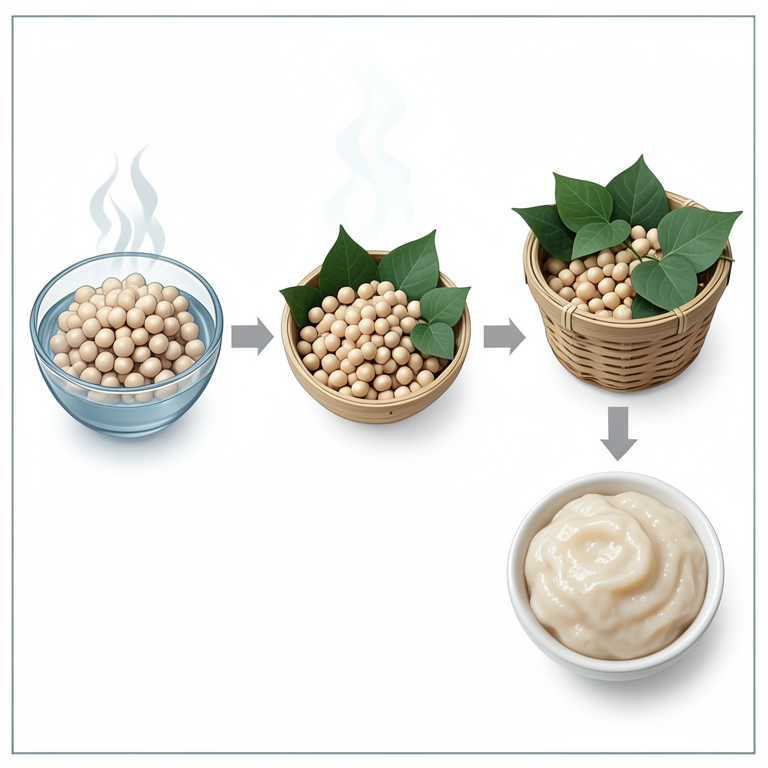
Traditional Hawaijar Production Workflow
AI-generated conceptual illustration (soybeans and Ficus hispida leaves in bamboo baskets). It explains the idea and does not show study data.
View source evidence ↗Introduction
The relationship of the plants and human beings was known since time immemorial. Nowadays there is scientific study of the relationship that exist between people and plants. This includes plants used as food, phytochemical, pharmacology, clothing, currency, ritual, medicine, dye, construction and a lot more. Manipur was a small princely state in the North-East India, having a history of about 2000 years. Meiteis the dominant community of these state and the other 35 ethnic schedule tribes of Manipur also have traditional fermented foods like fermented soybean (hawaijar), fermented bamboo shoot, fermented fish, brewing of local alcohol (yungou), curd (Sangom afamba), fermented meat product of the Vaiphei tribe etc. Meitei have a unique traditional method of process of soybean fermentation. The history of fermentation has early records in South East Asia. Asian countries, people of North-East India catch fishes from the rivers and lakes. Some of the captured fishes are traditionally fermented, (Tamang, 2001) [15] . China is considered as cradle of mold fermented foods while Egyptians developed the combined brewery-bakery fermentation (Nout 1992) [11] . Though fermentation has been known in every human civilization but there is differences in the technique of fermentation. In advanced countries, the technique of brewing, wine making and dairying have emerged into large scale industries producing fermented consumable foods like cheese, pickles, wines, beers, spirit, fermented meat products, soy sauces, etc. Popularization of such "High Tech" fermented products in underdeveloped and developing countries with high price ensures status and refined quality pushing traditional indigenous food into the back stage, (N.S. Singh et al 2007) [11] . According to Steincraus (1995) [14] , the traditional fermentation of food serves the following functions: 1. Enrichment of diet through development of a diversity of flavors, aromas, textures in food substrates. 2. Preservation of substantial amount of food through lactic acid, alcoholic, acetic acid, and alkaline fermentation. 3. Enrichment of food substrates biologically with protein, essential amino acids, essential fatty acids, and vitamins. 4. Detoxification during food fermentation processing. 5. A decreasing in cooking time fuel requirement.
In the 20 th century fermentation was used for flavors productions and industrial mass productions The current century is the era of custom made foods satisfying personal and health benefit demands (Steincraus, 1995) [14] . Fermented foods play an important socioeconomic role in developing countries as well as major contribution to the protein requirement of general population. Food fermentation is regarded as one of the oldest ways of food processing and preservation. More than anything else, man has known the use of microbes for preparation of food products for thousands of years and all over the world a wide range of fermented foods and beverages contributed significantly to the diets of many people (O.K. Achi, 2005) www.extensionjournal.com [3] . Apart from increasing the shelf life, and a reduction in the anti-nutritional factors, fermentation markedly improves the digestibility, nutritive value, and flavors of the raw seeds. Significant contributions have been made in research to understand the microbiology and biochemistry of the fermentation, (Eka, 1980; Okafor, 1977; and Odunfa1985, Achi, 1990, 1992) [1,2] . With the changing of social demands people are given attentions to indigenous traditional foods for their health promoting aspects as well as their increased nutritional value. Population explosion fermented foods the world is the major problem famine. Moreover natural calamities like drought, flood and inadequate crop production due to uncertain rainfall affected by climate change compelled people to rely on traditional fermented foods as fermented foods are available round the year. Natto is a traditional Japanese food made from whole soybeans that have been fermented with Bacillus subtilis (bacteria). Natto is characterised by a slimy, sticky and stringy texture and have many nutritional benefits like strong bones, healthier heart and increased immune system. A diverse variety of soy food products are available in different places such as Akhuni, Bekang, Cheonggkjang, Chagempomba (Meitei), Doenjang, Doubanjang, Douchi, Gochujang, etc. Douchi or tochi (Chinese) is fermented black salted soybeans (wikipedia). Hawaijar is used in almost all the different dishes. Most popular dish is Hawaijar Chagempomba, Hawaijar U Morok (King Chilii) metpa with salt. Second popular dish is hawaijar cooked with pallukabi (Alocasia cucullata) ang fish.
Materials and Methods
One of the most popular fermented food of the Meiteis is the fermented soybean (hawaijar). According to Gurumayum (1994) [8] one bacterium Bacillus subtilis is involved in soybean fermentation. Molds are employed in most of the food fermentation of soybean (Hesseltine and Wang (1967) [9] . The involvement of microorganism in the mode of preparation hawaijar is somewhat similar with Natto. There are some methods of preparation by adding salt in the soybean fermentation e.g. miso and shoyu. In the traditional method of Meitei soybean fermentation no starter is added and the process is spontaneous. Two varieties of soybean (Glycin max) bigger grain size and smaller grain size are used by the Meiteis. Better taste and better result is found in smaller grain size. For fermentation process soybean grains are cleaned, washed and soaked for twenty four hours (Fig A ). The quantity of soya grain depends on the container to be cook and the size of the container to incubate for fermentation. The water is drained and the grains may be cooked in pressure cooker (requires less time in complete cooking) or large metallic big pots (Requires more time in complete cooking). The cooked grains are separated from the liquid () and washed 1 or 2 times with hot water or this step may also be skipped (not to loss nutrients by washing). While draining the top is covered with plates so as not to lose temperature. The separated cooked liquid is also used as a healthy drink which contains full of nutrients. For incubation basket made of bamboo chips (Ngarubak) is used in which Ficus hispida (Asi heibong) leaves made lining (Fig: E) and the drained cooked grains (Fig: C) are packed tightly with leaves and top is also covered with leaves. The completion of fermentation varies according to season. In summer it requires three days and in winter five days for complete fermentation. Again gradual nonstop warm temperature is required. For this the baskets can be put inside a paper cartoon box supplied with 40 watt bulb (Fig: H) or it may be exposed to bright sunlight after wrapping with warm cloth or sack. If there is disruption of power supply or temperature is downed the grains cannot be completely fermented. In another method of incubation the cooked grains are packed in a cloth stitched tightly and placed inside the baskets of paddy or placed on the racks above fireplace for 3-5 days. One drawback of incubation in cloth is that the cloth absorbs and the grains dried a little before complete fermentation. The quality of hawaijar thus produced is of lesser quality while incubation wrapped in Ficus hispida (Fig: A) produced best quality because hawaijar fermentation is carried out by two strains of Bacillus subtilis present on the leaves of Ficus hispida (Fig. A). One strain found in the fermenting seeds developed regularly rounded white colony. This strain can act as starter of fermentation. Another strain found in the leaves of Ficus hispida has white creamy colony with irregular margin (Gurumayum (1994) [8] . This proves that microorganisms are involved in carrying out fermentation. Soybean fermentation is associated with change in biochemical properties. Protein content of the soybean decreases during fermentation, probably due to the activity of the fermenting microorganism. However, total amino acid increases. There is sudden increase of lycin, leucine, isoleucine glutamic acid during the first 24 hours of fermentation and phenylalanine, methionine, cystein arginine during 36 hours. These amino acids are found to be maximum during 48 hours of fermentation and phenol also increase probably synthesized by bacteria. Fermentation of hawaijar is associated with the increase in the content of Thiamine which plays important role in carbohydrate metabolism. Phytosterol amount is maximum after 48 hours of fermentation. However, riboflavin amount is decrease after boiling (Gurumayum, 1994) [8] .
Results and Discussion
In Manipur, the Meitei community have many fermented foods like fermented bamboo shoot (Soibum), fermented soybean (hawaijar), fermented fish (Ngari and hentak), curd (Sangom afamba) etc. Other fermented food products like bread, beer, wine and cheese have developed scientific and technological knowledge. But the traditional methods of fermentation practiced in Manipur fermented foods are produced by spontaneous or natural fermentation which involve fungi and other microorganisms there is high risk of production of micotoxins (N.S. Singh et al 2007) [12] . Micotoxins are toxic compounds that are naturally produce by certain types of moulds. One of frequent case in consumption of fermented soybean is the food poisoning. This may be due to the use of pesticide treated grains which are sold out illegally from seed house or it may be due to growth of microorganisms like fungi. These microorganisms are to be eliminated for safe supply of food. The traditional method of soybean fermentation which has been practiced for many centuries people of Manipur have limited knowledge about various microorganisms and health risks associated with such type of food preparation. Modern scientific technologies are required to substitute the traditional method without changing the food value. Proper sanitation is also required to reduce the risks of Micotoxins. www.extensionjournal.com G: Ficus hispada tree H: Incubation in paper cartoon box
Conclusion
From this research we found that traditional fermented soybean of Meiteis are produced by spontaneous or natural fermentation. Traditional fermented soybean (hawaijar) is very popular not only in Manipur but also found to eat in South-East Asia popularly in Japan where it is known as natto (which involves with Bacillus subtilis as in hawaijar). The art of traditional process need to be transformed into a technology to standardized the quality of food products. Sometimes people faced highest rate of food poisoning by consumption of fermented soybean. This may be due to the use pesticide treated seeds for cultivation and care should be taken to avoid this. Even though fermentation processes have been practiced for many centuries rural people have limited knowledge about various microorganisms and health risks with such type of food preparation. Production of foods with high nutritional content and free from health risks is the key challenge for supplementing the food demands in Manipur.
References
8 in the original paper- Achi OK. Microbiology of Obiolor a Nigerian fermented non-alcoholic beverages. J Appl Bacterial. 1990;69:321-325.
- Achi OK. Microorganisms associated with natural fermentation of prosopis African seed for production of "okpiye". J Plant Foods Hum Nutr. 1992;42:297-304.
- Achi OK. The potential for Upgrading Traditional Fermented Foods through Biotechnology. Afr. J Biotechnol. 2005;4(5):375-380.
- Campbell-Platt G. Fermented foods -a world perspective. Food Res Intl. 1994;27:253-257.
- Fu SH, Yoon Y, Bazemore R. Aroma-Active Components of Fermented bamboo shoots. J Agric Food Chem. 2002;50:549-554.
- Giri SS. Release of HCN in Soibum fermentation. Phytol Res. 1996;7:169-170.
- Hesseltine CW, Wang Hwa L. Traditional fermented foods. Biotechnol Bioeng. 1967;9(3):275-288.
- Tamang JP. Food Culture in the Eastern Himalayas. J Himalayan Res Cult Found. 2001;5:629-635.
Cited by 1
From OpenAlex, OpenCitations and reference lists read by Scinovex
- Indigenous Fermented Foods of the Ethnic Meitei’s of Manipur and Its Nutritional Benefits ↗
Khwairakpam Sharmila, Ningthoujam Samarendra Singh, Khwairakpam Bembem · People, cultures and societies · 2026
❝ 0