
Research article · 2024 · Full text
International Journal of Advanced Biochemistry ResearchDetection of Staphylococcus aureus from bovine mastitis milk
Volume 8(1S) · Pages 300–303 · DOI: 10.33545/26174693.2024.v8.i1se.404 ↗
Research areasMilk Quality and Mastitis in Dairy CowsBiopolymer Synthesis and ApplicationsProbiotics and Fermented Foods
Abstract
Author-writtenMastitis, an inflammation of the mammary gland. Staphylococcus aureus is the most common cause of economic loss in dairy cattle due to decrease quality and quantity of milk. This study was aimed to find-out the prevalence of S.aureus in case of bovine mastitis (clinical) through conventional method. Absolute diagnosis of pathogens plays great role in cure of disease. A total of 27 S. aureus isolates were isolated from 50 individual milk samples from dairy cows with clinical mastitis. The results showed that they were positive in gram staining (forming a bacteria cluster of purple cocci), catalase test, coagulase test, blood agar haemolysis, and DNase test. The mannitol, trehalose, sucrose, maltose, and lactose tests were also positive. The prevalence of bacterial isolates in conventional detection were 55%.
Summary
Source-checkedPlain-language reading of the full paper, prepared with AI and checked against the text. Each point links to the authors' own words.
Why it matters
- Staphylococcus aureus is a primary driver of economic losses in the dairy industry because it reduces both the volume and quality of milk produced. View evidence ↗
- Despite being the world's largest milk producer, India's dairy farms are significantly impacted by mastitis, the most prevalent disease in the sector. View evidence ↗
- Mastitis caused by S. aureus is particularly challenging to manage using treatment alone. View evidence ↗
The question
- The study aimed to determine the prevalence of S. aureus in cows with clinical mastitis using conventional detection methods. View evidence ↗
What they did
- Researchers collected milk samples from 50 dairy cows exhibiting clinical mastitis, resulting in 27 S. aureus isolates. View evidence ↗
- Samples were taken from cows showing clinical signs such as udder inflammation, decreased milk production, and changes in milk color, stickiness, or the presence of flakes. View evidence ↗
- Milk samples were incubated at 37 °C for 24 hours on 5% blood agar and mannitol salt agar. View evidence ↗
- Identification of S. aureus was performed using Gram staining, catalase and oxidase tests, coagulase activity, sheep blood agar hemolysis, and sugar fermentation via API biochemical test strips. View evidence ↗
What they found
- The prevalence of S. aureus isolates among the sampled clinical mastitis cases was 55%. View evidence ↗
- Among the isolates, 70% (19 out of 27) produced coagulase, a key pathogenic factor for S. aureus. View evidence ↗
- Hemolytic activity was found in 82% (22 out of 27) of isolates, with 16 showing beta hemolysis and 6 showing alpha hemolysis. View evidence ↗
- Most isolates did not ferment arabinose (only 11%) or raffinose (only 7.4%). View evidence ↗
What it means
- The authors conclude that the incidence of S. aureus mastitis in the studied area was quite high at 55%. View evidence ↗
- The authors suggest that the prevalence of S. aureus is linked to poor milking hygiene, environmental sanitation, lack of awareness, and the excessive use of antibiotics. View evidence ↗
Visual summary
2 visualsIllustrations explain the paper; charts are replotted from the paper's own table values.
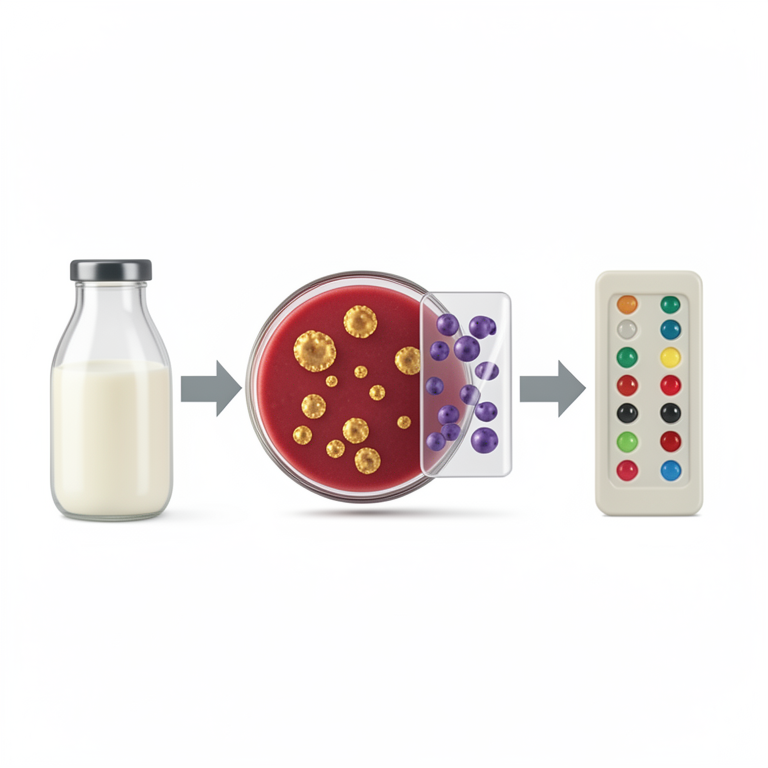
S. aureus Identification Workflow
AI-generated conceptual illustration (Bovine mastitis milk and Staphylococcus aureus bacteria). It explains the idea and does not show study data.
View source evidence ↗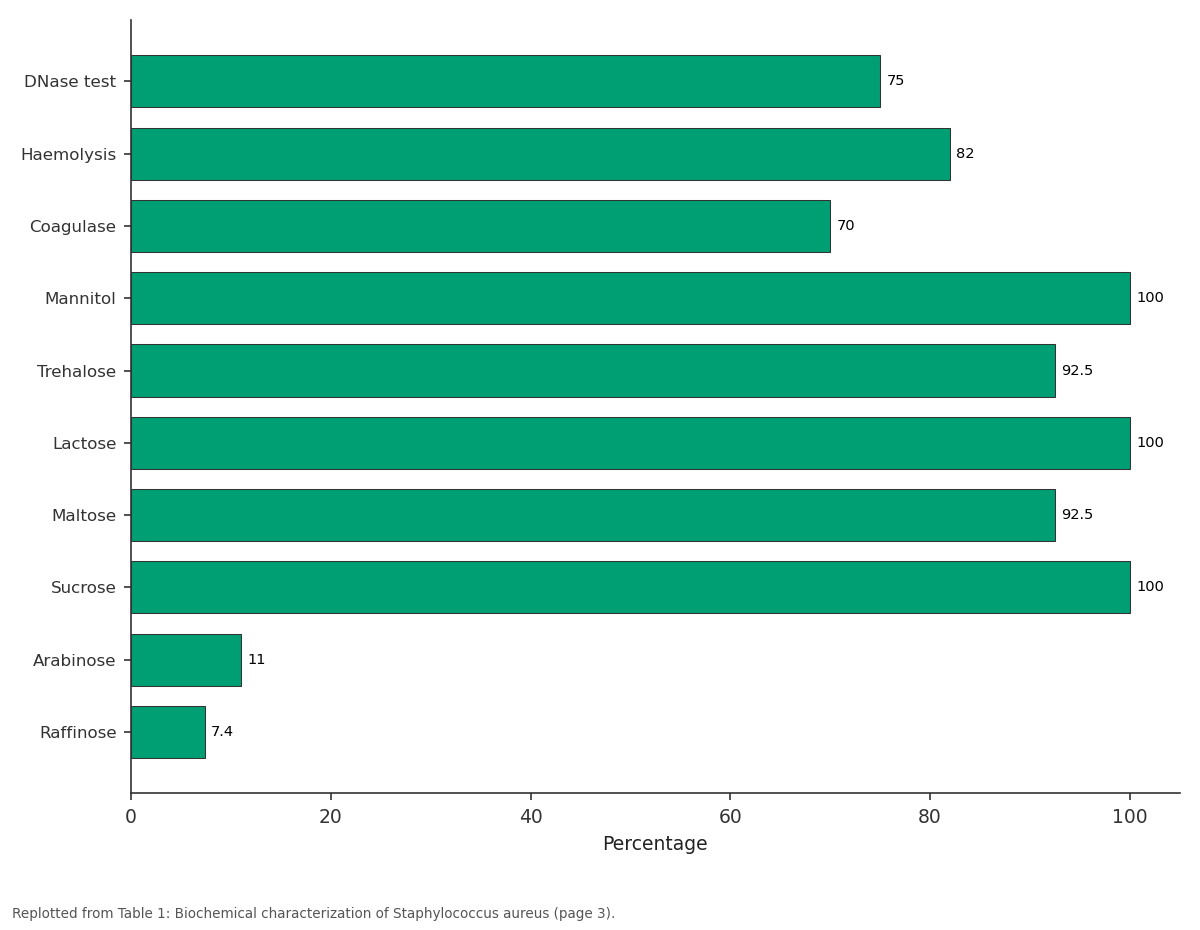
Percentage: DNase test vs Haemolysis vs Coagulase vs Mannitol vs Trehalose
Replotted from Table 1 (page 3) of the original paper. Every bar is the paper's own table value.
View source evidence ↗Figures & tables
From the original paper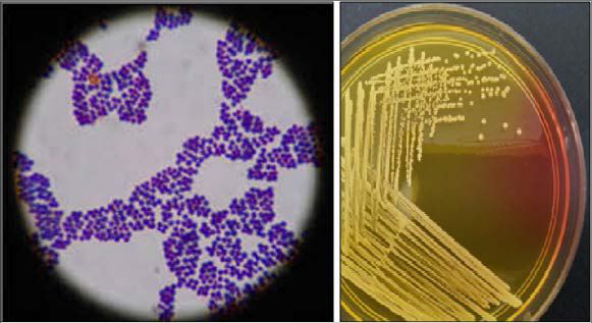 Figure 1
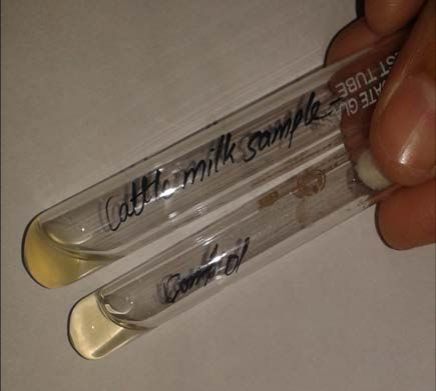 Figure 3
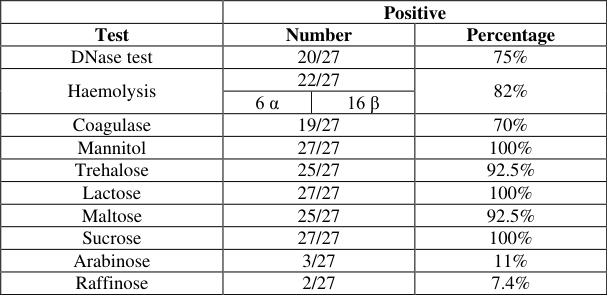 Table 1
Introduction
India has vast resources in terms of livestock and poultry which play major role in improving the socio-economic condition of rural masses. Total livestock population in country is 535.78 million of which total bovine population (Cattle, Buffalo, Mithun and Yak) is 302.79 million have increased by 1.0% over the previous census. The Female Cattle (Cows population) is 145.12 million, increased by 18.0%. (20 th livestock census, 2019) [1] . India is the largest producer of milk but mastitis is the most prevalent disease affecting dairy farms in country. It is defined as inflammation of parenchyma of mammary glands and is characterized by physical and pathological changes in glandular tissue, bacteriological changes in milk (Radostits, et al., 2000) [9] . Mastitis is a multi-etiological complex disease, which is affects milk quality directly in the technical characteristics and the hygienic quality of the milk, and indirectly through the intrinsic milk quality (Hogeveen et al., 2002) [4] . The overall prevalence of bovine mastitis in India has been reported to be 44.67% (Sharma et al., 2010) [11] . Staphylococcus aureus is one of the main etiological agent that cause contagious bovine mastitis. S. aureus mastitis is extremely difficult to control by treatment alone. (Pumipuntu et al., 2017) [8] . The bacteria persist in mammary glands, teat canals, and teat lesions of infected animal and infection is spread at the time of milking, when healthy gland come in contact with infected gland via milker's hand, infected utensils, milking machine etc. To date, successful control has been achieved only through the prevention of new infections and culling infected animals.
Materials and Methods
Materials and Methods
Collection of samples
The collection of milk samples was from cows affected with mastitis that had symptoms i.e. change in the colour of milk, presence of flakes, stickiness property in the milk, inflammation of the udder, and decreased production of milk. Before collection of milk, the udders of the affected cows were cleaned with water and then dried. Ethanol (70%) dipped cotton were used to disinfect the udder. Initially, the first few streams of milk were dropped and then the collected milk was kept in a cool carrier with ice and transported to the adjacent laboratory within 4 hrs. All samples were subjected for cultural examination and biochemical identification.
Isolation of bacteria
The milk samples were cultured on mannitol salt agar, 5% blood agar and incubated at 37 °C for 24 h.
Results and Discussion
The isolates of Staphylococcus aureus were gram positive which morphologically are cocci and was clustered together like grapes (Fig. 1). They were non motile, catalase positive and oxidase negative. Catalase enzyme functions as a catalyst, which diffused hydrogen peroxide (H2O2) into H 2 and O 2 ; thus, when the bacteria colonies are mixed up with H 2 O 2 , gas bubbles are produced. These isolates were showing golden yellow color on mannitol salt agar (Fig. 2) because during fermentation of mannitol, phenol red turned into yellow color by formation of acidic by-product. Coagulase testing is the reliable method for identifying Staphylococcus aureus (Koneman et al., 1997) [7] . The phenotypically identified isolates were confirmed by production of coagulase revealed that 70% of isolates were produced coagulase (Table 1). Some of the isolates showed weak coagulation reaction even after 5 hr. of incubation however, they all showed a strong reaction at the 24 h reading. The production of the coagulase enzyme becomes the pathogenic factor of S. aureus, differentiating it from other types of Staphylococci. The coagulase enzyme is able to clot blood plasma, since it resembles prothrombin, which can convert fibrinogen to fibrin (Fig. 3). Our results are in agreement with Turkyilmaz and Kaya (2005) [13] ; Kateete et al. (2010) [5] and Yadav et al. (2015) [15] .
| — | Positive | — | — |
|---|---|---|---|
| Test | Number | Percentage | |
| DNase test | 20/27 | 75% | |
| Haemolysis | 22/27 | 82% | |
| 6 α | 16 β | ||
| Coagulase | 19/27 | 70% | |
| Mannitol | 27/27 | 100% | |
| Trehalose | 25/27 | 92.5% | |
| Lactose | 27/27 | 100% | |
| Maltose | 25/27 | 92.5% | |
| Sucrose | 27/27 | 100% | |
| Arabinose | 3/27 | 11% | |
| Raffinose | 2/27 | 7.4% |
Table text extracted from the original PDF; superscript letters are shown inline. The original table image is below.
View original table image
In the present study, test result showed that twenty out of the 27 isolates (75%) were able to had DNase activity. Deoxyribonuclease (DNase) is an extracellular enzyme and virulence factor produce by S. aureus. It is capable of destroying deoxyribonucleic acid (Subathra et al., 2016) [12] . Kateete et al., (2010) [5] also found that 75% (24/32) of S. aureus isolates were showed DNase activity. Similar findings were reported by Rao et al. (2002) [10] . Following the identification of target organism, the colonies were then streaked onto sheep blood agar (BA), in order to observe the its ability to induce hemolysis of blood erythrocyte, to visualize the hemolytic zone around colonies. In the present study, 6 isolates produced alpha haemolysis (complete), 16 produced beta haemolysis (incomplete) and 5 isolates not produced haemolysis on sheep blood agar. Staphylococcus produces alpha haemolysin causes a narrow zone of complete haemolysis and beta haemolysin produces a wider zone of partial or incomplete heamolysis or both (double haemolysis) or no haemolysis in some other bacteria (Cowan, 1993) . The results of the present study are in complete agreement with that of Khichar and Kataria (2007) [6] ; Upadhyay and Kataria, (2010) [14] , Gangwal et al. (2016) [3] who did record hemolytic activity of S. aureus obtained from milk samples of cattle and goats. The sugar fermentation studies were carried out by using API biochemical test kit for S. aureus. In our investigation, all the isolates of target organism fermented mannitol, lactose, sucrose, 92.5% of the isolates fermented Trehalose and Maltose. Whereas more than 90% of the isolates not fermented arabinose and raffinose (Table 1). The observations of the present study with respect to fermentation of mannitol, maltose, fructose, dextrose, sucrose, mannose is similar to findings of Upadhyay (2010) [14] who carried out fermentation studies with S. aureus obtained from milk of mastitic cattle and goat.
Conclusion
On the basis of our study, it can be concluded that the incidence of S. aureus mastitis in a studied area was quite high which were 55%. It can be diagnosed on the basis of phenotypic characterization. It was little bit laborious but helpful to find-out the proper cause of mastitis which play tremendous role in cure out the disease. S. aureus is a contagious bacterium, which can be isolated from the skin surface of humans or animals. Its role as a cause of mastitis in cows is related to environmental sanitation, milking hygiene, improper diagnosis, lack of awareness about prevention and control. Abundantly use of antibiotic is maybe a major cause of its prevalence in field condition.
References
10 in the original paper- Gangwal A, Kashyap SK, Katiyar S, Meena D, Boyal P, Gupta K. Isolation and Identification of Common Mastitis Causing Pathogens from Clinical Bovine Mastitic Milk. J Pure Appl Microbiol. 2017 Mar;11(1):345-52.
- Kateete DP, Kimani CN, Katabazi FA, Okeng A, Okee MS, Nanteza A, et al. Identification of Staphylococcus aureus: DNase and Mannitol salt agar improve the efficiency of the tube coagulase test. Ann Clin Microbiol Antimicrob. 2010 Dec;9(1):1-7.
- Khichar V, Kataria AK. Capsular genotyping (cap5k and cap8k) of Staphylococcus aureus isolates from cattle with clinical mastitis. Hum Vet Med. 2014 Apr;6(1):30-33.
- Koneman EW, Allen SD, Janda WM, Schreckenberger PC, Winn WC. The enterobacteriaceae. Color atlas and textbook of diagnostic microbiology. 1997;5:211-302.
- Pumipuntu N, Kulpeanprasit S, Santajit S, Tunyong W, Kong-Ngoen T, Hinthong. Screening method for Staphylococcus aureus identification in subclinical bovine mastitis from dairy farms. Vet World. 2017 Jul;10(7):721.
- Rao JG, Qamruddin AO, Hassan IA, Burnie JP, Ganner M. Cluster of clinical isolates of epidemic methicillinresistant Staphylococcus aureus (EMRSA) with a negative deoxyribonuclease (DNase) test-implications for laboratory diagnosis and infection control. J Hosp Infect. 2002 Jul;51(3):238-239.
- Subathra Devi C, Mohanasrinivasan V, Subramaniam V, Parashar M, Vaishnavi B, Jemimah Naine S. Molecular characterization and potential assessment of extracellular DNase producing Staphylococcus aureus VITSV4 isolated from bovine milk. Iran J Sci Technol Trans A Sci. 2016 Sep;40:191-199.
- Türkyilmaz S, Kaya O. Determination of some virulence factors in Staphylococcus spp. isolated from various clinical samples. Turk J Vet Anim Sci. 2006;30(1):127-132.
- Upadhyay A, Kataria AK. Haemolytic properties and titration of haemolysins of Staphylococcus aureus of milk origin from cattle and goat with clinical mastitis. Indian J Vet Res. 2010;19(2):60-65.
- Yadav R, Sharma SK, Yadav J, Nathawat P, Kataria AK. Typing of Staphylococcus aureus obtained from mastitic milk of cattle and buffalo on the basis of coagulase (coa) gene RFLP patterns. Isr J Vet Med. 2015;70(4):36-40.