
Research article · 2024 · Full text
International Journal of Biology SciencesAntioxidant activity and inhibition of elastase and tyrosinase of peptide extracts obtained from Timbe seed albumin
Volume 6(1) · Pages 14–17 · DOI: 10.33545/26649926.2024.v6.i1a.175 ↗
Research areasProtein Hydrolysis and Bioactive PeptidesInsect Utilization and EffectsBiochemical and Structural Characterization
Abstract
Author-writtenAcaciella angustissima (Timbe) is primarily used as firewood, as fodder (for goats and sheep), as a natural fuel, and as a natural tanner. Recent studies have focused on obtaining bioactive compounds, mainly phenolics, from bark and pods with potential antioxidant, antimicrobial, and antimutagenic activities. However, there have been no studies on obtaining peptides from the seeds of these species. Therefore, the objective of this work was to obtain peptide extracts with antioxidant and elastase- and tyrosinase-inhibitory properties from Timbe seeds. Albumin extracted from Timbe seeds was hydrolyzed with alcalase to generate protein hydrolysates, which were then ultrafiltered to obtain peptide extracts with a molecular weight of less than 10 kDa. The peptide extracts showed higher reducing activity against the ABTS•+ radical and a greater inhibitory effect on elastase and tyrosinase. Although albumin exhibited higher iron-reducing power, the antioxidant properties and inhibition of elastase and tyrosinase observed in both Timbe albumin and peptide extracts were similar to those reported in albumin and peptide fractions derived from other plant sources (Amaranth, white sorghum, rice, cocoa, and chia). These results demonstrate that the enzymatic hydrolysis of Timbe seed albumin is a promising process for the generation of peptide extracts with beneficial properties for skin care.
Summary
Source-checkedPlain-language reading of the full paper, prepared with AI and checked against the text. Each point links to the authors' own words.
Why it matters
- Skin aging is driven by oxidative stress, which occurs when there is an imbalance between the production of free radicals and the body's own antioxidant defenses. View evidence ↗
- Tyrosinase is a key enzyme in melanin synthesis; its hyperactivity can lead to skin issues like age spots and melanoma. View evidence ↗
- Elastase is the only enzyme that can degrade elastin, meaning that inhibiting this enzyme can help prevent premature skin aging. View evidence ↗
The question
- The study aimed to produce peptide extracts from Timbe seeds and evaluate their ability to act as antioxidants and inhibit elastase and tyrosinase. View evidence ↗
What they did
- Timbe pods were harvested during spring in Queretaro, Mexico, and the seeds were air-dried for 72 hours. View evidence ↗
- The seed flour was defatted using hexane at a ratio of 10 mL/g for 24 hours at room temperature. View evidence ↗
- Albumin was hydrolyzed using alcalase at 50 °C and pH 7.5 for 120 minutes, with an enzyme-to-substrate ratio of 1:10. View evidence ↗
- Ultrafiltration membranes with a 10 kDa molecular weight cutoff were used to obtain the final peptide extracts from the albumin hydrolysate. View evidence ↗
- The researchers used analysis of variance and Tukey's tests to compare albumin and peptide extracts, reporting results as mean ± SD with a sample size of n=3. View evidence ↗
What they found
- The defatting process was efficient, reducing the fat content from 7.22 g/100 g in the original seeds to 0.1 g/100 g in the defatted flour. View evidence ↗
- Peptide extracts showed significantly higher ABTS•+ radical scavenging activity (58.85±0.45%) compared to albumin (45.76±0.14%). View evidence ↗
What it means
- The authors conclude that enzymatic hydrolysis of Timbe seed albumin is a promising method for creating peptide extracts that could benefit skin care. View evidence ↗
- The study establishes a foundation for future research into the production and characterization of these peptides for use in skincare product design. View evidence ↗
Visual summary
1 visualsIllustrations explain the paper; they do not show study data.
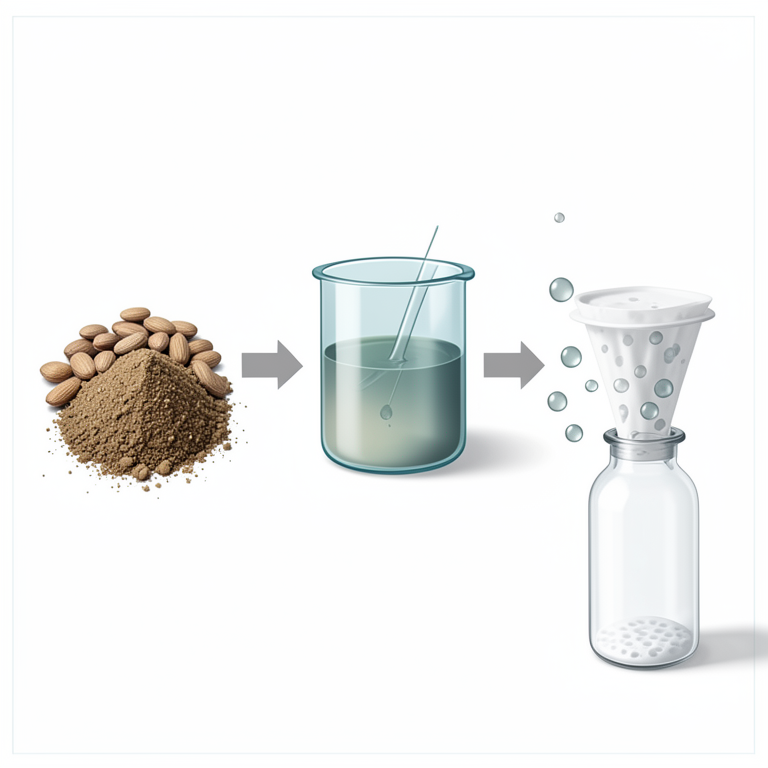
Peptide Production Workflow
AI-generated conceptual illustration (Timbe seeds (Sterculia quadrifida)). It explains the idea and does not show study data.
View source evidence ↗Figures & tables
From the original paper Table 1
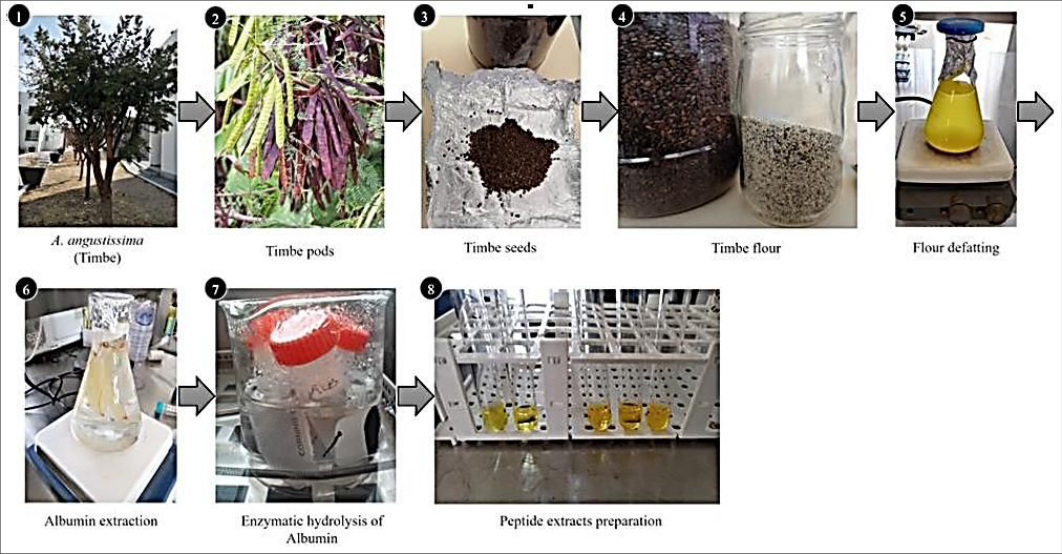 Figure 1
Introduction
The skin is arguably the organ most susceptible to damage from free radicals because it has greater contact with oxygen and the environment. External factors affecting the rate of skin aging are all attributed to a single process, oxidative stress, resulting from an imbalance between the generation of free radicals and the body's antioxidant defenses [1] . Therefore, the consumption of antioxidants that can promote the prevention of oxidative damage to the skin is necessary. In addition, tyrosinase is the crucial enzyme in melanin synthesis, acting as a multifunctional oxidase that catalyzes the first two steps in mammalian melanogenesis. Hyperactivity of this enzyme causes dermatological issues such as melanoma and age spots. Hence, the search for compounds that inhibit this enzyme is of great interest for use as antiaging agents [2] . Furthermore, skin aging is characterized by a progressive loss of tissue and changes in the extracellular matrix macromolecules of the skin, including elastin, a component of the skin's elastic fibers. With age, the quantity of elastin fibers decreases because of reduced synthesis and increased degradation, resulting in a loss of skin elasticity. Elastase is the only enzyme capable of degrading elastin [3] . Therefore, elastase inhibition prevents premature skin aging. Over the past two decades, multiple studies have recognized various health benefits (Antioxidant, antihypertensive, antithrombotic, among others) attributed to specific protein fragments capable of modulating physiological processes, known as bioactive peptides [4] . These peptides can be obtained from plant proteins, with cereal grains (Wheat, rice, oats, rye, and corn) and some legumes such as soybean, beans, broad beans, peas, and chickpeas standing out [5] . In this context, there is scientific evidence that peptide-rich extracts exhibit antioxidant capacity and inhibit elastase and tyrosinase activities, suggesting potential antiaging effects on the skin [6] .
Therefore, it is necessary to explore new (Natural) sources of bioactive peptides. Acaciella angustissima (Timbe) is a leguminous shrub native to Central America. This species is recognized as a significant source of secondary metabolites, including amines, alkaloids, glucosides, fatty acids, and phenolic compounds. Additionally, it is valued for its ecological contributions and various uses in traditional medicine and agriculture [25] . Some studies have reported antioxidant, antimicrobial, and antimutagenic activities of phenolic extracts obtained from Timbe pods [8,9] . However, the presence of bioactive peptides has not been investigated. Therefore, this work aimed to evaluate the antioxidant and elastase-and tyrosinase-inhibitory properties of peptide extracts produced by the enzymatic hydrolysis of Timbe seed albumin.
Materials and Methods
Figure 1 shows the experimental strategy for obtaining peptide extracts from Timbe seed albumin.
2.1 Plant material: Timbe pods were harvested at Amazcala, El Marques, Queretaro, Mexico during spring. Seeds were collected and air-dried for 72 h. afterwards, the seeds were subjected to grinding using an electric mill (Bosch TSM6A, Stuttgart, Germany). The flour was sieved through a 250-µm mesh and stored at 4 °C.
Flour defatting:
The obtained flour was defatted with hexane (10 mL/g) under constant stirring for 24 h at room temperature, followed by vacuum filtration. Defatted flour was placed in a fume hood for 24 h to allow solvent evaporation and stored at 4 °C until use.
Albumin extraction:
The Timbe seed albumin extraction was performed according to Voigt and Biehl [10] . Defatted flour (1:10 w:v) was mixed with Tris-HCl 10 mM (pH 7.5) containing EDTA 2 mM and sodium ascorbate 5mM. The slurry was stirred during 4 h at 4 °C and centrifuged at 10,000 rpm for 20 min at 4 °C. The supernatant was dialyzed in membranes of molecular weight 14 kDa cutoff for 2 days with deionized water at 4 °C, with a change every 24 h. The sample of dialysis tubes was centrifuged as indicated above and the supernatant (albumin) was stored at -20 °C. The protein concentration was determined according to Bradford [11] .
Enzymatic hydrolysis of albumin:
Albumin was hydrolyzed with alcalase (protease from Bacillus licheniformis, Sigma-Aldrich®) at pH 7.5 and 50 °C with an enzyme: substrate ratio of 1:10 (w:w). Hydrolysis reaction was performed for 120 min. At the end of the reaction time, the sample was heated at 95 °C for 10 min. The sample was centrifuged at 5000 rpm for 10 min at 4 °C. The obtained supernatant was denominated albumin hydrolysate.
Peptide extracts preparation:
The obtained albumin hydrolysate was filtered using ultrafiltration membranes with a molecular weight cutoff of 10 kDa (Merck Millipore®). Ultrafiltered samples were obtained and denominated peptide extracts. Peptide concentration in the peptide extracts was performed by TNBS method [12] using L-Leucine as standard.
Determination of antioxidant activity:
Antioxidant properties of albumin and peptide extracts was assessed through the scavenging effect on ABTS•+ radical and reducing power.
a) Scavenging effect on ABTS•+ radical:
The ABTS•+ radical scavenging effect of albumin and peptide extracts was determined according to Re et al., [13] . The results were reported in percentage inhibition using the following equation.
Where A is the absorbance at 734 nm.
b) Ferric reducing antioxidant power (FRAP assay):
The reducing power of albumin and peptide extracts was determined according to Wang et al., [14] . The results were reported in absorbance at 700 nm.
Elastase and tyrosinase inhibition a) Elastase:
Elastase inhibitory effect of albumin and peptide extracts was determined according to Royer et al., [15] . b) Tyrosinase: Tyrosinase inhibitory effect of albumin and peptide extracts was determined according to Ochiai et al., [16] . The results were reported in percentage of inhibition using the following equation:
Where, A = enzyme activity with sample, and B = enzyme activity without sample.
Statistical analysis:
All the data are presented as mean ± SD (n = 3). Data were analyzed by analysis of variance and Tukey´s tests for comparisons between albumin and peptide extracts using Statgraphics® (Centurion XVI).
Results
The fat content (ether extract) in Timbe seeds was 7.22 g/100 g of flour; likewise, in the defatted flour, a significantly lower (p<0.05) fat content of 0.1 g/100 g of flour was obtained compared with the initial content in the seed, indicating the efficiency of the hexane defatting process. The albumin extraction yield from defatted Timbe flour was 2.2 g/100 g, and the peptide concentration in the extracts obtained from the enzymatic hydrolysis of albumin was 460±10 µg/mL. Table 1 displays various bioactivities (antioxidant and elastase and tyrosinase inhibition) obtained from both peptide extracts and the protein (albumin), showing distinct behavior for each determination. Peptide extracts exhibited higher reducing activity against the ABTS•+ radical and greater inhibitory activity against elastase and tyrosinase. However, albumin showed a higher iron-reducing power.
| Compound | — | — | Bioactivity | — |
|---|---|---|---|---|
| ABTS•+ radical scavenging activity (%) | FRAP (Abs. λ=700 nm) | Elastase inhibition (%) | Tyrosinase inhibition (%) | |
| Albumin (protein) | 45.76±0.14b | 0.234±0.007a | 17.08±2.11b | ND |
| Peptide extracts | 58.85±0.45a | 0.076±0.006b | 68.68±2.26a | 41.95±0.40 |
Table text extracted from the original PDF; superscript letters are shown inline. The original table image is below.
View original table image
Discussion
Initially, the defatting process of Timbe flour allowed obtaining a suitable raw material for protein (albumin) extraction. To the best of our knowledge, there are no reports of albumin content in Timbe seeds; however, the albumin extraction yield was similar to that reported in amaranth grain [17] and cocoa seed [18] . It is worth mentioning that the extracted protein yield depends on various factors, including the extraction method, type and concentration of solvent used, the use of reducing agents, and seed variety. This study is the first to produce peptide extracts from Timbe seeds. In this regard, the peptide concentration obtained falls within the range reported for peptide extracts derived from cocoa seeds [17] and soybeans [19] , as well as white sorghum grain [20] . Ultrafiltration has been widely used for peptide separation (within a specific molecular weight range) and has been applied to plant-derived protein hydrolysates to separate peptides between 1 and 10 kDa [21] . It is noteworthy that both albumin and peptide extracts exhibited antioxidant properties through electron transfer and/or hydrogen atom transfer mechanisms. The FRAP assay has been widely employed in studies as a standard method for evaluating antioxidant activity, where an increase in absorbance values at 700 nm indicates an increase in the reducing power of the antioxidant [19] . Similarly, methods for evaluating free radical scavenging represent a chemically valid parameter for measuring the antioxidant effect of peptides [18] . The values of ABTS•+ radical reducing activity and FRAP obtained in both albumin and peptide extracts were similar or higher than those reported in albumin and peptides from amaranth grain [22] and cocoa seed [18] . Thus, peptide extracts from Timbe seeds could counteract damage caused by free radicals, thus preventing oxidative stress. Finally, Timbe seed peptide extracts showed high inhibitory activities against elastase and tyrosinase, similar to those reported in peptide fractions derived from rice bran albumin [23] and chia seed [24] . This indicates that peptide extracts can prevent the appearance of wrinkles and loss of skin elasticity as well as prevent age spots, hyperpigmentation, and melanoma formation [20,24] .
Conclusion
Timbe seeds can serve as a raw material for the generation of peptide extracts with antioxidant activity and elastaseand tyrosinase-inhibitory capacity. This work provides other use for Timbe seeds and lays the bases for future research related on the production and characterization of peptides for potential applications in the design of skincare products.
Acknowledgment
Authors thank to Autonomous University of Queretaro for financing this work through the FONDEC-UAQ-2022 project # FIN202301.
References
25 in the original paper- Dimaki A, Kyriazi M, Leonis G, Sfiniadakis I, Papaioannou GT, Ioannou E, et al. Diabetic skin and UV light: Protection by antioxidants. European Journal of Pharmaceutical Sciences. 2019;127:1-8.
- Vandeput M, Patris S, Silva H, Parsajoo C, Dejaeghere B, Martinez JA, et al. Application of a tyrosinase microreactor -detector in a flow injection configuration for the determination of affinity and dynamics of inhibitor binding. Sensors and Actuators B: Chemical. 2017;248:385-394.
- Sultana N, Lee NH. Antielastase and free radical scavenging activities of compounds from the stems of Cornus kousa. Phytotherapy Research: An International Journal Devoted to Pharmacological and Toxicological Evaluation of Natural Product Derivatives. 2007;21(12):1171-1176.
- Dullius A, Goettert MI, Volken de Souza CF. Whey protein hydrolysates as a source of bioactive peptides for functional foods: Biotechnological facilitation of industrial scale-up. Journal of Functional Foods. 2018;42:58-74.
- Kehinde BA, Sharma P. Recently isolated antidiabetic hydrolysates and peptides from multiple food sources: A review. Critical Reviews in Food Science and Nutrition. 2018;60(2):322-340.
- Deng Y, Huang L, Zhang C, Xie P, Cheng J, Wang X, et al. Skin-care functions of peptides prepared from Chinese quince seed protein: sequences analysis, tyrosinase inhibition and molecular docking study. Industrial Crops and Products. 2020;148(12):112331.
- Tirfi AG. Sorghum yield response to climate and other input factors in Ethiopia. International Journal of Agriculture and Food Science. 2022;4(2):88-100. DOI: 10.33545/2664844X.2022.v4.i2b.100
- Feregrino-Pérez AA, Torres-Pacheco I, VargasHernández M, Munguía-Fragozo PV, Loarca-Piña GF, Mendoza-Díaz SO, et al. Antioxidant and antimutagenic activities of Acacia pennatula pods. Journal of Scientific & Industrial Research. 2011;70(11):859-864.
- Vargas-Hernández M, Munguía-Fragozo PV, CruzHernández A, Guerrero BZ, Gonzalez-Chavira MM, Feregrino-Pérez AA, et al. Bioactivity and gene expression studies of an arbustive Mexican specie Acaciella angustissima (Timbe). Industrial Crops and Products. 2014;52:649-655.
- Voigt J, Biehl B. The major seed proteins of Theobroma cacao L. Food Chemistry. 1993;47(2):145151.
- Bradford MM. A rapid and sensitive method for the quantization of microgram quantities of protein utilizing the principle of protein-dye binding. Anal Biochem. 1976;72(1-2):248-254.
- Adler-Nissen J. Determination of the degree of hydrolysis of food protein hydrolysates by trinitrobenzenesulfonic acid. Journal of Agricultural and Food Chemistry. 1979;27(6):1256-1262.
- Re R, Pellegrini N, Proteggente A, Pannala A, Yang M, Rice-Evans C et al. Antioxidant activity applying an improved ABTS radical cation decolorization assay. Free Radical Biology and Medicine. 1999;26(910):1231-1237.
- Wang XJ, Zheng XQ, Kopparapu NK, Cong WS, Deng YP, Sun XJ, et al. Purification and evaluation of a novel antioxidant peptide from corn protein hydrolysate. Process Biochem. 2014;49(9):1562-1569.
- Royer M, Prado M, García-Pérez ME, Diouf PN, Stevanovic T. Study of nutraceutical, nutricosmetics and cosmeceutical potentials of polyphenolic bark extracts from Canadian forest species. Pharma Nutrition. 2013;1(4):158-167.
- Ochiai A, Tanaka S, Imai Y, Yoshida H, Kanaoka T, Tanaka T, et al. New tyrosinase inhibitory decapeptide: molecular insights into the role of tyrosine residues. Journal of Bioscience and Bioengineering. 2016;121(6):607-613.
- Tovar-Pérez EG, Guerrero-Legarreta I, Farrés-González A, Soriano-Santos J. Angiotensin I-converting enzymeinhibitory peptide fractions from albumin 1 and globulin as obtained of amaranth grain. Food chemistry. 2009;116(2):437-444.
- Tovar-Pérez EG, Guerrero-Becerra L, Lugo-Cervantes E. Antioxidant activity of hydrolysates and peptide fractions of glutelin from cocoa (Theobroma cacao L.) seed. CyTA-J Food. 2017;15(4):489-496.
- Meza-Espinoza L, Sáyago-Ayerdi SG, García-Magaña ML, Tovar-Pérez EG, Yahia EM, Vallejo-Cordoba B, et al. Antioxidant capacity of egg, milk and soy protein hydrolysates and biopeptides produced by Bromelia pinguin and Bromelia karatas-derived proteases. Emirates Journal of Food and Agriculture. 2018;30(2):122-130.
- Castro-Jácome TP, Alcántara-Quintana LE, LugoCervantes E, Montalvo-González E, Ortiz-Basurto RI, Tovar-Pérez EG et al. Anti-elastase, anti-tyrosinase and antioxidant properties of a peptide fraction obtained from sorghum (Sorghum bicolor L. Moench) grain. International Food Research Journal. 2019;26(6):18231822.
- Ranamukhaarachchi S, Meissner L, Moresoli C. Production of antioxidant soy protein hydrolysates by sequential ultrafiltration and nanofiltración. Journal of Membrane Science. 2013;429:81-87.
- Soriano-Santos S, Escalona-Buendía H. Angiotensin IConverting Enzyme inhibitory and antioxidant activities and surfactant properties of protein hydrolysates as obtained of Amaranthus hypochondriacus L. grain. Journal of Food Science and Technology. 2015;52(4):2073-2082.
- Kubglomsong S, Theerakulkait C, Reed RL, Yang L, Maier CS, Stevens JF et al. Isolation and identification of tyrosinase-inhibitory and copper-chelating peptides from hydrolyzed rice-bran-derived albumin. Journal of Agricultural and Food Chemistry. 2018;66(31):83468354.
- Aguilar-Toalá JE, Liceaga AM. Identification of chia seed (Salvia hispanica L.) peptides with enzyme inhibition activity towards skin-aging enzymes. Amino Acids. 2020;52(8):1149-1159.
- Alonso-Herrada J, Rico-Reséndiz F, Campos-Guillén J, Guevara-González RG, Torres-Pacheco I, CruzHernández A et al. Establishment of in vitro regeneration system for Acaciella angustissima (Timbe) a shrubby plant endemic of México for the production of phenolic compounds. Industrial Crops and Products. 2016;86:49-57.