
Research article · 2023 · Full text
International Journal of Advanced Biochemistry ResearchEffect of spacing and fertilizer levels on growth and yield of amaranth (Amaranthus hypochondriacus L.)
Volume 7(2S) · Pages 568–570 · DOI: 10.33545/26174693.2023.v7.i2sh.268 ↗
Research areasSeed and Plant Biochemistry
Abstract
Author-writtenA field experiment was conducted during Rabi-2022 at Experimental Farm, Agronomy Department, College of Agriculture, Parbhani to investigate the impact of spacing and fertilizer levels on growth and yield of amaranth. The experiment was laid out in split plot design with two factors and replicated thrice. Main plots were assigned to the different spacing viz S1: 45cm x 15cm, S2: 45cm x 20cm and S3: 30cm x 20cm and subplot comprises of four fertilizer levels viz. F1: 30:20:10 NPK kg ha-1, F2:45:30:15 NPK kg ha-1, F3:60:40:20 NPK kg ha-1 and F4:75:50:25 NPK kg ha-1. The experimental gross plot size was 5.4 x 4.8 m2 and net plot size varied as per treatment. On 21st November, 2022, sowing was carried out by dibbling the seed @ 2 kg ha-1. The result of experiment revealed that sowing of amaranth at spacing of 45cm×15cm and application of 75:50:25 NPK Kg ha-1 were found more productive. While spacing of 45 cm×20 cm produced higher value of growth attributes except plant height.
Summary
Source-checkedPlain-language reading of the full paper, prepared with AI and checked against the text. Each point links to the authors' own words.
Why it matters
- Grain amaranth is a pseudo-cereal from the Amaranthaceous family that provides a rich source of minerals, lipids, carbohydrates, protein, and essential amino acids. View evidence ↗
- The tender leaves of the amaranth plant are used as vegetables and contain high levels of iron, calcium, and vitamin-A. View evidence ↗
- Adjusting plant spacing is a key method for farmers to increase crop production, as it influences nutrient uptake, growth, and overall yield. View evidence ↗
The question
- The study aimed to investigate the production potential of amaranth under various fertilizer levels and plant spacing configurations. View evidence ↗
What they did
- The field experiment was conducted during the Rabi season of 2022 at the PG Research Farm in Parbhani, Maharashtra. View evidence ↗
- The study used a split plot design with three replications, testing three spacing levels (45x15cm, 45x20cm, 30x20cm) and four NPK fertilizer levels (ranging from 30:20:10 to 75:50:25 kg ha-1). View evidence ↗
- Seeds were sown via dibbling at a rate of 2 kg ha-1 on November 21, 2022, and harvested on April 5, 2023. View evidence ↗
What they found
- The 45 x 20 cm spacing achieved the highest per-plant yield attributes, with 57.68 inflorescences and 12.00 g of grain per plant. View evidence ↗
- The 45 x 15 cm spacing produced the maximum overall grain yield of 1419 kg ha-1 and a harvest index of 25.06, outperforming the 45 x 20 cm spacing. View evidence ↗
- The 75:50:25 NPK kg ha-1 fertilizer level yielded the highest grain output (1544 kg ha-1) and harvest index (25.70), though results were similar to the 60:40:20 NPK level. View evidence ↗
What it means
- The authors recommend the 75:50:25 NPK kg ha-1 fertilizer level for significantly higher growth and yield, noting it is comparable to the 60:40:20 NPK level. View evidence ↗
Visual summary
2 visualsIllustrations explain the paper; charts are replotted from the paper's own table values.
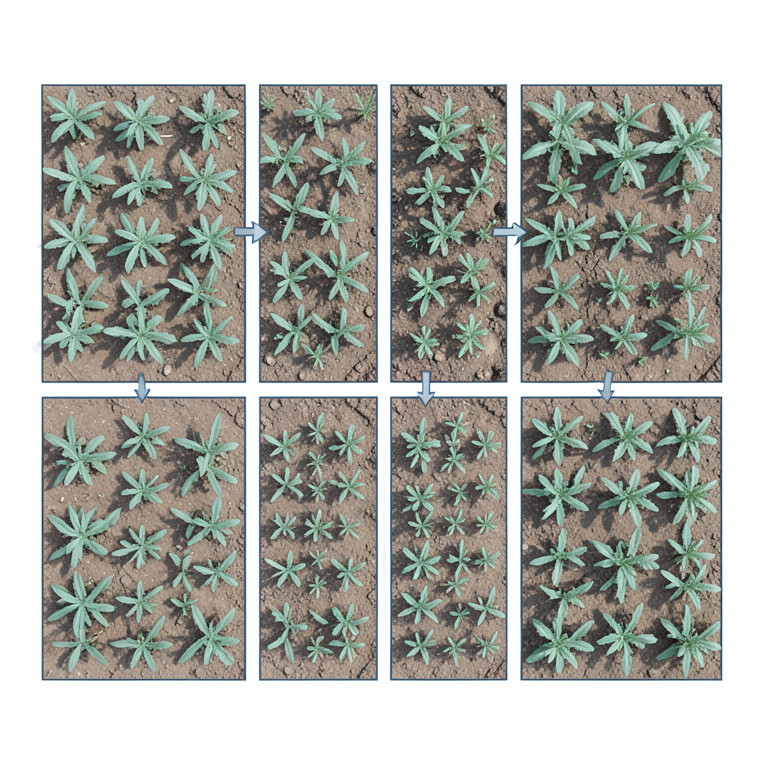
Experimental Layout
AI-generated conceptual illustration (amaranth plants (Amaranthus hypochondriacus L.)). It explains the idea and does not show study data.
View source evidence ↗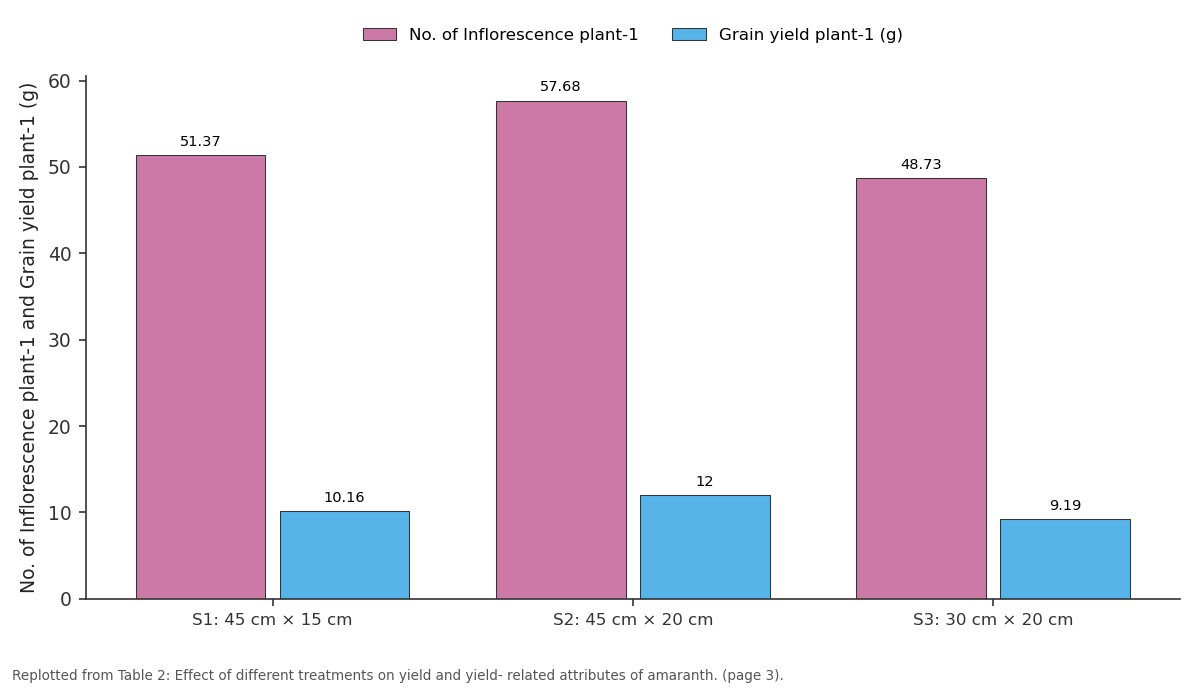
No. of Inflorescence plant-1 and Grain yield plant-1 (g): S1: 45 cm × 15 cm vs S2: 45 cm × 20 cm vs S3: 30 cm × 20 cm
Replotted from Table 2 (page 3) of the original paper. Every bar is the paper's own table value.
View source evidence ↗Figures & tables
From the original paper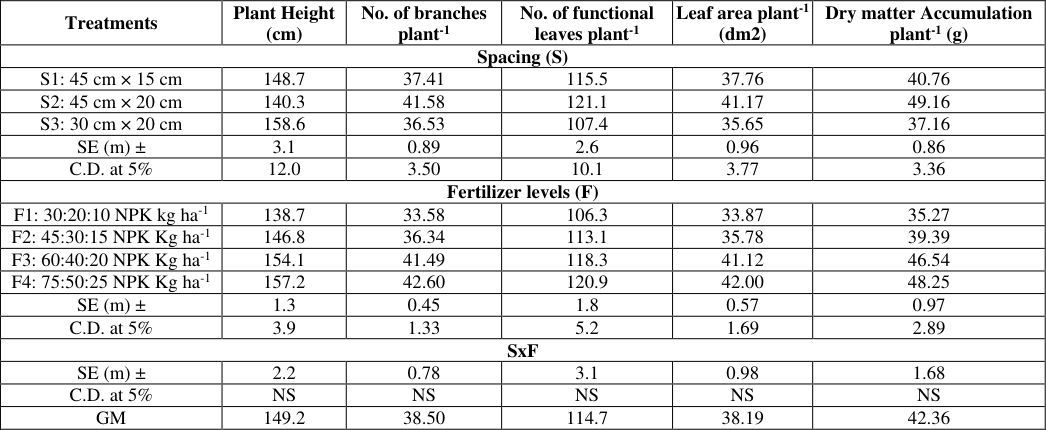 Table 1
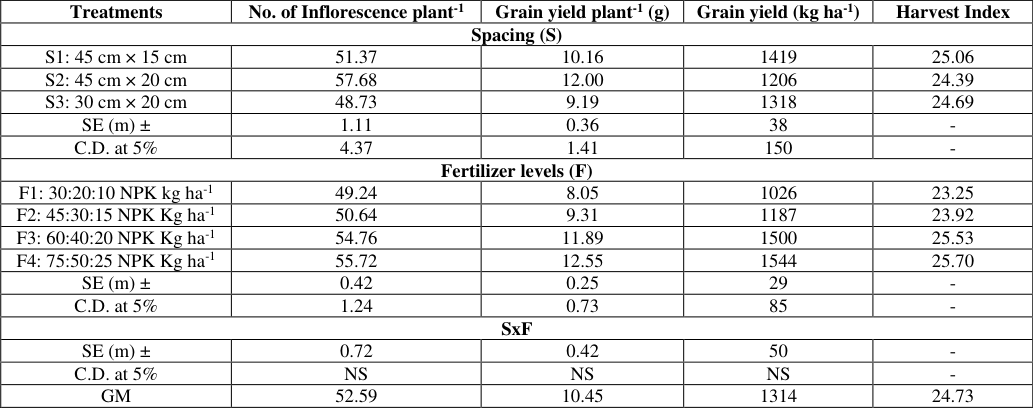 Table 2
Introduction
Grain Amaranth is called as pseudo cereal as it is not a member of Gramineae family but it has grain like seeds. It belongs to the family Amaranthaceous. It has rich sources of protein, carbohydrates, lipids and minerals as well as balanced composition of essential amino acids. Which are lacking in other cereals (Raiger et al. 2009) [11] . Amaranth plays a beneficial role of dietary in human nutrition. It is an excellent source of folic acid helps in increasing the blood haemoglobin level. The tender leaves of amaranth are used as vegetables and are rich in vitamin-A, calcium and iron content. Amaranth grows best under hot and humid climate although, it tolerates drought, low fertility and adverse climate condition. It has C4 metabolism as well as deep root system. The crop can be grown in any type of soil. Amaranth has a short growing period, grain amaranth can be harvested at 90 days. In India, Amaranth is cultivated both in hills as well as plains covering states of Madhya Pradesh, Uttar Pradesh, Uttarakhand, Maharashtra, Gujarat, Orissa, Karnataka, Bihar. The exact information about area, production and productivity of grain amaranth at national level is lacking. Plant spacing is one of the most important factors that can manipulate by farmers or growers to increase the production of the crop. It plays an important role in increasing crop yield which indirectly affects growth, yield and nutrient uptake of plant. Higher plant population may compensate the lower individual plant yield. Hence, it is necessary to maintain optimum plant population to get high productivity. The balanced use of fertilizer plays a vital role in enhancing the productivity of crop. Grain yield have been increased, across the world, by application of mineral fertilizers to different crops. Additional nutrients like nitrogen, phosphorus and potassium are the essential plant nutrients required for healthy growth of plants. Availability of low concentration of these nutrients in plants rigorously limits the yield and produces more or less distinct deficiency symptoms. In one of the study, it has been observed that the grain amaranth respond good up to fertilizer dose of 60:40:20 NPK kg ha -1 (Raiger et al., 2009) [11] . There is limited and preliminary information available on the plant spacing and fertilizer requirements of amaranth (Olaniyi et al., 2008) [6] Hence to investigate its production potential under different spacing and fertilizer levels the field experiment was under taken during rabi-2022 at the experimental farm of Agronomy Department, VNMKV, Parbhani.
Material and Methods
A field experiment was carried out at PG Research Farm, Department of Agronomy, College of Agriculture Parbhani, Maharashtra during Rabi season of 2022.The soil of the experimental plot was clayey in texture, low in organic carbon, medium in available nitrogen and phosphorus, but very high in available potassium and slightly alkaline in reaction. The experiment was laid out in split plot design with two factors and replicated thrice. Main plots were assigned to the different spacing viz S1: 45cm x 15cm, S2: 45cm x 20 cm and S3: 30cm x 20cm and subplot comprises of three fertilizer levels viz. F1: 30:20:10 NPK kg ha -1 , F2:45:30:15 NPK kg ha -1 , F3:60:40:20 NPK kg ha -1 and F4:75:50:25 NPK kg ha -1 . The experimental gross plot size was 5.4 x 4.8 m2 and net plot size varied as per treatment. Sowing was done by dibbling seeds @ 2 kg ha -1 on 21st November, 2022. The harvest took place on April 05, 2023.
Results and Discussion
Results and Discussion
Growth attributes
The data presented in Table 1 revealed that various growth parameter of amaranth were significantly influenced by different spacing and fertilizer levels. The sowing of amaranth seed at spacing of 45 x20 cm recorded maximum number of branches plant -1 (41.58), number of functional leaves plant -1 (121.1), leaf area plant -1 (41.17), drymatter accumulation plant -1 (49.16 g) which was significantly superior over rest of the spacings. The maximum growth was recorded in wider spacing as compared to close spacing. The higher growth might be due to sufficient space, moisture and nutrients in wider spacing, which accelerated the growth and development of the crop. These findings are in conformity with the earlier findings reported by Rahman et al. (2007) [10] , Patel et al. (2011) [9] , Chaudhari et al. (2022) [1] . As regards to fertilizer levels, application of 75:50:25 NPK kg ha -1 (F4) recorded the higher growth attributes like plant height (157.2 cm), number of branches plant -1 (42.60), number of leaves plant -1 (120.9), leaf area plant -1 (42.00 dm2), total dry matter accumulation plant -1 (48.25 g). The higher growth of plant might be due to beneficial effect of nutrients which resulted in higher amaranth growth. These findings are in line with the earlier findings of Kushare et al. (2010) [4] , Dehariya et al. (2019) [7] , Srujanet al. (2021) [14] Yield and yield attributes The data presented in Table 2 revealed that the effect of spacing and fertilizer levels was found significant on yield andyield attributes. Maximum number of inflorescence plant -1 (57.68), grain yield plant -1 (12.00g) were recorded under spacing 45cm x 20 cm (S2). while maximum grain yield (1419 kg ha -1 ), harvest index (25.06) were recorded under the spacing of 45 cm x 15 cm and was significantly superior over spacing of 45cm x20 cm, however, it was at par with 30 cm x 20 cm. The higher yield might be due to higher plant population under closer spacing that resulted in higher photosynthetic activity along with proper grain filling and thus contributed to higher yield. These findings are parallel with the earlier findings reported by Vaghela et al. (2018) [15] , Verma et al. (2022) [16] . Application of 75:50:25 NPK kg ha -1 (F4) recorded the higher yield and yield attributes like number of inflorescence plant -1 (55.72), grain yield plant -1 (12.55 g), grain yield (1544 kg ha -1 ), harvest index (25.70) but it was found at par with 60:40:20 NPK kg ha -1 (F3). It might be due to balanced application of nutrients which enhanced growth and development of the crop and resulted higher yield. Similarly, application of 75:50:25 NPK kg ha -1 recorded higher harvest index (25.70) closely followed by harvest index obtained with application of 60:40:20 NPK kg ha -1 . The higher harvest index might be due to higher grain yield obtained under fertilizer level 75:50:25 NPK kg ha -1 . These findings are in line with the earlier findings reported by Parmar et al. (2009), [8] Solanki et al. (2016) [13] , Keraliya et al. (2017) [3] , Jangir et al. (2019) [2] , Srujanet al. (2021) [14] , Rana et al. (2022) [12] .
| Treatments | No. of Inflorescence plant-1 | Grain yield plant-1 (g) | Grain yield (kg ha-1) | Harvest Index |
|---|---|---|---|---|
| Spacing (S) | ||||
| S1: 45 cm × 15 cm | 51.37 | 10.16 | 1419 | 25.06 |
| S2: 45 cm × 20 cm | 57.68 | 12.00 | 1206 | 24.39 |
| S3: 30 cm × 20 cm | 48.73 | 9.19 | 1318 | 24.69 |
| SE (m) ± | 1.11 | 0.36 | 38 | - |
| C.D. at 5% | 4.37 | 1.41 | 150 | - |
| Fertilizer levels (F) | ||||
| F1: 30:20:10 NPK kg ha-1 | 49.24 | 8.05 | 1026 | 23.25 |
| F2: 45:30:15 NPK Kg ha-1 | 50.64 | 9.31 | 1187 | 23.92 |
| F3: 60:40:20 NPK Kg ha-1 | 54.76 | 11.89 | 1500 | 25.53 |
| F4: 75:50:25 NPK Kg ha-1 | 55.72 | 12.55 | 1544 | 25.70 |
| SE (m) ± | 0.42 | 0.25 | 29 | - |
| C.D. at 5% | 1.24 | 0.73 | 85 | - |
| SxF | ||||
| SE (m) ± | 0.72 | 0.42 | 50 | - |
| C.D. at 5% | NS | NS | NS | - |
| GM | 52.59 | 10.45 | 1314 | 24.73 |
Table text extracted from the original PDF; superscript letters are shown inline. The original table image is below.
View original table image
| Treatments | Plant Height (cm) | No. of branches plant-1 | No. of functional leaves plant-1 | Leaf area plant-1 (dm2) | Dry matter Accumulation plant-1 (g) |
|---|---|---|---|---|---|
| Spacing (S) | |||||
| S1: 45 cm × 15 cm | 148.7 | 37.41 | 115.5 | 37.76 | 40.76 |
| S2: 45 cm × 20 cm | 140.3 | 41.58 | 121.1 | 41.17 | 49.16 |
| S3: 30 cm × 20 cm | 158.6 | 36.53 | 107.4 | 35.65 | 37.16 |
| SE (m) ± | 3.1 | 0.89 | 2.6 | 0.96 | 0.86 |
| C.D. at 5% | 12.0 | 3.50 | 10.1 | 3.77 | 3.36 |
| Fertilizer levels (F) | |||||
| F1: 30:20:10 NPK kg ha-1 | 138.7 | 33.58 | 106.3 | 33.87 | 35.27 |
| F2: 45:30:15 NPK Kg ha-1 | 146.8 | 36.34 | 113.1 | 35.78 | 39.39 |
| F3: 60:40:20 NPK Kg ha-1 | 154.1 | 41.49 | 118.3 | 41.12 | 46.54 |
| F4: 75:50:25 NPK Kg ha-1 | 157.2 | 42.60 | 120.9 | 42.00 | 48.25 |
| SE (m) ± | 1.3 | 0.45 | 1.8 | 0.57 | 0.97 |
| C.D. at 5% | 3.9 | 1.33 | 5.2 | 1.69 | 2.89 |
| SxF | |||||
| SE (m) ± | 2.2 | 0.78 | 3.1 | 0.98 | 1.68 |
| C.D. at 5% | NS | NS | NS | NS | NS |
| GM | 149.2 | 38.50 | 114.7 | 38.19 | 42.36 |
Table text extracted from the original PDF; superscript letters are shown inline. The original table image is below.
View original table image
Conclusion
On the basis of the present investigation it may be concluded that dibbling of amaranth at spacing of 45 x15 cm was found more productive. Application of 75:50:25 NPK kg ha -1 recorded significantly higher growth and yield attributes of amaranth. However, it was comparable with 60:40:20 NPK kg ha -1 .
References
16 in the original paper- Chaudhari RH, Mali PC, Darulekar VR, Salvi BR, Mahadik SG. Effect of consecutive sowings and spacing on growth and yield of Amaranthus. Pharma Innovation J. 2022;11(7):2274-2278.
- Jangir R, Thanki JD, Tajane D, Kumar S. Growth, yield and economic of grain amaranth (Amaranthus hypochondriacus L.) as affected by integrated nitrogen management. Int J Pure App Biosci. 2019;7(3):329-334.
- Keraliya SJ, Desai LJ, Patel SJ, Kanara DA. Effect of integrated nitrogen management on yield, quality and economics of grain amaranth (Amaranthus hypochondriacus L.). Int J Pure App Biosci. 2017;5(6):531-534.
- Kushare YM, Shete PG, Adhav SL, Baviskar VS. Effect of FYM and inorganic fertilizer on growth and yield of Rabi grain amaranth (Amaranthus hypochondriacus L.). Internat J Agric Sci. 2010;6(2):491-493.
- Nawlakhe SM, Mankar DD. Response of grain amaranth (Amaranthus gangeticus L.) to spacing and fertilizer levels under irrigated condition. Crop Res. 2010;41(1-3):85-87.
- Olaniyi JO, Adelasoye KA, Jegede CO. Influence of nitrogen fertilizer on the growth, yield and quality of grain amaranth varieties. World J Agric Sci. 2008;4:506-513.
- Dehariya P, Mishra DK, Dhakad R, Kumar A. Studies on different levels of nitrogen application on growth and yield of amaranthus (Amaranthus tricolor L.). Int J Curr Microbio App Sci. 2019;8(04):1423-1427.
- Parmar JK, Patel JJ. Effect of nitrogen management on growth and yield of grain amaranth (Amaranthus hypochondriacus L.) grown on loamy sand soil. Asian J Soil Sci. 2009;4(1):106-109.
- Patel KI, Patel BM, Patel SJ, Patel PT, Patel SM, Patel PM. Effect of levels of nitrogen and iron on yield of grain amaranth (Amaranthus hypochondriacus L.) under different planting techniques. Agric Sci Digest. 2011;32(3):193-198.
- Rahman MJ, Uddain J, Halim MA. Effect of different levels of nitrogen and spacing on growth and yield of stem amaranth (Amaranthus lividis L.). J Sher Agric Univ. 2007;1(1):30-38.
- Raiger HL, Phogat BS, Dua RP, Sharma SK. Improved varieties and cultivation practices of grain amaranth. Intensive Agriculture. 2009;8-17.
- Rana R, Paliwal A, Kumar A, Shikha, Goswami G. Productivity and profitability enhancement in grain amaranth (Amaranthus hypochondriacus L.) through the use of sulfur fertilization in the hilly region of Uttarakhand. Pharma Innovation J. 2022;11(3):648-651.
- Solanki RP, Solanki RM, Patel HA, Odedra RK, Prajapati VS, Dodia VD. Effect of scheduling irrigation and organic manure on yield attributes, nutrient content and uptake of Rabi amaranthus (Amaranthus paniculatus L.) in Saurashtra Region. Int J Sci Environ Technol. 2016;5(4):2076-2083.
- Srujan CS, Patel HH, Madagaudre YB, Lokesh R, Terin P. The effect of irrigation and nitrogen levels on growth, yield and economics of grain amaranth (Amaranthus hypochondriacus L.). Pharma Innovation J. 2021;10(9):1146-1149.
- Vaghela GM, Chauhan NP, Dabhi MS, Patel HK. Effect of dates of sowing and crop geometry on growth, yield attributes, yield and quality of Amaranthus (Amaranthus hypochondriacus L.). Int J Agric Sci. 2018;10(10):6044-6046.
- Verma V, Kumar S, Yadav S, Maurya S, Yadav V. Effect of different varieties and spacing on growth and yield of amaranths (Amaranthus tricolor L.) under Lucknow conditions. Pharma Innovation J. 2002;11(1):984-986.
Cited by 1
From OpenAlex, OpenCitations and reference lists read by Scinovex
- Influence of nitrogen and plant spacing on edible leaf and seed yield of vegetable amaranth ( Amaranthus spp . L.) ↗
Mukesh Kumar, Manoj Raghav, Alka Verma, Lalit Bhatt, Rohitashav Singh, Yashpal Singh Bisht et al. · Journal of Plant Nutrition · 2025
Being a minor vegetable, the amaranth is not getting sufficient attention and realization of its leaf yield and nutritional potential. Therefore, to know the influence of nitrogen and plant spacing on leaf and seed yield of amaranths an experiment was conducted with four nitrogen levels N (0, 30, 60, and 90 kg/ha) with three plants spacing viz., S1 (15 cm),…
❝ 0