
Research article · 2023 · Full text
International Journal of Agriculture Extension and Social DevelopmentRe-examining the factors influencing the adoption of ICT for agricultural information dissemination in Uganda (Rubanda, Mayuge districts, and Mbarara city)
Volume 6(2) · Pages 15–18 · DOI: 10.33545/26180723.2023.v6.i2a.187 ↗
Research areasAgricultural Innovations and Practices
Abstract
Author-writtenThe purpose of this research was to re-examine the factors influencing ICT adoption for agricultural information dissemination in Uganda. The study adopted the descriptive survey design of the ex-post facto type, a structured questionnaire that was subjected to face and content validity and reliability test, and analyzed using descriptive statistics of frequency counts and percentages. Findings revealed that the foremost inhibiting factor influencing the adoption of ICT for agricultural information dissemination was the lack of training and re-trainings. The study recommended that training and re-training in the usage of ICT devices be conducted for the farmers from time to time such that they become conversant with all the required and necessary devices and able to take advantage of the entire alternative device as each device is uniquely difference, serving uniquely different purposes.
Summary
Source-checkedPlain-language reading of the full paper, prepared with AI and checked against the text. Each point links to the authors' own words.
Why it matters
- Lack of access to effective agricultural information prevents farmers from applying improved agronomic practices, which negatively impacts productivity and household food security. View evidence ↗
- While Information and Communication Technologies (ICTs) are seen as appropriate for use in Africa and Vietnam, various factors hinder their widespread adoption. View evidence ↗
- ICTs have high potential to improve small-scale agriculture in Africa, yet they currently suffer from low and unreliable adoption rates. View evidence ↗
The question
- The study aimed to re-examine the factors that influence the adoption of ICT for disseminating agricultural information in Uganda. View evidence ↗
What they did
- The researchers used a cross-sectional survey design employing key informant interviews and structured questionnaires. View evidence ↗
- The study randomly selected 374 farmers from Mbarara City, Mayuge District, and Rubanda District. View evidence ↗
- Data analysis was performed using descriptive statistics, including percentages, frequency counts, standard deviation, and mean ranking scores. View evidence ↗
What they found
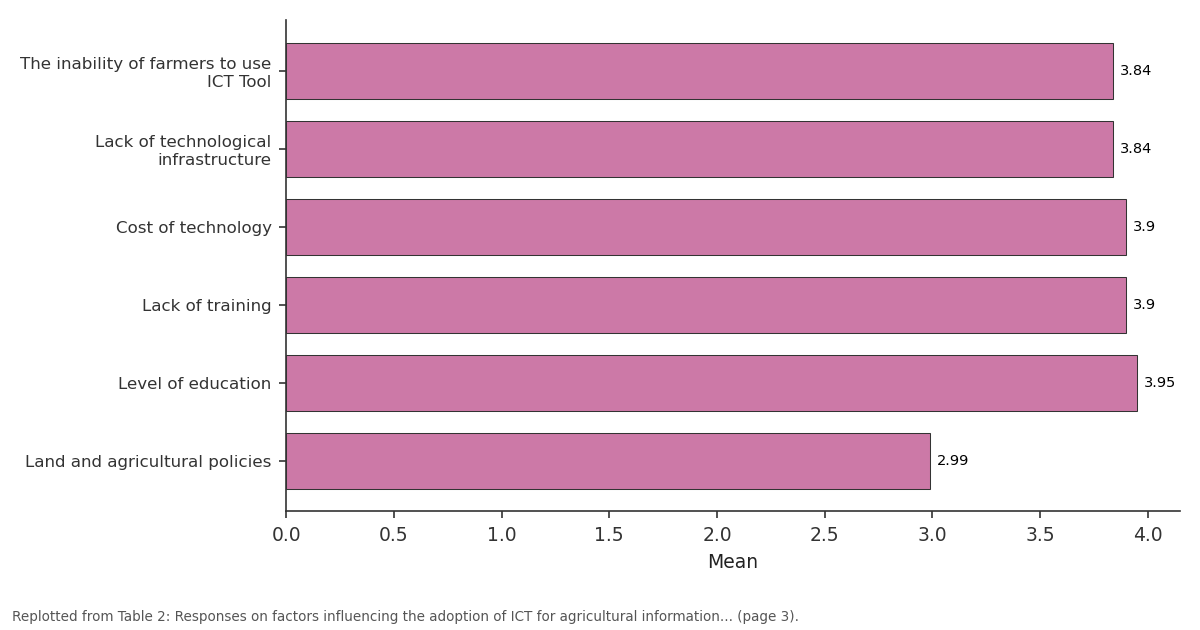
- The level of education was identified as the most prominent factor influencing ICT adoption, with a mean score of 3.95. View evidence ↗
- Other highly influential factors included lack of training (mean 3.90), cost of technology (mean 3.90), and lack of technological infrastructure (mean 3.84). View evidence ↗
- Land and agricultural policies were found to be the least influential factor, with a mean score of 2.99. View evidence ↗
- Over half of the respondents agreed that lack of training (54.5%), low awareness of ICT roles (54.5%), and insufficient time for technology (54.3%) were inhibiting factors. View evidence ↗
- Younger, single farmers demonstrated greater ICT skills and were more comfortable using computers for agricultural information. View evidence ↗
- Farmers with higher levels of education reported being more comfortable using television for agricultural information compared to those with less education. View evidence ↗
What it means
- The authors concluded that the primary barrier to ICT adoption for agricultural information in the studied regions is a lack of training. View evidence ↗
- The authors recommend periodic training and re-training to ensure farmers become proficient with various ICT devices. View evidence ↗
Visual summary
1 visualsIllustrations explain the paper; charts are replotted from the paper's own table values.
Mean: The inability of... vs Lack of technological... vs Cost of technology vs Lack of training vs Level of education
Replotted from Table 2 (page 3) of the original paper. Every bar is the paper's own table value.
View source evidence ↗Figures & tables
From the original paper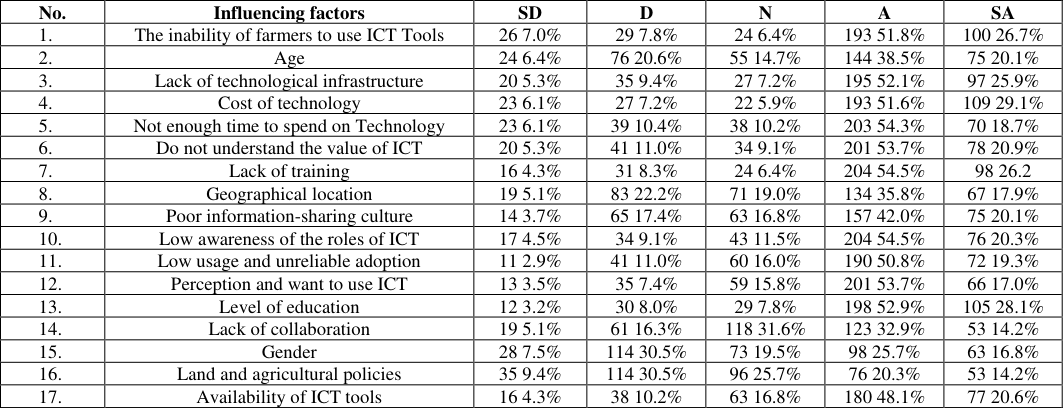 Table 1
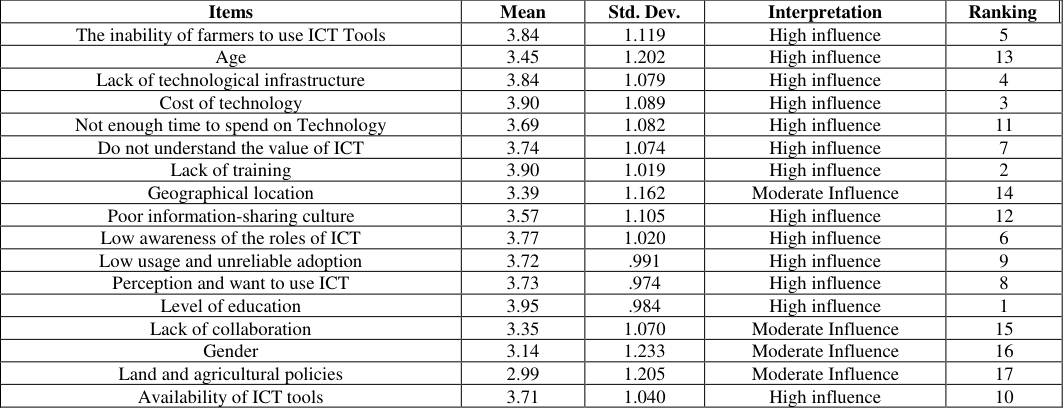 Table 2
Introduction
The seemingly influencing factors in accessing agricultural information in Kenya's exploitation of some ICT channels. The study utilized a scientific sampling technique, an interview, and a chi-square technique was used to test the hypothesis (Maina et al. 2021) [7] . The study disclosed that radio was used among the farmers at age forty and higher and with low formal education, whereas farmers at age below forty most preferred TV, Mobile Phones, and Computers. However, the study reveals that most farmers were exploiting their smartphones for chatting instead of profitable agricultural activities. It had been conjointly disclosed that farmers who possessed education used their mobile phones for vital activities like receiving and retrieving agricultural information. The main gap during this study is the lack of awareness of the relevance and use of mobile phones particularly smartphones for agricultural information. Additional studies ought to investigate however how ICT tools may be promoted among farmers. Lack of awareness and education attainment is among the main attributes limiting smallholder farmers once it involves the adoption and usage of ICT for development in rural areas. Naik et al. (2021) [8] studied the dissemination of agricultural information using ICTs. The study utilized a structured questionnaire and interviews were employed to gather relevant information among the selected farmers.
(Armstrong & Gandhi, 2012) [2] believed that the key stakeholders claimed that there ought to be an improvement in information delivery. For this reason, there ought to be a lot of studies on how agricultural information dissemination using ICT is effectively delivered to the end-users which means that extension professionals have to be compelled to answer the task ahead by collaborating with key stakeholders to produce effective agricultural information to the end-users. To and Trinh (2021) [12] state that, though there's perceived appropriateness of ICTs in African countries and Vietnam, a broad variety of factors are known for inhibiting the widespread introduction and use of the new technologies. These factors embody cognitive content concerning the importance of and want for ICTs that makes even those made enough to acquire them indifferent to ICTs; general impoverishment that results in the perception of computers, as an example, as foreign and luxury acquisitions; When equipment crashes down, spare parts and technical experts from the manufacturers are imported, which is a poor maintenance and repair culture, it wastes resources, time, and money. Poverty leads persons to perceive computers, for instance, as foreign and costly expenditures. (Chavula, 2014) [4] states different factors such as poor infrastructural support base; examples embody inefficient electricity and telephone systems; lack of support from the government resulting in under funding of science and technology www.extensionjournal.com programs in tertiary institutions; illiteracy and lack of basic computing skills; the absence of a culture of democracy, this feeds political unrest and also the temperament of foreign investors to speculate within the space of ICTs; and perception of the technologies (Example, computer) as a standing image or statement of one's hierarchy in society. Despite the high potential of ICTs in rising small-scale agriculture in Africa, there is a low usage pattern and unreliable adoption. This case is especially a result of ICT initiatives that are scattered and uncoordinated. Consequently, there's a high price of obtainable technologies, inadequate infrastructure and ICT skills, poor and high-priced property, inappropriate ICT policies, language barriers, the high price of ICTs and telecommunication, low information measure, inadequate and/or inappropriate credit facilities and systems. Further, there's poor involvement of women and alternative deprived teams, inadequate acceptable content, weak establishments, inadequate collaboration and awareness of existing ICT facilities and resources, poor information-sharing culture, and low awareness of the role of ICTs in development in the slightest degree levels Ogutu et al. (2014) [9] . According to Awojide & Akintelu (2018) [3] , geographical location plays an important role in the determination of communications costs and practicality. In rural communities, where there is a sparse population implies that potential users sleep in a section of low demand density, communications prices are higher and services are less well developed. This can be because of what's called the social science of networks and therefore ICT in rural areas costs more as a result of the association from one line to the other, and since it's also impossible to realize economies of scale in switching. The results of this will be seen within the penetration of ICT into rural areas while not a whole indicator, tele-densities (the range of mainlines per one thousand people) provide some plan of the extent to which this may be a problem for farmers in rural Africa once employed in combination with mobile phone densities (Mobile phones per one thousand people). The use of ICT needs a positive attitude from the actors as emphasized and proved by many previous studies (Levi et al., 2015) [6] . Referring to attitudes, Chavula (2014) [4] states that it represents a mental and neural state of readiness that is organized through expertise. It exerts a directive or dynamic influence upon the individual's response to any or all objects and things with that it's connected with. For Rodrigues & Rodríguez (2013) [11] , attitude will be shaped according to a human degree of like or dislike towards one thing. The perceived usefulness is crucial for constructing a positive attitude towards ICT usage. Once communities understand that ICT is beneficial, it'll produce a positive perspective toward ICT usage (Chhachhar et al. 2014) [5] . According to Rodrigues & Rodríguez (2013) [11] , the perceived usefulness should be persistent. For ICT to be perceived as helpful it should be a low price to reach a wider market, and be able to gather massive data within a brief time. Aker et al., (2016) [1] urged within the results of their study that the foremost vital limiting factor that affects the utilization of ICT in agriculture is the cost of technology. Lack of training and therefore the inability of farmers to use ICT is the second issue that affects usage. The other is; trust level within the ICT system; lack of technological infrastructure and lack of ICT proficiency is the third level category that affects the utilization of ICT in agriculture. Thus, in general, to confirm the effectiveness of ICT, the agricultural community particularly their leaders should have a positive attitude toward ICT usage. The researcher observed that there are some notable factors influencing the adoption of ICT for agricultural information dissemination in Rubanda District, Mayuge District, and Mbarara City that necessitates the majority of the farmers not to have access to effective agricultural information and such factors had been left unchecked and the farmers are so denied access to agricultural enhancing information affecting their chances of finding out and apply improved and economical agronomic practices that can improve productivity and household food security. Thus a need to Re-examine the factors influencing the adoption of ICT for Agricultural Information Dissemination in Uganda namely Rubanda, Mayuge Districts, and Mbarara City.
Methodology
The study adopted a cross-sectional design of survey research and the instrument for this study consisted of structured questionnaires and key informant interviews. The questionnaire was subjected to face and content validity and reliability test. Data collected were analyzed using descriptive statistics of frequency counts, percentages, mean and standard deviation with ranking means score. The target population of this study comprised all farmers in the Rubanda District, Mayuge District, and Mbarara City and 374 farmers were randomly selected and made to participate in the study. Copies of the questionnaire were distributed to them and interviews conducted and collected for analysis after they were completed.
Results and Discussions
The results in Table 1 reveal the factors influencing the adoption of ICT for agricultural information dissemination in Rubanda district, Mayuge district, and Mbarara City. A simple majority of the respondents (54.5%) strongly agreed and agreed that lack of training, low awareness of the roles of ICT (54.5%), not enough time to spend on technology (54.3%), perception and want to use ICT (53.7%), do not understand the value of ICT (53.7%), level of education (52.9%), lack of technological infrastructure (52.1%), the inability of farmers to use ICT tools (51.8%), cost of technology (51.6%), low usage and unreliable adoption (50.8%), availability of ICT tools (48.1%), poor information sharing culture (42%), age (38.5%), geographical location (35.8%), lack of collaboration (32.9%) are all the factors inhibiting the adoption of ICT for agricultural dissemination in Rubanda district, Mayuge district and Mbarara City except gender (30.5%) and land and agricultural policies (30.5%). These results conform with the study by Rashid et al., (2016) [10] who stated that the significant factor to empower farmers was the use of eagriculture which contributed to 84% of the total empowerment and recommended governments implement and invest in e-agriculture projects on a massive scale. www.extensionjournal.com above show the means ranking of responses for the factors influencing the adoption of ICT for agricultural information dissemination in Rubanda District, Mayuge District, and Mbarara City. It is observed that among the factors, the level of education (Mean of 3.95) is the most prominent factor. This is followed by lack of training (Mean of 3.90), followed by the cost of technology (Mean of 3.90), followed by lack of technological infrastructure (Mean of 3.84). This is followed by the inability of farmers to use ICT tools (Mean of 3.84), followed by low awareness of the roles of ICT (Mean of 3.77), followed by perception and want to use ICT (Mean of 3.73). The least factor of influence in the adoption of ICT for agricultural information and communication dissemination is the land and agricultural policies (mean of 2.99).
| No. | Influencing factors | SD | D | N | A | SA |
|---|---|---|---|---|---|---|
| 1. | The inability of farmers to use ICT Tools | 26 7.0% | 29 7.8% | 24 6.4% | 193 51.8% | 100 26.7% |
| 2. | Age | 24 6.4% | 76 20.6% | 55 14.7% | 144 38.5% | 75 20.1% |
| 3. | Lack of technological infrastructure | 20 5.3% | 35 9.4% | 27 7.2% | 195 52.1% | 97 25.9% |
| 4. | Cost of technology | 23 6.1% | 27 7.2% | 22 5.9% | 193 51.6% | 109 29.1% |
| 5. | Not enough time to spend on Technology | 23 6.1% | 39 10.4% | 38 10.2% | 203 54.3% | 70 18.7% |
| 6. | Do not understand the value of ICT | 20 5.3% | 41 11.0% | 34 9.1% | 201 53.7% | 78 20.9% |
| 7. | Lack of training | 16 4.3% | 31 8.3% | 24 6.4% | 204 54.5% | 98 26.2 |
| 8. | Geographical location | 19 5.1% | 83 22.2% | 71 19.0% | 134 35.8% | 67 17.9% |
| 9. | Poor information-sharing culture | 14 3.7% | 65 17.4% | 63 16.8% | 157 42.0% | 75 20.1% |
| 10. | Low awareness of the roles of ICT | 17 4.5% | 34 9.1% | 43 11.5% | 204 54.5% | 76 20.3% |
| 11. | Low usage and unreliable adoption | 11 2.9% | 41 11.0% | 60 16.0% | 190 50.8% | 72 19.3% |
| 12. | Perception and want to use ICT | 13 3.5% | 35 7.4% | 59 15.8% | 201 53.7% | 66 17.0% |
| 13. | Level of education | 12 3.2% | 30 8.0% | 29 7.8% | 198 52.9% | 105 28.1% |
| 14. | Lack of collaboration | 19 5.1% | 61 16.3% | 118 31.6% | 123 32.9% | 53 14.2% |
| 15. | Gender | 28 7.5% | 114 30.5% | 73 19.5% | 98 25.7% | 63 16.8% |
| 16. | Land and agricultural policies | 35 9.4% | 114 30.5% | 96 25.7% | 76 20.3% | 53 14.2% |
| 17. | Availability of ICT tools | 16 4.3% | 38 10.2% | 63 16.8% | 180 48.1% | 77 20.6% |
Table text extracted from the original PDF; superscript letters are shown inline. The original table image is below.
View original table image
Furthermore, findings show 1. Married people are more settled and stable, they tend to have equipped the home with some electronics among which is television unlike their singles counterparts who are less settled and less stable and often time do not have a television set. 2. That the younger farmers who were mostly singles were vaster in ICT-related skills and more comfortable with the use of computers for agricultural information. 3. The implication of this is that the younger farmers who were mostly singles were more comfortable with the use of the mobile phone for agricultural information. 4. That the highly educated farmers were more comfortable with the use of Television for agricultural information than their counterparts. 5. That the most educated farmers were vaster in ICTrelated skills and more comfortable with the use of computers for agricultural information. 6. That the well-educated farmers were also having better use of mobile phones resulting from their vastness in ICT-related skills and can comfortably use mobile phones for agricultural information. 7. That it's obvious that the majority of the farmers do not www.extensionjournal.com know how to operate the computer system. Secondly, the financial implication of having a personal computer may be on the high side for many poor rural farmers. 8. That middle-aged to older farmers were more comfortable with the use of Television for agricultural information 9. That the middle-aged to the younger farmers were more comfortable with the use of computers for agricultural information. 10. Middle-aged farmers to older farmers seem to be having better usage of mobile phones for agricultural purposes than the young ones who use them for social media purposes. 11. That the farmers with average to higher monthly income seem to be more comfortable with television for catching up with agricultural information than their low monthly income counterparts. 12. That the farmers with average to higher monthly income seem to be more conversant with computers for assessing agricultural information than their low monthly income counterparts and, 13. That the farmers with average to higher monthly incomes seem to be more comfortable with the mobile phone for catching up with agricultural information.
Conclusion and Recommendations
Finding shows that the foremost inhibiting factor influencing the adoption of ICT for agricultural information dissemination in Rubanda district, Mayuge district, and Mbarara city is the lack of training. It is recommended that training and re-training in the usage of ICT devices be conducted for the farmers from time to time such that they become conversant with all the required and necessary devices and able to take advantage of the entire alternative device as each device is uniquely difference, serving uniquely different purposes.
Figures and tables from the paper
| Items | Mean | Std. Dev. | Interpretation | Ranking |
|---|---|---|---|---|
| The inability of farmers to use ICT Tools | 3.84 | 1.119 | High influence | 5 |
| Age | 3.45 | 1.202 | High influence | 13 |
| Lack of technological infrastructure | 3.84 | 1.079 | High influence | 4 |
| Cost of technology | 3.90 | 1.089 | High influence | 3 |
| Not enough time to spend on Technology | 3.69 | 1.082 | High influence | 11 |
| Do not understand the value of ICT | 3.74 | 1.074 | High influence | 7 |
| Lack of training | 3.90 | 1.019 | High influence | 2 |
| Geographical location | 3.39 | 1.162 | Moderate Influence | 14 |
| Poor information-sharing culture | 3.57 | 1.105 | High influence | 12 |
| Low awareness of the roles of ICT | 3.77 | 1.020 | High influence | 6 |
| Low usage and unreliable adoption | 3.72 | .991 | High influence | 9 |
| Perception and want to use ICT | 3.73 | .974 | High influence | 8 |
| Level of education | 3.95 | .984 | High influence | 1 |
| Lack of collaboration | 3.35 | 1.070 | Moderate Influence | 15 |
| Gender | 3.14 | 1.233 | Moderate Influence | 16 |
| Land and agricultural policies | 2.99 | 1.205 | Moderate Influence | 17 |
| Availability of ICT tools | 3.71 | 1.040 | High influence | 10 |
Table text extracted from the original PDF; superscript letters are shown inline. The original table image is below.
View original table image
References
8 in the original paper- Aker JC, Ghosh I, Burrell J. The promise (And pitfalls) of ICT for agriculture initiatives. Agricultural Economics. 2016;47(S1):35-48.
- Awojide S, Akintelu SO. Empirical Investigation of factors affecting information and communication technologies (ICTS) in Agric-Business among small scale farmers in Esan Community, Edo State, Nigeria. Journal of Research in Marketing. 2018;9(1):713-722.
- Chavula HK. The role of ICTs in agricultural production in Africa. Journal of Development and Agricultural Economics. 2014;6(7):279-289.
- Chhachhar AR, Qureshi B, Khushk GM, Ahmed S. Impact of information and communication technologies in agriculture development. Journal of Basic and Applied Scientific Research. 2014;4(1):281-288.
- Maina CM, Nyang'anga HT, Mburu JI, Kasina JM, Guantai MM, Nderitu JH, et al. Determinants influencing farmers' use of macadamia nut information sources in central Kenya. Journal of Agriculture and Food Research, 2021, 100184.
- Ogutu SO, Okello JJ, Otieno DJ. Impact of information and communication technology-based market information services on smallholder farm input use and productivity: The case of Kenya. World Development. 2014;64:311-321.
- Rashid SMM, Islam MR, Quamruzzaman M. Which factor contribute most to empower farmers through eAgriculture in Bangladesh? Springer Plus. 2016;5(1):114.
- To AT, Trinh THM. Understanding behavioral intention to use mobile wallets in Vietnam: Extending the tam model with trust and enjoyment. Cogent Business & Management. 2021;8(1):1891661.
Cited by 4
From OpenAlex, OpenCitations and reference lists read by Scinovex
- Cost-benefit analysis of ICT investment for smallholder agricultural development in Sub-Saharan African economies ↗
Samuel K Ochieng, Faith W Njeri, Patrick Maina Kamau · International Journal of Research in Finance and Management · 2026
Information and communication technology (ICT) has emerged as a transformative instrument for enhancing agricultural productivity among smallholder farming communities in Sub-Saharan Africa. This study conducted a comprehensive cost-benefit analysis of ICT investment directed at smallholder agricultural development across selected Sub-Saharan African economies, focusing on Uganda, Kenya, and Tanzania. A cross-sectional research design was employed, drawing upon primary data collected through
- Impact of digital extension services on adoption of improved agronomic practices and crop yield enhancement in rural Uganda
Amina J Mwakasege, Emmanuel R Kileo, Happiness B Mushi · International Journal of Biology Sciences · 2026
Digital extension services have been increasingly promoted as a scalable alternative to conventional face-to-face agricultural extension in rural Uganda. This study investigated the impact of digital extension services on the adoption of improved agronomic practices and crop yield enhancement among 385 smallholder farmers in four districts of rural Uganda. A quasi-experimental design with propensity score matching was employed to compare outcomes between farmers receiving digital extension (treatment group, n = 198) and those relying solely on conventional extension (control group, n = 187). D
- Role of digital platforms in promoting awareness of medicinal plant cultivation practices among smallholder farmers in Uganda ↗
Frank P Massawe, Neema S Chaula · International Journal of Herbal Medicine · 2025
Medicinal plant cultivation represents a promising enterprise for smallholder farmers in Uganda, yet awareness of evidence-based cultivation practices remains limited. This study examined the role of digital platforms in promoting awareness and knowledge of medicinal plant cultivation practices among 350 smallholder farmers across five districts of Uganda. A descriptive cross-sectional design was adopted, and data were gathered through structured questionnaires
- Promoting the implementation of teaching-learning-assessment integration in English learning in junior high school ↗
Miaomiao Zhang · International Journal of Social Science and Education Research · 2024
The English Curriculum Standard for Compulsory Education (2022 Edition) is the basic basis for the construction of English curriculum and talent cultivation in the new era of China's compulsory education, and the "teaching-learning-assessment integration" proposed therein is applied to junior high school English reading teaching, which can develop students' reading ability and improve the quality of thinking, and play a