
Research article · 2026 · Full text
International Journal of Biology SciencesImpact of digital extension services on adoption of improved agronomic practices and crop yield enhancement in rural Uganda
Volume 8(4) · Pages 76–79 · DOI: 10.33545/26649926.2026.v8.i4a.623 ↗
Research areasAgricultural Innovations and PracticesAgricultural Development and ManagementICT in Developing Communities
Abstract
Author-writtenDigital extension services have been increasingly promoted as a scalable alternative to conventional face-to-face agricultural extension in rural Uganda. This study investigated the impact of digital extension services on the adoption of improved agronomic practices and crop yield enhancement among 385 smallholder farmers in four districts of rural Uganda. A quasi-experimental design with propensity score matching was employed to compare outcomes between farmers receiving digital extension (treatment group, n = 198) and those relying solely on conventional extension (control group, n = 187). Data were collected through structured questionnaires, focus group discussions, and crop yield measurements. Results indicated that digital extension recipients demonstrated significantly higher adoption rates for improved seed varieties (61.1% vs. 28.3%, p
Summary
Source-checkedPlain-language reading of the full paper, prepared with AI and checked against the text. Each point links to the authors' own words.
Why it matters
- Agriculture is vital to Uganda's economy, employing over 70% of the workforce and contributing about 24% of the GDP, but its extension services suffer from funding and resource shortages. View evidence ↗
- Digital technologies offer a way to bypass structural constraints in agricultural extension by providing scalable and cost-effective remote advisory services. View evidence ↗
The question
- The study aims to address the lack of empirical evidence regarding how digital extension services affect the adoption of improved farming practices and crop yields for smallholders in rural Uganda. View evidence ↗
What they did
- The research was conducted in the Lira, Gulu, Iganga, and Kamuli districts of rural Uganda to represent Northern and Eastern agro-ecological zones. View evidence ↗
- The study used a quasi-experimental design with propensity score matching to compare 198 farmers using digital extension (treatment) against 187 using only conventional extension (control). View evidence ↗
- Data were gathered from March to August 2023 using structured questionnaires, 8 focus group discussions (10-12 farmers each), and interviews with 16 extension officers. View evidence ↗
- The researchers measured the adoption of five specific practices: improved seed varieties, soil testing, integrated pest management, crop rotation, and fertilizer management. View evidence ↗
What they found
- Farmers using digital extension had a significantly higher adoption rate for improved seed varieties (61.1%) compared to those using conventional extension (28.3%). View evidence ↗
- The adoption of soil testing was more than three times higher among digital extension users (38.4%) than conventional users (12.0%). View evidence ↗
- Fertilizer management saw the highest absolute adoption rate among digital extension users at 64.1%, compared to 30.2% in the control group. View evidence ↗
- Mean crop yields were significantly higher for digital extension users (2.18 ± 0.64 t/ha) than for conventional extension users (1.62 ± 0.58 t/ha). View evidence ↗
- Digital extension users achieved a 34.6% increase in crop yields compared to non-users. View evidence ↗
- After controlling for confounders, the average treatment effect on the treated (ATT) was a yield increase of 0.49 t/ha. View evidence ↗
- The primary factors predicting whether a farmer adopted improved technologies were their access to digital extension, education level, farm size, and membership in farmer groups. View evidence ↗
What it means
- The authors recommend that the Ugandan government integrate digital platforms, specifically mobile-based advisory services, into the national agricultural extension framework. View evidence ↗
- Strategic priorities should include investing in rural digital infrastructure, expanding broadband, and subsidizing smartphones for farmers. View evidence ↗
- The authors state that longitudinal research is needed to evaluate the long-term income effects and sustainability of digital extension across different farming systems in Uganda. View evidence ↗
Visual summary
1 visualsIllustrations explain the paper; charts are replotted from the paper's own table values.
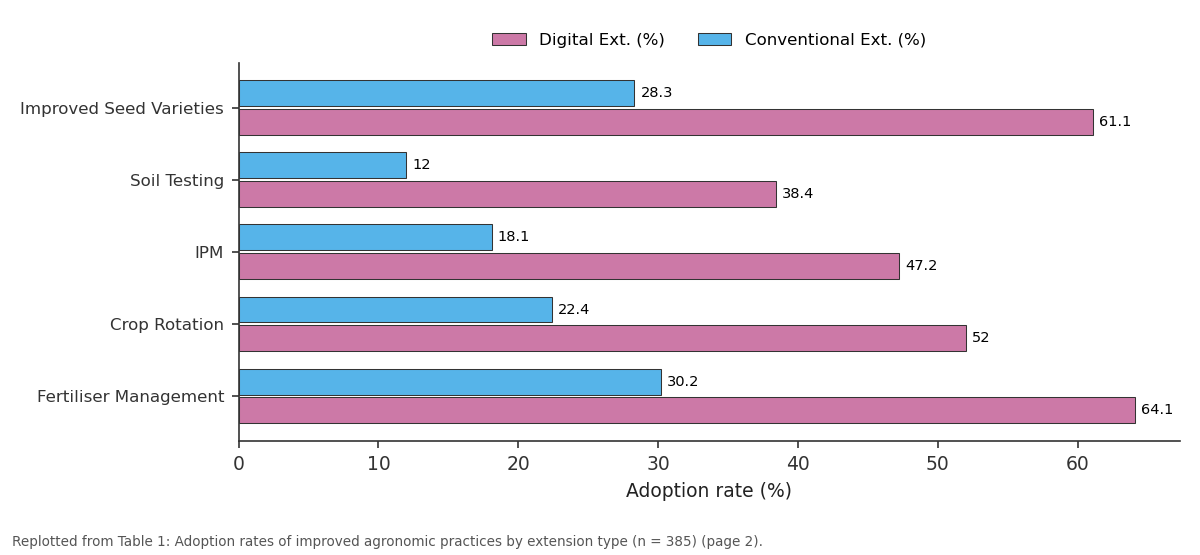
Digital Ext. (%) and Conventional Ext. (%): Improved Seed Varieties vs Soil Testing vs IPM vs Crop Rotation vs Fertiliser Management
Replotted from Table 1 (page 2) of the original paper. Every bar is the paper's own table value.
View source evidence ↗Figures & tables
From the original paper Table 1
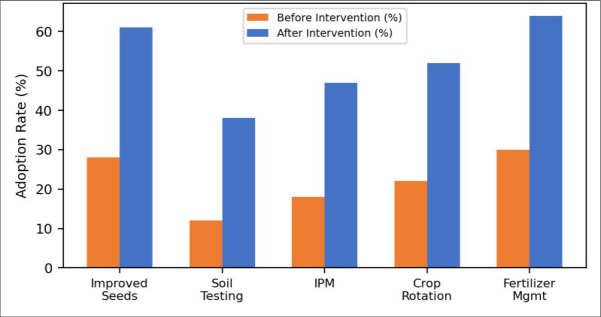 Figure 1
 Table 2
Introduction
Agricultural extension services serve as a critical institutional mechanism for transferring research-generated knowledge and improved technologies to farming communities, thereby enhancing agricultural productivity and rural livelihoods [1] . In Uganda, where agriculture contributes approximately 24% of gross domestic product and employs over 70% of the workforce, the extension system has historically faced challenges of inadequate human resources, limited geographical coverage, and insufficient funding [2,3] . The conventional extension model, characterised by face-to-face interactions between extension agents and farmers, achieves a farmer-to-extension-worker ratio of approximately 1:5, 000 in Uganda, far exceeding the internationally recommended ratio of 1:400 [4] . The emergence of digital technologies has created opportunities to overcome these structural constraints by enabling remote, scalable, and cost-effective delivery of agricultural information and advisory services [5, 6] . Digital extension services encompass a range of ICT-mediated platforms including mobile phone-based advisory systems, video-enabled extension, interactive voice response services, e-extension portals, and social media-based farmer networks [7] . International evidence suggests that digital extension can increase technology adoption rates by 15-40% and improve crop yields by 10-25%, depending on the context and mode of delivery [8,9] . In Uganda specifically, factors such as income level, institutional support, and access to training have been identified as significant determinants of ICT adoption for agricultural information dissemination [10] . However, rigorous empirical evidence on the causal impact of digital extension services on agronomic practice adoption and yield outcomes remains limited, particularly in the resource-constrained settings of rural Uganda [11,12] . The digital literacy levels among farming communities, socio-economic disparities, and the availability of complementary inputs further mediate the effectiveness of digital extension interventions [13,14] . The problem addressed in this study is the insufficient empirical evidence quantifying the impact of digital extension services on the adoption of improved agronomic practices and associated crop yield changes among smallholder farmers in rural Uganda [15] . The objectives of this study were: (i) to assess the adoption rates of improved agronomic practices among recipients and non-recipients of digital extension services; (ii) to quantify the difference in crop yields between the two groups; and (iii) to identify factors influencing the adoption of improved agronomic practices. It was hypothesised that farmers receiving digital extension services exhibit significantly higher adoption rates of improved agronomic practices and correspondingly higher crop yields compared to farmers relying exclusively on conventional extension [16,17,18] .
Material and Methods Study Area and Sampling
This study was conducted in the districts of Lira, Gulu, Iganga, and Kamuli in rural Uganda, purposively selected to represent both Northern and Eastern agro-ecological zones characterised by smallholder crop production systems [2,4] . A quasi-experimental research design with propensity score matching (PSM) was adopted to address selection bias in comparing outcomes between farmers exposed to digital extension services (treatment group) and those receiving only conventional extension (control group) [8,12] . The treatment group comprised 198 farmers registered on digital extension platforms including the Uganda National Agricultural Advisory Services (NAADS) e-extension portal, Sauti ya Wakulima mobile advisory service, and district-level WhatsApp-based farmer networks. The control group consisted of 187 farmers in the same districts who had no access to digital extension but received conventional face-to-face extension visits [10,15] . Primary data were collected between March and August 2023 through structured questionnaires, supplemented by focus group discussions with 8 groups of 10-12 farmers each and key informant interviews with 16 extension officers [6,14] .
Data Analysis
Propensity score matching was implemented using a logistic regression model to estimate the probability of receiving digital extension based on observed covariates including age, gender, education, farm size, distance to market, and farmer group membership [8,12] . The average treatment effect on the treated (ATT) was computed for both adoption rates and crop yields. Adoption of improved agronomic practices was assessed across five domains: improved seed varieties, soil testing, integrated pest management (IPM), crop rotation, and fertiliser management, measured as binary variables [3,9] . Crop yield data were obtained from farmer recall and triangulated with extension officer records for the 2022-2023 growing season. A binary logistic regression model was estimated to identify the determinants of technology adoption, with the dependent variable being adoption status (adopted/not adopted) and independent variables including access to digital extension, farmer demographics, socio-economic indicators, and institutional factors [10,16] . Chi-square tests and independent samples ttests were employed for bivariate comparisons between treatment and control groups. All analyses were conducted using Stata version 17, with statistical significance evaluated at the 5% level [17,18] . 1 presents the comparative adoption rates of improved agronomic practices between digital extension recipients and conventional extension users. Across all five agronomic practices assessed, digital extension recipients demonstrated statistically significantly higher adoption rates than their counterparts relying on conventional extension services [5,9] . The largest differential was observed for soil testing, where digital extension users showed an adoption rate more than three times that of conventional extension users (38.4% vs. 12.0%, χ² = 35.62, p<0.001) [3,14] . Fertiliser management recorded the highest absolute adoption rate among digital extension users at 64.1%, compared to 30.2% for the control group [7,16] . The propensity score matching analysis yielded an average treatment effect on the treated (ATT) of 0.49 t/ha, indicating that access to digital extension services was associated with a statistically significant increase in crop yield after controlling for observed confounders [8,12] . The mean crop yield among digital extension users (2.18 ± 0.64 t/ha) was 34.6% higher than the mean yield of conventional extension users (1.62 ± 0.58 t/ha), and this difference was highly significant (t = 5.84, p<0.001) [10,15,18] .
Results
Results
Discussion
The results of this study provide compelling evidence that digital extension services have a significant positive impact on both the adoption of improved agronomic practices and crop yield enhancement among smallholder farmers in rural Uganda [1,5] . The substantially higher adoption rates observed among digital extension recipients across all five agronomic domains are consistent with findings from comparable studies in East Africa and South Asia, which have documented adoption differentials of 20-35 percentage points attributable to ICT-mediated extension [8,9] . The soil testing adoption rate differential of 26.4 percentage points is particularly noteworthy, as soil testing represents a knowledge-intensive practice whose adoption is heavily contingent upon timely and localised information delivery, which digital platforms are well-positioned to provide [3,7] . The 34.6% yield advantage among digital extension users, corresponding to an ATT of 0.49 t/ha, is economically meaningful for resource-poor farmers and exceeds the yield gains reported in earlier e-extension trials in Uganda and Tanzania [4,12] . The findings of Byamukama, Businge, and Kalibwani on the re-examination of factors influencing ICT adoption for agricultural information dissemination in Uganda further contextualise these results, as they demonstrated that training access and institutional support mechanisms are critical enablers of sustained digital engagement among farming communities [10] . Our logistic regression results corroborate this finding, as farmer group membership, which often provides both social support and structured training opportunities, emerged as a significant predictor of technology adoption [6,14] . The positive association between education and adoption underscores the importance of investing in human capital as a prerequisite for effective digital extension delivery, reinforcing the conclusions drawn by earlier researchers regarding the complementarity of digital literacy and agricultural technology transfer [11,13] . These findings support the hypothesis that digital extension services constitute a viable mechanism for accelerating technology adoption and improving crop productivity, and carry significant implications for the redesign of national agricultural extension systems in Uganda and similar SSA contexts [15,16,17,18] .
Conclusion
This study has demonstrated that digital extension services exert a statistically significant and economically meaningful impact on the adoption of improved agronomic practices and crop yield enhancement among smallholder farmers in rural Uganda. The quasi-experimental evidence, strengthened by propensity score matching to control for selection bias, confirms that farmers receiving digital extension services adopted improved seed varieties, soil testing, integrated pest management, crop rotation, and fertiliser management practices at rates substantially exceeding those of farmers relying on conventional extension alone. The associated yield advantage of 34.6%, equivalent to an average treatment effect of 0.49 tonnes per hectare, underscores the tangible productivity gains achievable through digital agricultural advisory systems. The logistic regression analysis further reveals that access to digital extension, education level, farm size, and farmer group membership are the principal determinants of technology adoption, highlighting the need for multi-faceted intervention strategies that address both technological and socio-economic dimensions of agricultural innovation. On the basis of these findings, it is recommended that the Government of Uganda and its development partners accelerate the integration of digital platforms into the national agricultural extension framework, prioritising mobile-based advisory services that have demonstrated the highest reach and adoption impact. Investment in rural digital infrastructure, including expansion of mobile broadband coverage and subsidisation of smartphone acquisition for farming households, should be pursued as a strategic priority. Farmer training programmes should incorporate digital literacy modules to ensure that all farmers, regardless of age or educational background, can effectively utilise e-extension services. The formation and strengthening of farmer groups should be actively promoted as a mechanism for enhancing collective learning, technology dissemination, and peer support in the adoption of improved agronomic practices. Finally, longitudinal research should be commissioned to assess the sustainability and long-term income effects of digital extension interventions across diverse agro-ecological zones and farming systems in Uganda.
Figures and tables from the paper
| Agronomic Practice | Digital Ext. (%) | Conventional Ext. (%) | χ² | p-value |
|---|---|---|---|---|
| Improved Seed Varieties | 61.1 | 28.3 | 42.18 | <0.001** |
| Soil Testing | 38.4 | 12.0 | 35.62 | <0.001** |
| IPM | 47.2 | 18.1 | 38.05 | <0.001** |
| Crop Rotation | 52.0 | 22.4 | 36.74 | <0.001** |
| Fertiliser Management | 64.1 | 30.2 | 44.31 | <0.001** |
Table text extracted from the original PDF; superscript letters are shown inline. The original table image is below.
View original table image
| Parameter | Digital Ext. (n=198) | Conventional (n=187) | t / p-value |
|---|---|---|---|
| Mean Yield (t/ha) | 2.18 ± 0.64 | 1.62 ± 0.58 | t=5.84, p<0.001 |
| Yield Increase (%) | 34.6 | — | — |
| ATT (PSM) | 0.49 t/ha | — | p<0.001 |
Table text extracted from the original PDF; superscript letters are shown inline. The original table image is below.
View original table image
References
18 in the original paper- Anderson JR, Feder G. Agricultural extension. In: Evenson R, Pingali P, editors. Handbook of Agricultural Economics. Vol. 3. Amsterdam: Elsevier; 2007. p. 2343-2378.
- UBOS. Uganda Bureau of Statistics: Statistical Abstract 2022. Kampala: UBOS; 2022. p. 1-320.
- Waddington H, Snilstveit B, Hombrados J, et al. Farmer field schools for improving farming practices and farmer outcomes. Campbell Syst Rev. 2014;10(1):1-335.
- MAAIF. National Agricultural Extension Policy. Kampala: Ministry of Agriculture, Animal Industry and Fisheries; 2016. p. 1-48.
- Nakasone E, Torero M, Minten B. The power of information: the ICT revolution in agricultural development. Annu Rev Resour Econ. 2014;6(1):533550. International Journal of Biology Sciences https://www.biologyjournal.net
- Aker JC. Dial A for agriculture: a review of ICT for agricultural extension in developing countries. Agric Econ. 2011;42(6):631-647.
- Baumüller H. An exploratory review on mobile phoneenabled services for smallholder farmers. J Int Dev. 2018;30(1):134-154.
- Fabregas R, Kremer M, Schilbach F. Realizing the potential of digital development: agricultural advice. Science. 2019;366(6471):eaay3038-eaay3038.
- Aker JC, Ghosh I, Burrell J. The promise and pitfalls of ICT for agriculture initiatives. Agric Econ. 2016;47(S1):35-48.
- Byamukama W, Businge PM, Kalibwani R. Reexamining the factors influencing the adoption of ICT for agricultural information dissemination in Uganda (Rubanda, Mayuge districts, and Mbarara city). Int J Agric Extension Social Dev. 2023;6(2):15-18. doi:10.33545/26180723.2023.v6.i2a.187
- Kelsey KD, Bond JA. A model for measuring technology adoption in agricultural extension. J Extension. 2001;39(4):1-8.
- Kassie M, Teklewold H, Jaleta M, Marenya P, Erenstein O. Understanding the adoption of a portfolio of sustainable intensification practices in Eastern and Southern Africa. Land Use Policy. 2015;42:400-411.
- Duncombe R. Understanding the impact of mobile phones on livelihoods in developing countries. Dev Policy Rev. 2014;32(5):567-588.
- Deichmann U, Goyal A, Mishra D. Will digital technologies transform agriculture in developing countries? Agric Econ. 2016;47(S1):21-33.
- Trendov NM, Varas S, Zeng M. Digital technologies in agriculture and rural areas: status report. Rome: FAO; 2019. p. 1-152.
- Rogers EM. Diffusion of innovations. 5th ed. New York: Free Press; 2003. p. 1-576.
- Mittal S, Mehar M. Socio-economic factors affecting adoption of modern ICT by farmers in India. Indian J Agric Sci. 2016;86(12):1593-1597.
- Davis FD. Perceived usefulness, perceived ease of use, and user acceptance of information technology. MIS Q. 1989;13(3):319-340.