
Research article · 2023 · Full text
International Journal of Horticulture and Food SciencePost-harvest study of mandarin in cold storage condition and ambient condition at Syangja, Nepal
Volume 5(2) · Pages 17–22 · DOI: 10.33545/26631067.2023.v5.i2a.172 ↗
Research areasPostharvest Quality and Shelf Life ManagementPlant Physiology and Cultivation StudiesDate Palm Research Studies
Abstract
Author-writtenMandarin (Citrus reticulate Blanco) falls under Rutaceae family is the major fruit crop of mid-hills region of Nepal. Syangja being the Citrus super-zone, the Mandarin area and production in this district has been significantly expanded and increased. The Mandarin fruit industry grapples with major challenge of huge post-harvest losses. Two different postharvest studies were carried out in the same time at Syangja cold-store. Different concentration of calcium chloride (0, 2% and 4%) was used to enhance the shelf life of mandarin along with the study on physiology of mandarins (harvested and stored in different date) after removal from cold storage was done. Decay loss caused by Green and Blue mold (Penicillium spp) was reduced when mandarins were dipped in a 4% solution of calcium chloride and kept in cold storage. Mandarins harvested and kept in cold storage on 1st week of December had comparatively low weight loss and decay loss. In general, the mandarins produced in Syangja district must picked safely from second fortnight of November to first week of December and stored them in cold storage by treating with 4% calcium chloride.
Summary
Source-checkedPlain-language reading of the full paper, prepared with AI and checked against the text. Each point links to the authors' own words.
Why it matters
- Mandarin is a primary fruit crop grown in the mid-hills region of Nepal. View evidence ↗
- The mandarin industry in Nepal faces significant challenges with post-harvest losses, with approximately 20-25% of fruits wasted due to poor management. View evidence ↗
- Because mandarins ripen between November and January, market surpluses during this window often lead to lower prices for farmers. View evidence ↗
The question
- The study aimed to extend the shelf life of mandarins using various concentrations of calcium chloride and to evaluate the physiology of fruits harvested and stored on different dates. View evidence ↗
What they did
- The research was conducted between November and March 2022/23 at the Syangja cold store and the Horticulture Research Station laboratory in Malepatan. View evidence ↗
- The first study used a completely randomized design with three replications, testing untreated mandarins against those treated with 2% and 4% calcium chloride, using 25 uniform fruits per treatment per replication. View evidence ↗
- The researchers measured physiological loss in weight (PLW), decay loss from mold and rot, total soluble solids (TSS), and titrable acidity (TA). View evidence ↗
- Cold storage was maintained at 4-6 °C with 80-85% relative humidity, while the laboratory ambient conditions were 11-17 °C with 62-82% relative humidity. View evidence ↗
What they found
- During one month of cold storage, decay loss was significantly lower in fruits treated with 4% calcium chloride (4.16%) compared to 2% treatment (12%) and untreated fruits (58.33%). View evidence ↗
- Physiological weight loss was lowest in the 4% calcium chloride group, measuring 24% during cold storage and 37.09% after 15 days of removal, compared to 25.6% and 46.45% for untreated fruits. View evidence ↗
- Fruits harvested and stored during the first week of December exhibited lower weight loss and decay compared to those harvested later. View evidence ↗
- Harvesting after the second week of December led to over-maturity and peel separation, resulting in increased damage. View evidence ↗
What it means
- The authors recommend harvesting mandarins in Syangja from the second fortnight of November to the first week of December and treating them with 4% calcium chloride before cold storage. View evidence ↗
- The authors conclude that managing temperature, relative humidity, and bio-security is essential for successful cold storage. View evidence ↗
Visual summary
2 visualsIllustrations explain the paper; charts are replotted from the paper's own table values.
Effect of Calcium Chloride on Fruit Preservation
AI-generated conceptual illustration (mandarin oranges). It explains the idea and does not show study data.
View source evidence ↗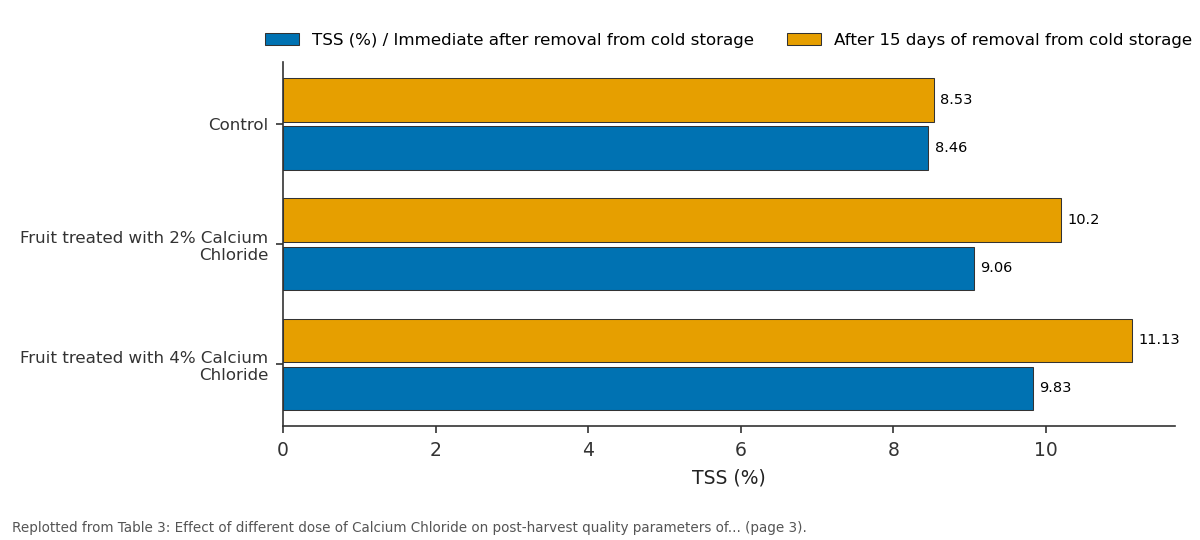
TSS (%) / Immediate after removal from cold... and After 15 days of removal from cold storage: Control vs Fruit treated with 2%... vs Fruit treated with 4%...
Replotted from Table 3 (page 3) of the original paper. Every bar is the paper's own table value.
View source evidence ↗Figures & tables
From the original paper Table 2
 Table 1
 Table 3
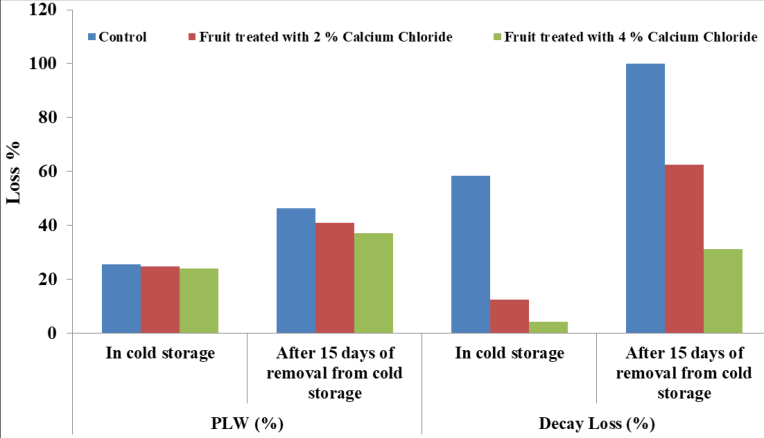 Figure 1
 Table 4
 Table 5
 Table 6
Introduction
Citrus species mainly: mandarin orange, sweet orange and acid lime are the main fruit crops of Nepal. The government of Nepal has given high priority to the research and development of the citrus species in the mid-hills regions of the country. Since 1960s, there have been systematic research and development efforts by the public sector, which has resulted in projects supported by various organizations and donors to commercialize these crops (Poudyal, 2015) [13] . Many technologies related to variety development and improvement, nursery management, orchard management, plant protection and post-harvest management have been developed (NCRP, 2021) [11] . Currently, the commercial cultivation and production of citrus crops is expanding in about 50 districts of the country. In the mid-hill region of Nepal, mandarin orange cultivation from 1000 to 1500 meters above sea level contributes 0.85 percent to the country's total agricultural production. The area, production and productivity of mandarin oranges in Nepal are 18, 369 ha, 1, 98, 406 tons and 10.80 tons/ha, respectively, in which the area, production and productivity in Syangja district is 1,225 ha, 18350 tons and 14.97 tons/ha respectively (MOALD, 2021) [9] . It is a major cash crop for the farmers of Syangja district. In the fiscal year 2073/74, the government declared Syangja district as Citrus Super Zone under the Prime Minister Agriculture Modernization Project. After that, the mandarin orange production area and production in this district has been significantly expanded and increased. In general, 20-25% of mandarin fruits are wasted due to suboptimal post-harvest management, with 7% lost during harvesting, 25% during transportation, 3% during grading, 10% in the packaging process, and an additional 5% during marketing (Bhattarai et al., 2013) [2] . As fruits are highly perishable, they cannot endure extended transportation and storage times. The failure to adopt improved techniques at both pre and post-harvest stages results in the loss of key chemical quality attributes both internally and externally. To mitigate these post-harvest losses, measures should be taken to prolong shelf life by controlling transpiration rates, respiration, preventing microbial infection, and maintaining membrane integrity (Sahu, 2016) [16] .
The ripening period of mandarin oranges is from November to January in Nepal. During this period, the fruits produced were surplus to the market at one time, so they do not get a reasonable price. If consumers have to buy mandarin orange beyond this period, they have to buy low-quality fruits imported from another country at a higher price. The Nepalese fruit industry grapples with critical challenges including huge post-harvest losses (Rokaya, 2017) [14] . If improvements can be made in various post-harvest management practices (Appropriate time of fruit picking, method of fruit picking, fruit grading, packaging, transportation and storage), the storage period can be increased and the farmers will also get a reasonable price results in long time availability of Nepali oranges in the market. Various research works have been done to reduce post-harvest damage and prolong the post-harvest life of oranges and good technologies have also been developed. The use of low-cost technologies, such as applying edible coatings (Including oils, waxes, and chemicals), has garnered global attention due to their ability to preserve the quality even under typical storage conditions (Bisen et al, 2012) [4] . Edible coatings create a modified atmosphere around the fruit by sealing the fruit's pores, which reduces the respiration rate and enhances post-harvest quality (Kader, 2005) [7] . With these considerations in mind, this study was conducted to extend the life of mandarins after harvest and to store the fruit for a long time in cold store using different concentrations of calcium chloride along with the study of physiology of mandarins (Harvested and stored in different date) after removal from cold storage.
Materials and Methods
Materials and Methods
Experimental Site
A post-harvest experiment was conducted at Syangja cold store and post-harvest laboratory (Ambient condition) of Horticulture Research Station, Malepatan, Kaski in 2022/23 (Nov-March) in collaboration with Prime Minister Agriculture Modernization Project, Project Implementation Unit, Syangja. Two different studies were carried out accordingly at the same time.
Experimental Setup and Management
In first study, the experimental setup consisted of three treatments (Table 1) and allocated in the completely randomized design (CRD) with three replications. Mandarins were treated with different amounts of calcium chloride (2% and 4%) and untreated mandarins were kept in cold storage for 1 month and the same mandarins were taken out of cold storage after 1 month and brought to the laboratory at Horticulture Research Centre, Malepatan, Kaski for quality analysis. The solutions of Calcium Chloride (2% and 4%) were prepared by dissolving 117.6 gm and 235.2 g Calcium Chloride in 4 liters of water. All total, 25 uniform fruits were kept per treatment per replication. In second study, the mandarins harvested and kept in cold storage in different date were taken as a treatment.
| S. N. | Treatment details |
|---|---|
| 1 | T1: Control |
| 2 | T2: Fruit treated with 2% Calcium Chloride |
| 3 | T3: Fruit treated with 4% Calcium Chloride |
Table text extracted from the original PDF; superscript letters are shown inline. The original table image is below.
View original table image
According to this, the mandarins kept by the farmers in cold storage in different dates were collected 4 times at 15 days interval and kept them at the laboratory of HRS, Malepatan.
On each sampling, 15 fruits were taken as samples from the crates of fruits kept in cold storage. The shelf life of mandarins after removal from cold storage was observed for two weeks.
During both study periods, cold storage temperature was (4-6 °C) and relative humidity was (80-85%) whereas laboratory temperature was (11-17 °C) and relative humidity (62-82%).
Parameters Observed
During storage at cold store and after removal from there, changes in post-harvest quality of mandarin were observed and their data was recorded accordingly in a week interval. Different qualitative parameters of fruits: physiological loss in weight (PLW), decay loss (Losses due to green mold, blue mold and cold rot), total soluble solid (TSS), and titrable acidity (TA) were recorded. For both studies, average weight (Per fruit) of mandarins was 125 g, average total soluble solid (TSS) was 9.91% and the average titrable acidity was 1.5%.
Physiological loss in weight (PLW)
For PLW, 5 fruits from each treatment were separated and marked so as to observe their changes in weight and recorded it accordingly. PLW was calculated based on change in weight (Difference between initial and final weight of fruit) divided by initial weight and expressed in percentage.
Decay loss percent
Fruits were evaluated visually for symptoms of decay during the entire storage period (Cold storage and ambient condition). Samples having decayed and diseased symptoms were counted and discarded. Decay loss was calculated based on number of discarded fruits (Decayed and diseased) divided by the total number of fruit expressed in percentage.
Total soluble solid (TSS)
For TSS determination in ºBrix, the hand-held refractometer (Model: Atago, Japan, N-1 Brix 0-32%) was used by placing two to three drops of clear juice on the prism surface.
Titrable acidity (TA)
TA determination was done by acid-base titration method (Tyl and Sadler, 2017) [21] . Five ml of fresh lime juice was titrated against 0.1 N NaOH (Sodium Hydroxide). The amount of NaOH consumed till end point was represented by the appearance of pink coloration, and that volume of NaOH was noted. TA was calculated by following formula,
Where, V1= Volume of NaOH consumed during titration of sample (ml), a V2= Volume of sample (ml) and ( = Acid milli equivalent conversion factor
Data Analysis
The data occurred during the study period was entered in Microsoft excel 2010. The analysis of variance was determined by using the statistical tool for agricultural research (STAR) version 2.0.1 and the significance was determined using Fisher's least significant difference at p<0.05 (Gomez and Gomez, 1984) [19] .
Results
Results
First Study:
Total soluble solids (TSS °Brix), titrable acidity (TA %), PLW (%) and decay loss (%) of mandarins were recorded just after removal of mandarins from the cold storage and after 15 days of its removal. Significant difference was observed among the treatment methods in mandarin. According to Table 3, TSS and TA of untreated oranges were found to be 8.47% and 1.49% respectively, just after removal from cold storage. After 15 days of removal from cold storage, it was found to be 8.53% and 1.15% respectively. TSS and TA of mandarin treated with 2% calcium chloride were 9.06% and 1.19% just after removal, while TSS and TA of same were 10.2% and 0.89% after 15 days of removal from cold storage. The TSS and TA of oranges treated with 4% calcium chloride were 9.83% and 1.32% just after removal from cold storage, while TSS and TA were 11.13% and 0.89% after 15 days of removal from cold storage. TSS of mandarin was gradually increased and TA was gradually decreased after 15 days of removal from cold storage. The result showed that TSS of mandarins treated with 4% calcium chloride was higher than that of untreated oranges. Significant differences were also observed in physiological weight loss (%) and decay loss (%) between the mandarins treated with different amounts of calcium chloride (2 and 4%) and untreated mandarins. According to Figure 1, the physiological weight loss of untreated fruits, fruits treated with 2% calcium chloride and fruits treated with 4% calcium chloride during one-month storage at cold store were 25.6%, 24.8% and 24% respectively. And after 15 days of its removal from cold storage the physiological weight loss was 46.45%, 40.97% and 37.09% respectively.
In mandarins treated with 4% of calcium chloride, the physiological weight loss was found to be less than others.
Similarly, the decay loss of untreated fruits, fruits treated with 2% calcium chloride and fruits treated with 4% calcium chloride during one-month storage at cold store were 58.33%, 12% and 4.16% respectively while after 15 days of its removal from cold storage, the decay loss was 100%, 62.5% and 31.25%, respectively. In untreated fruits, 100% decay loss was recorded.
Second Study
According to Table 4, the mandarins kept in cold storage on 1 st December, 2022 were taken out after 3 weeks for the first time and at each 15 days interval they were taken out for second, third and fourth time and kept for 15 days under ambient conditions. Changes in their quality parameters and damages were recorded accordingly. TA was decreased in second week as compared to the first week in every removal from cold storage, but the TSS increased gradually in the first and second removal whereas in third and fourth removal TSS decreased in the second week. Physiological weight loss in first week (1.89%) and second week (11.05%) were less in first removal of mandarin as compared to rest of three removals. Decay loss was found to be nil at first week and only 10% at second week in the second and fourth removal of mandarin from cold storage. According to Table 5, the mandarins kept in cold storage on 11 th December 2022 were taken out after 2 weeks for the first time and at each 15 days interval they were taken out for second, third and fourth time and kept for 15 days under ambient conditions. As compared to the first week, TSS and TA of mandarin were decreased gradually in the second week. But in fourth removal, TSS was higher (11.6%). The physiological weight loss of mandarin after first week was less (7.99%) in first removal as compared to others. But the physiological weight loss in the second week was less (19.94%) in third removal. Although, the decay loss was less in the first week, it was found to be 40% and 60% at second week in second and third removal respectively and its acceptability was also very poor. In forth removal, the decay loss of mandarin was only 10% in both first and second weeks. According to Table 6, the mandarins kept in cold storage on 21 st December 2022 were taken out after 2 weeks for the first time and at each 15 days interval they were taken out for second, third and fourth time and kept for 15 days under ambient conditions. Changes in their quality parameters and damages were recorded accordingly. As compared to the first week, TSS and TA of mandarin were decreased gradually in the second week. But in second and fourth removal, TSS was higher (11.0%). The physiological weight loss of mandarins in fourth removal was minimum in the first week and second week (7.83% and 14.99% respectively). Decay loss of mandarin in the first week was zero in first and second removal, but at second week it was 40% with poor acceptability. Decay loss was found to be zero at first and second week in the fourth removal of mandarin from cold storage.
| Quality of mandarin | After first week | — | — | — | After second week | — | — | — |
|---|---|---|---|---|---|---|---|---|
| Sample collection | TSS (%) | TA (%) | PLW (%) | Decay Loss (%) | TSS (%) | TA (%) | PLW (%) | Decay Loss (%) |
| First removal | 9 | 2.81 | 8.73 | 0 | 9 | 0.89 | 28.68 | 40 |
| Second removal | 11 | 1.28 | 23.42 | 0 | 10 | 1.53 | 33.74 | 40 |
| Third removal | 7.4 | 0.82 | 17 | 20 | 6.4 | 0.64 | 25 | 30 |
| Forth removal | 11 | 1.66 | 7.83 | 0 | 10.8 | 1.02 | 14.99 | 0 |
Table text extracted from the original PDF; superscript letters are shown inline. The original table image is below.
View original table image
| Quality of mandarin | After first week | — | — | — | After second week | — | — | — |
|---|---|---|---|---|---|---|---|---|
| Sample collection | TSS (%) | TA (%) | PLW (%) | Decay Loss (%) | TSS (%) | TA (%) | PLW (%) | Decay Loss (%) |
| First removal | 9.5 | 2.68 | 7.99 | 10 | 7.7 | 1.53 | 23.40 | 20 |
| Second removal | 9.2 | 1.41 | 25.64 | 0 | 7.2 | 0.76 | 35.53 | 40 |
| Third removal | 8.8 | 0.9 | 8.49 | 30 | 7.6 | 0.7 | 19.94 | 60 |
| Forth removal | 11.6 | 1.28 | 12.03 | 10 | 8.6 | 1.28 | 24.87 | 10 |
Table text extracted from the original PDF; superscript letters are shown inline. The original table image is below.
View original table image
| Quality of mandarin | After first week | — | — | — | After second week | — | — | — |
|---|---|---|---|---|---|---|---|---|
| Sample collection | TSS (%) | TA (%) | PLW (%) | Decay Loss (%) | TSS (%) | TA (%) | PLW (%) | Decay Loss (%) |
| First removal | 10.1 | 2.17 | 1.89 | 10 | 10.8 | 1.66 | 11.05 | 20 |
| Second removal | 10.9 | 1.02 | 9.49 | 0 | 12 | 1.02 | 18.62 | 10 |
| Third removal | 9.3 | 0.9 | 4.91 | 10 | 7.6 | 0.76 | 17.85 | 30 |
| Forth removal | 10.4 | 1.53 | 5.32 | 0 | 9.6 | 0.89 | 17.51 | 10 |
Table text extracted from the original PDF; superscript letters are shown inline. The original table image is below.
View original table image
Discussion
According to the first study, it was observed that the damage caused by Green and Blue mold (Penicillium spp.) was reduced when mandarins were dipped in a 4% solution of calcium chloride and kept in cold storage. Although there was not more difference in weight loss between untreated and treated mandarins during cold storage, decay loss was minimum in mandarins treated with 4% calcium chloride. Chlorine in calcium chloride helps to deactivate and cleans all kinds of pathogens in the peel of the mandarin fruit, and there is not any growth of pathogens in cold storage so that mandarins can be stored for a long time. As well as the calcium helps to delay shriveling of fruit with minimum weight loss of fruit and it also protects against rotting. The findings were in consonance with the findings of the (Ahmad and Siddiqui, 2013) [1] in Kinnow fruit, (Rokaya, 2017) [14] in Mandarin and (Sahu, 2016) [16] in custard apple. The faster rate in the TSS increment in the calcium chloride treated and untreated fruits were might be due to faster metabolic activities through respiration and transpiration.
Similarly, the results are in line with the results of (Bisen et al., 2012) [4] in Kagzi lime, (Shahid and Abbasi, 2011) [17] in sweet orange and (Hassan et al., 2014) [6] in tangerine citrus.
According to the second study, mandarins kept in cold storage at 3 different dates showed less damage when they were taken out after 8-9 weeks (2 months). Mandarins harvested and kept in cold storage on 1 st week of December had comparatively low weight loss and decay loss. Mandarins harvested after second week of December were over matured and the segments were separated from the peel, so the damage is more. Maturity at harvest is the most important factor that determines final fruit quality as well as storage life (Bhusal et al., 2007) [3] . Moreover, the harvesting date especially affected fruit weight, rind thickness, juice content, fruit marketability, fruit disorders, titrable acidity and soluble solids in citrus varieties (Dou, 2005) [20] . The late harvest causes more water loss of fruits.
It can be the main causes of deterioration, since it is not only resulting in indirect quantitative losses, but also causes losses in appearance (due to wilting and shriveling) and nutritional quality (Kader, 1986) [8] . The TSS was higher in the fruits harvested earlier and was lower rest of other harvest. These results agree with those reported by (Nasciment et al, 2011) [10] on Murcott mandarins and (Gemail et al, 2015) [5] . TSS levels increase as citrus matures. However, it can be reduced due to the overmaturity of fruits. Rokaya et al., 2016 [15] also observed a greater increase in the TSS of Feutrell's Early and Kinnow fruits. The findings of the present research also agree with the observations for TSS, TA, and sugar content of Gannan navel orange, indicating that TSS and sugar content gradually increases, while acidity decreases with the advancement of fruit maturity (Zhang et al, 2022) [18] .
Conclusion
From this study, it seems necessary to facilitate the farmers to treat the mandarins with 4% of calcium chloride before storage. The mandarins produced in Syangja district must be picked safely from second fortnight of November to first week of December and stored them in cold storage by treating with 4% calcium chloride. To conduct these activities, it is most crucial to manage the temperature, relative humidity and bio-security of cold storage.
Acknowledgement
We would like to extend our gratitude to mandarin growers of Syangja, scientific and technical personnel of Nepal Agricultural Research Council, Horticulture Research Station, Malepatan and Prime-Minister Agriculture Modernization Project, Project Implementation Unit, Syangja for provision of all the necessary financial and supportive research materials provided to accomplish this research.
Figures and tables from the paper
| S. N. | Harvest date and Storage date of mandarin |
|---|---|
| 1 | T1: 1st December, 2022 |
| 2 | T2: 11th December, 2022 |
| 3 | T3: 21st December, 2022 |
Table text extracted from the original PDF; superscript letters are shown inline. The original table image is below.
View original table image
References
7 in the original paper- MoALD. Statistical Information on Nepalese Agriculture, 2020/21. Government of Nepal. Ministry of Agriculture and Livestock Development, Planning and Development Cooperation Coordination Division, Statistics and Analysis Section, Singhdurbar, Kathmandu, Nepal; c2021.
- Nasciment LM, Do MC, Arruda IH, Fischer LP, Ferraz, Fonseca MB. Storage potential of Murcott mandarin: Refrigerated storage x modified atmosphere. [in Portuguese] Citrus Research and Technology. 2011;32(3):167-172.
- NCRP. Annual Report 2077/78 (2020/21). National Citrus Research Program, Paripatle, Dhankuta; c2021.
- NCRP. Annual Report 2078/79 (2021/22). National Citrus Research Program, Paripatle, Dhankuta; c2022.
- Rokaya PR, Baral DR, Gautam DM, Shrestha AK, Paudyal KP. Effect of altitude and maturity stages on quality attributes of mandarin (Citrus reticulata Blanco). American Journal of Plant Sciences. 2016;7(6):958.
- Zhang J, Zhang JY, Shan YX, Can G, Lian H, Zhang LY, et al. Effect of harvest time on the chemical composition and antioxidant capacity of Gannan navel orange Citrus sinensis L. Osbeck 'Newhall' juice. Journal of Integrative Agriculture. 2022;21(1):261-272.
- Dou Y, Milne TA, Tackett AJ, Smith ER, Fukuda A, Wysocka J, et al. Physical association and coordinate function of the H3 K4 methyltransferase MLL1 and the H4 K16 acetyltransferase MOF. Cell. 2005;121(6):873885.
Cited by 4
From OpenAlex, OpenCitations and reference lists read by Scinovex
- Preparation of mandarin blended passion fruit syrup
Gourav Madhukar Bhagat, S. R. Dalal, SG Bharad, A. D. Warade, Yogita Sanap, Sonal R Nikoshe · International Journal of Agriculture and Food Science · 2025
An experiment entitled “Evaluation of passion fruit genotypes for preparation of blended syrup” was carried out during the year 2024-2025 at Post Harvest Technology Laboratory, Section of Horticulture, College of Agriculture, Dr. Panjabrao Deshmukh Krishi Vidyapeeth, Akola with the objectives to evaluate the genotypes of passion fruit for preparation of mandarin blended passion fruit syrup, to study the effect of different proportions of mandarin-passion fruit juice blending for preparation of syrup, to assess the chemical changes of mandarin-passion fruit blended syrup during storage and to f
- Molecular and morphological characterization of Fusarium oxysporum f. sp. lycopersici causing wilt disease in tomato (Solanum lycopersicum) in Karnataka
M. M. Srinivas Bharath, Kopparthi Amrutha Valli Sindhura, Shadab M Khatib, Pooja PS, M. N. Nagaraj, VB Sanath Kumar · International Journal of Advanced Biochemistry Research · 2024
Tomato (Solanum lycopersicum L.) is the one of the most important vegetable crop globally, but its production and quality are known to be largely affected by many pests and diseases. One of the major hindrances to tomato production is the fungal wilt disease caused by Fusarium spp. In the current study we isolated, visually examined and characterized the fungal pathogen both morphologically and at the molecular level by employing standard techniques for tissue isolation, microscopic observations and PCR methods. Under the microscope, morphological features like white to whitish pink mycelium w
- In vitro anti-fungal potential of selected plant extracts against Fusarium oxysporum ↗
Mohd Zishan, Dolly Wattal Dhar, Uzma Manzoor · Journal of Medicinal Plants Studies · 2024
Plant diseases caused by pathogenic microorganisms such as viruses, fungi, bacteria, and nematodes, along with unfavourable environmental factors, significantly reduce crop production. Among these pathogens, fungal diseases are particularly detrimental, especially to vegetable crops. India, a leading producer of vegetables, faces substantial crop losses due to fungal infections, with Fusarium oxysporum being one of the most common pathogens affecting solanaceous…
❝ 0PDF - Economics of cultivation of mustard varieties (Brassica juncea L.) under Nagpur mandarin (Citrus reticulata Blanco.) based agroforestry system in South-Eastern Rajasthan
K. K. Singh, Sbs Pandey, Ramniwas Vaishnav · International Journal of Research in Agronomy · 2024
Field experiment was conducted deploying 24 treatments in Randomized Block Design with three replications during two successive years from October 2020 to March 2021 and October 2021 to March 2022. The fourteen year old plantation of mandarin planted at 6 x 6 m spacing, which was used for the present intercropping study. Mustard with three varieties (var. Giriraj, RH-725 and NRCHB-101) and was selected along with the application (4 ml/lit.) of biofertilizers (Azotobacter and Phosphorus solubilizing bacteria) for the study. Higher benefit cost ratio in the treatment M10 (1: 3.39 in 2020-21 and