
Research article · 2023 · Full text
International Journal of Advanced Biochemistry ResearchEvaluation the effects of biofertilizers on growth and yield of carrot (Daucus carota L.)
Volume 7(2S) · Pages 413–416 · DOI: 10.33545/26174693.2023.v7.i2sf.243 ↗
Research areasFlowering Plant Growth and CultivationAgricultural Science and FertilizationPotato Plant Research
Abstract
Author-writtenAt the Horticulture Research Farm, (CRC-1) Department of Horticulture, School of Agriculture, ITM University, Gwalior (M.P.), the current study, named Evaluation the Effects of Organic Manures and Bio fertilizers on Growth and Yield of Carrot (Daucus carota L.), was carried out. Vegetables are understood to be a crucial ally in the upkeep of good health and in ensuring nutritional security. Important vitamins, minerals, carbohydrates, proteins, and roughages are all provided by them in significant amounts. The carrot's expanded fleshy taproot, which is made up of a phloem- and xylem-rich cortex, is its edible portion. Carrots of high grade have the most cortex and the least core. When applied with chemical fertilizers, biofertilizers increase crop production and optimize nutrient usage. Because chemical fertilizer is more expensive and it is getting harder to satisfy the nutrient needs of farming, the idea of an integrated plant nutrient supply system is gaining popularity. The physio-chemical characteristics of soil (aggregation, stability, pH, EC, bulk density, water holding capacity, organic matter) are improved by the use of vermicompost. The main waste products from the poultry business are by far chicken manure and litter, which are frequently employed as sources of nutrients for crop development. The overall N and P contents of poultry wastes are among the highest of all wastes. Three replications were used in the experiment, which was set up using a randomized block design. In the carrot (Daucus carota L.) cultivar Super Red, 10 treatments totalling FYM, Vermicompost, Azotobactor, and PSB with varying RDF doses were utilized in each replication. The findings showed that the growth and yield characteristics of carrots at various growth stages were strongly impacted by the various organic manures and biofertilizers. It was noted that the greatest treatment for boosting carrot growth and yield was determined to be T9 (Vermi + Azo + Psb 100% greater).
Summary
Source-checkedPlain-language reading of the full paper, prepared with AI and checked against the text. Each point links to the authors' own words.
Why it matters
- Vegetables are essential for maintaining good health and nutritional security because they provide significant amounts of proteins, carbohydrates, minerals, vitamins, and roughages. View evidence ↗
- The carrot (Daucus carota L.) is one of the most common cool-season root crops grown globally. View evidence ↗
- Integrated plant nutrient supply systems are becoming more popular as chemical fertilizers increase in cost and struggle to meet agricultural nutrient demands. View evidence ↗
The question
- The study aimed to evaluate how different organic manures and biofertilizers affect the growth and yield of carrots. View evidence ↗
What they did
- The experiment used a randomized block design with three replicates of carrots planted during the 2022-2023 rabi season, with seeds placed 2.5 cm deep and spacing of 45 cm between rows and 10 cm between plants. View evidence ↗
- Ten treatments were tested, including a control (T0), recommended dose of fertilizer (T1), and various combinations of Farm Yard Manure (FYM) or Vermicompost with increasing percentages (25% to 100%) of Azotobacter and Phosphorus Solubilizing Bacteria (PSB). View evidence ↗
- Treatment variations were analyzed using analysis of variance and critical difference (C.D.) based on the Panse and Sukhatme (1985) method. View evidence ↗
What they found
- Treatment T9 (Vermicompost + Azotobacter + PSB 100%) produced the highest plant height at harvest (64.87 cm) and most leaves (13.97), while the control (T0) produced the lowest (42.27 cm height and 10.69 leaves). View evidence ↗
- T9 achieved the highest root length (22.23 cm), root diameter (3.38 cm), and germination percentage (91.67%), whereas T0 had the lowest values (18.53 cm, 2.59 cm, and 73.33% respectively). View evidence ↗
- The improved growth in treated plants is attributed to organic manures providing essential macro and micronutrients, which enhance soil structure and nutrient/moisture availability. View evidence ↗
- Biofertilizers contributed to growth by increasing nitrogen availability through biological fixation and producing growth substances like auxins, gibberellins, and cytokinins. View evidence ↗
What it means
- The authors concluded that the combination of Vermicompost, Azotobacter, and PSB at 100% (T9) is the most effective treatment for increasing carrot growth and yield. View evidence ↗
Visual summary
1 visualsIllustrations explain the paper; they do not show study data.
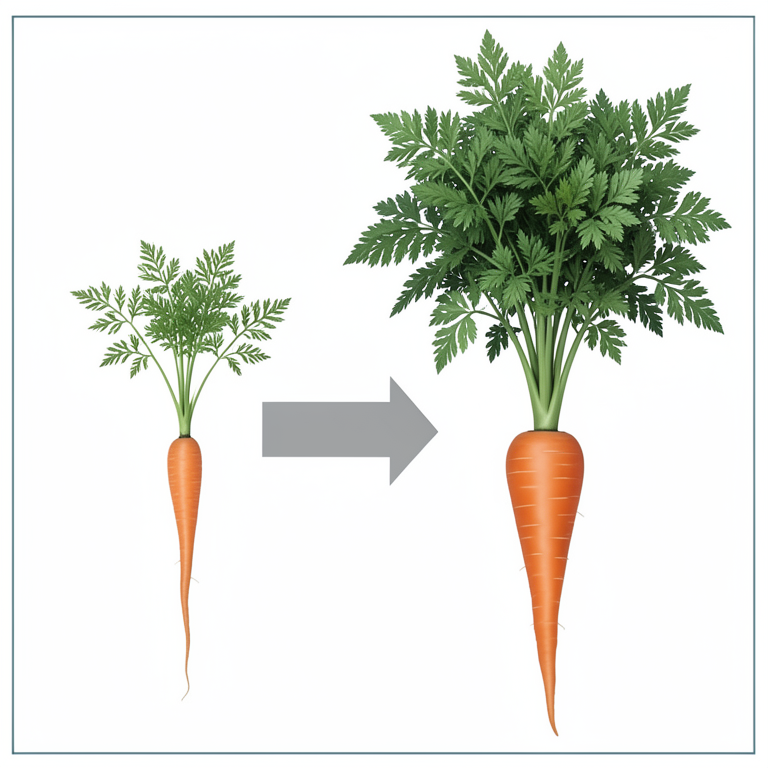
Treatment Comparison Concept
AI-generated conceptual illustration (carrot plants (Daucus carota L.)). It explains the idea and does not show study data.
View source evidence ↗Figures & tables
From the original paper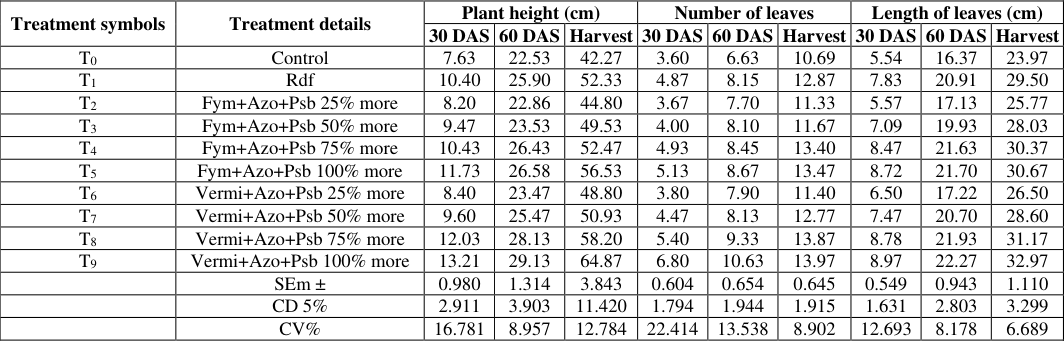 Table 1
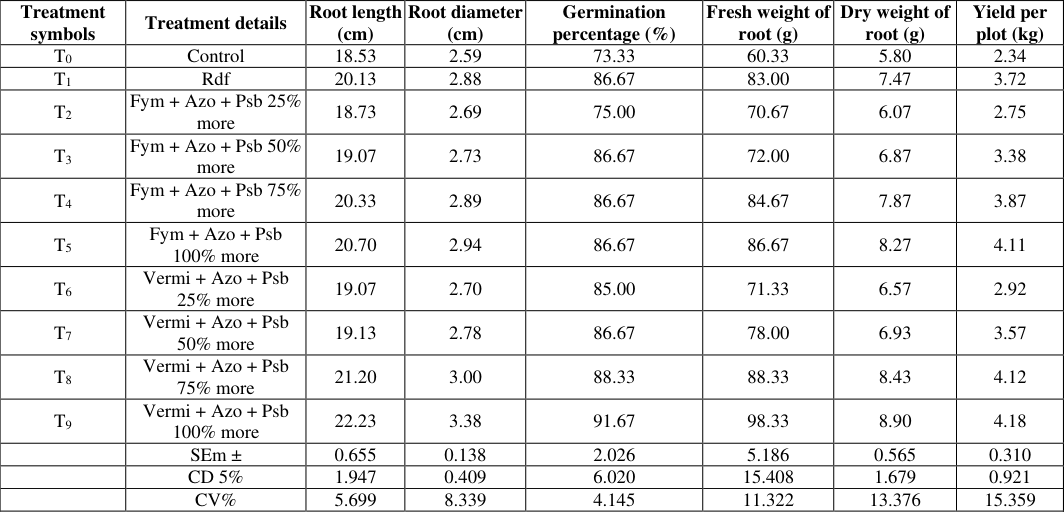 Table 2
Introduction
The preservation of good health and ensuring nutritional security are both acknowledged as goals of eating vegetables. They are essential for supplying essential vitamins, minerals, carbohydrates, proteins, and roughages. The root vegetable carrot (Daucus carota L.) is one of the most widely grown cool-season root crops in the world. It is a biennial plant in the Apiaceae subfamily of the Umbellifer genus, and its edible portion is an expanded fleshy taproot made up of cortex (phloem) and core (xylem). Carrots of high grade have a high cortical content and low core content. Carrots are cultivated all throughout India. Leading producers include Haryana, Andhra Pradesh, Punjab, Bihar, Tamil Nadu, and Assam. In India, it will have a 108 thousand hectare production area and produce 1867 million tons year in 2021-2022, according to an anonymous source. In Madhya Pradesh, it has a surface area of 9.57 thousand hectares and a production volume of 179.79 million tons per year (Anonymous, 2021-22). When used with chemical fertilizers, biofertilizers increase crop productivity and optimize nutrient usage. Because chemical fertilizer is more expensive and it is getting harder to meet the nutrient needs of farming, the idea of an integrated plant nutrient supply system is gaining popularity. Due to the volatility of soil particles, a constant reliance on synthetic fertilizers may result in a decrease in the amount of organic material in the soil, a rise in soil acidity, a deterioration of the soil's physical qualities, and an increase in the rate of erosion (Olowoake & Adeoye, 2010) [11] . The physio-chemical characteristics of soil (aggregation, stability, pH, EC, bulk density, water holding capacity, organic matter) are improved by the use of vermicompost.
The main waste products from the chicken business are by far poultry manure and litter, which are frequently employed as sources of nutrients for crop production. The overall N and P contents of poultry wastes are among the highest of all wastes (Amanullah et al. 2007) [2] . The roots are rich with nutrients that are beneficial to the body, including carotene (provitamin A), sucrose (88.6% moisture), 1.1% protein, 0.2% fat, 9.1% carbs, 1.1% fiber, and 12,000 IU of vitamin A (Banga, 1963) [19] . They are also a good source of traces of vitamin B1, B2, C, and other minerals. By delivering vitamin A, carrot roots are essential in protecting children with vision impairment. There is a serious problem with vitamin A deficiency right now in India. Therefore, it is vital to implement various programs for the development of carotene-rich crops. Along with peas, carrots are widely used in pickles, maintains, and salads. They can also be eaten fresh. When utilized with synthetic fertilizers, bio Fertilizers increase yields of crops and optimize nutrient usage. Because chemical fertilizer is more expensive and it is getting harder to meet the nutrient needs of farming, the idea of an integrated plant nutrient supply system is gaining popularity. Due to the instability of soil aggregates, a constant reliance on chemical fertilizers may result in a decrease in the amount of organic matter in the soil, a rise in soil acidity, a deterioration of the soil's physical qualities, and an increase in the rate of erosion (Olowoake & Adeoye, 2010) [11] . Maintaining the organic matter in the soil is one technique to keep it fertile or make it more fertile.
Material and Methods
The experimental material comprised of one cultivar including check, which was collected from different source are grown in Gwalior Chambal region which comes under Grid Region of Agro-climatic zone. The experimental field of Crop Research Centre, ITM University, Gwalior is located in the Gird belt (MLS) at an elevation of 211.5 m above sea level and latitudes 26 o 13 1 N and 78 o 20 1 E. It is located in the northern region of MP and has a subtropical climate. Summers are sweltering and arid. The hottest months are May and June, when the mean maximum temperature ranges from 38.40 C to 47 °C, respectively. The coldest months of the year are December and January, with average low temperatures ranging from 10 ° to 12 °C. The average annual rainfall falls around 760 and 1060 mm throughout the course of three months from the middle of June to the end of September. During the winter, three replicates of the carrot cultivar were grown in a randomized block design with a row-to-row distance of 45 cm and a plant-to-plant distance of 10 cm. while seeds are placed about 2.5 cm deep during rabi season of the year 2022-2023. The experiment comprised of ten treatments and replicated thrice, treatments include T0 (Control), T1(RDF 100:80:50 Kg/ha), T2(FYM 15t/ha + Azotobacter 25% more + PSB 25% more) T3(FYM 15t/ha + Azotobacter 50% more + PSB 50% more) T4 (FYM 15t/ha + Azotobacter 75% more + PSB 75% more) T5 (FYM 15t/ha + Azotobacter 100% more + PSB 100% more) T6 (Vermicompost 10t/ha + Azotobacter 25% more + PSB 25% more) T7(Vermicompost 10t/ha + Azotobacter 50% more + PSB 50% more) T8 (Vermicompost 10t/ha + Azotobacter 75% more + PSB 75% more) T9 (Vermicompost 10t/ha + Azotobacter 100% more + PSB 100% more).
Statistical Analysis
The initial and most significant step is to perform an analysis of variance in accordance with Panse and Sukhatme's (1985) [20] advice and assess the importance of demographic differences. A critical difference (C.D.), which was determined using the Panse and Sukhatme (1985) [20] formula, was used to assess the importance of the treatment variation.
Result and Discussion
Result reported that the different organic manure and biofertilizers were significantly influenced the growth parameters of carrot at different growth stages. It was recorded that the maximum vegetative growth parameters (viz., plant height, number of leaves and length of leaves at 30, 60 DAS and at harvest were registered in treatment T9 (Vermi + Azo + Psb 100% more) and of all the treatments, it was the most effective. However, treatment T0 (Control) only showed the minimal vegetative growth characteristics, such as plant height, number of leaves, and length of leaves at 30, 60 DAS, and at harvest. It could be attributed to the action of applied organic manures, which contained all the macronutrients and the majority of the micronutrients required for crop growth, which results in an improvement in soil structure and increased nutrient and moisture availability and uptake, which may have boosted up the plant's growth and thus improved the plant's architecture by enhancing the height of the plant and leaves, as well as due to the ability of biofertilizers to increase in availability of N through biological N fixation and P and produce ammonia, vitamins and plant growth substances like IAA (auxins), gibberellins and cytokinin and greater availability of phosphorus by Phosphobacteria, which helped the plants in better nutrient absorptions as resulted in gradual increase in plant height of carrot plant. Findings are in agreement with those of Qureshi et al. (2015) [14] , Kumar and Pandita (2016) [6] , Agbede et al. (2017) [1] , Kumar et al. (2017) [7] , Khede et al. (2019) [4] , Pal et al. (2019) [12] , Shanu et al. (2019) [16] and Rani et al. (2022) [15] . The most effective organic manure and biofertilizer treatment was discovered to be treatment T 9 (Vermi + Azo + Psb 100% more), which also provided the highest yield indicators (including the length of the root, root diameter, germination percentage, fresh weight of root, dried weight of root, and yield per plot). However, under treatment T0 (Control), the minimal yield characteristics (namely, root length, root diameter, germination %, fresh weight of root, dry weight of root, and yield per plot) were noted. The availability of sufficient amounts of vital nutrients for plants from organic sources, a balanced C: N ratio, the production of auxin and other growth-promoting compounds, and the conversion of insoluble phosphate to soluble form by Phosphorous Solubilizing Bacteria (PSB) may have all contributed to the increase in carrot yield. When neither organic manure nor biofertilizer was used, a minimum output was observed, which may have been caused by a lack of nutrients needed for crops to go through their productive phase. The use of various organic manures, biofertilizers, FYM, and vermicompost, which provide all the macronutrients and nearly all the micronutrients required for plant growth, appears to have a direct impact on crop yield by either accelerating the respiratory processes by increasing the permeability of cells or by hormone growth action. It provides the plants with readily usable types of nitrogen, phosphorous, and sulphur through biological breakdown. According to Uikey et al. (2015) [18] , pea crop production (26.54 q/ha), maximum plant height (65.87 cm), number of pods per plant (26.40), and number of seeds per pod (7.01) all increased significantly under 10t FYM /ha + 45:75:60 kg/ha NPK + Rhizobium + PSB culture. Mali et al. (2018) [9] investigated the effects of organic manures and bio-fertilizers on radish root crop growth and yield. Plant height (34.5 cm) and root yield per plot (6.70 kg) reached their maximum levels as a result of the application of PSB 4 kg/ha plus vermicompost 5 t/ha. In a field experiment, Khede et al. (2019) [4] used the treatment (50% RDF + 25% vermicompost + 25% poultry manure) to record the highest growth in terms of plant height (32.43 cm) and yield of radish roots (498.89 q ha-1).
Conclusion
The findings showed that the development and yield parameters of carrots at various growth stages were strongly influenced by the various organic manures and bio fertilizers. It was noted that the greatest treatment for boosting carrot development and yield was determined to be T9 (Vermi + Azo + Psb 100% more).
Figures and tables from the paper
| Treatment symbols | Treatment details | Plant height (cm) | — | — | Number of leaves | — | — | Length of leaves (cm) | — | — |
|---|---|---|---|---|---|---|---|---|---|---|
| 30 DAS | 60 DAS | Harvest | 30 DAS | 60 DAS | Harvest | 30 DAS | 60 DAS | Harvest | ||
| T0 | Control | 7.63 | 22.53 | 42.27 | 3.60 | 6.63 | 10.69 | 5.54 | 16.37 | 23.97 |
| T1 | Rdf | 10.40 | 25.90 | 52.33 | 4.87 | 8.15 | 12.87 | 7.83 | 20.91 | 29.50 |
| T2 | Fym+Azo+Psb 25% more | 8.20 | 22.86 | 44.80 | 3.67 | 7.70 | 11.33 | 5.57 | 17.13 | 25.77 |
| T3 | Fym+Azo+Psb 50% more | 9.47 | 23.53 | 49.53 | 4.00 | 8.10 | 11.67 | 7.09 | 19.93 | 28.03 |
| T4 | Fym+Azo+Psb 75% more | 10.43 | 26.43 | 52.47 | 4.93 | 8.45 | 13.40 | 8.47 | 21.63 | 30.37 |
| T5 | Fym+Azo+Psb 100% more | 11.73 | 26.58 | 56.53 | 5.13 | 8.67 | 13.47 | 8.72 | 21.70 | 30.67 |
| T6 | Vermi+Azo+Psb 25% more | 8.40 | 23.47 | 48.80 | 3.80 | 7.90 | 11.40 | 6.50 | 17.22 | 26.50 |
| T7 | Vermi+Azo+Psb 50% more | 9.60 | 25.47 | 50.93 | 4.47 | 8.13 | 12.77 | 7.47 | 20.70 | 28.60 |
| T8 | Vermi+Azo+Psb 75% more | 12.03 | 28.13 | 58.20 | 5.40 | 9.33 | 13.87 | 8.78 | 21.93 | 31.17 |
| T9 | Vermi+Azo+Psb 100% more | 13.21 | 29.13 | 64.87 | 6.80 | 10.63 | 13.97 | 8.97 | 22.27 | 32.97 |
| SEm ± | 0.980 | 1.314 | 3.843 | 0.604 | 0.654 | 0.645 | 0.549 | 0.943 | 1.110 | |
| CD 5% | 2.911 | 3.903 | 11.420 | 1.794 | 1.944 | 1.915 | 1.631 | 2.803 | 3.299 | |
| CV% | 16.781 | 8.957 | 12.784 | 22.414 | 13.538 | 8.902 | 12.693 | 8.178 | 6.689 |
Table text extracted from the original PDF; superscript letters are shown inline. The original table image is below.
View original table image
| Treatment symbols | Treatment details | Root length (cm) | Root diameter (cm) | Germination percentage (%) | Fresh weight of root (g) | Dry weight of root (g) | Yield per plot (kg) |
|---|---|---|---|---|---|---|---|
| T0 | Control | 18.53 | 2.59 | 73.33 | 60.33 | 5.80 | 2.34 |
| T1 | Rdf | 20.13 | 2.88 | 86.67 | 83.00 | 7.47 | 3.72 |
| T2 | Fym + Azo + Psb 25% more | 18.73 | 2.69 | 75.00 | 70.67 | 6.07 | 2.75 |
| T3 | Fym + Azo + Psb 50% more | 19.07 | 2.73 | 86.67 | 72.00 | 6.87 | 3.38 |
| T4 | Fym + Azo + Psb 75% more | 20.33 | 2.89 | 86.67 | 84.67 | 7.87 | 3.87 |
| T5 | Fym + Azo + Psb 100% more | 20.70 | 2.94 | 86.67 | 86.67 | 8.27 | 4.11 |
| T6 | Vermi + Azo + Psb 25% more | 19.07 | 2.70 | 85.00 | 71.33 | 6.57 | 2.92 |
| T7 | Vermi + Azo + Psb 50% more | 19.13 | 2.78 | 86.67 | 78.00 | 6.93 | 3.57 |
| T8 | Vermi + Azo + Psb 75% more | 21.20 | 3.00 | 88.33 | 88.33 | 8.43 | 4.12 |
| T9 | Vermi + Azo + Psb 100% more | 22.23 | 3.38 | 91.67 | 98.33 | 8.90 | 4.18 |
| SEm ± | 0.655 | 0.138 | 2.026 | 5.186 | 0.565 | 0.310 | |
| CD 5% | 1.947 | 0.409 | 6.020 | 15.408 | 1.679 | 0.921 | |
| CV% | 5.699 | 8.339 | 4.145 | 11.322 | 13.376 | 15.359 |
Table text extracted from the original PDF; superscript letters are shown inline. The original table image is below.
View original table image
References
18 in the original paper- Agbede TM, Adekiya AO, Kevin E. Impact of Poultry Manure and NPK Fertilizer on Soil Physical Properties and Growth and Yield of Carrot. Journal of Horticultural Research. 2017;25:81-88.
- Amanullah MM, Somasundaram E, Vaiyapur K, Sathyamoorthi K. Poultry manure to crops. A review. Agriculture Review. 2007;28(3):216-222.
- Kalita N, Bhuyan S, Maibangsa S, Saud RK. Effect of biofertilizer seed treatment on growth, yield and economics of toria (Brassica compestris L.) under rainfed condition in hill zone of Assam. Current Agriculture Research Journal. 2019;7(3):332-336.
- Khede K, Kumawat A, Tembare D. Effect of organic manures, fertilizers and their combinations on growth, yield and quality of radish (Raphanus sativus L.) cv. Japanese White. International Journal of Current Microbiology and Applied Sciences. 2019;8(3):400405.
- Kothyari HS, Yadav LK, Jat R, Gurjar PC. Influence of biofertilizers on plant growth and seed yield of pea (Pisum sativum L.). International Journal of Current Microbiology and Applied Sciences. 2017;6(11):18101817.
- Kumar A, Pandita VK. Effect of integrated nutrient management on seed yield and quality in cowpea. Legume Research. 2016;39(3):448-452.
- Kumar A, Batra VK, Panghal VPS, Malik A. Effect of FYM and gypsum on economics of carrot seed production under high residual sodium carbonate of water. Bhartiya Krishi Anusandhan Patrika. 2017;32(4):273-275.
- Lasmini S, Burhanuddin N, Nur H, Nur E. Improvement of soil quality using bokashi composting and NPK fertilizer to increase shallot yield on dry land. Australian Journal of Crop Science. 2020;12:17431749.
- Mali DL, Singh V, Sarolia DK, Teli SK, Chittora A, Dhakar R. Effect of organic manures and bio-fertilizers on growth and yield of radish (Raphanus sativus L.) cv. Japanese White. International Journal of Chemical Studies. 2018;6(2):1095-1098.
- Maxime Merlin DT, Edith MFK, Bertrand KE, Mariette A, François ZN. Effect of fertilizers' types on yield parameters, sweetness and nutritional quality of carrot (Daucus carota L.) genotypes. Int. J Agric. Sc. Food Technol. 2020;6(1):079-087.
- Olowoake AA, Adeoye GO. Comparative efficacy of NPK fertilizer and composted organic residues on growth, nutrient absorption and dry matter accumulation in maize. International Journal of Organic Agriculture Research and Development. 2010;2:43-53.
- Paul K, Aniekwe N, Samuel C. Effects of Rice Hull and Different Fertilizer Sources on the Growth and Yield of Carrot (Daucus carota L.) In Abakaliki. IOSR Journal of Agriculture and Veterinary Science. 2022;15:1-08.
- Qureshi F, Bashir U, Ali T. Effect of integrated nutrient management on growth, yield attributes and yield of field pea (Pisum sativum L.) cv. Rachna. Legume Research. 2015;38(5):701-703.
- Rani NS, Ismail S, Reddy YN. Effect of cropping situations and integrated nutrient management practices on growth, yield, quality and economics of growing carrot in ber-based cropping system. Indian Journal of Dry land Agricultural Research and Development. 2022;21(2):136-140.
- Shanu V, Lakshminarayana D, Prasanth P, Saida Naik D. Studies on the effect of integrated nutrient management (INM) on growth and yield parameters of carrot (Daucus carota L.) cv. Kuroda Improved under Southern Telangana Conditions. International Journal of Current Microbiology and Applied Science. 2019;8(4):2786-2791.
- Sharmila A, Kumar A, Dev R, Kropi R, Narayanan L. Comparative studies on the effect of certain biofertilizers on growth, yield and quality of carrot (Daucus carota L.) under Punjab conditions. Ecology, Environment and Conservation. 2022;28:1784-1787.
- Uikey V, Verma H, Nawange D. Influence of organic, chemical and biofertilizer on growth and yield of pea. Agricultural Science Digest. 2015;35(3):237-240.
- Panse M, Block HU, Föster W, Mest HJ. An improved malondialdehyde assay for estimation of thromboxane synthase activity in washed human blood platelets. Prostaglandins. 1985 Dec 1;30(6):1031-40.
Cited by 2
From OpenAlex, OpenCitations and reference lists read by Scinovex
- Effects of Nopal and Goat Manure on Soil Fertility and the Growth, Yield and Physical Characteristics of Tomato and Carrot Plants ↗
Guadalupe Yohana González-Torres, Aurea Bernardino‐Nicanor, Stephanie Fernández-Avalos, Gerardo Acosta‐García, José Mayolo Simitrio Juárez-Goiz, Leopoldo González-Cruz · Agronomy · 2024
Nopal (Opuntia) is a resource that is discarded after pruning complete cladodes. For this reason, the aim of this study was to investigate the effects of the combined use of organic matter (nopal) and goat manure on changes in soil characteristics and on the growth and yield performance of carrot and tomato plants. Physicochemical analysis of the soil and goat…
❝ 4PDF - Phosphate Fertilizer Doses in Carrot Production in an Organic System ↗
Joseantonio Ribeiro de Carvalho, Thatiane Nepomuceno Alves, Antônio Ismael Inácio Cardoso, Jolinda Mércia de Sá, Rogério Lopes Vieites, Emanuele Possas de Souza et al. · Brazilian Archives of Biology and Technology · 2025
Abstract The growing consumer demand for organically grown vegetables highlights the need for research into organic fertilization strategies. Phosphorus, a key nutrient required in large quantities, warrants further investigation into its application doses and sources, particularly for short-cycle crops like carrots. This study evaluated the efficacy of bone meal and Yoorin® thermophosphate as organic phosphorus sources in carrot production. The…
❝ 1PDF