
Research article · 2022 · Full text
International Journal of Agriculture Extension and Social DevelopmentChallenges of implementing technical and vocational Institution-Led programmers in Bo City, Southern Sierra Leone
Volume 5(1) · Pages 32–40 · DOI: 10.33545/26180723.2022.v5.i1a.121 ↗
Research areasEducation Systems and PolicyVocational and Entrepreneurial EducationHigher Education Learning Practices
Abstract
Author-writtenTechnical-Vocational Education and Training (TVET) is that aspect of education that exposes the learner to the acquisition of demonstrable skills that transform into economic benefits. TVET is a broad term of study encompassing technologies and all related sciences. It also involves acquiring practical skills, attitudes, understanding, and knowledge related to occupations in various sectors of economic and social life. The study examined critically the challenges faced by Technical Vocational Institutions in the Implementation of Technical and Vocational Programmes in Bo City. The main objective was to identify the challenges/ problems of Technical and Vocational Institutions in implementing Technical Vocational Programmes in Bo City. The study used a mixed design consisting of descriptive and inferential statistics. The research used qualitative and quantitative approaches to capture the data. The population is 331 subjects with a sample size of 75 from all the technical Vocational Institutions in Bo City. The significant findings were that the Technical Vocational Institutions in Bo City were operating with insufficient academic and supporting staff, poor Information Communication Technology, and insufficient supply of electricity and water. The resources provided by the government were grossly inadequate for the operation of Technical and Vocational Institutions; hence inadequate human, financial, and material resources posed severe operational challenges. Conclusively, the Technical Vocational Institutions in Bo City provided training in diverse disciplines. These include; tailoring, catering, Hairdressing, Agriculture, Masonry, Gara-Tie-Dying, and farm mechanics. The programs offered were relevant and practical-oriented. The Sierra Leone Government is the primary provider of resources for running Technical Vocational Institutions in Bo City, but the resources provided were grossly inadequate. The significant recommendations were: that government should allocate adequate funds for the management of Technical Vocational Institutions. Technical Vocational Institutions should improve on the infrastructural and accommodation facilities to enable them to enroll more students as the demand for these institutions increases every year. Adequate water and electricity should be available in all the Technical and Vocational Institutions in Bo City.
Summary
Source-checkedPlain-language reading of the full paper, prepared with AI and checked against the text. Each point links to the authors' own words.
Why it matters
- Technical-Vocational Education and Training (TVET) is designed to provide learners with practical skills that can be converted into economic advantages. View evidence ↗
- Investment in technical education is considered fundamental for a nation's productivity and overall economic, social, and political development. View evidence ↗
- Despite its importance, the implementation of the TVET curriculum in Sierra Leone has not produced the expected results. View evidence ↗
The question
- The study aims to critically examine the challenges facing the TVET curriculum in institutions located in Bo City and identify potential solutions. View evidence ↗
What they did
- The research was carried out in Bo City, Southern Sierra Leone, from June 16, 2020, to March 13, 2021. View evidence ↗
- The study utilized a sample size of 75 individuals drawn from a total population of 331 subjects. View evidence ↗
- A mixed-methods design was employed, using questionnaires and focus group discussions to collect both quantitative and qualitative primary data. View evidence ↗
What they found
- Inadequate funding was identified as a challenge by 80% of the respondents. View evidence ↗
- Insufficient academic staff was reported as very challenging by 60% of the respondents. View evidence ↗
- Expanding infrastructure was viewed as very challenging by 80% of the respondents. View evidence ↗
- Poor ICT facilities (60%) and insufficient electricity supply (40%) were cited as very challenging by institutional heads. View evidence ↗
- Tractors were reported as unavailable by 80% of the respondents. View evidence ↗
- The Sierra Leone government is the primary source of human resources for 90% of the institutions. View evidence ↗
- The government serves as the primary source of material and financial resources for 80% of the institutions. View evidence ↗
- 100% of respondents reported a high impact on the development of trainees' skills and knowledge in Agriculture. View evidence ↗
- Metal works training was reported to have a high impact by 100% of respondents, evidenced by the visibility of metal works across Bo City. View evidence ↗
What it means
- The authors conclude that while the government is the primary resource provider, the funds provided are inadequate for managing the institutions. View evidence ↗
- The authors recommend that the government allocate adequate funds to manage TVET institutions both in Bo City and nationwide. View evidence ↗
Visual summary
1 visualsIllustrations explain the paper; they do not show study data.
TVET Implementation Barriers
AI-generated conceptual illustration (A technical vocational college building in Bo City, Sierra Leone). It explains the idea and does not show study data.
View source evidence ↗Figures & tables
From the original paper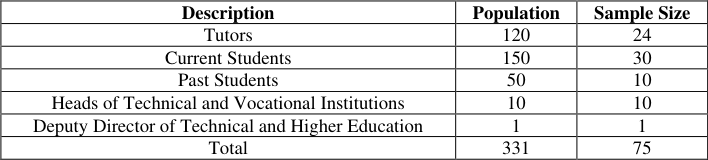 Table 1
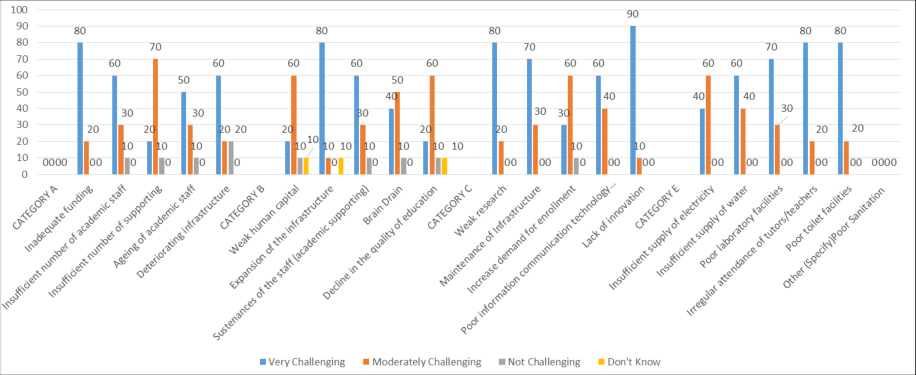 Figure 1
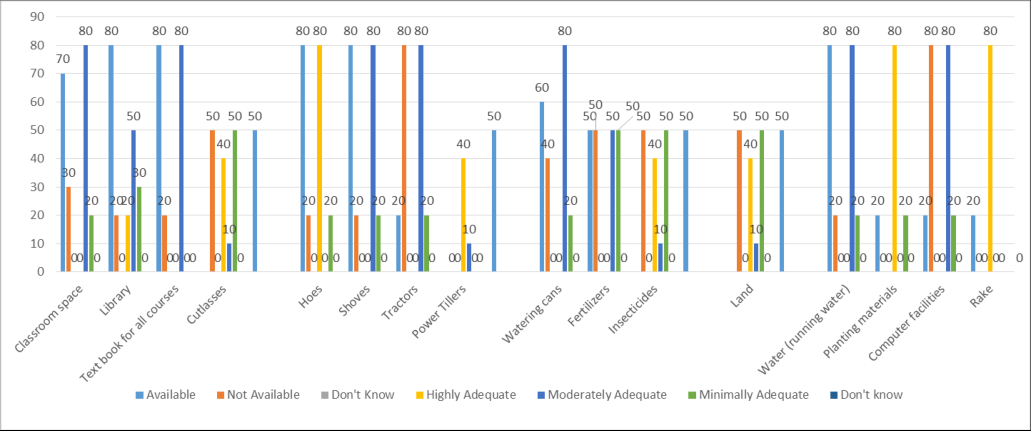 Figure 2
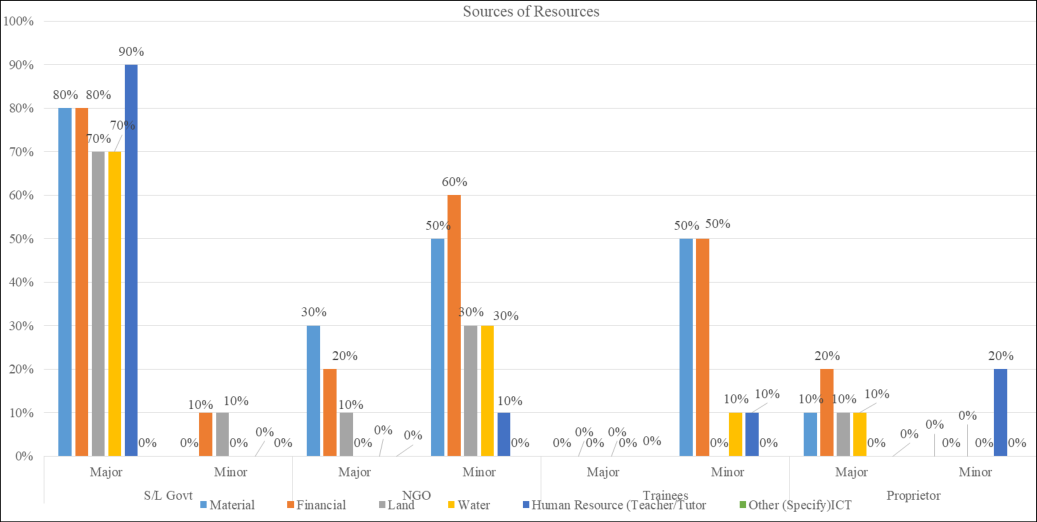 Figure 2
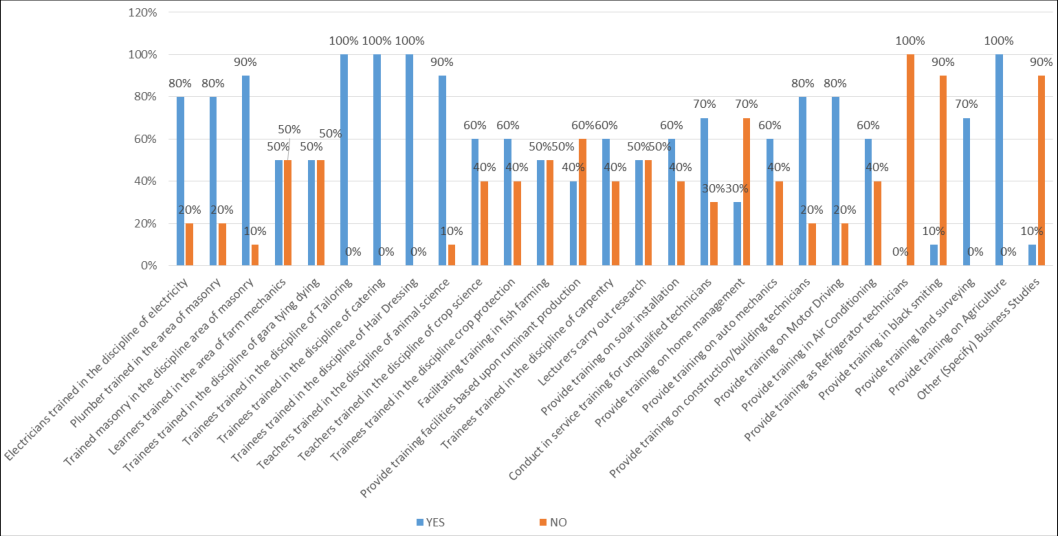 Figure 3
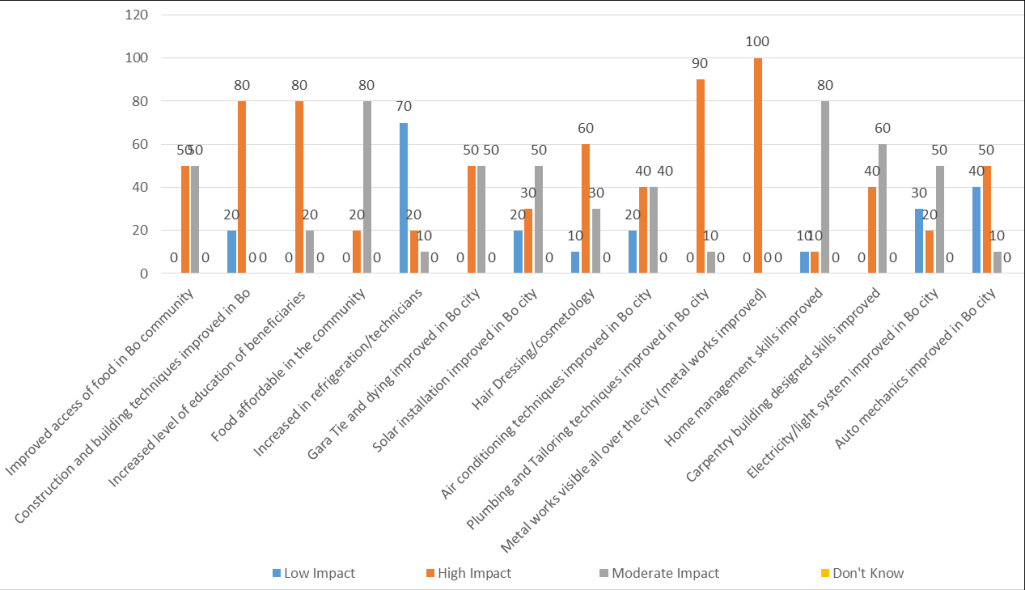 Figure 5
Introduction
Technical-Vocational Education and Training (TVET) is an aspect of education that exposes the learner to the acquisition of demonstrable skills, transforming into economic benefits (Akerele, 2007) [2] . UNESCO views TVET as a broad term encompassing the study of technologies and related sciences and acquiring practical skills, attitudes, and understanding. Furthermore, it considers its knowledge related to occupations in various sectors of economic and social life. Technical Education forms the basis of any nation's economic, social, and political development. Investment in Technical Education helps to foster economic growth and enhance productivity. It also contributes to national and social development and reduces social inequality. UNESCO argues that the level of a country's education is one of the critical indicators of its level of development. Globally, education is a fundamental human right. In 1948 the Universal Declaration of Human Rights laid down Article 26, that everyone had the right to education and that education should be free, at least in the elementary and fundamental stages. Okebukola (2012) [8] stated that the challenges of TVET are numerous. They include inadequate human and material resources in terms of quality and quantity; poor funding of TVET, inadequacies in infrastructural facilities; poor quality preparation of lessons by TVET teachers; and social vices. According to McGrath, governments seek solutions to the growing youth unemployment. Moreover, the problem of www.extensionjournal.com where young people will go after primary education led to a renewed focus on the TVET sector, particularly in 2010, when UNESCO announced that the 10th Edition of the Global Monitoring Report would be on skills development.
McGrath posits that the TVET sector is an issue that 'is currently neglected by academics notwithstanding its significance to millions of people and its fruitfulness for broader theoretical work on the links between education and development in Africa.' Historically, the foundation of TVET is on the process of industrialization and economic development; its policies are often the informed economic and equity perspectives. However, McGrath argues that this approach to TVET is grounded in an outdated development model. Psacharopoulos postulate that conceptualising TVET in terms of human capital theory means that colleges have to focus on skills development for employability, which may be confusing. However, acquiring some form of training may not necessarily guarantee a job, although it increases the chances. The belief in investing in human capital has been widespread in South Africa. Furthermore, the TVET sector fills this gap through skills development. However, Vally and Motala (2014) [11] postulate that if human capital theory continues to frame the TVET sector, it will see the sector as pivotal in solving a not primarily educational problem'. Instead, the emphasis is the role of TVET in 'deepening knowledge, developing capabilities (including hard and soft skills required to work) and strengthening (occupational and wider social) identities that enable learners to become both workers and citizens'. Vally and Motala (2014) [11] argued that education and training should instil in society the importance of knowledge essential to the development of a citizenry. For the fullest expression of civil rights and responsibilities, such elementary rights as numeracy and literacy, accessing public goods, making informed choices, and, most importantly, ensuring more significant levels of democratic accountability of public representatives and organisations. The Human Resources Development Council of South Africa (HRDC) argues that the human development approach acknowledges the new challenges that the global economy and TVET face: skills shortage; differences between the rich and the poor; and marginalization based on social class, reality, gender, and ethnicity. After independence, previous governments of Sierra Leone had periodically reformed the education and training system in the country. These governments emphasize Technical and Vocational Education and Training to make our educational system more relevant for the world of work, boost the informal economy, and minimize unemployment and poverty. Both private individuals and Non-governmental Organisations (NGOs) have also been playing complementary roles in helping to provide skills training to the Sierra Leonean citizenry, especially those in the informal sector (Agbenyo, 2010) [1] . Nevertheless, the implementation of the TVET curriculum has not been yielding the expected outcome and results. TVET have not, as enshrined in the National Policy on Education (NPE), met its aim and objectives. However, this explains why the labour market's persistent petition that Sierra Leonean university graduates (TVET graduate inclusive) do not possess employable skills due to implementing the educational curriculum. Thus, this work intends to examine critically the challenges facing the Technical and Vocational Education (TVET) curriculum in institutions in Bo city and the way forward. This study would provide valuable insights to the government, heads of technical and Vocational Institutions, development partners, and the communities on the effects and challenges likely to be encountered during the implementation of the Technical and Vocational Education initiatives. The study's findings could provide the Ministry of Technical and Higher Education data on how technical and vocational education heads implement the Scheme. In turn, the Ministry of Education may analyse these strategies to take adequate measures regarding the implementation of Technical and Vocational Education in Sierra Leone.
Purpose and objectives of the study
Purpose and objectives of the study
Map of Sierra Leones Showing Bo District
Map of Sierra Leones Showing Bo District
Map of Bo City
Map of Bo City
Design of the Study
The study was a mixed design based on qualitative and quantitative approaches to collect primary data from the self-participant completed questionnaire and focus group discussion.
Population and Sample Size
The study targeted all the ten heads of Technical and Vocational Institutions and 120 tutors, the deputy director of technical and higher education, and 200 students from the
Questionnaire and data collection procedure
The researchers developed questionnaires guided by the study's objectives to elicit information pertinent to the investigations. The researchers designed instruments bearing in mind that they elicit precisely the type and quality of required data; that is, the researchers ensured that the questionnaires developed were valid and reliable.
Experts from the Department of Agricultural Education, Njala University, validated the questionnaire and pilottested for reliability with a selected sample of respondents in Technical and Vocational institutions in Kenema City.
Questionnaires collected data from the study population sample. The researchers administered the questionnaires alongside trained enumerators of social workers. They conducted Focus Group Discussions (FGD) among homogeneous sub-sample populations, including the principal/heads of Technical and Vocational institutions, tutors/teachers, past students, and Deputy Directors of Technical and higher education in Bo City.
Data Analysis
The quantitative data collected through the questionnaires were analysed using Microsoft Excel and the Statistical Package for Social Sciences (SPSS) version 20. The researchers presented data using Bar charts and other pictograms.
Results and Discussions Challenges/problems of technical vocational institutions in the implementation of technical vocational Programmes in Bo City
Figure I illustrates the frequencies and percentages of Technical Vocational Institutions on the challenges faced by principals/heads in implementing Technical Vocational programs in their institutions. The results revealed that 80% of the respondents stated that inadequate funding was challenging, while 20% indicated moderately challenging. Also, 60% of the respondents claimed that an insufficient academic staff is very challenging. Furthermore, 80% of the respondents indicated expansion of the infrastructure as very challenging. About 60% and 40% of the respondents stated that poor information communication technology (ICT) facilities and insufficient electricity supply were very challenging, respectively, for the institutional heads. Also, 70% of the respondents indicated poor laboratory facilities as challenging, while 80% of the respondents stated irregular attendance of tutors as very challenging. Eighty per cent (80%) of the respondents indicated "Weak research" and "Poor toilet facilities" as very challenging. About 70% of the respondents stated infrastructure maintenance as very challenging, while 60% indicated that insufficient water supply is very challenging for their institutions. About 60% of the respondents claimed deteriorating infrastructure, while that same percentage stated the sustenance of academic and supporting staff as very challenging.
The study revealed that 80% and 60% of the respondents The results revealed that 80% of the principals/heads indicated that textbooks for all courses were available. Also, 80% of the respondents stated they were moderately adequate in terms of adequacy. Eighty percent of the principals claimed that library facilities were available in their institutions, while 20% indicated that library facilities were highly adequate. About 50% of the principals /heads claimed that cutlasses were available; 40% of the respondents stated that they were minimally adequate in terms of adequacy. Fifty percent (50%) of the respondents indicated ''Land and power tillers'' were available, in terms of adequacy; 40% stated they were highly adequate. About 80% of the respondents stated that running water was available in their institutions, while 20% of respondents claimed it was unavailable. Also, 60% of the heads indicated that watering cans were available in their institutions, while 40% stated they were unavailable. Also, 80% of the respondents claimed the items were moderately adequate in terms of adequacy. In contrast, 10% of the principals indicated moderately adequate. Again 50% of the respondents claimed electricity facilities in their respective institutions were available while 50% of them declared that electricity facilities were unavailable. Regarding adequacy, 50% of the respondents claimed that they were minimally adequate. About 70% of the respondents claimed that classroom space was available in terms of adequacy; about 80% indicated that they were moderately adequate. Also, 80% of the respondents stated that tractors were unavailable in their institutions, while 20% of the heads declared that they were available. Furthermore, 80% of the heads claimed computer facilities were not available in their respective institutions, while 20% of the respondents stated they were available. The researchers found that fifty percent of the principals indicated that fertilisers were available in their institutions, while the same percentage claimed they were minimally adequate. Also, 80% of the respondents stated that planting materials were unavailable in their institutions, while 20% indicated they were available. Regarding adequacy, 80% of the principals claimed that the planting materials were moderately adequate. About 50% of the respondents stated that insecticides were available. At the same time, the same percentage declared that they were not available. In terms of adequacy, 40% of the respondents indicated highly adequate. In comparison, 10% of the respondents stated moderately adequate. One of the main objectives of technical vocational institutions is to develop and produce skilled human resources for sustainable agricultural and vocational production to enhance self-reliance and national development. This objective requires many resources accessible to all technical and vocational institutions. This objective also requires the acquisition of skills by the learners through practical activities. Lack of resources or similar situational barriers will adversely affect the efficient and effective implementation of Technical Vocational programmes and make the objectives appear plausible at face value but not tenable. For instance, trainees cannot grow plants if material resources like tools and land laboratory, planting materials are unavailable. Neither would they acquire skills of tailoring, Gara tying dying, carpentry, and masons, catering if there were no material resources to enhance effective and efficient training.
Sources of resources in technical vocational institutions in Bo City
The data in Figure 2(ii) shows the responses of principals of Technical Vocational Institutional on the sources of resources available in their respective institutions. The results revealed that 90% of the respondents indicated that the Sierra Leone government was the primary source of human resources in Technical Vocational Institutions. www.extensionjournal.com About 80% of the respondents further revealed that the government was also the primary source of these institutions' material and financial resources. Also, 70% of the respondents claimed that Sierra Leone Government was the primary source of water and land for the technical and vocational institutions. Furthermore, 60% and 50% of the respondents indicated that Non-Government Organization (NGOs) was the minor source of finance and material resources for these institutions. About 50% of the respondents stated that trainees were the minor sources of finance and material resources for the institutions. Figure 2(ii) depicts that 90% of the principals/ heads of Technical Vocational Institutions indicated that Sierra Leone Government was the primary source of human resources in vocational institutions. At the same time, the results further revealed that 80% of the heads claimed that Sierra Leone Government was the primary source of material and financial resources in those institutions. It implies that the Government of Sierra Leone is the main employer of all personnel in these institutions. These findings confirm the fact that salaries and wages of personnel were paid by the employer, the Government of Sierra Leone. With the sagging economy, the government of Sierra Leone alone cannot afford the huge compensation packages for all the staff. This means that salaries and wages of workers are low with poor conditions of service. Under poor conditions of services, the performances of administrators and the teaching staff are generally affected. Therefore, the effectiveness of teaching and learning in these institutions is poor, leading to the production of weak graduates.
Role of technical and vocational institutions in the implementation of technical vocational programmes in Bo City.
Figure 3 below reveals the responses of principals in relations to the roles of Technical and Vocational Programmes in Bo City. Eighty percent (80%) of the respondents claimed that students were trained in the discipline of electricity. That same percentage indicated that students were trained in the area of plumbing. About 90% of the respondents stated that students were trained in the discipline of Masonry while 50% of the principals claimed that students were trained in the disciplines of Farm Mechanics and Gara tie Dying. Hundred percentage (100%) of the respondents declared that students were trained in the disciplines of tailoring, catering and hairdressing. Also, 90% of the respondents stated that students were trained in the discipline of animal science, while 60% claimed that students were trained in the disciplines of crop science and crop protection. Fifty percent (50%) of the respondents indicated that the institutions facilitated training in fish farming while 50% refuted the statement. Furthermore, 60% of the respondents claimed that the students were trained in the area of Carpentry while 40% of the respondents stated that the students were not offering carpentry in their institutions. About 50% of the respondents indicated that the lecturers in the institutions "carried out research" while 50% of the respondents refuted the statement. Also, 60% of the respondents claimed that the students were trained in solar installation while 40% of the respondents stated students were not trained in solar installation. About, 70% of the respondents declared that students were trained in Air Conditioning. Eighty percent (80%) of the principals claimed that students were trained in the disciplines of building construction and motor driving. Also 70% of the respondents stated that students were trained in the area of land surveying while 100% of the respondents indicated that student were trained in the discipline of Agriculture. Furthermore, 70% of the principals claimed that their institutions were not offering home management while 30% of the principals stated they were offering home www.extensionjournal.com management. Hundred percent (100%) of the principals indicated that their institutions did not provide training for refrigerator technicians. Also, 90% of the principals stated that their institutions did not provide training in Black Smiting and Business Studies. Hundred percent (100%) of the heads of Technical Vocational Institutions in Bo City stated that they provided training in the disciplines of Gara tie-dying, Tailoring, Catering, and Hairdressing. This study is in line with the study conducted by Valley and Motta (2014) [11] . The authors opined that education and training should instil in society the importance of knowledge essential for the development of a citizenry and to ensure greater levels of democratic accountability of public representatives and organisations. The study's findings are also similar to the finding of stated that skills training is essential to the functioning of our society. The author draws attention to society's principal business conducted through specially trained professionals. These include designing and constructing buildings, growing crops and rearing animals, training electricians, plumbers, caterers, tailors, and carpenters, and providing quality education for our children. These pieces of training can help our learners to be selfreliant.
Impact of technical vocational programmer offered in technical and vocational institutions on Bo City
Figure 5 illustrates the responses of past students of Technical Vocational Institutions on the impact of Technical Vocational Programmes on Bo City. The researcher found that 90% of the respondents claimed that trainees' skills and knowledge developed in masonry had a high impact, while 10% stated low impact. Also, 70% of the past students indicated that the trainee's skills and knowledge in farm mechanics have a high impact, while 30% stated moderate impact. All (100%) of the respondents stated high impact on development trainees skills and knowledge in Agriculture. About 80% of the respondents claimed high impact of an increased level of education of beneficiaries, while 20% declared moderate impact. Furthermore, 80% of the respondents claimed high impact on construction and building techniques improvement, while 20% stated low impact. The statistics showed that 50% of the respondents indicated a high impact on improving Gara tie and dying in Bo City, while 50% claimed moderate impact. About 60% of the respondents stated high impact on hairdressing/cosmetology, while 30% claimed moderate impact. Also, 90% of the respondents stated a high impact on plumbing and tailoring techniques, while 10% indicated moderate impact. A hundred percent (100%) of the respondents stated high impact on metal works as metal works were visible all over the city of Bo. Also, 80% of the respondents claimed moderate impact on improvement in home management skills, 10% stated high impact, and 10% claimed low impact. The researcher also found that 60% of the respondents stated moderate impact on carpentry and building design skills, while 40% claimed high impact. Also, 50% of the past students stated that there is a moderate impact on improving the electricity and light system in Bo City, while 30% claimed low impact. Regarding auto mechanics, 50% of the respondents claimed high impact while 40% declared low impact. About 90% of the past students claimed a very high impact on improvement in plumbing, tailoring, Agriculture, Gara Tie-dying, and Masonry in the city.
Conclusions and Recommendations Conclusions
Conclusively, technical-vocational institutions in Bo city provided training in diverse disciplines; including, Tailoring, Catering, Hairdressing, Agriculture, Masonry, Animal Science, Motor driving, Gara-tie-dying, and Farm Mechanics. These trainings were relevant and practical oriented. The Sierra Leone Government is the primary provider of resources for running technical-vocational institutions in Bo city. Also non-governmental organizations (NGOs) and other humanitarian organizations were the provider of financial and material resources in most of the technical vocational institutions in Bo City. But the technical and vocational institutions were managed without adequate funds from government. Administrative, academic, supporting staff and farm assistants were available in all the technical and vocational institutions in Bo city but were moderately adequate. Resources, including planting materials, fertilisers, insecticides, farm tools, textbooks, cutlasses, teaching and learning facilities, were available but inadequate. These challenges harmed both the students and institutions as poorly motivated staff could not perform at their best thus, producing graduates with lower academic quality.
Recommendations
Based on the findings, the researcher made the following recommendations and conclusions of the study. be re-structured to accommodate practical courses as skills training is the bedrock of the programs offered. 9. Students and lecturers should be encouraged to research technical and vocational institutions in Bo City. The lectures should be provided with funds to conduct research, leading to professional growth and development for the tutors. 10. Government should establish construction firms for graduates of Technical Vocational Institutions in Bo city to practice the vocational skills. This practice will have a positive impact on the community.
Figures and tables from the paper
| Description | Population | Sample Size |
|---|---|---|
| Tutors | 120 | 24 |
| Current Students | 150 | 30 |
| Past Students | 50 | 10 |
| Heads of Technical and Vocational Institutions | 10 | 10 |
| Deputy Director of Technical and Higher Education | 1 | 1 |
| Total | 331 | 75 |
Table text extracted from the original PDF; superscript letters are shown inline. The original table image is below.
View original table image
References
3 in the original paper- Ayonmike CS. Technical and vocational education status in rural institutions in Delta state Nigeria. Makerere Journal of Higher Education. 2013;5(1):8190.
- McGrath S. Where to now for vocational education and training in Africa? International Journal of Training Research. 2011;9(1-2):35-48.
- Okebukola FO. The view of Nigerian teachers in public and private primary schools on early literacy teaching. United Kingdom Literacy Association. 2012;46(2):94100.
Cited by 4
From OpenAlex, OpenCitations and reference lists read by Scinovex
- Exploring entrepreneurship and business start-up ecosystem: A case study of Chama district ↗
Rodwell Soka Msimuko, Serah K Mbetwa · International Journal of Humanities and Education Research · 2025
This study, explores entrepreneurship and business startup ecosystem, undertaking a comprehensive investigation into the complex network of dynamics that define entrepreneurship and the startup environment. At its core, the endeavor seeks to unknot the complexity of this ecosystem by accurately dissecting its components, understanding their interactions, and evaluating their impacts. The research finds that 60% of entrepreneurs in Chama are
- A new playbook for SDG alignment: Strategic frameworks for social startups operating in resource-constrained regions ↗
Zeel Mangukiya, Tulsi Mangukiya · International Journal of Sociology and Humanities · 2025
This paper proposes a novel strategic framework to help social startups in resource-constrained regions effectively align their missions with the United Nations Sustainable Development Goals (SDGs). Recognizing that traditional business models often fail to address local complexities, the study emphasizes context-sensitive approaches, stakeholder engagement, and adaptable scaling strategies. By analyzing case studies and synthesizing best practices, the framework offers actionable
- Emotional intelligence and leadership effectiveness in private universities in East Africa: Evidence from Somalia and neighbouring countries ↗
Mohamud Mohamed Alasso, Abdikarim Mohaidin Ahmed, Amina Omar Mohamud · International Journal of Advanced Academic Studies · 2025
This study investigated the relationship between emotional intelligence (EI) and leadership effectiveness among leaders of private universities in East Africa, specifically focusing on Somalia, Kenya, Ethiopia and Uganda. This qualitative research studied how EI competences, such as self-awareness, self-regulation, motivation, empathy and social skills, influence behaviours of leaders and results of institutions. Data were collected using a qualitative research method,
- Women entrepreneurship ecosystem: Role of management practices ↗
Shivshakti Nanda, Shinde Suvarna R · International Journal of Applied Research · 2025
Women entrepreneurship has emerged as a vital catalyst for economic growth and social development globally. However, gender-based disparities, structural constraints, and ecosystem gaps hinder the effective participation and success of women entrepreneurs. This paper analyzes the role of management practices within the women entrepreneurship ecosystem using secondary data and literature synthesis. The research aims to highlight key challenges, successful management