
Research article · 2023 · Full text
International Journal of Agriculture Extension and Social DevelopmentGender utilization of information communication technology (ICTs) among agriculture extension workers for community development in Edo state, Nigeria
Volume 6(1) · Pages 10–14 · DOI: 10.33545/26180723.2023.v6.i1a.163 ↗
Research areasICT Impact and Policies
Abstract
Author-writtenThe study assessed gender utilization of among agriculture extension workers in Edo State, Nigeria and specifically, described the socio-economic characteristics of respondents, determined level of gender use of ICTs, and ascertain gender difference in the use of ICTs were ascertained. Data were collected with use of structured questionnaire administered to hundred and twenty-five (125) simple randomly selected agriculture extension workers. Means, percentages and t-statistic statistics were used for data analysis. Results showed that 77.6% of the sampled respondents were males 22.4% females while 85.0% males and 50.0% females were married. All (males 97 and females 28) agriculture extension workers had higher educational degrees and job experience of 5 to 9 years (males 56.7%; females 53.6%) respectively. There is low (20%) use of ICTs by agriculture extension workers. The result of t-statistic showed that significant gender difference existed in the agriculture extension workers use of ICTs (t=3.27, p<0.01). It is recommended that in-service training on ICTs importance and use for agriculture extension works should be organize for agriculture extension workers. Also, official vehicles should be provided for agriculture extension workers for official purpose.
Summary
Source-checkedPlain-language reading of the full paper, prepared with AI and checked against the text. Each point links to the authors' own words.
Why it matters
- Agricultural extension services are critical for human food security and the overall development of rural areas. View evidence ↗
- The appropriate use of Information Communication Technologies (ICTs) is necessary to transform extension services and support comprehensive rural development. View evidence ↗
- Despite government efforts to increase accessibility, the use of ICTs in Nigerian extension service delivery is reported to be low or limited. View evidence ↗
The question
- The study aimed to assess how agriculture extension workers in Edo State, Nigeria, utilize ICTs, specifically looking at differences based on gender. View evidence ↗
What they did
- The researchers used simple random sampling to select 125 agriculture extension workers (97 males and 28 females) from NIFOR, CRIN, and Edo ADP. View evidence ↗
- Primary data was collected from the participants using a structured questionnaire. View evidence ↗
- Data analysis was performed using frequency counts, percentages, means, and t-statistics. View evidence ↗
What they found
- The sample consisted of 77.6% males and 22.4% females. View evidence ↗
- The overall use of ICTs among the agriculture extension workers was found to be low at 20%. View evidence ↗
- Among male workers, only GSM and telephones were highly used, both with a mean score of 2.88. View evidence ↗
- Access to official vehicles was very low for both genders, with only 2.1% of males and 3.6% of females having access. View evidence ↗
What it means
- The authors concluded that ICT use among extension workers in the study area is low, which may hinder rural development prospects. View evidence ↗
Visual summary
2 visualsIllustrations explain the paper; charts are replotted from the paper's own table values.
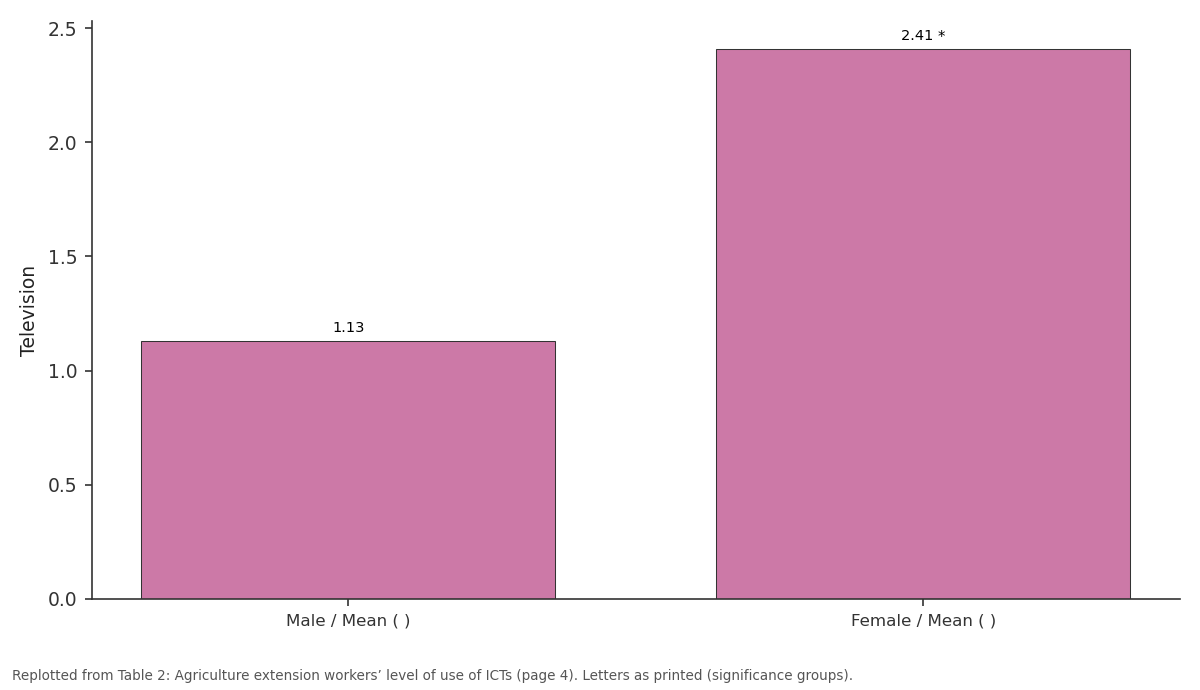
Television: Male / Mean ( ) vs Female / Mean ( )
Replotted from Table 2 (page 4) of the original paper. Every bar is the paper's own table value.
View source evidence ↗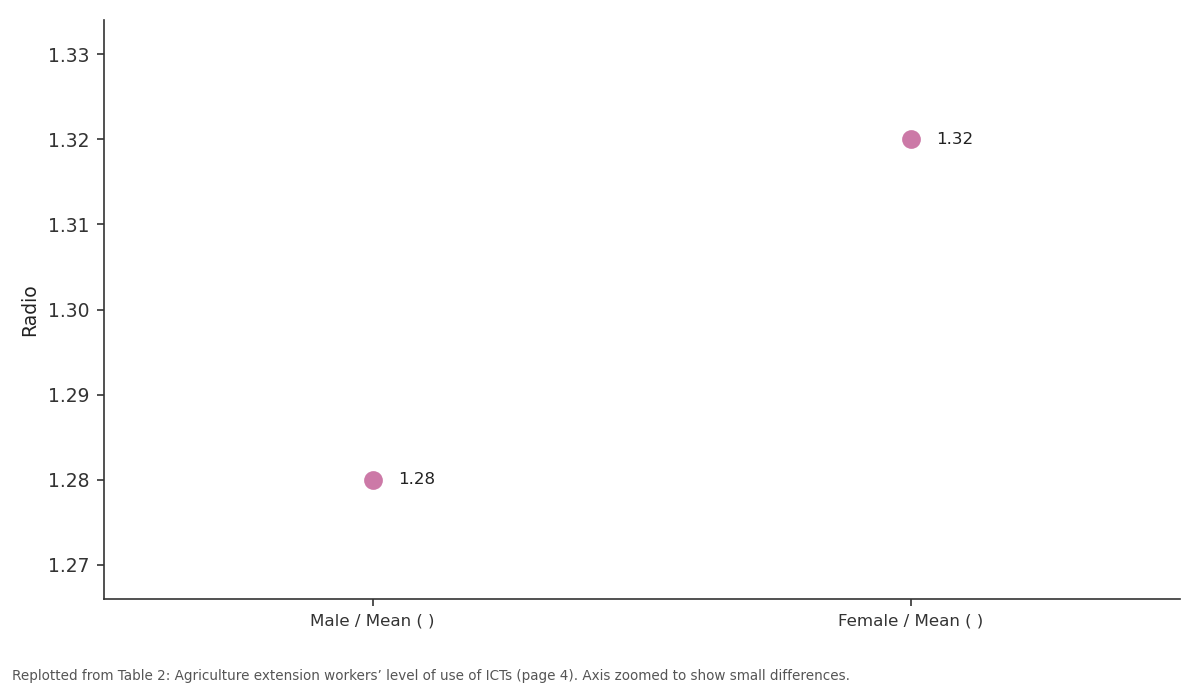
Radio: Male / Mean ( ) vs Female / Mean ( )
Replotted from Table 2 (page 4) of the original paper. Every bar is the paper's own table value.
View source evidence ↗Figures & tables
From the original paper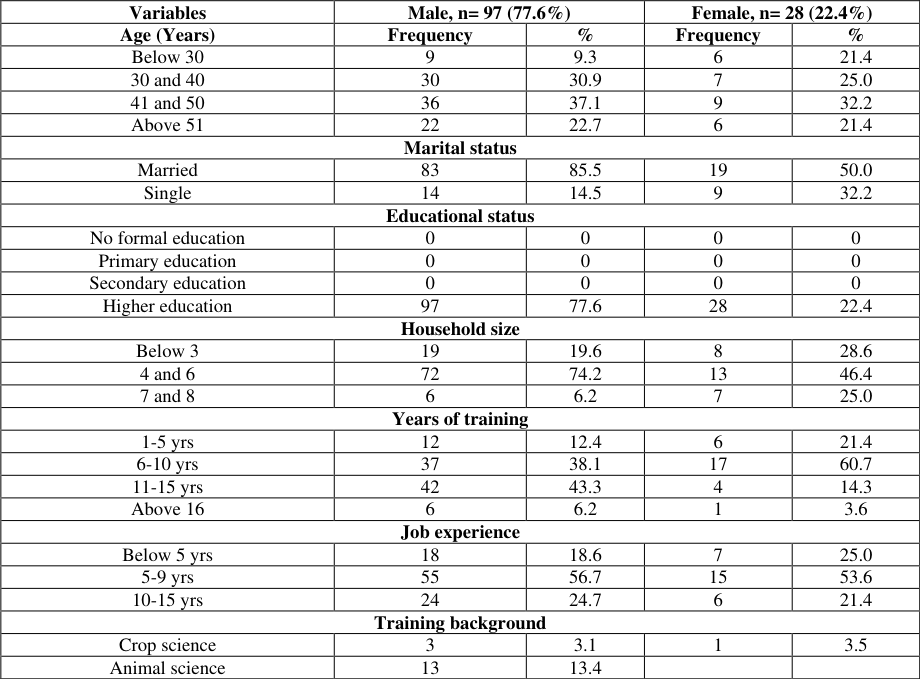 Table 1
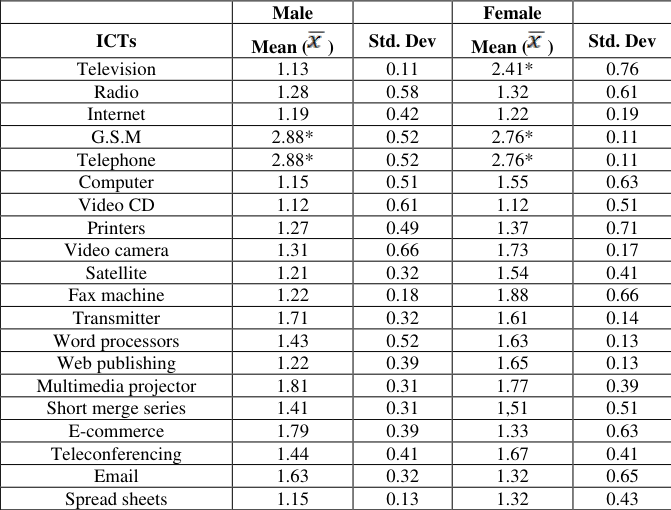 Table 2
 Table 3
Introduction
Agriculture is the main source of food for mankind; rural small-scale farmers that use crude farm implements are main producers of agricultural crops in sub-Saharan Africa. Extension services/or works are critical to human food security and progress which probably explain why it is at the hub of all human fields of study. World present population grows from 6.7 to 9.1 billion by 2050 and food production will need to double over same period. Agricultural extension is an important public service with widest range of responsibilities for agricultural and rural development (Adeyanju and Akinwumi, 2015) [1] . Therefore, availability of proven agricultural information and rural development cannot be undermined. Agricultural information creates awareness among community farmers about relevant modern agricultural technologies for adoption which is needed for overall development of agriculture and for improvement of living standard of farmers (Bello and Obinne, 2012) [4] . Thus, more effective and efficient extension services are needed to tackle agricultural challenges among small scale farmers in developing countries. There is need for adequate and appropriate use of ICTs to transform agricultural extension to enable it help in the all-round rural development. Use of ICTs in agriculture is increasing globally. ICTs such as mobile communication, electronic mail (email), facsimile, Internet and others are extensively used for information dissemination in agriculture in developed countries (Lio and Liu, 2006) [11] . It had been asserted that the advent of ICTs like personal computers, the internet and mobile telephone during the last two decades have provided much wider choice in collection, storage, processing, transmission and presentation of information in multiple formats to meet the diverse requirement and skills of people (Kwadwo et al., 2012) [9] . Gender could be social attributes, opportunities, the relationships between male and females. According to World Bank (2011) [16] it is the socio-cultural differences or ascribed roles between men and women in a given society. Gender is an important factor for socio-cultural analysis including class, race, poverty level, ethnic group and age.
Problem Statement
The use of ICTs by agriculture extension workers, community developers is significant especially now that ICT use has witness upsurge in all areas of life in many Africa countries where it has provided media for adequate access to agricultural information despite the persisting problems of access, connectivity, literacy, content and costs (CTA, 2003) [5] . Since agriculture extension works are based on the dissemination of proven information emanating from different sources to the end users, it becomes very necessary to tap from numerous benefits ICT provides to boost rural agriculture and community development efforts through www.extensionjournal.com effective dissemination of up-to-date information. Arokoyo (2005) [2] reported that radio and television have been major ICTs use in agricultural extension delivery in Nigeria. Despite the important roles information and communication technology (ICT) is playing in extension service delivery and efforts of government towards making ICTs accessible to all Nigeria citizens, ICT use is said to be low or very limited due to several factors (Katengeza et al., 2011) [8] . So, this study assessed the use of ICT by gender among agriculture extension workers in Edo state, Nigeria.
The study objectives are to: 1. Examine the socioeconomic characteristics of extension workers, 2. Ascertain level of gender utilization of ICTs, and 3. Ascertain if there is significant gender difference in agricultural extension workers use of ICT in Edo State.
ICT is important in the total development of nations, and it helps to promote agricultural production (Mugo and Vermeulen, 2011) [12] . Information is viewed as power and an important working tool for advancement of human and society (Apata and Ogunrewo (2010) [14] . To Lal (2007) [10] , major factors inhibiting ICT diffusion and intensive utilization is poor physical infrastructure represented by inadequate and interrupted electricity supply and communication connectivity infrastructure. Also, Zainab et al. (2008) [17] identified problems associated with ICT use as frequent power failure and lack of alternative power supply, lack of basic knowledge of ICT utilization, system difficulties operation, inadequate finance for procurement and maintenance of ICT facilities (components), and lack of adequately trained staff to handle ICT facilities.
Methodology
Methodology
Population of the Study
The population of this study was male and female agriculture extension workers in Edo State, Nigeria.
Sampling Procedure and sample size
A simple random sampling method was used to select 97 male and 28 female agriculture extension workers from the list of extension staffs of NIFOR, CRIN and Edo ADP. These added together gave a total of 125 respondents.
Instrument for Data Collection
Data was collected from both primary and secondary sources. A structured questionnaire was used to obtain primary data from the extension workers.
Data analysis
The collected data were analysed using descriptive and inferential statistics such as frequency count, percentage, mean and t-statistic.
Results and Discussions Socio-economic characteristics of respondents
Table 1 shows that 30.9% male and 25.0% female agriculture extension workers in the study area were between age bracket of 30 and 40 years while 22.7% of males and 21.6% of females were found to be above 51 years of age respectively. The finding shows that male agriculture extension workers are slightly older than their female counterparts. Both the male and female agriculture extension workers were still within their farm labour active and productive ages. The finding implies that male and female agriculture extension workers may adopt and use Information and Communication Technology (ICT) tools to disseminate useful information as modern ICTs is adjudged effective and efficient in information dissemination; and information is pinpointed as useful and the hallmark of extension activities (Oladele, 2015) [15] . The use of ICT has been confirmed to positively and significantly correlate with age (Arokoyo, 2010) [3] . Table 1 shows that 85.5% of male and 50.0% of female agriculture extension workers were married but 32.2% of females were slightly higher (14.5%) than single males. Being married is a call for responsibility which should promote and enhance one's seriousness at work. But in situation in which there is large family to cater for, it would have negative effects on staff use of ICTs for official purpose/duties as much time would be devoted to caring for family members. More so, two are better than one concept may assist extension workers in acquiring knowledge of the use of ICTs as spouse may assist in teaching each other the use of some of the ICTs that are for extension works. Furthermore, all (97) male and (28) female agriculture extension workers had higher educational degrees. This shows that all extension workers read beyond first degree level in their education pursuits. This high educational attainment/exposure of agricultural extension workers is useful in promoting the use of ICTs in the development of rural community agriculture and other rural sectors. 19.6% of male and 28.6% of female agriculture extension workers had less than 3 persons eating from same pot under the same roof while 74.2% of male and 46.4% of female agriculture extension workers had 4 and 6 persons respectively. Small household is likely to promote use of ICTs as much time will be available for user of ICT.
| Variables | Male, n= 97 (77.6%) | — | Female, n= 28 (22.4%) | — |
|---|---|---|---|---|
| Age (Years) | Frequency | % | Frequency | % |
| Below 30 | 9 | 9.3 | 6 | 21.4 |
| 30 and 40 | 30 | 30.9 | 7 | 25.0 |
| 41 and 50 | 36 | 37.1 | 9 | 32.2 |
| Above 51 | 22 | 22.7 | 6 | 21.4 |
| Marital status | ||||
| Married | 83 | 85.5 | 19 | 50.0 |
| Single | 14 | 14.5 | 9 | 32.2 |
| Educational status | ||||
| No formal education | 0 | 0 | 0 | 0 |
| Primary education | 0 | 0 | 0 | 0 |
| Secondary education | 0 | 0 | 0 | 0 |
| Higher education | 97 | 77.6 | 28 | 22.4 |
| Household size | ||||
| Below 3 | 19 | 19.6 | 8 | 28.6 |
| 4 and 6 | 72 | 74.2 | 13 | 46.4 |
| 7 and 8 | 6 | 6.2 | 7 | 25.0 |
| Years of training | ||||
| 1-5 yrs | 12 | 12.4 | 6 | 21.4 |
| 6-10 yrs | 37 | 38.1 | 17 | 60.7 |
| 11-15 yrs | 42 | 43.3 | 4 | 14.3 |
| Above 16 | 6 | 6.2 | 1 | 3.6 |
| Job experience | ||||
| Below 5 yrs | 18 | 18.6 | 7 | 25.0 |
| 5-9 yrs | 55 | 56.7 | 15 | 53.6 |
| 10-15 yrs | 24 | 24.7 | 6 | 21.4 |
| Training background | ||||
| Crop science | 3 | 3.1 | 1 | 3.5 |
| Animal science | 13 | 13.4 |
Table text extracted from the original PDF; superscript letters are shown inline. The original table image is below.
View original table image
On the year of training, results show that about 43.3% of male and only 14.3% of female extension workers had www.extensionjournal.com between 11 and 15 years of training while 38.1% of males and 60.7% of females had between 6 and 10 years of training. This shows that both male and female respondents had relatively high number of years of training, but male extension workers recorded higher training years. This is probability due the fact that male extension workers have had more (5 to 15 years, 81.4%) experience in the use of ICTs in carrying out extension works delivery than females (below 5 to 9 years, 78.6%). On experience on the job, results indicate that about 56.7% male agricultural extension workers had 5 to 9 years of training experience and 53.6% females were in this category. 18.6% of males and 25.0% of females had less than 5 years of experience on the job. This indicates that female agriculture extension workers had higher years on the job experience than their male counterpart. It shows that most of the female agriculture extension workers may likely be at administrative level. 33.0% of male and 42.9% of female agriculture extension workers were trained in the field of agricultural extension while 36.1% of male and 53.6% of female had their training background in agricultural economics. This shows that many of the people employed as
Agricultural Extension Workers' Level of Use of ICTs
Table 2 shows the result for respondents' level of identified ICTs use for extension activities. Only GSM ( = 2.88) and telephone ( = 2.88) were the ICTs that were highly used among male agriculture extension workers, while female category, television ( = 2.41), GSM ( = 2.76) and telephone ( = 2.76) recorded high level of use. The implication of this finding is that benefits accruable from the other numerous ICTs not highly used would be denied the system thereby hindering early agriculture and rural development. Interestingly, the ICT tools used might be use by agriculture extension workers for personal activities and not official duties. For instance, use of telephone and GSM may not necessarily be for official activities as everyone uses them for calls and for sending messages on daily basis. Hence, male agriculture extension workers in the study area had high level of use of the two ICTs while females had high level use of Television ( = 2.4), GSM ( = 2.76), and telephone ( = 2.76) respectively. Generally, there is low level use of ICT tools among agriculture extension workers in study area and the result is likely to impact negatively on rural agriculture and rural community development as rural dwellers would continue in their old ways farming and developing their respective communities.
| — | Male | — | Female | — |
|---|---|---|---|---|
| ICTs | Mean ( ) | Std. Dev | Mean ( ) | Std. Dev |
| Television | 1.13 | 0.11 | 2.41* | 0.76 |
| Radio | 1.28 | 0.58 | 1.32 | 0.61 |
| Internet | 1.19 | 0.42 | 1.22 | 0.19 |
| G.S.M | 2.88* | 0.52 | 2.76* | 0.11 |
| Telephone | 2.88* | 0.52 | 2.76* | 0.11 |
| Computer | 1.15 | 0.51 | 1.55 | 0.63 |
| Video CD | 1.12 | 0.61 | 1.12 | 0.51 |
| Printers | 1.27 | 0.49 | 1.37 | 0.71 |
| Video camera | 1.31 | 0.66 | 1.73 | 0.17 |
| Satellite | 1.21 | 0.32 | 1.54 | 0.41 |
| Fax machine | 1.22 | 0.18 | 1.88 | 0.66 |
| Transmitter | 1.71 | 0.32 | 1.61 | 0.14 |
| Word processors | 1.43 | 0.52 | 1.63 | 0.13 |
| Web publishing | 1.22 | 0.39 | 1.65 | 0.13 |
| Multimedia projector | 1.81 | 0.31 | 1.77 | 0.39 |
| Short merge series | 1.41 | 0.31 | 1,51 | 0.51 |
| E-commerce | 1.79 | 0.39 | 1.33 | 0.63 |
| Teleconferencing | 1.44 | 0.41 | 1.67 | 0.41 |
| 1.63 | 0.32 | 1.32 | 0.65 | |
| Spread sheets | 1.15 | 0.13 | 1.32 | 0.43 |
Table text extracted from the original PDF; superscript letters are shown inline. The original table image is below.
View original table image
Gender Difference in the Use of ICT between Male and Female respondents
Results in Table 3 show that significant difference exists in the gender use of ICTs between male ( = 22.17) and female ( = 9.74) agricultural extension workers with a tvalue of 3.27 at 0.01 significant level. This means gender difference exists in use of ICTs for agriculture extension works. Looking at the results, it simply that males used ICTs more than their females' counterparts with high mean values of 22.17 as against 9.74 for females. The reason for this may not be farfetched as males may be more involved in extension field works than their female counterparts due to social, cultural and gender issues that may restrict females to office administration office works in their respective agricultural institutions.
| — | Mean ( | Std. Err | Mean Diff | t-test | Sig | Decision |
|---|---|---|---|---|---|---|
| Male | 22.17 | 2.28 | 12.63 | 3.27 | 0.01 | S (significant) |
| Female | 9.74 | 0.16 |
Table text extracted from the original PDF; superscript letters are shown inline. The original table image is below.
View original table image
Conclusion and Recommendations
From the results of this study, gender extension workers use of ICTs was low in the study area despite the undeniable immense benefits accruable from use of ICTs globally. It was observed that respondents are within labour active age which potent prospects for agriculture extension services delivery and rural development but their low use of ICTs especially by female extension workers and the gender difference in ICTS use may likely hinder the prospects. Based on the findings, the following recommendations were made: 1. In-service training on ICTs use/benefits should be organize for all categories of agriculture extension workers paying much attention on younger staffs. 2. Relevant bodies/agencies should provide modern miss of mobility for agriculture extension service delivery.
References
13 in the original paper- Adeyanju AA, Akinwumi DM. Utilization of Extension Information among Pig Farmers in Oke-aro Farm Settlement in Ogun State of Nigeria. American Journal of Humanities and Social Sciences. 2015:3(1):1-6.
- Arokoyo T. Information and Communication Technology in the Transformation of Agricultural Extension: The case of Nigeria; c2010. Available On www.fao.ord. Accessed 20-12-2019
- Bello M, Obinne CPO. Problems and Prospects of Agricultural Information Sources Utilization by Small Scale Farmers: A Case from Nasarawa State of Nigeria. Journal of Communication. 2012;3(2):91-98.
- CTA. ICTs -Transforming Agricultural Extension an e-discussion, 20 th August -29 th September. 2003;17. FAO; c1993.
- Food and Agricultural Organization, FAO (2010). How to Feed the World in 2050; Rome, Italy; c2009. Available Online: http://www.fao.org/fileadmin/templates/wsfs/docs/expe rt_paper/How_to_Feed_the_World_in_2050.pdf (accessed on 20 January 2019).
- Javeed I, Narayan S, Malik AA, Kumar A, Rahman R, Nisar S, et al. Role of Information and Communication Technology in Agriculture. International Journal of Current Microbiology and Applied Sciences. 2020;11:2028-2037.
- Katengeza SP, Okello JJ, Jambo NN. Use of Mobile Phone Technology in Agricultural Marketing: The Case of Smallholder Farmers in Malawi. International Journal of ICT Research and Development in Africa (IJICTRDA). 2011;2(2):14-25.
- Kwadwo DF, Amankwah DF. An Analysis and Assessment of Customer Satisfaction with Service Quality in Insurance Industry in Ghana, c2012. Access On 18 th July 2022 from: https://www.divaportal.org/smash/record.jsf?pid=diva2%3A1031412&ds wid=9875
- Lio M, Liu MC. ICT and agricultural productivity: evidence from cross-country data. Agricultural Economics. 2006;34(3):221-228.
- Mugo A, Vermeulen M. The many possibilities of ICTs in African Agriculture. Farming Matters. 2011;27(1):18-20 http://www.agriculturesnetwork.org/magazines/global/y outh-and-farming. c2012. Accessed in July 2022.
- Ogunrewo JO, Odusina EK. An appraisal of Internet usage among academic staff members of Joseph Ayo Babalola University, Ikeji Arakeji, Osun state, Nigeria. Ozean Journal of Applied Sciences. 2010;3(4):379-385.
- Oladele OI. Effect of Information and Communication Technology (ICT) on Agricultural Information Access among Extension Officers in North West Province, South Africa. South African Journal of Agricultural Extension. 2015;43(2):12-18.
- Abdullah A, Zainab AN. The digital library as an enterprise: The Zachman approach. The Electronic Library. 2008;26(4):446-67.
Cited by 13
From OpenAlex, OpenCitations and reference lists read by Scinovex
- A critical appraisal of mammography utilization in Nigeria: Challenges and prospects ↗
Thomas Anthony Awolowo, Olujobi Babatunde A, Gbala Michael Olumide, Abayomi Olawale Ayobami, Fawole Tolulope Samuel, Adebisi Mathew Olumide et al. · International Journal of Radiology and Diagnostic Imaging · 2025
Background: Mammography is a critical tool for the early detection of breast cancer, reducing morbidity and mortality rates.However, in Nigeria, its utilization remains limited due to infrastructural deficits, financial barriers, and sociocultural factors.Addressing these challenges is vital to improving women's health outcomes and aligning with global standards for cancer control.Objective: To critically appraise mammography utilization in Nigeria, focusing on challenges,
- The roles of AI in the prevention of unplanned pregnancy among adolescents: A critical review of the Nigerian situation ↗
Michael Olumide Gbala, Tiamiyu Oladele Salau, Adebayo Augustine Adeniyi, Catherine Iyabo Akinsipe, Gbenga Damilola Akinlua, Mathew Olumide Adebisi et al. · International Journal of Clinical Obstetrics and Gynaecology · 2024
Unplanned pregnancies among adolescents in Nigeria present a significant public health challenge, with far-reaching consequences for health, education, and socioeconomic development. These pregnancies are driven by a complex interplay of factors, including limited access to comprehensive sexual education, inadequate healthcare infrastructure, cultural stigmas, and socioeconomic disparities. Addressing this issue requires innovative and scalable solutions that overcome traditional barriers. Artificial Intelligence
- Empowering small-scale agriculture: Effective strategies for technology transfer
S. K. Pradhan, Ajay Kumar Prusty, Subhankar Das, Moupiya Ghosh, Y. Chandra, Samridh Nayak · International Journal of Advanced Biochemistry Research · 2025
Technology transfer in agriculture is crucial for enhancing food security and promoting sustainable farming practices, especially for small-scale farms. This article examines strategies for effective technology transfer, focusing on bridging the gap between scientific advancements and practical application. It identifies barriers such as limited access to capital and technical knowledge, and the impact of the technology gap on productivity and livelihoods. Opportunities for improvement include training programs, infrastructure development, and financial support. Key players in agricultural tec
- ChatGPT and journalistic practices: Unpacking the Nigerian newsroom experiences ↗
Chukwudubem Chukwugozie Umeora · International Journal of Advanced Mass Communication and Journalism · 2025
The research analyzes how ChatGPT transforms traditional news production methods in Nigerian newsrooms by studying its integration into journalistic work. The research analyzes the changes in journalistic routines together with professional consequences through qualitative interviews of thirteen journalists working at different Nigerian media organizations. The Technology Acceptance Model (TAM) serves as a foundation to analyze how journalists adopt new systems
- Socioeconomic determinants of nutritional status amongst low income household in selected communities In Nsukka
Joshua Chukwuma Onwe, Abigail Chisom Onwe, Cornelius Onwe Ogayi · International Journal of Agriculture and Nutrition · 2025
This study explores the socioeconomic determinants of nutritional status among low-income households in selected communities in Nsukka, Nigeria. Using a cross-sectional survey design, data were collected from respondents and analysed through logistic regression models. The study examined the impact of household income, educational attainment, and occupational type on nutritional status, while controlling for variables such as dietary practices, age, gender, and digital access. Results revealed that household income had a significant but negative association with nutritional status, suggesting
- An assessment of public relations functions for marketing and advertisement of fisheries products in Kainji lake basin, Nigeria ↗
Abdullahi JZ, Ibeun BA, G. Au, Abubakar GR, Ifejika PI, T. Olowosegun et al. · International Journal of Fisheries and Aquatic Studies · 2025
Public relations (PR) play a critical role in strengthening communication between producers and consumers, particularly in the fisheries sector where perishability, weak branding, and limited market reach often hinder effective marketing. This study assessed PR functions-specifically social media management and market research-in the marketing and advertising of fisheries products in Kainji Lake Basin, Nigeria. A survey research design was adopted,
- Automation, artificial intelligence, and the green economy: The future of industrial work and employment in Nigeria ↗
Agbamu, OBORO · International Journal of Advanced Academic Studies · 2025
This study investigates the impact of automation and artificial intelligence (AI) on green employment in Nigerias industrial sectors between 2010 and 2024, within the context of the countrys transition toward a sustainable, low-carbon economy. Anchored on Ecological Modernization Theory, Skill-Biased Technological Change, and the Just Transition Framework, the study employs an Autoregressive Distributed Lag (ARDL) model to examine both short-
- Technology as a catalyst of change: Redefining gender roles and women’s agency in India ↗
Vijyeta Kumari · International Journal of Financial Management and Economics · 2025
Technological innovation has been the epicentre of strategy to empower women in India. Till few decades ago, Indian women have been considered as the recipient of consequences of any development. Despite the growth of education, there exists gender inequality in Indian society. In last two decades, many technologies have helped to bridge those gaps. Some of those technologies discussed in
- Accessible AI-powered tools for communication and learning: Opportunities and challenges for learners with intellectual disability ↗
Charity Oluwatoyin Olufokunbi, Khadijat Olatinuyo Olayiwola, Funmilade Faith Olapade · International Journal of Childhood and Development Disorders · 2025
The integration of artificial intelligence (AI) in education has opened unprecedented opportunities for learners with intellectual disabilities, particularly in the domains of communication and learning support. This article examines the landscape of AI-powered assistive technologies, focusing on augmentative and alternative communication (AAC) systems and adaptive learning platforms designed for individuals with intellectual disabilities. Through a comprehensive analysis of recent literature,
- Socioeconomic determinants of factors influencing social media usage among poultry farmers in delta central agricultural zone, Nigeria
Ekokogbe OO, Ebewore SO, Gbigbi T.M, Enwa S · International Journal of Agriculture and Food Science · 2025
This study explores the socio-economic determinants of social media usage among poultry farmers in the Delta Central Agricultural Zone of Nigeria. Data were collected from 240 respondents using structured questionnaires. Key variables examined include age, gender, education, farming experience, household size, and income, with a focus on their influence on the adoption of social media for poultry farming. Descriptive analysis revealed that most poultry farmers were aged 31-45 (42.5%), male (70%), and well-educated, with 75% having at least secondary education. Most had 5-10 years of farming ex
- Diversification & Expansion of MARDI Premium Plant Varieties at the State of Selangor: A Case Study ↗
I. Khairol, Nur Atifah K. · Mediterranean Journal of Basic and Applied Sciences · 2024
This research was written to ascertain the situation of Malaysian Agriculture Research And Development Institute (MARDI) plant variety diversity in Selangor. Several plant varieties, including MDUR 88 Durian, Melomas lime, Mutiara Wangi/Merah Rambutan, and MKL coffee, have been chosen for the project. This reward was announced on social media (via MARDI Selangor's Facebook page). The announcement contains a Google form.…
❝ 0PDF - Information science innovations: Challenges and opportunities for information management in libraries ↗
Supari Muslim · International Journal of Social Science and Education Research · 2024
This study used the experiences of a few US libraries to explore the difficulties of encouraging innovative thinking and creativity amongst information technology and library personnel in Nigeria. A representative consisting of 70 participants was employed in the investigation. Well-organized, created by I surveys were employed to gather information. The percentages and counts of frequencies have been employed in a
- Improving livestock production through extension: Analysing the role of institutions and information dissemination ↗
L. Andersen, M. Nielsen · International Journal of Research in Management · 2024
The role of extension services in improving livestock production is paramount for enhancing agricultural productivity and fostering rural development. This paper examines the multifaceted role of extension services in the dissemination of knowledge and the pivotal role of institutions in facilitating effective information transfer. Through a comprehensive analysis of the involvement of various stakeholders, such as government agencies, private organizations,