
Research article · 2021 · Full text
International Journal of Research in AgronomyEffect of minimum tillage on productivity and economics of sweet corn-pulses intercropping system
Volume 4(1) · Pages 115–117 · DOI: 10.33545/2618060x.2021.v4.i1a.136 ↗
Research areasCrop Yield and Soil Fertility
Abstract
Author-writtenField experiment was carried out at Department of Agronomy, Dr. Panjabrao Deshmukh Krishi Vidyapeeth, and Akola (M.S.) during kharif 2013 to study the effect of minimum tillage on productivity and economics of sweet corn - pulses intercropping system in FRBD with four replication. The main plot treatment viz., S1- Conventional tillage (one Ploughing and two harrowing), S2- Minimum tillage (one harrowing) and three sub-plot treatment of intercropping I1- Sole sweet corn, I2- Sweet corn+ Green gram (1:2ratio), I3- Sweet corn + Black gram (1:2ratio).The result revealed that conventional tillage treatment recorded higher number of cob ha-1, biological yield, harvest index, GMR (186507 ₹ ha-1), NMR (148159 ₹ ha-1), and B: C ratio (4.96) than minimum tillage and among intercropping treatments sweet corn + black gram recorded highest GMR (194698 ₹ ha-1), NMR (157467 ₹ ha-1), B: C ratio (5.23) followed by treatment sweet corn + green gram.
Summary
Source-checkedPlain-language reading of the full paper, prepared with AI and checked against the text. Each point links to the authors' own words.
Why it matters
- Maize is a critical global crop used for both human food and animal feed, playing a major role in the agricultural economy. View evidence ↗
- Sweet corn is highly popular for human consumption because it has been bred to contain higher levels of natural sugars. View evidence ↗
- Intercropping is used to improve the use of space, nutrients, and soil moisture, while reducing the risk of crop failure from pests or climate issues. View evidence ↗
The question
- The study aimed to evaluate how minimum tillage affects the productivity and economic returns of a sweet corn and pulses intercropping system. View evidence ↗
What they did
- The field experiment was conducted during the kharif season of 2013 at the Department of Agronomy, Dr. Panjabrao Deshmukh Krishi Vidyapeeth in Akola, Maharashtra. View evidence ↗
- Fertilization consisted of a recommended dose of 120 kg N, applied in three equal splits at sowing, 30 days after sowing (DAS), and 50 DAS. View evidence ↗
What they found
- Conventional tillage resulted in a significantly higher biological yield (213.03 q ha-1) compared to minimum tillage (197.46 q ha-1). View evidence ↗
- Among intercropping treatments, sole sweet corn achieved the highest biological yield (218.32 q ha-1), while the sweet corn and green gram combination had the lowest (195.33 q ha-1). View evidence ↗
- Conventional tillage provided higher gross monetary returns (186,507 per ha-1) than minimum tillage (170,496 per ha-1). View evidence ↗
- The sweet corn and black gram intercrop yielded the highest gross monetary returns (194,698 per ha-1), while sole sweet corn yielded the lowest (154,115 per ha-1). View evidence ↗
- Net monetary returns were highest for the sweet corn and black gram system (157,467 per ha-1) and lowest for sole sweet corn (119,594 per ha-1). View evidence ↗
- The benefit-cost ratio was highest for sweet corn and black gram (5.23) and lowest for sole sweet corn (4.47). View evidence ↗
- There was no significant interaction effect between the tillage methods and the intercropping treatments. View evidence ↗
What it means
- The authors concluded that conventional tillage is superior to minimum tillage in terms of cob number, biological yield, harvest index, and overall economic returns. View evidence ↗
- The authors found that intercropping sweet corn with black gram provides the best economic results, including the highest gross and net monetary returns. View evidence ↗
Visual summary
2 visualsIllustrations explain the paper; charts are replotted from the paper's own table values.
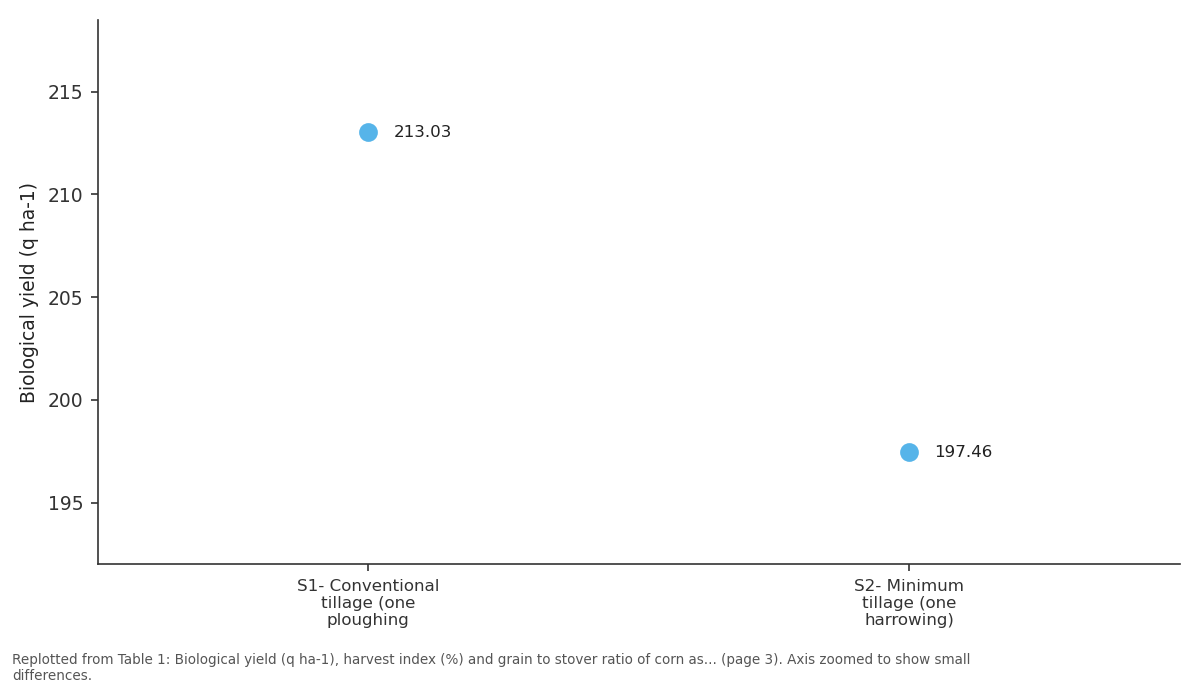
Biological yield: S1- Conventional... vs S2- Minimum tillage...
Replotted from Table 1 (page 3) of the original paper. Every bar is the paper's own table value.
View source evidence ↗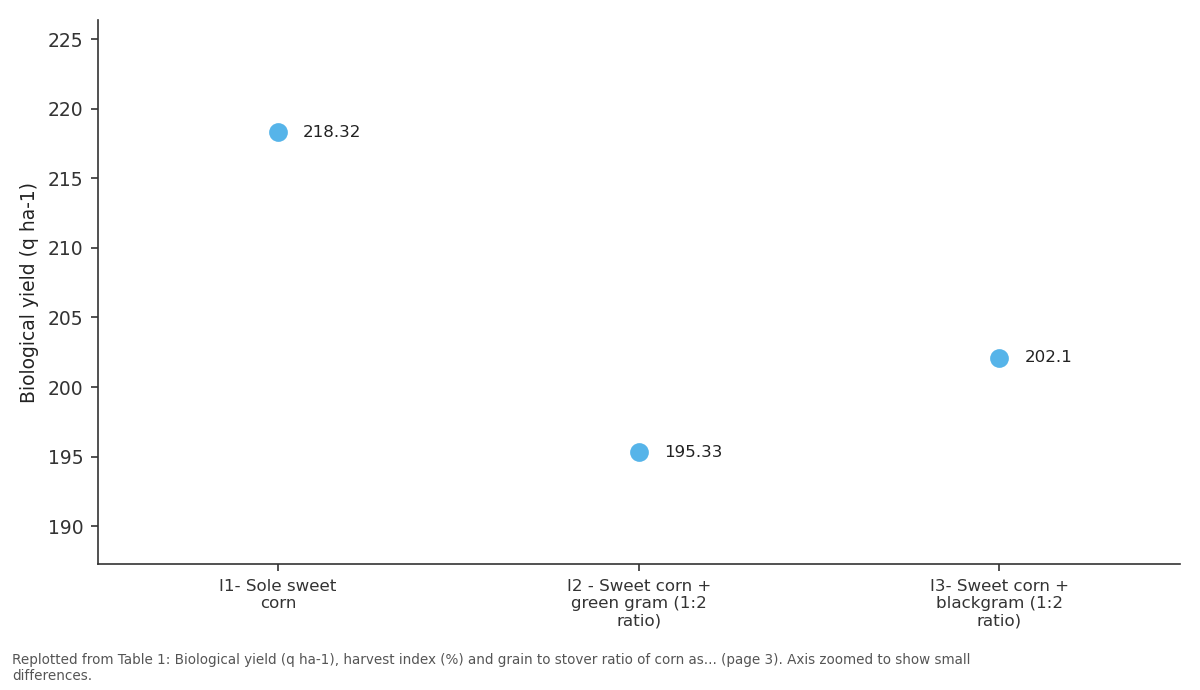
Biological yield: I1- Sole sweet corn vs I2 - Sweet corn + green... vs I3- Sweet corn +...
Replotted from Table 1 (page 3) of the original paper. Every bar is the paper's own table value.
View source evidence ↗Figures & tables
From the original paper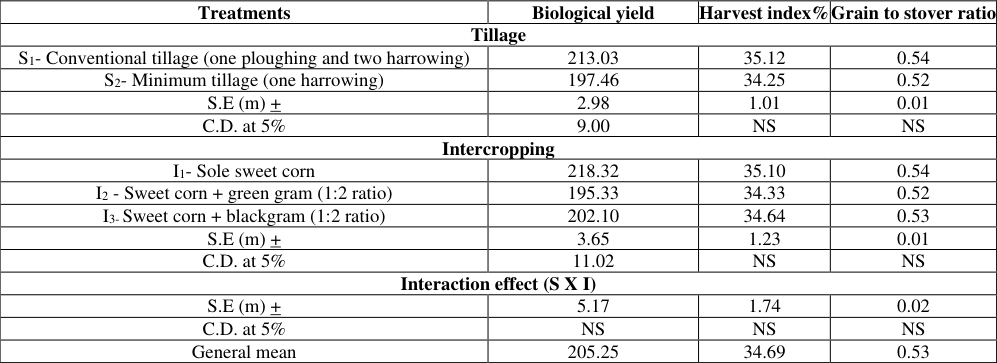 Table 1
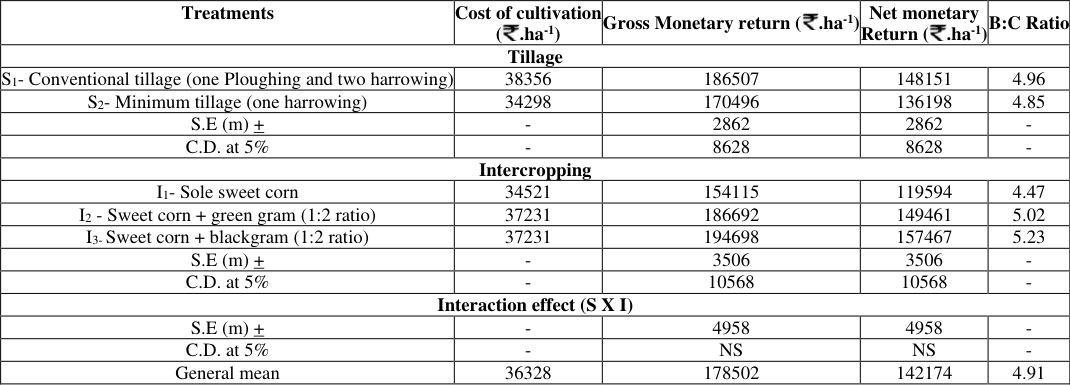 Table 2
Introduction
Maize is known a queen of cereals". It plays important role in the world agricultural economy, both as food for man and feed for animal. Maize is one of the world's leading crop cultivated over an area of about 157.51 million hectare with a production of about 781.36 million metric tons and recorded 4.96 tones average yield per hectare. In India it is grown over an area of 8.6 million hectare with total production of about 19 million tones and average yield per hectare of 2.67 tones (Anonymous 2014) [1] . Sweet corn is one of the most popular types for human consumption among different types of corn grown. Sweet corn has been bread to higher levels of natural sugars, which makes it very popular. Modern sweet corn started growing in 19 th century, which a single gene shrunken-2 (sh-2). This gene affects the table quality, synthesis and texture. It is hybridized maize, specially bred to increase sugar content and also known as "Sugar corn". The significance of in-situ soil moisture conservation measure is to conserve maximum possible rainwater at the place where it falls, to make efficient use of it. Soil management and agronomic practices are tailored to store and conserve as much rainfall as possible by reducing runoff and increasing the storage capacity of the profile. Dry land occupies an important place in Indian agriculture with 70% cultivated area and 40% of food grain production. Intercropping has various benefits associated with it viz. better utilization of soil moisture, nutrients and space and reduce risk of crop, failure due to weed, insect and climate vagaries. Among all, the use of intercrop, improving nutrient use efficiencies is one of the important aspects. Intercropping increases the cropping intensity and recourse utilization through introduction on some variable planting pattern (Pandey et al. 2014) [3] , which also gives certain insurance against biotic and environmental stresses and gives extra yield advantage by simple expedient of growing crop (Willey 1979) [6] . Keeping these points in view, the current study was undertaken to study the effect of minimum tillage on productivity and economics of sweet corn -pulses intercropping system.
Materials and Methods
A field experiment was conducted during kharif 2013 at Department of Agronomy, Dr. Panjab rao Deshmukh Krishi Vidyapeeth, Akola (M.S.).The experimental soil was clay in texture, slightly alkaline in nature (pH 7.78) with normal EC (0.5 dS/m) having moderate organic carbon content (0.48%), low available nitrogen (186.06 kg/ ha.), low available Phosphorus (19.35 Kg/ha.) and high available potassium (321.49 Kg/ha.).
The field experience was laid out in Factorial Randomized Block Design with four replications. The main plot treatment The main plot treatment viz., S1-Conventional tillage (one Ploughing and two harrowing), S2-Minimum tillage (one harrowing) and three sub-plot treatment of intercropping I1-Sole sweet corn, I2-Sweet corn+ Green gram (1:2ratio), I3-Sweet corn + Black gram (1:2ratio).Crops were grown in 5.4×3 m plot at a spacing 90 X 10 cm for sweet corn and black and green gram intercrop sown at 30 X 5 cm. Sweet corn var.Sugar-75 was sown on 4th July 2011 with seed rate 18 kg per ha. By dibbling two seed per hill. Intercrops green gram and black gram var. Kopargaon and TAU-1 were sown same day respectively. The quantities of fertilizers to be applied were calculated on gross plot basis as per treatments. The fertilizers were given as per the recommended dose i.e. 120 kg N. The nitrogen was given in 3 split doses, 1/3 at time of sowing, 1/3 at 30 DAS and 1/3 at 50 DAS. The fertilizers used were urea (46% N) for N only. The 1/3 dose of nitrogen at time of sowing and remaining two third nitrogen was top dressed at two times i.e. one third at 30 days after sowing and one third at 50 days after sowing, by placing the fertilizers by the side of each row and covering the same with soil, through hoeing, immediately. All the data pertaining to the present investigation were statistically analyzed with FRBD as given in the Gomez and Gomez (1984) [2] . The statistical analysis of plant characters was done by variance method (Panse and Sukhatme, 1978) [4] .
Result and Discussion
Biological yield, harvest index and grain to stover ratio Data regarding Biological yield, harvest index and grain to stover ratio as influenced by different treatments are shown in table 1.
| Treatments | Biological yield | Harvest index% | Grain to stover ratio |
|---|---|---|---|
| Tillage | |||
| S1- Conventional tillage (one ploughing and two harrowing) | 213.03 | 35.12 | 0.54 |
| S2- Minimum tillage (one harrowing) | 197.46 | 34.25 | 0.52 |
| S.E (m) + | 2.98 | 1.01 | 0.01 |
| C.D. at 5% | 9.00 | NS | NS |
| Intercropping | |||
| I1- Sole sweet corn | 218.32 | 35.10 | 0.54 |
| I2 - Sweet corn + green gram (1:2 ratio) | 195.33 | 34.33 | 0.52 |
| I3- Sweet corn + blackgram (1:2 ratio) | 202.10 | 34.64 | 0.53 |
| S.E (m) + | 3.65 | 1.23 | 0.01 |
| C.D. at 5% | 11.02 | NS | NS |
| Interaction effect (S X I) | |||
| S.E (m) + | 5.17 | 1.74 | 0.02 |
| C.D. at 5% | NS | NS | NS |
| General mean | 205.25 | 34.69 | 0.53 |
Table text extracted from the original PDF; superscript letters are shown inline. The original table image is below.
View original table image
Effect of tillage
Data on biological yield showed that treatment conventional tillage (S1) produced significantly higher biological yield than minimum tillage (S2).
Effect of intercropping
Data on biological yield revealed that treatment sole sweet corn (I1) recorded significantly maximum biological yield of (218.32 q ha-1). However the lowest biological yield (195.33 q ha-1) recorded by treatment sweet corn + green gram (I2).
Interaction effect
The interaction between tillage and intercropping treatments were found to be non-significant.
Effect of tillage
Harvest index and Grain to Stover ratio was not significantly influenced due to different tillage management techniques.
Effect of intercropping
Harvest index and Grain to stover ratio was not significantly influenced due to different intercropping treatment.
Interaction effect
The interaction between tillage and intercropping treatments were found to be non-significant.
Economics
Data regarding cost of cultivation, gross monetary returns, net monetary returns and benefit: cost ratio as influenced by different treatments are shown in table 2.
| Treatments | Cost of cultivation ( .ha-1) | Gross Monetary return ( .ha-1) | Net monetary Return ( .ha-1) | B:C Ratio |
|---|---|---|---|---|
| Tillage | ||||
| S1- Conventional tillage (one Ploughing and two harrowing) | 38356 | 186507 | 148151 | 4.96 |
| S2- Minimum tillage (one harrowing) | 34298 | 170496 | 136198 | 4.85 |
| S.E (m) + | - | 2862 | 2862 | - |
| C.D. at 5% | - | 8628 | 8628 | - |
| Intercropping | ||||
| I1- Sole sweet corn | 34521 | 154115 | 119594 | 4.47 |
| I2 - Sweet corn + green gram (1:2 ratio) | 37231 | 186692 | 149461 | 5.02 |
| I3- Sweet corn + blackgram (1:2 ratio) | 37231 | 194698 | 157467 | 5.23 |
| S.E (m) + | - | 3506 | 3506 | - |
| C.D. at 5% | - | 10568 | 10568 | - |
| Interaction effect (S X I) | ||||
| S.E (m) + | - | 4958 | 4958 | - |
| C.D. at 5% | - | NS | NS | - |
| General mean | 36328 | 178502 | 142174 | 4.91 |
Table text extracted from the original PDF; superscript letters are shown inline. The original table image is below.
View original table image
Cost of cultivation Effect of tillage
Data presenting in table 2 in relation to cost of cultivation indicated that the cost of cultivation was significantly more in (S1) conventional tillage (.38357 ha-1) than (S2) minimum tillage (34899. ha-1).
Effect of intercropping
Treatment, sweet corn + blackgram and sweet corn + green gram (I2) (. 37231 ha-1) was significantly more cost of cultivation. The lowest cost of cultivation was recorded by sole sweet corn (I1) (34521. ha-1).
Interaction effect
The interaction between tillage and intercropping treatment was found to be non-significant.
Gross and Net monetary returns
The mean gross and net monetary returns obtained from sweet corn was.178502 ha-1 and.142174 ha-1 respectively.
Effect of tillage
The data on gross monetary returns was significantly influenced due to different tillage. Maximum gross monetary returns of. 186507 ha-1 were observed with the treatment conventional tillage (S1) than minimum tillage (S2) (170496. ha-1). The data on net monetary returns were significantly influenced due to different tillage. Maximum gross monetary returns of. 148151 ha-1 were observed with the treatment conventional tillage (S1) than minimum tillage (S2) (136198. ha-1).
Effect of intercropping
The data on gross monetary returns were significantly influenced due to various intercropping practices. The treatment sweet corn + blackgram (I3) recorded highest gross monetary returns (. 194698 ha-1) followed by treatment sweet corn + green gram (I2). The lowest gross monetary returns were recorded by sole sweet corn (I1) (154115. ha-1). The data on net monetary returns were significantly influenced due to various intercropping practices. The treatment sweet corn + blackgram (I3) recorded highest net monetary returns (. 157467 ha-1) followed by treatment sweet corn + green gram (I2). The lowest net monetary returns were recorded by sole sweet corn (I1) (119594.ha-1). Similar results were observed by Singh (2000).
Interaction effect
The interaction between tillage and intercropping treatments were found to be non-significant.
Benefit: cost ratio
Data presented in table 2 indicated that the average benefit to cost ratio of sweet corn crop was 4.91.
Effect of tillage
The higher benefit: cost ratio of 4.96 was obtained by conventional tillage (S1) treatment, than minimum tillage (S2).
Effect of intercropping
The data in table shows that, treatment sweet corn + blackgram (I3) recorded significantly maximum benefit: cost ratio of 5.23 which was closely followed by treatment sweet corn + green gram (I2) (5.02).The lowest benefit: cost ratio was obtained by the treatment sole sweet corn (I1) (4.47).
References
2 in the original paper- Pandey AKV, Prakash RD, Singh, Mani VP. Effect of intercropping pattern of maize and soybean on yield and economics under mid hills of N-W Himalayas, Annals of agricultural research. 2014;20(3):354-359.
- Singh VP. Planting geometry in maize (Zea and) black gram (phaseolus mungo) intercropping system under rainfed low hill valley of Kumaon. Indian Journal of Agronomy. 2000;45(2):274-278.
Cited by 2
From OpenAlex, OpenCitations and reference lists read by Scinovex
- Effect of Different Levels and Times of Nitrogen Application on Grain and Forage Quality of Sweet Corn (Zea mays L. saccharata) ↗
M. K. Gamit, V. G. Bavalgave, K. K. Patel, J. M. Ganvit · International Journal of Environment and Climate Change · 2023
This field experiment conducted during the rabi season of 2017-18 at N. M. College of Agriculture, Navsari Agricultural University, Gujarat, aimed to investigate the response of sweet corn (Zea mays L. saccharata) to different levels and times of nitrogen application under the south Gujarat conditions. The factorial randomized block design (FRBD) with three replications was employed, considering four nitrogen levels…
❝ 3PDF - Efficacy of integrated weed management practices on growth and yield of sweet corn
D Senthilkumar, S. Kalaisudarson · International Journal of Research in Agronomy · 2024
Field experiment was carried out at Vangudi village of udaiyarpalayam taluk, Ariyalur district, Tamil Nadu during July to October, 2022. The treatments included of best combinations consisting of chemical and cultural method of weed control. The experiment was laid out in randomized block design with ten treatments and replicated thrice. Among the different treatments, pre-emergence application of metolachlor 50% EC @ 1 kg a.i. ha-1 on 3 DAS + Intercropping (Blackgram) (T8) which helps in reducing weed density and ultimately reduced weed biomass which resulted in increase in crop growth and yi