
Research article · 2024 · Full text
International Journal of Research in AgronomyEfficacy of integrated weed management practices on growth and yield of sweet corn
Volume 7(2) · Pages 229–232 · DOI: 10.33545/2618060x.2024.v7.i2d.308 ↗
Research areasAgriculture and Biological Studies
Abstract
Author-writtenField experiment was carried out at Vangudi village of udaiyarpalayam taluk, Ariyalur district, Tamil Nadu during July to October, 2022. The treatments included of best combinations consisting of chemical and cultural method of weed control. The experiment was laid out in randomized block design with ten treatments and replicated thrice. Among the different treatments, pre-emergence application of metolachlor 50% EC @ 1 kg a.i. ha-1 on 3 DAS + Intercropping (Blackgram) (T8) which helps in reducing weed density and ultimately reduced weed biomass which resulted in increase in crop growth and yield. Higher plant height, DMP and higher green cob yield were recorded under T8-IWM practice might be due to maintenance of weed free environment, particularly throughout vital growth stages of crop, cut back crop weed competition helped in higher growth and development of sweet corn crop leading to higher green cob yield.
Summary
Source-checkedPlain-language reading of the full paper, prepared with AI and checked against the text. Each point links to the authors' own words.
Why it matters
- Weeds negatively impact sweet corn by competing for sunlight, water, and nutrients, which can result in stunted growth and lower yields. View evidence ↗
- Prior research indicates that weed presence in maize can reduce yields by 27% to 60%. View evidence ↗
- Integrated Weed Management (IWM) combines various control methods to provide a more sustainable and effective strategy than relying on a single method. View evidence ↗
The question
- The study aimed to evaluate which weed management practices are most effective for improving the growth and yield of sweet corn. View evidence ↗
What they did
- The field experiment took place in Vangudi village, Tamil Nadu, from July to October 2022. View evidence ↗
- The researchers used a randomized block design with ten different treatments, each replicated three times. View evidence ↗
- The experiment was conducted using the Sugar-75 sweet corn hybrid. View evidence ↗
- Treatments ranged from an unweeded control to combinations of herbicides (pendimethalin or metolachlor), hand weeding, intercropping with blackgram, and sugarcane trash mulching. View evidence ↗
What they found
- The combination of metolachlor and blackgram intercropping (T8) produced the tallest plants, reaching 177.2 cm at 60 days after sowing (DAS). View evidence ↗
- The unweeded control (T1) had the shortest plants, measuring only 107.4 cm at 60 DAS. View evidence ↗
- The T8 treatment (metolachlor + blackgram) achieved the highest dry matter production at 7501 kg ha-1 at 60 DAS. View evidence ↗
- The highest leaf area index (LAI) of 6.96 at 60 DAS was recorded under the T8 treatment. View evidence ↗
- The T8 treatment resulted in the highest green cob yield of 9548 kg ha-1. View evidence ↗
- The lowest green cob yield, 5886 kg ha-1, was observed in the unweeded control (T1). View evidence ↗
What it means
- The authors concluded that the combination of metolachlor application and blackgram intercropping (T8) is an effective IWM practice for controlling weeds and increasing sweet corn growth and yield. View evidence ↗
Visual summary
3 visualsIllustrations explain the paper; charts are replotted from the paper's own table values.
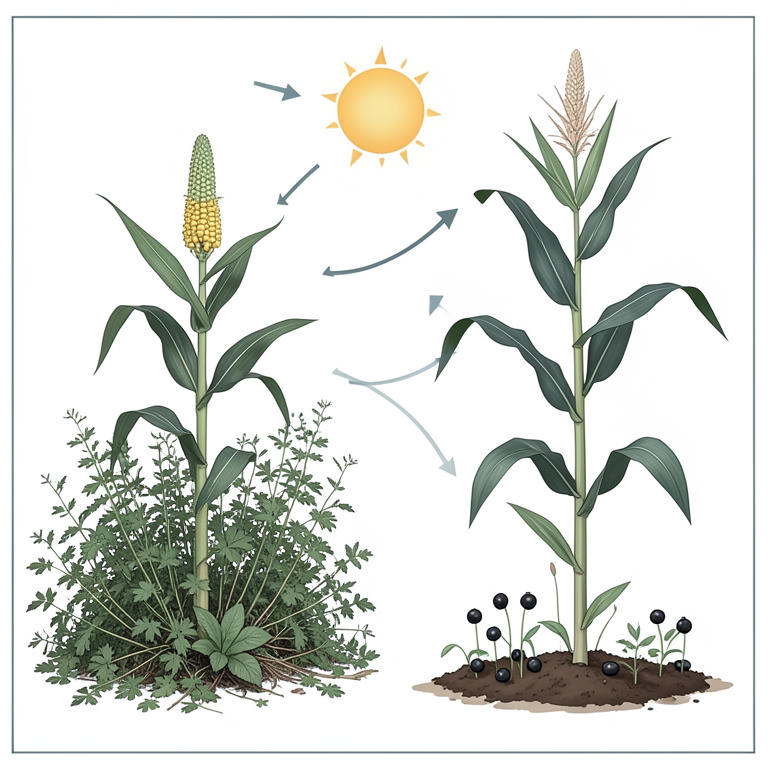
Impact of IWM on Sweet Corn
AI-generated conceptual illustration (sweet corn plants and blackgram intercrop). It explains the idea and does not show study data.
View source evidence ↗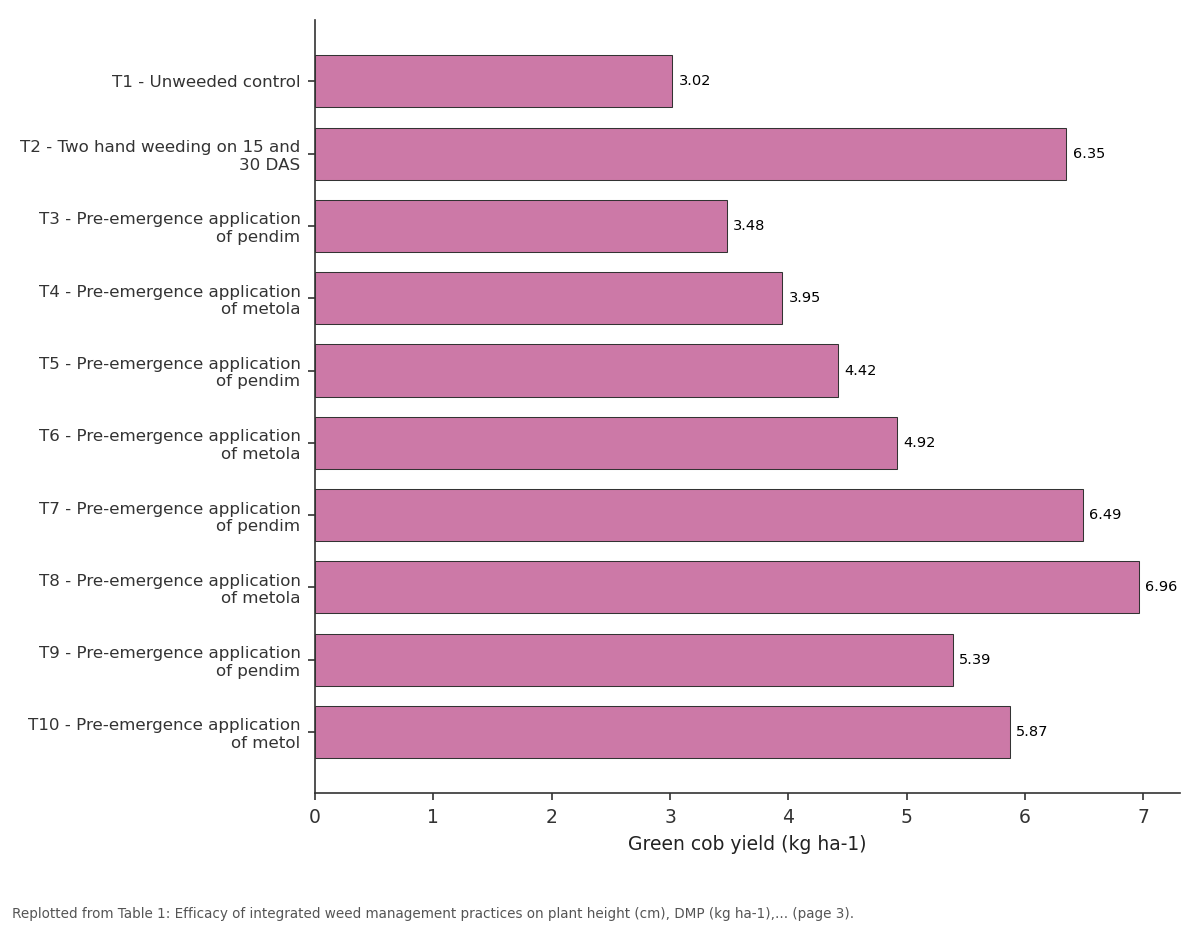
Leaf area index: T1 - Unweeded control vs T2 - Two hand weeding... vs T3 - Pre-emergence... vs T4 - Pre-emergence... vs T5 - Pre-emergence...
Replotted from Table 1 (page 3) of the original paper. Every bar is the paper's own table value.
View source evidence ↗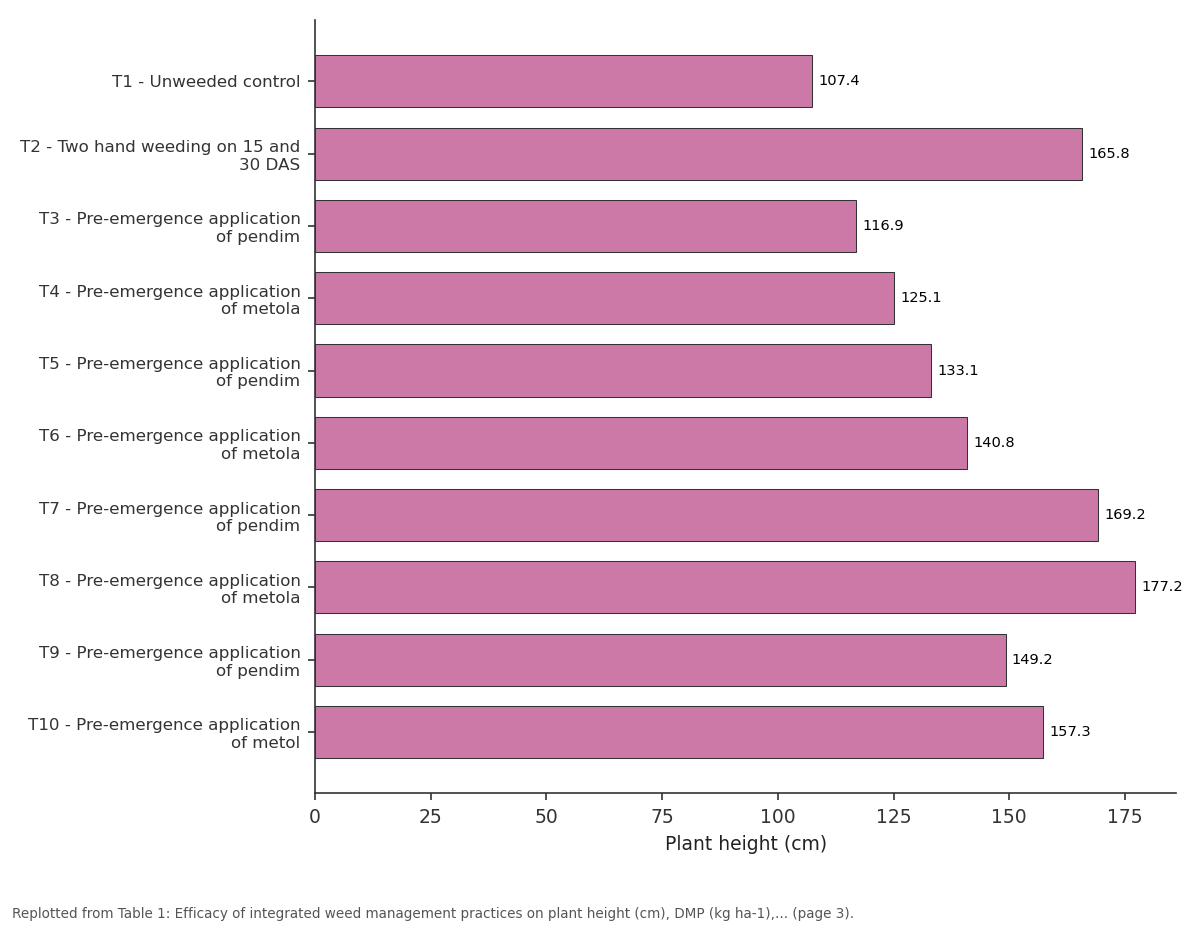
Plant height (cm): T1 - Unweeded control vs T2 - Two hand weeding... vs T3 - Pre-emergence... vs T4 - Pre-emergence... vs T5 - Pre-emergence...
Replotted from Table 1 (page 3) of the original paper. Every bar is the paper's own table value.
View source evidence ↗Figures & tables
From the original paper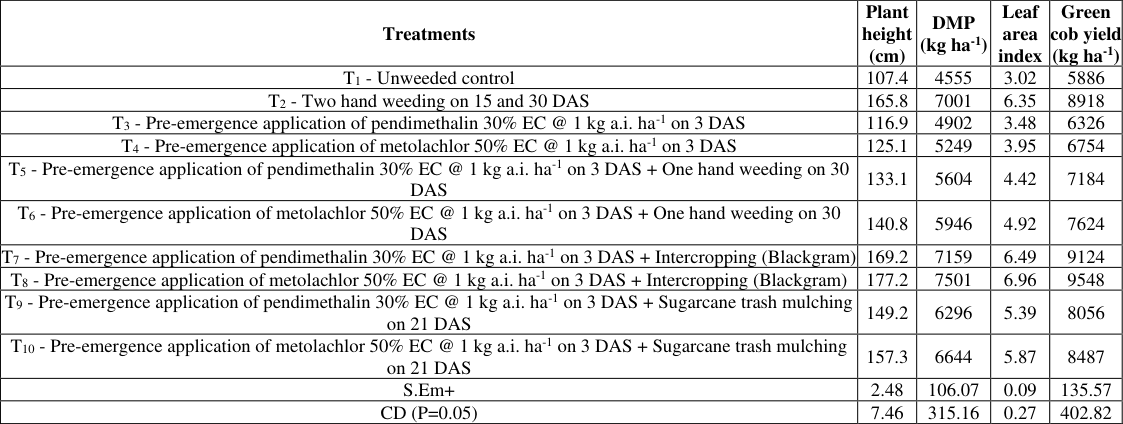 Table 1
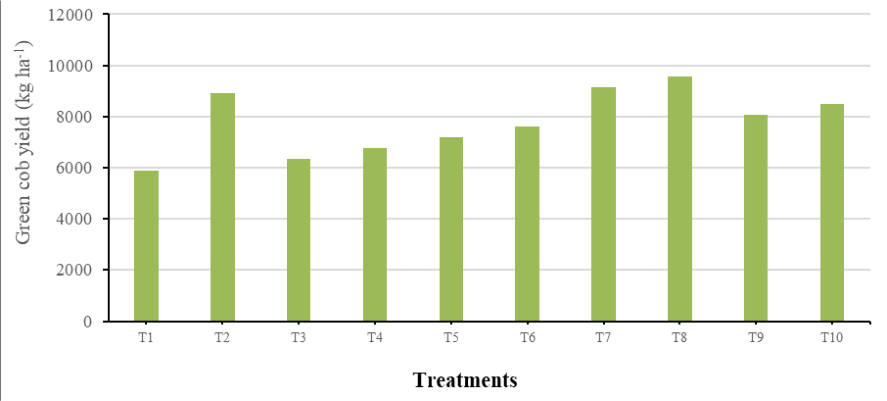 Figure 1
Introduction
Sweet corn (Zea mays var. saccharata) also called as sugar corn is a type of maize with high sugar content belongs to the family poaceae, it is one of the warm season crops. In India, maize occupies an area of 9.9 million hectares with a production of 32.50 million tonnes and with a productivity of 3.28 t ha -1 (USDA, 2022) [12] . In Tamil Nadu, it is cultivated in an area of 0.33 million hectares with a production of 2.61 million tonnes with a productivity of 7.06 t ha -1 and also it occupies the fourth position in India (Salient statistics on agriculture, 2022) [11] . Weeds compete with sweet corn plants for essential resources such as sunlight, water, and nutrients. This competition can lead to stunted growth of sweet corn, reduced ear size, and overall lower yields. Anil et al. (2015) [1] revealed that presence of weeds in maize reduced the maize yield by 27 to 60 percent depending upon the growth and persistence of weed population. IWM is an approach that emphasizes the use of a combination of different weed control methods to create a more sustainable and effective strategy. The goal is to integrate various practices and techniques to manage weeds while minimizing the reliance on any single method. This approach is particularly important in small farm holdings where resource optimization and sustainable farming practices are crucial. By adopting an IWM approach, farmers can achieve better weed control, enhance crop yields, and reduce the weed seed bank in the soil over time. This integrated and holistic approach aligns with sustainable farming practices, promoting long-term environmental and economic benefits. Maqsood et al. (2020) [8] stated that integrated approach entailing cultural, manual, mechanical and chemical control can be developed as a environmental and farmer friendly approach for weed control by reducing weed seed reserves which can potentially lead to higher economic returns through higher maize yield. Mishra et al. (2020) [9] concluded that critical period of crop weed competition in maize is between 15 to 45 DAS. Sweet corn is a medium plant type and provides green ears within 75 to 85 days after sowing. Sweet corn is consumed as raw or used as an ingredient in the preparation of soup, salad, Manchurians and Chinese dishes. In India, sweet corn is cultivated on very small area by some farmers and private sectors to meet the demands of many industries. Sweet corn is the recent form of grain vegetable. Presence of iron makes it highly suitable for women who suffer from anaemia.
The use of herbicides is an effective method for controlling weed infestation, which enables a quicker breakthrough and contributes to an increase in maize yield (Kantwa et al., 2020) [5] . Hence, the present study has been carried out to evaluate the best weed management practices on growth and yield attributes of sweet corn.
Materials and Methods
The experiment was carried out at the Vangudi village, Ariyalur district, Tamil Nadu during July to October, 2022. The experimental field was located at 11°25' North latitude and 79°45' East longitude with an altitude of +18.0 m above mean sea level. The crop season recorded a maximum temperature which ranged from 31.9 ºC to 36.2 ºC with a mean of 33.7 ºC. The minimum temperature ranged from 22.9 ºC to 24.7 ºC with a mean of 23.9 ºC. The relative humidity ranged from 67.2 to 79.7 percent with a mean of 74.21 percent. The crop period received a rain fall of 192.2 mm distributed over 18 rainy days during crop season The texture of the experimental field soil was sandy clay loam in with a pH of 7.8. The soil was low in available nitrogen, medium in available phosphorus and potassium. The study used the popular sweet corn hybrid Sugar-75. The experiment used randomised block design, with three replications and ten treatments. There were ten treatment, viz., T1-Unweeded control, T2-Two hand weeding on 15 and 30 DAS, T3 -Pendimethalin 30% EC @ 1 kg a.i. ha -1 on 3 DAS, T4 -Metolachlor 50% EC @ 1 kg a.i. ha -1 on 3 DAS, T5-Pendimethalin 30% EC @ 1 kg a.i. ha -1 on 3 DAS + One hand weeding on 30 DAS, T6 -Metolachlor 50% EC @ 1 kg a.i. ha -1 on 3 DAS + One hand weeding on 30 DAS, T7 -Pendimethalin 30% EC @ 1 kg a.i. ha -1 on 3 DAS + Intercropping (Blackgram), T8 -Metolachlor 50% EC @ 1 kg a.i. ha -1 on 3 DAS + Intercropping (Blackgram), T9 -Pendimethalin 30% EC @ 1 kg a.i. ha -1 on 3 DAS + Sugarcane trash mulching on 21 DAS and T10 -Metolachlor 50% EC @ 1 kg a.i. ha -1 on 3 DAS + Sugarcane trash mulching on 21 DAS. The sweet corn seeds were dibbled at the rate of 12.5 kg ha -1 with the spacing of 60 × 20 cm. Blackgram variety VBN 8 was sown at rate of 20 kg ha -1 with spacing of 30 × 10 cm. All other standard cultural practices were followed during the cropping season. Preemergence application of pendimethalin and metolachlor was done with the help of knapsack sprayer fitted with a flood fan nozzle with a spray volume of 500 L ha -1 as per treatment schedule. In manual weed control treatments, weeds are uprooted within the row and between the rows using with hand weeding as per days mentioned in each treatment. The weed count was taken from the tagged spot of 0.25 m 2 in the randomly selected each net plot and were calculated and converted into square meter basis for convenience. In order to draw a valid conclusion, the weed count data were subjected to ( as suggested by Gomez and Gomez (1984) [4] before statistical analysis. The green cob yield and green fodder yield
Results and Discussion
Efficacy of IWM on plant height Among the integrated weed management practices, preemergence application of metolachlor 50% EC @ 1 kg a.i. ha -1 on 3 DAS + Intercropping (Blackgram) (T8) was found to be advanced in plant height of 177.2 cm on 60 DAS. This might be due the better weed control at different growth stages of crop.
This effective suppression of the weeds provided competition free condition and hence, the plant can utilize all the available resources viz., light, moisture, space and more nutrients at all stages which results in increased plant height. These findings were similarly related by Poddar et al. (2023) [10] . Unweeded control (T1) showed significant reduction in plant height of 107.4 cm on 60 DAS and at all stages of the crop due to high competition by weeds and suppression of growth due to lesser availability of growth attributing factors to crop thus reduced the plant height to a greater extent.
Efficacy of IWM on dry matter production
The dry matter production is the result of cumulative and complementary effect of plant height, number of leaves and leaf area. Pre-emergence application of metolachlor 50% EC @ 1 kg a.i. ha -1 on 3 DAS + Intercropping (Blackgram) (T8) recorded (7501 kg ha -1 ) on 60 DAS has shown a better crop dry matter production. The increased crop dry matter production might be due to better control of weeds which resulted in increase in number of leaves and leaf area to better photosynthesis and reduction in weed competitiveness with the crop which ultimately favoured better environment for growth and development of crops. These findings were similar with Sharma et al. (2023) [12] .
Efficacy of IWM on leaf area index
Pre-emergence application of metolachlor 50% EC @ 1 kg a.i. ha -1 on 3 DAS + Intercropping (Blackgram) (T8) was recorded higher LAI of 6.96 on 60 DAS. High value of leaf area index is due to lesser weed competition resulting in higher availability of plant nutrients and moisture favouring increased growth characters and also improved nutrient uptake and vigour due to elimination of weed competition from the beginning of the crop might have contributed to higher leaf area index. From the experiment, it is evident that high competition of weed reduced the input availability and thus reduced the leaf area index in greater extent under unweeded control (T1). Similar type of results was also reported by (Maitra et al., 2023) [7] .
Efficacy of IWM on green cob yield
The higher green cob yield was recorded under the treatment pre-emergence application of metolachlor 50% EC @ 1 kg a.i. ha -1 ha on 3 DAS + Intercropping (Blackgram) (T8) recorded (9548 kg ha -1 ) (Fig. 1). This treatment resulted in better control of weeds and provided weed free condition for longer period of crop growth and resulted in increase of all growth and yield parameters as well as it might be due to effective control of weeds, which cumulatively resulted in higher dry matter accumulation which helped in greater translocation of food materials to reproductive parts and reflected in terms of yield attributing characters such as number of grains cob -1 . All these parameters showed positive and significant relationship on green cob yield of sweet corn. Unweeded control (T1) showed the real picture of the aggressive nature of weeds on the growth of sweet corn. The lowest green cob yield was recorded 5886 kg ha -1 in unweeded control. This was due to increased crop weed competition for different resources viz., light, moisture, space and nutrients. Yield losses of similar magnitude due to the weed competition reported by Chang et al. (2021) [2] and Deshmane et al. (2023) [3] . T6 -Pre-emergence application of metolachlor 50% EC @ 1 kg a.i. ha -1 on 3 DAS + One hand weeding on 30 DAS 140.8 5946 4.92 7624 T7 -Pre-emergence application of pendimethalin 30% EC @ 1 kg a.i. ha -1 on 3 DAS + Intercropping (Blackgram) 169.2 7159 6.49 9124 T8 -Pre-emergence application of metolachlor 50% EC @ 1 kg a.i. ha -1 on 3 DAS + Intercropping (Blackgram) 177.2 7501 6.96 9548 T9 -Pre-emergence application of pendimethalin 30% EC @ 1 kg a.i. ha -
Conclusion
Based on the result of field experiment, it concluded that preemergence application of metolachlor 50% EC @ 1 kg a.i. ha -1 on 3 DAS + Intercropping (Blackgram) (T8) was effective integrated weed management practice for controlling weeds and increased growth and green cob yield of sweet corn.
Figures and tables from the paper
| Treatments | Plant height (cm) | DMP (kg ha-1) | Leaf area index | Green cob yield (kg ha-1) |
|---|---|---|---|---|
| T1 - Unweeded control | 107.4 | 4555 | 3.02 | 5886 |
| T2 - Two hand weeding on 15 and 30 DAS | 165.8 | 7001 | 6.35 | 8918 |
| T3 - Pre-emergence application of pendimethalin 30% EC @ 1 kg a.i. ha-1 on 3 DAS | 116.9 | 4902 | 3.48 | 6326 |
| T4 - Pre-emergence application of metolachlor 50% EC @ 1 kg a.i. ha-1 on 3 DAS | 125.1 | 5249 | 3.95 | 6754 |
| T5 - Pre-emergence application of pendimethalin 30% EC @ 1 kg a.i. ha-1 on 3 DAS + One hand weeding on 30 DAS | 133.1 | 5604 | 4.42 | 7184 |
| T6 - Pre-emergence application of metolachlor 50% EC @ 1 kg a.i. ha-1 on 3 DAS + One hand weeding on 30 DAS | 140.8 | 5946 | 4.92 | 7624 |
| T7 - Pre-emergence application of pendimethalin 30% EC @ 1 kg a.i. ha-1 on 3 DAS + Intercropping (Blackgram) | 169.2 | 7159 | 6.49 | 9124 |
| T8 - Pre-emergence application of metolachlor 50% EC @ 1 kg a.i. ha-1 on 3 DAS + Intercropping (Blackgram) | 177.2 | 7501 | 6.96 | 9548 |
| T9 - Pre-emergence application of pendimethalin 30% EC @ 1 kg a.i. ha-1 on 3 DAS + Sugarcane trash mulching on 21 DAS | 149.2 | 6296 | 5.39 | 8056 |
| T10 - Pre-emergence application of metolachlor 50% EC @ 1 kg a.i. ha-1 on 3 DAS + Sugarcane trash mulching on 21 DAS | 157.3 | 6644 | 5.87 | 8487 |
| S.Em+ | 2.48 | 106.07 | 0.09 | 135.57 |
| CD (P=0.05) | 7.46 | 315.16 | 0.27 | 402.82 |
Table text extracted from the original PDF; superscript letters are shown inline. The original table image is below.
View original table image
References
9 in the original paper- Anil K, Jai K, Puniya R, Amit M, Neetu S, Lobzang S. Weed management in maize-based cropping system. Indian Journal of Weed Science. 2015;47(3):254-266.
- Chang MS, Kandhro MN, Abbasi ZA, Sootaher JK, Buriro KA, Channa Z, et al. Comparative efficacy of purple nutsedge allelopathy and other methods on weed management in Barley (Hordeum vulgare L.). Pakistan Journal of Weed Science Research. 2021;27(2):127-137.
- Deshmane AD, Ghanbahadur MR, Chavhan KR. Effect of minimum tillage on productivity and economics of sweet corn: Pulses intercropping system. The Pharma Innovation Journal. 2023;12(3):407-409.
- Gomez KA, Gomez AA. Statistical procedures for agricultural research. John Wiley and Sons; 1984.
- Kantwa S, Jadon CK, Tetarwal JP, Ram B, Kantwa SR, Yadav RK. Effect of weed management practices on weed dynamics, yield attributes and yield of maize. International Journal of Bio-resource Stress Management. 2020;11(5):488-493.
- Khan I, Iqbal M, Malik MH, Jilani MS, Baloch MS, Khan MS, Mamoon-ur-Rashid M. Efficacy of dual gold (smetolachlor) on weed biomass, and on the growth and yield components of sugar beet (Beta vulgaris L.). Pakistan Journal of Weed Science Research. 2021;27(4):495.
- Maitra S, Praharaj S, Brestic M, Sahoo RK, Sagar L, Shankar T, Hossain A. Rhizobium as Biotechnological Tools for Green Solutions: An Environment-Friendly Approach for Sustainable Crop Production in the Modern Era of Climate Change. Current Microbiology. 2023;80(7):1-15.
- Maqsood Q, Abbas RN, Iqbal MA, Serap KA, Iqbal A, Sabagh AE. Overviewing of weed management practices to reduce weed seed bank and to increase maize yield. Planta Daninha. 2020;38:1-10.
- Mishra GC, Mishra G, Nayak BS, Behera MP, Lenka SK. Influence of weed management practices on weed control efficiency, growth and productivity of hybrid maize. International Journal of Chemical Studies. 2020;8(3):20852089.