
Research article · 2022 · Full text
International Journal of Research in AgronomyEvaluating performance of recently released tomato (Lycopersicon esculentum Mill.) varieties at highland areas of West Hararghe, Ethiopia
Volume 5(2) · Pages 18–24 · DOI: 10.33545/2618060x.2022.v5.i2a.105 ↗
Research areasAgricultural Practices and Plant Genetics
Abstract
Author-writtenTomato (Lycopersicon esculentum Mill.) is one of the most important and widely grown vegetable crops both during rainy and dry seasons for its fruit by smallholder farmers, commercial state and private farms in Ethiopia. Field study was conducted during 2018 to 2020 cropping season at highland areas of West Hararghe aimed at evaluating performance of recently released tomato varieties. Treatments used were composed of three released tomato varieties (Gelilema, Chali & ARP-Tomato-d2) arranged in a randomized complete block design (RCBD). Traits such as plant height, number of primary branches, days to 50% flowering, days to 50% maturity, number of clusters per plant, number of fruits per cluster, fruit weight, unmarketable fruit yield, marketable fruit yield and total fruit yield were analyzed using R software (R 3.4.1). According to analysis of variance, tomato varieties were found to cause significant (p≤0.001) difference for plant height (cm), number of primary branches per plant, days to 50% flowering (days), days to 50% maturity (days), number of clusters per plant, number of fruit per cluster, fruit weight (gmfruit-1 ), marketable fruit yield (tha-1 ) and total fruit yield (tha-1 ) while unmarketable fruit yield (tha-1 ) nonsignificantly affected by tomato varieties. Hence, highest plant height (60cm), the highest days to 50% flowering (53 days), highest days to 50% maturity (102days), the highest number of primary branches (9 numberplant-1 ), the highest number of cluster (14 number plant-1 ), highest number of fruits (4.33 number cluste-1 ), highest marketable fruit yield (30.33 tha-1 ) and highest total fruit yield (33.33tha-1 ) recorded with variety Gelilema. Among tomato varieties evaluated, variety Gelilema showed best performances in plant height, primary branches, fruit yield and fruit yield components of tomato. Therefore, as variety Gelilema was superior in these parameters, recommended for the study areas to maximize productivity and production of tomato.
Summary
Source-checkedPlain-language reading of the full paper, prepared with AI and checked against the text. Each point links to the authors' own words.
Why it matters
- Tomato is a critical vegetable crop in Ethiopia, widely cultivated by smallholders and commercial farms across both rainy and dry seasons. View evidence ↗
- The crop is highly valued for human health due to its rich content of minerals, vitamins C and E, and various secondary metabolites like lycopene and β-carotene. View evidence ↗
- While the West Hararghe highlands have potential for tomato production, productivity is limited by a lack of improved varieties specifically suited for the area. View evidence ↗
The question
- The study aimed to evaluate how recently released tomato varieties perform in the highland areas of West Hararghe. View evidence ↗
What they did
- The field experiment took place in the highland areas of West Hararghe during the 2018 to 2020 cropping seasons. View evidence ↗
- Three released tomato varieties, Gelilema, Chali, and ARP-Tomato-d2, were tested using a randomized complete block design. View evidence ↗
- Researchers measured growth parameters (height, branches), phenology (flowering and maturity days), and yield components (clusters, fruit weight, and marketable/total yield) using R software for analysis. View evidence ↗
What they found
- Variety Gelilema produced the tallest plants at 60 cm, compared to the shortest plants from ARP-Tomato-d2 at 53.6 cm. View evidence ↗
- Gelilema had the most primary branches (9 per plant), while ARP-Tomato-d2 and Chali had the fewest (6 per plant). View evidence ↗
- Gelilema was the latest to flower (53 days to 50% flowering), whereas ARP-Tomato-d2 was the earliest (43 days). View evidence ↗
- Gelilema took the longest to reach 50% maturity (102 days), while ARP-Tomato-d2 reached it fastest (80 days). View evidence ↗
- Gelilema produced the most clusters per plant (14), while ARP-Tomato-d2 produced the fewest (10). View evidence ↗
- ARP-Tomato-d2 had the highest average fruit weight (79.6 g), while Gelilema had the lowest (60.3 g). View evidence ↗
- Gelilema achieved the highest marketable fruit yield (30.33 t/ha), significantly outperforming ARP-Tomato-d2 (21.81 t/ha). View evidence ↗
- Gelilema recorded the highest total fruit yield (33.33 t/ha), while ARP-Tomato-d2 recorded the lowest (24.21 t/ha). View evidence ↗
- The variety of tomato did not have a statistically significant effect on the amount of unmarketable fruit yield. View evidence ↗
What it means
- The authors conclude that Gelilema is the superior variety for fruit yield and its components, and they recommend it for the study area and similar agro-ecologies to maximize production. View evidence ↗
Visual summary
3 visualsIllustrations explain the paper; charts are replotted from the paper's own table values.
Yield Comparison
AI-generated conceptual illustration (tomato plants (Lycopersicon esculentum Mill.)). It explains the idea and does not show study data.
View source evidence ↗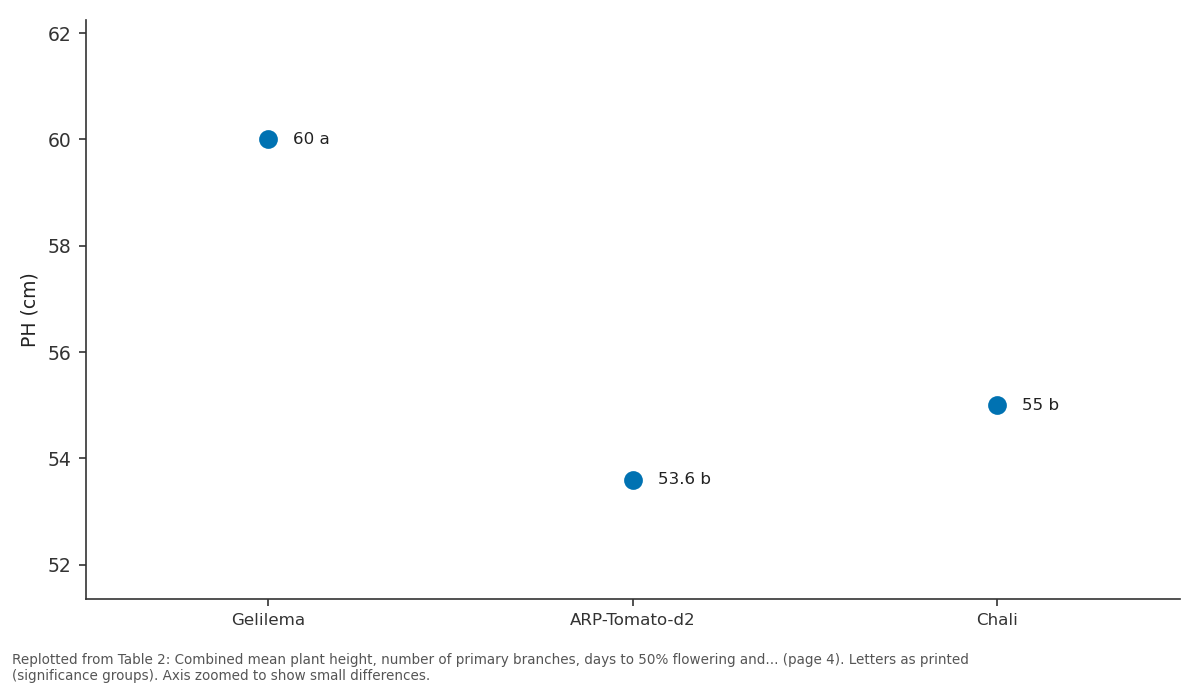
PH (cm): Gelilema vs ARP-Tomato-d2 vs Chali
Replotted from Table 2 (page 4) of the original paper. Every bar is the paper's own table value.
View source evidence ↗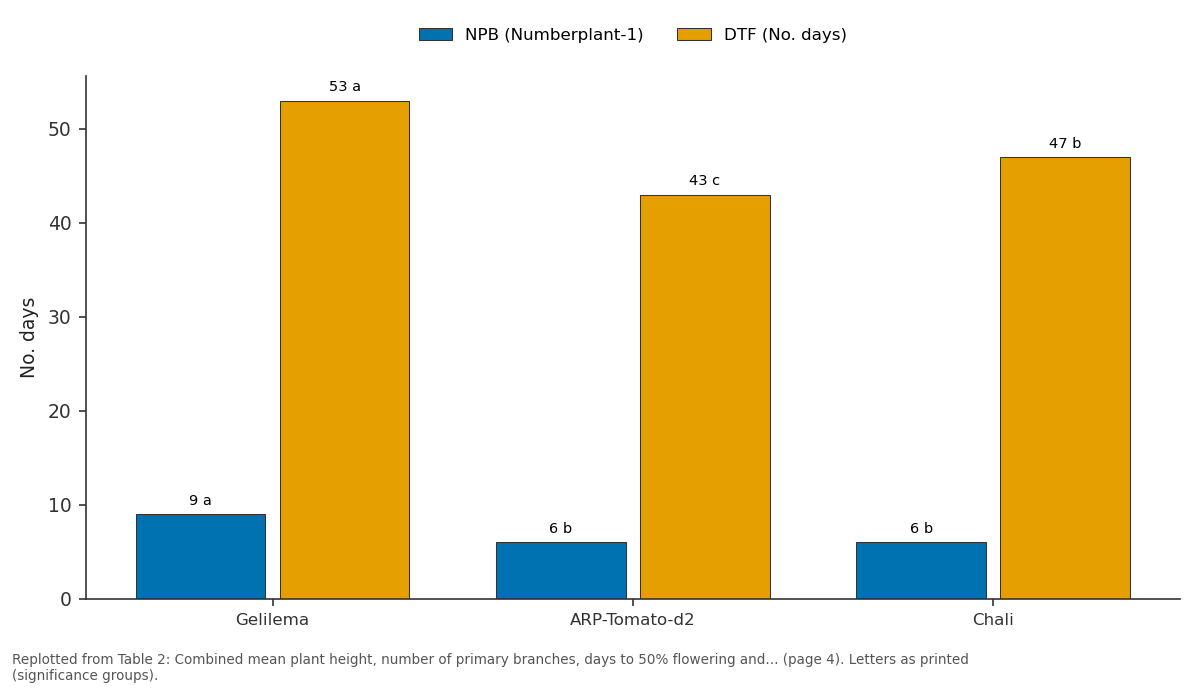
NPB (Numberplant-1) and DTF (No. days): Gelilema vs ARP-Tomato-d2 vs Chali
Replotted from Table 2 (page 4) of the original paper. Every bar is the paper's own table value.
View source evidence ↗Figures & tables
From the original paper Table 1
 Table 2
 Table 3
Introduction
The crop, tomato (Lycopersicon esculentum Mill) belongs to Solanaceae family, and originated in the area extending from Ecuador to Chile in the western coastal plain of South America. It was first domesticated in Mexico where various plants with variety of fruit sizes and colors were selected (Jones, 2008; Kelley and Boyhan, 2010) [32,16] . The introduction of cultivated tomato into Ethiopian agriculture dates back to the period between 1935 and 1940 (Samuel et al., 2009) [28] . It is widely cultivated in the tropical, sub-tropical and temperate climates and ranks third next to potato and sweet potato in terms of world vegetable production. According to FAOSTAT (2014) [9] , world tomato production in 2012 was 161.8 million tons harvested from 4.8 million hectares of land. Leading tomato producer countries were china followed by India and United states were with the productivity of 13.2, 17.5 and 50tha -1 respectively. However in terms of productivity the Netherlands is the leading country in the world with the productivity of 130tha -1 .It is also produced widely in Africa for many purposes. However, its productivity is different from country to country. De Lannoy (2001) reported that average productivity of tomato in Africa ranged from 8 to 25tha -1 , the highest in South Africa and the least in Benin and Nigeria. In Ethiopia, tomato is cultivated in different major growing areas of the country. In 2015 cropping calendar, tomato production in Ethiopia was about 22,788 tons from harvested area of 3,677 ha (CSA, 2015) [7] . In Ethiopia, tomato ranks fourth in total production (5.45%) after Ethiopian cabbage, red pepper and green pepper are third in area coverage (4.49%) next to red pepper and Ethiopian cabbage from vegetable crops cultivated. Its national mean yield is 6.2 ton/ha (CSA, 2015) [7] . This is by far below the world average 34.84 ton/ha (FAO, 2009) [8] . Likewise, tomato (Lycopersicon esculentum Mill.) is not only one of the world's most important vegetables and consumed fresh as well as used to manufacture a wide range of processed products. It is an excellent source of nutrients and secondary metabolites which are important for human health including minerals, vitamins C and E, β-carotene, lycopene, flavonoids, organic acids, phenolic and chlorophyll (Naika, 2005) [22] . Tomato has medicinal values and being used for blood purification and curing digestive ailments (Kaushik et al., 2011) [15] . Tomato is also used as canned vegetable having multiple uses and supplies essential nutrients in human diets (Choudhury, 1979) [6] . It is popularly used for both commercial and home use purposes. The fresh produce is sliced and used as salad. It is also cooked for making local saucer ('watt').The processed products like tomato paste, tomato juice, tomato catch-up and whole peeltomato are produced in the country for local market and export. It was recognized as quality product for both local and export markets and providing a route out of poverty for small scale producers who are living in developing countries in general and in Ethiopia in particular (Tewodros and Asfaw, 2013) [27] . Despite its importance, the production and productivity tomato is constrained by different factors such as lack of adapted and improved tomato technologies, land shortage, inadequate knowledge on production and management (processing) systems, poor extension services, poor marketing system and proper utilization of the crop (Mersha, 2008) [20] . According to Lemma (2002) [19] , tomato production is constrained by many factors: Lack of suitable varieties for a particular location and recommended information packages, poor quality seed, lack of information on soil fertility, disease and insect pests, high postharvest loss, and poor marketing system could be causes for lower productivity and production of the crop. Besides, West Harare highlands of study site is potential area for tomato production however, its production is constrained by biotic and abiotic factors specially lack of improved tomato variety suitable specific for the study area is the major factor that affecting productivity and production of tomato crop. Therefore, the objective of the experiment was to evaluate the performance of different recently released tomato varieties for West Hararge highlands of study areas.
Materials and Methods
Materials and Methods
Experimental area description
Field experiment was conducted during 2018 to 2020 cropping seasons at highland areas of West Hararge. West Hararghe is subdivided into three major climatic Zones namely highland locally known as Dega (12.49%),midland known as Woinadega (38%) and low land locally known as Kola (49.5%). The topography of West Hararghe Zone is characterized by steep slopes in the highlands and mid-plains in the lowland areas. Mean monthly minimum temperature ranging from 16 ℃ to 20 ℃ and maximum is 24 ℃ to 28 ℃. Rainfall is dispersed and year is classified in to two rainy seasons, Belg from February to April and Meheror main season rain fall from June to September with small showers in dry months. Average annual rainfall ranged from below 700 mm for the lower Kolla to nearly1, 200mm for the higher elevations of woinadega and Dega areas.
Treatments and Experimental Procedures
A single factor field experiment was conducted using three recently released tomatoes (Lycopersicon esculentum Mill.) varieties such as Gelilema, ARP-Tomato-d2 and Chali arranged in a randomized complete block design (RCBD) with three replications aimed at evaluating performance of recently released tomato varieties. Details about variety treatments presented in the (Table 1) below here. [13] , Regessa et al., 2012) [24] , Ministry of Agriculture (MOA, 2009)
| Serial number | Variety name | Year of release | Environmental requirements | — | Days to maturity (Days) | Yield (tha-1) | — |
|---|---|---|---|---|---|---|---|
| Altitude (masl) | Rainfall (mm) | Research field | Farmers field | ||||
| 1 | Gelilema | 2015 | - | - | - | - | - |
| 3 | ARP-Tomato-d2 | 3012 | 800 - 2000 | 1400 | 100-120 | 37.2 | 13 |
| 3 | Chali | 2007 | 500 - 2000 | 1400 | 110-120 | 46.3 | 14-18 |
Table text extracted from the original PDF; superscript letters are shown inline. The original table image is below.
View original table image
Land Preparation, Sowing and Planting
Totally, three level seed beds of 5 m x 1 m sized were prepared for three tomato varieties separately and soil of seed bed was mixed with 60.5 gm NPS fertilizer before sowing. After leveling and fertilizing seed beds, tomato seeds of each variety were sown uniformly in rows at 15 cm spacing intervals between rows and then beds were mulched well with 3cm thick dry grass and watered properly. After sowing tomato seeds, Seed beds were watered every day and continued until tomato seeds germinated and then done every two days and twice in a week interval. Similarly, relevant activities such as weeding, hoeing, thinning and shade construction were also carried out to get vigor seedlings. Before transplanting of tomato seedlings, experimental field was well tilled, leveled and divided into three blocks and nine (9) individual plots of 5 m x 4 m (20 m 2 ) sized to accomodate16 and 64 seedlings per row and per plot respectively. When tomato seedlings attained transplanting size (usually15-25 cm in height), carefully uprooted and transplanted to well tilled and leveled experimental plots at 100 cm x 30 cm inter row and intra row spacing respectively (Lemma, 2002) [19] . After transplanting, full doze of the recommended NPS (121kgha -1 ) and 1/3 of recommended urea (1ookgha -1 ) applied at 1and ½ month after transplanting while remaining 2/3 doze of the recommended urea was applied during active growth stage.
Data collection and measuring
Data collection was carried out on different parameters of tomato crop such as growth, phonological, fruit yield and fruit yield components separately as follows.
Growth and phonological parameters
These parameters encompassed the following traits of tomato crop: plant height (cm), number of primary branches (number plant -1 ), days to 50% flowering (number of days) and days to 50% maturity (number of days). Plant height (cm) was determined by measuring the heights of five randomly selected plants from the ground level to the apex from net plot area using rules at maturity stage and mean values were used for analysis. Numbers of primary branches (numberplant -1 ) were determined based on the primary branches of five randomly selected plants from net plot area taken at the maturity stage and their average values were used for analysis. Days to 50% flowering (number of days) was recorded and determined by counting the number of days from date of transplanting up to the days when 50% of the plants get flowered and used for analysis. Similarly, days to 50% maturity (number of days) was determined by counting the number of days from date of transplanting up to the days when 50% of the plants in plots contained horticulturally matured fruits and used for analysis (Lemma, 2000) [29] .
Fruit Yield and Fruit Yield Component Parameters
Under these parameters, traits like number of clusters (number plant -1 ), number of fruits (number cluster -1 ), fruit weight (gmfruit -1 ), marketable fruit yield (tha -1 ), unmarketable fruit yield (tha -1 ) and total fruit yield (tha -1 ) were determined using different methods. Number of clusters per plant were determined by counting number of clusters from five randomly selected plants at 50% flowering and the average values were used for analysis. Similarly, number of fruits per cluster were determined by counting number of fruits in lower, middle and upper part of five randomly selected tomato plants and their average values were used for analysis (Lemma, 2000) [29] . Likewise, fruit weight (gmfruit -1 ) was recorded and determined by taking five randomly selected fruits and weighing them using sensitive balance and their average values were taken for analysis. Unmarketable fruit yield (tha -1 ) was determined by considering diseased and infected fruits by pests, physiologically and mechanically damaged fruits (Lemma, 2000) [29] , while marketable fruit yield (tha -1 ) was determined by taking fruits free from any visible damages considered as marketable yield. Both marketable and unmarketable fruit yields weretaken from net plot area of middle rows and weighed using sensitive balance in kg and converted into hectare basis. Moreover, total fruit yield (tha -1 ) was obtained by adding marketable and unmarketable fruit yield (Lemma, 2000) [29] .
Statistical data analysis
All collected quantitative and qualitative data were analyzed using R software (R 3.4.1) and least significant difference (LSD) test at 5% probability was used for mean separation when the analysis of variance indicates the presence of significant differences (Gomez and Gomez, 1984) [11] .
Results and Discussion
Results and Discussion
The combined analysis of variance over three years showed that plant height was highly significantly (p≤0.001) influenced by the tomato varieties (Table -2).Variety Gelilema caused the tallest plant height (60 cm) while the shortest plant height (53.6 cm) was recorded from variety ARP-Tomato-d2 (Table -2). It is agreed with the finding of Ketema et al. (2021) [17] who reported that the shortest plant height was recorded withvarietyARP-Tomato-d2. The range between longest and shortest plant height was about6.4cm. This is indicating that variety Gelilema was caused 10.67% additional plant height overvarietyARP-Tomato-d2. Likewise, plant height values (53.6cm, 55cm & 60cm) could be ranged as 53.60 to 60cm, however, it is on the contrary with the observations of Meseret et al., (2012) [21] who found that height of tomato crop ranged from 36.80-126.7cm. Another thing is, plant height value with variety ARP-Tomato-d2 was found to be statistically at par with plant height value of variety Chali (Table-2). As reported by several authors, different tomato varieties need different management practices for h better performance: For instance, taller tomato varieties need long growth periods, proper management practices and also need proper pest management operations for maximum productivity. This idea is agreed with report of Alemayehu et al. (2016) [2] who explained that tallest tomato varieties were generally require long growth period and special management practices such as stalking and may also face the incidence of diseases and insect pests. Nevertheless, according to various research findings, short varieties need short growth and maturity periods, hence, they are not resource intensive and require less field management practice as well as less pest controlling costs as compared to taller tomato varieties. This idea was supported by Naika (2005) [22] who reported that short tomato varieties may not need stalking and their production may require less labor expense that makes them highly popular for commercial cultivation in tropics. In addition, as short tomato varieties get matured in short periods, they are beneficial for producers enabling them to produce twice in one cropping season. Similar idea was also reported by Baudoin (1995) who showed that short tomato varieties were most suitable and enabling to produce two crops per season.
Number of Primary Branches per Plant
Analysis result indicated that tomato varieties were showed highly significant (p≤0.001) difference for number of primary branches plant(Table -2), which is in line with the finding of Sharma and Rastogi (1993) [30] who reported that there was significant variation in number of branches among cultivars of tomato. However, it is on the contrary with the finding of Ketema et al. (2021) [17] who reported that number of primary braches found to be non-significantly different among tomato varieties. Similarly, Baliyan and Rao (2013) [3] reported that plant height was non-significantly different among the varieties. According to analysis result, highest numbers of primary branches (9 plant -1 ) were recorded from variety Gelilema while lowest number of primary branches (6 plant -1 ) was obtained from ARP-Tomato-d2 and Chali varieties (Table-2). Variety ARP-Tomato-d2 and Chali were produced primary branches which were uniform and statistically at par. The range between highest and lowest number of primary branches per plant was (3 number plant -1 )which is indicating that 33% additional number of primary branches were recorded with variety Gelilema as compared to variety ARP-Tomato-d2 and Chali. The Primary branches have indirect effect on economic yield of tomato. Having more number of primary branches per plant enable formation of more number of flowers per cluster and more number of clusters per plant, and hence, having more number of flowers per cluster and more number of clusters per planting turn enhances increased fruit production. It is in line with report of Shushay et al., (2013) who mentioned that the number of branches per plant is an important parameter which indicates yielding capacity of tomato variety. However, this result was on the contrary with report of Alemayehu et al. (2016) [2] who revealed that tomato varieties with highest number of primary braches gave low fruit yield. Also disagreed with report of AARC (2003) [1] who revealed that tomato varieties with highest number of primary braches gave low yield which is probably associated with increased nutrient competition.
Analysis results revealed that days to 50% flowering was found to be highly significantly (p≤0.001) influenced by tomato varieties (Table-2), which was in agreement with the finding of Alemayehu et al. (2016) [2] who reported that days to 50% flowering is highly significantly (p≤0.01) influenced by tomato varieties. With this result, the longest days to 50% flowering (53) was recorded from variety Gelilema while the shortest days to 50% flowering (43) caused by variety ARP-Tomato-d2 (Table -2).The range between the highest and lowest days to 50% flowering was about 10 days. This is to show that variety Gelilema was late flowering but variety ARP-Tomato-d2 was early flowering type. Moreover, days to 50% flowering values (43, 47 and 53) could be ranged as 43-47 days, which are on the contrary with the finding of Meseret et al. (2012) [21] and Fayaz et al. (2007) [10] who found that days to 50% flowering of tomato varieties was in ranges of 40-49 days. A tomato variety with longest days to 50% flowering is an indication of better growth and high yielding potential. This is in consistent with the finding of Parvej (2010) who reported that days to 50% flowering was one of the most important phonological parameters which is determining factors for growth and productivity of tomato crop. This result revealed that tomato varieties tested showed differences in relation to days to 50% flowering. These differences in days to 50% flowering among varieties could be mainly due to genetically since they impact crop maturity and fruit yields. This idea is also in agreement with report of Abdel mated and Gruda (2009) who explained that difference in days to 50% flowering could be attributed by the genetic makeup of genotypes. In addition, early as well as late flowering situations have their own effect on fruit maturity as well as fruit yield of tomato, which was in line with report of Lohar and Peat (1998) who showed that delay in flowering can correspondingly lead to the delay of fruit maturity in tomato crop.
The combined analysis of the variance revealed that tomato varieties showed highly significant (p≤0.001) difference for days to 50% maturity (Table -2). It is in agreement with the findings of Alemayehu et al. (2016) [2] who reported that days to 50% maturity was highly significantly (p≤0.01) influenced by tomato varieties. The longest days to 50% maturity (102) obtained from variety Gelilema while shortest days to 50% maturity (80) was obtained with varietyARP-Tomato-d2 (Table 2). Also values of days to 50% maturity (80, 90 and 102 days) were in range of 80-102 days. The range between longest and shortest days to50% maturitywas22 days and this is showing that variety ARP-Tomato-d2 was early maturing type whereas variety Gelilema was late maturing. As revealed from various research findings, tomato varieties with longest days to 50% maturity are high yielders as they are efficient in resource utilization enhancing continuous fruit harvest. Moreover, both early as well as late maturing varieties have indirect effect on growth and fruit yield, and this effect could be due to genotypic variability. This is in agreement with idea of Fayaz et al. (2007) [10] who reported that early or late maturity is attributed by genotypic character and affected by the environmental factors. [18] who reported that the main effect of variety was showed highly significant (p≤0.01) variation over year and location on number of cluster per pant. The highest number of cluster (14 number plant -1 ) was recorded with variety Gelilema whereas the lowest number of cluster (10 number plant -1 ) was obtained from variety ARP-Tomato-d2 (Table -3). The range between the highest and lowest number of cluster was found to be (4 number plant -1 ). Variety Gelilema was produced 28.57% additional number of cluster per plant when compared to variety ARP-Tomato-d2. This is confirming the superiority of variety Gelilema over variety ARP-Tomato-d2in relation to number of cluster per plant. Number of clusters per plant is one of the fruit yield components of tomato crop and has direct effect on final fruit yield. Fruit yield increases with increasing number of clusters per plant. Likewise, a tomato variety with more number of clusters per plant is regarded as high yielding type. According to report of Pandey (2006) [23] , production of clusters per plant is one of the major criteria in selecting tomato varieties and it determines the yielding potential of a variety.
| Variety Treatments | PH (cm) | NPB (Numberplant-1) | DTF (No. days) | DTM (No. days) |
|---|---|---|---|---|
| Gelilema | 60a | 9a | 53a | 102a |
| ARP-Tomato-d2 | 53.6b | 6b | 43c | 80c |
| Chali | 55b | 6b | 47b | 90b |
| LSD (0.05) | 4.47 | 2.734 | 4.30 | 1.12 |
| CV% | 2.69 | 5.504 | 3.98 | 5.38 |
| Significant level | ** | ** | ** | ** |
Table text extracted from the original PDF; superscript letters are shown inline. The original table image is below.
View original table image
Number of Fruits per Cluster
Analysis of variance revealed that number of fruits per cluster were highly significantly (p≤0.001) influenced by tomato varieties (Table -3). It is in line with finding of the Kibiru et al. (2018) [18] who reported that the main effect of variety was showed highly significant (p≤0.01) variation over year and location on number of fruits per cluster. Similar idea was reported by Saleem et al. (2013) [26] ; Chernet et al. (2013) [5] ; Ketema et al. (2021) [17] highly significant difference for number of fruits per plant for tomato genotypes evaluated. However, number of fruits per cluster is highly influenced by number of flowers per cluster. Number of fruits per cluster increase with increasing number of flowers per cluster and hence, tomato variety with highest number of fruits per cluster is considered high yielder and preferable by producers. This idea is agreed with report of Meseret et al. (2012) [21] who mentioned that number of fruits per cluster was affected by the number of flowers per cluster and it is one of the major criteria to select variety for its higher yielding potential. With this result, the highest number of fruits (4.33 number plant - 1 ) were recorded from variety Gelilema while the lowest number of fruits (3 Number plant -1 ) were obtained from variety ARPTomato-d2 and which is statistically at par with variety Chali produced (3.33) fruits per cluster. This is showing that, variety Gelilema produced 30.72% additional number of fruits per cluster over variety ARP-Tomato-d2 which is indicating the superiority of variety Gelilema over variety ARP-Tomato-d2 in relation to number of fruits per cluster. Having the highest number of fruits per cluster is an indication of yielding potential. Number of fruits per cluster is one of the fruit yield components of tomato crop and fruit yield increases with increasing number of fruits per cluster. This is in line with the reported of Pandey (2006) [23] who expressed that higher the number of fruits per cluster more fruit yield is expected. As number of fruits per cluster have direct effect on fruit yield is yield determining traits of genotypic character enhancing increased tomato fruit yield.
Fruit Weight (gmfruit -1 )
Fruit weight was found to be highly significantly (p≤0.001) influenced by tomato varieties (Table -3), and this is in agreement with the findings of Baliyan and Rao (2013) [3] and Hussein et al. (2001) [31] who found that highly significant difference for single fruit weight of tomato varieties evaluated for pest and disease and production in Botswanan. The highest mean fruit weight (79.6 gm fruit -1 ) was recorded from variety ARP-Tomato-d2 however; lowest mean fruit weigh (60.3 gm Fruit -1 ) was obtained from variety Gelilema (Table -3). This result is in line with finding of Ketema et al. (2021) [17] who expressed that highest single fruit weight was recorded from variety ARP-Tomato -d2 and the lowest single fruit weight was recorded from Gelilema. The range of mean fruit weight between highest and lowest fruit weight was about 19.3gm. Fruit weight is one of the fruit yield components of tomato and has direct effect on fruit yield of tomato crop. Moreover, as fruit weight affects fruit yield of tomato, it limits amount of fruit yield to be harvested. In agreement with the report of Pandey (2006) [23] who mentioned that fruit size also determines the yield estimation. With this result, variety ARP-Tomato-d2 found to cause the highest fruit weight of tomato whereas the lowest fruit weight was resulted from variety Gelilema. The lowest fruit weight obtained from variety Gelilema could be due to presence of more number of fruits per cluster over the rest tomato varieties evaluated since fruit size decreases with increasing number of fruits per cluster. On the other hand, decrease in fruit size with increasing number of fruits per cluster could be due to presence of intraspecific competition among fruits.
Marketable Fruit Yield (tha -1 )
Marketable fruit yield was found to be highly significantly (p≤0.001) affected by tomato varieties (Table -3). This result is in agreement with finding of Ketema et al. (2021) [17] who showed that Marketable fruit yield of tomato varieties was found to show highly significant different (p≤0.001). It is a total fruit yield minus unmarketable fruit yield and also defined as a fruit free from any form of damage and fruits free from defects as well as non-under sized due to different factors. This is also in agreement with the report of Lemma (2000) [29] who mentioned that tomato fruits free from any visible damages considered marketable yield. Marketable fruit yield was found to be highly affected by unmarketable yield as its value decreases with increasing unmarketable fruit yield. The highest marketable fruit yield (30.33 tha -1 ) was recorded from variety Gelilema while lowest marketable fruit yield (21.81 tha -1 ) was obtained from variety ARP-Tomato-d2 (Table-3). The range between highest and the lowest marketable fruit yield (tha - 1 ) was 8.52 tha -1 (Table -3), and when this difference calculated in percent basis, marketable yield (tha -1 ) was found to be increased by 28% with variety Gelilema as compared to variety ARP-Tomato-d2. Showing that variety Gelilema produced 28% additional marketable yield over the variety ARP-Tomato-d2 and values of marketable fruit yield (21.81 tha -1 , 25.75tha -1 and 30.33 tha -1 ) were in the range of 21.81-30.33tha -1 . However this is in contrast with the report of Meseret et al. (2012) [21] who reported that marketable fruit yield was ranging from 7.21-43.80 tha -1 . Again, this was disagreed with the report of Rida et al. (2002) [25] that showed that marketable fruit yield of tomatoes was in the range of 37.1 tha -1 to76.2tha -1 . Moreover, marketable fruit yield could be the major criteria to select tomato variety as it affects fruit production and income of the tomato producers. This idea is agreed with report of Pandey (2006) [23] who mentioned that marketable fruit yield is the major determinant variable for selection of a particular tomato variety, as it directly affects commercialization and thus income generation of the farms. The highest marketable fruit yield with Gelilema variety was could be due to having the highest number of clusters and number of fruits per cluster enhancing production of increased marketable fruit yield. Likewise, tomato varieties with highest marketable fruit yield are high yielders and not vulnerable for damaging factors as compared to varieties with highest unmarketable fruit yield, and then, these characteristics were could be due to genetically inherited.
Total Fruit Yield (tha -1 )
This result indicating that total fruit yield was highly significantly (p≤0.001) affected by tomato varieties (Table 3). This is in agreement with finding of Ketema et al. (2021) [17] who reported that fruit yield of tomato varieties showed highly significant difference (p≤0.001).However, it is on the contrary with the report of Kibiru et al. (2018) [18] who explained that total yield was non-significantly (p≥0.05) influenced by tomato varieties. Also total fruit yield could be defined as the summation of marketable and unmarketable yield of tomato crop. Similar definition was given by Lemma (2000) [29] who explained that total fruit yield (tha -1 ) was obtained by adding marketable and unmarketable fruit yield. The highest total fruit yield (33.33 tha -1 ) was recorded from variety Gelilema while the lowest total fruit yield (24.21 tha -1 ) obtained from variety ARP-Tomato-d2 (Table -3). The range between highest and lowest total fruit yield was about 9.12 tha -1 . When the range between highest and lowest total fruit yield calculated in percent basis, total fruit yield produced with variety Gelilema was increased by 27.36% as compared to variety ARP-Tomato-d2. This is indicating that variety Gelilema produced 27.36% additional total fruit yield over varietyARP-Tomato-d2-d2. Moreover, total fruit yield values (24.21 tha -1 , 28.25 tha -1 and 33.33 tha -1 ) of this trait were in the range of 24.21-33.33 tha -1.But it was in contrast with the report of Meseret et al. (2012) [21] who reported that total fruit yield of tomato ranging from 6.46-82.50 tha -1 . Differences in total fruit yield values among varieties might be due to genetic potential differences. Based on field observations, variety Gelilema found an indeterminate tomato type and showed continuous growth and fruiting habit with resource availability. Another thing it, regarding agricultural pest reactions: tomato varieties evaluated showed different reaction for damaging agricultural pest attacks. Variety Gelilema was promising as compared to variety ARP-Tomato-d2 which was found to be more vulnerable for damaging agricultural pests.
| Variety Treatments | NCPP (No. plant-1) | NFPC (No. plant-1) | FW (gmfruit-1) | UMFY (tha-1) | MFY (tha-1) | TFY (tha-1) |
|---|---|---|---|---|---|---|
| Gelilema | 14a | 4.33a | 60.3c | 3.00a | 30.33a | 33.33a |
| ARP-Tomato-d2 | 10c | 3.00b | 79.6a | 2.40b | 21.81c | 24.21c |
| Chali | 12b | 3.33b | 70.9b | 2.50b | 25.75b | 28.25b |
| LSD (0.05) | 1.75 | 1.00 | 7.21 | 0.65 | 3.75 | 3.85 |
| CV% | 13.76 | 12.65 | 10 | 16.41 | 14.31 | 14.2 |
| Significant level | ** | ** | *** | NS | ** | ** |
Table text extracted from the original PDF; superscript letters are shown inline. The original table image is below.
View original table image
Conclusion and Recommendations
Field experiment was conducted during 2018 to 2020 cropping season at tomato potential areas of West Hararge highlands using three recently released tomato varieties (Gelilema, Chali and ARP-Tomato-d2) under irrigation fed conditions. A West Hararghe highland of study site is potential area for tomato production. At West Hararghe highlands of study site, farmers have been producing tomato crop for consumption and market purposes since now, however, its productivity and production is very low due to lack of improved tomato varieties suitable for study site. Instead, farmers obliged to use local tomato variety which is low yielder. Hence, productivity and production of tomato could be maximized using improved tomato varieties suitable for study areas. According to the result of this study, variety Gelilema showed best performance in fruit yield and fruit yield components of tomato over rest tomato varieties evaluated. Therefore, variety Gelilema could maximize productivity and production of tomato crop and recommended for the study site and similar agro-ecologies for extensive production.
Acknowledgement
AcknowledgmentsFirst of all, I would like to thank almighty Allah for helping me to start and successfully complete this work. Next, would like to thank the Ethiopian Institute Agricultural Research (EIAR) and Crop Research Directorate for the provision of research budget. Also I would like to acknowledge Melkassa Agricultural Research Center Vegetable research team for provision of vegetable seeds and technical advice. Lastly, I would like also to acknowledge Chiro Sorghum Research and Training Center (SRTC) research team who actively involved in the research process.
References
24 in the original paper- Baliyan SP, Rao MS. Evaluation of tomato varieties for pest and disease adaptation and productivity in Botswana. International Journal of Agricultural and Food Research. 2013;2(3):20-29
- Chernet S, Belew D, Abay F. Genetic variability and association of characters in tomato (Solanum lycopersicon L.) genotypes in Northern Ethiopia. Int. J. Agric. Res. 2013;8(2):67-76.
- CSA (Central Statistical Agency). Crop Production Forecast Sample Survey, 2013/14. Report on Area and Production for Major Crops (for Private Peasant Holdings 'Meher' season). Addis Ababa, Ethiopia; c2015.
- FAO. Statistical bulletin. Rome, Italy. 2009;150:1-2
- FAOSTAT. Statistical Database of the Food and Agriculture of the United Nations. FAO, Rome, Italy; c2014 Available at http://faostat.fao.org. 2015, Accessed on September 2015.
- Fayaz OK, SS AH, SA. Performance evaluation of tomato cultivars at high altitude. Sarhad Journal of Agriculture. 2007;23(3):581-585.
- Hussain SI, Khokhar KM, Mahmood T, Laghari MH, Mahmud MM, HRI N. Yield potential of some exotic and local tomato cultivars grown for summer production. Pakistan Journal of Biological Sciences. 2001;4(10):12151216.
- Jiregna TD. Field, greenhouse and detached-leaf evaluation of tomato (Lycopersicon esculentum Mill.) genotypes for late blight resistance. World Applied Sciences Journal. 2014;32(11):2259-2263.
- Sahu S, Choudhary AS, Raj S, Ghode N, Ashish Kumar. Effect of micronutrients on yield attributes of tomato. Int. J Agric. Nutr. 2022;4(1):34-38. DOI: 10.33545/26646064.2022.v4.i1a.51
- Kaushik SK, Tomar DS, Dixit AK. Genetics of fruit yield and it's contributing characters in tomato (Solanum lycopersicom). Journal of Agricultural Biotechnology and Sustainable Development. 2011;3(10):209-213
- Ketema W, Beyene D. Adaptability study and evaluation of improved varieties of tomato (Lycopersicon esculentum L.) under irrigation for their yield and yield components in east Wollega, western Ethiopia. International Journal of Advanced Research in Biological Sciences. 2021;8(7):118125.
- Kibiru K, Zewdu T, Ashenafi D, Admasu R. Adaptability and performance evaluation of recently released tomato (Lycopersicon esculentum Mill. L.) varieties at west and Kellem Wollega zones under supplementary irrigation. International Journal of Agricultural Science Research. 2018;7(4):028-032.
- Mersha A. Effects of stage and intensity of truss pruning on fruit yield and quality of tomato (Lycopersicon esculentum Mill.) M.Sc Doctoral dissertation, Thesis presented to the school of graduate studies of Alemaya University. 2008;2:10-16.
- Meseret Degefa, Mohammed A, Bantte K. Evaluation of Tomato (Lycopersicon esculentum Mill.) Genotypes for Yield and Yield Components. Evaluation of tomato (Lycopersicon esculentum Mill.) Genotypes for yield and yield Components. 2012;6:45-49.
- Pandey YR, Pun AB, Upadhyay KP. Participatory varietal evaluation of rainy season tomato under plastic house condition. Nepal Agriculture Research Journal. 2006;7:1115.
- Regassa MD, Mohammed A, Bantte K. Evaluation of tomato (Lycopersicon esculentum Mill.) genotypes for yield and yield components. Evaluation of tomato (Lycopersicon esculentum Mill.) genotypes for yield and yield components. 2012;6(1):45-49.
- Rida AS, Muhammad AA, Ereifij IE, Hussain A. Evaluation of thirteen open pollinated Cultivars and three hybrids of tomato (Lycopersicon esculentum Mill.) for yield, physiological disorders, seed production and vegetative growth. Pakistan Journal of Agricultural Research. 2002;17(3):290-296.
- Saleem MY, Asghar M, Iqbal Q. Augmented analysis for yield and some yield components in tomato (Lycopersicon esculentum Mill.). Pakistan Journal of Botany. 2013;45(1):215-218.
- Tewodros M, Asfaw K. Promotion and evaluation of improved technologies through participatory approach in South Ethiopia: Experience from hot pepper. Unique Res. Journal of Agricultural Science. 2013;1(4):57-62.
- Louie JK, Acosta M, Winter K, Jean C, Gavali S, Schechter R, et al., Factors associated with death or hospitalization due to pandemic 2009 influenza A (H1N1) infection in California. Jama. 2009;302(17):1896-1902.
- Sickel W, Skrzypczak L. Radial subspaces of Besov and Lizorkin-Triebel classes: Extended Strauss Lemma and compactness of embeddings. The Journal of Fourier Analysis and Applications. 2000;6:639-662. https://doi.org/10.1007/BF02510700
- Rastogi A, Singh VK, Biswas S, Haq W, Mathur KB, Agarwal SS. Augmentation of human natural killer cells by splenopentin analogs. First published. 1993;317(1-2):93-95. https://doi.org/10.1016/0014-5793(93)81498-O
- Hussein, Hussein S, Jeffrey M. Brasel. Toxicity, metabolism, and impact of mycotoxins on humans and animals. Toxicology. 2001;167(2):101-134.
- Jones JB. Tomato Plant Culture in the Field, Greenhouse, and Home Garden. CRC Press, Boca Raton London New York Washington, DC. 2008;6(2):64.
Cited by 7
From OpenAlex, OpenCitations and reference lists read by Scinovex
- Screening of tomato varieties/cultivars against Fusarium oxysporum f. sp. lycopersici causing wilt of tomato
Suman Maurya, Deepak Kumar Saini, Narendra Kumar Bharti, Varsha Phanan, Anita Saini · International Journal of Agriculture and Food Science · 2026
Tomato (Solanum lycopersicum L.) cultivars were evaluated to identify the source of resistance against wilt caused by Fusarium oxysporum f. sp. lycopersici. The eleven varieties were screened for relative resistance or susceptibility to Fusarium oxysporum f. sp. lycopersici under cage house condition. Tomato eleven varieties namely, Pusa ruby, Tycon, Sulabh, Sarathi, Shakti, To-1057, NHT-1813, MAHY-302, Emrol, Arka samrat, KSP-1154 are observed of larger variation in respect of disease expression. Among the different varieties with incidence ranging from 10.03-85.00 percent mortality recorded.
- Germination Response of Traditional tomato (Solanum Lycopersicum) Species to Organic Treatments in Polyhouse Conditions in Nagaland
Kulvinder Singh, Nagato K Aye, Tumei Konyak · International Journal of Biology Sciences · 2025
This study investigates the germination percentages and optimal organic treatments for three traditional tomato species in Nagaland, India: Tomato (Solanum lycopersicum L. Syn. Lycopersicon esculentum Mill.), Cherry tomatoes (Solanum pimpinellifolium), and Tree tomato or Tamarillo (Solanum betaceum Cav.). Conducted from 2022 to 2023 in polyhouses at K-Station, Tseminyu, and Pfutseromi, Phek, the research reveals that and cherry tomato seeds exhibited superior germination rates compared to tree tomato seeds. The selection of treatments significantly influenced germination percentages, with comb
- Biotechnological interventions and sustainable practices in augmenting Solanum lycopersicum productivity
Atreyee Majumder, Sudeshna Sengupta, Malavika Bhattacharya · International Journal of Agriculture Extension and Social Development · 2025
A review of Solanum lycopersicum, or the tomato, highlights its significance in agriculture, nutrition, and research. As a member of the Solanaceae family, tomatoes display a range of morphological diversity, characterized by compound leaves, yellow flowers, and fleshy berries of various sizes and colors. They can grow as compact determinate varieties or sprawling indeterminate types, with morphological features such as anisocytic stomata and collateral vasculation. Optimal cultivation requires specific techniques, considering soil preparation, climate, and integrated farming practices. Modern
- Heterosis analysis for biochemical fruit quality parameters in tomato (Solanum lycopersicum L.)
P. T. Patel, NB Patel, SD Solanki, KN Prajapati · International Journal of Agriculture and Food Science · 2025
Tomato is one of the most important vegetable crop widely grown in the world's tropics and subtropics. In this study, 8 parents were crossed in a half diallel mating design to produce 28 F1 hybrids. The experimental materials consisted 37 entries comprising of 28 crosses, 8 parents and one standard check hybrid Arka Rakshak were evaluated in a Randomized Complete Block Design. The standard heterosis for all the characters showed that none of the hybrids displayed consistent standard heterosis for all the characters under study. The Kashi Aman × ATL-21-18 cross showed a 26.05% higher fruit yiel
- Genetic variability, correlation and path coefficient studies in cherry tomato (Solanum lycopersicum var. cerasiforme) grown under protected condition
Pavithra YN, Akkamahadevi D Agasimani, M. S. Biradar, SA Biradar, Prasanna Kumar BH · International Journal of Advanced Biochemistry Research · 2025
An experiment was conducted to evaluate the cherry tomato (Solanum lycopersicum var. cerasiforme) genotypes grown under protected condition at, ICAR-Krishi Vigyan Kendra, Saidapur farm, University of Agricultural Sciences, Dharwad during 2022-23. The present experiment was taken out in Randomized Block Design (RBD) with fifteen treatments and three replications. The fifteen genotypes are namely, Punjab Red Cherry, SJCT-01, BRCT-1, Dharwad Local, Pusa Golden Cherry Tomato-2, Phule Jayshree, Red Cherry Tomato, CT-IET, Swarna Ratna, Namdhari-096, Zircconyta, Kaziranga Red Cherry Tomato, Black Che
- Genetic architecture of yield and fruit quality traits in cherry tomato (solanum lycopersicum var. cerasiforme) revealed through f2 population analysis ↗
Abdulaziz Ahmad Alrashidi, Faisal Almutairi · International Journal of Sociology and Humanities · 2024
The study investigated the genetic architecture of yield and fruit-quality traits in cherry tomato (Solanum lycopersicum var. cerasiforme) using an F₂ segregating population derived from a cross between two contrasting parental lines. The research aimed to quantify genetic variability, heritability, and trait interrelationships to guide selection strategies for yield and quality improvement. The experiment was conducted under open-field conditions in
- Participatory tomato (Lycopersicon esculentum Mill) variety selection and evaluation for production in Eastern Amhara regional state
Tadesse Wudu, Teshome Ashagrie, Berhan Kelemu Sirinka · International Journal of Horticulture and Food Science · 2023
A field experiment was conducted at Kobo and Mersa under irrigation with the objectives of evaluating the adaptability and yield potential of different tomato varieties and asses’ farmers’ perception. The experiment was laid out in Randomized Complete Block Design (RCBD) with three replications and used six released tomato varieties. The result showed that there was variation on yield and yield components of tomato varieties. The highest number of fruit clusters per plant (15.7) and marketable yield (45.8 tha-1) was recorded from variety Oval red whereas highest fruit per plant (70.5) and frui