
Research article · 2019 · Full text
International Journal of Advanced Chemistry ResearchA Kinetic approach to oxidation of p methoxy-benzaldehyde di-nbutyl acetal by n-chloroisonicotinamide in aqueous acetonitrile acid medium: A comprehensive and mechanistic study
Volume 1(1) · Pages 53–55 · DOI: 10.33545/26646781.2019.v1.i1a.58 ↗
Research areasInorganic and Organometallic ChemistryChemical Synthesis and ReactionsSynthesis and biological activity
Abstract
Author-writtenN-halo compound, N-chloroisonicotinamide (NCIN), in aqueous acetonitrile medium have been investigated. The new oxidant, N-chloroisonicotinamide is characterized by formal redox potential (1.05 V).The observed rate of oxidation is first order in [oxidant] and [substrate]. An increase in the dielectric constant of the medium decreases the rate. Variation in ionic strength of the medium has no significant effect on the rate and the addition of the reaction product, nicotinamide has a slight retarding effect on the rate. The reaction follows first order dependence of rate on [substrate] and [oxidant]. The rate increases with the decrease in dielectric constant of the medium. Variation of ionic strength and the addition of isonicotinamide has significant effect on the reaction rate. A suitable mechanism has been proposed and a rate law explaining the experimental results is obtained.
Summary
Source-checkedPlain-language reading of the full paper, prepared with AI and checked against the text. Each point links to the authors' own words.
Why it matters
- Studying the kinetics of organic compound oxidation is a powerful tool in physical organic chemistry. View evidence ↗
- N-Halo compounds are highly useful for the synthesis of organic substrates. View evidence ↗
- There was a lack of reported kinetic studies on the oxidation of aromatic diethers by N-chloroisonicotinamide (NCIN) in acetonitrile. View evidence ↗
The question
- The study aimed to comprehensively investigate the kinetics and mechanism of the oxidation of p-methoxy-benzaldehyde di-n-butyl acetal by N-chloroisonicotinamide in an aqueous acetonitrile acid medium. View evidence ↗
What they did
- The researchers prepared seven different acetals, including p-methoxybenzaldehyde di-n-butyl acetal, using standard methods. View evidence ↗
- The reaction was conducted in a jena glass vessel containing acetal, sodium perchlorate, acetonitrile, and water, pre-equilibrated in a water thermostat for 30 minutes. View evidence ↗
- The reaction began with the addition of NCIN, and progress was monitored iodometrically by measuring unconsumed NCIN over time. View evidence ↗
What they found
- The oxidation rate showed a first-order dependence on both the acetal substrate and the NCIN oxidant. View evidence ↗
What it means
- The authors concluded that the mechanism likely involves an electrophilic attack by the oxidizing species on the electron-rich oxygen atom of the acetal. View evidence ↗
- The proposed mechanism identifies Cl+ as the active oxidizing species. View evidence ↗
Visual summary
2 visualsIllustrations explain the paper; charts are replotted from the paper's own table values.
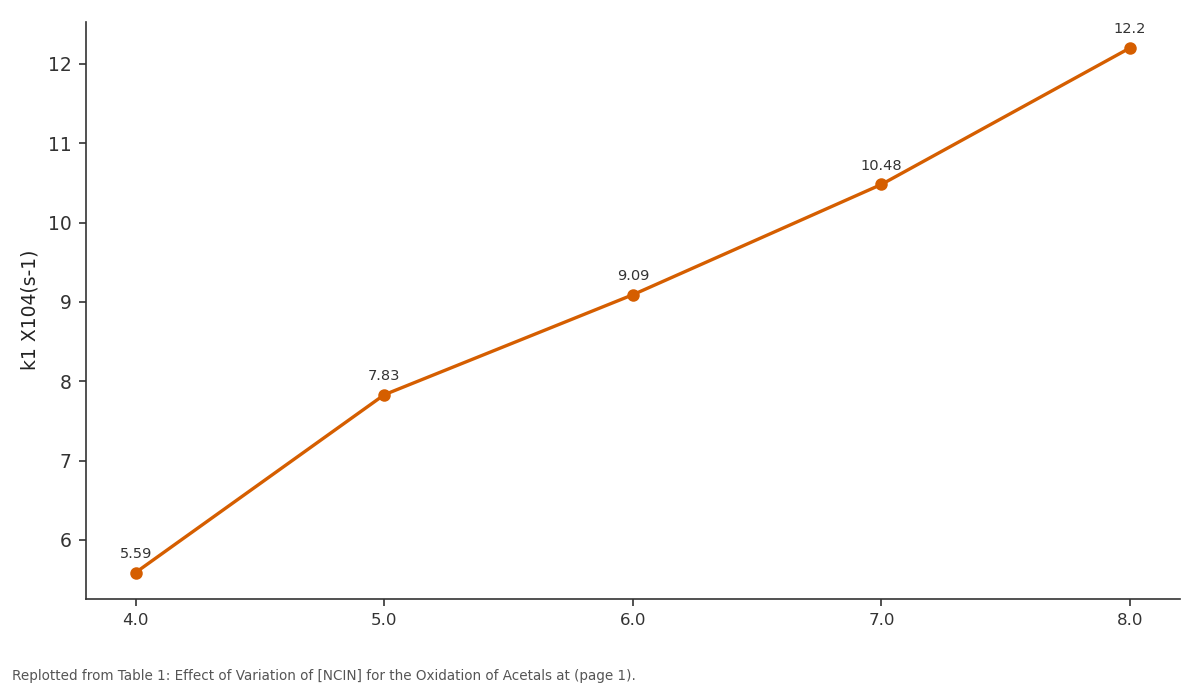
k1 X104(s-1): 4.0 vs 5.0 vs 6.0 vs 7.0 vs 8.0
Replotted from Table 1 (page 1) of the original paper. Every bar is the paper's own table value.
View source evidence ↗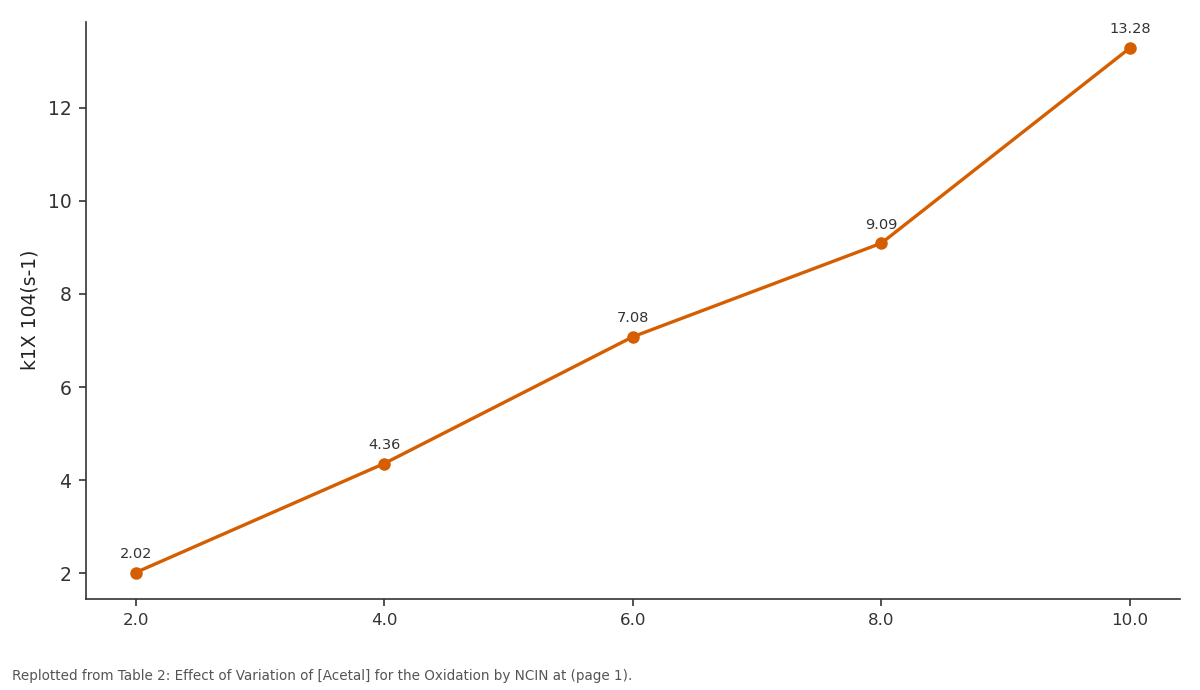
k1X 104(s-1): 2.0 vs 4.0 vs 6.0 vs 8.0 vs 10.0
Replotted from Table 2 (page 1) of the original paper. Every bar is the paper's own table value.
View source evidence ↗Figures & tables
From the original paper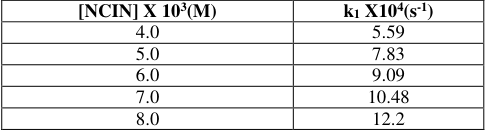 Table 1
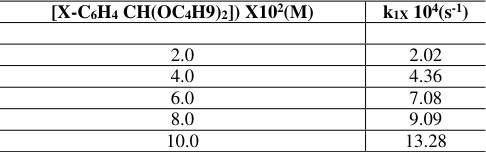 Table 2
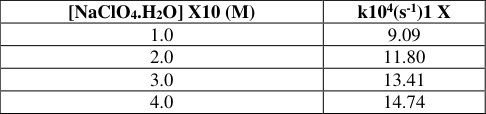 Table 5
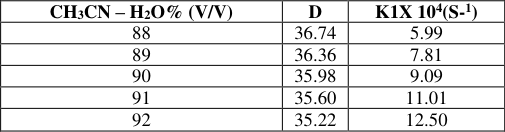 Table 3
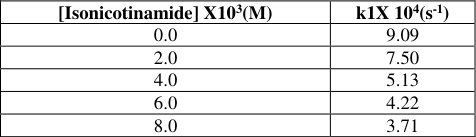 Table 4
Results And Discussion
The rate of oxidation is found to be first order each in [XC6H4CH (OR)2] and [NCIN]. Linear plot of log kobs versus log [XC6H4CH(OR)2] with a slope unity shows first order dependence on the rate of reaction. The log kobs values at different [acetal] are given in Table-1. The log [NCIN] versus time is found be linear indicating first order dependence on the rate of reaction.
The log kobs values obtained at different initial concentrations of NCIN reveal that the rates are almost independent of the initial concentration of NCIN (Table 2). Table 1: Effect of Variation of [NCIN] for the Oxidation of Acetals at 323 [X-C6H4 CH (OC4H9)2] = 8.0 X 10⁻²M [NaClO4.H2O] = 1.0 X 10- 2M Solvent (v/v) = 90% CH3CN 10% H2O [NCIN] X 103(M) k1 X104(s-1) 4.0 5.59 5.0 7.83 6.0 9.09 7.0 10.48 8.0 12.2 Table 2: Effect of Variation of [Acetal] for the Oxidation by NCIN at 323 K [NCIN] = 6.0X 10⁻²M [NaClO4.H2O] = 1.0 X 10⁻²M Solvent (v/v) = 90% CH3CN-10% H2O [X-C6H4 CH(OC4H9)2]) X102(M) k1X 104(s-1) 2.0 2.02 4.0 4.36 6.0 7.08 8.0 9.09 10.0 13.28
| [X-C6H4 CH(OC4H9)2]) X102(M) | k1X 104(s-1) |
|---|---|
| 2.0 | 2.02 |
| 4.0 | 4.36 |
| 6.0 | 7.08 |
| 8.0 | 9.09 |
| 10.0 | 13.28 |
Table text extracted from the original PDF; superscript letters are shown inline. The original table image is below.
View original table image
| [NCIN] X 103(M) | k1 X104(s-1) |
|---|---|
| 4.0 | 5.59 |
| 5.0 | 7.83 |
| 6.0 | 9.09 |
| 7.0 | 10.48 |
| 8.0 | 12.2 |
Table text extracted from the original PDF; superscript letters are shown inline. The original table image is below.
View original table image
Introduction
Chemical kinetics is a branch of chemistry which deals with rate of reaction. The kinetic study of oxidation of organic compound is a useful and powerful method in physical organic chemistry. The role of Nhalo compounds in this field is very wide. They are being used in kinetics, analytical 1 and organic structural investigation.
N-Halo compounds are particularly useful in synthesizing organic substrates. The electro negativities of halogens, except fluorine, are less than that of nitrogen. Hence they acquire a positive charge when linked with nitrogen. The electro-negativity of nitrogen is further enhanced by linking it with certain electron withdrawing groups such as acyl group.
Thus N-halo compounds are referred as positive halogen compounds. Recently, considerable attention has been focused on the chemistry of N-halo compounds. N-Chloroisonicotinamide (m.p. 214 ºC) was prepared bypassing a slow stream of chlorine into a solution of isonicotinamide (15 g in 30 mL 3 N HCl) at 32 ºC for 1 h. The NCIN formed as white crystals was filtered and the process of passing chlorine into the filtrate and filtering off the precipitate was repeated till no more precipitate was obtained.
N-Chloroisonicotinamide was found to be soluble in water, dimethylsulphoxide, acetic acid, but insoluble in chloroform and carbon tetrachloride. The kinetic study of oxidation of aromatic diethers by NCIN in acetonitrile is not reported so far and hence need for the title investigation.
Experimental
Section NCIN was prepared [17] and the purity was checked iodometrically [18]. All other chemicals were of AnalaRgrade. The seven acetals namely benzaldehyde di-n-butyl acetal, p- methoxybenzaldehyde di-nbutyl acetal, p-methylbenzaldehyde di-n-butylacetal, p-chlorobenzaldehyde di-n-butyl acetal, mchlorobenzaldehyde di-n-butylacetal, m-nitrobenzaldehyde di- n-butyl acetal and p-nitrobenzaldehyde din-butyl acetal were prepared by the standard methods [19-21]. Kinetic runs were carried out under pseudo-first order conditions 53 [NaClO4.H2O].
The reaction rate increases with the increase in ionic strength of the medium (Table 5). Table 5: Effect of Variation of Ionic Strength for the Oxidation of Acetals by NCIN at 323 K [X-C6H4 CH(OC4H9)2] = 8.0 x10⁻²M [NCIN] = 6.0 X10⁻³M Solvent (v/v) = 90% CH3CN 10% H2O The influence of solvent dielectric constant on the rate of NCIN oxidation of acetals has been studied in various solvent mixtures of acetonitrile and water. The rate of oxidation increases with the increase in acetonitrile content of the solvent mixture (Table 3). Table 3: Effect of Variation of Dielectric Constant for the Oxidation of Acetals by NCIN at 323 K [X-C6H4 CH(OC4H9)2] = 8.0 X10⁻²M [NCIN] = 6.0X 10⁻²M [NaClO4.H2O]] = 1.0 X 10⁻²M M [NaClO4.H2O]] =1.0 X10⁻²M CH3CN – H2O% (V/V) D K1X 104(S-1) 88 36.74 5.99 89 36.36 7.81 90 35.98 9.09 91 35.60 11.01 92 35.22 12.50 The effect of one of the products of the reaction on the rate of oxidation has been studied by adding various concentrations of isonicotinamide, keeping the concentrations of acetal and NCIN constant.
| CH3CN – H2O% (V/V) | D | K1X 104(S-1) |
|---|---|---|
| 88 | 36.74 | 5.99 |
| 89 | 36.36 | 7.81 |
| 90 | 35.98 | 9.09 |
| 91 | 35.60 | 11.01 |
| 92 | 35.22 | 12.50 |
Table text extracted from the original PDF; superscript letters are shown inline. The original table image is below.
View original table image
| [NaClO4.H2O] X10 (M) | k104(s-1)1 X |
|---|---|
| 1.0 | 9.09 |
| 2.0 | 11.80 |
| 3.0 | 13.41 |
| 4.0 | 14.74 |
Table text extracted from the original PDF; superscript letters are shown inline. The original table image is below.
View original table image
There is a decrease in the reactivity with the increase in the initially added concentration of isonicotinamide (Table 4). Table 4: Effect of Variation of [Isonicotinamide] for the Oxidation of Acetals by NCIN at 323 K [X-C6H4 CH(OC4H9)2] = 8.0 X 10⁻²M [NCIN] = 6.0 X 10⁻²M Solvent (v/v) = 90% CH3CN10% H2O [NaClO4.H2O = 1.0 X 10⁻²M [NaClO4.H2O] X10 (M) k104(s-1)1 X 1.0 9.09 2.0 11.80 3.0 13.41 4.0 14.74 The effect of added isonicotinamide (INA) is studied at different initial concentrations of isonicotinamide. It has as light retarding effect on the reaction rate. The ionic strength of the reaction is varied by the addition of NaClO4 and its influence on the reaction rate is studied.
| [Isonicotinamide] X103(M) | k1X 104(s-1) |
|---|---|
| 0.0 | 9.09 |
| 2.0 | 7.50 |
| 4.0 | 5.13 |
| 6.0 | 4.22 |
| 8.0 | 3.71 |
Table text extracted from the original PDF; superscript letters are shown inline. The original table image is below.
View original table image
It is found that increase in ionic strength of the reaction medium has no observable change on the rate of the reaction. Mechanism The results of NCIN oxidation of acetal in the present investigation can be accounted for, by identifying the rate- determining step. A probable mechanism may involve electrophilic attack of the positive part of oxidising species on the electron – rich oxygen atom of acetal rather than on the electron – deficient aldehydic hydrogen. The mechanism has been proposed assuming Cl+as the oxidizing species.
Solvent consists of a mixture of acetonitrile and water. The reactive oxidizing species may be Cl+ or solvated Cl +. The reactive species formed in the above equilibrium step attacks the acetal molecule in the rate- determining step. [Isonicotinamide] X103(M) k1X 104(s-1) 0.0 9.09 2.0 7.50 4.0 5.13 6.0 4.22 8.0 3.71 The influence of variation of ionic strength on the rate of oxidation has been studied by varying the concentrations of 54 Assuming Cl+ as the effective oxidizing species, the rate law is given as follows: The above rate law accounts for the first order dependence on [NCIN] and [acetal]. This also explains the retardation in the rate by the addition of isonicotinamide.
The pseudo-first order rate constant increases with the increase in [NCIN].
References
21 in the original paper- Patrocino FA. J Organomet. Chem; c2000;603:220.
- Singh AK, Sharma VK. Transition. Met. Chem. 2009;4:521.
- Praphu DV. J Indian Chem. Soc. 2007;84:1135.
- Jagadeesh RV. J Puttaswamy. Phy. Org. Chem. 2008;21:844.
- Baumstark AL, Pedro C, Hetero. Commun. 2002;8:9.
- Ramakrishnan PS. Asian J Chem. 2000;12:1096.
- Mathiyalagan N, Sridharan R, Priya V, J Indian Chem. Soc. 2005;82:795.
- Priya V, Mathiyalagan N, Asian J Chem. 2010;22:5218.
- Mathiyalagan N, Priya V, Bosco JJ, J Indian Chem. Soc. 2009;86:453.
- Priya V, Mathiyalagan N. Asian J Chem. 2011;23(4):1871.
- Ashok Sharma K, Punit Mudgal K, Gupta KS. J Indian Chem. Soc. 2008;85:920.
- Mathiyalagan N, Priya V, John Bosco J. J Indian Chem. Soc. 2006;86:453.
- Mathiyalagan N, Balasubramaniyan M. Orient J Chem., 2010;26:1541.
- Balasubramaniyan M, Priya V, Mathiyalagan N. Int. J Chem. Tech. Rech. 2011;3(3):1096.
- Pusphalatha L, Vivekanandan K. J Indian Chem. Soc. 2009;86:875.
- Karunakaran C, Chidambaranathan V. Croat. Chem. Acta. 2001;74:51.
- Mahamed Farook NA. J Iran. Chem. Soc., 2006;3(4):378.
- Jagadeesh RV, Puttaswamy J. Phy. Org. Chem. 2008;21:844.
- Puttaswamy, Anusukhdev. Ind J Chem. 2009;48(A):339- 345.
- Sridharan, Mathiya Lagan, Mapana J Science. 2004;3(1):1- 6.
- Priya V, Subalakshmi M. IJPCBS. 2017;7(1):50-54. 55