
Research article · 2021 · Full text
International Journal of Advanced Chemistry ResearchChemical control of cowpea anthracnose caused by (Colletotrichum lindemuthianum)
Volume 3(1) · Pages 35–37 · DOI: 10.33545/26646781.2021.v3.i1a.57 ↗
Research areasPlant Pathogens and Fungal DiseasesAgricultural pest management studiesPlant pathogens and resistance mechanisms
Abstract
Author-writtenThe pulse crop is very much known as poor man’s meat. One such crop is cowpea which has all the nutritional requirements that meets the demand of poverty trodden people. But, its bumper production is significantly hampered due to the anthracnose disease caused by Colletotrichum lindemuthianum. Prior to application of fungicides in the crop for the management of pathogen, tests were conducted by taking 13 different contact and systemic fungicides to find out their effectiveness in controlling the growth of mycelium of the test fungus in five different concentrations i.e. 0.05, 0.10, 0.15, 0.20, 0.25 and 0.30%. Difenoconazole proved to be fatal against the mycelial growth of the pathogen at 0.10% while other fungicides such as Thiophanate methyl at 0.15% followed by copper hydroxide, carbendazim and penconazole proved their efficacy at 0.25% but others influenced least.
Summary
Source-checkedPlain-language reading of the full paper, prepared with AI and checked against the text. Each point links to the authors' own words.
Why it matters
- Cowpea is a vital pulse crop that provides essential nutritional requirements for impoverished populations. View evidence ↗
- The production of cowpea is significantly reduced by anthracnose disease, which is caused by the fungus Colletotrichum lindemuthianum. View evidence ↗
- Laboratory-based (in vitro) fungicide testing is a critical first step to screen for effective chemicals and determine the minimum dose needed before moving to field tests. View evidence ↗
The question
- The study aimed to evaluate the effectiveness of 13 different contact and systemic fungicides in inhibiting the mycelial growth of Colletotrichum lindemuthianum. View evidence ↗
What they did
- Thirteen fungicides were tested at seven concentrations: 0.01%, 0.05%, 0.10%, 0.15%, 0.20%, 0.25%, and 0.30%. View evidence ↗
- The researchers used the filter paper disc plate method, placing 10mm sterilized discs soaked in fungicide into petriplates containing 20 ml of Richard’s Agar medium. View evidence ↗
- Five inoculum discs from a 10-day-old fungal culture were placed in the plates, which were then incubated at 28 ± 10°C for 8 days, with each treatment replicated three times. View evidence ↗
- Fungicide activity was measured by calculating the percentage inhibition of mycelial growth compared to a control group without fungicide. View evidence ↗
What they found
- Difenoconazole was the most effective fungicide, achieving 100% inhibition of mycelial growth starting at a concentration of 0.10%. View evidence ↗
- Thiophanate methyl achieved complete (100%) inhibition of fungal growth at concentrations of 0.15% and above. View evidence ↗
- Copper hydroxide, carbendazim, and penconazole all reached 100% inhibition of mycelial growth at concentrations of 0.20% and above. View evidence ↗
- Mancozeb showed effective inhibition from 0.15% and only achieved total (100%) inhibition at the highest tested concentration of 0.30%. View evidence ↗
What it means
- The authors conclude that difenoconazole is the most promising fungicide for controlling the mycelial growth of C. lindemuthianum. View evidence ↗
Visual summary
1 visualsIllustrations explain the paper; they do not show study data.
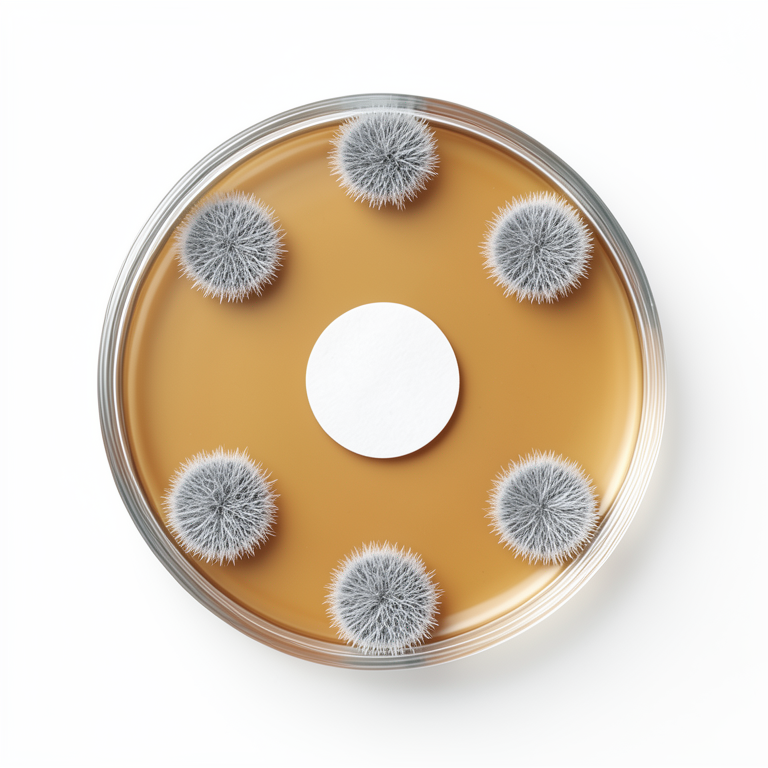
In Vitro Testing Setup
AI-generated conceptual illustration (Colletotrichum lindemuthianum fungus on agar in a petri dish). It explains the idea and does not show study data.
View source evidence ↗Figures & tables
From the original paper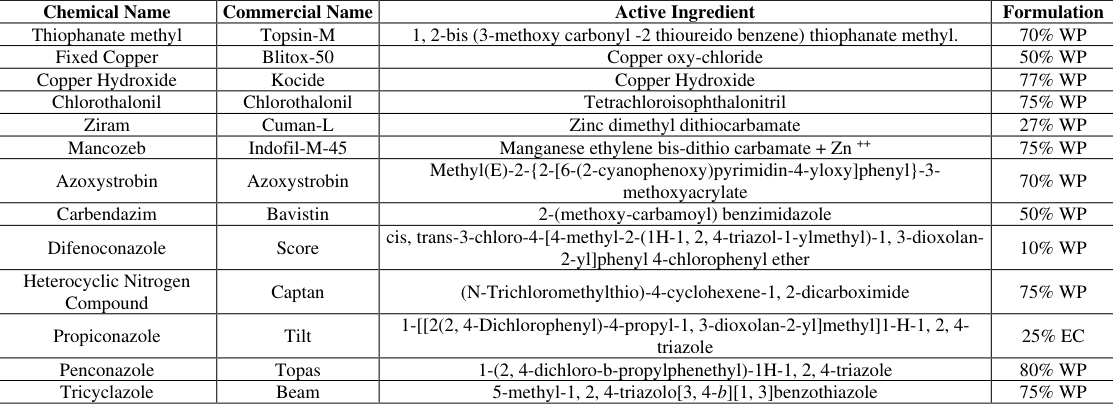 Table 1
Introduction
The cowpea (Vigna unguiculata L.) is an important food legume and an essential component of cropping systems of the drier regions of the tropics covering parts of Asia, Middle East, Southern Europe, Africa, Southern USA and Central and Southern America. Besides being a fast growing crop, cowpea curbs erosion by covering the ground, fixes atmospheric nitrogen and its decaying residues contribute to the soil fertility. Cowpea diseases induced by different pathogens belonging to various pathogenic groups (fungi, bacteria, viruses and nematodes) constitute one of the most important constraints to the profitable cowpea production. Anthracnose is one of the most dreaded fungal diseases of cowpea incited by Colletotrichum lindemuthianum (Sacc and Magn) Scribber affecting all parts of the plant throughout the growth season of the crop. This causes economic loss in tropical regions of Africa especially Nigeria, Latin America and Asia where conditions are wet and humid for the main part of the growing season (Satpathy et al.,2020) [8] . In vitro fungicide testing is important investigation for preliminary screening and evaluation of the effectiveness of fungicides to control a specific fungal pathogen. Laboratory evaluation allows researchers to distinguish effective from ineffective fungicides and thus, select appropriate candidate fungicides for field tests. In vitro fungicide testing is also important to determine the minimum or effective dose required to control the fungus, as well as to detect fungicide resistance. In vitro tests have been widely implemented in previous studies to determine the efficacy of fungicides towards Colletotrichum spp. causing anthracnose on various types of crops, e.g., C. truncatum on chilli (Gopinath et al. 2006) [3] , C. gloeosporioides on mango (Kumar et al. 2007) [5] , and C. acutatum on tomato (Chapin et al. 2006) [1] .
Materials and Methods
Thirteen different contact and systemic fungicides such as Thiophanate methyl, Fixed Copper, Copper Hydroxide, Chlorothalonil, Ziram, Mancozeb, Azoxystrobin, Carbendazim, Difenoconazole, Captan (heterocyclic nitrogen compound), Propiconazole, Penconzole and Tricyclazole were tried in seven different concentrations of 0.01, 0.05, 0.10, 0.15, 0.20, 0.25 and 0.30% in order to find out the efficacy of these chemicals against C. lindemuthianum by the filter paper disc plate method (Loo et al., 1945) [6] . All the details of chemicals have been mentioned in Table : 1. the sterilized filter paper discs of 10mm diameter were soaked with the fungicidal solution at desired concentration. The disc was placed at the center of petriplates (one disc per plate) containing 20 ml of Richard's Agar medium. Five inoculum discs were cut from the margin of a 10 days old culture of the test fungus and placed equidistantly from each other along with filter paper discs along the periphery of each petriplates. All the petriplates were incubated at 28 + 1 0 C for 8 days. Each treatment was replicated thrice. A control check without fungicide was maintained. The activity was measured in terms of inhibitory zone of C.lindemuthianum in each concentration of individual fungicide and was compared with control checks. The per cent inhibition of mycelial growth under each concentration of the fungicide was worked out by the following formulae: Where I = Inhibition percentage of diameter growth. Dc = diameter growth of fungal colony in control. Dt = diameter growth of fungal colony in treatment.
The commercial name, chemical name, active ingredient and formulation of different fungicides used in the present investigation are given in Table 1.
| Chemical Name | Commercial Name | Active Ingredient | Formulation |
|---|---|---|---|
| Thiophanate methyl | Topsin-M | 1, 2-bis (3-methoxy carbonyl -2 thioureido benzene) thiophanate methyl. | 70% WP |
| Fixed Copper | Blitox-50 | Copper oxy-chloride | 50% WP |
| Copper Hydroxide | Kocide | Copper Hydroxide | 77% WP |
| Chlorothalonil | Chlorothalonil | Tetrachloroisophthalonitril | 75% WP |
| Ziram | Cuman-L | Zinc dimethyl dithiocarbamate | 27% WP |
| Mancozeb | Indofil-M-45 | Manganese ethylene bis-dithio carbamate + Zn ++ | 75% WP |
| Azoxystrobin | Azoxystrobin | Methyl(E)-2-{2-[6-(2-cyanophenoxy)pyrimidin-4-yloxy]phenyl}-3- methoxyacrylate | 70% WP |
| Carbendazim | Bavistin | 2-(methoxy-carbamoyl) benzimidazole | 50% WP |
| Difenoconazole | Score | cis, trans-3-chloro-4-[4-methyl-2-(1H-1, 2, 4-triazol-1-ylmethyl)-1, 3-dioxolan- 2-yl]phenyl 4-chlorophenyl ether | 10% WP |
| Heterocyclic Nitrogen Compound | Captan | (N-Trichloromethylthio)-4-cyclohexene-1, 2-dicarboximide | 75% WP |
| Propiconazole | Tilt | 1-[[2(2, 4-Dichlorophenyl)-4-propyl-1, 3-dioxolan-2-yl]methyl]1-H-1, 2, 4- triazole | 25% EC |
| Penconazole | Topas | 1-(2, 4-dichloro-b-propylphenethyl)-1H-1, 2, 4-triazole | 80% WP |
| Tricyclazole | Beam | 5-methyl-1, 2, 4-triazolo[3, 4-b][1, 3]benzothiazole | 75% WP |
Table text extracted from the original PDF; superscript letters are shown inline. The original table image is below.
View original table image
Results and Discussion
It may be seen from the Table 2 that there were significant inhibition of mycelial growth of C.lindemuthianum in difenoconazole, thiophanate methyl, copper hydroxide, carbendazim and penconazole in different concentrations. At 0.05% concentration, thiophanate methyl and difenoconazole caused inhibition by more than 80%. But, at 0.10%, the reduction in mycelial growth was remarkable with thiophanate methyl, copper hydroxide, carbendazim, difenoconazole and penconazole. Mancozeb was effectively inhibiting at 0.15% onwards but at 0.30% totally stops mycelial growth. Chlorothalonil was significantly effective at a concentration of 0.25%. But at 0.30%, almost all were effective in inhibiting the mycelial growth. As difenoconazole totally inhibited mycelial growth at 0.10% onwards, thiophanate methyl at 0.15% onwards and copper hydroxide, carbendazim and penconazole at 0.20% onwards, these fungicides were found to be most efficacious against the test fungus as indicated by the laboratory tests. Bioassay studies of thirteen fungicides on seven different concentrations were tested against C.lindemuthianum (Table 2). It was revealed that complete inhibition of mycelial growth occurred at 0.15% conc. of Thiophanate methyl, 0.20% conc. of Copper hydroxide, Carbendazim and Propiconazole, and at 0.10% conc. of Difenoconazole. Copper oxychloride and Mancozeb both at 0.30% conc. were found effective against the test fungus. The efficacy of carbendazim against the anthracnose disease has also been proved in rose-scented geranium and also in chilli by Sattar et al. (2003) [9] and in chilli by Ekbote (2005) [2] which are in agreement with the present findings. However, in the present investigation, difenoconazole was found to be the most promising fungicide for inhibition of mycelial growth of C. lindemuthianum. Nuraini and Latiffah (2019) [7] reported similar effects by the application of systemic fungicide propiconazole where mycelium growth was inhibited in Colletotrichum spp. causing anthracnose in chilli. Jayalakshmi et al., 2013 [4] working on C. gleosporioides, the causative of pomegranate anthracnose noted the complete inhibition of mycelial growth by applying carbandazim + Mancozeb and propiconazole. Similar conclusions were made by Sashikumara et al. (2020) [10] while working on C. truncatum observed the efficacy of carbandazim + Mancozeb and propiconazole as complete fungi static but the individual action of carbendazim could inhibit the mycelial growth by 73% only. But, Propiconazole and tricyclazole were not proved fungi static in this experimentation.
References
10 in the original paper- Chapin LJG, Wang Y, Lutton E, Gardener BBM. Distribution and fungicide sensitivity of fungal pathogens causing anthracnose-like lesions on tomatoes grown in Ohio. Plant Disease. 2006;90:397-403.
- Ekbote SD. Effect of Pseudomonas fluorescens on anthracnose of chilli caused by Colletotrichum capsici. Karnataka Journ. Agricul. Sci. 2005;18(1):162-165.
- Gopinath K, Radhakrishnan NV, Jayaraj J. Effect of propiconazole and difenoconazole on the control of anthracnose of chilli fruits caused by Colletotrichum capsici. Crop Protect. 2006;25:1024-1031.
- Jayalakshmi K, Nargund VB, Raju J, Benagi. Effect of fungicides and plant extracts on growth of Colletotrichum gleosporioides (Penz) Penz and Sacc. causing anthracnose of Pomegranate. Bioinfolet. 2013;10(2A):502-506.
- Kumar AS, Reddy NE, Reddy KH, Devi MC. Evaluation of fungicidal resistance among Colletotrichum gloeosporioides isolates causing mango anthracnose in Agri Export Zone of Andhra Pradesh, India. Pl. Pathol. Bullet. 2007;16:157-160.
- Loo YH, Skell PS, Thornberry HH, Ehrlich John Mc, Guire JM, Savage GM, Sylvester JC. Assay of streptomycin by the paper disc plate method. Journ. Bacteriol. 1945;50:701709.
- Nuraini MN, Latiffah Z. Efficacy of selected fungicides against mycelial growth of Colletotrichum spp. causing anthracnose of chilli. Plant Patho. & Quaran. 2019;9(1): 43-45.
- Satpathy MR, Beura SK. Management of Colletotrichum lindemuthianum (Sacc. & Magn.) Scribber, the incitant of cowpea anthracnose: An integrated approach. Adv. Pl. Sci. 2020;33(I-II):95-97.
- Sattar A, Allam M, Khaliq A, Yaseen M, Kumar S. Incidence and chemical control of anthracnose disease of rose-scented geranium. Journ. Med. and Arom. Pl. Sci. 2003;25:113-117.
- Shashikumara B, Rajeswari B, Uma Devi G, Sridevi G, Konda S. In vitro evaluation of fungicides, botanicals and bioagents against Colletotrichum truncatum. Int. J. Curr. Microbiol. App. Sci. 2020;9(7):551-556. doi: https://doi.org/10.20546/ijcmas.2020.907.061
Cited by 6
From OpenAlex, OpenCitations and reference lists read by Scinovex
- Effects of four years of continuous conservation agriculture practice on soil fertility and maize (Zea mays L.) yield in agroecological transition context in western Burkina Faso
Kalifa Coulibaly, Alain PK Gomgnimbou, Idriss Sermé, Joseph FK Sanon, Hassan B Nacro · International Journal of Agriculture and Food Science · 2023
The objective of this study is to show the potential of conservation agriculture on chemical parameters, soil respiration activity and maize yields after 4 years of continuous CA practices. The experimental design is a factorial block with two treatments and three replications. The conventional system (CS = plowing + maize) is compared to the conservation agriculture system (CA = 2 t/ha of straw + direct seeding of maize/ cowpea). The results show that the CA system significantly increased soil pH (11.32%), carbon (81.13%), nitrogen (85.71%) and potassium (97.55%) in the 0-5 cm soil layer comp
- Impact of hot pepper, black pepper, Ginger and Moringa powder extracts against cowpea weevil Callosobruchus maculates and two storage methods on cowpea, Mogadishu, Somalia ↗
Abdihamid SH Abdi, Mohamed RA Samad, Abdirahman Barre, Abdulahi N Mohamed · Journal of Entomology and Zoology Studies · 2023
Cowpea weevil (Callosobruchus maculates) is a serious Cowpea pest which affects and destroys severely the grain within short period of 6 month in an open field and during storage period. This study aimed to evaluate the performance of hot pepper, black pepper, ginger and Moringa powder extracts and two storage methods against cowpea weevil. Laboratory experiment was conducted at plant…
- Assessment of fungitoxic effects of botanicals on the management of growth in Colletotrichum lindemuthianum, the incitant of cowpea anthracnose ↗
Manas Ranjan Satpathy, Debaraj Parida, Anirudha K Khillar · Journal of Current Research in Food Science · 2022
Antifungal activities of thirty six botanicals were assessed with an objective to find out the potential of botanicals against the mycelia growth of Colletotrichum lindemuthianum in vitro. Plant specimens were collected locally based on its medicinal, antimicrobial properties and extracted using aqueous means. The botanicals were tried in six different concentrations. Strychnos, Rauwolfia, Pongamia, Azadirachta, Datura, Zingiber, Allium cepa, Allium…
❝ 0PDF - Growth performance of soviet chinchilla rabbits under different feeding regimes
N Anandan, N. Kumaravelu, R. Venkataramanan, S. Usha, C. Bandeswaran, S Meenakhi Sundaram · International Journal of Biology Sciences · 2022
A trial was conducted to assess the performance of Soviet Chinchilla rabbit under different feeding regimes at Livestock Farm Complex, Madhavaram Milk Colony, Chennai-51. Thirty Soviet Chinchilla weaned bunnies of both sex aged around six weeks were randomly selected and divided into three groups namely T1(Guinea grass + Concentrate),T2 (Hydroponic Maize + Concentrate) and T3 (Hydroponic Cowpea +Concentrate). All the trial animals were reared under similar intensive system of management. Statistical analysis revealed that at start of the trial there was no significant difference in body weight
- Study on genetic variability heritability and correlation studies in cowpea (Vigna unguiculata L. Walp.)
Datthi Satayanarayan, Deepanshu Deepanshu, Vijay Bahadur · International Journal of Horticulture and Food Science · 2022
The present investigation entitled “Study on genetic variability heritability and correlation studies in cowpea (Vigna unguiculata L. Walp.)” was conducted at Research field, Department of Horticulture, SHUATS, Prayagraj. (U.P) during Rabi season of 2020-2021 The soil of experimental plot was sandy loam in texture nearly neutral in soil reaction (pH6.7) The experiment was conducted in randomized block design (RBD), consisting of 33 treatments combinations with 3 replications and was allocated randomly in each replication which consists of 33 genotypes The result concluded that out of tested th
- Development of protein enriched multigrain wheat flour ↗
Rajasekar Saranya, A Janani · International Journal of Home Science · 2021
Good nutrition requires a satisfactory diet, which is capable of supporting the individual consuming it, in a state of good health by providing the desired nutrients in required amounts. It must provide the right amount of fuel to execute normal physical activity. If the total amount of nutrients provided in the diet is insufficient, a state of under nutrition will…
❝ 0PDF