
Research article · 2022 · Full text
International Journal of Advanced Chemistry ResearchEffect of gamma radiation treatment on growth and morphology of red Amaranthus
Volume 4(2) · Pages 254–256 · DOI: 10.33545/26646781.2022.v4.i2d.107 ↗
Research areasSeed and Plant BiochemistryPlant Genetic and Mutation StudiesMagnetic and Electromagnetic Effects
Abstract
Author-writtenA field experiment was conducted during Rabi season 2020-21 at Instructional cum Research Farm, Indira Gandhi Krishi Vishwavidyalaya, Raipur, (C.G.) to study the effect of gamma radiation treatment on growth and morphology of red Amaranthus. The red Amaranthus was grown and treatments were replicated three times in randomized block design. The experiment consists of eleven doses of gamma radiation viz., 600, 650, 700, 750, 800, 850, 900, 950, 1000, 1050 GY and control. The result revealed that growth parameters viz., number of functional leaves plant-1, Number of branches plant-1, dry weight (g) plant-1, Weight of inflorescence (g) plant-1 and Seed yield (g) plant-1 was recorded in 850 dose of gamma radiation which was at par to 1000 doses of gamma radiation. The lowest growth parameters were recorded under with out treated with gamma radiation (control).
Summary
Source-checkedPlain-language reading of the full paper, prepared with AI and checked against the text. Each point links to the authors' own words.
Why it matters
- Red Amaranth is a valuable vegetable crop known for its high nutritional content and resilience against pests, diseases, drought, and heat. View evidence ↗
- Induced mutation is a critical technology for improving crops and understanding the mechanisms of mutation processes. View evidence ↗
- Mutation breeding is used to improve specific target traits by breaking tight genetic linkages, which increases variability for quantitative characters. View evidence ↗
The question
- The study aimed to evaluate how different doses of gamma radiation treatment affect the growth and morphology of red Amaranthus. View evidence ↗
What they did
- The field experiment took place at the Instructional cum Research Farm in Raipur, Chhattisgarh, during the 2020-21 Rabi season. View evidence ↗
- The study used a randomized block design with three replications for each treatment. View evidence ↗
- The treatments included a control group and ten different gamma radiation doses ranging from 600 to 1050 Gy. View evidence ↗
- The researchers measured seed yield, inflorescence weight, dry weight, the number of branches, and the number of functional leaves per plant. View evidence ↗
What they found
- The 850 Gy dose produced the highest number of functional leaves per plant (reaching 147.92 at harvest), performing similarly to the 1000 Gy and 750 Gy doses. View evidence ↗
- The 850 Gy dose led to significantly higher dry matter accumulation per plant across all growth stages, peaking at 34.68 g at harvest. View evidence ↗
- The maximum weight of inflorescence per plant (7.66 g) was achieved with the 1000 Gy dose, which outperformed other treatments. View evidence ↗
- The 850 Gy dose produced the highest seed yield per plant at 20.38 g, significantly exceeding other treatments. View evidence ↗
- The control group (untreated seeds) consistently showed the lowest growth parameters, including the lowest dry matter production (5.46 g at harvest). View evidence ↗
What it means
- The authors conclude that the 850 Gy dose of gamma radiation is highly effective for improving growth parameters and seed yield, performing comparably to the 1000 Gy dose. View evidence ↗
Visual summary
2 visualsIllustrations explain the paper; charts are replotted from the paper's own table values.
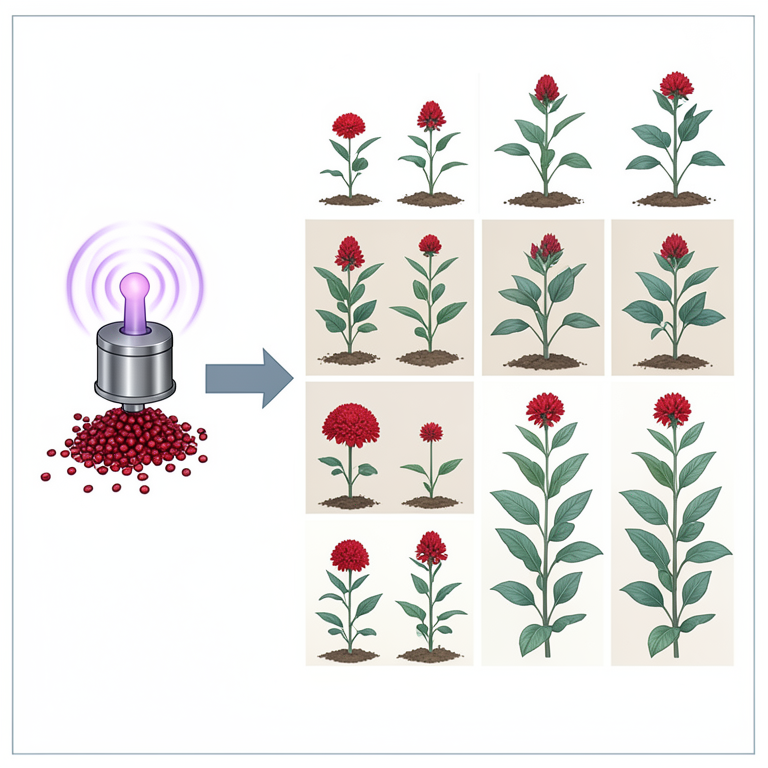
Experimental Setup
AI-generated conceptual illustration (red Amaranthus seeds and plants). It explains the idea and does not show study data.
View source evidence ↗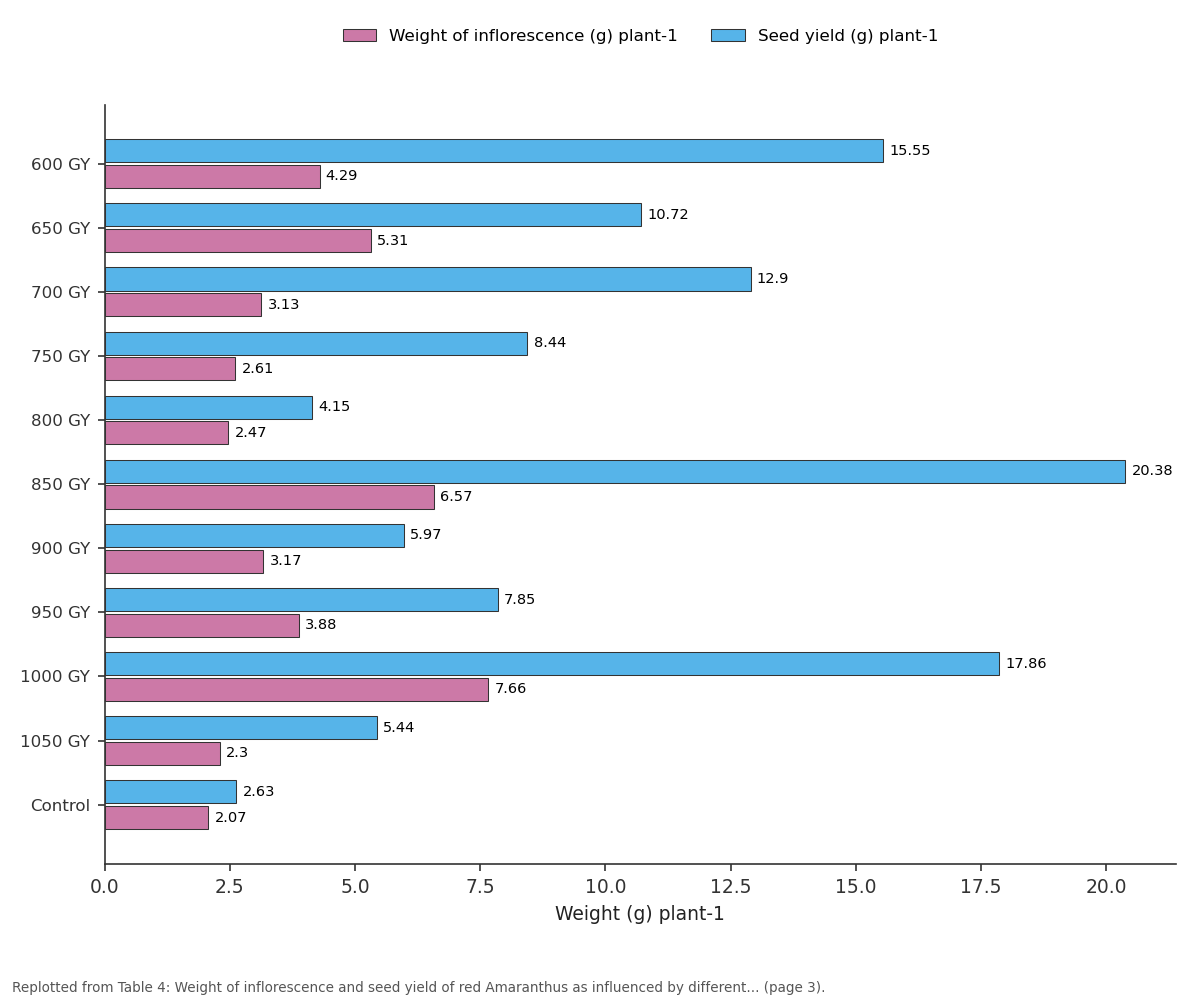
Weight of inflorescence (g) plant-1 and Seed yield (g) plant-1: 600 GY vs 650 GY vs 700 GY vs 750 GY vs 800 GY
Replotted from Table 4 (page 3) of the original paper. Every bar is the paper's own table value.
View source evidence ↗Figures & tables
From the original paper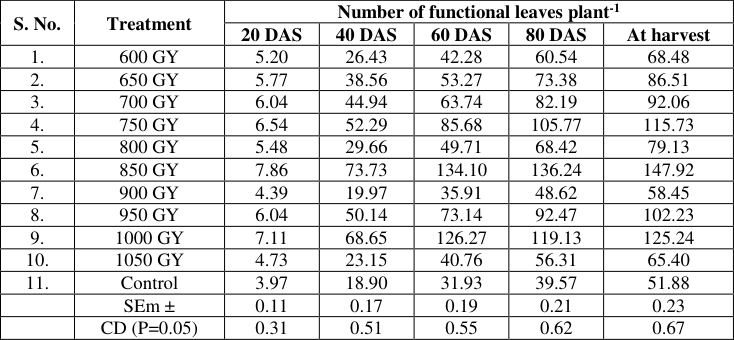 Table 1
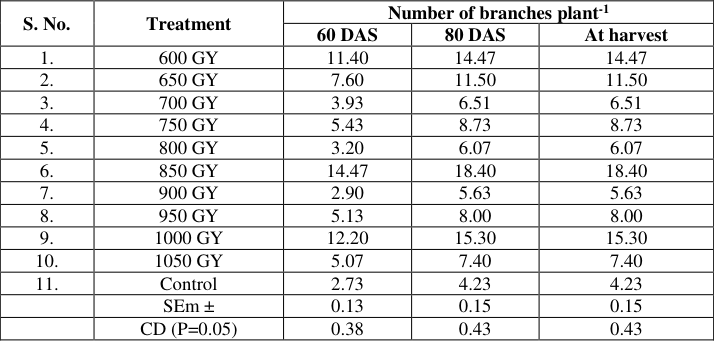 Table 2
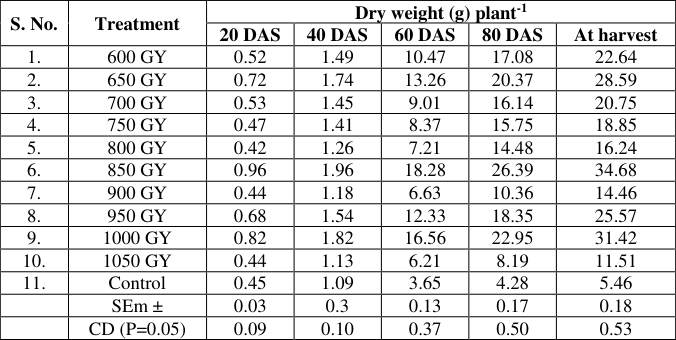 Table 3
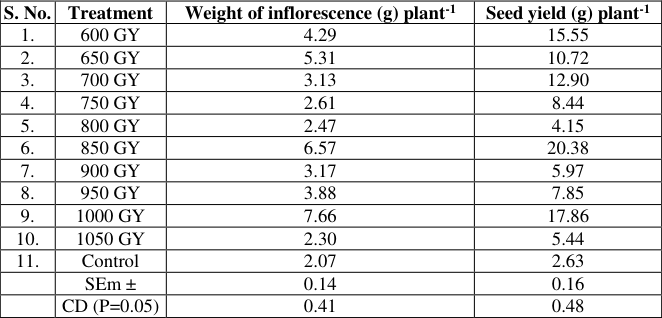 Table 4
Introduction
Red Amaranth (Amaranthus tricolor L.) (2n=34) belongs to family Amaranthaceae, originated from Central America is a promising vegetable crop for its resistance to heat, drought, diseases and pests, as well as high nutritional value (Sreelathakumary and Peter, 1993; India is a well know for the production of vegetables crop growing areas among other countries. After china, India is the second largest producer of the vegetables crop. India produced 1, 88, 907 thousand million tonnes of fresh vegetables from 10,303 thousand ha areas (Ministry of agriculture and farmers Welfare, 2019-20). In Chhattisgarh, total area comes under the vegetable cultivation is 489.27 thousand ha and total production of vegetables is about 6,868.12 million tonnes out of which the area comes under the leafy vegetables is about 9.95 thousand ha and total production of vegetables is about 97.581 million tonnes (Ministry of agriculture and farmers Welfare, Govt. of India, 2019-20). Induced mutation is one of the most important method for the crop improvement technologies which played a significant role in the improvement and play a major role for the understanding regarding the nature and mechanism of mutation processes. They provide good results in most of crops for the improvement of their yield performance. The major importance of the mutation breeding is an improvement of specific target characters in the different adopted and durable genotypes breaking tight linkages thus helping in obtaining rare recombinations and in enlarging variability for quantitative characters. The success of the induced mutation breeding programme mostly depends on the numbers of useful mutants produced by the induced mutation. Naturally, an enlarged mutation spectrum as well as increased mutation frequency would enhance the chances of isolating beneficial mutants (Joseph et al., 2015) [3] .
Material and methods
A field experiment was conducted during Rabi season 2020-21 at Instructional cum Research Farm, Indira Gandhi Krishi Vishwavidyalaya, Raipur, (C.G.). The red Amaranthus was grown and treatments were replicated three times in randomized block design. The soil of the experiment field was clay-loam. Gamma ray irradiated seeds were obtained from the Bhabha Atomic Research Centre (BARC), Trombay, Mumbai (M.H.). Ten different absorbed doses of gamma rays were used viz., 600 Gy, 650 Gy, 700 Gy, 750 Gy, 800 Gy, 850 Gy, 900 Gy, 950 Gy, 1000 Gy and 1050 Gy. (Gray is the S.I. unit of absorbed dose). The irradiated seeds are considered as treated and the untreated seeds are termed as control. A week after the treatment, seeds were sown in the field along with control.
Observation was recorded on the five randomly selected plants were used for calculating the mean. Observation was recorded number of functional leaves plant -1 , Number of branches plant -1 , dry weight (g) plant -1 , Weight of inflorescence (g) plant -1 and Seed yield (g) plant -1 .
Results and Discussion
Results and Discussion
Number of functional leaves plant -1
The data on number of functional leaves plant -1 was significantly influenced by different doses of gamma radiation and presented in Table-1 number of functional leaves plant -1 at 20, 40 60, 80 DAS and at harvest was significantly influenced by different doses of gamma radiation. The highest number of functional leaves plant -1 was recorded in 850 GY which was at par to 1000 GY and 750 GY at all the stages of crop growth and 20 DAS. However, the lowest number of functional leaves plant -1 was noted under control plot. Ochatt et al. (2007) [6] reported that the production of the growth regulator, kinetin, might have been stimulated, which may be responsible for the increased number of leaves. Dubey et al. (2007) [2] showed an increase in the number of leaves when okra seeds were irradiated with different doses of gamma rays. Indeed, the number of leaves positively correlated with leaf length (𝑟 = 0.970) and leaf width (𝑟 = 0.931). Minisi et al. (2013) reported that the increased number of branches and number of leaves may be due to the enhanced production of IAA and kinetin which stimulates the production of large number of leaves and branches.
Number of branches plant -1
The data on number of branches plant -1 are presented in table 4.7. revealed that the various doses of gamma radiation are significantly influenced number of branches plant -1 of red Amaranths at 60, 80 DAS and at harvest. Significantly the highest number of branches plant -1 of red Amaranths was noted under 850 dose of gamma radiation (14.47). However it was statistically at par with 1000 and 600 radiations of gamma rays at 60 DAS (12.83 and 17.56) and at harvest (12.66 and 18.50). Significantly the lowest number of branches plant -1 was recorded under control plot (2.73).
| S. No. | Treatment | Weight of inflorescence (g) plant-1 | Seed yield (g) plant-1 |
|---|---|---|---|
| 1. | 600 GY | 4.29 | 15.55 |
| 2. | 650 GY | 5.31 | 10.72 |
| 3. | 700 GY | 3.13 | 12.90 |
| 4. | 750 GY | 2.61 | 8.44 |
| 5. | 800 GY | 2.47 | 4.15 |
| 6. | 850 GY | 6.57 | 20.38 |
| 7. | 900 GY | 3.17 | 5.97 |
| 8. | 950 GY | 3.88 | 7.85 |
| 9. | 1000 GY | 7.66 | 17.86 |
| 10. | 1050 GY | 2.30 | 5.44 |
| 11. | Control | 2.07 | 2.63 |
| SEm ± | 0.14 | 0.16 | |
| CD (P=0.05) | 0.41 | 0.48 |
Table text extracted from the original PDF; superscript letters are shown inline. The original table image is below.
View original table image
The data regarding crop dry matter accumulation at 20, 40, 60, 80 DAS and at harvest are presented in table-3. The data reveals increased dry matter accumulation with the advancement of crop growth stages, irrespective of treatments. Among the different doses of gamma radiation significantly higher dry matter accumulation plant -1 was recorded under 850 dose of gamma radiation (0.96, 1.96, 18.28, 26.39 and 34.68 g) as compared to others.
The weight of inflorescence was recorded at 20, 40, 60, 80 DAS and at harvest was significantly influence by various doses of gamma radiation are presented in Table -3. Among all the doses of gamma radiation significantly the maximum weight of inflorescence was recorded under 1000 dose of gamma radiation (7.66 g) which was superior over rest of treatment. However it was statistically at par with 850 and 650 dose of gamma radiation (6.57 and 5.31 g). The lowest weight of inflorescence was found under control plot (2.07 g).
The data given in table 4.12 reveal that the seed yield plant -1 was significantly influenced by various doses of gamma radiation. Among all the different doses of gamma radiation maximum seed yield plant -1 was recorded under 850 dose of gamma radiation (20.38 g) which was significantly superior over rest of the treatment. However it was statistically at par with 1000 dose of gamma radiation (17.86 g). The lowest seed yield plant -1 was found under control pot (2.63 g). The impact of gamma radiations on Pisum sativum L. was examined by exposing Pea seeds to gamma rays of 50, 100, 150, and 200Gy. Result reveals the highest plant yield was recorded in 50Gy and 100Gy as compared to control while 200Gy had the lowest yield (Khan et al., 2021) [4] .
Figures and tables from the paper
| S. No. | Treatment | Number of functional leaves plant-1 | — | — | — | — |
|---|---|---|---|---|---|---|
| 20 DAS | 40 DAS | 60 DAS | 80 DAS | At harvest | ||
| 1. | 600 GY | 5.20 | 26.43 | 42.28 | 60.54 | 68.48 |
| 2. | 650 GY | 5.77 | 38.56 | 53.27 | 73.38 | 86.51 |
| 3. | 700 GY | 6.04 | 44.94 | 63.74 | 82.19 | 92.06 |
| 4. | 750 GY | 6.54 | 52.29 | 85.68 | 105.77 | 115.73 |
| 5. | 800 GY | 5.48 | 29.66 | 49.71 | 68.42 | 79.13 |
| 6. | 850 GY | 7.86 | 73.73 | 134.10 | 136.24 | 147.92 |
| 7. | 900 GY | 4.39 | 19.97 | 35.91 | 48.62 | 58.45 |
| 8. | 950 GY | 6.04 | 50.14 | 73.14 | 92.47 | 102.23 |
| 9. | 1000 GY | 7.11 | 68.65 | 126.27 | 119.13 | 125.24 |
| 10. | 1050 GY | 4.73 | 23.15 | 40.76 | 56.31 | 65.40 |
| 11. | Control | 3.97 | 18.90 | 31.93 | 39.57 | 51.88 |
| SEm ± | 0.11 | 0.17 | 0.19 | 0.21 | 0.23 | |
| CD (P=0.05) | 0.31 | 0.51 | 0.55 | 0.62 | 0.67 |
Table text extracted from the original PDF; superscript letters are shown inline. The original table image is below.
View original table image
| S. No. | Treatment | Number of branches plant-1 | — | — |
|---|---|---|---|---|
| 60 DAS | 80 DAS | At harvest | ||
| 1. | 600 GY | 11.40 | 14.47 | 14.47 |
| 2. | 650 GY | 7.60 | 11.50 | 11.50 |
| 3. | 700 GY | 3.93 | 6.51 | 6.51 |
| 4. | 750 GY | 5.43 | 8.73 | 8.73 |
| 5. | 800 GY | 3.20 | 6.07 | 6.07 |
| 6. | 850 GY | 14.47 | 18.40 | 18.40 |
| 7. | 900 GY | 2.90 | 5.63 | 5.63 |
| 8. | 950 GY | 5.13 | 8.00 | 8.00 |
| 9. | 1000 GY | 12.20 | 15.30 | 15.30 |
| 10. | 1050 GY | 5.07 | 7.40 | 7.40 |
| 11. | Control | 2.73 | 4.23 | 4.23 |
| SEm ± | 0.13 | 0.15 | 0.15 | |
| CD (P=0.05) | 0.38 | 0.43 | 0.43 |
Table text extracted from the original PDF; superscript letters are shown inline. The original table image is below.
View original table image
| S. No. | Treatment | Dry weight (g) plant-1 | — | — | — | — |
|---|---|---|---|---|---|---|
| 20 DAS | 40 DAS | 60 DAS | 80 DAS | At harvest | ||
| 1. | 600 GY | 0.52 | 1.49 | 10.47 | 17.08 | 22.64 |
| 2. | 650 GY | 0.72 | 1.74 | 13.26 | 20.37 | 28.59 |
| 3. | 700 GY | 0.53 | 1.45 | 9.01 | 16.14 | 20.75 |
| 4. | 750 GY | 0.47 | 1.41 | 8.37 | 15.75 | 18.85 |
| 5. | 800 GY | 0.42 | 1.26 | 7.21 | 14.48 | 16.24 |
| 6. | 850 GY | 0.96 | 1.96 | 18.28 | 26.39 | 34.68 |
| 7. | 900 GY | 0.44 | 1.18 | 6.63 | 10.36 | 14.46 |
| 8. | 950 GY | 0.68 | 1.54 | 12.33 | 18.35 | 25.57 |
| 9. | 1000 GY | 0.82 | 1.82 | 16.56 | 22.95 | 31.42 |
| 10. | 1050 GY | 0.44 | 1.13 | 6.21 | 8.19 | 11.51 |
| 11. | Control | 0.45 | 1.09 | 3.65 | 4.28 | 5.46 |
| SEm ± | 0.03 | 0.3 | 0.13 | 0.17 | 0.18 | |
| CD (P=0.05) | 0.09 | 0.10 | 0.37 | 0.50 | 0.53 |
Table text extracted from the original PDF; superscript letters are shown inline. The original table image is below.
View original table image
References
6 in the original paper- Dubey AK, Yadav JR, Singh B. Studies on induced mutations by gamma irradiation in okra (Abelmoschus esculentus (L.) Monch.). Progressive Agriculture 7 (1and2); 2007, 46-48.
- Joseph XK, Baba S, Nelson O. Potential of gamma rays to improve grain yield and nutritional quality of pearl millet (Pennisetum glaucum L.): A review. Elixir Agriculture. 2015;79:30667-30671.
- Khan SA, Sahani RM, Tripathi RP, Akhtar MS, Srivastava A. Influence of gamma-irradiation on the optical and structural properties of nano-thin chalcogenide films. Radiation Physics and Chemistry. 2021;188:1096-1102.
- Maisi VF, Lotkhov SV, Kemppinen A, Heimes A, Muhonen JT, Pekola JP. Excitation of single quasiparticles in a small superconducting Al island connected to normal-metal leads by tunnel junctions. Physical Review Letters. 2013;111(14):123130.
- Ochatt SJ, Koné M, Patat OEM, Conreux C, Sangwan RS. In vitro morphogenesis from cotyledon and epicotyl explants and flow cytometry distinction between landraces of Bambara groundnut [Vigna subterranea (L.) an under-utilised grain legume. Plant cell, tissue and organ culture. 2007;88(1):61-75.
- Sreelathakumary I, Peter KV. Amaranth Amaranthus spp. In: Genetic Improvement of Vegetable Crops. Pergamon Press; 1993, p. 315-323.
Cited by 1
From OpenAlex, OpenCitations and reference lists read by Scinovex
- Mutation induction through Gamma irradiation and evaluation of Amaranthus (A. tricolor and A. viridis) mutant lines for yield attributes
Vijay Jyoti Khalkho, Pravin Kumar Sharma, Puleshwar Kumar, Gulab Das Barman · International Journal of Advanced Biochemistry Research · 2026
The present investigation entitled “Induction of mutation through physical mutagen and characterization of mutant lines in Amaranthus (A. tricolor and A. viridis)” was conducted during Rabi and Summer seasons of 2021-22, 2022-23 and 2023-24 at the Horticultural Research and Instructional Farm, Department of Horticulture, Indira Gandhi Krishi Vishwavidyalaya, Raipur, Chhattisgarh. Fourteen amaranthus lines were evaluated in a Randomized Block Design with three replications for germination, establishment, vegetative growth, flowering, inflorescence characteristics, dry matter accumulation and yi