
Research article · 2022 · Full text
International Journal of Agriculture and NutritionThe effect of the erosion process on the grayish mountain-brown (Chestnut) soil of Shamakhi region, located on the southeastern slope of the greater Caucasus
Volume 4(2) · Pages 58–60 · DOI: 10.33545/26646064.2022.v4.i2a.82 ↗
Research areasHorticultural and Viticultural ResearchPlant Ecology and Soil ScienceSoil erosion and sediment transport
Abstract
Author-writtenThe complexity, sharp change in the relief condition, the tension of the anthropogenic factors in the Shamakhi region, where we have investigated, has intensified the erosion process. Because of the lack of agrotechnical measures on the slopes, the erosion process has been intensified, the soil is flooded with soil, the physical and chemical properties of the soil have deteriorated, the nutritional elements have declined, the vegetation has been degraded and reached the limit of destruction. For some reason, the object of research was Shamakhi two land cuts were set up to determine the degree of actual erosion of the soil in the village of Melham. Which will result in preventive measures to prevent erosion intensities and to develop and implement appropriate preventive measures.
Summary
Source-checkedPlain-language reading of the full paper, prepared with AI and checked against the text. Each point links to the authors' own words.
Why it matters
- In the Shamakhi region, erosion has been intensified by complex relief conditions and anthropogenic factors. View evidence ↗
- A lack of agrotechnical measures on slopes has led to deteriorated soil properties, declined nutrients, and degraded vegetation. View evidence ↗
The question
- The study aimed to determine the actual degree of soil erosion in the village of Melham, Shamakhi. View evidence ↗
What they did
- The researchers performed morphological descriptions of mountain-chernozem soils that were subjected to erosion and flushed to an average degree. View evidence ↗
- The study utilized two soil sections, including one located on the gentle east Bakharli slope in Jabani village. View evidence ↗
What they found
- Middle flushed soils showed a decrease in waterproof aggregates compared to non-flushed soils, indicating a disordered soil structure. View evidence ↗
- Flushed mountain-black soils experienced a decrease in physical clay, resulting in a lighter mechanical composition. View evidence ↗
- In non-flushed mountain-black soils, humus levels ranged from 1.94% to 5.35% and common nitrogen from 0.10% to 0.26%. View evidence ↗
- The studied soils were carbonated, with CaCO3 levels between 2.73% and 3.57%. View evidence ↗
- In the profile alkali, phosphorus levels were 27.2–33.3 mg/kg and exchanged potassium was 335.0–442.0 mg/kg. View evidence ↗
What it means
- The authors conclude that the erosion process significantly reduces the fertile potential of mountain chernozem soils. View evidence ↗
Visual summary
2 visualsIllustrations explain the paper; charts are replotted from the paper's own table values.
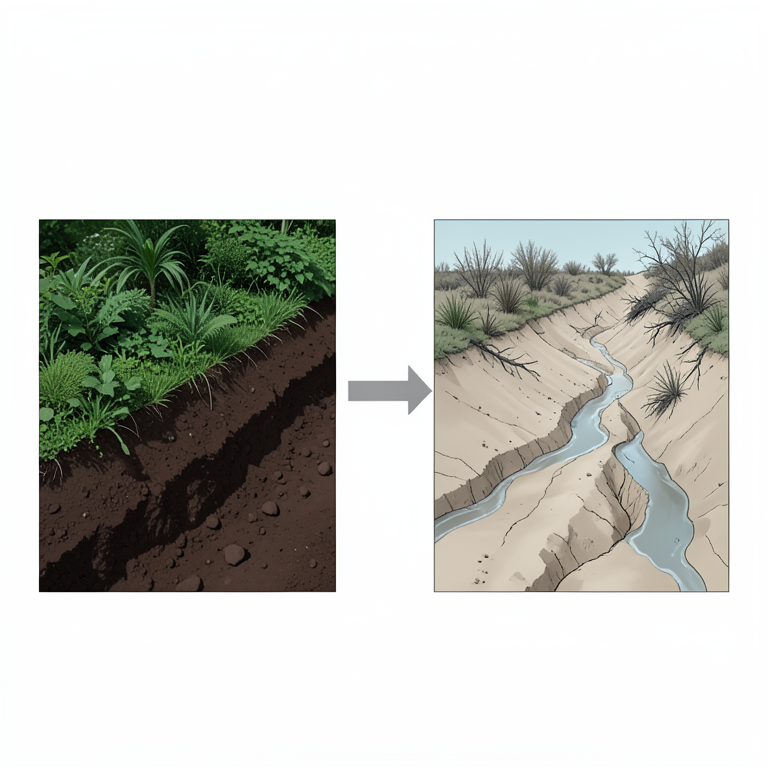
Erosion Feedback Loop
AI-generated conceptual illustration (grayish mountain-brown soil on a mountain slope in the Caucasus region). It explains the idea and does not show study data.
View source evidence ↗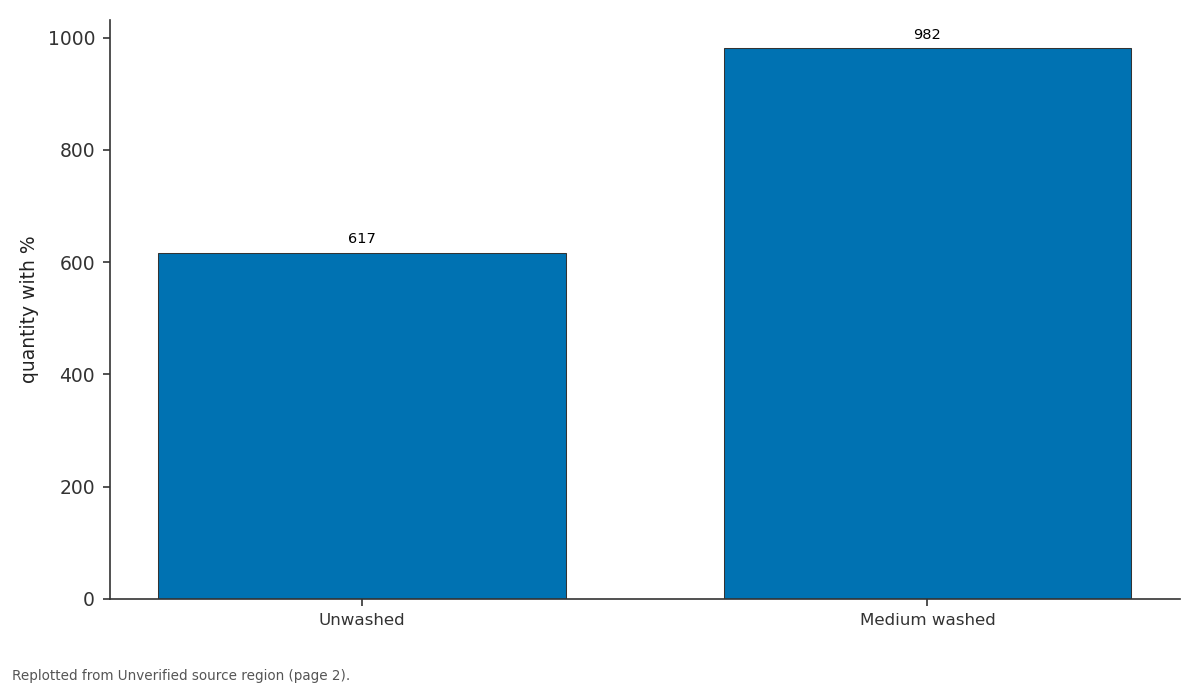
0,25-0, 05: Unwashed vs Medium washed
Replotted from a table (page 2) of the original paper. Every bar is the paper's own table value.
View source evidence ↗Figures & tables
From the original paper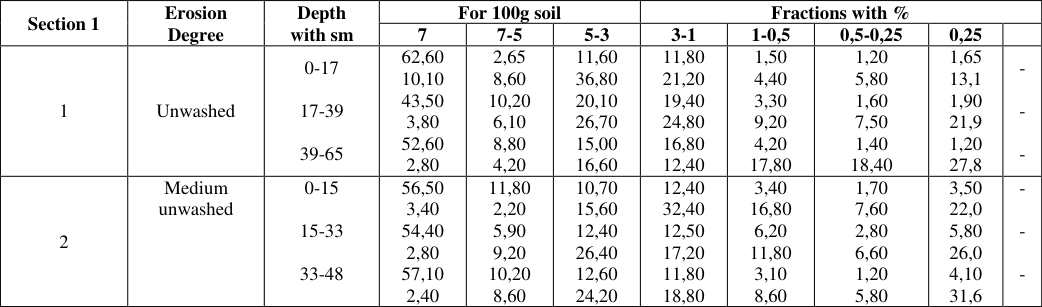 Table 1
Introduction
Impact Factor: RJIF 5.2 IJAN 2022; 4(2): 58-60 Dr. Zakir Aliyev Institute of Soil Science and Agrochemistry NAS of Azerbaijan, Azerbaijan Dr. MA Quliyeva Institute of Soil Science and Agrochemistry NAS of Azerbaijan, Azerbaijan Dr. Zakir Aliyev Institute of Soil Science and Agrochemistry NAS of Azerbaijan, Azerbaijan Shamakhi region, situating in south-east slope of Great Caucasian has 393, 3 thousand hectare area.
The area of region is situated in 200-2500 m. height above seal level. As in all regions of Great Caucasian, this region is belonged to low mountainous zone, from geological and geomorphologic point of view. In soil formation process, rocks play a great role in formation of their fertility. When the rocks, rich with mineral elements are weathered in the region, absorbs into soil a great number of nourishment elements.
A lot of potassium and other elements are absorbed into the structure of soils, of which hydromica arises from fieldspar, mica and slates. In mountainous part of the region, soil former rocks mainly consist of slates, marls and sandy. But in watersheds, basalt, marble and granites are met. https://www.agriculturejournal.net/ In middle mountainous part the rocks mainly consist of clayey slates, clay with lime mixture and sandy. As it is known, climate plays a very great role in soil formation process.
V.V. Dokuchayev (1), I.P.Gerasimov (2), I.F.Figurovski (3), A.Shikhlinski (4), and others have informed about a great role of climate in erosion formation process. Climate of Shamakhi region corresponds to the climate of Middle Europe. Here, the minimum temperature is observed between 3rd ten days of December and 2nd ten days of February.
And the maximum temperature is observed in February, July-August months. Average yearly quantity of rains is about 460-600 mm. Mountain and meadow, mountain and forest, mountain- chernozem, mountain and grey-dark brown soils have spread in region area. Because of our investigation covers mountain-chernozem, we dwell on their main character.
V.V.Akimitsev (9), M.A.Salayev (10), G.B.Salamov (11), B.G.Shakuri (8) and others have noted on spreading of chernozem in mountain zone of Azerbaijan. Chernozems have spread in limited area in Great Caucasian and are strongly used under agriculture plants. They have mainly developed in middle mountainous area of Shamakhi and Ismayilli regions. The course of research and discussion of materials We have investigated mountain-chernozems in Shamakhi region.
Morphological description of soils types, flushed in average degree and subjected to erosion is indicated below. Section 1: Divided in the region of Jabani village, gentle east Bakharli slope. A 0-17 cm chernozem clayey, heap, hard, dry, plant roots, rootlets, worm ways, small stones, boils for the impact of chlorine acid, the passage is clear. B 17-39 cm-chernozem, upper layer is relatively light, clayey, heap a little hard, root and rootlets, small stones, spots in brown vein form, worm ways, damp, boils for the impact of chlorine acid, passage is gradual.
Table 1: Stutuctural aggregate composition of carbonated mountain-black soil Section 1 Erosion Degree Depth with sm For 100g soil Fractions with % 7 7-5 5-3 3-1 1-0,5 0,5-0,25 0,25 0-17 - 62,60 10,10 43,50 2,65 8,60 10,20 1 Unwashed 17-39 - 3,80 52,60 39-65 - 2,80 6,10 8,80 4,20 11,60 36,80 20,10 26,70 15,00 16,60 11,80 21,20 19,40 24,80 16,80 12,40 1,50 4,40 3,30 9,20 4,20 17,80 1,20 5,80 1,60 7,50 1,40 18,40 1,65 13,1 1,90 21,9 1,20 27,8 0-15 56,50 11,80 - Medium unwashed 3,40 16,80 15-33 3,40 54,40 - 2 6,20 11,80 33-48 2,80 57,10 2,20 5,90 9,20 10,20 - 2,40 8,60 10,70 15,60 12,40 26,40 12,60 24,20 12,40 32,40 12,50 17,20 11,80 18,80 3,10 8,60 1,70 7,60 2,80 6,60 1,20 5,80 3,50 22,0 5,80 26,0 4,10 31,6 Hygroscopic Section 1 Erosion degree Depth with sm humidity Fractions' measure with mm, quantity with % 1-0,25 0,25-0, 05 0, 05-0, 01 0, 01-0, 005 0, 005-0, 001 < 0, 001 < 0, 001 Unwashed 1 0-17 5,74 4,63 6,17 29,20 15,20 15,20 15,20 60,00 17-39 6,41 0,32 10,88 24,40 19,60 19,60 18,40 64,40 39-65 6,71 2,40 9,20 19,20 18,40 18,40 18,40 69,28 Medium 2 washed 0-15 5,28 0,30 9,82 32,40 14,84 14,84 22,40 57,48 15-33 5,65 0,40 12,76 24,08 12,96 12,96 25,60 62,76 33-48 6,24 4,58 6,62 22,40 16,80 16,80 14,40 66,40 B/C-39-65 cm - color is more lighter, clayey, heap, solid, root, rootlets as weak vessel carbonate spots, stone, rocks boils from HCL effect. Morphological description shows that the soil, we have investigated, are the carbonated half type of mountain black soil. The area where these types of soil are situated has the compound physical condition. In the result of complexity of physical condition and mutual effect of anthropogenic factors erosion process has developed.
Taking into consideration the damages, which erosion process inflicted to soil fertility, there was put sections in this type of soil. Morphological description of such sections is given below. Section 2 B1 0-15 cm light black, heavy clayey, heap, little stones, root and rootlets boiled weakly, boils from HCL effect, passage is clear. B2 15-33 cm - light black, clayey, heap, very solid, small and flat stones, sparse root and rootlets, limestone boils from HCL effect, passage is clear.
B/C 33-48 cm - light black, clayey, heap, very solid, flat white stones, weak carbonate vessels sparse root and rootlets boils from HCL effect. Cover in these regions is sparse. As indicated in morphological description of section "A" layer structure was disordered and other physical factors have subject to deformation. Some chemical factors of mountain - black soil were indicated in schedule No 1 and No 3.
As indicated in schedule No 1 amount of waterproof aggregates in middle flushed soil than in non-flushed soil was decreased, and this shows the disorder of such soil structure. Amount of physical clay in the type of flushed mountain-black soil has decreased and mechanical composition has become lighter. (Schedule No 1 and 2). Amount of humus in non-flushed type of mountain-black soil was 5.35-1.94%, common nitrogen is 0.26-0.10%. The soil is carbonated, carbonates (CaCO3) was 3.57-2.73%. https://www.agriculturejournal.net/ 11.
Salamov QB. Formation and characteristics of chernozem soil of forest-steppe and forest zone of the Great Caucasus. Baku, 1961. This soil is saturated with alkali.
So, total of absorbed ground was 28.2-29.2 m. ekv (lOOgr soil) along profile. Calsium has priority in cations. Mounting chernozem soils are well provided by nutrients. As evident from figures of schedule No.3 quantity of phosphorus (PiOs) solved in profile alkali was 33.3-27.2 mg (1kg. soil), exchanged potassium (K:O) was 442.0- 335.0mg/kg.
As can be seen from figures of the table mounting chernozem soils have a good potential of prolificacy. As erosive process changed morphological characters of the soils, it has influence on its prolificacy parameters.
Results
of my investigations also show it. It is possible to see it from the numerals of schedule No.2. As we see, the amount of humus was 3, 48-1,36 % general nitrogen in the profile of carbonate mountain chernozem subject to erosion in middle degree, and as a result it has decreased in compare of unwashed soils. In the profile of those soils was CaCO3 2,18-1,77 %, and sum of absorbed bases was 31,50 25,5 m.ekv. (in 100 gr. soil).
Here the amount of phosphor dissolved in alkali is between 27,3-23,9 mg/kg and changeable potassium is between 305,0-246,0. We can come into the following conclusions from the investigation we held
Conclusion
1. Mountain chernozems include to the soil groups situating in the vertical direction of south-east slope of Great Caucasus. 2. Mountain chernozems have high fertile potential. 3. Erosion process decreases more the fertile potential of mountain chernozems.
References
10 in the original paper- Dokuchaev VV. Prior account on investigations in theCaucasus in summer of 1899. Press. The Caucasus, IRTO Department, 1899, XII, pub.3,
- Gerasimov IP. Scientific basis of systematization of soils. Tr. soilsof institute named after V.V. Dokuchaev. 1948, XXVIL.
- Figure VSKY IV. Climate of the Caucasus (prior account). Tiflis, 1919.
- Climate of Azerbaijan (1, 2, 8, II section). Press. AS of Azerbaijan SSR, Baku, 1968, p. 743.
- Shikhlinski AM. Defense of soil from erosion. Baku, Azernashr, 1967, p. 25-36.
- Mustafaev KH. M, Alakbarov KA. Increasing of erosion in the south slope of the Great Caucasus and basis of struggle with them, Baku, 1975.
- Shakuri EG. Investigation of fertility of soils subject to erosion of the Republic of Azerbaijan in recent 50 years. Report Journals devoted to 50 years annual of SR Erosion and Irrigation" Institute, Baku, 2001, p. 17-22.
- Shakuri EG. Fertility of basic types of mountain-soil zones of Great Caucasus south-east extremity and factors influencing to its parameters. Monography, Baku, 2001, p. 115.
- Akimtsev VV. Ganja region soils. Materials on zoning of Azerbaijan SSR., v. 2, Press 5, Baku, 1927.
- Salayev ME. Soil formation conditions and top-soil in Azerbaijan in km.