
Research article · 2021 · Full text
International Journal of Agriculture and NutritionFicus palmata a nutraceutical under took advantage of the product
Volume 3(2) · Pages 14–18 · DOI: 10.33545/26646064.2021.v3.i2a.67 ↗
Research areasPhytochemistry and biological activities of Ficus species
Abstract
Author-writtenWild fig is an under taken advantage of organic product having a few medical advantages. Its significance isn't known to everyday citizens, in this way either not utilized for food purposes or exceptionally restricted. Nonetheless, a few exploration paper and specialists revealed that figs are a fantastic wellspring of minerals, nutrients A, B1, B2 and C, dietary fiber, sugars, fundamental amino acids as well as phenolic substances. It shows excellent tangible worthiness because of its taste, variety and smell. Figs are utilized as medication and furthermore utilized in decreasing the gamble of malignant growth and coronary illness. It is rich in polyphenolic compounds, anthocyanin, and flavonoids principally Kaempferol. It shows powerful cancer prevention agent potential. The Ficus palmata plant is utilized in different sicknesses, for example, e gastrointestinal problems, hypoglycemia, cancer, ulcer, diabetes, hyperlipidemia and contagious diseases. It likewise showed anti-proliferative action. Extremely uncommon handling has been completed on fig, subsequently a few future possibilities of fig in food and medication industry.
Summary
Source-checkedPlain-language reading of the full paper, prepared with AI and checked against the text. Each point links to the authors' own words.
Why it matters
- Wild fig is an organic product with medical benefits that is currently underutilized for food because its significance is not widely known to the general public. View evidence ↗
- Figs are used as medicine and are believed to help reduce the risk of heart disease and cancer. View evidence ↗
- Ficus palmata is used to treat various conditions, including diabetes, ulcers, cancer, hypoglycemia, hyperlipidemia, fungal infections, and gastrointestinal issues. View evidence ↗
The question
- The author aims to highlight the potential of the fig in the food and pharmaceutical industries, noting that very little processing research has been conducted on it. View evidence ↗
What they did
- The subject of the study is Ficus palmata (also known as Phlegra or fig), a deciduous tree from the Moraceae family that typically grows 6 to 10 meters tall. View evidence ↗
What they found
- The composition of wild fig includes 85.52% moisture, 18.68% crude fiber, 17.69% total carbohydrates, 7.00% total sugars, and 1.69% protein. View evidence ↗
- Antioxidant activity measured by DPPH scavenging was higher in the acetone (CH3)2CO extract (146.9 mg Catechin equivalents/100g) than in the methanol extract (104.9 mg Catechin equivalents/100g). View evidence ↗
- ABTS cation scavenging activity was 729.45 mg Butylated hydroxyanisole/100g in the acetone extract compared to 557.09 mg in the methanol extract. View evidence ↗
- Ferric reducing activity was significantly higher in the acetone extract (146.67 mg Ascorbic acid/100g) than in the methanol extract (77.6 mg Ascorbic acid/100g). View evidence ↗
- Extracts showed strong anti-proliferative activity against C33A cervical cancer cells, but no activity against HeLa cells, with the acetone extract being more effective than the methanol extract. View evidence ↗
What it means
- The author concludes that because very little processing has been done on the fig, there are significant future opportunities for its use in the pharmaceutical and food industries. View evidence ↗
Figures & tables
From the original paper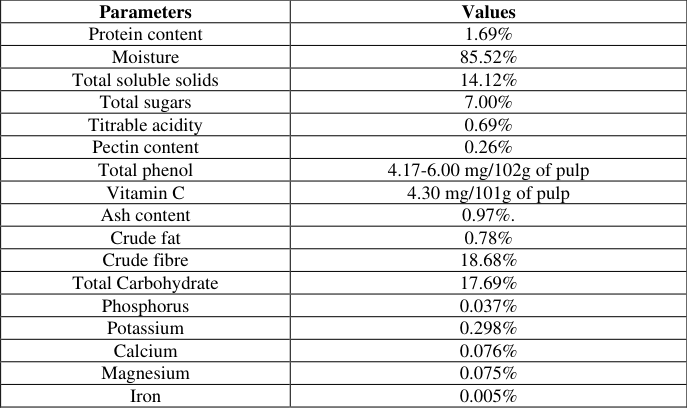 Table 1
Introduction
Introduction
Substance Structure
The past investigations with figs demonstrated that they are a magnificent wellspring of minerals, nutrients A, B1, B2 and C, dietary fiber, sugars, fundamental amino acids as well as phenolic substances [37,38] . Table 1 Genna et al [7] . vegetable. They are heated up, the water is taken out by pressing and they are then broiled [16] .
| Parameters | Values |
|---|---|
| Protein content | 1.69% |
| Moisture | 85.52% |
| Total soluble solids | 14.12% |
| Total sugars | 7.00% |
| Titrable acidity | 0.69% |
| Pectin content | 0.26% |
| Total phenol | 4.17-6.00 mg/102g of pulp |
| Vitamin C | 4.30 mg/101g of pulp |
| Ash content | 0.97%. |
| Crude fat | 0.78% |
| Crude fibre | 18.68% |
| Total Carbohydrate | 17.69% |
| Phosphorus | 0.037% |
| Potassium | 0.298% |
| Calcium | 0.076% |
| Magnesium | 0.075% |
| Iron | 0.005% |
Table text extracted from the original PDF; superscript letters are shown inline. The original table image is below.
View original table image
Research on fig handling is restricted [45,46] particularly drying of pre-treated figs.
Restorative purposes of natural product
Iqbal et al [15] . revealed that Ficus palmata Forsk extricate had critical cell reinforcement movement, geno protective property, enzymatic action of HMG-CoA Reductase and subsequently plays its part in fighting different oxidative stress related illnesses, including atherosclerosis. Various fig species are utilized in people medication as hostile to growth, mitigating and tonic medicament [23,22] . Microbial sicknesses like epilepsy and jaundice [28,3] , bronchitis, flu outshining hack, tonsillitis, toothache, bacillary looseness of the bowels, enteritis and injuries were additionally answered to be treated by fig separates. The fig organic products contain mainly sugars and adhesive and furthermore goes about as a demulcent and diuretic. The crude figs of F. palmata subsp. virgata are utilized as vegetable and matured as organic product for the most part by ancestral and nearby individuals in uneven and timberland regions. They are mainly utilized as a thing of diet in the treatment of stoppage and illnesses of the lungs and bladder [21,6] . They are likewise utilized as a poultice [43,20,6] . The twigs are utilized as grub. The plastic is supposed to be utilized in coagulating of milk and sap in the treatment of moles [25,11] .
Pharmacological action of fig
The Ficus palmata natural products showed critical cell reinforcement potential utilizing free extremist rummaging and ferric diminishing exercises
Cell reinforcement action
Cancer prevention agent exercises were additionally detailed for Ficus removes (1, 5). Alqasoumi et al. exhibited the ethyl acetic acid derivation portion (Table 2) had the option to diminish the stable free extremist DPPH, to yellowshaded DPPH at low focuses (50 and 100 g / ml). The impact was practically like that of the standard ascorbic corrosive. The higher fixations (500 and 1000 g / ml) of the unrefined concentrate and chloroform part had the option to decrease the DPPH albeit the lower focuses showed just frail action. Saklani and Chandra revealed that Ficus palmata is a rich wellspring of polyphenolic compounds, flavonoids, which are liable for solid cell reinforcement properties that assistance in counteraction and treatment of different oxidative pressure related sicknesses like neurodegenerative and hepatic illnesses. Hegazy et al [12] . confirmed that 1.1 mg/ml centralization of fig showed 40% hindrance of DPPH. Be that as it may, 45% hindrance was displayed in hydrogen peroxide rummaging measure. Caliskan and Polat [5] broke down phytochemicals and cancer prevention agent limit of green, yellow, purple and dark fruited fig. They detailed that cancer prevention agent limit of fig was related with the polyphenols and anthocyanin content of natural product. Dark fig showed 2 overlap more noteworthy cell reinforcement limit, 15 crease more noteworthy all out anthocyanins and 2.5 overlay more prominent phenolics than green and yellow figs though fructose, glucose and sucrose is higher in brown and purple figs. Fructose (56%) was the primary sugar alongside glucose (43%). Kamiloglu and Capanoglu [17] [38] .
Vinson et al [42] . Detailed critical cell reinforcement action in dried products of Ficus carica Linn. These discoveries propose that dried organic products ought to be a larger piece of the eating routine as they are thick in phenol cell reinforcements and supplements, most presumably fiber.
Anti-proliferative action
The anti-proliferative movement of the natural product extricate was dissected against cervical malignant growth cell lines, to be specific C33A, HeLa and one typical Fringe Blood Mononuclear (PBM) cells utilizing colorimetric 3-(4,5-Dimethylthiazol-2-yl)-2,5Diphenyltetrazolium Bromide (MTT) examines. C33A and HeLa cells were refined with a concentrate focus identical to 0.667, 1.66, 3.33, 5.0 and 6.67 mg / ml of natural product while essential culture of PBMCs was brooded with 5.0 and 6.67 mg/ml organic product removes. Every one of the concentrates showed intense anti proliferative action against C33A cells. The concentrates didn't show anti proliferative movement against HeLa cells. CH3) 2CO separate showed most elevated anti proliferative movement while it was low for methanol remove [33] . The high anticancer impacts of CH3) 2CO concentrates of Ficus palmata were upheld by its somewhat higher ellagic corrosive substance as uncovered by RP-HPLC investigation. Ellagic corrosive was before displayed to have anti proliferative movement against cervical disease cells [48] . Khodarahmi et al [19] . detailed that concentrates of various types of Ficus are cytotoxic to some human harmful cell lines. In this way, natural product, leaf, with ethyl acetic acid derivation and dichloromethane and plastic concentrates were ready through permeation and after 24 h brooding at 37 °C, the cells were treated with various groupings of the concentrates or plastic. The practicality of the not entirely settled by the decrease of 3-(4, 5dimethylthiazol-2-yl)-2, 5-diphenyl tetrazolium bromide (MTT) from formazan following 48 h brooding and the plastic and various concentrates of Ficus carica upsides of the ethanolic, ethyl acetic acid derivation and dichloromethane concentrates of the leaves and organic products.
References
39 in the original paper- Abdel-Hameed ES. Total phenolic contents and free radical scavenging activity of certain Egyptian Ficus species leaf samples. Food Chem. 2009;114:1271-1277.
- Alqasoumi SI, Basudan OA, Al-Rehaily AJ, AbdelKader MS. Phytochemical and pharmacological study of Ficus palmata growing in Saudi Arabia. Saudi Pharmaceutical Journal; c2013. Doi: org/10.1016/j.jsps 2013.12.010.
- Betti JL. An ethnobotanical study of medicinal plants among the DJA biosphere reserve, Cameroon. African Study Monogr. 2004;25(1):1-27.
- Caliskan O, Polat AA. Phytochemical and antioxidant properties of selected fig (Ficus carica L.) accessions from the eastern Mediterranean region of Turkey. Sci. Hortic. 2011;128:473-478.
- Genna A, De Vecchi P, Maestrelli A, Bruno M. Quality of 'Dottato' dried figs grown in the Cosenza region, Italy. A sensory and physical-chemical approach. Acta Hortic. 2008;798:319-323.
- Goncalves A, Lajolo FM, Genovese MI. Chemical composition and antioxidant ⁄ anti diabetic potential of Brazilian native fruits and commercial frozen pulps. Journal of Agricultural and Food Chemistry. 2010;58:4666-4674.
- Grison-Pige´ L, Hossaert-McKey M, Greeff JM, Bessie´ re JM. Fig volatile compounds-a first comparative study. Phytochemistry. 2002;61:61-71.
- Hegazy AK, Al-Rowaily SL, Faisal M, Alatar AA, ElBana MI, Assaeed AM. Nutritive value and antioxidant activity of some edible wild fruits in the Middle East. Journal of Medicinal Plant Research. 2013;7(15):938946.
- Ibrahim Mujic´, MojcaBavconKralj, StelaJokic´, KristjanJarni, Tjasa Jug, Z eljkoPrgomet. Changes in aromatic profile of fresh and dried fig -the role of pretreatments in drying process. International Journal of Food Science and Technology. 2012;47:2282-2288.
- Iqbal DM, Khan S, Khan A, Khan MS, Ahmad S, Srivastava AK, et al. In vitro Screening for -Hydroxy -methylglutaryl-CoA Reductase Inhibitory and Antioxidant Activity of Sequentially Extracted Fractions of Ficus palmata Forsk. Bio Med Research International. 2014;762620:10.
- Joshi Y, Joshi AK, Prasad N, Juyal D. A review on Ficus palmate (Wild Himalayan Fig). The Journal of Phytopharmacology. 2014;3(5):374-377.
- Kamiloglu S, Capanoglu E, Investigating the in vitro bio accessibility of polyphenols in fresh and sun-dried figs (Ficus carica L.). International Journal of Food Science and Technology. 2013;48:2621-2629.
- Khan KY, Khan MA, Ahmad M, Shah GM, Zafari M, Niamat R, et al. Foliar anatomy of some ethno botanically important species of genus Ficus Linn. J Med Plants Res. 2011;5(9):1627-1638.
- Khodarahmi GA, Ghasemi N, Hassanzadeh F, Safaie M. Cytotoxic Effects of Different Extracts and Latex of Ficus carica L. on HeLa cell Line. Iranian Journal of Pharmaceutical Research. 2011;10(2):273-277.
- Kirtikar KR, Basu BD. Indian Medicinal Plants. (2 nd edn). Basu LM, Allahadad, India. 1935;3:15932393
- Kirtikar KR, Basu BD. Indian Medicinal Plants-2 nd Edition. Oriental Enterprises, Dehra Dun, 2001;10:15+451.
- Kitajima J, Kimizuka K, Tanaka Y. New dammaranetype acetylated triterpenoids and their related compounds of Ficus pumila fruit. Chem Pharm Bull. 1999;47:1138-1140.
- Lansky EP, Paavilainen HM, Pawlus AD, Newman RA. Ficus spp. (fig): Ethnobotany and potential as anticancer and anti-inflammatory agents. J Ethnopharmacol. 2008;119:195-213.
- Reem Fadul Kabbar Mohamed, Abdelmoniem Awadalla Babiker, Wefag Tajeldin O Mohammed. Dietary diversity score (HDDS) in measuring food security status among refugees in the White Nile State, Sudan. Int. J Agric. Extension Social Dev. 2020;3(2):71-75. DOI: 10.33545/26180723.2020.v3.i2b.59
- Manandhar NP. A survey of medicinal plants of Jajarkot District, Nepal. J Ethnopharmacol. 1995;48:16.
- Naikwadi PM, Chavan UD, Pawar VD, Amarowicz R. Studies on dehydration of figs using different sugar syrup treatments. International Journal of Food Science and Technology. 2010;47(4):442-445.
- Noumi E, Fozi FL. Ethnomedical botany of epilepsy treatment in fongo-tongo village, western province. Cameroon. Pharm Biol. 2003;41:330-339.
- Oliveira AP, Silva LR, de Pinho PG. Volatile profiling of Ficus carica varieties by HS-SPME and GC-IT-MS. Food Chemistry 2010; 123:548-557.
- Pant HM. Study on Traditional Knowledge of Himalayan Medicinal Plants of Rath Region of Uttarakhand. Research Journal of Agricultural Sciences 2010;1(3):277-279.
- Riu-Aumatell M, Castellari M, Lo´ pez-Tamames, E, Galassi S, Buxaderas S. Characterization of volatile compounds of fruit juices and nectars by HS ⁄SPME and GC⁄ MS. Food Chemistry. 2004;87:627-637.
- Saini R, Garg V, Dangwal K. Comparative study of three wild edible fruits of Uttarakhand for antioxidant, anti-proliferative activities and polyphenolic composition. International Journal of Pharma and Bio Sciences. 2012;3(4):158-16.
- Saklani S, Chandra S. Antimicrobial activity, nutritional profile and quantitative study of different fractions of Ficus palmata. International Research Journal of Plant Science. 2011;2(11):332-337.
- Saklani S, Chandra S, Mishra AP. Evaluation of Antioxidant activity, Quantitative Estimation of Phenols, Anthocynins and Flavonoids of Wild Edible Fruits of Garhwal Himalaya. Journal of Pharmacy Research. 2011;4:4083-4086.
- Sharma SK, Badiyala SD. Variability studies in common fig in Hamirpur district of Himachal Pradesh. Indian Journal of Horticulture. 2006;63(2):159-161.
- Slavin JL. Figs: Past, Present and Future. Nutrition Today. 2006;41:180-184.
- Solomon A, Golubowicz S, Yablowicz Z. Antioxidant activities and anthocyanin content of fresh fruits of common fig (Ficus carica L.). Journal of Agricultural and Food Chemistry. 2006;54:7717-7723.
- Tiwari R, Sudhakar JV, Srivastava AK, Chaudhary LB, Murthy GVS, Durgapal A. Taxonomy, distribution and diversity of Ficus palmate Forssk. subsp. Virgata (Roxb.) Browicz (Moraceae) in India. Journal of Threatened Taxa. 2014;6(9):6172-6185.
- Vallejo F, Marin JG, Tomas-Barberan FA. Phenolic compound content of fresh and dried figs (Ficus carica L.). Food Chemistry. 2012;130:485-492.
- Vinson JA. The functional food properties of figs, Cereal foods world. 1999;44:82-86.
- Wong M. Ficus plants for Hawai'i landscapes. Ornamental sand Flowers. 2007;34:1-13.
- Xanthopoulos G, Yanniotis S, Lambrinos G. Water Diffusivity and Drying Kinetics of Air Drying of Figs. Drying Technology. 2009;27:502-512.
- Xanthopoulos G, Yanniotis S, Lambrinos G, Study of the drying behaviour in peeled and unpeeled whole figs. Journal of Food Engineering. 2010;97:419-424.
- Yemis O, Bakkalbasi E, Artik N. Changes in pigment profile and surface colour of fig (Ficus carica L.) during drying. International Journal of Food Science and Technology. 2012;47:1710-1719.
- Losso JN, Bansode RR, Trappey A, Bawadi HA, Truax R. In vitro anti-proliferative activities of ellagic acid. Journal of Nutritional Biochemistry. 2004;15:672-678.
Cited by 8
From OpenAlex, OpenCitations and reference lists read by Scinovex
- Chemical composition and tannin content in leaves of Ficus spp. as top feed for ruminants from the Dang forest of South Gujarat Province, India
Minal H. Patel, SS Malek, VR Patel, B.M. Desai, SK Jha, DP Patel · International Journal of Veterinary Sciences and Animal Husbandry · 2023
An experiment was conducted to estimate proximate composition, fibre fraction and tannin content of leaves amongst 10 spp. of genus Ficus L. belonging to family Moraceae from the Dangs Forest in South Gujarat. Results revealed that all parameters varied significantly among different species leaves. Leaves of F. racemosa was observed with high (p
- Diuretic activity and acute oral toxicity study of ethanolic extract of leaves of Ficus benjamina L. in Wistar albino rats ↗
Sana Begum Ladaf, Arati Malpani, Nisar Ali · Journal of Pharmacognosy and Phytochemistry · 2023
The main goal of the study was to know the diuretic activity of the ethanolic extract of leaves of Ficus benjamina L. The diuretic activity of ethanolic extract of EEFB was tested at the doses of 200 and 400 mg/kg. The diuretic activity was evaluated by various parameters such as volume of urine output, diuretic action, diuretic activity (Lipschitz value),
- Anjeer (Ficus carica Linn.): A famous fruit with distinct pharmacological properties: A review ↗
Ansari Mohd. Masihuzzaman, Munshi Younis Iftikhar · International Journal of Unani and Integrative Medicine · 2023
Anjeer (Ficus carica Linn.) is a well known fruit and an important Unani Medicine mentioned in classical Unani literature with significant pharmacological activity. It is being used as Mughazzi (Nutritive), Mulyyan (Laxative), Muqawwi baah (Aphrodisiac), Daf-e-Waram (Anti-inflammatory), Mukhrij Balgham (Expectorant) and Mudrr-e-Baul (Diuretic) since long times. This fruit has remarkable nutritional ingredients besides pharmacological properties. The aim of this review
- Phytochemical analysis, assessment of acute and subacute toxicological profile of the ethanolic extract of Ficus elastica Roxb. Ex Hornem (Moraceae) lianas in experimental Wistar rats ↗
Jean Emmanuel Mbosso Teinkela, Jean Baptiste Hzounda Fokou, Joseph Crépin Kouopmtchop Sado, Alain Njoya Mbouombouo, Philippe Belle Ebanda Kedi, Judith Caroline Ngo Nyobe · International Journal of Herbal Medicine · 2023
Ficus elastica Roxb. Ex Hornem, also called Rubber fig tree is a plant of the Moraceae family widely used in traditional medicine for the treatment of various ailments including allergies and skin infections, as well as a diuretic agent. This study points out the acute and sub-acute toxicological profile of the ethanolic extract of Ficus elastica lianas. The plant material
- Evaluating the Ripening Process of Ficus palmata: A Biochemical Perspective
Mala Rathore, Manisha Gusain, Surender Singh · International Journal of Horticulture and Food Science · 2025
Biochemical changes in Ficus palmata fruits at different maturity stages, focusing on physical attributes, nutritional composition, and phytochemical variations were investigated. Fruit samples were collected from Naseerpur, Roorkee Range, Haridwar Forest Division, Uttarakhand, at an altitude of 247 m. The study revealed significant differences in fruit color, moisture content, carbohydrate levels, crude fiber, total soluble solids (TSS), titratable acidity, and vitamin C content across the ripening process. The results suggest that unripe fruits have higher fiber and phenolic content, while r
- Study on anti-sickling properties of the aqueous and methanol leaf extract of Ficus mucuso (Wild figs) ↗
George D.G., Uwakwe A.A., Jude C. Ikewuchi · Journal of Medicinal Plants Studies · 2023
This study investigated the antisickling properties of the aqueous and methanol leaf extract of Ficus mucuso (wild figs) by determining its effect on haemoglobin-S (HbS) polymerization inhibition rate, haemoglobin/methaemoglobin (Fe2+/Fe3+) ratio and erythrocyte osmotic fragility. Preliminary phytochemical analysis of F. mucuso showed the presence of phenols, terpenoids, tannins, flavonoids, saponins and alkaloids. The extract significantly inhibited the rate of HbS…
❝ 0PDF - Record of lac insect occurrence in Maharashtra ↗
Pratibha Bhatnagar, Balram Lodhi, Ramdeen Bhalavi, Sunil Prajapati · Journal of Entomology and Zoology Studies · 2022
In the present study, intensive surveys were conducted in 36 districts of Maharashtra state from 2015 to 2020 under the ICAR funded “Network Project on Conservation of Lac Insect Genetic Resources” to record the district level occurrence of lac insects on different host plants for in-situ and ex-situ conservation. During the survey, information was taken from the concerned Forest department,…
❝ 0PDF - Antibacterial properties and phytochemical composition of Ficus iteophylla Linn leaves ↗
Tsague Marthe Valentine, Nyemb Nyunaï · International Journal of Chemical Research and Development · 2022
This study investigates the antibacterial properties and phytochemical composition of Ficus iteophylla Linn leaves, a plant traditionally used in herbal medicine. Employing methods such as Gas Chromatography-Mass Spectrometry (GC-MS) for phytochemical analysis and disk diffusion and broth dilution assays for antibacterial testing, the study aims to scientifically validate the medicinal claims associated with these leaves. The research focuses on identifying