
Research article · 2022 · Full text
International Journal of Biology SciencesMolecular analysis of Spodoptera frugiperda from India using 28S nuclear genes markers
Volume 4(1) · Pages 255–258 · DOI: 10.33545/26649926.2022.v4.i1d.129 ↗
Research areasInsect Resistance and GeneticsIdentification and Quantification in FoodGenomics and Phylogenetic Studies
Abstract
Author-writtenThe fall army worm Spodoptera frugiperda (J E Smith), commonly called as fall armyworm (FAW) (Lepidoptera: Noctuidae) is a highly voracious insect pest which is native to the tropical and subtropical regions of America. It is one of the most serious pests of maize in India. In this study, we have collected mainly larvae of S. frugiperda from the maize fields of across India using 28S nuclear gene as markers. The larvae exhibited sexual dimorphism in their morphological characteristics. BLAST search on Indian specimen’s revealed 98-99% nucleotide sequence identity with S. FAW voucher specimens from France and Western South America of either maize or rice populations. The phylogenetic relationship was inferred using IQ Tree1.6.12 built with input data of 54 sequences with 867 nucleic acid sites and using the best model BIC: F81+F Model with ultrafast bootstrap (1000 replicates) support. Phylogeny tree generated from the Spodoptera frugiperda of 28S data from this study alone did not show any major clades or differences. The present study revealed that the Indian maize populations were clustered in clade one which had a high degree of geographical representation consisting of Guadeloupe (France), and Peru (Western South America) maize/rice populations. As this pest is reported to have remarkable dispersal capacity, high reproductive capacity, absence of diapause, and wide host range, it is likely to spread to the entire country and further, neighbouring countries.
Summary
Source-checkedPlain-language reading of the full paper, prepared with AI and checked against the text. Each point links to the authors' own words.
Why it matters
- The fall armyworm (Spodoptera frugiperda) is a highly voracious pest native to the Americas and is currently one of the most serious threats to maize crops in India. View evidence ↗
- This pest has a broad host range exceeding 353 plant species, frequently damaging crops such as maize, sorghum, rice, and cotton. View evidence ↗
- Understanding the genetic diversity and specific strains of the fall armyworm is critical for developing effective pest management strategies. View evidence ↗
The question
- The study aimed to explore the bio-geographical distribution pattern of the fall armyworm in India using the 28S nuclear gene as a marker. View evidence ↗
What they did
- The researchers collected larvae of S. frugiperda from maize fields across various regions of India. View evidence ↗
- Collected specimens were reared using both artificial media and natural maize leaves to observe differences in growth and development. View evidence ↗
- Genomic DNA was extracted and subjected to PCR amplification of an 867bp region near the 5' terminus of the 28S gene. View evidence ↗
What they found
- Adult moths showed sexual dimorphism: males were dark greyish with white forewing markings and hair tufts on forelegs, while females lacked these features. View evidence ↗
- The life cycle consisted of an embryonic period of 2-3 days, a larval period of 19-23 days, a pupal period of 7-8 days, and an average adult lifespan of 10 days (ranging from 7 to 21 days). View evidence ↗
- BLAST analysis showed that Indian specimens had 98-99% nucleotide sequence identity with S. frugiperda specimens from France and Western South America. View evidence ↗
- The Indian fall armyworm was identified as S. frugiperda with a similarity of 99.66%. View evidence ↗
- Phylogenetic clustering placed Indian maize populations in Clade 1, alongside populations from Guadeloupe (France) and Peru (Western South America). View evidence ↗
What it means
- The authors conclude that the fall armyworm species likely migrated to India from France and Western South America. View evidence ↗
- Due to its high reproductive and dispersal capacities and wide host range, the authors warn that the pest is likely to spread across India and into neighboring countries. View evidence ↗
- The authors state that the exact point of entry of the fall armyworm into India has not yet been determined and could not be deciphered using trade or haplotype analysis. View evidence ↗
Figures & tables
From the original paper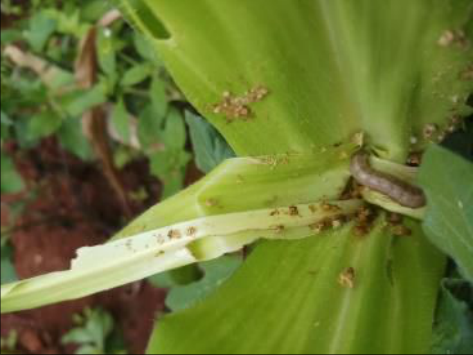 Figure 1
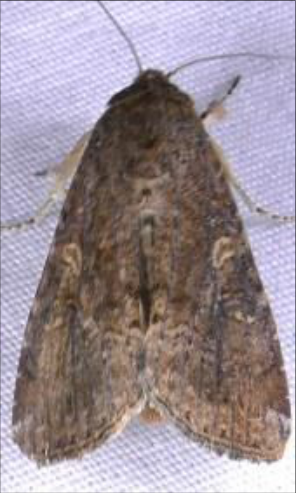 Figure 2
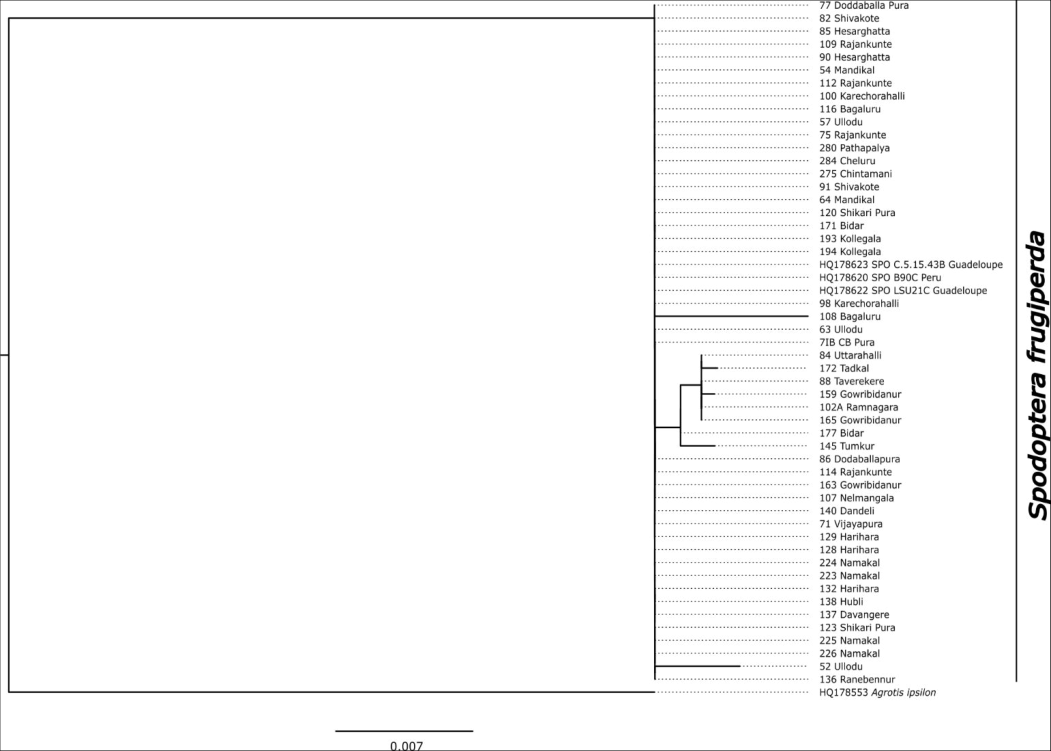 Figure 3
Introduction
Spodoptera frugiperda (JE Smith), commonly called as fall army worm (FAW) (Lepidoptera: Noctuidae) is a highly voracious insect pest which is native to the tropical and subtropical regions of America. It has a wide host range of >353 host plants (Montezano et al., 2018) [9] . The most frequently fed and damaged plants are maize, sorghum, rice, millet, soybean, peanut, cotton, Sudan grass, and other fodder grasses. Among different host plants, maize was the major crop infested. In India, FAW was first reported on maize from Shivamogga district of Karnataka (Sharanabasappa et al., 2018). It is highly migratory and has rapidly spread all over the country and reported in neighbouring countries like Nepal and China (Rathna et al., 2019; FAO 2019) [12] . The incidence on maize ranged from 9.0 to 62.5% and 6 to 100% (Shylesha et al., 2018; Mallapur et al., 2018) [16,7] in different districts of Karnataka. There are two strains that are morphologically indistinguishable but differ in their host plant preference. The Rice (R) strain most consistently feeds on rice, Bermuda grass, and other small grasses, while the Corn (C) strain prefers maize, sorghum, and other large grasses (Pashley et al., 1985). Recent studies on its population in India have revealed that the majority of these are 'R' strain feeding on maize, sorghum and sweet corn; while 'C' strain feeds on sugarcane (Mahadevaswamy et al., 2018; Chormule et al., 2019) [2] . The knowledge on its strains and genetic diversity is important for strategizing pest management. (Srinivasan et al., 2018) [17] . Hence, in this study we have explored the bio-geographical distribution pattern using 28S nuclear gene.
Materials and Methods
To know the status of FAW, larvae were collected from different geographical areas and reared in laboratory. While some were reared on artificial media (Shobha et al., 2009) [15] , some were reared on natural host, i.e., maize leaves in individual boxes to see any difference in their development and growth. The abdomen/legs/thorax of larvae/adult were used to extract DNA by CTAB method for molecular analysis (Reineke et al., 1998) [13] . The extracts were subjected to PCR amplification at 867bp using primers specific to the region near the 5' terminus of the 28S gene from the genomic DNA using primers > 28S-01-5'GAC TAC CCC CTG AAT TTA AGC AT 3' and 28SR-01-5'GAC TCC TTG GTC CGT GTT TCA AG 3' <. PCR reactions were carried out in 96 wells PCR with 50µl reaction volume containing GeNei TM Taq buffer 5µl, 1µl of GeNei TM 10 ml dNTP mix, 2.5µl of (20 pmol/µl) forward primer, 2.5µl of (20 pmol/µl) reverse primer, 1 µl of GeNei TM Taq DNA polymerase (1 U/µl), DNA (50 ng/µl) 2µl, and sterile water 36µl. PCR was performed using a C1000™ Thermal Cycler of Biorad with Initial denaturation at 94 °C for 3 min, Cycle denaturation with 92 °C for 1 min, annealing temperature of 54 °C for 1 min, extension for 70° c for 30 sec, followed by final extension at 70 °C for 10 min and kept in 40c until use. The amplicon was visualised on 1.2% agarose gel containing 0.5 μg/ml of ethidium bromide and the amplified product was purified using Qiagen Mini elute PCR purification kit (Qiagen India), quantified using Nano drop1000 (Thermo fisher scientific, USA). The purified fragments were sequenced by M/S Biokart India Pvt. Ltd., Bengaluru, India. Sequences were edited manually and aligned using Clustal W and submitted to NCBI GenBank. The sequences were verified and edited using BioEdit Sequence Alignment Editor Version 7.2.5 (Hall 1999). The sequences were aligned using MUSCLE (Edgar 2004) [3] in MEGA 11 (Tamura et al. 2021) [18] . IQ-TREE (Nguyen et al. 2015) [10] was used for performing the maximum likelihood method of phylogenetic inference. A preliminary phylogenetic analysis was run to identify any doubtful sequences and those were subsequently omitted from the analysis. The optimal models were determined through Model Finder (Kalyaanamoorthy et al. 2017) [6] in IQ-TREE, using the minimum BIC score. Statistical support for the clades in ML was assessed by Ultrafast bootstrap (BP) for 10,000 iterations, 0.1 perturbations, and 500 num stops (Minh et al. 2013) [8] using IQ-TREE web server (Trifinopoulos et al. 2016) [19] . The tree obtained from ML analyses was visualized using Fig Tree v1.4.4 (http://tree.bio.ed.ac.uk/software/figtree).
Results and Discussion
Results and Discussion
Morphological data
The fall army worm Spodoptera frugiperda under the family Noctuidae is one of the most serious pests of maize in India.
In this study, we have collected mainly larvae of S. frugipedra from the maize fields of across India. The eggs are dome shaped; the base of the egg is flattened and the egg gets curved upward with a broadly rounded apex. The freshly hatched larvae measured 1 mm in length and 0. Adult moths 32 to 40mm with a conspicuous spot on the forewings, which have a wavy patterns on the fringe. The insects measured about 15 mm in length and had a wing span of 30-35 mm. The adult moths exhibited sexual dimorphism in their morphological characteristics. Males were dark greyish with white markings on forewings. They possessed large tufts of hair on the forelegs. Females lacked both white markings and tufts of hairs (Fig 3). On the whole, the embryonic period lasted 2-3 days, larval period 19-23 days and pupal period 7-8 days and adults average about 10 days, with the range of about seven days to 21 days.
Sequence analysis
Fragments amplified from 28s primer pairs aligned to their target reference sequence. The search and analysed results indicated that they belong to S. frugipedra. The S. frugipedra 28S sequences from Indian population were identical to each other, and they were 87-100% identical compared to sequences from other countries. BLAST search of Indian specimen's revealed 98-99% nucleotide sequence identity with S. frugipedra voucher specimens from France and Western South America of either maize or rice populations. The base identification from BLAST search also shows that Indian fall armyworm belongs to S. frugipedra sps with 99.66% similarity. S. frugipedra sequences from India are deposited with NCBI Gen Bank.
Phylogenetic Analysis
Phylogenetic tree generated from the S. frugipedra of 28S data from this study alone, did not show any major clades or differences. The present phylogenetic analysis consisted of fifty Spodoptera. frugipedra 28S sequences generated from this study and three from NCBI Gene bank. The 28S sequence of Agrotis ipsilon (HQ178553) accession number served as an out group for the analysis. The evolutionary relationship was inferred using IQ Tree1.6.12 built with input data of 54 sequences with 867 nucleotide sites and using the best model BIC: F81+F Model with ultrafast bootstrap (1000 replicates) support. The bootstrap frequencies converged at 0.991 after 9300 iterations. The tree generated by combining the NCBI Genbank sequences showed one major clade (FIG 1).The S. frugipedra Indian maize populations were clustered in clade 1.which had a high degree of geographical representation consisting of Guadeloupe (France), and Peru (Western South America) maize or rice populations. This indicates the species have migrated from France and Western South America to India. At this point, the point of entry of the fall army worm into India is not yet determined but could not decipher based on the trade analysis and employing haplotype analysis. One of the possible modes of infestation is through agricultural commodities. As this pest is reported to have remarkable dispersal capacity, high reproductive capacity, absence of diapause, and wide host range, it is likely to spread to the entire country and further, neighbouring countries.
Figures and tables from the paper
References
15 in the original paper- Chormule A, Shejawal N, Sharanabasappa CM, Asokan R, Swamy HM, Studies Z. First report of the fall Armyworm, Spodoptera frugiperda (JE Smith) (Lepidoptera, Noctuidae) on sugarcane and other crops from Maharashtra, India. J Entomol. Zool. Stud. 2019;7(1):114-117.
- Edgar RC. MUSCLE: multiple sequence alignment with high accuracy and high throughput. Nucleic acids research. 2004;32(5):1792-1797.
- Giribet G, Wheeler WC. On gaps. Molecular phylogenetics and evolution. 1999;13(1),132-143.
- Kalleshwaraswamy CM, Maruthi MS, Pavithra HB. Biology of invasive fall army worm Spodoptera frugiperda (JE Smith) (Lepidoptera: Noctuidae) on maize. Indian journal of entomology. 2018;80(3):540543.
- Kalyaanamoorthy S, Minh BQ, Wong TK, Von Haeseler A, Jermiin LS. Model Finder: fast model selection for accurate phylogenetic estimates. Nature methods. 2017;14(6):587-589.
- Mallapur CP, Naik AK, Hagari S, Prabhu ST, Patil RK. Status of alien pest fall armyworm, Spodoptera frugiperda (JE Smith) on maize in Northern Karnataka. J Entomol. Zool. Stud. 2018;6(6):432-436.
- Minh BQ, Nguyen MAT, Von Haeseler A. Ultrafast approximation for phylogenetic bootstrap. Molecular biology and evolution. 2013;30(5):1188-1195.
- Montezano DG, Sosa-Gómez DR, Specht A, RoqueSpecht VF, Sousa-Silva JC, Paula-Moraes SD, et al. Host plants of Spodoptera frugiperda (Lepidoptera: Noctuidae) in the Americas. African entomology. 2018;26(2):286-300.
- Nguyen LT, Schmidt HA, Von Haeseler A, Minh BQ. IQ-TREE: a fast and effective stochastic algorithm for estimating maximum-likelihood phylogenies. Molecular biology and evolution 2015;32(1):268-274.
- Pashley DP. Host-associated genetic differentiation in fall armyworm (Lepidoptera: Noctuidae): a sibling species complex? Annals of the Entomological Society of America. 1986;79(6):898-904.
- Reineke A, Karlovsky P, Zebitz CPW. Preparation and purification of DNA from insects for AFLP analysis. Insect molecular biology. 1998;7(1):95-99.
- Sharanabasappa S, Kalleshwaraswamy CM, Poorani J, Maruthi MS, Pavithra HB, Diraviam J. Natural enemies of Spodoptera frugiperda (JE Smith) (Lepidoptera: Noctuidae), a recent invasive pest on maize in South India. The Florida Entomologist. 2019;102(3):619-623.
- Shylesha AN, Jalali SK, Gupta ANKITA, Varshney RICHA, Venkatesan T, Shetty PRADEEKSHA, et al. Studies on new invasive pest Spodoptera frugiperda (JE Smith) (Lepidoptera: Noctuidae) and its natural enemies. Journal of Biological Control. 2018;32(3):1-7.
- Tamura K, Stecher G, Kumar S. MEGA11: molecular evolutionary genetics analysis version 11. Molecular biology and evolution. 2021;38(7):3022-3027.
- Trifinopoulos J, Nguyen LT, Von Haeseler A, Minh BQ. W-IQ-TREE: a fast online phylogenetic tool for maximum likelihood analysis. Nucleic acids research. 2016;44(W1):W232-W235.