
Research article · 2022 · Full text
International Journal of Agriculture and Food ScienceReducing orange-fleshed sweet potato (OFSP) losses and waste: An evaluation of triple-s technology in northern Ghana
Volume 4(1) · Pages 21–27 · DOI: 10.33545/2664844x.2022.v4.i1a.61 ↗
Research areasFood Waste Reduction and Sustainability
Abstract
Author-writtenThis paper examines how the use of storage technology (Triple-s) has helped to improve access to vines and reduced food loss and waste. The study explored primary data collected from three communities in the East Mamprusi Municipal, North East Region of Ghana. The study adapted a food waste pyramid to analyze the impact of Triple-s in reducing losses and waste associated with OFSP production. The paper, argues that the Triple-S technology plays a dual role of contributing to reducing food loss/waste and ensuring availability of vines in the study area. The study established a link between OFSP waste/loss reduction, access to vines and the triple-s technology.
Summary
Source-checkedPlain-language reading of the full paper, prepared with AI and checked against the text. Each point links to the authors' own words.
Why it matters
- Orange-Fleshed Sweet Potato (OFSP) is important for local communities as it provides income and is a source of vitamin A. View evidence ↗
- Sweet potatoes have a short shelf life, with storage roots typically lasting less than one month. View evidence ↗
- In northern Ghana, using shallow earthen heap storage results in average sweet potato losses of 20–25%. View evidence ↗
The question
- The study aims to explore how Triple-S technology helps in reducing food waste and losses. View evidence ↗
- The research investigates the contribution of Triple-S technology to the availability of vines and subsequent food security. View evidence ↗
What they did
- The study focused on OFSP farmers from three communities (Langbina, Nyingari, and Gbala) in the East Mamprusi Municipality of Ghana's North East Region. View evidence ↗
- A sample of 90 farmers was purposively selected from the three target communities. View evidence ↗
- Data was collected in December 2020 using semi-structured questionnaires with open-ended questions. View evidence ↗
- The impact of the technology on reducing waste and losses was measured on a scale from 1 (least impact) to 5 (highest impact). View evidence ↗
What they found
- 78% of the surveyed farmers had used Triple-S technology at some point to reduce OFSP losses. View evidence ↗
- According to the participants, Triple-S technology increased access to vines for 71% of respondents and reduced food losses/waste for 68%. View evidence ↗
- The perceived impact of Triple-S was very positive for 64% of respondents and positive for 29%. View evidence ↗
- The primary benefits reported were vine availability (71%) and extended shelf-life (65%). View evidence ↗
- The most significant challenge to adopting the technology was the unavailability of sea sand, cited by 75% of respondents. View evidence ↗
- When mapped to the waste pyramid, respondents indicated the technology minimizes waste (71%), prevents waste (69%), and reuses waste (64%). View evidence ↗
What it means
- The authors conclude that Triple-S technology positively impacts both the availability of vines and the reduction of food losses and waste. View evidence ↗
- The authors recommend intensifying the promotion of household adoption of Triple-S to further reduce OFSP productivity losses. View evidence ↗
- The authors suggest a need to test alternative storage mediums to overcome the scarcity of sea sand and improve adoption. View evidence ↗
Visual summary
2 visualsIllustrations explain the paper; charts are replotted from the paper's own table values.
Percentage: Vines availability vs Reduces food... vs Shelf-life vs Income vs Food security
Replotted from Table 3 (page 5) of the original paper. Every bar is the paper's own table value.
View source evidence ↗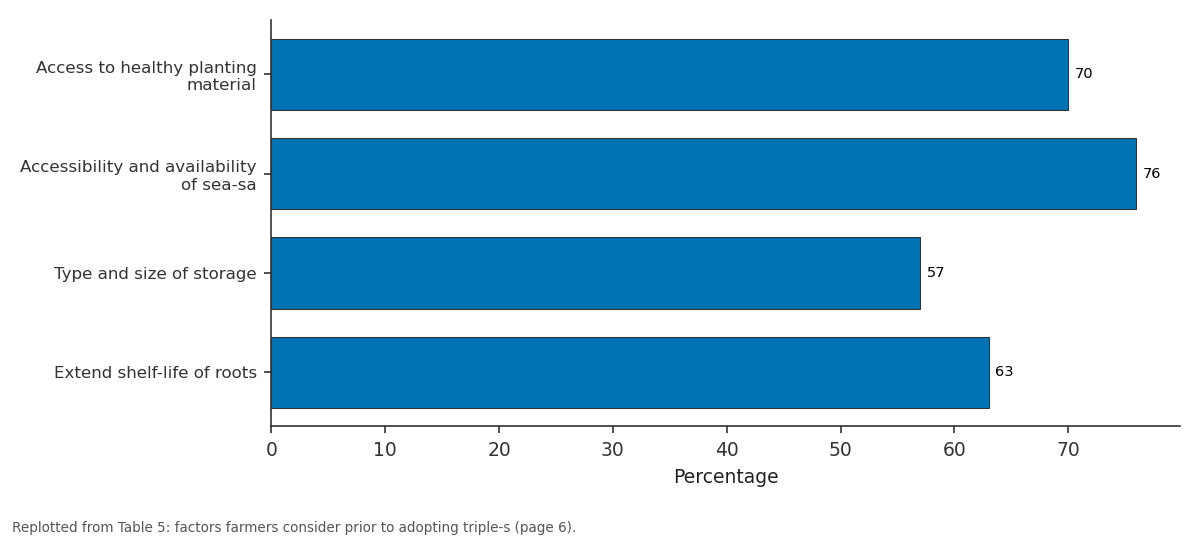
Percentage: Access to healthy... vs Accessibility and... vs Type and size of storage vs Extend shelf-life of...
Replotted from Table 5 (page 6) of the original paper. Every bar is the paper's own table value.
View source evidence ↗Figures & tables
From the original paper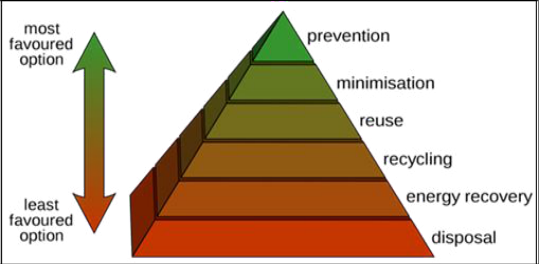 Figure 1
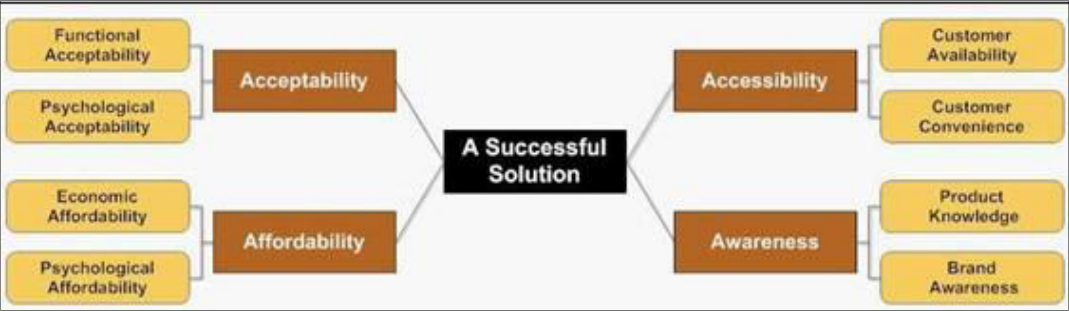 Figure 2
 Table 1
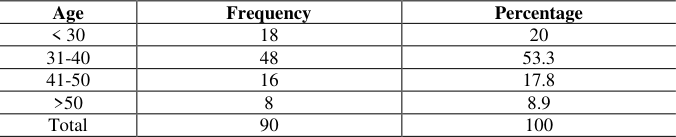 Table 2
 Table 3
 Table 4
 Table 5
Introduction
Sweet-potatoes are among the cultivated roots crops in Sub-Sahara Africa (Sowly et al., 2015) [1] . Essentially, sweet-potato plays vital role in addressing food insecurity. The Orange-Fleshed Sweet Potato (OFSP) is a source of vitamin A and serves as a source of income for local communities (Ezin et al. 2018) [2] . Like other tubers and roots crop, sweet-potato is cultivated mainly for its storage roots which are mostly harvested either at once or gradually, and consumed with little processing: steamed or boiled (Rees et al., 2003) [3] . Even though sweet potatoes can be grown from seeds they are predominantly propagated from vine cuttings, an easy technique suitable and convenient for small scale and subsistence farming (Burri, 2011) [4] . Given the role sweet-potato play in food security, there is a need for storage and suitable "seed" systems that assure planting material access when farmers need to plant, so as to maximize their output and sustain its production. Therefore, to sustain OFSP production vine availability and good storage is critical given that sweet potato is cultivated on a small-scale, in some parts of the northern Ghana. The major challenge in orange flesh sweet potato (OFSP) cultivation is availability of adequate planting material at the beginning of raining season (Stather et al., 2013) [5] . Despite the role of OFSP in food security, it was reported that smallholder farmers are exposed to uneven food shocks 'due to limited and inappropriate storage facilities to improve storability of sweet potatoes' (Mutandwa and Gadzirayi, 2007) [6] . Also, it was reported that the lack of proper techniques for long-lasting storage of sweetpotato is a major limitation in its cultivation (Ezin et al. 2018). Similarly, argues that sweetpotato is characterized by short life: storage roots barely store for less than one month (CIP, 2019) [7] . Parmar acknowledges that sweet-potato food losses include harvest, handling at farm level and shelf life issues which are vulnerable hot-spots in its supply chain (Parmar et al., 2017) [8] . Considering the storability challenges of sweet potato, there is food loss associated with harvested roots due to short storage duration of the produce after harvest and this is a threat to the production of OFSP. For instance, a study conducted in northern Ghana found that sweet-potato average losses range between 20-25% in shallow earthen heap storage (Atuna, 2017) [9] . As suggests that food losses worsen the state of food insecurity as they take away fraction of the food from the total food obtained (Parmar et al., 2017) [8] . . On the other hand, High Level Panel of Expert (HLPE) opined that decreasing food losses and waste involves classifying causes and opting for possible solutions which could be modified to suit local and product specificities (HLPE, 2014) [10] . A study in Ethiopia found that absence of storage structures at field and selling point results in food losses as obvious during a survey conducted (Parmar et al., 2017) [8] . Undeniably, food products are vulnerable to damage and loss during and after harvest, so, tackling these losses could make a significant contribution towards combating food insecurity and improving livelihoods in the least developed and developing countries (Parmar et al., 2017) [8] . According to HLPE there are emerging initiatives around the globe which focus on mitigating food loss and waste, at state, provincial and local levels. Therefore, there is a multitude of strategies that can be tapped ranging from a diverse range of technological interventions and innovations/techniques which could address local vines shortages and food losses associated with sweet-potato (HLPE, 2014). In Ghana, particularly in northern part of the country, in an effort to ensure the sustainability of the Orange Fleshed Sweet Potato (OFSP) production at the community and household level, there has been attempt by stakeholders to promote the TRIPLE-S (Storage in Sand and Sprouting) (Namanda et al., 2013) [11] technology among small holder farmers. This is intended to augment the household's capacity to store roots with the intention of sprouting vines that can later be transplanted for vine multiplication and subsequently OFSP production. This technology was introduced to farmers by USAID-Resiliency in Northern Ghana and International Center for Sweet potato. Considering vine shortage and loss-related challenges associated with OFSP among household farmers, there exist an emerging opportunity to narrow vines unavailability and demand-supply gap through appropriate storage system. However, there exist rare or limited studies on Triple-S as a form of technology or strategy that can contribute to vine availability and reduce food losses and waste. According to Van der Werf the amount of food wasted is an issue of social and academic interest (van der Werf, 2018) [12] . Yet, academic research in this area is emerging as there is a substantial knowledge gap with respect to food waste issues (ibid.). Therefore, this study seeks to explore the role of triple-s in reducing food losses and food waste. The study is imperative because rare/limited studies, to date, have analyzed the usefulness of triple-s technology in terms of its ability to make vine available and, reduce food losses and waste. This paper argues that the triple-s technology plays dual role of contributing to reducing food loss/waste and availability of vines in the study area using the waste pyramid. This scholarship will be among few research that adopt waste pyramid to evaluate triple S in relation to reducing food waste and vines availability. The central objective of this study is to analyze the triple-s technology and assess its significance in reducing food losses and waste in Northern Ghana. The study aimed at evaluating the contribution of triple-s technology to minimizing food loss and waste along the OFSP value chain in northern Ghana. How does triple-s contribute to vines availability and as such food security. The study also sought to ascertain the main challenge(s) farmers faced in adopting the technique. It further examined the factors that influence their adoption of the triple-s techniques as well as their thoughts about the link between the technology and waste reduction, OFSP shelf life and food security.
Materials and Methods
The study employed a mixed method -quantitative and qualitative instruments to collect information from selected participants for the purposes of data collection and analysis. The study population was OFSP farmers in Langbina, Nyingari and Gbala communities in the East Mamprusi Municipality of North East Region. The sample frame was exposed farmers within the municipality. Purposively, three communities were selected from which 90 farmers were sampled from exposed households/communities. A semi structured questionnaire with open ended question to allow for probing covering gender, experience, impact, adoption, challenges, factors influencing adoption, features of sustainable solution and the role of Triple-s in reducing food losses and waste was used to collect data in December 2020. Four trained data collectors who were conversant with Mampruli language were employed to administer the questionnaire face-to-face under close supervision by the researcher. The impact of triple-s in reducing losses and waste were measured on scale with a score of one (1) for the least impact and (five) 5 for highest impact. The questionnaire also sought to know from the farmers the reasons for their adoption of the technology or otherwise.
Respondents were asked the challenge(s) they face in adopting the technology. Waste reduction was measured using waste reduction features which include: prevention, minimizing, reuse, recycle, energy recovery and disposal as respondents indicated which within the pyramid is applicable to OFSP. Data were analyzed using frequency counts, and percentages, while some responses were coded to allow for analysis. The results were presented in tables. The management options for food losses and waste can be ranked according to the waste hierarchy. As depicted from the food waste pyramid above, the most preferable option is prevention of food waste and losses. Thus: ensuring preventable food waste throughout the Food Supply Chain. Disposal: end-of-life management without increase in value is the least preferable options (Beausang et al., 2017) [13] .
Framework for analysis
Accordingly, recycle describes a process through which waste materials is used to make the same or different products whiles, re-use refers to process which intends to keep waste in the productive economy and benefits the environment by decreasing the need for new materials and waste absorption (EPA, 2017) [14] . But if farmers are not aware of the existence of such innovation adoption is likely to be low HLPE, 2014 [10] . As suggested by study conducted in Guatemala, the actors understood as key for addressing the food waste issue: the raising of awareness on the subject (Monzón Santos, 2017) [15] . Additionally, it is essential to raise awareness, prepare and design training plans (CIP, 2019) added. Ensuring access to loss reducing technologies is key for continues production. For a solution to be successful in terms of accessibility it should serve the clients at the right time. But, if clients do not accept an innovation as being useful within the contexts of their social, cultural, and economic settings, the innovations could be ignored, and loss mitigation is not achieved (Affognon et al., 2015) [16] . Therefore, awareness campaigns and sensitization on the benefit of the triple-s is essential for greater impact on the implementation (CIP 2019). The study assessed the various features of a successful solution and situated the triple-s within waste pyramid taken into consideration waste reducing ranks. The part of the pyramid which the triple-s technology reflects or plays relevance was assessed. It was proposed that when the constraints are identified along the value chain and linked to specific food losses then it provides a key to design better mitigation strategies and improve efficiencies and in turn enhancing food security especially in developing countries (Parmar et al., 2017) [8] .
Results and Discussion
Results and Discussion
Background Characteristics of the Study Respondents
The sex distribution of the study respondents from the table 1 indicates that, fifty-two farmers representing 57.8% of the respondents were males while the remaining thirty-nine representing 42.2% were females. The results show some level of gender sensitivity regarding male and female participation in the study.
| Sex | Frequency | Percentage |
|---|---|---|
| Male | 52 | 57.8 |
| Female | 38 | 42.2 |
| Total | 90 | 100 |
Table text extracted from the original PDF; superscript letters are shown inline. The original table image is below.
View original table image
The age distribution from table 2 shows that majority of the respondents representing 53.3% were between the ages of 31-40. Also, 1/5 of the respondents representing 20% indicated that they were less than 30 years. Whereas, 17.8% fall within the age of 41-50 and 8.9% represented those who were above 50 years. The result from age distribution shows that majority of the farmers who were surveyed for the study was youth and within the active working age. The implication of this is that, with favorable response from the farmers, Triple-s technology will have a future in the Municipality.
| Age | Frequency | Percentage |
|---|---|---|
| < 30 | 18 | 20 |
| 31-40 | 48 | 53.3 |
| 41-50 | 16 | 17.8 |
| >50 | 8 | 8.9 |
| Total | 90 | 100 |
Table text extracted from the original PDF; superscript letters are shown inline. The original table image is below.
View original table image
Types of triple-s
The study participants' responses demonstrated that they had idea about the types of triple-s employed in storing OFSP at the household level. Of these participants, 78 percent of respondents had used triple-s at some point in their farming career as a strategy or technique to reduce OFSP losses thus, 35% indicated that they are familiar with sandbox while 43% said they were familiar with step-pit type. Out of this, 54% were able to described and explained how these types work. These findings were in line with a study which proposed that two techniques thus, sawdust in wooden box and pit method with layer of sea sand have great possibilities of keeping sweet-potato for as long as five months without change in nutrient content and could be prescribed to farmers (Dandago and Gungula 2011) [17] .
Adoption of triple-s technology
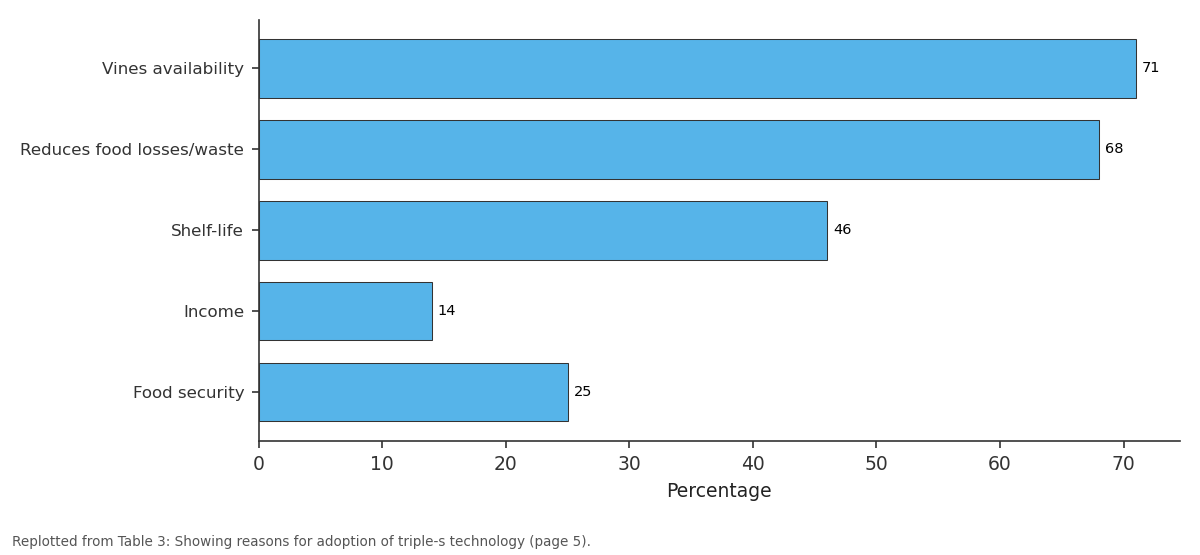
Technology is essential in reducing food loss and waste and Triple-s is such a technology with the ability to minimize food waste and make vines available for smallholder farmers. The responses from this study revealed that triple-s is being adopted by farmers as a coping strategy against OFSP losses. An author noted that, small portion of food wasted is recuperated across the food value chain, and prevention strategies are rare. Hence, there is the need to examine the reasons why food is wasted and how to prevent as well as recover this waste (Van Bemmel and Parizeau) [18] . On the reasons for adopting the technology, majority of the respondents representing 71% respondents said they are adopting because it makes vines available, 68% indicated that they adopt because it minimizes or reduces food losses/waste, on the other hand some 46% say increased shelf-life was the reason for their adoption, ¼ of the respondents representing 25% stated that food security is the reason for adopting and interestingly, 14% indicated income was what influenced their adoption of the technology. One respondent (Iddrisu Grace) said I adopted the Triple-S and produce vines and sold it to some community members. It has helped me to have access to my own vines and serves as food for the family. As indicated 71% said they are adopting while 29% indicated they are not adopting. This increase in adoption could be due to the implementation of triple-s technology by the RING and CIP from 2016 -2019, which encourages use of triple-s as part of effort to reduce losses associated with OFSP. However, adopting and strategizing has increased search of alternative mediums to be employed in this practice by the adopters. According to respondents, the primary drivers for the adoption of triple-s include; shelf-life, vines, income and food security. The results in better management of their OFSP harvests and minimizing of OFSP roots from going waste as oppose to previous times they had to quickly sell off their harvest to avoid losing their produce.
Modification
HLPE opines that decreasing food losses and waste involves classifying causes and opting for possible solutions which could be modified to suit local and product specificities HLPE 2014 [10] . For those adopting, they indicated that they have to modify the technique to fit into their environment. One respondent said, I used ash to spread in the pit or box to avoid termite or pest attack while in storage. Another respondent also said, I use millet chaffs under and at the top of my storage structure as stated by another respondent.
Impact of triple-s on OFSP losses
As depicted from table 3, according to responses from the interviews conducted, 68% indicated that the triple-s technology reduces food losses/waste, while 71% stated that the technology increased access to vines. On measuring of the impacts, 64% said the impact was very positive while 29% claimed it has positive impact. However, 7% said they are not sure of the impact of the triple-s. From the study, when farmers were asked what their experiences were with the triple-s, the respondents mentioned their experience with triple-s as follows: 57% stated they had very good experience or impression with this technology while 32% said they were impressed with the Triple-S. Some, 11% of the interviewees were of the view that their experience was fair.
| Reason | Frequency | Percentage |
|---|---|---|
| Vines availability | 64 | 71 |
| Reduces food losses/waste | 62 | 68 |
| Shelf-life | 42 | 46 |
| Income | 13 | 14 |
| Food security | 23 | 25 |
Table text extracted from the original PDF; superscript letters are shown inline. The original table image is below.
View original table image
Benefit of triple-s
A significant number of the respondents adduced that triples was beneficial thus, according to 71% of the study respondents they agreed that the technology was beneficial and their reasons were as follows; 71% claimed it makes vine available, 65% see shelf-life as what they benefit from the use of the technology. Meanwhile a quarter of the respondents representing 25% say food security was the benefit associated with the reason for their use of the technology.
Sources of information on triple-s
There are different sources of information to clients but with the end goal for individuals to be encouraged and proficiently contribute to decrease in losses and waste, making information available could persuade and empower people with skills to assist them with understanding their role in supporting activities that will reduce waste and losses (van der Werf, 2018) [12] .
Respondents were asked to respond to a series of options, based on source of their information on the technology. Of the respondents, 85% said there is information available while 15% were of the view that there was no much information on the technique. When asked where they got information from, 85% said they got the information through the Agricultural Extension Agents; 9% said they got information from the media and 4% said their source of information was from other sources such as community members and friends.
Assessing triple-s through features of successful solution
The study respondents were asked to select from features of successful solution which is applicable to the triple-s in relation to features such as acceptability, affordability, accessibility and awareness of the technology. They were further asked to rank the features they have selected. Their responses as indicated from table 4 were as follows; in terms of acceptability, 43% agreed that it's highly acceptable; 29% said its acceptability is moderate; 21% indicated low acceptability while 7% of the respondents claimed it is very low in terms of acceptability. In terms of affordability, 57% said it is affordable, 25% said it is moderately affordable, 10% agreed that it is highly affordable whereas 7% of the respondents said its affordability is low. In terms of accessibility, 76% said it highly accessible, 14% indicated its moderate in terms of accessibility, 7% claimed it is highly accessible and 3% said its low in accessibility. In relation to awareness, majority (77%) claimed that there is high awareness of the technology, 17% said they were moderately aware, 3% indicated that there was low awareness of the technology. As indicated, awareness of quantity, where and when food losses and waste happens would assist with understanding the effect of these losses, which when persuaded could offer ways of tackling these losses (Parmar et al., 2017) [8] . The study assessed the various features of a successful solution, and assessed the extent to which it is applicable to triple-s.
| Feature | Frequency | Percentage |
|---|---|---|
| Awareness | 70 | 77 |
| Accessibility | 69 | 76 |
| Acceptability | 67 | 74 |
| Affordability | 58 | 64 |
Table text extracted from the original PDF; superscript letters are shown inline. The original table image is below.
View original table image
Challenges respondents' faced in adopting triple-s
Farmers when probed to mention major constraints affecting the adoption of the technology, they provided responses and majority (75%) indicated that the most important challenge for them is the unavailability of sea sand the medium the technique utilizes in storing the produce. Hence, respondents' major worry was the inaccessible medium for storage. The appropriate solution for this challenge can be found in a collaborative effort from researchers and farmers as they share their knowledge and skills in a more participatory approach. This will enable the farmers and promoters to understand the local material conditions, as well as their specific needs and preferences. Hence the researcher together with farmers can test local and accessible medium which can be improved through trials. There is the need to tackle food waste with respect to the issues of sustainability (Monzón Santos, 2017) [15] . Concerns raised by farmers have implications for sustainability. Therefore, there is the need to try some other available or potential medium that might be combined alongside with others/known medium to improve technology adoption among the household.
Factors that influence adoption of triple-s
The study participants were examined on factors they considered prior to adopting the Triple-S innovation with the following options; availability of healthy planting material; easy access and availability of sand; the appropriate type and size of pit for storage; access to irrigation for off-season vine production; and extension of shelf life of OFSP root. Seventy six percent of the respondents indicated (table 5) that accessibility and availability of sea-sand was a factor they considered before adopting the triple-s technology, seventy percent of the study participants were of the view that access to healthy planting material influenced their decision in adopting the technology whereas, sixty three percent stated that the shelf-life of the stored roots influenced their acceptance of the triple-s technology, whiles type and size of the storage influenced fifty seven percent of the participants in adopting the technology.
| Feature | Frequency | Percentage |
|---|---|---|
| Access to healthy planting material | 63 | 70 |
| Accessibility and availability of sea-sand | 69 | 76 |
| Type and size of storage | 51 | 57 |
| Extend shelf-life of roots | 56 | 63 |
Table text extracted from the original PDF; superscript letters are shown inline. The original table image is below.
View original table image
Assessing triple-s technology through waste pyramid:
With respect to reducing waste, this was assessed through the waste pyramid. Food waste pyramid is useful in analyzing and understanding how technology or strategy could be employed with waste as lens to see how it impacts losses relative to the commodity involved. Respondents were asked where they think this technology fits or works better in relation to: prevention, minimization, reuse, recycling, energy recovery and waste disposal. Accordingly, 71% indicated it minimizes waste, 69% said it prevents waste, 64% said it that reuses waste, and 16% claimed it is a form of energy recovery. Finally, respondents' opinions were sought ways triple-s reduces food waste/losses. Of the respondents interviewed, 73% indicated that it minimizes wastes/losses, 69% claimed it reuse what will be waste, 65% responded that it recycles what will have been considered as waste, 58% are of the view that it prevents losses or wastes, 21% said it recovers energy. Only 3 % suggested it disposes wastes. Sustainable development goal 12.3 focuses on food waste to reduce food losses/waste along the production and supply chains including post-harvest losses. The part of the pyramid which the triple-s technology reflects or plays relevance was also assessed. From the analysis and discussion above, majority of the respondents indicated that triple-s technology minimizes wastes/losses. Even though, the most preferred option was prevention, on the contrary, the study found that majority of the respondents agreed that triple-s minimizes losses/waste with respect to OFSP.
Figures and tables from the paper
References
11 in the original paper- Mutandwa E, Gadzirayi CT. Comparative Assessment of Indigenous Methods of Sweet Potato Preservation among Smallholder Farmers: Case of Grass, Ash and Soil based Approaches in Zimbabwe. Afri Stud. Quart, 2007, 3(9). Available online at http://web.africa.ufl.edu/asq/v9/v9i3a4.htm
- Parmar A, Hensel O, Sturm B. Post-harvest handling practices and associated food losses and limitations in the sweetpotato value chain of southern Ethiopia. NJAS-Wag J. Life Sci. 2017:80:65-74. Available online at http://dx.doi.org/10.1016/j.njas.2016.12.002
- Atuna RA, Carey EE, Amagloh FK. 'Shelf life extension of sweetpotato (Ipomoea batatas (L) Lam) storage roots using household-level storage methods, Int. J. Postharvest Tech and Inn. 2017:5(4):274-285.
- Namanda S, Amour R, Gibson RW. The Triple S Method of Producing Sweet Potato Planting Material for Areas in Africa with Long Dry Seasons. J. Crop Improve, 2013, 27. Available online at DOI:10.1080/15427528.2012.727376
- Beausang C, Hall C, Toma L. Food waste and losses in primary production: qualitative insights from horticulture. Res. Conserv and Recyc. 2017:126:177185. Available online at https://doi.org/10.1016/j.resconrec.2017.07.042
- Environmental Protection Agency (EPA). The waste Hierarchy; c2017. Available online at https://www.epa.nsw.gov.au/yourenvironment/recycling-and-reuse/warr-strategy/thewaste-hierarchy Accessed 4th September, 2020.
- Monzón Santos JLA. Food Waste Management - Perceptions, Decisions, and Actions: The case of Guatemala City Department Restaurants. Master Thesis in Sustainable Development at Uppsala University. 2017:25:76. 30 ECTS/hp
- Affognon H, Mutungi C, Sanginga P, Borgemeister C. Unpacking postharvest losses in sub-Saharan Africa: A meta-analysis, World Dev,2015:66:49-68. Available online at http://dx.doi.org/10.1016/j.worlddev.2014.08.002.
- Dandago MA, Gungula DT. Effects of various storage methods on the quality and nutritional composition of sweet potato (Ipomea batatas L.) in Yola Nigeria: Intern. Food Res. J. 2011:18(1):271-278.
- Van Bemmel A, Parizeau K. Is it food or is it waste? The materiality and relational agency of food waste across the value chain, J Cul. Econ. 2020:13(2):207220. Available online at DOI: 10.1080/17530350.2019.1684339
- Abidin E. Storing sweet potato in sand can improve diets and incomes in West Africa; c2018. Available online at https://cipotato.org/blog/storing-sweetpotatosand-improve-diets-incomes-west-africa/Accessed 12th August, 2021.