
Research article · 2020 · Full text
International Journal of Agriculture and Food ScienceEvaluation of commercial maize cultivars for their resistance to aflatoxigenic fungi under storage conditions in Ethiopia
Volume 2(2) · Pages 40–43 · DOI: 10.33545/2664844x.2020.v2.i2a.76 ↗
Research areasMycotoxins in Agriculture and FoodGenetics and Plant Breeding
Abstract
Author-writtenA seed system can be defined as all activities related to seed production, seed storage, seed management, seed dissemination, and seed use. The aim of the study was to evaluate commercial maize cultivars for their resistance to aflatoxigenic fungi under storage conditions in Ethiopia. The collected samples were analyzed using a two-way analysis of variance (ANOVA, SAS version: 9.4) and the mean differences were separated by a t-test (LSD). There was a significantly different (p< 0.05) storage fungi incidence in the commercial maize cultivars and the highest incidence of 30.00 and 30.33% of A. flavus and A. Niger was recorded in BH661 and BH546, respectively. There were significantly different (p< 0.05) variations in the germination percentage of the maize cultivars throughout the locations. The highest germination, 97.33 %, was obtained from the Jibat cultivar whereas the lowest, 72.67 %, was recorded in BH546. In all the five commercial maize cultivars analyzed, aflatoxin types were not detected and quantified because it was below the quantification limits of 0.35 μg/kg and the development of secondary metabolite was low due to limited development of the factors that aggravated it in the seed’s storage. This study showed storage periods have a low effect on the development of Mycotoxins/secondary metabolites on the seeds of commercial maize cultivars since the samples were taken from seeds stored for more than one to three years but no aflatoxin types were detected. Therefore, from this study, it was concluded that seed storage has less impact on the aflatoxin types' development but has a high impact on seed germination.
Summary
Source-checkedPlain-language reading of the full paper, prepared with AI and checked against the text. Each point links to the authors' own words.
Why it matters
- Maize is a globally significant crop used for both human and livestock consumption, particularly in warm regions. View evidence ↗
- Fungal infections in maize are a problem because they can reduce plant yield and slow growth. View evidence ↗
- There is a lack of research regarding how commercial maize cultivars in Ethiopia resist mycotoxigenic fungi during storage. View evidence ↗
The question
- The study aimed to evaluate the ability of commercial maize cultivars to resist aflatoxigenic fungi during storage. View evidence ↗
What they did
- Maize samples were collected from three research centers: Ambo, Melkasa, and Bako. View evidence ↗
- The study tested five commercial maize varieties: MH140, BH546, M6Q, BH661, and Jibat. View evidence ↗
- Fungal identification was performed using the agar plate method, placing 10 grains per treatment on potato dextrose agar (PDA). View evidence ↗
- Aflatoxin content was analyzed using High-Performance Liquid Chromatography (HPLC) with a fluorescence detector. View evidence ↗
What they found
- Six fungal species were identified in the samples: A. flavus, A. niger, A. noxious, F. moniliforme, Penicillium spp., and R. stolonifer. View evidence ↗
- The highest fungal incidence was found in BH661 (30.00% A. flavus) and BH546 (30.33% A. niger). View evidence ↗
- Germination rates varied significantly, with the Jibat cultivar showing the highest (97.33%) and BH546 the lowest (72.67%). View evidence ↗
- No aflatoxins were detected in any of the five cultivars, as levels were below the quantification limit of 0.35 μg/kg. View evidence ↗
- Storage periods of one to three years had a low effect on the development of mycotoxins in the tested commercial cultivars. View evidence ↗
What it means
- The authors concluded that while seed storage significantly impacts germination rates, it has a smaller impact on the development of aflatoxins. View evidence ↗
Visual summary
1 visualsIllustrations explain the paper; they do not show study data.
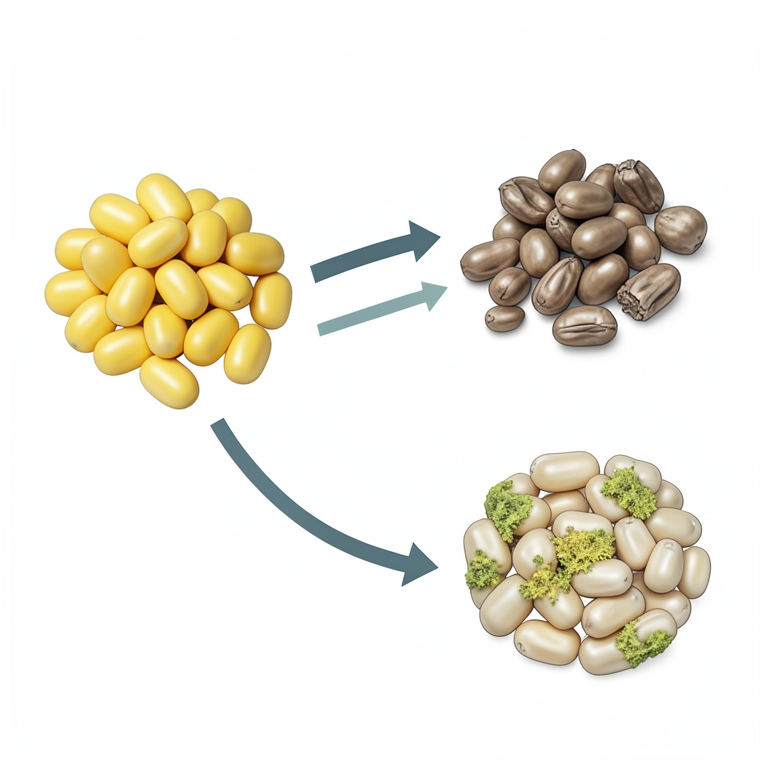
Impact of Storage on Maize Quality
AI-generated conceptual illustration (maize kernels). It explains the idea and does not show study data.
View source evidence ↗Introduction
Maize is one of such crops cultivated extensively in warm regions and consumed worldwide by both humans and livestock (Ranum et al., 2014) [18] . Maize is prone to infection by several fungal species, which can slow the growth and reduce the yield of the plant (Muthomi et al., 2012) [17] . Mycotoxins contamination of maize can take place at different stages of production, including in the field during cultivation, during processing, storage, or transportation (Coulibaly et al., 2008) [8] . In Africa, certain aflatoxin production is associated with hot, dry agro-ecological zones with latitudinal shifts in climate influencing the fungal community structure (Cotty and Jaime-Garcia, 2007) [7] . Interactions between fungi and their plant hosts or insects govern the infestation of fungi in the field, whereas the availability of nutrients, temperature, moisture, and biotic factors such as insect infestation, govern the invasion of fungi after harvesting (Miller, 1994) [14] . The susceptibility of maize plants towards plant pathogenic fungi in the field has been extensively studied. Sources of resistance to A. flavus and Fusarium spp., particularly F. verticillioides, have been identified and have been incorporated into public and private breeding programs (Munkvold, 2003) [16] . There were a number of factors that aggravated the incidence of mycotoxigenic fungi and Mycotoxins during storage. Some of these factors are extrinsic and intrinsic, some like physical, chemical, and biological factors, though others categorize them as ecological, environmental, and storage factors (Zain, 2011) [20] . Mycotoxins occur more frequently in areas with a hot and humid climate, favorable for the growth of moulds. The most prevalent fungi that can produce Mycotoxins belong to the genera Alternaria, Aspergillus, Fusarium, and Penicillium (Tsitsigiannis et al., 2012) [19] . Seed health, that is the absence of any pathogens causing seed deterioration of plant diseases after germination, can only be controlled through the source of seed, i.e., the seed system (Bishaw et al., 2013) [4,5] . A seed system can be defined as all activities related to seed production, seed storage, seed management, seed dissemination, and seed use. A sustainable seed system can ensure that high-quality seeds of a wide range of varieties and crops are produced and fully available in time and affordable to farmers and others (Louwaars, 2007) [13] . Many organizations such as IITA are continuously working on resistance breeding programs in Africa (Hell et al., 2005) [9] . To devise effective strategies to control fungal infection and minimize Mycotoxins production in host plants, a better knowledge of genetic variability and population structure at the intra-specific level and the ability to detect cryptic populations or lineages which might arise that possess significant features in terms of toxin profile or host preferences is necessary (Mule et al., 2005) [15] . However, the ability of maize kernels to withstand the infestation of fungi during storage has not yet been reported, even though infestation levels of fungi in stored maize throughout Africa are high (Bankole et al., 2006) [2] . In Ethiopia, there were limited studies on the resistance of commercial maize cultivars to mycotoxigenic fungi and Mycotoxins during storage. Therefore, the objective of this study was to evaluate commercial maize cultivars for their ability to resist Aflatoxigenic fungi associated with maize during storage.
Materials and Methods Study areas and Sample collection
The samples were collected from three agricultural research centers, Bako, Melkasa, and Ambo. The laboratory experiment was arranged in CRD with three replications (Ambo, Melkasa, and Bako). The treatments are five commercial maize varieties, MH140, BH546, M6Q, BH661, and Jibat. 250 to 500 grams of samples were taken from each commercial maize variety and location. Agar plate method: Samples of commercial maize grains with and without surface disinfection were used and 10 grains of each treatment were aseptically placed on potato dextrose agar (PDA) by the method of agar plate according to the procedures used by Binyam and Girma (2016) [3] . The laboratory analysis was carried out in the Ambo Plant Protection research center mycology laboratory department. Firstly, from each sample, 360 maize grains, in 3 replications of 120 seeds were selected. Initially, the freshly harvested seed of BH661 was used and periodically the stored maize grains were used and thoroughly washed with distilled water during each period. From surface disinfected and non-disinfected samples, 10 grains/Petri-dish/plate (9 cm diameter plates) containing potato dextrose agar (PDA) were aseptically placed. The plate that contains the fungus was incubated at 26 °C for 7 days and after 7 days of incubation, the identification of fungus isolates was done based on: estate, growth rate, color, and morphology of mycelia, conidia, and sporulation structures. Then, the isolated fungi were sub-cultured after three days of incubation for purification of the isolate. Finally, the incidence of isolation of fungi (%) and frequency of isolation of fungi (%) were calculated as follows: Incidence of fungi: Incidence of fungi infections on each sample was calculated using the following formula:
Detection and quantification of Mycotoxins using HPLC Method 50.14 gm of disodium phosphate (DSP) was dissolved with 700 ml of distilled water in a 1000ml flask. 42.50 gm of Sodium phosphate monobasic was dissolved in 350ml of distilled water. The two dissolved solutions were mixed to adjust it to 7.4 ph. 200 ml of buffer was filled into 1000 ml of graduating cylinder. Take 230ml of a buffer from the prepared and add 20 ml polytene 2020. 20 gm of samples were weighed and 2 gm of NaCl was added into a conical flask and Shaked by using a mechanical shaker and then filtered by a vacuum pump. The two layers were separated and the bottom layer was used for the analysis. Take 7 ml of samples and 43ml of buffer (Figure 3). Elute 50ml of solution in an ingenuity affinity column (Afla CLEAN) and wash with distilled water. Then add 2ml of methanol to degrade the proteins and wait for 5 minutes and elute. Finally, use the preserved glass and take it into the vial and inject the analysis undergone. 200 gm of samples were weighed and placed in labeled paper bags before they were sent to the Bless Agri-food laboratories services PLC (ISO/IEC 17025:2017 Accredited) which was established by the joint venture of Ethiopia and French investors. The total Aflatoxin content analysis in the samples was performed using HPLC protocols consisting of two chromatographic pumps, a sampling system, and a fluorescence detector (HPLC-FLD).
Data Analysis
The data were analyzed using a two-way analysis of variance (ANOVA) and the mean of fungi incidence was separated by a t-test (LSD).
Results and Discussions Isolation and identification Fungi from the commercial maize cultivars
There were significant differences (p < 0.05) between the fungi species grown on the commercial maize varieties and locations (Table 1). A total of fourteen ( 14) commercial maize samples were collected, of which nine were from Melkasa, five from Bako, and one from Ambo. Among these, five commercial maize varieties, MH-140, BH-546, M-6Q, BH-661, and Jibat were used for mycotoxins analysis because these commercial cultivars were recently used by farmers. The result indicated that six fungi species, Aspergillus flavus, Aspergillus niger, Aspergillus noxious, Fusarium moniliforme, Penicillium spp., and Rhizopus stolonifer were identified through the agar plate method. The incidence of A. flavus, A. niger, A. nomius, F. moniliform, penicillium, and R. stolonifera was recorded in low 18.33, 15.12, 5.33, 9.67, 2.00, and 3.10 in Jibat variety of Ambo agricultural research center than the commercial maize varieties sampled from the two agricultural research centers. This is due to three reasons: 1) freshly harvested during the sample taken for analysis. 2) The environmental condition of the Ambo agricultural research center lies on Woina Dega, where there are few variations in storage temperature and relative humidity of the areas. 3) Commercial maize varieties of MQ6, BH546, MH140, and BH661 were stored for more than one year, and additionally, MQ6 has a soft endosperm than the other because it is quality protein maize. These commercial maize cultivars were stored for more than one to three years but no aflatoxins types were detected in all the cultivars. Likewise, Aliyu and Kutama (2007) [1] identified six fungal species; Aspergillus Rhizopus, Penicillium Curvularia, Fusarium, and Mucor. Ihejirika et al. (2005) [10] reported that A. Niger occurred with the highest incidence of 60%, followed by A. Versicolor at 25 %, and A. fumigatus occurred with the lowest incidence of 15 %. The fungal development was highly obtained as the storage period increased because of the metabolic activity of the produce, inappropriate storage conditions, and moisture increment due to microbial activities.
Evaluation of germination percentage of commercial maize cultivars
Table 1 indicated that there were significant differences (p < 0.05) between cultivars in germination percentage. The highest germination, 97.33 %, was obtained from the Jibat cultivar whereas the lowest, 72.67 %, was recorded in BH 546, which was collected from Ambo and Bako, respectively. This is due to the Jibat cultivar being freshly harvested and being also located at woyinadega rather than Bako, which has kola conditions that shorten the viability of the seeds due to biochemical analysis of the seeds. However, Louwaars (1994) [12] reported that loss of viability was due to poor seed storage conditions which caused up to 10 % loss in seed quality mainly in the tropics. Bosci and Kovacs (1990) [6] report that the germination of seeds may vary with temperature management. This is because the temperature is a modifying factor in germination since it can influence available soil water and nutrient supply necessary for maize growth and development (Keeling and Greaves, 1990) [11] .
Aflatoxin detected from the commercial maize cultivars using HPLC A total of fourteen ( 14) commercial maize varieties, nine from Melkasa, five from Bako, and one from Ambo were collected. Five commercial maize varieties, MH-140, BH-546, M-6Q, BH-661, and Jibat were used for HPLC analysis. The aflatoxin types were not detected in all the five commercial maize cultivars because they were below the quantification limit of 0.35 μg/kg. This might be because maize endosperm was hard to degrade with few storage periods and metabolites were developed slowly. Since mycotoxin's development, it has been aggravated by moisture content, temperature, and relative humidity of the storage and environment. The figures below represent aflatoxin was not detected in all the analyzed commercial maize varieties (Figure 34567).
Conclusions and Recommendations
Maize is prone to infection by several fungal species, which can slow growth and reduce the yield of the plant. Six fungi species; Aspergillus flavus, Aspergillus Niger, Aspergillus nomius, Fusarium moniliforme, Penicillium, and Rhizopus stolonifer were identified through the agar plate method. The incidence of A. flavus and A. Niger was high in the commercial maize cultivars of BH661 and BH546 and low in the Jibat cultivar. This is due to the Jibat cultivar being freshly harvested and the environmental condition of Ambo lies on Woina Deg, where there are few variations in storage temperature and relative humidity of the areas. There were significant differences (p < 0.05) among cultivars in germination percentage. The highest germination percentage was obtained from the Jibat cultivar, whereas the lowest was recorded in BH546, respectively. The aflatoxin types were not detected in all the five commercial maize cultivars because they were below the quantification limit of 0.35 μg/kg. This might be because maize endosperm was hard to degrade with few storage periods and metabolites were developed slowly. Aflatoxin's development was aggravated by the quantity of the stored produce, storage condition, moisture content, temperature, and relative humidity of the storage and the environment. The storage periods have a minimal effect on the detection and quantification of aflatoxin types on the analyzed seeds of commercial maize cultivars since the samples were taken from one to three years of stored seeds. Seed storage has less impact on the aflatoxin types' development but has a high impact on the seed germination percentage.
Acknowledgement
AcknowledgementsThe authors thank the Ethiopian Institute of Agricultural Research (EIAR) for financing this research. Thanks also go to the Bako, Melkasa, and Ambo Agricultural Research Center for their assistance in seed collection. The authors also thank Kitessa Gutu for the financial payment for the analyzed samples and Bless Agri Food Laboratory Services for the detection of aflatoxin. The authors are also very grateful to the people and daily laborers who closely assisted during the laboratory analysis.
References
12 in the original paper- Binyam T, Girma A. Detection of Fungi Infecting Maize (Zea mays L.) Seeds in Different Storages around Jimma, Southwestern Ethiopia. Journal of Plant Pathology and Microbiology. 2016;7(3):2-6.
- Bishaw Z, Struik PC, Van Gastel AJG. Farmers' seed sources and seed quality: 2. seed health. Int. J. Plant. Prod. 2013;7:637-658.
- Bishaw Z, Struik PC, Van Gastel AJG. Farmers' seed sources and seed quality: 2. seed health. Int. J. Plant. Prod. 2013;7:637-658.
- Bosci J, Kovacs G. Inheritance of the rate of germination and emergence at low temperatures in maize. Acta Agronomica Hungarica. 1990;39:127-135.
- Cotty PJ, Jaime-Garcia R. Influences of climate on aflatoxin produce fungi and aflatoxin contamination. International Journal of Food Microbiology. 2007;119:109115.
- Ihejirika GO, Nwufo MI, Durugbo CI, Ibeawuchi II, Onyia VH, Onweremadu EU, et al. Identification of Fungi Associated with Storage Rot of Groundnut in Imo State, South Eastern Nigeria. Plant Pathology Journal. 2005;4:110-112.
- Mule G, Gonzalez-Jaen MT, Hornok L, Nicholson P, Waalwijk C. Advances in molecular diagnosis of toxigenic Fusarium species. Food Addit. Contam. 2005;22:16-323.
- Munkvold GP. Cultural and genetic approaches to managing Mycotoxins in maize. Ann Rev Phytopathol. 2003;41:99-116.
- Muthomi J, Mureithi B, Chemining'wa GN. Aspergillums species and aflatoxin B1 in soil, maize grain and flour samples from semiarid and humid regions of Kenya. International Journal of Agricultural Science. 2012;2(1):2234.
- Ranum P, Pena-Rosas JP, Garcia-Casal MN. Global maize production, utilization and consumption. Annals of the New York Academy of Sciences. 2014;1312(1):105-112.
- Tsitsigiannis DI, Dimakopoulou M, Antoniou PP, Tjamos EC. Biological control strategies of mycotoxigenic fungi and associated Mycotoxins in Mediterranean basin crops. Phytopathol. Mediterr. 2012;51:158-174.
- Zain ME. Impact of Mycotoxins on humans and animals. J Saudi Chem Soc. 2011;15:129-144.