
Research article · 2021 · Full text
International Journal of Agriculture and Food ScienceInvestigation on the biochemical changes occurs in the seeds of Pongamia pinnata (L.) Pierre by fungal infection
Volume 3(1) · Pages 51–54 · DOI: 10.33545/2664844x.2021.v3.i1a.93 ↗
Research areasPotato Plant Research
Abstract
Author-writtenPongamia pinnata has been found to be one of the most suitable bio-fuel plants due to its various favourable attributes. Numbers of fungal species were found associated with seeds. Among these fungi C. cladosporioides was dominant followed by Alternaria and Aspergillus species. The aim of research work is to estimate primary metabolites such as total lipid, protein, reducing sugar, carbohydrate and starch which are present in seeds of Pongamia pinnata. The percent of total Lipid content in healthy seeds (0.79 mg / gm.), reducing sugar (1.26 mg / gm.), protein (2.66 mg / gm.) and carbohydrate (15.44 mg / gm.) respectively. During fungal infection biochemical changes occur in the seeds and the infected seeds shows reduction in total lipid content (0.58 mg / gm.), proteins (1.95 mg / gm.), reducing sugars (0.819 mg / gm.) and carbohydrates (12.70 mg / gm.). The percent of reduction in total lipid about 0.21%, reducing sugar 0.44% and carbohydrate 2.74%. From 100 gm. of healthy seeds 37 ml oil is obtained by Soxhlet apparatus, while in infected seeds (100 gm.) it was 32 ml. There was a reduction of 5% of oil.
Summary
Source-checkedPlain-language reading of the full paper, prepared with AI and checked against the text. Each point links to the authors' own words.
Why it matters
- Pongamia pinnata is considered one of the most suitable plant species for producing biodiesel due to its oil yield. View evidence ↗
- Beyond biofuel, the plant has long-standing uses in traditional medicine, animal fodder, and various industrial applications. View evidence ↗
- While the plant has high growth potential, there is limited knowledge regarding its pathology and the losses caused by infections. View evidence ↗
The question
- The study aimed to estimate the levels of primary metabolites, including total lipid, protein, reducing sugar, carbohydrate, and starch, in Pongamia pinnata seeds. View evidence ↗
- The researchers also sought to identify fungi associated with the plant and determine how these infections change primary metabolites and oil extraction. View evidence ↗
What they did
- Healthy, infected, and seedless Pongamia pinnata fruits were collected from various locations on the GUG campus. View evidence ↗
- Oil was extracted from the seeds using a Soxhlet apparatus with hexane for approximately 12 hours. View evidence ↗
What they found
- Total lipid content decreased from 0.79 mg/gm in healthy seeds to 0.58 mg/gm in infected seeds, representing a 0.21% yield loss. View evidence ↗
- Protein levels dropped from 2.66 mg/gm in healthy seeds to 1.95 mg/gm in infected seeds, a reduction of 0.71%. View evidence ↗
- Reducing sugar content was reduced from 1.26 mg/gm in healthy seeds to 0.819 mg/gm in infected seeds, a loss of 0.44%. View evidence ↗
- Carbohydrate content decreased from 15.44 mg/gm in healthy seeds to 12.70 mg/gm in infected seeds, a reduction of 2.74%. View evidence ↗
- Starch levels showed a significant decrease from 24.70 mg/gm in healthy seeds to 18.2 mg/gm in infected seeds, a 6.5% loss. View evidence ↗
- Oil extraction yield fell from 37 ml per 100g of healthy seeds to 32 ml per 100g of infected seeds, a 5% reduction. View evidence ↗
What it means
- The authors conclude that reducing fungal association with seeds is critical because it diminishes protein content. View evidence ↗
- The authors recommend increasing productivity by selecting seeds from superior plants with high oil content and high yield. View evidence ↗
- The authors state that further research is needed to investigate specific fungal diseases and their impact on biochemical reduction. View evidence ↗
Visual summary
1 visualsIllustrations explain the paper; they do not show study data.
Study Framework
AI-generated conceptual illustration (Pongamia pinnata seeds). It explains the idea and does not show study data.
View source evidence ↗Figures & tables
From the original paper Table 1
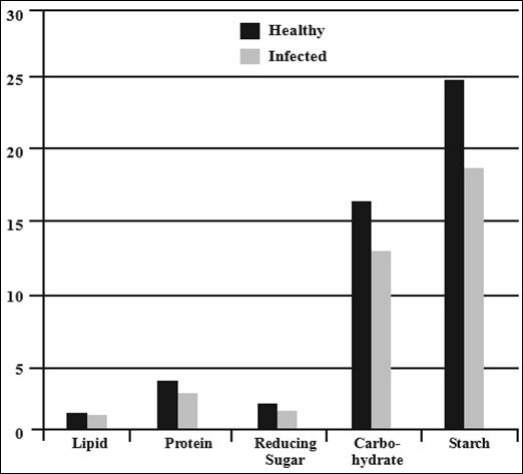 Figure 1
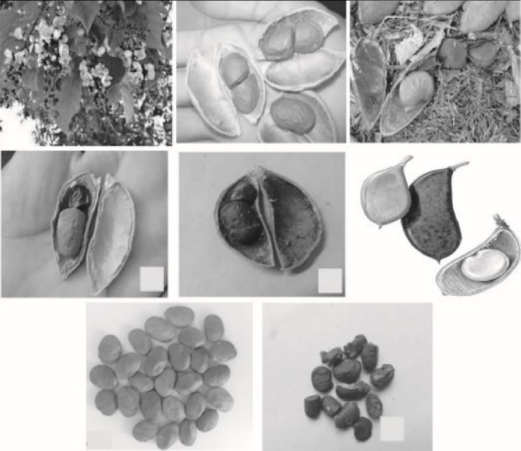 Figure 2A
Introduction
Pongamia pinnata, (syn. Millettia pinnata), also known as the malapari or karanja tree, has a large native distribution in Asia and Australia. The species is also cultivated in Africa, the United States, and other countries. Recent research has shown the tree has great potential for reforesting damaged or degraded landscapes. The tree grows well in humid and subtropical environments, and its dense root network and thick taproot make it drought tolerant. Among the many tree species, which can yield oil as a source of energy in the form of bio diesel, Pongamia pinnata has been found to be one of the most suitable species. Pongamia pinnata (L.) Pierre or its synonym Millettia pinnata is a small evergreen tree species belonging to the plant family Fabaceae. This legume tree species is widely distributed in various regions of the world like Australia, China, India and Pakistan (Kirtikar et al., 1994) [25] . The biofuel obtained from P. pinnata is used as a bio-diesel in industries (De and Bhattacharya, 1999; Azam et al., 2005; Karmee and Chadha, 2005) [6,1,26] . India has shown positive signs towards renewable energy technologies and committed to the use of renewable sources to supplement its energy requirements (Doshi and Gopal, 2013) [9] . The Pongamia pinnata plant resource as the best plant material with higher productivity, as the quality of bio diesel is dependent on the specific ratio of saturated and unsaturated fatty acids in the oil (Ramos et al., 2009) [17] . This plant has been widely used as a source of animal fodder, fuel, manure, fish poison, timber and traditional medicine for a long time. The pongam seed oil has a bitter taste and considered as non-edible oil. It is used as fuel for cooking and lamps, lubricant, tanning leather making soap and as illuminating oil. In many parts of the world, production of Karanja for industrial (biodiesel) and medicinal purposes is gaining popularity (Nagalakshmi et al., 2011) [12] particularly in Ayurvedic medicine in bronchitis, whooping cough, rheumatic joints and diabetes. Leaves used as a medicated bath for relieving rheumatic pain and for cleaning ulcer in gonorrhea (Pathak et al., 2015) [15] .
The seed oil contains karanjin (Pathak et al., 2015) [15] . It is estimated that the large scale of cultivation of P. pinnata would fulfil the demands of bio-fuel for India (Punia et al., 2006) [16] . In supporting the demand of new and renewable energy, the use of biomass-based biofuels are needed and several forest tree species can be utilized as a source of raw materials (Syamsuwida et al., 2015) [27] . The tree is also a host plant for Lac insect. The plant to grow in larger areas is high, but very less is known about the plant pathology and loss due to the infections. In this investigation, studied fungi associated with plant and biochemical changes in the primary metabolites and on oil extraction.
Materials and Methods
The work done was in the mycology and plant pathology laboratory, dept. of Botany, GUG. The survey was carried out to collect the fruit and seed samples of Pongamia pinnata. The fresh Pongamia pinnata fruits were collected which are healthy, infected as well as seedless fruits, collected from different locations of GUG campus.
Isolation of fungi
To study the fungal association, infected fruits and seeds were placed on moist sterilized blotter and incubated at 28C. The spore suspension was prepared from infected parts of seeds and fruits separately and spore concentration was adjusted to 103 spores/ml and inoculated on PDA and MRBA nutrient medium and incubated at 28C. After a period of 24 h different fungi seen growing, were sub-cultured using a scotch tape method and identified using manuals (Barnet and Hunter, 1972; Raper and Fennel, 1965) [4,18] .
Biochemical estimation
For the quantitative estimation different protocols were used. Healthy and infected seeds were collected and washed with distilled water, dried and powdered. The powder was used for analysis of total lipid (Bligh and Dyer method), protein DOI: https://doi.org/10.33545/2664844X.2021.v3.i1a.93 (Lowry's method), reducing sugar (Nelson-Somogyi method), carbohydrate (Anthorone method) and starch (Anthorone method). Oil extraction of the Pongamia pinnata done by Soxhlet apparatus. The oil was then extracted with hexane in a Soxhlet apparatus for about 12 hours. The solvent was then removed using a rotary vacuum evaporator at reduced pressure and the percentage of oil was determined
Results and Discussion
Pongamia pinnata is one of the further fuel plants. Its management from disease, stress related yield loss is one of the very important criteria. Very few reports are with respect to diseases of this plant and that of fungal diseases very limited information is available. The plants are rich sources of high value metabolites like total lipid, protein, reducing sugar, carbohydrates and starch etc. A primary metabolites is directly is involved in the development, reproduction and normal growth (Sagwan et al., 2010) [20] . The fungal association with Pongamia plant may be parasitic or saprophytic but in this study reports change in biochemical due to interaction of fungi in the plant parts. According to Jamaluddin et al., (2005) [30] Aspergillus species is predominant in the stored seeds of Pongamia. In Anonymous (1969) [2] reported association of few fungi on Pongamia tree. Pongamia pinnata seeds were evaluated quantitatively for the analysis of protein, lipid, reducing sugar, starch and carbohydrates. In the present study, Phytochemical screening of Pongamia pinnata evaluated and results shown in Table 1, biochemical estimation of primary metabolites of seeds of Pongamia pinnata has been undertaken.
| Sl. No. | Metabolites | In healthy | In infected | Yield loss in % |
|---|---|---|---|---|
| 1. | Total Lipid | 0.79 mg / gm. | 0.58 mg / gm. | 0.21% |
| 2. | Protein | 2.66 mg / gm. | 1.95 mg / gm. | 0.71% |
| 3. | Reducing Sugar | 1.26 mg / gm. | 0.819 mg / gm. | 0.44% |
| 4. | Carbohydrate | 15.44 mg / gm. | 12.70 mg / gm. | 2.74% |
| 5. | Starch | 24.70 mg / gm. | 18.2 mg / gm. | 6.5% |
| 6. | Extraction of Oil | 37 ml / 100g m | 32 ml / 100 gm. | 5% |
Table text extracted from the original PDF; superscript letters are shown inline. The original table image is below.
View original table image
The higher amount of plant lipid can be used as natural food colors, essential oils and spice oleoresins. With a strong foundation in research and development, plant lipids have developed products that work with diverse requirements, be it culinary, medicinal or cosmetic (Yadav and Tyagi, 2006) [28] . Lipid content of the healthy seeds was 0.79gm/gm. the infected seeds shown the decreases in the lipid content that is 0.58 gm. / gm. the percentage reduction of about 0.21%, Compared to earlier reports of Kumar et al., (2007) [10] ; Solmon Raju and Rao (2005) [22] ; Natanam et al., (1989) [14] , Nagaraj and Mukata (2004) [13] , it is very less. Since we used crude method of collection and isolation, the percentage of lipid contents was less. When lipid content in infected seed was compared to healthy there was reduction of 0.21%. There are no such reports of reduction in lipid contents due to fungal association. Proteins are the primary components of living things. The presence of higher protein level in the plant points towards their possible increase food value or that a protein base bioactive compound could also be isolated in Future (Thomsen et al., 1991) [29] . Protein content in Pongamia seeds was 2.66 mg / gm. that was reduced to 1.95mg/gm with the percent reduction in the protein content of the seed is 0.71%. Earlier reports of Duke (1983) [8] , presence of 17.4% protein in dry kernels. Scott et al., (2008) [21] reported deoiled cake of seed contain 30% of protein which is good supplement of cattle feed. Hence, it is very important to reduce fungal association with seed as it reduces protein content. Extraction of Oil 37 ml / 100g m 32 ml / 100 gm. 5%
The reducing sugar in healthy seeds was 1.26 mg / gm. that was reduced to 0.819 mg / gm. in the infected seeds with the percentage reduction of 0.44%. Sugars are very important biochemical nutrients for the plants. If abundantly existing, these are detected naturally by various other micro-organisms like bacteria, fungi, insects etc. (Srilakshmi, 2012) [24] . No reports are there with this kind of reductional information.
Hence, this is one of the unique additions to the knowledge of Pongamia.
Total carbohydrate content of healthy seeds was 15.44 mg / gm. compared to report of Duke (1983) [8] , starch content was 6.6% which is less due to fungal association carbohydrate content reduced to 12.70 mg / gm. with reduction of 2.74%. Hence, the study of fungal association is very relevant and is required. Plant sugars can be used as artificial sweeteners and they can even help diabetics by supporting the body in its rebuilding (Birajdar et al., 2011) [3] . Starch is biodegradable and renewable in nature. They are increasingly being considered as an ecofriendly alternative to the use of synthetic additives in many other products, including plastics, detergents, pharmaceutical tablets, pesticides, cosmetics and even oil-drilling fluids (Sagwan et al., 2010). The starch in healthy seeds was 24.70 mg / gm. and in a infected seeds 18.2 mg / gm., with the total reduction is 6.5%.
Estimation of oil
Phyto chemically the extraction of oil was carried out by using Soxhlet apparatus. The total content of oil from 100 gm. of healthy seeds after 65 hrs. of evaporation was 37 ml. where as in 100 gm. of infected seeds was 32 ml. there was reduction of 5% of oil. The seeds contain about 27-39% oil and in the study of Kesari et al., (2008) [31] , the highest oil yield 33% from seeds was recovered in n-Hexane. Seeds consist of 95 per cent kernel and are reported to contain about 27 per cent oil. The oil yield is reported to be about 24 to 26.5 per cent if mechanical expellers are used for the recovery of oil from kernels, but it is only 18-22 per cent from village crushers. The crude oil is yellow orange to brown in colour which deepens on standing. It has a bitter taste and disagreeable odour, thus, it is not considered for edible purpose.
We quantify that Pongamia pinnata contain many primary metabolites like carbohydrates, proteins, total lipids, reducing sugar and starch. These results are suggestive of primary bioactive compound of commercially importance and may result in great interest in plants pharmaceuticals. Primary metabolites analysis is necessary for knowing the nutritional potential of plants and them also from the precursors for the synthesis of secondary metabolites. The plant pathogen causes significant losses in forests. Fungal pathogens are one of the most common resistant types of pathogens as well as prevent their infection is of utmost importance. Further studies are required with specific fungal disease and reduction in bio chemicals. There is need to increase the productivity by increasing our basic knowledge especially by using seeds from the superior plants, possessing characteristics like high yield and high oil content.
Figures and tables from the paper
References
22 in the original paper- Azam MM, Waris A, Nahar NM. Prospects and potential of fatty acid methyl esters of some nontraditional seed oils for use as biodiesel in India. Biomass and Bioenergy. 2005;1(2)293-302.
- Birajdar S, Kedarnath, Chimkod V, Patil CS. Phytochemical screening and characterization of Pongamia pinnata (L.) seed oil. International Journal of Pharmaceuticals Analysis. 2011;3(1)17-20.
- Hedge JE, Hofreiter BT. In: Carbohydrate Chemistry 17 (edition Whistler RL and Be Miller JN) (Academic Press, New York, USA) Bligh EG and Dyer WJ (1959). A rapid method of total lipid extraction and purification. Canadian Journal of Biochemistry and Physiology. 1962;37(8):911917.
- De BK, Battacharyya DK. Biodiesel from minor vegetable oils like karanja oil and nahor oil. Lipid / Fett. 1999;101:404-406.
- Doshi P, Srivastava G. Sustainable approach to produce bioethanol from Karanja (Pongamia pinnata) oilseed residue. Turkish Journal of Agriculture and Forestry. 2013;37781-788.
- Kumar S, Radhamani J, Singh AK, Varaprasad KSGermination and seed storage behaviour in Pongamia pinnata L. Current Science. 2007;93(7)910-911.
- Lowery OH, Rosebrough NJ, Farr AL, Randall RJ. Protein measurement with the Folin phenol reagent. The Journal of Biological Chemistry. 1951;193:265-275.
- Nagalakshmi D, Dhanalakshmi K, Himabindu D. Replacement of groundnut cake with sunflower and Karanj seed cakes on performance, nutrient utilisation, immune response and carcass characteristics in Nellore lambs. Small Ruminant Research. 2011;97:12-20.
- Nagaraj G, Mukata N. Seed composition and fatty acid profile of some tree born oilseeds. Journal of Oilseeds Research. 2004;21:117-120.
- Natanam R, Kadirvel R, Chandrasekaran D. Chemical composition of karanja (Pongamia glabra vent [P. pinnata] kernel and cake as animal feed. Indian Journal of Animal Nutrition. 1989;6:270-273.
- Pathak H, Maru S, Satya HN, Silawat SC. Fungal Diseases of Trees in Forest Nurseries of Indore, India. Journal of Plant Pathology & Microbiology. 2015;6:297.
- Punia MS, Kureel RS, Pandy A. Status and potential of tree borne oil seeds (TBO'S) in biofuel production of India. Indian Journal of Agroforestry. 2006;8:80-86.
- Ramos MJ, Fernandez CM, Caras A, Roudriguez L, Perez A. Influence of fatty acid composition of raw materials on bio diesel properties. Bioresource Technology. 2009;100:261-268.
- Sagwan S, Rao DV, Sharma RA. Biochemical estimation of primary metabolites from Pongamia pinnata (L.): An important biodiesel plant. International Journal of Pharmaceutical Sciences Review and Research. 2010;5:146-149.
- Scott PT, Pregelj L, Ning C, Hadler JS, Michael A, Gresshoff PM. Pongamia pinnata: An un-trapped Resource for the Biofuels Industry of future. Bioenergy Research. 2008;1:2-11.
- Pierre (Fabaceae). Current Science. 2005, 90.
- Srilakshmi P, Sailaja D, Bhanuteja M, Kumar DR, Madhuri M. Quantitative estimation of Carbohydrate in insect induced and fungal infected leaf galls of Pongamia pinnata. International Journal of Plant, Animal and Environmental Sciences. 2012;2:203-205.
- Kirtikar V, Singh KK, Morris DE. Substitutions in Hgcuprate superconductors. Journal of materials research. 1994 Nov;9(11):2809-13.
- Karmee SK, Chadha A. Preparation of biodiesel from crude oil of Pongamia pinnata. Bioresource technology. 2005 Sep 1;96(13):1425-9.
- Syamsuwida D, Putri KP, Kurniaty R, Aminah A. Seeds and seedlings production of bioenergy tree species Malapari (Pongamia pinnata (L.) Pierre). Energy Procedia. 2015 Jan 1;65:67-75.
- Thomsen S. Pathologic analysis of photothermal and photomechanical effects of laser-tissue interactions. Photochemistry and photobiology. 1991 Jun;53(6):825-35.
- Kesari A, Pirra LN, Bremadesam L, McIntyre O, Gordon E, Dubrovsky AL, et al. Integrated DNA, cDNA, and protein studies in Becker muscular dystrophy show high exception to the reading frame rule. Human mutation. 2008 May;29(5):728-37.