
Research article · 2023 · Full text
International Journal of Advanced Chemistry ResearchSynthesis, characterization and biological evaluation of tetrazole derivatives
Volume 5(1) · Pages 41–46 · DOI: 10.33545/26646781.2023.v5.i1a.142 ↗
Research areasSynthesis of β-Lactam CompoundsSynthesis of Tetrazole DerivativesClick Chemistry and Applications
Abstract
Author-writtenHeptanitrile was used in preparation azide β-lactam derivatives to produce a number of new derivatives contain tetrazole ring connected to the β-lactam moiety, which were then determined the chemical structure of prepared end products by using NMR and IR spectroscopy. The biological test against selected microorganisms showed that the majority of the end derivatives had good antifungal and antibacterial activity. The antifungal and antibacterial activity of the (t2) derivative in particular was equivalent to or even superior to that of the reference drugs Amoxicillin and Fluconazole.
Summary
Source-checkedPlain-language reading of the full paper, prepared with AI and checked against the text. Each point links to the authors' own words.
Why it matters
- The increase in multidrug-resistant bacteria and fungi, along with new pathogens, has created significant concerns regarding the treatment of microbiological diseases. View evidence ↗
- Tetrazoles are important aromatic heterocyclic molecules that can bind to various biological receptors or enzymes through various weak interactions, making them valuable for pharmaceutical development. View evidence ↗
- Research indicates that tetrazole derivatives may act as antimicrobial agents by inhibiting the production of proteins in microorganisms. View evidence ↗
The question
- The study aimed to synthesize new molecules consisting of a β-lactam ring connected to a tetrazole ring and evaluate their antibacterial and antifungal activities in vitro. View evidence ↗
What they did
- The chemical structures of the synthesized products were characterized using 1H-NMR (300 MHz), 13C-NMR (75 MHz), and FT-IR spectroscopy. View evidence ↗
- Tetrazole derivatives (t1-t3) were synthesized by reacting β-lactam azide derivatives with heptane-nitrile in DMF using ammonium chloride as a catalyst at 120 °C for 8 hours. View evidence ↗
- The antimicrobial activity was tested in vitro against Escherichia coli (ATCC 25922), Staphylococcus aureus (ATCC 29213), and selected fungi. View evidence ↗
- The study used DMSO as a negative control, while ampicillin and fluconazole served as positive controls for the bioassays. View evidence ↗
What they found
- The synthesized tetrazole derivatives (t1, t2, and t3) showed good to moderate antibacterial activity, with minimum inhibitory concentrations (MIC) ranging from 75 to 125 µg/mL. View evidence ↗
- Against E. coli, compounds t2 and t3 were particularly strong (MIC 75-90 µg/mL), whereas t1 showed good activity (MIC 125 µg/mL). View evidence ↗
- Against S. aureus, compounds t2 and t3 showed good activity (MIC 125-140 µg/mL), while t1 showed moderate activity (MIC 200 µg/mL) compared to ampicillin. View evidence ↗
- The synthetic compounds (t1-t3) exhibited better antifungal activity against C. albicans (MIC 150-250 µg/mL) than the reference drug Fluconazole (MIC 250 µg/mL). View evidence ↗
What it means
- The authors conclude that they successfully developed a simple and practical method for the first-time synthesis of a novel tetrazole type from 5-methoxybenzothiazol-2-amine. View evidence ↗
- The authors found that compounds containing -Cl and -NO2 groups exhibited superior antibacterial performance compared to other synthesized compounds. View evidence ↗
Visual summary
1 visualsIllustrations explain the paper; charts are replotted from the paper's own table values.
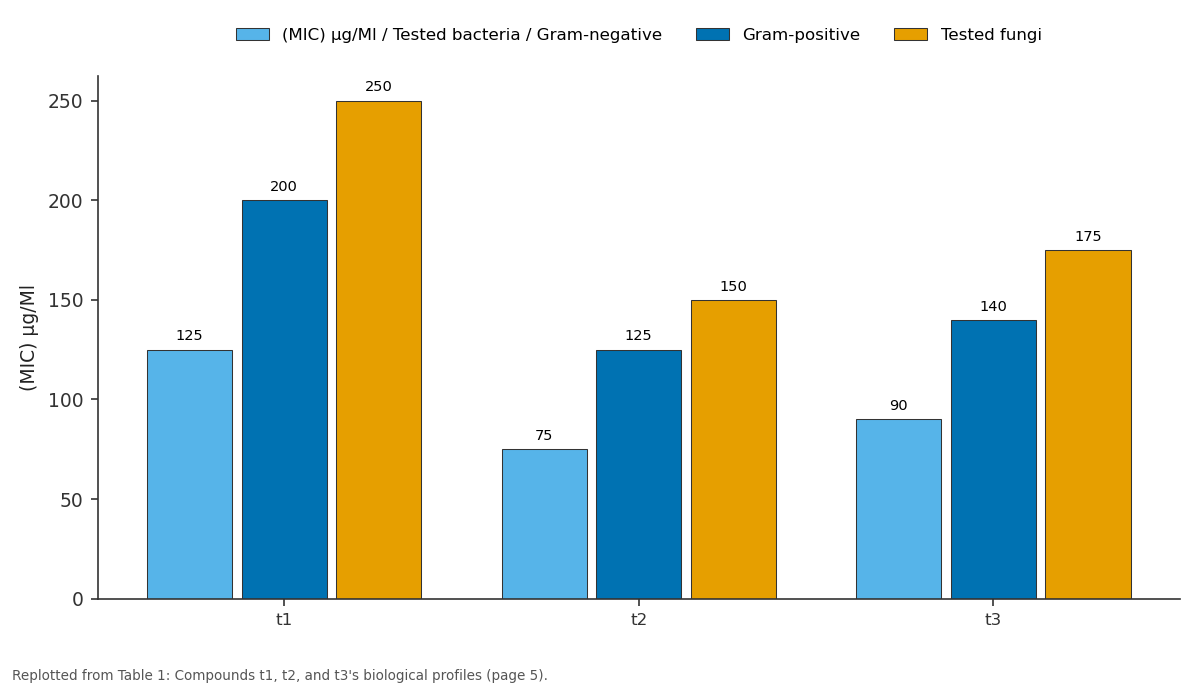
(MIC) µg/Ml / Tested bacteria / Gram-negative and Gram-positive and more: t1 vs t2 vs t3
Replotted from Table 1 (page 5) of the original paper. Every bar is the paper's own table value.
View source evidence ↗Figures & tables
From the original paper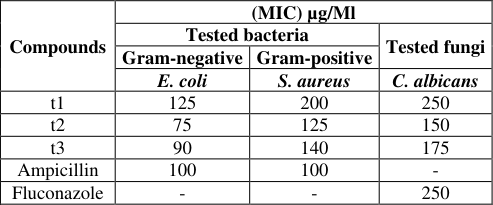 Table 1
Introduction
The rapid rise in multidrug-resistant strains, uncontrollable pathogenic fungi and bacteria, and novel emerging pathogens have raised concerns about microbiological illnesses [1][2][3][4] . To treat a wide range of community and hospital-acquired microbial diseases, numerous synthetic antimicrobial medicines and semi-synthetic have been identified and are widely employed in clinical settings. Particularly, the FDA-approved medicine auranofin, which has received a lot of attention recently, has a remarkable impact on Gram-positive and multidrugresistant bacteria [5,6] . Narrow antibacterial spectrum, negative effects, high toxicity, and other issues with clinical medicines remain unresolved, nevertheless. One of the key methods to increase effectiveness and bioavailability while treating many diseases in the clinic is combination therapy, which involves the use of two or more drugs. Combination therapy can typically overcome multi-drug resistance [7,8] . However, it is very desirable to find and create structurally new antimicrobial drugs that have outstanding action against resistant bacteria and favorable pharmacological proles [9][10][11] . Tetrazole is a significant five-membered aromatic heterocyclic molecule with planar structural characteristics rich in polynitrogen electrons. Tetrazole compounds can readily bind with different receptors or enzymes in organisms thanks to their special structure, which enables them to do so through weak interactions like van der Waals forces, cation-, anion-, hydrogen bonds, and coordination bonds, among others. As a result, they display a variety of biological functions and are important to the pharmaceutical sector [12,13] . Tetrazole rings serve as enticing linkers that can be used to stabilize or combine various pharmacophores fragments to create unique functionalized compounds [14,15] . In addition, the tetrazole moiety functions as an amide [16] , isostere of carboxyl, and a few heterocycles (benzotriazole, 1, 2, 3-triazole, 1, 2, 4-triazole imidazole carbazole benzimidazole,) Molecules that contain tetrazole derivatives have been effectively produced and widely used as clinical medications to treat a variety of disorders, including antibiotics Flomoxef antihypertensives Lorsartan and Valsartan and antinociceptive Alfentanil According to certain research, tetrazole derivatives can successfully stop the manufacture of microorganism's proteins to suppress the growth of a variety of bacteria. This shows that tetrazole compounds have a great deal of potential as a new class of antimicrobial medications.
We are very interested in researching tetrazole derivatives as a new derivatives of possible antibacterial medicines in light of the aforementioned factors and as a continuation of our ongoing study. Here, we'd like to report on the creation of molecules of β-lactam connected with tetrazole ring. The antibacterial and antifungal capabilities of each novel molecule were examined in vitro, and the interaction between the most potent tetrazole molecule and prescription medications was also examined.
Experimental Techniques and Materials
The chemical supply came from Merck, Fluka, and Acros Chemicals. NMR spectra from Bruker's DMSO-d6 were taken (operating at 300 MHz for 1H-NMR and 75 MHz for 13C-NMR). The TMS revealed ppm-level chemical alterations downfield. It is stated in Hertz for each coupling constant (J). An FT-IR 8300 spectrophotometer from Shimadzu was used to generate FTIR spectra. An electronic melting point instrument has researched melting points. The reactions with different polarity solvent solutions were observed using TLC.
Synthesis of Schiff base (s1-s3)
A solution (25 mmol) of 5-methoxybenzothiazol-2-amine was dissolved in 40 mL ethanol with the presence 2-3 drops of glacial acetic acid and then (25 mmol) benzaldehyde derivatives was added. The mixture of reaction was stirred for 6 hrs at 80 ℃ continued stirring until the reaction was complete. TLC ethylacetate: hexane (1: 1) was used as the eluent after the reaction course to produce the desired product. Under reduced pressure, the solvent was withdrawn, and the residue was dissolved in 80 mL of DCM and 150 mL of water. The organic layer was dried by using MgSO4, filtered, and concentrated by evaporated solvent.
Compound (s1)
Yield, 84%; M.P. 187-189 ℃; FTIR, ν (cm Synthesis new β-Lactam rings (b1-b3) [33] In 50 mL of dioxane, Schiff base compounds (s1, s2, s3) (15 mmol) were dissolved. Trimethylamine (8 mmol) was then added slowly, and the mixture of reaction was chilled in an ice-salt bath. After stirring the mixture for 10 minutes, 16 mmol of chloroacetyl chloride was gradually added over the course of an hour. The mixture was continuously stirred for a whole day at room temperature until the reaction was finished. TLC ethyl acetate: hexane (1:1) was used as an eluent to afford the product after the reaction course. Under reduced pressure, the solvent was withdrawn, and the residue of the product was dissolved in organic solvent about 50 mL of DCM and 50 mL of water. The organic layer was dried using MgSO4, filtered, and removed organic solvent that had evaporated.
Compound (b1)
Yield, 72%; M.P. 158-160 ℃; FTIR, ν (cm
Compound (b2)
Yield, 75%; M.P. 188-190 ℃; FTIR, ν (cm -1 ): (phenyl-H) 3080, (aliphatic, C-H, asym.) 2959, (aliphatic, C-H, asym.) 2850, (C=O group of β-lactam ring) 1737, (C=C in phenyl ring) 1581, (C-N) 1344, (OCH 3 , methoxy sym.) 1040, (OCH 3 , methoxy asym.) 1155; 1 H NMR δ: 7.63-7.24 ppm (m, 3H, phenyl-H, protons of aromatic ring), 5. 41 ppm (d, J = 7.4 Hz, 1H, N-CH-Cl of β-lactam ring), 4.87 ppm (d, J = 7.4 Hz, 1H, CH-Proton of β-lactam ring), 3.82 ppm (s, 3H, OCH 3 , methyl protons in methoxy group), 13
Synthesis of β-lactam azide derivatives (z1-z3)
(22 mmol) of sodium azide was added to a solution of βlactam derivatives (b1-b3) in (15 mL) DMF, and the mixture was agitated for 8 hours at 85 °C. TLC ethyl acetate: hexane (1:1) was used as the eluent in the reaction to produce the product. A 50 mL quantity of petroleum ether was used for extraction, the layer of organic solvent was separated, the residue was washed several times with petroleum ether, and the solvent was then evaporated using a rotary evaporator.
Compound (z1)
M.P. 184-186 ℃; yield, 82%; FTIR, ν (cm -1 ): (phenyl-H) 3058, (aliphatic, C-H, asym.)2984, (aliphatic, C-H, asym.) 2850, (azide group,-N 3 )2133, (C=O group of β-lactam ring) 1735, (C=C in phenyl ring) 1595, (C-N) 1350, (OCH 3 , methoxy sym.) 1065, (OCH 3 , methoxy asym.) 1162; 1
Synthesis of tetrazole derivatives (t1-t3) [34]
(12 mmol) of the-lactam azide derivatives (z1-z3) were added to a solution (10 mmol) of the chemical heptanenitrile in (15 mL) of DMF. Ammonium chloride (20 mmol) was added once the mixture had achieved homogeneity, and the mixture was agitated at 120 °C for 8 hrs. TLC ethyl acetate: hexane (1:1) was used as the eluent after the reaction course. The solvent was eliminated at reduced pressure, and the leftover substance was absorbed by ethanol and glacial acetic acid to cause recrystallization.
Compound (t1)
Yield, 79%; M.P. 201-203 ℃; FTIR, ν (cm -1 ): (phenyl-H) 3089, (aliphatic, C-H, asym.), 2971, (aliphatic, C-H, asym.) 2841, (C=O group of β-lactam ring) 1729, (C=C in phenyl ring) 1588, (C-N) 1358, (OCH 3 , methoxy sym.) 1039, (OCH 3 , methoxy asym.) 1168; 1 H NMR δ: 7.52-7.24 ppm (m, 3H, phenyl-H, protons of aromatic ring), 5. 87 ppm (d, J = 7.4 Hz, 1H, CH-Proton of β-lactam connected tetrazole ring), 5.14 ppm (d, J = 7.4 Hz, 1H, N-CH-Cl of β-lactam ring),3.83ppm (s, 3H, OCH 3 , methyl protons in methoxy group), 2.86 ppm (t, J = 6.0 Hz, 2H, protons of methylene group connected directly tetrazole ring-CH 2-), 1.94-1.86 ppm(m, 2H, protons of methylene group connected tetrazole ring-CH 2 -CH 2 -), 1.49-1.29 ppm(m, 6H,-CH 2 -) 3 , protons of alkyl chain), 0.86 ppm (t, J = 6.0 Hz, 3H,-CH 3 , methyl protons in the end alkyl chain); 13
Compound (t3)
Yield, 74%; M.P. 215-217 ℃; FTIR, ν (cm -1 ): (phenyl-H) 3061, (aliphatic, C-H, asym.), 2981, (aliphatic, C-H, asym.) 2884, (C=O group of β-lactam ring) 1741, (C=C in phenyl ring) 1587, (C-N) 1355, (OCH 3 , methoxy sym.) 1041, (OCH 3 , methoxy asym.)1171. 1 H NMR δ: 7.59-7.27 ppm (m, 3H, phenyl-H, protons of aromatic ring), 5. 74ppm (d, J = 7.4 Hz, 1H, CH-proton of β-lactam connected tetrazole ring), 4.88 ppm (d, J = 7.4 Hz, 1H, N-CH-Cl of β-lactam ring), 3.82 ppm (s, 3H, OCH 3 , methyl protons in methoxy group), 2.90 (t, J = 6.0 Hz, 2H, protons of methylene group connected directly tetrazole ring-CH 2-), 1.94-1.86 ppm (m, 2H, protons of methylene group connected tetrazole ring-CH 2 -CH 2 -), 1.47-1.27 ppm (m, 6H,-CH 2 -) 3 , protons of alkyl chain), 0.88 ppm (t, J = 6.0 Hz, 3H,-CH 3 , methyl protons in the end alkyl chain); 13 C NMR δ: 163.91 ppm (C=O of β-lactam ring), 158.74 ppm (C 2 in thiazole ring), 158.17 ppm, 148.99 ppm, 147.07 ppm, 137.47 ppm, 129.17 ppm, 128.57 ppm, 123.49 ppm, 122.47 ppm, 115.47 ppm, 109.89 ppm (12C carbons of phenyl rings), 154.27 ppm (1C carbon of tetrazole ring), 63.79 ppm (1C, CH-methylene carbon connected tetrazole-β-lactam), 60.92 ppm (1C, N-CH-methylene carbon connected tetrazole ring), 55.84 ppm (1C, carbon of methoxy group, OCH 3 ), 31.48 ppm, 29.71 ppm,27.37 ppm, 25.47 ppm, 22.378 ppm (5C, methylene carbons in alkyl chain, (-CH 2 -) 5 ), 14.17 ppm (1C, carbon methyl in the end alkyl chain,-CH 3 ).
Anti-microbial screening
Escherichia coli ATCC No. 25922 and Staphylococcus aureus, ATCC No. 29213, were two Gram-positive bacteria that the target derivatives were tested against in vitro. They were tested for their antifungal effectiveness against selected fungi. In this study, the method was used by Mueller Hinton Agar to determine the inhibition efficacy against the bacteria selected for the study. New vaccines have been produced from these bacteria and diluted with sterile saline. The turbidity of these cultures was corrected using 0.5 McFarland. A consistent bacterial herb was made using sterile cotton swabs. Using a 6 mm drill bit, boreholes were drilled by drilling out diseased plates. Dimethyl sulfoxide (DMSO), which served as a negative control for the bioassay, was used to dilute each sample. DMSO was utilized at a concentration of 100 g/mL. These plates underwent a 24-hour incubation period at 37 °C. DMSO was utilized as a negative control, and ampicillin and fluconazole were employed as positive controls, at doses ranging from 100 g/mL. The diameter of the inhibition zone, measured in millimeters, was used to gauge the antibacterial activity of the produced derivatives (t1-t3) after taking the activity of the negative control into account.
Results and Discussion
The synthesized tetrazole compounds t1, t2, and t3 were prepared by refluxing heptane-nitrile with prepared β-lactam azide derivatives (z1-z3) in DMF as a solvent and NH 4 Cl as a catalyst at 120 ℃ (Scheme 1). Firstly, Schiff base derivatives (s1-s3) were synthesized by stirring aminobenzothiazole derivative and selected Benz aldehyde derivatives in presence an acid and absolute ethanol. The benzothazole amine (NH 2 ) absorption band vanished, in addition to, the other IR spectra of prepared compounds showed the presence of new bands at 3145-3125 cm -1 (-N=CH-) and 1727-1717 cm -1 (-N=C-) due to imine group. The 1 H NMR spectra showed the signal of the (N=CH) in imine group at range 8.89-8.82 ppm. On the other hand, the 13 C NMR spectra showed a new signal at the range 154.35-153.27 ppm due to the imine carbon group. β-lactam derivatives (b1-b3) was prepared by reaction-prepared Schiff base (s1-s3) and triethylamine, an organic base, and chloroacetylchloride in dioxane as the solvent. The IR spectra of β-lactam compounds revealed the presence of new bands that corresponded to the carbonyl groups connected β-lactam ring in the range 1737-1721 cm -1 . The 1 H NMR spectra revealed doublet signals at 4.87 and 4.79 ppm for (-N-CH-) in the-lactam ring, doublet signals for (-CH-Cl) in the-lactam ring at 5.47 and 5.35 ppm, and multiples signals for aromatic proton at 7.66 and 7.21 ppm. 13 C NMR spectra give good data such as new signals in the region of 169.74-164.57 ppm assigned to carbonyl moiety, 72.14-69.78 ppm attributed to (CH-Cl that connected in 3 position β-lactam), and 62.97-61.89 ppm due to (N-CH-that connected in 4 position β-lactam). By re-flushing betalactam derivatives (b1-b3) with sodium azide in DMF at 60-65 °C, beta-lactam azide derivatives (z1-z3) were generated. The infrared spectra of the synthesized azide-lactam compounds appearance new absorption bands at 2133-2124 cm-1 and 1735-1727 cm -1 , which due to the azide group (N 3 ) and carbonyl group that connected in 2 position βlactam, respectively. The 1 H NMR data give signals in aromatic region at 7.61-7.18 ppm, a doublet at 4.78-4.74 ppm for (-N-CH-that connected in 4 position β-lactam), and a double at 5.18-5.14 ppm for (-CH-N ). In the β-lactam ring. 13 When β-lactam azide derivatives (z1-z3) were stirred with heptanitrile and ammonium chloride in DMF to produce new tetrazole derivatives (t1-t3). The absorption band of CN and N3, present in starting materials heptanitrile and prepared azide derivatives, can no longer be detected in the IR spectra. They also showed the presence of absorption bands for carbonyl that connected in position 2 in β-lactam ring between 1741 and 1728 cm-1. Through aromatic Ar-H substitution, some additional peaks appear, with groupinduced (C-N) absorption bands at 3089 and 3067 cm-1 and 1362 and 1355 cm-1, respectively. double at 7.59-7.24 ppm, which assigned to protons of aromatic rings, double at 5.14-4.89 ppm, which due to (-N-CH-β-lactam ring), and double at 5.87-5.47 ppm, which return to the-CH β-lactam ring attached to the tetrazole ring are common signals in 1 HNMR spectra. A triple signal at 2.91-2.86 ppm for the methylene protons that attach to the tetrazole ring, and a single signal at 3.82-3.84 ppm for OCH3. New signals were detected in the 13 C NMR spectra in the carbon-carbon resonance band of 163.98-162.86 ppm and the four-ring carbon resonance band of 154.61-154.09 ppm. On the other hand, the earlier signals at 56.81-55.84 ppm were attributed to the methoxy carbon, while the new ones in the region 64.02.-63.78 ppm were attributed to (CH-) linked to the tetrazole ring, as well as 60.98-60.36 ppm due to (N-CH-) in the β-lactam ring.
Antimicrobial activity
The antibacterial activity of the synthetic derivatives (t1, t2, and t3) was tested against a variety of pathogenic bacterial strains, including Gram-negative Escherichia coli (ATTC-25922) and Gram-positive Staphylococcus aureus (ATTC-25923). These chemicals (t1, t2, and t3) were tested against the fungus Candida albicans for their antifungal properties (MTCC 227). Serial plate dilution was used to conduct the antibacterial activities, as described in. In Table 1, you can see the minimum inhibitory concentrations (MICs) of the medications that were researched. When determining fluconazole's antifungal and antibacterial effects, reference drugs fluconazole and ampicillin were employed.
| Compounds | (MIC) µg/Ml | — | — |
|---|---|---|---|
| Tested bacteria | Tested fungi | ||
| Gram-negative | Gram-positive | ||
| E. coli | S. aureus | C. albicans | |
| t1 | 125 | 200 | 250 |
| t2 | 75 | 125 | 150 |
| t3 | 90 | 140 | 175 |
| Ampicillin | 100 | 100 | - |
| Fluconazole | - | - | 250 |
Table text extracted from the original PDF; superscript letters are shown inline. The original table image is below.
View original table image
Antibacterial activity
Antibacterial activity
Antifungal activity
The results of the generated compounds' antifungal screening are shown in Table 1. The synthetic drugs (t1, t2, and t3) showed better activity against C. albicans than Fluconazole (MIC value: 150-250 µg/mL).
Conclusion
The first successful synthesis of a novel type of terazole from commercially available 5-methoxybenzothiazol-2amine was accomplished employing a simple, instructive, and practical synthesis method. A complete analysis of the antibacterial activity of the produced compounds showed that the-Cl and-NO 2 containing compounds performed better than the other compounds. Fluconazole was used in the test strains (t1, t2, and t3) instead of a placebo. Fluconazole was
References
12 in the original paper- Scheffler RJ, Colmer S, Tynan H, Demain AL, Gullo VP. Antimicrobials, drug discovery, and genome mining. Applied Microbiology and Biotechnology. 2013 Feb;97:969-978.
- Peng XM, Kumar KV, Damu GL, Zhou CH. Coumarinderived azolyl ethanols: Synthesis, antimicrobial evaluation and preliminary action mechanism. Science China Chemistry. 2016 Jul;59:878-894.
- Mohite PB, Bhaskar VH. Potential pharmacological activities of tetrazoles in the new millennium. International Journal of Pharm Tech Research. 2011;3(3):1557-1566.
- Asif M. Biological Potentials of Substituted Tetrazole Compounds. Pharmaceutical Methods. 2014 Jul 1;5(2).
- Mohammed JH. Biological activities importance of tetrazole derivatives. European Academic Research. 2016;3(12):12803.
- Mohite PB, Pandhare RB, Khanage SG, Bhaskar VH. A novel approach for synthesis of substituted tetrazoles. Digest Journal of Nanomaterials and Biostructures. 2009 Dec 1;4:803-807.
- Moustafa MA. Synthesis and Characterization of new tetrazole derivatives. Journal of Drug Research of Egypt. 1985;16(2-Jan):227-233.
- Cui JJ, Liu WL, Fu L. Synthesis and Antibacterial Activity in Vitro of Tetrazoles. Progress in Modern Biomedicine. 2012 Jun;12(18):3478-3482.
- Tawfeeq HM, Muslim RF, Abid OH, Owaid MN. Synthesis and characterization of novel tetrazole derivatives and evaluation of their anti-candidal activity. ACTA Pharmaceutica Sciencia. 2019;57(3):45-63.
- Al-Labban HM. Synthesis, characterization, and study of biological activity of some new 1, 2, 3, 4-Tetrazole derivatives. Research Journal of Pharmacy and Technology. 2017;10(10):3645-3652.
- Dighe NS, Saudagar RB, Kalkotwar RS, Jain DA. Pharmacological and Synthetic Profile of 1, 2, 4Triazoles. Asian Journal of Research in Chemistry. 2011;4(12):1807-1811.
- Koldobskii GI, Ostrovskii VA, Popavskii VS. Advances in the chemistry of tetrazoles. Chemistry of Heterocyclic Compounds. 1981 Oct 17;17:965-988.
Cited by 7
From OpenAlex, OpenCitations and reference lists read by Scinovex
- Exploring tetrazole chemistry: synthetic techniques, structure–activity relationship, and pharmacological insights in antimicrobial and anticancer therapy ↗
Lalmohan Maji, Ghanshyam Teli, Rohit Pal, Neelesh Maheshwari, Praveen Kumar Soni, Gurubasavaraja Swamy Purawarga Matada et al. · Frontiers in Chemistry · 2025
Tetrazoles are nitrogen-rich heterocycles that have attracted interest because of their numerous applications in pharmaceutical and medicinal chemistry. Four nitrogen atoms and one carbon atom make up these five-membered rings, which have special physicochemical and electrical characteristics, including acidity, resonance stabilization, and aromaticity. This article highlights the structure, spectroscopic characteristics, and physical and chemical characteristics of tetrazoles. It also describes…
❝ 10PDF - Antimicrobial Resistance, Integron and Class 1 Integron in E. coli isolated from Ready-to-Eat Foods ↗
J. C. Cyril Antony · Journal of Advances in Microbiology Research · 2025
A total of 740 ready-to-eat food samples were collected from roadside shops in Tiruchirappalli, Tamil Nadu, to assess E. coli contamination. Among these, 500 (68%) samples tested positive for E. coli, while 240 were negative. Biochemical characterization confirmed 162 (32.4%) isolates. Simultaneously, water samples from these shops were analysed, revealing E. coli contamination in 295 samples, with bacterial counts ranging
- Heterocyclic Schiff's base transition metal complex synthesis: An overview ↗
Santosh V Padghan · International Journal of Chemical and Biological Sciences · 2025
Schiff bases have attracted a lot of attention because of their adaptable metal chelating capabilities, innate biological activity, and ability to fine-tune their structure for a specific biological use. Research is being done on Schiff’s base-based metallo-drugs to create novel anticancer and antimicrobial chemotherapy treatments. Since anticancer and antimicrobial targets differ, heterocyclic Schiff-bases can be structurally altered to produce the
- Synthesis, characterization, antimicrobial evaluation and docking studies of 3-(5-(2-oxido-2-(4-substituted phenyl)-ureido-benzo[d][1,3,2]dioxaphosphol)-5-yl-1h-tetrazol-1-yl) thiophene-2-carboxamides and carbamoyl thiophene-1h-tetrazolyl-dioxaphosphol-(morpholine/piperidine/4-methyl piperizine)-carboxamides ↗
T Sailaja Rani, Ramkrishna Reddy · International Journal of Applied Research · 2025
A series of compounds, 3-(5-(2-oxido-2-(4-substitutedphenyl)-ureido-benzo[d][1,3,2]dioxaphosphol)-5-yl-1H-tetrazol-1-yl)thiophene-2-carboxamides (9a-f), were synthesized through the condensation of 3-(5-(3,4-dihydroxyphenyl)-1H-tetrazol-1-yl)thiophene-2-carboxamide (7) with 4-substituted phenyl-carbamido-phosphoric acid dichlorides (8a-f). Similarly, carbamoyl thiophene-1H-tetrazolyl-dioxaphosphol morpholine/piperidine/4-methylpiperazine-carboxamides (9g-i) were obtained by condensing compound (7) with morpholinyl-, piperidinyl-, or N-methylpiperazinyl-carbamido-phosphoric acid dichlorides (8g-i). Hydrolysis of 3-(5-(3,4-dimethoxyphenyl)-1H-tetrazol-1-yl) thiophene-2-carboxamide (6) produced the key intermediate (7). Compound (6) was synthesized via the reaction of 3-((3, 4-dimethoxybenzylidene) amino)
- Comparative Bioactive Assessment of Selected Amaranthaceae Plants with Antibacterial Importance ↗
Manorma Kumari, Abhishek Kumar, Pushpa Kumari, Seema Rani · International Journal of Pharmacology and Clinical Research · 2025
The study investigates the phytochemical profiles, UV–Visible spectrophotometric characteristics, and antibacterial activity of three Amaranthaceae plants—Achyranthes aspera, Chenopodium album, and Amaranthus viridis. Qualitative phytochemical screening revealed notable variation in secondary metabolite composition, with A. aspera showing strong alkaloid and flavonoid presence, C. album displaying dominance of phenolic compounds, and A. viridis exhibiting elevated tannin and saponin levels. UV–Vis spectral analysis
- Exploring the phytochemical constituents present in Capsicum frutescens: Isolation and their pharmacological evaluation ↗
Tej Pratap Gond, Shilpi Mishra, Ashish Mishra · International Journal of Multidisciplinary Trends · 2025
The current study focuses on the complete phytochemical analysis and pharmacological assessment of Capsicum frutescens, a plant of high medical and nutritional significance commonly employed in traditional medicine. The research involved the isolation, identification, and assessment of the bioactive constituents responsible for the therapeutic properties of the plant. Soxhlet apparatus-based methanolic extraction provided 3.18% w/w extractive value, representing a reasonable
- An in-vitro study to evaluate the anti-bacterial activity of cantharis in various potencies against uropathogenic Escherichia coli ↗
Anti-bacterial, bacteriolytic, cantharis, E Coli, homoeopathy · International Journal of Homoeopathic Sciences · 2024
Background: In the human intestine, Escherichia coli, also known as E. Coli, is a prevalent bacterium. The specific strain of E. Coli responsible for Urinary Tract Infections (UTIs) is referred to as Uropathogenic E. Coli (UPEC). Recent results from the Global Antimicrobial Surveillance System (GLASS) conducted by the WHO reveal a troubling prevalence of antibiotic resistance, with E. Coli standing