
Research article · 2022 · Full text
International Journal of Biology SciencesA first photogenic record of smooth-coated otter (L. perspicillata) in Dabhoi (Vadodara), North Gujarat
Volume 4(2) · Pages 255–256 · DOI: 10.33545/26649926.2022.v4.i2d.128 ↗
Research areasFish Biology and Ecology StudiesFish Ecology and Management StudiesIdentification and Quantification in Food
Abstract
Author-writtenThe presence of the smooth-coated otter (L. perspicillata) in the Dabhoi (Vadodara) North Gujarat has been confirmed by direct sighting and Camera trapping. A family of smooth-coated otters was observed in a stream, hunting and eating fish from fishermen’s nets, resting and swimming around during the end of morning low tide. This is the first study that confirms the presence of otters here. The next closest known record is from Surat district which is about 80 km south of the Study area. The report suggests the available rich biodiversity of the river and agricultural field which should come under conservation criteria.
Summary
Source-checkedPlain-language reading of the full paper, prepared with AI and checked against the text. Each point links to the authors' own words.
Why it matters
- The smooth-coated otter is a social, nocturnal, fish-eating member of the mustelid family found across Iraq and South and Southeast Asia. View evidence ↗
- Conservation strategies for the smooth-coated otter are limited by a general lack of knowledge about the species across its range. View evidence ↗
The question
- The study aimed to confirm the presence of smooth-coated otters in Dabhoi (Vadodara), North Gujarat. View evidence ↗
What they did
- The researchers used direct sightings and camera trapping to identify the presence of the otters. View evidence ↗
What they found
- A family of otters was observed in a stream, where they were seen swimming, resting, and eating fish taken from fishermen's nets during the end of the morning low tide. View evidence ↗
- This report provides the first confirmation of smooth-coated otters in the Dabhoi area. View evidence ↗
- The nearest previously known record of the species is located in the Surat district, approximately 80 km south of the study site. View evidence ↗
What it means
- The authors conclude that the biodiversity of the river and agricultural fields in the area should be included in conservation criteria. View evidence ↗
Visual summary
1 visualsIllustrations explain the paper; they do not show study data.
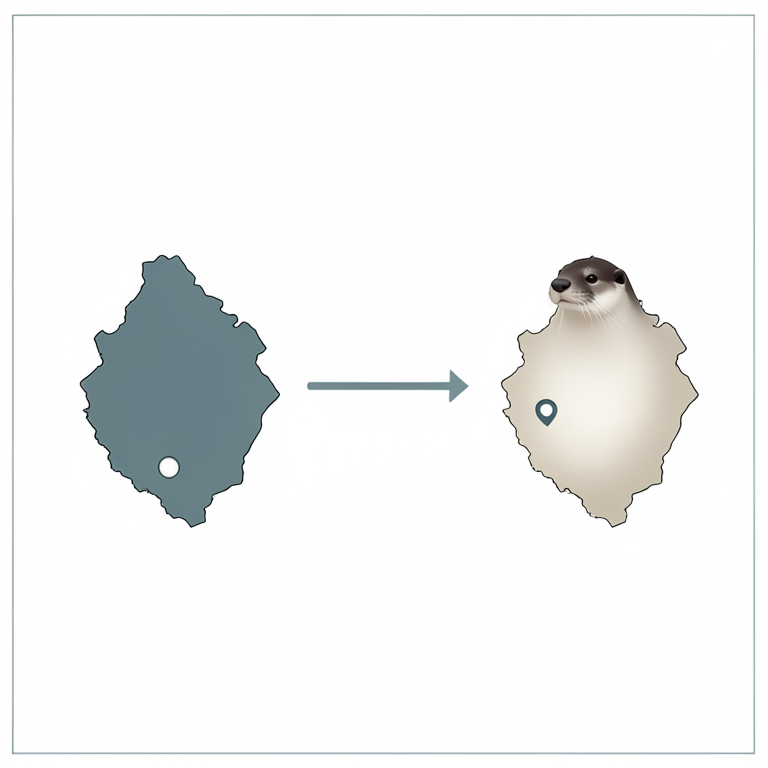
Geographic Distribution
AI-generated conceptual illustration (smooth-coated otter (Lutrogale perspicillata) in Gujarat, India). It explains the idea and does not show study data.
View source evidence ↗Introduction
The smooth-coated otter (Lutrogale perspicillata) is social, nocturnal, piscivorous mustelid occurring throughout South and Southeast Asia, and Iraq (Blantord 1890; Hussain and Choudhury Iyy/: Medway Iyoy). Un the Indian pen Insula, this species is primarily found in plains, deserts aria areas, and the highlands of the Deccan. In habiting 2 Springe Mammal Respir canals, and irrigation tanks, using Hooded held, estuaries, coastal belts, and the open sea as hunting grounds (Prater 2005) [9]. Fish, crabs, shrimp, insects, and amphibians constitute its diet (Anoop and Hussam 2005: osterurev 1992).The species is classified "Vulnerable' on the IUCN Red List of threatened Species and listed under Schedule-Il of the Indian Wild Protection Act.
IV 2 (Debilva et al. 2015). Wildlife Protection Act 1972). In Gujarat, L. perspicillata genera v occurs. In large rivers characterised or brackish water and mangrove forest patches (Borker et al. 2016) [10].
Occurrence of Smooth-coated otters could be an indicator of abundance of prey, but they also known to adapt to the changes in land use patterns and anthropogenic led changes in habitat. Three species of otter have been reported in India (Smooth-coated otter, Eurasian otter and Small-clawed otter) (Reuther, 1999) [7]. Among these, smooth-coated otters have been reported nationwide while other two species are restricted to some specific locations and they are not reported in central and south India (Hussain and Choudhary, 1995; Forster-Turley and Santiapalli, 1990) [2, 1]. The distribution of suitable habitat for smooth-coated otters is quite high but these areas are also near shore or in estuaries that are prone to unmanaged development and infrastructure growth, making this species IUCN Otter Spec.
Group Bull. 39 (1) 2022 exposed to a range of threats. Smooth-coated otters remain one of the least studied species in Asia and are classified as insufficiently studied by the IUCN Red list and are in schedule II in the Indian Wildlife Protection Act, 1972. The lack of knowledge of smooth-coated otters throughout their range, limits the conservation strategy required to conserve the species (Hussain and Choudhary, 1995) [2]. Habitat selection studies on L. perspicillata.
In India have largely been carried out in protected areas. Perivar Tiger Reserve, Kerala. South India. Hussain (2014) [3] studied habitat selection of this species with the help of an ordination technique using parameters such as defecating areas, holts, tootprints, and grooming Siles as indicators for presence.
The study concluded that several environmental factors such as shallow water deins. In number or distribution of potential holt sites, sandy substratum, vegetation cover, grooming sites, and latrine sites influenced habitat selection. (Similarly Khan et al. 2014) [11]. Studied habitat use pattern of smooth-coated otters in the upper Gangetic basin. This study indicated the preference for sandy substrates in some reloans of the study area and muddy substrates as well as weal and farms. https://www.biologyjournal.net/ GPS Location plotted Map of study area Smooth-coated otter (L. perspicillata) Image Institute of Ocean Management, Anna University; c2008. 7.
Reuther C. Development of weight and length of Eurasian otter (Lutra lutra) cubs. IUCN Otter Spec. Group Bull. 1999;16(1):1126. https://www.iucnosgbull.org/Volume16/Reuther_1999. html 8.
Shenoy K, Varma S, Prasad KVD. Otters in Cauvery wildlife sanctuary, Southern India; A study on Habitat choice and Diet composition of smooth-coated otters (Lutra perspicillata), Nityata foundation, Indian Institute of Science; c2003. p. 1-53. http://www.asiannature.org/sites/default/files/Otters%2 0in%20Cauvery%20WLS.pdf. 9. Prater E, Ghosh S. Current operational practices of US
Acknowledgements
We would extremely glad to say Thank you to Mr. Akash Vasava, Mr. Ronak Rawal, Mr. Vaibhav Patel, Mr.
Yogesh Mistry And Mr. Kausal Modi for helping during study.
References
8 in the original paper- Foster-Turley P, Santiapillai C. Action plan for Asian otters. In Otters: An Action Plan for their Conservation IUCN/SSC Otter Specialist Group; c1990. p. 52-63.
- Hussain SA, Choudhury BC. Seasonal movement, home range and habitat use by Smooth-coated otters Lutra perspicillata in National Chambal Sanctuary, India. In: Proceedings of VI. International Otter Colloquium, Pietermaritzburg. Reuther, C., Rowe- Rowe, D. (Eds.). Aktion Fischotterschutz Hankensbüttel. Habitat. 1995;11:45-55.
- Hussain SA, De Silva PK, Mostafa Feeroz M. small and medium‐sized enterprises in Europe. Journal of Small Business Management. 2005 Apr;43(2):155- 69.
- Borker DR. Global management accounting principles and the worldwide proliferation of IFRS. The Business & Management Review. 2016 Apr 1;7(3):258.
- Khan MI, Asgher M, Khan NA. Alleviation of salt- induced photosynthesis and growth inhibition by salicylic acid involves glycinebetaine and ethylene in mungbean (Vigna radiata L.). Plant Physiology and Biochemistry. 2014 Jul 1;80:67-74. Lutrogale perspicillata. In: IUCN 2013. IUCN Red List of Threatened Species. Version 2013.2. Downloaded on 22 January 2014; c2008.
- Medhi K, Chakraborty R, Upadhyay J. Photographic record of smooth-coated otters (Lutrogale perspicillata Geoffroy 1826) in Nyamjang Chu Valley, Arubachal Pradesh, India; c2014.
- Nowak RM. Walkers mammals of the world, The John Hopkins University, fifth Edison. 1991;2:1135-1143.
- Ramesh R, Nammalwar P, Gowri VS. Database on coastal information of Tamil Nadu, Report submitted to