
Research article · 2022 · Full text
International Journal of Biology SciencesComparative studies on biophysical and biochemical basis of resistance in Brinjal and chilli against aphid (Aphis gossypii)
Volume 4(2) · Pages 108–111 · DOI: 10.33545/26649926.2022.v4.i2b.85 ↗
Research areasAgricultural Practices and Plant GeneticsAgricultural pest management studiesAgricultural Science and Fertilization
Abstract
Author-writtenInvestigations on studies of aphid on brinjal and chilli and host plant resistance studies were carried out during 2020 in vallampadugai village, Tamil Nādu, India. Significant difference was observed between the brinjal and chilli local variety in length, thickness, breath was positive correlated and trichome density and trichome length and types were negatively correlated. Biochemical component of resistant plants is sugar, nitrogen was positively correlated, and phenol, potash and silica were negatively correlated with aphid feeding preference.
Summary
Source-checkedPlain-language reading of the full paper, prepared with AI and checked against the text. Each point links to the authors' own words.
Why it matters
- Brinjal is a significant vegetable crop in India, with a productivity of 26.68 metric tonnes and cultivation across 73,300 hectares. View evidence ↗
- Chilli is a globally popular vegetable and condiment crop, with India leading the world in its production. View evidence ↗
The question
- The study aimed to investigate aphid activity and host plant resistance in brinjal and chilli crops. View evidence ↗
What they did
- Biochemical resistance factors, including total sugars, nitrogen, total phenols, potash, and silica, were analyzed in 50-day-old leaf samples. View evidence ↗
- Nitrogen content in the leaf samples was determined using the micro kjedahl method. View evidence ↗
What they found
- Trichome density was highest on the adaxial surface of brinjal (33.5 no/mm2) and tomato (37.6 no/mm2), and lower on the abaxial surface of brinjal (18.45 no/mm2). View evidence ↗
- Brinjal leaves were thicker (242.23 µm) than chilli leaves (170.70 µm). View evidence ↗
- Brinjal exhibited higher levels of sugar (10.74%) and nitrogen (7.32%) in its foliage. View evidence ↗
- Chilli had higher phenol (7.08), potassium (4.83), and silica (6.40) content than brinjal, which the authors link to resistance against sucking pests. View evidence ↗
- In brinjal, aphid feeding preference was positively correlated with sugar (0.902) and nitrogen (0.855), but negatively correlated with phenol (-0.988), potash (-0.900), and silica (-0.970). View evidence ↗
- In chilli, aphid feeding was positively correlated with sugar (0.402) and nitrogen (0.380), and negatively correlated with phenol (-0.290), potash (-0.854), and silica (-0.377). View evidence ↗
What it means
- The authors conclude that resistance to aphids is associated with lower levels of phenol, potash, and silica, while higher sugar and nitrogen levels correlate with aphid preference. View evidence ↗
Visual summary
3 visualsIllustrations explain the paper; charts are replotted from the paper's own table values.
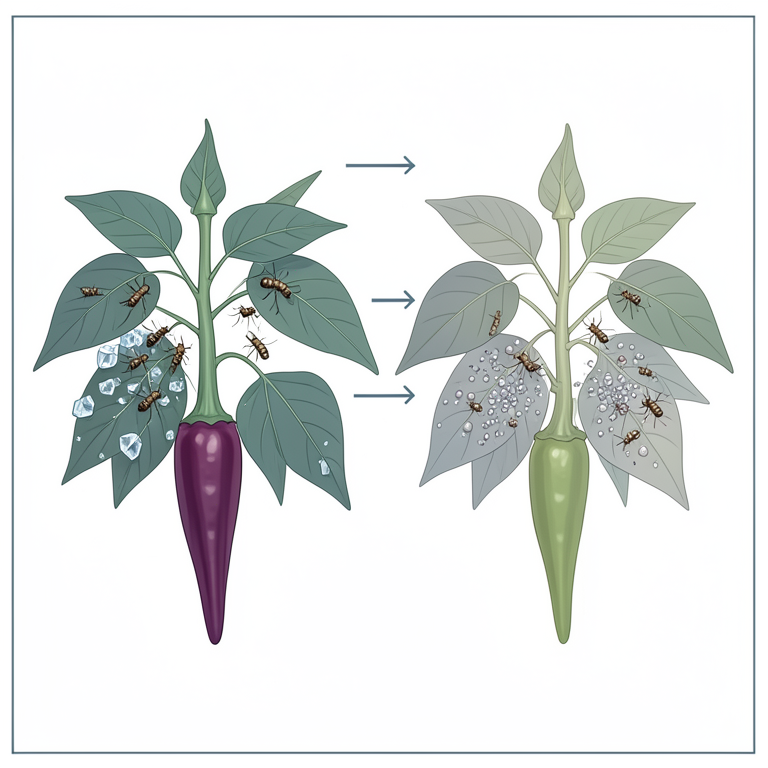
Biochemical Correlation with Aphid Feeding
AI-generated conceptual illustration (Brinjal and chilli plants infested with Aphis gossypii aphids). It explains the idea and does not show study data.
View source evidence ↗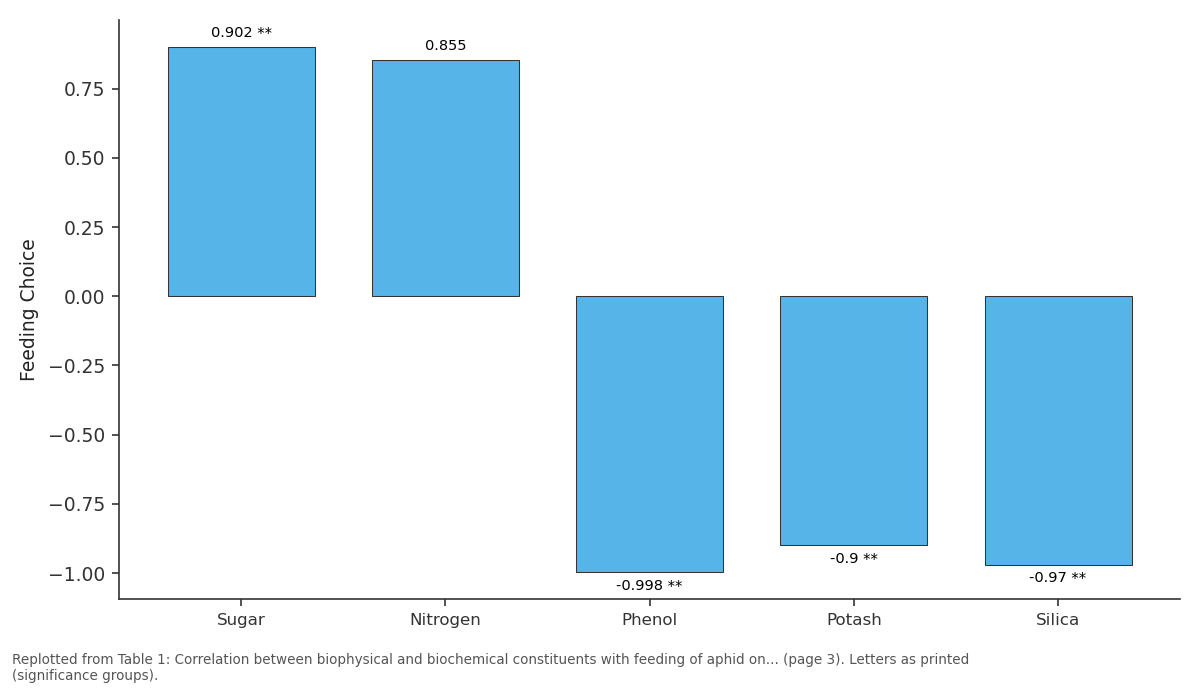
Feeding Choice: Sugar vs Nitrogen vs Phenol vs Potash vs Silica
Replotted from Table 1 (page 3) of the original paper. Every bar is the paper's own table value.
View source evidence ↗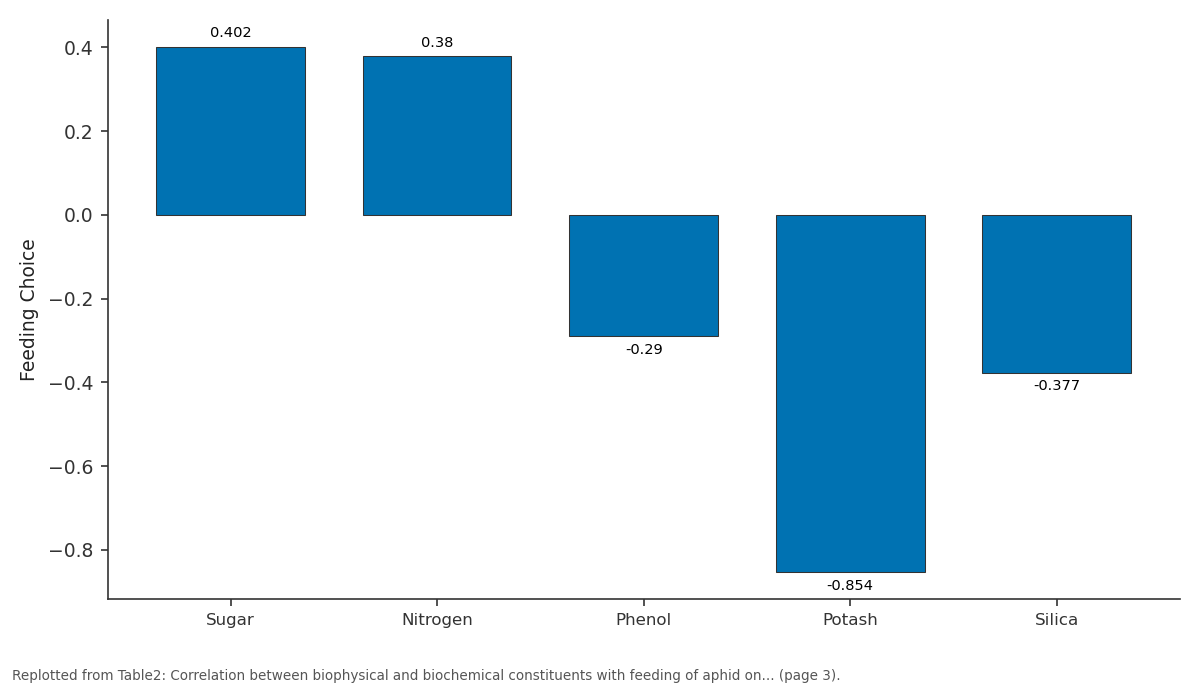
Feeding Choice: Sugar vs Nitrogen vs Phenol vs Potash vs Silica
Replotted from Table2 (page 3) of the original paper. Every bar is the paper's own table value.
View source evidence ↗Figures & tables
From the original paper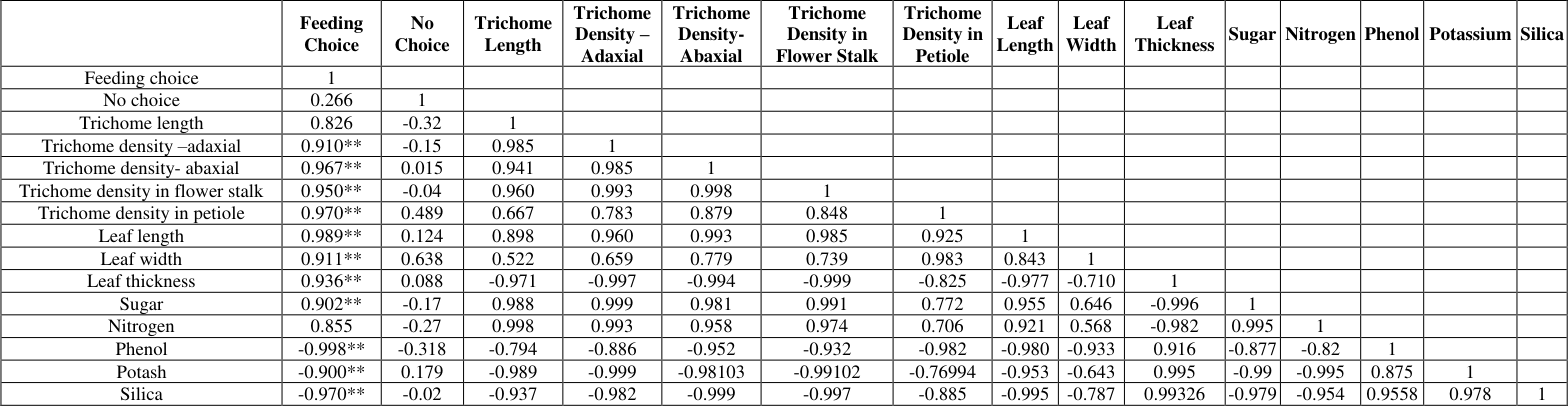 Table 1
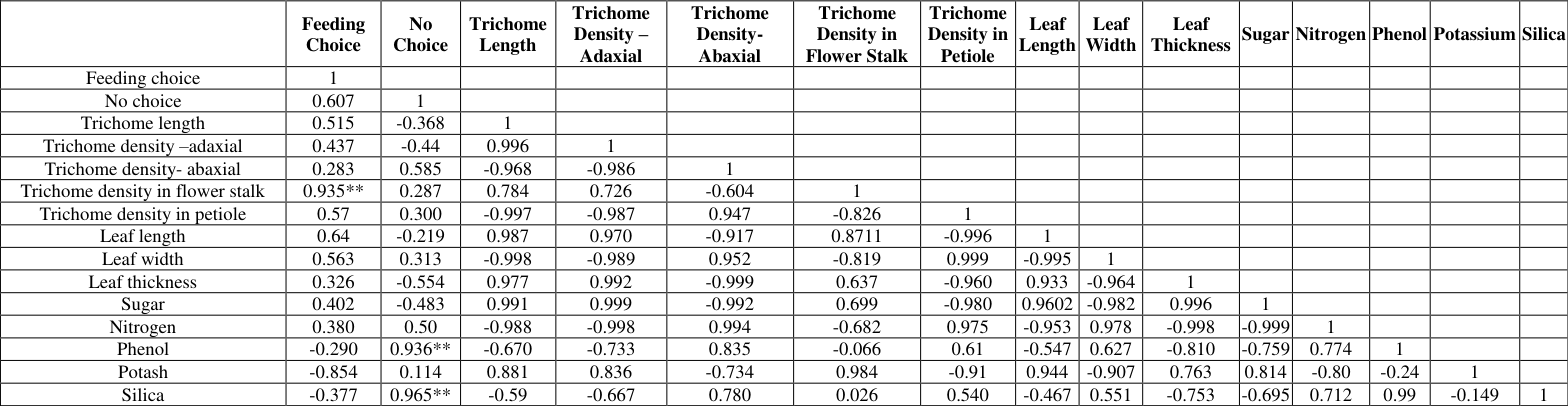 Table2
Introduction
Brinjal (Solanum melongena L.) is an important vegetable. In India it is cultivated in 73,300 hectares with an annual production of 12,510 million tonnes and productivity of 26.68 metric tonnes. However, China stands first with 35.97 metric tonnes. Chilli (Capsicum annum L.) is a popular vegetable and condiment crop grown throughout the world. India is the world leader in chilli production followed by China. In India it is cultivated throughout the country in about 31,600 hectares with an annual production of 3,634 million tonnes and productivity of 16.43 metric tonnes.
Materials and Methods
Estimation of leaf length, width and thickness: The length and width of the Solanaceous plant (Brinjal, tomato and chilli) was measured and expressed in centimetre (cm), (Amin et al., 2014) [3] .
Trichome length and density: Density of trichomes present in the adaxial and abaxial surface of leaf was estimated. One mm long transverse section of leaf was cut from leaves of 50 days old plants and the sectioned sample of brinjal was placed transversely on a clean glass slide and the trichomes length and density per mm were counted with the help of stage and ocular meter using a microscope. Similar procedure was followed to estimate the trichome length and density of tomato and chilli plant leaves (Amin et al., 2011) [2] .
Biochemical factors of resistance on Brinjal and chilli crops:
The biochemical constituents i.e., total sugars, nitrogen, total phenols, potash, silica were estimated in 50 days old leaf samples of brinjal and chilli plant. Collected samples were preserved by using freeze dryer and powdered leaf samples were analysed.
Estimation of sugar:
Total sugars present in leaves of brinjal, tomato and chilli plant were estimated by calorimetric assay described by Sadasivam and Manikam (1992) [6] . 200 mg of leaf sample of respective test plant was taken in a conical flask and 5 ml of 2.5 N HCL was added and hydrolysed by boiling the sample on mantle heater for 3 hours. The sample as cooled to room temperature and the volume was, made up to 100 ml by adding distilled water and supernatant was collected and aliquots of 0.5 ml and 1.0 ml were used for estimation. Aliquots of 0.5 and 1.0 ml were pipette out into different test tubes, after making up the volume to 10 ml in each tube with distilled water. 1.0 ml of 5 per cent volume to 10 ml in each tube with distilled water. 1.0 ml of 5 per cent phenol was added followed by 5.0 ml 96 percent sulphuric acid, after incubating the samples for ten minutes to room temperature. The absorbance was read at 490 nm.
The amount of total sugars reagent present in samples was calculated from the standard glucose calibration curve established with different concentration (20-100 mg) of glucose. The data were represented as per cent.
Estimation of total phenol: The total phenols present in leaves of brinjal, tomato and chilli were estimated as per the method developed by Sadasivam and Manickam (1992) [6] . From each sample 0.5 g materials were weighed and were added with ten times volume of 80% ethanol and the homogenate was centrifuged at 10,000 rpm for 20 minutes. The supernatant was collected, and residues were extracted with five times the volume of 80% ethanol, then centrifuged and the supernatants were pooled and evaporated to dryness. The residue then dissolved in 5ml distilled water and different aliquots ranging from 0.26 to 2.0 ml were pipette out into the test tubes and the volume in each tube was made up to 3 ml by adding distilled water. To this extract, 0.5 ml of folin-ciocalteau reagent was added and after 3 minutes 2 ml 0f 20% sodium carbonate solution was added to each tube. The material was mixed thoroughly, and tubes were placed in boiling water exactly for one minute. The tubes were then cooled, and the absorbance was measured at 650 nm against a reagent blank in spectrophotometer. The standard curve was prepared by plotting the catechol concentrations on X-axis and absorbance values on Y-axis. From the standard curve, concentration of total phenols in terms of mg phenols/100 gm of test plant's leaf material was estimated and converted to per cent (%).
Estimation of Silica:
Estimating silica content as per the method developed by A.O.A.C. (1960) [1] , 0.5g of dried leaf sample of brinjal, Tomato and chilli plants were individually weighed and transferred to 50 ml Erlenmeyer flask which was thoroughly cleaned with hot alkali followed by acid and distilled water. Ten ml of triple acid mixture was added, and the contents were digested over a hot plate. The digestion was continued till the brown fumes ceased and the volume of the acid was reduced to about 2ml which took about 30 min. overheating and drying were avoided. The resultant solutions from the digestion were then carefully transferred with repeated washing into tall stainless-steel beakers containing 1-1.5g anhydrous sodium carbonate in suspension such that there was sufficient alkali in excess after boiled for 3-5 min to ensure complete dissolution of silica. The resultant solution after cooling as made up to 250 ml and stored in polyethylene bottles. Two ml of aliquots were treated with 2ml of 1:1 HCl and agitated for a while to remove the CO2 evolved. This was followed by addition of 2ml of 10 per cent Ammonium molybdate and the content in the flask were allowed to stand for 5 min. the interference of iron was then removed b the addition of 0.5ml of 5 per cent solution of hydroxylamine HCl and of phosphorous by the addition of 1 ml of 10 per cent oxalic acid. The resultant silica molybdate complex after dilution to volume as reduced by the addition of 2 ml of 0.5 per cent ascorbic acid and the volume made up to 50 ml. The blue color developed was kept on standard for 15-20 min and read at 650nm in a Bauchand Lomb spectronic calorimeter. Reagent blank as also employed for minimizing the error. The unknowns were calculated from standard prepared with sodium meta silicate.
Estimation of nitrogen:
The leaf samples of brinjal, tomato and chilli were analysed for nitrogen content by micro kjedahl method as suggested by A.O.A.C. (1960) [1] .
Estimation of potassium:
The potassium content of the brinjal, tomato and chilli leaf samples were estimated by flame photometer using the tri acid mixture as suggested by Jackson (1973) [5] .
Result and Discussion
Result and Discussion
Biophysical factors of resistance on brinjal and chilli:
Various biophysical factors of resistance operative in the test Solanaceae crops were investigated. Among the biophysical factors, trichome density on the foliage was found to influence the insect activity. Trichomes detected in the leaves, flower stalk and petioles of the selected crops. Regarding the distribution and density of the trichomes on their foliage, a wider variation was observed among the test crops. Trichome density was more predominant in adaxial surface of brinjal (33.5 no/mm 2 ) and tomato (37.6 no/mm 2 ) and followed by abaxial surface of brinjal (18.45 no/mm 2 ) followed by chilli (0.56 cm). Trichomes density on flower stalk on brinjal (12.87 no/mm 2 ) and chilli (5.11 no/mm 2 ) Leaf length and width on brinjal was highest (20.57 & 9.49 cm). Brinjal leaf thickness (242. 23 µm) was more when compared chilli (170.70 µm). Among the biophysical factors, trichome density on foliage influence aphid population more on brinjal whereas, chilli have less trichome density and thickness of leaf.
Biochemical factors of resistance in brinjal and chilli:
The sugar and nitrogen content of the foliage favour the sucking pests on the selected Solanaceae crops. The sugar content was higher in brinjal (10.74%) and nitrogen content in brinjal (7.32%). The phenol content of the foliage was maximum in chilli (7.08) followed by in brinjal (5.64). Similarly, potassium and silica content were more on chilli potassium (4.83) and silica (6.40) which exhibits the resistance against sucking pests. Aphid feeding on brinjal positively correlated with the biophysical factors. Trichome length (0.826), trichomes adaxial density (0.910) trichomes abaxial density (0.967), in addition, trichome on flower stalk, trichome density in petiole, leaf length, leaf width, leaf thickness was positively correlated (0.970), (0.989), (0.911), (0.936) respectively. Whereas estimation of biochemical components in the leaf samples concerned, sugar (0.902) and nitrogen (0.855) were positively correlated in brinjal but phenol (-0.988), potash (-0.900) and silica (-0.970) were negatively correlated with preference of aphids feeding. Aphid feeding on the leaves of chilli was positively correlated with the biophysical factors i.e., trichome length (0.515), trichomes adaxial density (0.437) trichomes abaxial density (0.283), whereas trichome in flower stalk, trichome density in petiole, leaf length, leaf width, leaf thickness was also positively correlated (0.937), (0.570) (0.640), (0.563), (0.326) respectively. Whereas correlation of biochemical component in chilli sugar (0.402) and nitrogen (0.380) was positive correlated but phenol (-0.290), potash (-0.854) and silica (-0.377) were negatively correlate.
Figures and tables from the paper
| — | Feeding Choice | No Choice | Trichome Length | Trichome Density – Adaxial | Trichome Density- Abaxial | Trichome Density in Flower Stalk | Trichome Density in Petiole | Leaf Length | Leaf Width | Leaf Thickness | Sugar | Nitrogen | Phenol | Potassium | Silica |
|---|---|---|---|---|---|---|---|---|---|---|---|---|---|---|---|
| Feeding choice | 1 | ||||||||||||||
| No choice | 0.266 | 1 | |||||||||||||
| Trichome length | 0.826 | -0.32 | 1 | ||||||||||||
| Trichome density –adaxial | 0.910** | -0.15 | 0.985 | 1 | |||||||||||
| Trichome density- abaxial | 0.967** | 0.015 | 0.941 | 0.985 | 1 | ||||||||||
| Trichome density in flower stalk | 0.950** | -0.04 | 0.960 | 0.993 | 0.998 | 1 | |||||||||
| Trichome density in petiole | 0.970** | 0.489 | 0.667 | 0.783 | 0.879 | 0.848 | 1 | ||||||||
| Leaf length | 0.989** | 0.124 | 0.898 | 0.960 | 0.993 | 0.985 | 0.925 | 1 | |||||||
| Leaf width | 0.911** | 0.638 | 0.522 | 0.659 | 0.779 | 0.739 | 0.983 | 0.843 | 1 | ||||||
| Leaf thickness | 0.936** | 0.088 | -0.971 | -0.997 | -0.994 | -0.999 | -0.825 | -0.977 | -0.710 | 1 | |||||
| Sugar | 0.902** | -0.17 | 0.988 | 0.999 | 0.981 | 0.991 | 0.772 | 0.955 | 0.646 | -0.996 | 1 | ||||
| Nitrogen | 0.855 | -0.27 | 0.998 | 0.993 | 0.958 | 0.974 | 0.706 | 0.921 | 0.568 | -0.982 | 0.995 | 1 | |||
| Phenol | -0.998** | -0.318 | -0.794 | -0.886 | -0.952 | -0.932 | -0.982 | -0.980 | -0.933 | 0.916 | -0.877 | -0.82 | 1 | ||
| Potash | -0.900** | 0.179 | -0.989 | -0.999 | -0.98103 | -0.99102 | -0.76994 | -0.953 | -0.643 | 0.995 | -0.99 | -0.995 | 0.875 | 1 | |
| Silica | -0.970** | -0.02 | -0.937 | -0.982 | -0.999 | -0.997 | -0.885 | -0.995 | -0.787 | 0.99326 | -0.979 | -0.954 | 0.9558 | 0.978 | 1 |
Table text extracted from the original PDF; superscript letters are shown inline. The original table image is below.
View original table image
| — | Feeding Choice | No Choice | Trichome Length | Trichome Density – Adaxial | Trichome Density- Abaxial | Trichome Density in Flower Stalk | Trichome Density in Petiole | Leaf Length | Leaf Width | Leaf Thickness | Sugar | Nitrogen | Phenol | Potassium | Silica |
|---|---|---|---|---|---|---|---|---|---|---|---|---|---|---|---|
| Feeding choice | 1 | ||||||||||||||
| No choice | 0.607 | 1 | |||||||||||||
| Trichome length | 0.515 | -0.368 | 1 | ||||||||||||
| Trichome density –adaxial | 0.437 | -0.44 | 0.996 | 1 | |||||||||||
| Trichome density- abaxial | 0.283 | 0.585 | -0.968 | -0.986 | 1 | ||||||||||
| Trichome density in flower stalk | 0.935** | 0.287 | 0.784 | 0.726 | -0.604 | 1 | |||||||||
| Trichome density in petiole | 0.57 | 0.300 | -0.997 | -0.987 | 0.947 | -0.826 | 1 | ||||||||
| Leaf length | 0.64 | -0.219 | 0.987 | 0.970 | -0.917 | 0.8711 | -0.996 | 1 | |||||||
| Leaf width | 0.563 | 0.313 | -0.998 | -0.989 | 0.952 | -0.819 | 0.999 | -0.995 | 1 | ||||||
| Leaf thickness | 0.326 | -0.554 | 0.977 | 0.992 | -0.999 | 0.637 | -0.960 | 0.933 | -0.964 | 1 | |||||
| Sugar | 0.402 | -0.483 | 0.991 | 0.999 | -0.992 | 0.699 | -0.980 | 0.9602 | -0.982 | 0.996 | 1 | ||||
| Nitrogen | 0.380 | 0.50 | -0.988 | -0.998 | 0.994 | -0.682 | 0.975 | -0.953 | 0.978 | -0.998 | -0.999 | 1 | |||
| Phenol | -0.290 | 0.936** | -0.670 | -0.733 | 0.835 | -0.066 | 0.61 | -0.547 | 0.627 | -0.810 | -0.759 | 0.774 | 1 | ||
| Potash | -0.854 | 0.114 | 0.881 | 0.836 | -0.734 | 0.984 | -0.91 | 0.944 | -0.907 | 0.763 | 0.814 | -0.80 | -0.24 | 1 | |
| Silica | -0.377 | 0.965** | -0.59 | -0.667 | 0.780 | 0.026 | 0.540 | -0.467 | 0.551 | -0.753 | -0.695 | 0.712 | 0.99 | -0.149 | 1 |
Table text extracted from the original PDF; superscript letters are shown inline. The original table image is below.
View original table image
References
6 in the original paper- Amin MR, Tithi, DA, Kwon YJ. Characteristics of three cotton varieties and their impact on feeding and growth of cotton armyworm. Entomol. Res. J. 2011;41:151-156.
- Amin SMR, Alam MZ, Rahman MM, Hossain MM, Mian IH. Study on morphological characteristics of leaves, shoots and fruits of selected brinjal varieties/lines influencing brinjal shoot and fruit borer infestation. Int. J Econ. Plant. 2014;1:1-8.
- Anjali M, Singh NP, Mahesh M, Swaroop S. Seasonal incidence and effect of abiotic factors on population dynamics of major insect pests on brinjal crop. J Environ. Res. Develop. 2012;7(1a).
- Sadasivam S, Manickam A. Biochemical methods (Second edition). New Age International (P) Limited Publishers, New Delhi and TNAU, Coimbatore, India. 1992;25:259-267.
- Sarangdevot. Seasonal incidence of major insect pests of brinjal and their natural enemies. Indian journal of plant protection. 2006;12(1):9-12.
- Shah MMR., Liu TX. Feeding Experience of Bemisia tabaci (Hemiptera: Aleyrodidae) Affects their Performance on Different Hoat Plants. Plosone, J. 2013;8(10):224-234.
Cited by 5
From OpenAlex, OpenCitations and reference lists read by Scinovex
- Prey preference of an aphidophagous ladybird, Coccinella transversalis (Coccinellidae: Coleoptera) on two aphid species ↗
Mamtesh Kumari, Noorin Saifi, Deepa Arya, Ahmad Pervez · Journal of Entomology and Zoology Studies · 2022
Prey Preference of adult male and female, Coccinella transversalis (Fabricius) was studied when fed on aphids, Aphis craccivora (Koch) and Aphis gossypii (Glover), which sequester toxic allelochemicals from their host plants. Adult males and females of C. transversalis prefer to consume A. gossypii over A. craccivora in most mixed diet combinations (cafeteria setup). This was strongly supported by significantly high
- Standard heterosis for yield and its attributing traits in brinjal (Solanum melongena L.)
ZF Khasdar, Nitin Patel, Akshay I. Patel, Nihar A Patel · International Journal of Research in Agronomy · 2024
The study of heterosis is a basic prerequisite for the exploitation of transient hybrid vigour. Six phenotypically diverse parents were used for hybridization following half diallel mating design to obtain fifteen hybrids. Evaluation of hybrids along with the parents and standard check (GAOB-2) was conducted followed by randomised complete block design with three replications. The analysis of variance revealed that considerable genetic variation was present among genotypes, parents and hybrids for all characters under investigation. With regards to per se performance, AB-08-14 and AB-08-14 × G
- Integrating Bio-Psycho-Social dimensions: A homeopathic perspective on the aetiology of food allergies ↗
Shary Krishna BS · International Journal of Homoeopathic Sciences · 2024
Food allergy prevalence has risen considerably in recent decades, yet there is a dearth of comprehensive literature examining the bio-psycho-social factors in relation to Homoeopathy. This study aims to delineate these factors among patients presenting with food allergy symptoms at the National Institute of Homoeopathy (NIH) in Kolkata. Through a prospective questionnaire method, data from 2017 to 2019 were analysed,…
❝ 0PDF - On a collection of (Insects, Acari) some insects and mites from medicinal plants of Ramakrishna mission, Narendrapur (India: West Bengal, Dist south 24 Paraganas) ↗
Airin Sultana, Sagata Mondal, Salil Kumar Gupta · Acta Entomology and Zoology · 2023
A total 37 species of mites (under 22 genera, 9 family and 2 orders) and 17 species of insects (under 14 genera,11 family and 3 orders) has been recorded from 99 medicinal plants grown in three medicinal plant gardens of Ramakrishna Mission Ashrama, Narendrapur, collected during November 2021 - July 2022. Out of 37 species of mites, 23 species belonged…
❝ 0PDF - Comparative toxicological observations of Tivra gandha, Akarkara, Pushkarmool and Chichori indigenous biorational extractives for the management of okra aphid, Aphis gossypii Glover (Hemiptera: Homoptera: Aphididae) under laboratory trials
BS Chandel, Anju Bhati · International Journal of Agriculture and Food Science · 2023
An experiment was conducted to assess the comparative toxicological biopotentency of certain asteraceous botanicals ie. Tivra gandha (Chromolaena odorata), Akarkara (Acemella paniculata), Pyrethrum Daisy (Tanacetum cinerariifolium), Pushkarmool (Inula racemosa) and Chichori (Cichorium intybus) extractives were carried out under laboratory condition against nymph and adults of okra ahid, Aphis gossypii. The okra leaves were used as food for the nymph and adults of A. gossypii. Okra leaves were treated with different concentrations (0.5,1.0 and 2.0 per cent) for two minutes. The treated leaves w