
Research article · 2022 · Full text
International Journal of Agriculture Extension and Social DevelopmentAdoption of agricultural innovations among rice farmers in federal capital territory, Nigeria
Volume 5(2) · Pages 30–36 · DOI: 10.33545/26180723.2022.v5.i2a.145 ↗
Research areasAgricultural Innovations and Practices
Abstract
Author-writtenThe study accessed rice farmers’ adoption of innovations in the Federal Capital Territory, Nigeria. The FCT has six area council; Abaji, kuje, Municipal, Kwali, Bwari and Gwagwalada. The study area covers a land mass of 8,000 kilometer (km2). It is bordered by four states Kaduna, Nassarawa, Kogi and Niger, it lies between latitude 80 251 and 90 251 North of the equator and longitudes 60 451 and 70 451 east of the Greenwich meridian. Abuja is located in the middle belt of Nigeria, its size is equivalent to 0.8% of Nigeria. There exist expansive fertile marshy plains good for rice production. The multistage sampling method was used to sample a total of 120 rice farmer using structured questionnaires as instruments in Gwagwalada council, 20 farm cells were selected, 6 farmers were then randomly selected from each cell. The data were analyzed using simple descriptive statistics. Most of the farmers (87.5%) were male. 6-11 persons (33.3%) per house-hold constituted the largest household size of the total farmers sampled. Majority of the farmers (26.76%) earned only between N21, 000 and N60, 000 annually. Adoption rate of some agricultural innovation in rice were rated as Fertilizer (60.2%), herbicides (60.2%), improved seed (30.8%), use of agricultural extension services (3.3%) use of farm machinery (2.1%) and silos (1.1%). Constraints faced by farmers in the study area were inadequate capital (80%), inadequate extension services (85.8%) poor market price (30.8%), high cost of agro chemicals (98.3%), inadequate storage and processing facilities (92.5%), No access to loans and credits (95.0%). The research recommended public private partnership (PPP) to sensitize and educate farmers to enable them benefit from the new innovations and technology that abound in rice farming.
Summary
Source-checkedPlain-language reading of the full paper, prepared with AI and checked against the text. Each point links to the authors' own words.
Why it matters
- Rice is a critical staple food for over half the global population, making the adoption of agricultural innovations essential for boosting production and ensuring food security in Africa and Asia. View evidence ↗
- In Nigeria, average rice yields (2.0 to 3.0 t/ha) are significantly lower than the yields achieved on research plots (6-8 t/ha), highlighting a gap in productivity. View evidence ↗
- The Nigerian government has attempted to stimulate domestic rice production by raising import tariffs to 75% in 2007 to protect local producers. View evidence ↗
The question
- The study aims to assess the adoption of agricultural innovations among rice farmers within Nigeria's Federal Capital Territory (FCT). View evidence ↗
What they did
- The researchers used a multi-stage sampling method to select 120 rice farmers from 20 farm cells in the Gwagwalada council, using structured questionnaires for data collection. View evidence ↗
What they found
- The majority of sampled farmers were male (87.5%), and the most common household size was between 6 and 10 persons (33.3%). View evidence ↗
- Most rice farmers in the study area operate on a small scale, with 93.3% holding between 1 and 5 hectares of land. View evidence ↗
- Adoption rates were relatively high for chemical inputs, with 70.1% using pesticides and 60.2% using both fertilizers and herbicides. View evidence ↗
- Adoption was very low for structural and technical innovations: only 30.8% used improved seeds, 3.3% used extension services, 2.1% used machinery, and 1.1% used modern silos. View evidence ↗
- The most severe constraints facing farmers were the high cost of agrochemicals (98.3%), delays in input supply (98.3%), and lack of access to agricultural loans (95.0%). View evidence ↗
- Farmers also reported significant issues with inadequate storage and processing facilities (92.5%) and inadequate extension services (85.8%). View evidence ↗
- The regression model indicated that the use of fertilizers, the use of pesticides, and farming experience significantly influenced the probability of adopting agricultural innovations. View evidence ↗
What it means
- The authors conclude that while adoption of basic chemical inputs is high, severe financial and institutional constraints hinder the overall ability of farmers to cultivate rice effectively. View evidence ↗
- The authors recommend that the government explore Public-Private Partnerships to educate farmers and mandate financial institutions to provide low-interest loans to enhance productivity. View evidence ↗
Figures & tables
From the original paper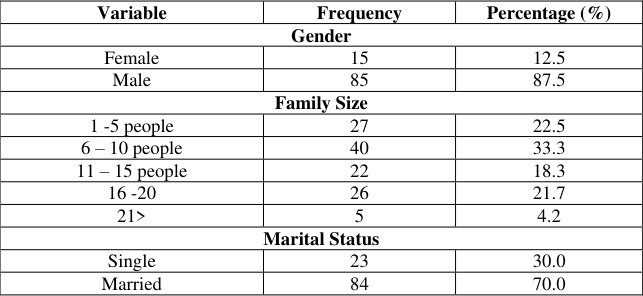 Table 1
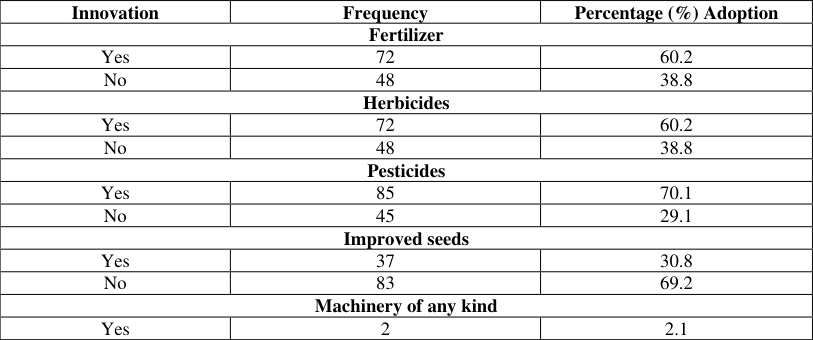 Table 2
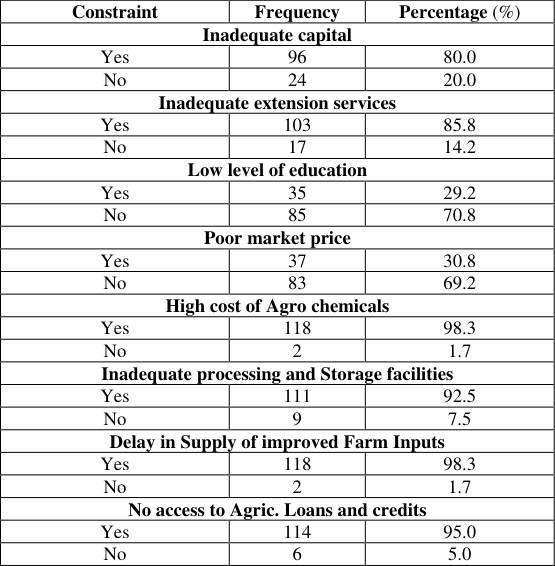 Table 3
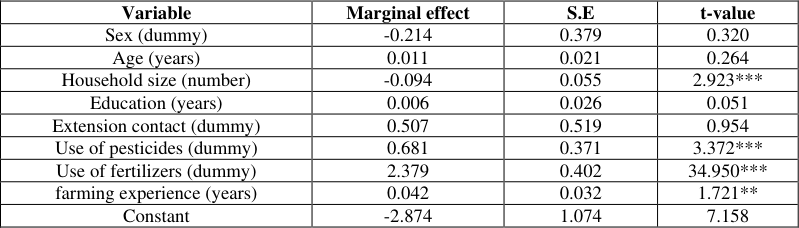 Table 4
Introduction
Adoption of good innovations by rice farmers is central to boosting the production of rice International Rice Research Institute IRRI, (2022) [16] . Rice is an important cereal crop of a large monocotyledonous family of some 600 genera and around 10,000 species called Graminae (FAO, 2013) [11] . It is considered as one of the most important staple foods for over half the population and third after wheat and maize in the world (Sennuga, et al., 2020; Jegede, et al, 2021) [27,17] . According to FAO (2013) [11] , more than half of the world's population feed on rice, majorly Oryza sativa and Oryza glaberrima. As one of the major staple food crops consumed by more than half of the world population, rice then, is seen as central to the food security of the evergrowing population especially in Africa and Asia. The areas where rice is cultivated in Nigeria are classified into five ecosystems namely: rain-fed upland, rain-fed lowland, irrigated lowland, deep-water and mangrove (Oyewole and Sennuga 2021) [17] . Rain-fed lowland accounts for 50% of the total area under rice cultivation followed by rain-fed upland (30%) and irrigated (16%) system. Deep-water and mangrove swamp systems constitute the remaining 4% of the total land area. Rice is cultivated in about 32 States in Nigeria with a total land area of about 2.43 million hectares and annual production of over 4.47 million metric tons of milled rice thus giving an average of 1.84 metric tons per hectare and the major rice producing States in Nigeria includes Taraba, Kaduna, Niger and Kano. (Abubakar, et al., 2016; Ojo, et al., 2021) [1,24] . According to Mustapha et al., (2012) [20] , Taraba State also in the northeast of Nigeria has the largest land area under rice cultivation with 375,670 hectares representing 15.4% of the total land area, followed by Kaduna State with 344,890 hectares (14.17%). Niger State has 330,670 hectares (13.59%) while Kano contributes 219.060 hectares or 9% of the total land area under rice cultivation in Nigeria (Fadiji and Sennuga, 2020) [10] . Demand for consumption of rice is on the increasing side, especially with the deliberate policies created by the government to encourage speedy adoption of innovations by rice farmers in recent years and it has now become a food security and cash commodity crop with states like Lagos, Kebbi, Ebonyi and Cross River in the front line (Abubakar et al., 2016; Lai-Solarin et al. 2021) [1,19] . In 2007, the Federal Government of Nigeria raised the tariff on rice importation to 75% to "Protect local producers against massive imports of rice". This policy is stimulating interest in the domestic production of Rice (Hassan, 2014; Ebisike, et al., 2021) [32,8] . It is estimated that home-grown www.extensionjournal.com rice yield is at about 5 million tons annually in Nigeria with the possibility of increasing if innovations required for growing the crop are properly adopted by rice farmers (Idu, et al., 2013; Egboduku, et al., 2021) [14,9] . Nigeria's rice production rose from 3.7 million metric tonnes in 2017 to 4.0 million metric tonnes in 2018. For the record, the major rice producing states in Northern Nigeria are Kebbi, Borno, Kano, and Kaduna. Currently, most of the farmers producing rice rely on traditional technology with low use of improved input technologies. Average rice yields per unit area in the country are low and range between 2.0 and 3.0 t / ha compared to yields of 6-8 t / ha reported on research plots. It is important for farmers to adopt improved varieties and have a good knowledge of rice agronomy to increase rice production and productivity in the various states in Nigeria. (Kamai, et al., 2020; Aluko, et al., 2021) [18, 6] . Significant improvement in rice production in the FCT started in 2002 and continued steadily it is cultivated in Abaji and also along the flood plains of River Gurara in the western part of the FCT. Of the total land area in the FCT, 20.605,000 Ha is used in cultivating Rice (Hassan, 2014; Adangara, et al., 2022) [32,2] . The adoption rate of any agricultural technology can be measured in terms of the number of farmers who adopt the technology or in terms of the total area on which the technology is adopted depending on the objective of the study (Ogeneve, 2017; Oduwole, et al., 2022) [23,22] . In a study on the adoption of improved rice varieties among smallholder farmers in Kogi State Nigeria. Adisa, et al., (2019) [5] applied the logit regression model to both adopters and non-adopters to identify factors influencing the farmers' decision to adopt or not adopt the improved rice varieties while the linear regression was applied only to adopters to identify factors that influence the intensity of use after farmers might have decided to or adopted the improved rice varieties. They found that a substantial proportion of land area grown to rice was cultivated with improved rice varieties with an adoption rate of 68.7% while the adoption rate for local varieties was 31.3% and income, farm size, age, use of fertilizer, storage facilities, availability of extension services also influence farmers adoption of innovations in rice farming. In another study on the adoption of innovation on productivity of NERICA rice farming, AKinnagbe and Akinbola (2022), analyzed data obtained from sample survey of NERICA rice farmers in Ekiti State, tobit regression indicated that farmers' technology score was affected significantly by farmers" level of education, extension visit, farming experience, land ownership status, credit use and level of rice commercialization. In an assessment of the adoption improved technologies by the rice farmers in Kogi state, using the Tobit model to unravel the decision to adopt or not to adopt the use of fertilizer. Tobit model estimates of factors affecting adoption and use intensity of chemical fertilizer in rice production showed that farm size, type of ecosystem, tillage type, education, population pressure on land, farmers age and non-farm income to be positively and significantly related to adoption and use intensity of chemical fertilizer while field distance to the village, gender, access to credit and labour availability had indirect relationship with adoption and use intensity of chemical fertilizer. Adisa, et al., 2019; Oyetola, et al., 2022) [5,26] .
Objectives of the study
The purpose of the study is to assess the Farmers' Adoption of Innovation in Rice Farming in Federal Capital Territory, Nigeria. The specific objectives of the study are to: 1. Describe the socio-economic characteristics of rice farmers in study area; 2. Investigate some of the innovation adopted by rice farmers; 3. Ascertain the constraints of rice farmers in the adoption of innovations in rice farming.
The study area
The study area, the Federal Capital Territory, covers a land mass of 8,000 square kilometers (km2 [3] .
Sample and sampling techniques
On the multi-stage bases of sampling, a total of 120 rice farmers were randomly and purposively sampled for the study using structured questionnaires as instruments in Gwagwalada council. 20 farm cells as delineated by the Abuja Agricultural Development project FCTADP (2019) were selected, 6 farmers were then randomly selected from each cell, these constituted the total sample size for the study.
Method of data collection
Primary data were used for the study; the data was collected with the aid of well-structured questionnaire which were administered to the farmers with the help of an enumerator, three per cell of the FCTADP, (2018) [12] .
Method of analysis
Descriptive statistics (frequency, percentage) was used for data analyses with aid of Statistical Package for Social Science (SPSS) to analyse the data. The descriptive statistics was used to present the results. Descriptive statistics was used to summarize data in an organized manner by describing the relationship between variable in a sample or population. Binary logit regression analysis was used to www.extensionjournal.com analyze the effect of selected socioeconomic variables on the adoption of agricultural innovation as was adopted by Adejoh et al, (2017) [3] in a similar study. The logit modeled is specified below:
Where, Y = adoption (1 = adopter, 0 = otherwise) P = Probability of farmer adopting the technology 1 -P = probability of farmer not adopting the technology Ln = Natural logarithm function. Βi = vector of logistic regression coefficients. Xi = vector of independent variables given as follows: X1 = sex (male = 1, female = 0). X2 = Age of the farmer (in years). X3 = Household size (number of persons). X4 = Level of education (years spent schooling). X5 = Experience in rice farming (years). X6 = use of pesticides (yes = 1, 0 otherwise). X7 = use of herbicides (yes = 1, 0 otherwise). X8 = use of fertilizer (Yes = 1, 0 otherwise).
Discussion of Results
Socio-economic characteristics of the respondents Table 1.1 below shows the Socio-economic characteristics of rice farmers in the study. The table contained information on; gender, age, occupation, marital status, family size, literacy level and farming experience of respondents. The table further reveals that, most majority constituting about 87.5 percent of rice farmers numbering 85 were male, while the rest constituting about 12.5 percent attracting only 15 respondents were found to be female. This result indicates that, there were more males in rice production in the study area though female also participated in the farming.
| Variable | Frequency | Percentage (%) |
|---|---|---|
| Gender | ||
| Female | 15 | 12.5 |
| Male | 85 | 87.5 |
| Family Size | ||
| 1 -5 people | 27 | 22.5 |
| 6 – 10 people | 40 | 33.3 |
| 11 – 15 people | 22 | 18.3 |
| 16 -20 | 26 | 21.7 |
| 21> | 5 | 4.2 |
| Marital Status | ||
| Single | 23 | 30.0 |
| Married | 84 | 70.0 |
Table text extracted from the original PDF; superscript letters are shown inline. The original table image is below.
View original table image
Similarly, the family size of the respondents shows that, 33.3 percent accounting for 40 respondents were at the majority and they have a family size that range between 6 and 10 persons per house hold. The marital status of the respondents from the results obtained in table 1.1 also reveals that, 70.0 percent of rice farmers in the study area were married with only 30 percent was found to be unmarried. The contribution of marital status on agricultural production can be explained in terms of the supply of agricultural family labour. Family labour would be more where the household head is married and vise visa. majority of the respondents representing about 48.3 percent of the respondents constituting 58 had secondary school education, about 24.1 percent had at least primary school education while only 13.3 percent constituting 16 respondents had no formal education and these set of farmers hardly accept new innovation as asserted by Adenuga, et al., (2016) [4] , there exist a positive relationship between education and adoption of new innovation. While the remaining 13 percent attracting 16 respondents accounted for those with tertiary education. The implication of this is that, there is every likelihood that adoption of new innovations by the farmers in the study area would be very effective likely because education is one of the important factors that determines the ability of farmers to understand policies, programmes and innovations of their time. Education affects productivity through effective resource use, allocation and choice of inputs for production activities, all things been equal (Donkor, et al., 2013; Indahgiju, et al., 2022) [7,15] . The result of farming experience from the table further shows that about 28.3 percent accounting for 34 respondents had farming experience of 11 and 15 years, while 15.8 percent constituting 19 respondents had between 21 and 25 years farming experience, also about 8.4 percent accounting for 10 respondents were those that fell within experience years of between 1to five years, only 9 respondents, 7.5 percent had farming experience of 26 years and above. This indicates that most of the rice farmers in the study area have good knowledge of rice farming, signifying that, the respondents had adequate knowledge and experience in the production of rice and therefore, their long stay in the business indicates they usually had good returns that keep them in the cultivation of rice.
The result obtained on the farm size of the respondents shows that, majority constituting about 93.3 percent of the respondents numbering 112 had a land holding between 1 and 5 hectares, with about 4.2 percent constituting 5 farmers cultivated between 6 and 10 hectares, while, only about 2.0 percent with 2 respondent each cultivates between 11 and 15 hectares and only 0.8 percent accounting for only I respondent cultivated 16 hectares and above. From the analysis, it indicates that, majority of the rice farmers in the study area engage more in small scale rice production. This finding is in agreement with the findings of Idu, et al., (2013) [14] , that most farmers in the FCT cultivated crops on small and fragmented farm lands.
Adoption of rice innovation by the respondents
Adoption of innovation in study area as depicted from Table 1.2 shows that, about 90.4 percent accounting for 85 respondents adopted sprayers in their farming processes. 62.8 percent numbering 59 respondents each, applied fertilizer and herbicides when available. 49 percent and above adoption rate was considered as innovation adopted. The finding agrees with the findings of Yuguda, et al., (2013) [30] that over, 70 percent of Nigerian farmers make use of fertilizer and herbicides in their farming practices when available.
Top among non-adopters were machinery and extension services at 97.7 percent each, constituting 92 numbers of respondents. This implies that, machinery and extension services were not adopted or made available to the farmers. This may possibly constitute a great impediment on output of rice in the study area. This is in line with the findings of (Oyeneye, 2017; Olorunniyi, et al., 2022) [31,25] , that majority of farmers, over 90 percent, have not adopted use machinery in their farming practices which could be as result of absolutely no availability or introduction.
Conclusion
The study therefore concludes that, the adoption rate of fertilizer, agrochemicals, sprayers were high. By implication effort should be made to reach out to the farmers to encourage them cultivate rice so as to fill the food shortage gaps in rice as a common staple food for all. Nevertheless, certain constraints such as high cost of agro-chemicals, inadequate access to extension agents, no access to loan facilities etc. greatly militated against the farmers' ability to cultivate rice in spite of the high level of adoption rate in most of the rice farming technologies. The study therefore recommends that, Public Private Partnership (PPP) should be explored by government so as to help in the more education and adoption of farmers with regard to new technology and innovations. Government should ensure better funding of the extension service (i.e., workers) in the FCT through more training through workshops and seminars, provision of mobility such as motorcycles and motivation so as to reach out more frequently to the rice farmers and to enable adequate and timely supervision by supervisors with a view to make them extend knowledge to farmers. Accessible, affordable and simple rice production machineries and equipment that will be easily adopted by rice farmers should be made available to the farmers. Agricultural Financial institutions should be mandated to give out loans to the farmers at low interest rate to the farmers to enhance their productivity.
Figures and tables from the paper
| Innovation | Frequency | Percentage (%) Adoption |
|---|---|---|
| Fertilizer | ||
| Yes | 72 | 60.2 |
| No | 48 | 38.8 |
| Herbicides | ||
| Yes | 72 | 60.2 |
| No | 48 | 38.8 |
| Pesticides | ||
| Yes | 85 | 70.1 |
| No | 45 | 29.1 |
| Improved seeds | ||
| Yes | 37 | 30.8 |
| No | 83 | 69.2 |
| Machinery of any kind | ||
| Yes | 2 | 2.1 |
Table text extracted from the original PDF; superscript letters are shown inline. The original table image is below.
View original table image
| Constraint | Frequency | Percentage (%) |
|---|---|---|
| Inadequate capital | ||
| Yes | 96 | 80.0 |
| No | 24 | 20.0 |
| Inadequate extension services | ||
| Yes | 103 | 85.8 |
| No | 17 | 14.2 |
| Low level of education | ||
| Yes | 35 | 29.2 |
| No | 85 | 70.8 |
| Poor market price | ||
| Yes | 37 | 30.8 |
| No | 83 | 69.2 |
| High cost of Agro chemicals | ||
| Yes | 118 | 98.3 |
| No | 2 | 1.7 |
| Inadequate processing and Storage facilities | ||
| Yes | 111 | 92.5 |
| No | 9 | 7.5 |
| Delay in Supply of improved Farm Inputs | ||
| Yes | 118 | 98.3 |
| No | 2 | 1.7 |
| No access to Agric. Loans and credits | ||
| Yes | 114 | 95.0 |
| No | 6 | 5.0 |
Table text extracted from the original PDF; superscript letters are shown inline. The original table image is below.
View original table image
| Variable | Marginal effect | S.E | t-value |
|---|---|---|---|
| Sex (dummy) | -0.214 | 0.379 | 0.320 |
| Age (years) | 0.011 | 0.021 | 0.264 |
| Household size (number) | -0.094 | 0.055 | 2.923*** |
| Education (years) | 0.006 | 0.026 | 0.051 |
| Extension contact (dummy) | 0.507 | 0.519 | 0.954 |
| Use of pesticides (dummy) | 0.681 | 0.371 | 3.372*** |
| Use of fertilizers (dummy) | 2.379 | 0.402 | 34.950*** |
| farming experience (years) | 0.042 | 0.032 | 1.721** |
| Constant | -2.874 | 1.074 | 7.158 |
Table text extracted from the original PDF; superscript letters are shown inline. The original table image is below.
View original table image
References
27 in the original paper- Abubakar HN, Isa NK, Abdulahi AY, Yahaya G. Adoption of Production Technologies by Low land Rice Farmers in Lavun Local Government Area of Niger state, Nigeria State. International Journal of Agricultural Extension. 2016;4(01):49-56.
- Adangara UM, Sennuga SO, Ezinne EM, Barnabas TM, Alabuja FO. Effect of Information Sources on Farmers' Adoption of Sawah Eco-Technology in Rice Production in Kwali Area Council -FCT, Nigeria, Acta Scientific Agriculture. 2022;6(7):03-09.
- Adejoh SO, Madugu N, Shaibi UM. An Assessment of the Adoption of Improved Rice Processing Technologies: A Case Study of Rice Farmers in The Federal capital territory Abuja, Nigeria, Asian Research Journal of Agriculture. 2017;5(4):1-9.
- Adenuga A, Omotosho, Ojehomon VET, Diagne A. Adoption of Improved Rice varieties and its Impact on Multi-Dimensional Poverty of Rice Farming Households in Nigeria, Applied Tropical Agriculture. 2016;21(1):24-32.
- Adisa RE, Ahmed TA, Egbenehi O, Oyibo FO. Perceived benefits of Adoption of Improved rice Technologies among small Scale rice farmers in Kogi State, Nigeria. Journal of Agricultural Extension. 2019;23(1):138-148.
- Aluko KJ, Sennuga SO, Ezinne ME. Exploring Smallholder Farmers' Perception on the Uptake of Agricultural Innovations in Kuje Area Council, Abuja International Journal of Agricultural Economics. 2021;6(6):315-323.
- Donkor E, Owugu V, Sekyere EO, Ogundeji AA. Adoption of farm Innovation among Rice Producers in Northern Ghana: Implication for Sustainable Rice Supply, Agriculture. 2013;8(121):1-13.
- Ebisike C, Sennuga SO, Tuedon OA, Maimunatu KH. Exploring the Use of Information and Communication Technologies (ICTs) among Village Extension Agents in Federal Capital Territory, Nigeria. Journal of Research in Science and Technology. 2021;2(8):78-84.
- Egboduku CO, Sennuga SO, Okpala EF. Factors influencing the interest of youths towards career in agriculture: A case study of Bwari Area Council, Abuja, Nigeria, International Journal of Advance Agricultural Research. 2021;9(2):61-68
- Fadiji TO, Sennuga SO. Influence of Characteristics and Perception on Usage of Information and Communication Technologies (ICTs) by Selected Extension Agents in Northern Nigeria, Global Journal of Agricultural Research. 2020;8(2):45-57.
- Federal Capital Territory Agricultural Development Project FCTADP, Federal Capital Territory. Agricultural Development Project. 2018 Annual Report; c2018.
- Dimitrov D, Prodanova-Marinova N, Yoncheva T. Study of the effect of some herbicides on the volatile composition of red wines from Cabernet sauvignon. Int. J Agric. Food Sci. 2022;4(1):28-34. DOI: 10.33545/2664844X.2022.v4.i1a.62
- Indahgiju WD, Sennuga SO, Bako H, Maisule SA. Exploring the Utilization of Cowpea Storage Mechanisms for Post-Harvest Loss Avoidance in Kuje Area Council, Abuja, Nigeria. International Journal of Agricultural Research Pesticides and Biofertilizers. 2022;3(5):01-06.
- Jegede ME, Sennuga SO, Olorunniyi AA. Factors influencing the effectiveness of improved Soil management practices among Rice Farmers in Abuja Journal of Food Science and Nutrition. 2021;7(3):108117.
- Lai-Solarin WI, Adeoye WA, Sennuga SO. Technology Adoption Capabilities of Small Farm Dairy Cattle Holders in Gwagwalada, Abuja: Effects of Asymmetric Information and Extension Approaches, International Journal of Agricultural Economics. 2021;6(6):320-328.
- Mustapha SB, Uduandeye UC, Sanusi AM Bakari. Analysis of Adoption Improved Rice production technologies in Jere Local government Area of Borno State, Nigeria, International Journal of Development and Sustainability. 2012;1(3):1112-1120.
- Oduwole AE, Sennuga SO, Bako H, Wilberforce AG. Impact of Intensive Agricultural Training on Productivity of Smallholder Farmers: A Case Study of International Skill Acquisition Centre, Nasarawa State, Nigeria. International Journal of Latest Research in Agriculture & Veterinary Sciences. 2022;04(01):18-24.
- Ogeneve RU. Determinants of Adoption of Improved Technologies in Rice Production in Imo State, Nigeria. African Journal of Agricultural Research. 2017;12(11):888-896.
- Ojo IH, Sennuga SO, Kagbu JH, Omokore DF. Assessment of Women Farmers' Sources of Information on Adoption of Improve Cassava Production Technology in Mopamuro Local Government Area, Kogi State, Nigeria. Journal of Agricultural Economics, Extension & Social Sciences. 2021;4(1):78-85.
- Olorunniyi AA, Ezinne ME, Osiboye OO, Sennuga SO. Effect of social media in Enhancing Agricultural Extension among Farmers in Gwagwalada Area Council, Abuja. Journal of Research in Science and Technology. 2022;3(4):24-32.
- Oyetola IA, Sennuga SO, Bako H, Wilberforce AG. Exploring the Adoption of Fish Production Using Concrete Tank in the Municipal Area Council, Abuja. South Asian Research Journal of Agriculture and Fisheries. 2022;4(2):40-46.
- Oyewole SO, Sennuga SO. Factors Influencing Sustainable Agricultural Practices among Smallholder Farmers in Ogun State of Nigeria, Asian Journal of Advances in Agricultural Research. 2020;14(1):17-24.
- Sennuga SO, Adeniran BT, Olorunniyi AA. Assessment of the Constraints Associated with the Processing of Paddy Rice: A Case Study of Smallholder Farmers in Gwagwalada, Abuja. Journal of Current Trends in Agriculture, Environment and Sustainability. 2021;1(2):1-7.
- Sennuga SO, Baines RN, Conway JS, Naylor RK. Effect of Smallholders Socio-Economic Characteristics on Farming Households' Food Security in Northern Nigeria, International Journal of Economics and Sustainable Development. 2020;11(4):140-150.
- Yuguda RM, Girei AA, Dire B, Salihu M. Socio - economic Factors and Constraints Influencing Productivity among Cassava Farmers in Taraba State, Nigeria. International Journal of Art and Agricultural Science Technology. 2013;1(1):1-15.
- Oyeneye OO, Xu WZ, Charpentier PA. Designing catechol-end functionalized poly (DMAm-co-NIPAM) by RAFT with tunable LCSTs. Journal of Polymer Science Part A: Polymer Chemistry. 2017;55(24):406270.
- Hassan SM. Pattern and Trend of Rice Production in the Federal Capital territory. Abuja Nigeria Confluence Journal of Environmental Studie. 2014;29(9):12-23.
Cited by 10
From OpenAlex, OpenCitations and reference lists read by Scinovex
- Factors affecting the rate of adoption of agricultural technology among small scale rice farmers in Gwagwalada Area Council of FCT, Nigeria ↗
Grace Aladi Achukwu, Samson Olayemi Sennuga, Joseph Bamidele, Funso Omolayo Alabuja, Osho-Lagunju Bankole, Tena M. Barnabas · Journal of Agricultural Science and Practice · 2023
Rice (Oryza sativa) is the most important food crop in the world, being a staple food for more than half of the world’s population, predominantly in Asia and Africa where more than 90% of the rice is grown and consumed. The research study focused on factors affecting the rate of adoption of agricultural technology among small scale rice farmers in…
❝ 15PDF - Analysis of Gender Issues in Access to Land among Farmers in Karu Local Government Area of Nassarawa State, Nigeria ↗
Ajuma Owoicho, Samson Olayemi Sennuga, Joseph Bamidele, Osho-Lagunju Bankole, Alabuja Funso Omolayo · Journal of Media & Management · 2023
Gender issues in access to land among farmers in Karu L.G.A of Nassarawa State, Nigeria was investigated. Random sampling procedures were used. Primary data were obtained through structured questionnaires administered to 100 respondents. Data were analyzed using descriptive statistics, logit regression model. Findings showed that some socio-economic characteristics have significant effect on the access to land, these includes; sex, occupation,…
❝ 6PDF - Effects of Micro-Credit Scheme on Rice Production among Smallholder Farmers in Kwali Area Council, Abuja ↗
Sunday Dare Obagbemi, Joseph Bamidele, Hauwa Bako, Funso Omolayo Alabuja, Ajayi Anuoluwapo Hannah, Samson Olayemi Sennuga · European Journal of Business Management and Research · 2022
This study examined the effects of microcredit schemes on rice production among smallholder farmers in Kwali area council Abuja, FCT. A survey research design was employed in the study. A total of 100 respondents were used in the study and they were sampled using a multi-stage sampling technique. Primary data was used for the study, and these were collected using…
❝ 3PDF - Extension's role in improving livestock production: information needs, institutions and opportunities
Samson Olayemi Sennuga, Winifred Ifeoma Lai-Solarin, Wasiu A Adeoye, Funso O Alabuja · International Journal of Agriculture and Nutrition · 2022
This research looked into In Nigeria, livestock production intelligence is often prioritized by centralized extension services. National agricultural extension services are primarily designed to spread knowledge on crop production, whereas livestock institutions and sectors are driven by veterinarians who are concerned about animal health. In many developing nations, however, the possibility of raising livestock production through the supply of knowledge is growing. The context of such growth is described in this paper, as well as some of the differences between livestock extension services an
- A critical appraisal of mammography utilization in Nigeria: Challenges and prospects ↗
Thomas Anthony Awolowo, Olujobi Babatunde A, Gbala Michael Olumide, Abayomi Olawale Ayobami, Fawole Tolulope Samuel, Adebisi Mathew Olumide et al. · International Journal of Radiology and Diagnostic Imaging · 2025
Background: Mammography is a critical tool for the early detection of breast cancer, reducing morbidity and mortality rates.However, in Nigeria, its utilization remains limited due to infrastructural deficits, financial barriers, and sociocultural factors.Addressing these challenges is vital to improving women's health outcomes and aligning with global standards for cancer control.Objective: To critically appraise mammography utilization in Nigeria, focusing on challenges,
- Extent of adoption of paddy cultivation technologies of ANGRAU among farmers in Guntur District of Andhra Pradesh
A Manoj, V Visalakshmi, G Sivanarayana · International Journal of Agriculture Extension and Social Development · 2026
Adoption of improved technologies is the only way to minimize the cost of cultivation. The present study was formulated to investigate the extent of adoption of ANGRAU Technologies among the farmers in Guntur district. A total of 120 farmers were selected randomly for the present investigation. Finding revealed that majority of the farmers were marginal (43.33%) having middle age (51.67%) with primary school education (36.67%) doing farming as an occupation (86.67%), having less than 1 lakh of annual income (47.50%), friends are the source of information (42.50%), had no social participation (
- Available Resources and Factors Influencing the Adoption of Modern Rice Technologies among Farmers in Kambia District, Sierra Leone ↗
Ibrahim Munu, Baimba Abdulai Koroma, Prince Tongor Mabey, Mohamed Konneh, Daniel Boima Kpukumu, David Fortune et al. · Agricultural Sciences · 2026
This study examined the factors influencing the adoption of modern rice technologies among farmers in Kambia District. A cross-sectional survey design was employed using primary data collected from 312 rice farmers selected across three chiefdoms in four communities in Kambia District. Data were analyzed using descriptive statistics, binary logistic regression, chi-square tests, Kendall’s W ranking, and post-hoc analysis to identify…
❝ 0PDF - Contribution of Non-Timber Forest Products as a Subsidiary Source of Livelihood among Forest Dependent Households in Kwara State, Nigeria ↗
Jolayemi, J. O., Akinyode Timothy Olawumi, AA Akinsulu, Abiala Abiala, F. O. Afolayan · 2025
This study examines the contribution of non-timber forest products as a subsidiary source of livelihood among forest-dependent households in Kwara State, Nigeria. The study employed a descriptive survey design. A multi-stage sampling technique was used to select 300 forest-dependent households. At the first stage, 6 major forest communities in Kwara State; Ekan Meje, Idofin Igbana, Osi, Odo-Owa, Oke-Onigbin, Oro-Ago were…
❝ 0 - A discussion of the Arondizuogu daughters association community service in Rural Arondizuogu Nigeria ↗
Kristine Fleming, Maria Okeke, Brian M Hickey · International Journal of Multidisciplinary Trends · 2024
This article highlights some of the current trends and issues confronting the rural school environment in Nigeria. It examines factors that contribute to the dilapidation of these rural schools and articulates intervention strategies instituted by independent philanthropic agencies to improve the school environment status in rural Arondizuogu Nigeria. Furthermore, recommendations for the community, teachers and student body are discussed.
- Impact of loan acquisition among beef sellers in abattoir market, FCT-Abuja, Nigeria ↗
Yillaa Gongu Sati, Samson Olayemi Sennuga, Joseph Bamidele, Funso Omolayo Alabuja, Osho-Lagunju Bankole · International Journal of Research in Finance and Management · 2023
The study investigated the effects of loan acquisition among beef vendors in Abuja's abbattoir market. In the Abuja Municipal Area Council, FCT-Abuja, the study was carried out in Kubwa, Bwari Area Council, Gwarinpa, and Wuse. The study was directed by four goals: describing the respondents' socioeconomic traits; identifying their financial sources; identifying the problems faced by the beef dealers; and…
❝ 0PDF