
Research article · 2022 · Full text
International Journal of Geography Geology and EnvironmentA Study of groundwater depletion and its impact on agriculture in Eastern Haryana
Volume 4(1) · Pages 141–144 · DOI: 10.22271/27067483.2022.v4.i1b.99 ↗
Research areasWater resources management and optimization
Abstract
Author-writtenGround Water is the major source of freshwater available for various human activities worldwide. In the semiarid region of the Indian state of Haryana groundwater is primarily used as source of water supply for drinking and irrigating the agricultural land. Due to the rapid growth of population and the intensive agricultural activity and agriculture based industry dependency on ground water have increased the by manifold. In this research an attempt was made to study the groundwater depletion and its impact an agriculture in eastern Haryana. The principal objectives were to quantitatively analysis the spatial temporal aspect of groundwater depletion in the light of previously development methods and techiniques. The specific question which this study has addressed are: (a) what is magnitude and rate of groundwater depletion? (b) what are the impact of groundwater depletion on agriculture (c) what are the ecological, industrial and technological aspect of managements strategies which may be helpful to overcome this depletion?.
Summary
Source-checkedPlain-language reading of the full paper, prepared with AI and checked against the text. Each point links to the authors' own words.
Why it matters
- In the semiarid region of Haryana, India, groundwater is the primary source of water for drinking and agricultural irrigation. View evidence ↗
- Population growth, intensive farming, and agriculture-based industries have significantly increased the dependency on groundwater. View evidence ↗
The question
- The study aims to determine the magnitude and rate of groundwater depletion, its impact on agriculture, and potential management strategies. View evidence ↗
What they did
- The researchers used a descriptive and analytical research design incorporating both primary and secondary data. View evidence ↗
- Secondary data on groundwater quality and cropping patterns were obtained from the Haryana Agriculture Department and district revenue offices. View evidence ↗
- Primary data was gathered via questionnaires and personal surveys in villages selected through systematic random sampling. View evidence ↗
What they found
- Fluctuation declines varied significantly, with the minimum decline of -0.08 in Nuh block and a maximum decline of -48.04 in Ateli block. View evidence ↗
- From 1974 to 2016, the total change in groundwater storage across an area of 2,261,262 hectares was -2,654,156.27 ham. View evidence ↗
- Groundwater is depleting at a rate of 0.34 m3 per year, resulting in a daily magnitude of 40,938.37 m3. View evidence ↗
- In 2016, shallow tube wells were the dominant extraction method, accounting for 88.59% (667,256.2 ham) of the total groundwater draft. View evidence ↗
- The study found that the extraction of groundwater has caused ecological degradation in the region. View evidence ↗
What it means
- The authors recommend changing crop sequences, educating farmers on water requirements, and using surface and groundwater conjunctively to mitigate depletion. View evidence ↗
- The authors highlight the use of water-saving technologies, such as drip and sprinkler irrigation, as effective strategies. View evidence ↗
Visual summary
1 visualsIllustrations explain the paper; they do not show study data.
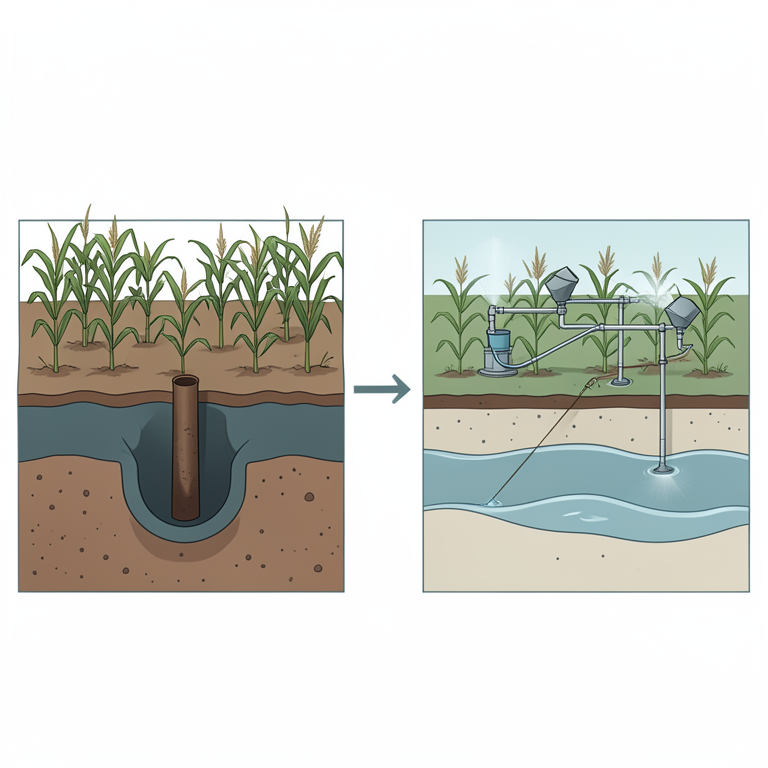
Groundwater Management Cycle
AI-generated conceptual illustration (Agricultural fields in Eastern Haryana with an underground aquifer). It explains the idea and does not show study data.
View source evidence ↗Introduction
Water is the most important input for survival of not only plant, human beings, animals and other living beings, on the earth but also economic development and environmental sustainability. At the same time, it is a dynamic component at the soil and plant system. This is the most scarce and precious natural resource. In arid areas water is known as Liquid Gold. Indeed few other resources affect so many areas of the economy or of human and environmental health as water. Water is in short a blessing for humanity. Water is most essential for the survival of human life on earth. It is the most indispensable resource after air for the existence of life on planet earth. The earth's population has quadrupled in the last 100 years and water use has grown by a factor of seven. Unfortunately, water is increasing becoming scarce in many parts of the world. Groundwater depletion appears to be the most severe crisis receiving scantiest attention both at the level of planning and management. Studies conducted in the Kolar district of Karnataka, Anantpur district of Andhra Pradesh, Amravati district of Maharastra, Mehsana district of Gujarat, Kurukshetra, Karnal, Kaithal, Panipat, some parts of Sonipat, Gurgaon, Rewari, and Mahendergarh district at Haryana indicate falling of groundwater table (25-30 metres in the last forty five years). Such negative trends have to be arrested. These conditions accentuate groundwater recoup studies which are necessary in affected areas to avoid harmful social, economic, and ecological consequences. Groundwater plays an important role for irrigation, domestic consumption and industrial water supply. Over exploitation of groundwater in certain areas has become a matter of deep concern among geographers and hydrologist. Overexploitation of groundwater does not signify total exhaustion but depletion of the stock of groundwater Groundwater is currently contributing more than 85 per cent of the drinking water requirements of rural areas, about 58 per cent of irrigation needs and more than 50 per cent of the urban and industrial water supply in India. It shall continue to play a key role in meeting the water needs of irrigated agriculture in a big way in the next millennium as well. The large number of tubewells creating huge burden on the groundwater storage in the Indo-Gangetic plains. The Punjab -Haryana plain is one of the most agriculturally advanced regions which have witnessed groundwater depletion in many administrative blocks. Haryana is mostly arid and semi-arid State with limiting rainfall ranging from 300 mm in the southwest to 1200 mm in the northwest. There is no perennial river which passes through the State except the Yamuna River and about two third of the area is underlain in the brackish water with rising water table and inadequate natural drainage. The State receives the water from the Sutlej and Yamuna Rivers and equal amount of surplus water from the Ravi and Beas rivers. According to the Groundwater Cell of Agriculture Department of Haryana, the total water resources available in the State is about 24.5 billion cubic metres out of this nearly 11.2 billion cubic comes from normalized monsoon recharge and 6.7 billion metres from annual groundwater recharge. Groundwater irrigation plays an increasingly critical role in Haryana's share of irrigated cultivation in total cultivated areas. The rapid extension of groundwater use has been a major factor contributing to the increase in net irrigated area. Consequently, the depletion is taking place in eastern Haryana especially in fresh groundwater quality zone. It is taking place in many districts of the State, namely, Ambala, Yamunanagar, Kurukshetra, Karnal, Panipat, some parts of Sonepat, Faridabad, Gurgaon, Mewat, Rewari, Mahendregarh, Kaithal and some parts of Bhiwani. Hence, this sinking water table behavior is playing negative role in the development of agriculture. The alarming depletion of groundwater resources in the last few decades has made it a focal point of attention for academicians, scientists, administrators, agriculturists, planners, and policy makers all over the world. Therefore, there is an urgent need for scientific, rational management and utilization of surplus available water which is possible through interventions like design of suitable groundwater structures. The practice will commensurate the rate of draft and will bridge the gap between water availability and requirement (Sethi, Kumar, Sharma. Moreover, the phased construction of water harvesting will resulting in an increase in the shortage of surface water resources which in turn will augment the groundwater reserve and subsequent availability.
Overview of Literature
Nace (1970) [7] postulated that pumpage from the Ogallala formation of USA has reduced storage by nearly 110 Km3 and annual withdrawals in recent years have been about 62 Km3. This is about six of fifteen times of variously estimated natural recharge rate, so the reserve is being depleted and could be exhausted in the foreseeable future. Depletion of groundwater due to overdraft has caused various environmental problems in the different part of the world. Ridgley (1991) [8] examined the loss of agricultural land and fall in aquifer level in central Oahu, Hawaii. He explored these limit by employ the result of a water balance simulation with in a multi-objectives land use programming model. Bradley and Carpenter (1986) [9] studied the fall of groundwater table in Texas, Arizona and California and explained that falling groundwater table was the cause of land subsidence in these States. Land subsidence due to groundwater withdrawal is a relatively recent problem. However, the effort to control subsidence and resulting damage is in its infancy stage. Das Gupta (1990) [10] recognized adverse environmental effects of groundwater overdraft in the Bankok metropolitan city. He indicated that the major cause of land subsidence in the Bankok metropolitan area is due to excessive groundwater pumping leading to depletion of groundwater reservoirs. The subsidence has caused some parts of the drainage systems to be below normal water level and has rendered them ineffective. These factors together with high intensity rainfall result in the frequent flooding of the Bankok metropolitan area. Land subsidence is quite common in various parts of USA. Al-Saleh (1992) [11] indicated decline groundwater level in Saudi Arabia. Rapid expansion in irrigated agriculture requires large quantity of groundwater. As a result, the actual volumes of water pumped from the Minjur Aquifer in this area for irrigation have been in excess of recharge rates. Therefore, groundwater level in this area started to decline. Ferguson (1996) [12] reported that the development of a model of monthly direct runoff consistent with the monthly book keeping format.
Objectives
To establish the climatic water availability. To evaluate the impact of depletion on agriculture. To suggest certain management strategies.
Data Source: This study requires both primary and secondary data. Therefore descriptive and analytical research design is used in this research. The relevant and supportive data on various aspects of groundwater resources such as groundwater quality and data collected from groundwater cell at Agriculture Department of Haryana. The relevant data about cropping pattern are collected from the State Agriculture Department and district revenue offices. In this research primary data is collected from the personal survey of sampled villages. Systematic Random Sampling is used for the selection Random Sampling is used for the selection of villages. Questionnaire is circulated to extract, those information which are not available through the secondary data sources.
Findings: Groundwater depletion appears to be the most severe crisis receiving scantiest attention, both at the level of planning and management. Groundwater resource has not been protected and managed to the extent as surface water, even though the former supplies nearly half of the water requirements in drought prone areas and is extremely important for water storage, treatment and distribution. The question arises for the management of the excessive overdraft of groundwater so that this valuable gift of nature can be preserved and sustained for a long time. Thus the problem of depletion can be solved or minimized by the introduction of proper management that answers the question of when to use water, how much to use it and evaluates the purpose for which it is used. For effective management of groundwater depletion, it is imperative to know other associate problems of groundwater use in the affected areas so that scientific study is made to understand the magnitude, rate and causes of depletion. In many areas in India, groundwater mining is taking place, either by design or by mismanagement. As the consequences, water table has been declining rapidly resulting into many undesirable and often irreversible environmental consequences. Overdevelopment of groundwater resources is increasingly recognised as a major environmental crises in eastern Haryana. The above conditions accentuate the groundwater depletion studies which are necessary in affected areas to avoid harmful economic, social and ecological consequences. The study has indicated that in the absence of sufficient amount of rainfall, farmers are extracting groundwater to meet water requirement for crops. Groundwater has, thus, been depleted to the extent that the aquifer no longer yields water to meet the demand. Consequently, water has been sinking at a very fast rate with depth ranging from more than 3 metre to less than 57 metre in June, 1974 and from more than 4 metre to less than 57 metre in June, 2016. Thus, it will be noted that during June, 1974 to June, 2016 depth to water table increased in many new blocks. The block wise average depth to water table below the ground surface in June, 2016 has been worked out and is compared with June, 1974 to arrive at the total change and also the average annual fluctuation in June, 1974-June, 2016. During this period except 2, all administrative blocks have experienced decline in water table ranging from 0.54 metre in the AmbalaI block of the Ambala district to 0.94 metre in the Siwanii block of the Bhiwani district. The groundwater conditions of the study area, 65 blocks have experienced average decline in water table ranging and remaining 2 blocks have experienced average rising in water table. The minimum declining in fluctuation is -0.08 in Nuh block of Mewat district and maximum declining in fluctuation is -48.04 in Ateli block of Mahendragarh district. The minimum rising in fluctuation is 0.54 in Ambala-I block of Ambala district and maximum fluctuation is 0.94 in Siwani in Bhiwani district. It is clear from that recharge due to fluctuation during monsoon varies from less than 1000 ham to more than 20,000 ham in the entire study area. Ambala and Mahendergarh blocks have fluctuation recharge is more than 20,000 ham while Pehowa, Ladwa, Baibain, Gulha, Nissing, Nagina, Touru and Rai blocks have less than 10,000 ham fluctuation recharge. It shows that recharge due to nonmonsoon rainfall is 78989.60 ham in the study area. It is very less comparative to monsoon rainfall recharge. In the study area, it is worked out that recharge due to seepage through canal is very low. Due to modernization of canals the total recharge through seepage in the study area is 6098.66 ham which is very low. It has been worked out that in 2016, shallow tube wells extracted 88.59 per cent (667256.2 ham) of total groundwater draft followed by pumping set, i.e. 3) conjunctive use of surface and groundwater. More importantly, the bulk of groundwater development has been seen primarily in the private sector with lakhs of scattered pampers exploiting the groundwater at will. It was also found that actual institutional management in the State had been done by limiting (NABARD) funds in the block classified as gray and dark. Loan and subsidies for tubewell installation were not being provided in the dark block. Along these institutional strategies, the following technological strategies were working in the study area: (1) efficient and water saving irrigation methods like sprinkler irrigation, drip irrigation and direct irrigation tubewells, and (2) the State government is trying to educate farmers through various programme.
Conclusion
Conclusions can be drawn from this study. First, groundwater is largely used by irrigation. It meets major part of drinking needs. Secondly, to meet these needs lakhs of tubewells have been dug for extracting the groundwater. Thirdly, the extraction rate of groundwater is more than recharge in all the blocks leading to permanent lowering of water table. Fourthly, the lowering of water table is causing various ecological and socio-economic variations throughout the study area. Fifthly, this study has contributed significantly to understand and explain the complex dimensions of groundwater depletion and to improve the policy making and management strategy.
References
12 in the original paper- Shankar VPS, Kulkarni P, Krishan S. Indian Groundwater challenge and the Way Forward, Economic and Political Weekly. 2012;46(2):37-45.
- Chanda DK. Groundwater Development and Artificial Recharge-Way to Prosperity, In Proceeding of 2nd International Conference on in Sustainable Agriculture, Water Resource Development and Earth Care Policies Bhoovigyan Vikas Foundation, New Delhi, 2002, 212233.
- Singh RB. Impact of Land Use Change on Groundwater in the Punjab-Haryana Plains, India, Impact of Human Activity on Groundwater Dynamics, IAHS Publications, 2001, 269.
- Jha BM. Groundwater Development and Management Strategies in India, Bhu-Jal News. 2007;22:1-5.
- Sethi RR, Kumar A, Sharma SP, Singadhupe RB. Water Resource Assessment in Munijhara Watershed of Orissa, Indian Journal Soil Conservation. 2008;36:158164.
- Sikdar PK, Bhattcharya P. Assessment and Management of Groundwater Resources in Purulia district, West Bangal, Indian Journal of Geology. 2000;72:31-41.
- Nace RL. Human Use of Groundwater, in R. J. Chorley (ed.), Water, Earth and Man, London, Methuen Publishing, 1970, pp. 285-293.
- Ridgley A Mark. Drought, Groundwater Management and Land Use Planning: The Case of Central Oahu, Hawaii, Applied Geography. 1991;2:289-307.
- Bradley MD, Carpenter MC. Subsiding Land and Falling Groundwater Tables, Public Policy, Private Liability and Legal Remedy, Economic Geography. 1986;62:241-253.
- Das Gupta A. Modelling of Groundwater Overdraft and Related Environmental Consequences, in A. K. Biswas, T. N. Khosoo and A. Khosla (eds.), Environmental Modeling for Developing Countries, London, Tycooly Publishing, 1990, pp. 85-119.
- Al-Saleh MA. Declining Groundwater Level of Minijor Aquifer Tebrak Area, Saudi Arabi, The Geographical Journal. 1992;158:215-222.
- Ferguson BK. Estimation of Direct Runoff in the Thornthwaite Water Balance, Association of American Geographers. 1996;48(3):263-271.
Cited by 11
From OpenAlex, OpenCitations and reference lists read by Scinovex
- Challenges for groundwater-irrigated agriculture and management opportunities in Punjab province of Pakistan
Ghulam Zakir-Hassan, Faiz Raza Hassan, JF Punthakey, Ghulam Shabir · International Journal of Research in Agronomy · 2021
Pakistan has one of the world’s largest contiguous irrigation canal networks which was initiated by the British during the early nineteenth century, and its continuous expansion significantly altered the hydrological balance of the Indus River Basin (IRB) in Pakistan. During the pre-irrigation era, the water table in the IRB was very deep which rose up with the introduction of canal network. Seepage from the earthen canals caused the dual menace of waterlogging and salinity and different Salinity Control and Reclamation Projects (SCARPs) were implemented. With the growing food and fiber requir
- Challenges for groundwater-irrigated agriculture and management opportunities in Punjab province of Pakistan
Ghulam Zakir-Hassan, Faiz Raza Hassan, JF Punthakey, Ghulam Shabir · International Journal of Agriculture and Nutrition · 2022
Pakistan has one of the world’s largest contiguous irrigation canal networks which was initiated by the British during the early nineteenth century, and its continuous expansion significantly altered the hydrological balance of the Indus River Basin (IRB) in Pakistan. During the pre-irrigation era, the water table in the IRB was very deep which rose up with the introduction of canal network. Seepage from the earthen canals caused the dual menace of waterlogging and salinity and different Salinity Control and Reclamation Projects (SCARPs) were implemented. With the growing food and fiber requir
- Evaluation of groundwater quality in Sirsa block of Haryana for agricultural use
DS Jakhar, Ketan · International Journal of Agriculture and Food Science · 2025
Groundwater is a critical resource for agriculture in the Sirsa block of Sirsa District in Haryana, where canal water is insufficient to meet irrigation demands. This study assessed groundwater quality by analysing 450 samples collected from various villages over three years (2021-2023) by Krishi Vigyan Kendra, Sirsa. Key parameters measured included electrical conductivity (EC), pH, residual sodium carbonate (RSC), sodium adsorption ratio (SAR), and major ions (Ca²⁺, Mg²⁺, Na⁺, CO₃⁻, HCO₃⁻, Cl⁻). The results indicated substantial spatial variation in groundwater quality. EC ranged from 0.4 to
- A study to analyze the correlation between groundwater depletion and migration trends in Jhunjhunu district ↗
Anurag Anurag, Dheer Singh · International Journal of Advanced Academic Studies · 2025
Groundwater is one of the most crucial sources of freshwater, particularly in regions that lack access to surface water or reliable municipal water systems. This study explores the impact of groundwater depletion on rural migration in Jhunjhunu District, Rajasthan, using a descriptive and analytical research design. The research area has experienced significant groundwater depletion over the last decade, influencing socio-economic
- Artificial intelligence in agriculture: A pathway toward sustainable and smart farming
Amit Kumar, Shashimala Kumari, Vijay Kumar Singh, Nitu Kumari, Sangeeta Shree · International Journal of Advanced Biochemistry Research · 2025
Artificial Intelligence (AI) is transforming agriculture by introducing intelligent systems that improve productivity, resource management, and sustainability. This journal presents an overview of AI applications in agriculture, focusing on irrigation, crop monitoring, disease detection, fertilization, and automated machinery. Drawing on interdisciplinary studies and real-world developments, the paper highlights the impact of AI in solving challenges such as labor shortages, inefficient input use, and climate variability. Additionally, it discusses the barriers to adoption and the potential of
- Underground water crisis in Punjab: A spatio-temporal analysis
Lakhveer Singh · International Journal of Geography Geology and Environment · 2025
Punjab, an agrarian state of India, is facing severe underground water crisis associated with high degree depletion of these water resources after the introduction of Green Revolution. Nonetheless, Punjab is getting less amount of river water due to political reasons like Indus water treaty, damming and diversion of river water, water conflict with Haryana, Rajasthan, and central government. However, the water demand for irrigation and domestic as well as industrial purposes is significantly high. In Punjab, out of the total area of 4158 thousand ha under agriculture in state, an area of 4070
- Impact of climatic factors on Crop Production Index in India ↗
Gnyana Ranjan Bal, Aruna Sharma, S. C. Sharma · Asian Journal of Management and Commerce · 2025
Climate change is increasingly understood as a global challenge, and agriculture is one of the sectors most vulnerable to its impacts. Changes in temperature, degree of moisture and greenhouse gas emissions can affect soil fertility, moisture availability and yield. Many studies have referred to the urgency of addressing climate, as agriculture concerns issues of food security and farmers' livelihoods. Taking
- Water resources management and quality monitoring in Bihar: Challenges, Infrastructure and Sustainable Initiatives ↗
Bimlesh Kumar · International Journal of Financial Management and Economics · 2025
Water resources are fundamental to Bihar’s socio-economic development, sustaining drinking water needs, agriculture, industry, and rural livelihoods. This study examines Bihar’s extensive surface and groundwater resources, relying on the Gangetic Plains’ river systems including the Ganga, Gandak, Kosi, Sone, and others. The research highlights the state’s diverse water infrastructure such as canals, reservoirs, tubewells, tanks, and lift irrigation, emphasizing their
- Impact of promising climate-resilient technologies under rainfed condition: A case study from NICRA Village of Mahasamund District, Chhattisgarh
Kamal Kant Lodhi, Ravish Keshri, R. L. Sharma, Saket Dubey, Kunal Chandrakar, T. R. Pradhan · International Journal of Research in Agronomy · 2025
Climate change has emerged as a critical threat to rainfed agriculture, particularly in regions characterized by high climatic variability. To enhance climate resilience among small and marginal farmers, the National Innovations in Climate Resilient Agriculture (NICRA) project introduced several climate-resilient technologies. This study evaluates the impact of three promising Climate Resilient Technologies viz. drought-tolerant paddy variety (Vikram TCR), heat-tolerant mustard (DRMR-150-35) and sesame in field bund in NICRA village Paraswani, Mahasamund district under rainfed farming system t
- Availability and extraction of ground water resources in the Western Haryana, India ↗
Himanshu Grover, Apperdeep Kaur · International Journal of Arts Humanities and Social Studies · 2024
Groundwater is a very vital natural resource that provides relatively clean, cheap drinking water for domestic use, industrial processes, drinking water supply, and agriculture throughout urban and rural areas. Use of groundwater has increased significantly in Western Haryana over the last few decades with widespread tubewell irrigation. The paper highlights a critical issue as the annual groundwater abstraction in the
- Impact of electricity subsidies on groundwater exploitation in rice and maize cultivation in Anantapur District, Andhra Pradesh
Poiba Ravi Prasad, DK Sinha, KM Singh, Tulika Kumari · International Journal of Agriculture Extension and Social Development · 2024
Rice and maize are crucial for food security and livelihoods in Andhra Pradesh, where electricity subsidies heavily influence groundwater extraction. This study explored the effect of these subsidies on groundwater use for paddy and maize in Anantapur district, sampling 160 farmers across selected blocks. Primary data related to groundwater extraction before and after irrigation subsidy (agricultural year, 2021-22) were collected for the study. Results showed a significant rise in groundwater use following subsidy implementation, particularly in over-exploited areas. Maize saw a 22.82% increas