
Research article · 2025 · Full text
International Journal of Geography Geology and EnvironmentUnderground water crisis in Punjab: A spatio-temporal analysis
Volume 7(8) · Pages 104–107 · DOI: 10.22271/27067483.2025.v7.i8b.399 ↗
Research areasWater Systems and OptimizationWater resources management and optimizationHydrology and Drought Analysis
Abstract
Author-writtenPunjab, an agrarian state of India, is facing severe underground water crisis associated with high degree depletion of these water resources after the introduction of Green Revolution. Nonetheless, Punjab is getting less amount of river water due to political reasons like Indus water treaty, damming and diversion of river water, water conflict with Haryana, Rajasthan, and central government. However, the water demand for irrigation and domestic as well as industrial purposes is significantly high. In Punjab, out of the total area of 4158 thousand ha under agriculture in state, an area of 4070 thousand ha (97.9 percent) is getting irrigation from canals (27 percent) and tubewells (73 percent). Resultantly, the underground water is being depleted at much faster pace and a large number of blocks in Punjab fall under the category of Over-Exploited. Therefore, the present paper addresses the issue of overexploitation of these underground water resources. The study is based on secondary data collected from various sources. Statistical methods are applied for deriving accurate results. Moreover, the present study provides solutions and alternatives to tackle with the present Punjab underground waters crisis.
Summary
Source-checkedPlain-language reading of the full paper, prepared with AI and checked against the text. Each point links to the authors' own words.
Why it matters
- Punjab, an agricultural state in India, is experiencing a severe underground water crisis characterized by significant resource depletion following the Green Revolution. View evidence ↗
- Political factors, including the Indus water treaty, damming, and conflicts with the central government and neighboring states, have reduced the amount of river water available to Punjab. View evidence ↗
- Of the 4,158 thousand hectares of agricultural land in Punjab, 97.9% (4,070 thousand ha) is irrigated, with 73% relying on tubewells and 27% on canals. View evidence ↗
The question
- The study aims to address the overexploitation of underground water resources in Punjab. View evidence ↗
What they did
- The research utilized secondary data from government departments (Central Ground Water and Punjab Water Resources), statistical abstracts from 1980, 2010, and 2021, and other published reports. View evidence ↗
- The administrative 'block' was used as the primary unit of analysis to assess the state of underground water. View evidence ↗
- Data processing and mapping were conducted using statistical, graphical, and cartographical techniques. View evidence ↗
What they found
- Groundwater development in Punjab is at 170%, with annual utilization (3,466,117 ham) far exceeding net annual availability (2,034,922 ham). View evidence ↗
- Assessment of groundwater resources shows that 76% of the state is over-exploited, 13% is critical or semi-critical, and only 11% is in the safe category. View evidence ↗
- Water level depths varied significantly in August 2016, ranging from 0.33 m below ground level in Hoshiarpur to 43.58 m in Sangrur. View evidence ↗
- The number of tubewells in the state increased from 1.92 lakh in 1970-71 to 14.19 lakh in 2020-21. View evidence ↗
What it means
- The authors conclude that current cropping patterns in Punjab have led to the over-extraction of underground water for irrigation. View evidence ↗
- The authors conclude that groundwater draft has resulted in the over-exploitation of regional aquifers, with over 80% of the state falling into the over-exploited category. View evidence ↗
Visual summary
2 visualsIllustrations explain the paper; charts are replotted from the paper's own table values.
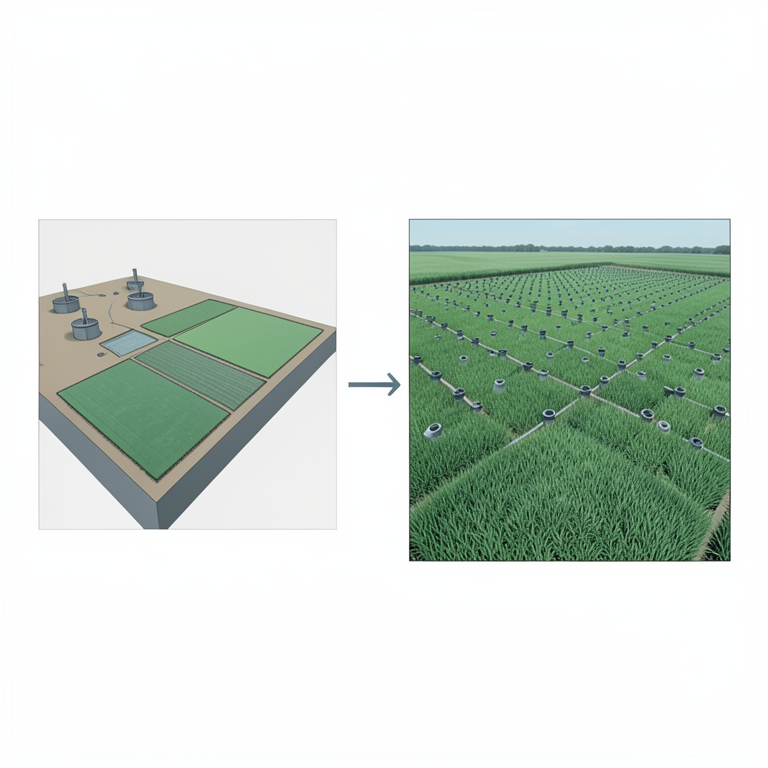
Growth of Groundwater Reliance
AI-generated conceptual illustration (Agricultural landscape of Punjab with groundwater tubewells). It explains the idea and does not show study data.
View source evidence ↗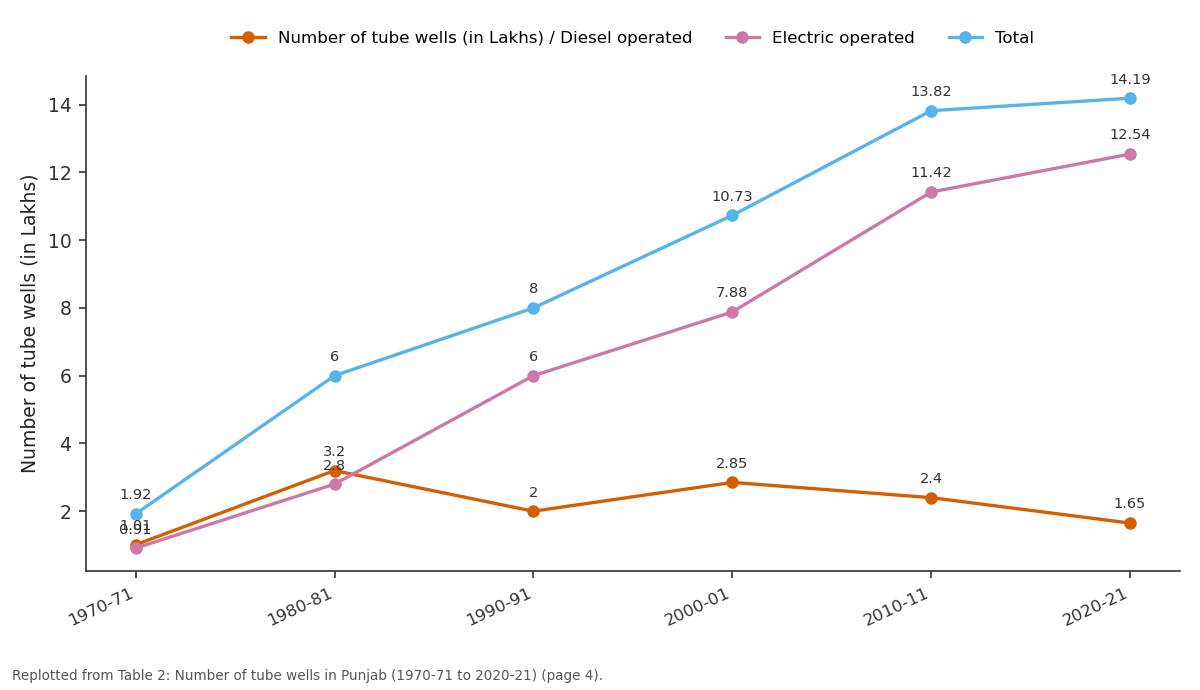
Number of tube wells (in Lakhs) / Diesel... and Electric operated and more: 1970-71 vs 1980-81 vs 1990-91 vs 2000-01 vs 2010-11
Replotted from Table 2 (page 4) of the original paper. Every bar is the paper's own table value.
View source evidence ↗Figures & tables
From the original paper Table 1
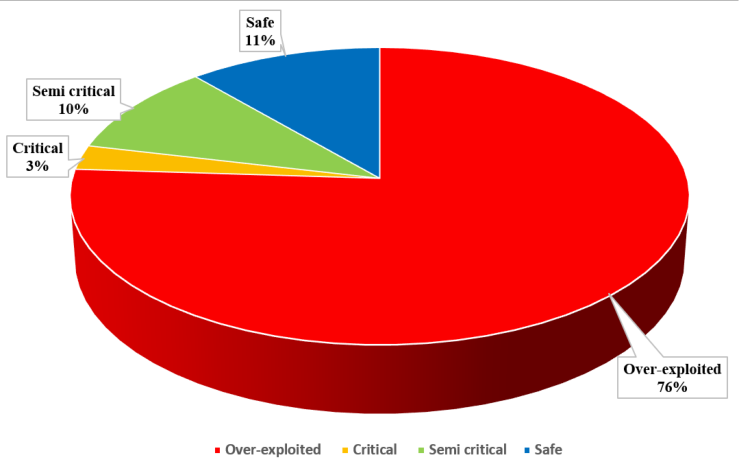 Figure 1
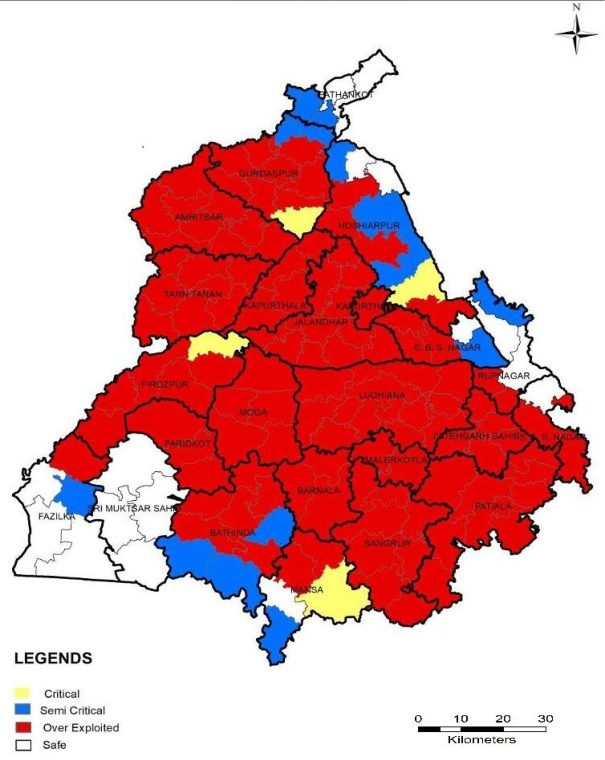 Figure 2
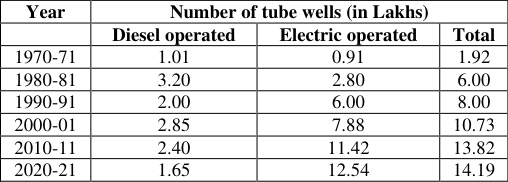 Table 2
 Table 3
Introduction
Water plays central role in the rich diversity of biological processes. The importance of water for life on earth does not require any special introduction, as it is the most precious gift of nature, next only to air. In environment, water exists in three states such as liquid, solid, and gas. It is in dynamic equilibrium between the liquid and gas states at standard temperature and pressure. It is one of the most dynamic components which mold our agricultural, economic and industrial growth. Water has the molecular formula H 2 O. Punjab has endowed with abundance of water in the form of five perennial rivers as well as rich under groundwater aquifers and the hard-working nature of Punjabi farmers harnessed this wealth and created fertile, rich and prosperous farms. However, owing to partition of the country a major portion of these water rich and fertile lands was left in the Pakistan and Punjab was left with only three major rivers (Satluj, Ravi and Beas) and semi-fertile land. The Indus dispute between India and Pakistan was settled through the good offices of the World Bank with the signing of the Indus Water Treaty on September 19, 1960 which conferred full rights on India on eastern rivers Ravi, Beas and Satluj after the transition period ending March 31, 1970. Thus, the state of Punjab in which these rivers lie became entitled to unrestricted rights of development and use of their waters (Singh, 2002). The central government introduced sections 78 to 80 in the Punjab Reorganisation Act, 1966, under which the central government "assumed the powers of control, maintenance, distribution and development of the waters and the hydel power of the Punjab Rivers" The reallocation of the waters among the states as follows: [5] .
Study area
Indian state of Punjab has been selected for the present study located in northwest part of Indian subcontinent. The total geographical area of the state is 50,362 sq. km. which accounts 1.5 percent of the total area of the country. The average annual rainfall in Punjab is 64 cm. spatially wide regional variation in the average annual rainfall from northeast (140 cm Dhar Kalan) to southwest (25 cm Abohar) is available in the state (Singh, 2012) [4] . Except few hills lying in the north eastern part (highest part 1000 metre) of the state more than 30 percent area of the state is plain and falls below 300 metre contour line. The upper rock strata of the state is soft and most suitable for the utilization of surface as well as ground water through canals, tubewells, etc. (Singh, 2013) [5] .
Source of data and methodology
The present study is based on secondary data collected from various sources, departments and agencies such as Department of Central Ground Water, Chandigarh, Department of Punjab Water Resources, Chandigarh, Statistical Abstracts of Punjab for the year of 1980, 2010, 2021, Ground Water Reports, Journals, Books, Newspapers, etc. suitable cartographical, statistical and graphical techniques have been applied for data processing and mapping. Block has been taken as a study unit to reveal the actual state of underground water in Punjab province (Amandeep Gahlawat, 2022) [7] . The quality of the underground water is demonstrated based on the geographical regions of Punjab, i.e., Majha Malwa and Doaba, however, Malwa region is divided into Western Malwa and Eastern Malwa to bring accuracy (Anand Kumar et al., 2023) [9] .
Status of underground water in PUNJAB
Status of underground water in PUNJAB
Depletion of underground water table in Punjab
In general, the depth to water level in Punjab State varies from 0.33 m bgl (below ground level) in Hoshiarpur district to 43.58 m bgl in Sangrur district during August 2016 (CS Armom, 2022) [6] . It is observed that shallowest water level conditions prevail in southwestern parts mainly in Muktsar, Ferozepur and Fazilika districts, even water table has been rising in the area comprising blocks of Muktsar, Lambi, Kot Bhai, Khuiyan Sarwar, Abohar and Fazilka creating water logging at many places (Chopra and Krishan, 2014), while deepest water level conditions exist in the central area in Ludhiana, Sangrur and Kandi areas of Hoshiarpur district. In most of rural and semi-urban areas of Punjab State, ground water is a major resource for drinking and irrigation uses especially in areas where surface water is inadequate or unavailable. Underground water resources of State Punjab have been estimated as on 31.03.2013 in the above table 1. Due to inadequate supply of water from other sources like surface water and atmospheric rainfall, Punjab utilizes more ground water than its net annual availability and thus underground water level is decreasing (Singh, 2013) [5] . Because of over-exploitation of ground water in Punjab, the extraction of ground water has increased by 200 times during last three decades. As on 31/03/2022, out of total 150 block, 114 block are under over-exploited category while 4 are under critical category and 15 are under semi-critical category (Table 1.1). However, only 17 blocks are under safe category in the all three geographical regions of Punjab. Spatial distribution of the block with their category can be depicted in Map. The district-wise categorization of blocks is also listed in Table 1.1. The reason for this stage of ground water development are excessive withdrawal of underground water primarily to meet the growing demands of agriculture in addition to industrial and domestic purposes. Surface water resources in the state are limited and are decreasing due to overexploitation. Therefore, stress is more and more on underground water utilization. At present, there are 14.19 lakhs tubewells as compared to 1.92 lakhs in 1970-71 and about 89% of total tubewells are electric-operated while the rest are operated with diesel engines. Out of the total irrigated area, the area under irrigation by groundwater through tubewells has increased from 57.33 percent to about 73.26 percent during this period.
| Sr. No. | Districts | No. of Blocks | Over-exploited | Critical | Semi critical | Safe |
|---|---|---|---|---|---|---|
| 1 | Amritsar | 9 | 9 | 0 | 0 | 0 |
| 2 | Barnala | 3 | 3 | 0 | 0 | 0 |
Table text extracted from the original PDF; superscript letters are shown inline. The original table image is below.
View original table image
Summary and Conclusion
The state of Punjab is endowed with abundant water resources but the diversion of its surface water resources to the neighboring states put more stress on underground water resources to meet the daily domestic, industrial and agricultural needs. On the basis of the study and related discussion conducted about the conditions of underground water in Punjab, it can be concluded that: Groundwater draft in the state has been resulted into over-exploitation of the aquifers of the region. More than 80 percent of the state are under the category of over-exploited and only 20 percent area is under critical and safe zone. The number of tubewells has been increased tremendously from 1.92 lakh in 1970-71 to 14.19 lakh in 2020-21. More than 70 percent under irrigation in Punjab is being irrigated with the help of underground water. Exiting cropping pattern in the state has led over extraction of underground water for irrigation purposes.
Figures and tables from the paper
| Year | Number of tube wells (in Lakhs) | — | — |
|---|---|---|---|
| Diesel operated | Electric operated | Total | |
| 1970-71 | 1.01 | 0.91 | 1.92 |
| 1980-81 | 3.20 | 2.80 | 6.00 |
| 1990-91 | 2.00 | 6.00 | 8.00 |
| 2000-01 | 2.85 | 7.88 | 10.73 |
| 2010-11 | 2.40 | 11.42 | 13.82 |
| 2020-21 | 1.65 | 12.54 | 14.19 |
Table text extracted from the original PDF; superscript letters are shown inline. The original table image is below.
View original table image
References
10 in the original paper- Central Ground Water Board. Groundwater Year Book Punjab and Chandigarh (UT). Chandigarh: Central Ground Water Board; 2017.
- Ground Water Management Circle, Central Ground Water Board. Ground Water Resources of Punjab State (as on 31st March, 2022). Punjab: Water Resources Department; Dec 2022.
- McDonald AT, Kay D. Water Resources: Issues and Strategies. Harlow (UK): Longman Scientific and Technical; 1988.
- Singh J. Trends in Crop Combination Regions in Punjab. Patiala: Twenty First Century Publications; 2012, p.214.
- Singh J. Irrigation Development and Over Exploitation of Ground Water Resources in Punjab. Geogr Rev India. 2013;75(2):139-52.
- Qureshi A, CS Armo. Evaluation of groundwater quality in Raya Block, Mathura District (Uttar Pradesh) using water quality index. Int. J Geogr Geol Environ. 2022;4(1):49-53.
- Gahlawat A. A Study of groundwater depletion and its impact on agriculture in Eastern Haryana. Int J Geogr Geol Environ 2022;4(1):141-144. DOI: 10.22271/27067483.2022.v4.i1b.99
- Singh Y. Canal Irrigation and Its Ecological Implication in Punjab, India. Malays J Trop Geogr. 2009;40(12):53-64.
- Kumar A, DC Gupta. Assessment of LULC and their impact on land surface temperature, using geospatial techniques in Kolar River catchment area, Madhya Pradesh, India. Int J Geogr Geol Environ 2023;5(1):0814. DOI: 10.22271/27067483.2023.v5.i1a.130
- Government of Punjab. Statistical Abstract of Punjab. Chandigarh: Economic and Statistical Organisation; 2013.