
Research article · 2022 · Full text
International Journal of Veterinary Sciences and Animal HusbandryMorphological comparison of proventricular and gizzard in starling birds Sturnus vulgaris and pigeon Columba livia
Volume 7(1) · Pages 15–18 · DOI: 10.22271/veterinary.2022.v7.i1a.398 ↗
Research areasAnimal Nutrition and PhysiologyLivestock and Poultry ManagementBird parasitology and diseases
Abstract
Author-writtenThe current study aimed to investigate the stomach of two species starling Sturnus vulgaris and pigeons Columba livia. The experiment was included 10 birds, it is distributed in two equal groups. Ages of birds were average range 6-9 months (adult age). The observations was appeared the stomach in both the species, divided into 2 chambers. The results were showed the first stomach is called proventriculus. It's characterized elongated in shape and expansion of the esophagus, located forward the gizzard to posterior at the esophagus in both species. Our study was included some gross findings differentiates in two kinds. However, the proventriculus in starling S. vulgaris was characterized a cylindrical-like and had gastric papillae which it's appeared from external surface of proventriculus with long isthmus. Whereas our results in pigeon C. livia, the glandular stomach was tubular in shape and no protrudes of gastric papillae during outer wall of it with short isthmus. Either gizzard was spherical in shape of starling and fusiform-like in pigeons, but it was thin muscular wall and clear at fatty tissue with pale color comparatively with pigeon, because the starling birds were represented at omnivores depend on the nutrition adding to the grains. In the pigeons, the gizzard had amount of adipose tissue it's covered most the external wall of it. The situation of gizzard in pigeon was situated posterior toward proventriculus and had thick muscular wall with dark-red in color according to nature of diet, facilities of the grinding grain for indigestion, therefore the pigeons were considered from granivorous. Also the study was included anatomical statics measurements, length, weight and volume in addition to weights of the birds. Where the study was recorded no significant data mean between species of birds proventriculus and gizzard (table 1).
Summary
Source-checkedPlain-language reading of the full paper, prepared with AI and checked against the text. Each point links to the authors' own words.
Why it matters
- Bird stomachs typically consist of two distinct chambers: the proventriculus and the gizzard (or ventriculus). View evidence ↗
- The gizzard serves a critical role in digestion by using its muscles to grind grains. View evidence ↗
- The size and shape of these stomach chambers vary based on whether the bird's diet is carnivorous, piscivorous, or granivorous. View evidence ↗
The question
- The study aimed to investigate and compare the stomach morphology of the starling (Sturnus vulgaris) and the pigeon (Columba livia). View evidence ↗
What they did
- Researchers measured the weight, length, and volume of the birds and their stomach organs using an electronic balance, electronic caliper, and volumetric cylinder. View evidence ↗
What they found
- In starlings, the proventriculus was cylindrical in shape, featured a long isthmus, and had gastric papillae on its external surface. View evidence ↗
- In pigeons, the glandular stomach (proventriculus) was tubular, had a short isthmus, and lacked protruding gastric papillae on the outer wall. View evidence ↗
- The gizzard was spherical in starlings but fusiform-like in pigeons. View evidence ↗
- The starling's gizzard had a thin muscular wall and pale color with clear fatty tissue, reflecting its omnivorous diet. View evidence ↗
- The pigeon's gizzard was largely covered by adipose tissue on its external wall. View evidence ↗
- The study found no statistically significant difference in the mean anatomical measurements (length, weight, volume) of the proventriculus and gizzard between the two species. View evidence ↗
What it means
- The authors concluded that both species possess a two-chambered stomach with an elongated proventriculus continuing from the esophagus. View evidence ↗
- The authors highlighted that starlings have gastric papillae on the proventriculus wall, whereas pigeons do not, and pigeons have gizzards covered in fatty tissue. View evidence ↗
Visual summary
1 visualsIllustrations explain the paper; they do not show study data.
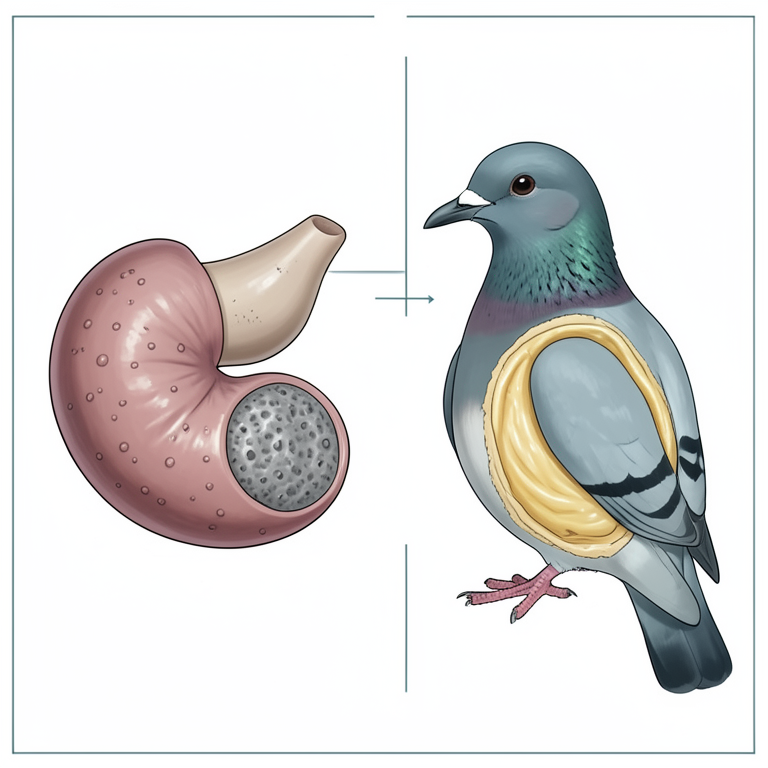
Comparative Stomach Morphology
AI-generated conceptual illustration (European starling (Sturnus vulgaris) and rock pigeon (Columba livia) stomachs). It explains the idea and does not show study data.
View source evidence ↗Figures & tables
From the original paper Table 1
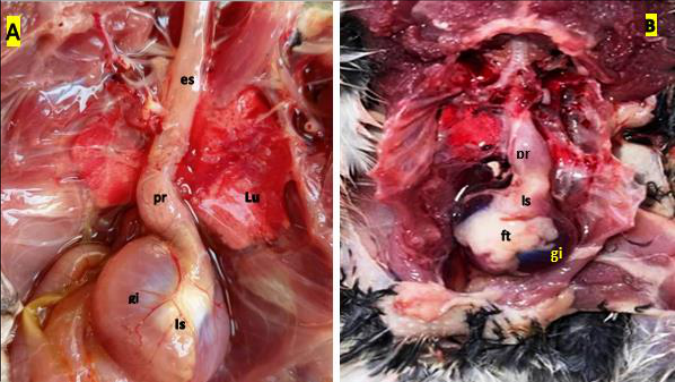 Figure 1
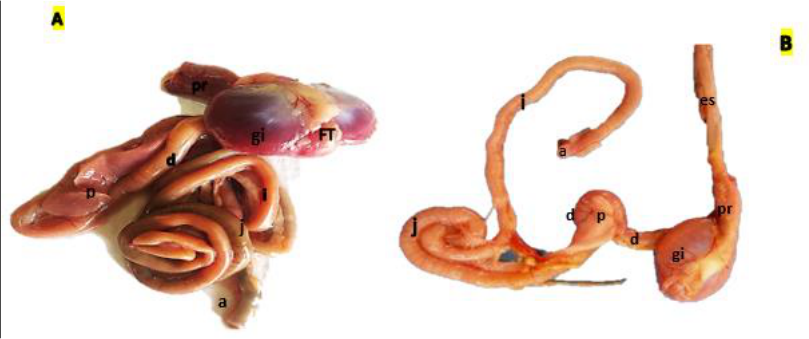 Figure 2
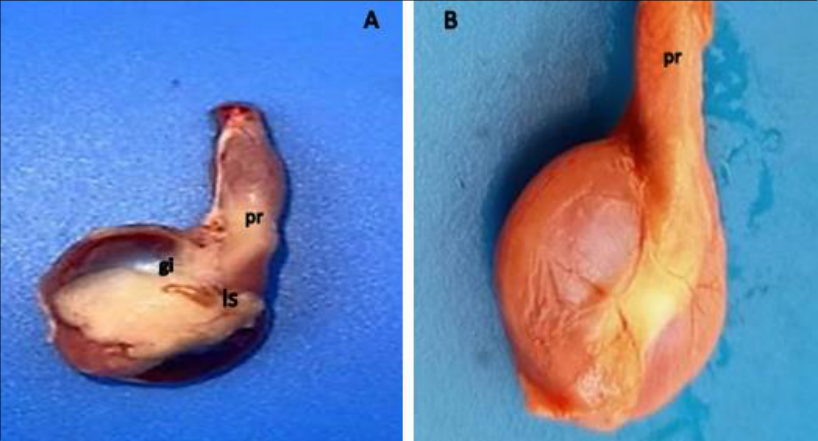 Figure 3
Introduction
The bird species are widespread around the world. Where they are more than 8000 styles of birds are lived between them. These birds are different in shape, location, and adaptation [1] . The starling birds Sturnus vulgaris are seasonal and come during winter. Whereas other birds such as pigeons Columba livia are presented along year [2,3] . The stomach of the birds is divided into two chambers. The first stomach is proventriculus and the second chamber is called gizzard or ventriculus. Gizzard stomach is grinding function of grains by their muscles, so that it's facilities indigestive process [4] . The two chambers of stomach are different in size and shape depending on the nature of birds' diets as carnivores, piscivorous and granivorous birds. The glandular stomach (proventriculus) is characterized thin layer based on the food force (grains). Either ventriculus is called muscular part, which it's crushed the grains in, omnivores, insectivores, granivorous, and herbivores [5,6] . The gizzard is varied among the birds depending on the diet. In vegetarian fowls are marked developed, and considerable masticator function for granivorous and insectivores [6,7] . The birds are subdivided into 3 groups according to food nature. The first group has soft eating diet as kestrel and owl, second birds have hard eating food such as turkey and sparrow. Either the final group geese, hoopoe, and darter are intermediate between the first and second group of the birds, the gizzard function is used in storage and physical digestion in these birds [8] .
Morphology, the stomach of avian is different according to species, chick's proventriculus seems spindle in shape and it has gastric papillae which it's projected processes at in upper surface of it. The papillae are secreted the gastric juice which it's mixed from mucin, hydrochloride acid and gastric enzymes [9,10] . The study aimed to light the application of some morphological differences between proventriculus and gizzard of S. vulgaris and C. livia.
Materials and methods
Materials and methods
Experimental design
Ten birds were used. The ages of birds included adults aged 6-9 months. It was divided into two equal groups, the first group included 5 starling birds and the other group had 5 pigeons. Then all the birds were sacrificed by dislocation in the neck region. The samples were put on dissected board for dissection. We are done mid-line incision through the abdomen region so that obtain on viscera. Proventriculus and gizzard were washed with tap water for the cleaning of blood, adhered particle, and food for the preparation of morphological techniques. The results included anatomical dimensions. The weights of birds were measured by sensitive electronic balance. So weight and lengths of proventriculus and gizzard. The lengths were measured by an electronic caliper. Either volume was measured by a volumetric cylinder. It contains normal saline and started to put samples inside it, then we read the scaling of a volumetric cylinder before and after putting of sample.
Results and discussion
The current study included the stomach of starling birds S. vulgaris and pigeon C. livia. Generally, the present observations appeared the stomach in both the species, divided into 2 chambers (figure 1, 2, 3). This result is accepted with [9] Japanese quail. [11] In domestic fowl Gallus gallus. [12] Partridge Rhynchotus rufescens. Whom said the stomach in some birds, consisted of three chambers, proventricular, ventriculus, and pyloric part. The current study showed the first stomach is called proventriculus. It's characterized elongated in shape and expansion of the esophagus, so it's located forward the gizzard to the posterior at the esophagus in both species (figure 1, 2, 3). These findings were corresponding with stated [13] in Ostrich [14] In common quail Coturnix and [15] in chicken. This part of the stomach was called the fore glandular stomach. These results were accepted with [16] in pigeon C. livia domestica. Our study observed some gross differences between the two species. However, the proventriculus in starling S. vulgaris was characterized a cylindrical-like and had gastric papillae which it's appeared from external surface of proventriculus with a long isthmus (figure 1a). These results were paralleled with said by [17] . While our results in pigeon C. livia, the glandular stomach was tubular in shape and no protrudes of gastric papillae during outer wall of it with short isthmus (figure 1b,3a). Either gizzard was spherical in shape during starling and fusiform-like in pigeons, but it was a thin muscular wall and clear at fatty tissue with pale color comparatively with pigeon, because the starling birds were represented at omnivores depend on the nutrition adding to the grains. In the pigeons, the gizzard had amount of adipose tissue it's covered most the external wall of it (figure 1b,3a). These results were accepted with [18,19] in Striated Scope Owl Otus Scors brucei and goose, turkey, sparrow, kestrel, hoopoe, owl respectively. Whom said the gizzard was fusiform in shape. The study accepted with them about the gizzard surrounded by amount from fatty tissue. Generally, the gizzard in pigeon was situated posterior toward proventriculus and had thick muscular wall with dark-red in color according to nature of diet, facilities of the grinding grain for indigestion. Therefore the pigeons were considered at granivorous. These results accepted with said by [16] . The study included anatomical measurements, length, weight, and volume in addition to the weights of the birds. Where the study recorded no significant data mean between species of birds proventriculus and gizzard (table 1). These results are accepted with [17] in starling birds.
| Species | — | Starling bird Sturnus vulgaris | — | Columba livia pigeon | — |
|---|---|---|---|---|---|
| Weight | 123.32g | 347.56g | |||
| Organs | proventriculus | gizzard | proventriculus | gizzard | |
| Length | 3.43±01cm | 4.54±02cm | 4.33±01cm | cm 5.21±01 | |
| Weight | 2.45±03g | 3.54±03g | 3.65±00g | 4.00±03g | |
| Volume | 2.28±23 cm³ | cm³ 2.33±30 | 3.54±32 cm³ | 3.65±25 cm³ |
Table text extracted from the original PDF; superscript letters are shown inline. The original table image is below.
View original table image
Conclusions
The stomach in S. vulgaris and C. livia included two chambers, fore stomach (proventriculus) and muscular stomach (gizzard). In both species, the proventriculus was elongated-like continue with esophagus posteriorly. In starling's proventriculus had appearance of projected processes of gastric papillae in external wall. While in pigeon's proventriculus has no appear. Pigeon's gizzard was covered by fatty tissue on the most external surfaces of it.
Acknowledgement
AcknowledgementsThe researcher wishes to send their gratitude to the Department of Anatomy and Histology, College of Veterinary Medicine of the University of Baghdad.
Figures and tables from the paper
References
17 in the original paper- King AS, Mclelland J. Outline of Avian Anatomy. 1 st edition Bailliere, Tindall, London. 1975, 33-39.
- Purcell KL, Verner J, Mori SR. Factors affecting the abundance and distribution of European starlings at the San Joaquin Experimental Range in R B. Standiford, D.D. McCreary and K. L. Purcell, technical coordinators. Oaks in California's Changing Landscape. USDA Forest Service Gen. Tech. Rep. PSW-GTR184. Albany, CA, 2002, 305-321.
- Taylor M. Anatomy and physiology of the gastrointestinal tract for the avian practitioner. In Birds. Post Grad Found in Vet. Sci. Uni. of Sydney, Aust. Proc. 2000;334:107-113.
- Gartrell BD. The nutritional, morphologic, and physiologic bases of nectarivory in Australian birds. J Avian Med. Surg. 2000;14(2):85-94.
- Duke GE. Gastrointestinal physiology and nutrition in wild birds, Proceedings of the Nutrition Society. 1997;56(3):1049-1056.
- Abumandour MMA. Histomorphological studies on the stomach of Eurasian Hobby Falconinae: Falco subbuteo, Linnaeus 1758) and its relation with its feeding habits. Life Sci J. 2014;11(7):809-819.
- Ahmed Abd-Galil Y, Kamel G, Ahmad A. Abo-El-Magd. Histomorphological studies on the stomach of the Japanese quail. Asian J Poult. Sci. 2011;5(2):56-67.
- Sherri C. Avian Digestive System. Holistic bird. News letter. Devoted to health and healing of a vian mind, body spirit. 2003;3:44-53.
- Akester AR. Structure of the glandular layer and koilin membrane in the gizzard the adult domestic fowl (Gallus domesticus). J. Anat. 1986;147:1-25.
- Rossi JR, Baraldi SM, Oliveira D, da Cruz C, Franzo VS, Sagula A. Morphology of glandular stomach (Ventriculus glandularis) and muscular stomach (Ventriculus muscularis) of the partridge. Rhynchotus rufescens. Ciencia Rural. 2005;35:1319-1324.
- Tadjalli M, Parto P, Shahraki AF. Histological study of proventriculus of male adult Ostrich. Global Veterinaria. 2011;7(2):108-112.
- Zaher M, El-Ghareeb AW, Hamdi H, Abu Amod F. Anatomical, histological And histochemical adaptations of the avian alimentary canal to their food habits: ICoturnix coturnix. Life Sci. J. 2012;9(3):253-275.
- Salem AO, Yousria AAR. Comparative morphometrical and scanning Electron microscopical studies on the glandular stomach of the chicken (Gallus domesticus Pigeon (Columba livia), duck (Anas domesticus) and cattle egret (Bubulcus ibis). Assiut Vet. Med. J. 2000;44(87):35-53.
- Al-Saffar FJ, Al-Samawy ERM. Histomorphological and histochemical study of stomach of domestic pigeon Columba livia domestica). Iraqi J. Vet. Med. 2016;40(1):89-96. https://doi.org/10.30539/iraqijvm.v40i1.144
- AL-Taai SAH, Hasan MS. Histomorphological Study of Proventricular and Gizzard in Adult Starling Bird (Sturnus vulgaris). Plant Archives. 2020;20(1):16711678.
- Al-Saffar FJ, Eyhab RM, Al-Samawy. Microscopic study of the proventriculus and ventriculus of the Striated Scope Owl (Otus Scors brucei) in Iraq. Kufa J. Vet. Sci. 2014;5(2):9-23.
- Hassouna EM A. Some anatomical and morphometrical studies on the esophagus and stomach in goose, turkey, sparrow, kestrel, hoopoe, owl and darter. Assiut Vet. Med. J. 2001;44(88):46-21.
Cited by 6
From OpenAlex, OpenCitations and reference lists read by Scinovex
- Passive acoustic monitoring of Red-wattled Lapwing (Vanellus indicus) and house crow (Corvus splendens) during breeding season in agricultural landscape of Punjab
Sakshi Singla, Manoj Kumar · International Journal of Biology Sciences · 2025
Bioacoustic technology has shown immense potential for understanding the biological soundscape of our surroundings leading to better understanding of animal behaviors. It helps in assessing the current state of ecosystems as well as in creating a bio-acoustic archive. Bird calls have always been the choice of ornithologists to identify and study the birds. The present study deals with the study and analysis of acoustic signals of Red-wattled Lapwing (Vanellus indicus) and House Crow (Corvus splendens) during breeding season. Calls of the species were recorded by using Recforge II mobile app an
- Morphological comparative study of proventriculus and gizzard between bronze fallow cockatiel and white eared bulbul ↗
Mohamed Ibrahim, S.M. Al-Kafagy · International Journal of Fauna and Biological Studies · 2025
The current result aimed to investigate the comparative morphological note of gizzard and proventriculus between two bird (white eared bulbul and bronze fallow cockatiel) according to their food type. In this study used (10 sample) from each bird. The proventriculus of bulbul was spindle tubular in shape-pink in color, the internal surface have shallow longitudinal fold. While in cockatiel the
- Feathered allies as bioindicators and agents for sustainable agriculture
A Bharathi, MS Sahala Thasnim, Constantin Veronica, Sree Madhumitha, G. Rajadurai · International Journal of Agriculture and Food Science · 2025
Feather allies, or Birds, have long coexisted with agricultural ecosystems, playing both direct and indirect roles in enhancing farm productivity, biodiversity, and ecological balance. From pest control and pollination to integrated farming and economic diversification, avians contribute significantly to sustainable agriculture. This ecosystem service supports integrated pest management (IPM) practices and reduces environmental pollution by chemicals. Additionally, many species of birds help to pollinate crops and disperse seeds and, in many cases help to promote biodiversity that can improve
- Efficacy of a bioactive botanical blend in enhancing gut integrity and productivity in broiler
Pratik Hivraj Barsinge, A Guha, Bhagyalaxmi Chinnavadu Junnuru, H. D. Merchant, Amit Chandrakant Kini · International Journal of Advanced Biochemistry Research · 2025
In this 42-day research trial, 1,760 one-day-old “Cobb-430Y” broiler birds were allocated to four treatment groups, A, B, C, and D, each with 440 birds further divided into four replicates of 110 birds each to evaluate the effects of Bioactive Botanical Blend (BBB) versus a standard symbiotic on gut integrity and productivity in broilers. The BBB consisted of a blend of Piper longum, Mangifera indica, Thymus vulgaris, Ocimum sanctum, Trachyspermum ammi, Allium cepa, and Curcuma longa, while the standard symbiotic contained probiotics including Bacillus licheniformis, Bacillus coagulans, Lactob
- Histologic structure of stomach in birds ↗
Alaa Najee Salih, Alyaa abdul-ridha Hanash · Zoological and Entomological Letters · 2024
- Assessing avian biodiversity in Swamithoppu saltpan with the fuzzy matrix approach ↗
Azhagu Raj R, F Patrick, D Jude, Jenifer Wency S, J F, I Divyanadam · Journal of Mathematical Problems Equations and Statistics · 2023
Fuzzy matrix is an invaluable tool in determining the biodiversity of a particular area. It is used to measure the species richness and abundance of a given area, as well as account for the presence of rare species. This study used fuzzy matrix analysis Initial Raw Data Matrix (IRDM), Average Quantity Dependent Data Matrix (AQDM), Refined Quantity Dependent Data Matrices