
Research article · 2021 · Full text
International Journal of Biology SciencesEffect of nutrients on cellulolytic and pectolytic enzyme production of Phomopsis viticola a leaf spot pathogen of grapes (vitis vinifera)
Volume 3(1) · Pages 18–20 · DOI: 10.33545/26649926.2021.v3.i1a.22 ↗
Research areasPlant Pathogens and Fungal DiseasesHorticultural and Viticultural ResearchYeasts and Rust Fungi Studies
Abstract
Author-writtenPhomopsis viticola causes leaf spot disease to the Grapes plant is a potential pathogen of Grapes plant (Vitis Vinifera), was isolated from diseased Vitis Vinifera leaves from Nashik district and used for the present study. Pathogen was grown on the Czapek-Dox liquid medium substituting or adding different carbon, nitrogen to study cellulolytic and pectolytic enzyme production and total phenol production. The activity of enzyme was observed on the 8th day of incubation period. A grate extent of growth variation was observed on different carbon, nitrogen. Among the carbon source, maximum growth on Glucose followed by Control, lactose, fructose and dextrose while in absence of carbon source there was no growth. From nitrogen source maximum growth on nickel nitrate. While barium nitrate, cobalt nitrate and control had more or less similar effect on the growth. The least growth was observed in potassium nitrate. In absence of nitrogen source in the medium resulted in lowest growth as compared to other compound. Nitrogen sources shows much variation in cellulolytic enzyme activity. The cellulose activity was maximum in nickel nitrate and minimum in barium nitrate and potassium nitrate as compare to cobalt nitrate and control.
Summary
Source-checkedPlain-language reading of the full paper, prepared with AI and checked against the text. Each point links to the authors' own words.
Why it matters
- Phomopsis viticola is a fungus that causes cane and leaf spot disease in grapes (Vitis vinifera). View evidence ↗
- The pathogen causes spots on old leaves and relies on cool, wet weather for the release of spores and subsequent infection. View evidence ↗
The question
- The study aimed to investigate how different carbon and nitrogen sources affect the production of cellulolytic and pectolytic enzymes in Phomopsis viticola. View evidence ↗
What they did
- The researchers used Czapek-Dox medium as the base, consisting of NaNo3, K2HPO4, MgSO4, FeSO4, and sucrose. View evidence ↗
- The Phomopsis viticola pathogen was isolated from diseased Vitis vinifera leaves collected from the Nashik district. View evidence ↗
- Cellulolytic enzyme activity was measured by observing the loss of viscosity in a cellulosic substrate using an Oswald viscometer. View evidence ↗
- Pectolytic activity was determined by measuring the mean time required for potato tuber discs to lose coherence when exposed to the culture filtrate. View evidence ↗
What they found
- For pectolytic activity, dextrose produced the maximum macerating enzyme (M.E. 166.66), whereas the control showed the minimum activity (M.E. 125). View evidence ↗
What it means
- The authors conclude that cellulolytic activity is maximized by fructose (carbon source) and barium nitrate (nitrogen source), while pectolytic activity is maximized by dextrose and nickel/potassium nitrate. View evidence ↗
Visual summary
3 visualsIllustrations explain the paper; charts are replotted from the paper's own table values.
Nutrient Influence on Enzyme Production
AI-generated conceptual illustration (Phomopsis viticola fungus and grape leaf tissue). It explains the idea and does not show study data.
View source evidence ↗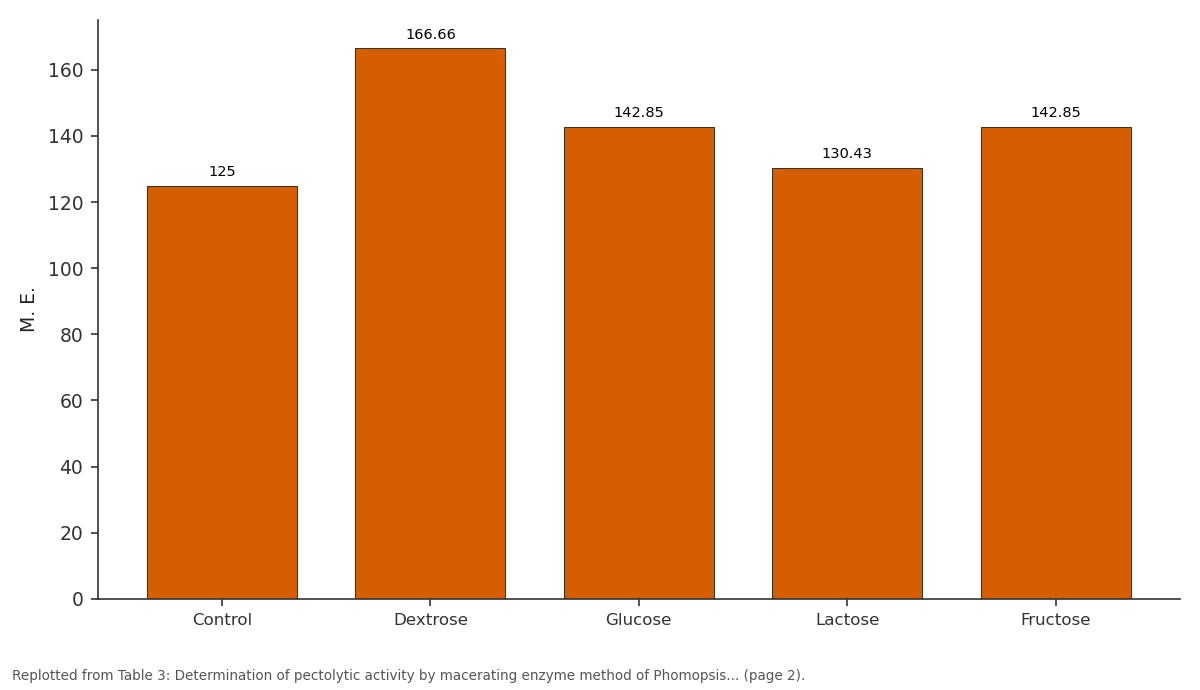
M. E.: Control vs Dextrose vs Glucose vs Lactose vs Fructose
Replotted from Table 3 (page 2) of the original paper. Every bar is the paper's own table value.
View source evidence ↗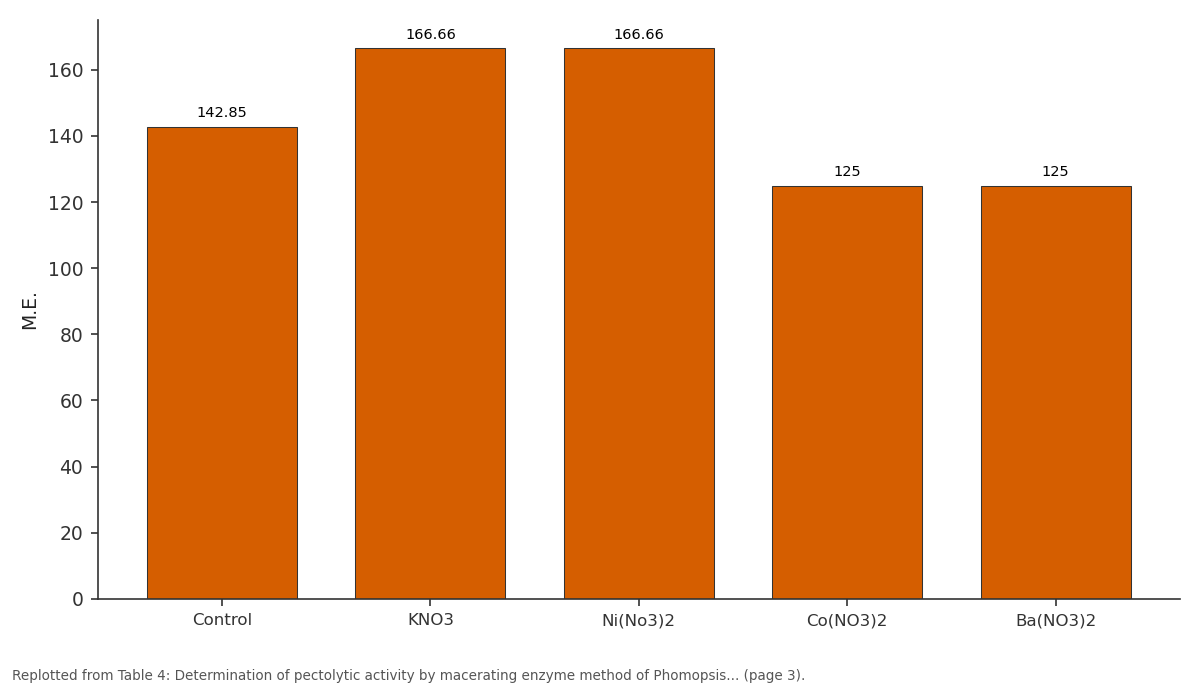
M.E.: Control vs KNO3 vs Ni(No3)2 vs Co(NO3)2 vs Ba(NO3)2
Replotted from Table 4 (page 3) of the original paper. Every bar is the paper's own table value.
View source evidence ↗Figures & tables
From the original paper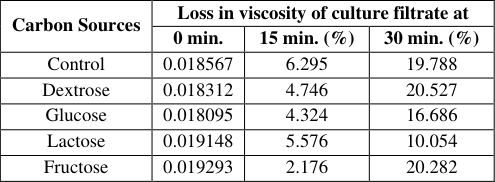 Table 1
 Table 2
 Table 3
 Table 4
Introduction
Vitis vinifera L is a indigenous to southern Europe and western Asia, and now it is today cultivated worldwide for its high value berries, or grapes. This plant affected by many fungi. Phomopsis cane and leaf spot is a grape fungal disease caused by fungi Phomopsis viticola. The Pathogenic fungi causes spots on old leaves of plant requires cool, wet weather for spore release and infection. The fungus produces flask shaped fruiting bodies called pycnidia. These pycnidia release spores in early spring and are spread by splashing rain droplets to developing shoots, leaves, and clusters. In the presence of free water, the spores germinate and cause infection. The optimum temperature for leaf infections was between 60 and 68 degrees F and at least six hours wetness duration is required at these temperatures for infection to occur. As the wetness duration increases, the opportunity for infection greatly increases. Spot on leaves appear at seven to ten days after infection. Fully expanded leaves become resistant to infection. Lesions on canes require two to four weeks to develop. The fungus does not appear to be active during the warm summer months, but it can become active during cool, wet weather later in the growing season. Pycnidia eventually develop in infected wood and will provide the initial inoculum for infections. Many worker reviewed physiology and biochemistry of fungi (Stall,1958;Rajderkar,1966;sharma et.al.,1985;Sankaran et.al.,1986;Nair and Sumaridi, 2000;Bhanumathi, 2007;Mantri, 1969;Jayraj and Ramabadran, 1998).
Material and Method
The material used and methods followed during the present investigations were as follows:
The Czapek-Dox solid and liquid medium was used as a common medium for the studies. The composition of media was NaNo 3 -2.00g, K 2 HPO 4 -1.00g, MgSO 4 ,7H 2 O -0.50g, FeSO 4 , 7H 2 O -0.01g, Sucrose -30g, Distilled water -1000ml. Vitis vinifera leaves affected with different diseases were collected from different locations of Nashik district. Isolation from these affected leaves was carried out on Czapek-Dox agar medium by usual tissue incubation technique. The Petri plates were incubated at room temperature (22-28 0 C) until good growth of organism was observed. The colonies free from contamination were transferred on Czapek-Dox agar slant and maintained for further studies. Eight days old culture of organism was used for biochemical studies. Due to the action of enzymes, the polymer cellulosic substrate is broken down into small molecular compounds which results into the loss in the viscosity. The loss in viscosity is measured by Oswald viscometer. The substrate enzyme mixture is used in the following composition: Ten discs are placed in five ml of an enzyme solution (culture filtrate) in a watch glass. At interval of 5 min. they are subjected to slight tension by hand or pulled apart. As soon as the first disc has lost coherence, the mean time for loss of coherence in all discs is noted and taken as the reaction time (R.T.) in minute.
Macerating activity (ME) is expressed as
The test are carried out at room temperature and optimum pH.
Results and Discussion
Phomopsis viticola was grown on Czapek-Dox liquid medium and cellulolytic and pectolytic enzyme was recorded.
Loss in percentage viscosity of culture filtrate was calculated after different time interval. After 30 min. there was considerable variation in viscosity which ultimately shows effect on production of cellulolytic enzyme.
The results shows (Table-1) the maximum loss in percentage viscosity in fructose followed by dextrose, there was not much variation in loss of percentage viscosity in dextrose and control, as compared to this the minimum loss in percentage viscosity in lactose. Data in the table -2 shows maximum viscosity loss followed by cobalt nitrate and potassium nitrate. There is not much variation is seen in loss of viscosity of nickel nitrate and control which shows minimum viscocity loss. The pectolytic enzyme activity was measure on different carbon and nitrogen the result shows (Table -3) that the maximum macerating activity in dextrose, followed by similar activity in glucose and fructose as a carbon source. Very little differences were found in between lactose and control which shows minimum macerating activity.
Summary
A grate extent of growth variation was observed on different carbon, nitrogen. Among the carbon source, cellulose activity of Phomopsis viticola was maximum in fructose followed by dextrose, control, glucose and minimum cellulolytic enzyme activity in lactose. From nitrogen source cellulolytic enzyme activity of Phomopsis viticola was maximum in barium nitrate followed by cobalt nitrate, potassium nitrate, nickel nitrate and control. Variation was also observe in pectolytic enzyme activity. Dextrose shows maximum pectolytic enzyme activity, while control with minimum cellulolytic enzyme activity. From nitrogen source the pectolytic activity was maximum in nickel nitrate and potassium nitrate. The minimum pectolytic activity was in barium nitrate as compared to cobalt nitrate and control.
Figures and tables from the paper
| Carbon Sources | Loss in viscosity of culture filtrate at | — | — |
|---|---|---|---|
| 0 min. | 15 min. (%) | 30 min. (%) | |
| Control | 0.018567 | 6.295 | 19.788 |
| Dextrose | 0.018312 | 4.746 | 20.527 |
| Glucose | 0.018095 | 4.324 | 16.686 |
| Lactose | 0.019148 | 5.576 | 10.054 |
| Fructose | 0.019293 | 2.176 | 20.282 |
Table text extracted from the original PDF; superscript letters are shown inline. The original table image is below.
View original table image
| Nitrogen Sources | Loss in viscosity of culture filtrate at | — | — |
|---|---|---|---|
| 0 min. | 15 min. (%) | 30 min. (%) | |
| Control | 0.018077 | 2.335 | 11.041 |
| KNO3 | 0.018158 | 4.296 | 14.720 |
| Ni(No3)2 | 0.019640 | 1.977 | 11.344 |
| Co(NO3)2 | 0.019652 | 5.323 | 16.322 |
| Ba(NO3)2 | 0.018351 | 9.102 | 17.525 |
Table text extracted from the original PDF; superscript letters are shown inline. The original table image is below.
View original table image
| Time / Carbon source | 2 | 4 | 6 | 8 | 10 | 12 | 14 | No of time Discs Macerated | Total time | Mean time | M. E. |
|---|---|---|---|---|---|---|---|---|---|---|---|
| Control | - | 1 | 3 | 3 | 2 | 1 | - | 5 | 40 | 8 | 125 |
| Dextrose | 2 | 1 | 2 | 3 | 2 | - | - | 5 | 30 | 8 | 166.66 |
| Glucose | 1 | 2 | 1 | 1 | 3 | 2 | - | 6 | 42 | 7 | 142.85 |
| Lactose | 2 | 1 | 2 | 1 | - | 3 | 1 | 6 | 46 | 7.6 | 130.43 |
| Fructose | 3 | 2 | 1 | 1 | 2 | 1 | - | 6 | 42 | 7 | 142.85 |
Table text extracted from the original PDF; superscript letters are shown inline. The original table image is below.
View original table image
| Time / Nitrogen source | 2 | 4 | 6 | 8 | 10 | 12 | 14 | No of time discs Macerated | Total Time | Mean time | M.E. |
|---|---|---|---|---|---|---|---|---|---|---|---|
| Control | 1 | 2 | 1 | 2 | 3 | 1 | - | 6 | 42 | 7 | 142.85 |
| KNO3 | 2 | 3 | 1 | 2 | 2 | - | - | 5 | 30 | 6 | 166.66 |
| Ni(No3)2 | 2 | 2 | 2 | 3 | 1 | - | - | 5 | 30 | 6 | 166.66 |
| Co(NO3)2 | - | 3 | 1 | 3 | 2 | 1 | - | 5 | 40 | 8 | 125 |
| Ba(NO3)2 | 1 | 3 | 2 | - | 2 | 1 | 1 | 6 | 40 | 8 | 125 |
Table text extracted from the original PDF; superscript letters are shown inline. The original table image is below.
View original table image
References
10 in the original paper- Baig MMV. Cellulolytic enzymes of Trichoderma lignorum produced on banana agro-waste: optimization of culture medium and conditions. Journal of Scientific and Industrial Research,2005:57:57-60.
- Stall RE. An Investigation of Nuclear Number in Alternaria solani, American Journal of Botany, Botanical Society of America,1958:45(9):657-659.
- Jones & grout, Springer Netherlands,1966:29:55-58.
- Mantri JM. Studies on physiology of Phytopthora spp. Ph.D. thesis Dr. B.A. Marathwada university, Aurangabad, 1969.
- Suryawanshi VS. Greener and efficient synthesis of Benzodiazepines using mixed Ferrite under solvent free condition. Int. J Adv. Chem. Res. 2020;2(2):32-35. DOI: 10.33545/26646781.2020.v2.i2a.25
- Sankaran KV, Balasundaran M, Sharma JK. Seedling diseases of Azadirachta indica in Kerala, India , Forest Pathology,1986:16(5-6):324-328.
- Agrios GN. Plant Pathology, 3rd. ed. Academic Press, Inc.: New York, 1988, p803.
- Jayraj J, Ramabadran R. Effect of certain nitrogenous sources on the invitro growth, sporulation and production of antifungal substances by Trichoderma haezianum. J. Mycology of plant pathology,1998:28(1):23-25.
- Nair KSS, Sumardi. Insect pests and diseases of major plantation species, 2000, p15-38.
- Sharma JK, Mohanan C, Maria Florence EJ. Disease survey in nurseries and plantations of forest tree species grown in Kerala. Kerala Forest Research Institute, KFRI Research Report No. 36, 1985.