
Research article · 2021 · Full text
International Journal of Geography Geology and EnvironmentSurface Water Pollution due To Hazardous Waste from Leather Tanning Industry in Colombo District- Sri Lanka
Volume 3(1) · Pages 31–33
Research areasChromium effects and bioremediationWater Quality and Pollution Assessment
Abstract
Author-writtenSurface water pollution has many sources and it is generally induced by anthropogenic activities. This study revealed on industrial hazardous waste which is generated by Chromium based leather tanning industry in Colombo District. The research study was conducted to identify industrial hazardous wastes which are generated by Chromium base leather tanning industry in the Colombo District. There are two types of tanning systems namely vegetable tanning, which does not contain chromium, and chrome tanning. Chromium salt Sulphates are the most widely used tanning substances today. At high concentrations chromium is toxic, mutagenic, carcinogenic, and teratogenic. Chromium exists in oxidation states of +2, +3, and +6. This study revealed on industrial hazardous waste which is generated by Chromium based leather tanning industry in Colombo District. According to the Central Environmental Authority (CEA) 2015, there are only two Chrome based tanneries are in operational level in Colombo District and others have closed or suspended due to non-compliance of CEA (Central Environmental Authority) regulations hence those two tanneries were selected for the study. Selected tanneries discharge their wastewaters through the one discharging point in to the Kelani River at Mattakkuliya area and use common chromium recovering facility to recover Chromium ions from the wastewater before discharge. Moreover untreated and treated wastewaters were analysed for total Chromium, by testing five hundred and thirty two wastewater and surface water samples at the laboratory during the 2015 -2016. Accordingly, the main pollutants were identified during the leather processing include, NaCl2 (Sodium Chloride) and pesticides, strong alkalines and sulphides, inorganic residual compounds, dissolved matter and chromium salts. Also total Chromium in untreated wastewater was detected 10.32 mg/l as average and 15.81 mg/l as maximum levels although Chromium was detected in 0.028 mg/l as maximum level in discharging effluent after the Chrome recovery.
Summary
Source-checkedPlain-language reading of the full paper, prepared with AI and checked against the text. Each point links to the authors' own words.
Why it matters
- Leather tanning is considered a highly polluting industry because it emits hazardous waste, including heavy metals. View evidence ↗
- Chromium salt sulphates are common tanning agents, but they are toxic, mutagenic, carcinogenic, and teratogenic at high concentrations. View evidence ↗
- Surface water pollution is typically caused by human activities, primarily through the discharge of city sewage and industrial waste into rivers. View evidence ↗
The question
- The primary goal of the study was to analyze surface water pollution in the Colombo District caused by wastewater contaminated with Cr+3 ions from chrome-based leather tanneries. View evidence ↗
- The research also aimed to identify pollution factors, compare effluent parameters against national standards, and examine how parameters in the Kelani River varied over time and water levels. View evidence ↗
What they did
- The study focused on the only two operational chrome-based tanneries in the Colombo District as of 2015. View evidence ↗
- Samples were collected during both the dry and rainy seasons between August 2015 and March 2016. View evidence ↗
- Data were analyzed using SPSS 16, employing descriptive analysis, One-way ANOVA for parametric variables, and Kendall's W and Wilcoxon Signed Ranks Tests for nonparametric variables. View evidence ↗
What they found
- Untreated wastewater showed an average total chromium concentration of 10.32 mg/l, with a maximum level of 15.81 mg/l. View evidence ↗
- The chromium levels in the effluent after recovery were well below the CEA tolerance limit of 2.0 mg/l. View evidence ↗
- Despite the chromium recovery, other parameters including pH, EC, COD, BOD, turbidity, TSS, TDS, and sulphides remained above the CEA tolerance limits. View evidence ↗
- Secondary data indicated that Cr+3 was not detected in the Kelani River, attributed to the shared chromium recovery facility used by the tanneries. View evidence ↗
What it means
- The authors concluded that 99.24% of chromium was recovered from the effluent before discharge. View evidence ↗
- The authors recommend strict control and monitoring by authorities to ensure all effluent by-products, not just chromium, are treated within accepted tolerance limits. View evidence ↗
Visual summary
1 visualsIllustrations explain the paper; they do not show study data.
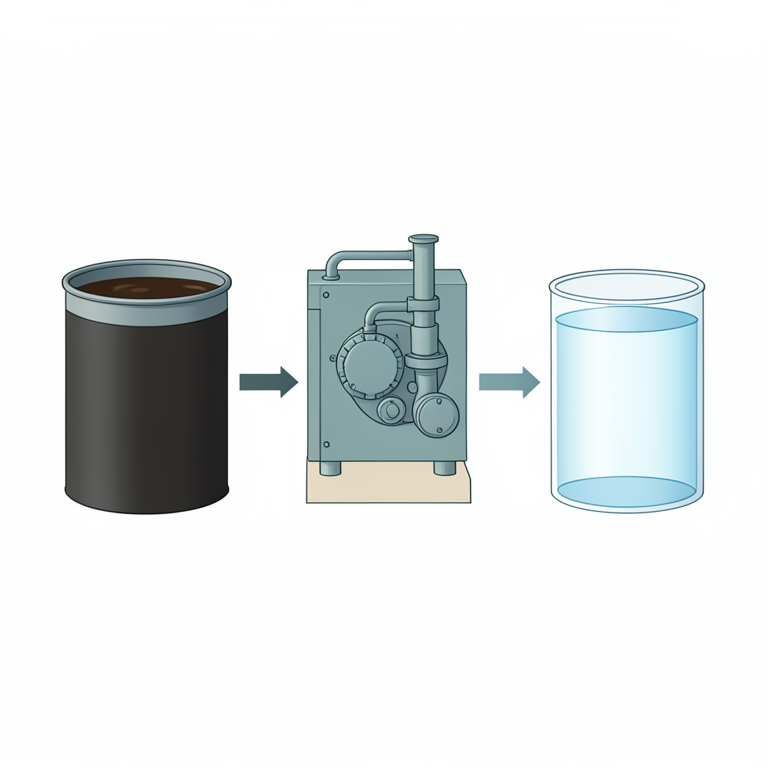
Chromium Reduction Flow
AI-generated conceptual illustration (industrial wastewater from leather tanning). It explains the idea and does not show study data.
View source evidence ↗Figures & tables
From the original paper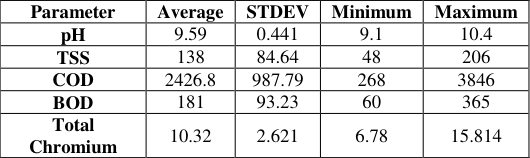 Table 1
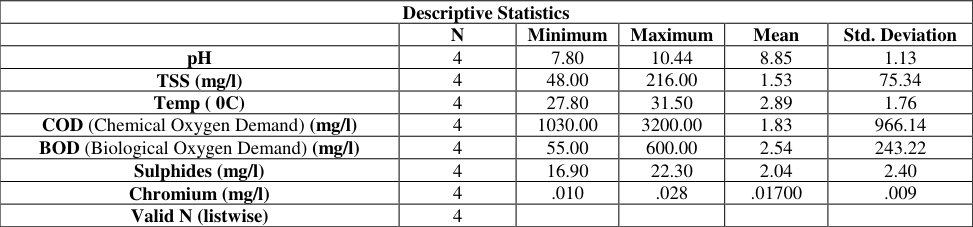 Table 2
Introduction
Waste products rise from our methods of life and they are generated at every degree of technique of manufacturing and development all around the international in which the era of stable waste is an inevitable effect of production and consumption activities in any economy (Jakab, 2011) [6] . Statistics.gov.lk (2019) [10] also suggested that fast growth of urban, agricultural and commercial activities encouraged by means of speedy population development, has produced a huge amount of stable waste that contaminates the ecosystem and damages resources. Volume of waste technology configuration of solid waste management in a selected city or country that depends on the financial and market popularity, population density, town life, mealtimes behaviors, and environmental situation (Friedman, Ritchie and Gallery, 1999) [4] . Consequently, the technology of strong waste has end up an essential international difficulty above the previous decades because of increasing progress of the population (Juhasz, Magesan and Naidu, 2004) [7] . Surface water pollution has many sources and it is generally induced by anthropogenic activities. The main pollution factors of them are the city sewage and industrial waste which discharged into the rivers. Industrial waste is defined as waste generated by manufacturing or industrial processes and types of industrial waste are divided into hazardous and nonhazardous waste. Industrial solid waste which are solid, liquid or gases is held in containers, generated from the industrial production process. Leather tanning is named as a high polluting industry due to emission of hazardous waste including heavy metals. Industrial waste has been a problem since the industrialization of the country with introducing Export Processing Zone in 1970's. (Madani 1999) [8] . The study is based on the industrial hazardous waste which are generated by Chromium base leather tanning industry in the Colombo District, which is the act of converting animal hides and skins into leather. There are two types of tanning systems namely vegetable tanning, which does not contain chromium, and chrome tanning. Chromium salt Sulphates are the most widely used tanning substances today. At high concentrations chromium is toxic, mutagenic, carcinogenic, and teratogenic (Belay, 2009) [2] . According to the records of Central Environmental Authority (CEA), there are fourteen tanneries established in the Western province, though none of them have Environmental Protection license or Scheduled Waste Management License which is issued under provisions of National Environmental Act (No.47of 1980 and No.01 of 2008), since of their poor conscious of hazardous waste management. Although CEA has entered into an agreement with the Ministry of Industries not to take legal action against tanneries until a suitable re-location plan is worked out (CEA 2009). According to the CEA EPL (Environment Protection License) Database 2015, there are only two Chrome based tanneries are in operational level in Colombo District and others have closed or suspended due to non-compliance of CEA regulations hence those two tanneries were selected for the study; Ceylon Leather Products (Pvt) Ltd, Kelani Mill Road, Mattakkuliya and Tan Lanka Pvt.Ltd. Kelani Mill Road, Mattakkuliya. Moreover those two tanneries are discharging their wastewater through the one discharge point to the Kelani River.
Research Objective
Main objective of this research is to analyse surface water pollution due to heavy metal contaminated wastewater (Cr +3 ions) from chrome based leather tanning industries in Colombo District. Also three specific objectives are considered; to analyse potential pollution factors of surface water pollution caused by Leather Tanning Industries, to evaluate deviation of current effluent discharging parameters of the discharge waste water of tanneries from the National standards 1 [National Environmental (Protection & Quality) Regulation No.01 of 2008] and to examine significance of parameter variation in Kelani river with time and water level.
Research Design and Method
The study has been mainly based on the Primary data known as a raw data and is collected by sampling and laboratory analysis of selected water bodies. Furthermore raw data has not been subjected to processing or any other manipulation, and are also referred to as primary data. Primary data is collected by field measurements and laboratory measurements of water quality of selected waste water discharge point. Selected leather tanning industries discharge their effluents through one discharging point in the Kelani River at Mattakkuliya area. Solid waste and effluents are generated through the production process and generate mixed wastewater in complete tanning process and composition is not solely the result of separate waste 1 Standard discharge parameters -According to the Central Environmental Authority's tolerance limits for Waste from being discharged from Leather Tanning Industries into inland waters and seawaters total Chromium concentration is usually limited to 2.0mg/l (CEA Regulation 2008).
streams that merge together. Moreover five hundred and thirty two wastewater and surface water samples were collected for the laboratory analysis including hundred and forty four wastewater samples from two selected leather tanneries and tree hundred and eighty eight samples of surface water of Kelani river. Concentration of Chromium ions of surface water of Kelani River was correlated with water level of the river and time. Sample collection was carried out during the dry season as well as the rainy season of the 2015 August -2016 March (Annual Weather Report -2015). Water level of Kelani River from mean sea level was gathered from Department of Irrigation secondarily. Data set is analyzed by using SPSS 16 software and normality and descriptive analysis have been carried out. Both parametric and nonparametric data analysis techniques were employed in this study to identify the variability of water quality with influential parameters. Parametric variables are tested with One-way ANOVA and nonparametric variable are analysed by Kendall's W and Wilcoxon Signed Ranks Tests. Analysis of Variance (ANOVA) is a statistical method used to test differences between two or more means (Penny, et al. 2006) [10] . The Wilcoxon signed rank test, also known as the Wilcoxon matched pairs test, is a nonparametric test used to test the median difference in paired data. Secondary data is collected from Ministry of Industry and Commerce, Industrial Development Board (IDB), Central Environmental Authority (CEA), Industrial Technological Institute (ITI), Sri Lanka Leather Tanners Association (SLAT), Department of Irrigation. Other relevant Authorities as University of Colombo.
Key Findings
Selected leather tanning industries in Colombo District are discharged their effluents through one discharging point in the Kelani River at Mattakkuliya area. Solid and effluents wastes have generated during the production process. As previously pointed out, throughout the tanning process at least 300 kg of chemicals (lime, salt etc.) are added per ton of hides. Excess of non-used salts has washed out with the wastewater by changing pH and these compounds can be precipitated and contributed to the solid waste or suspended solids in effluents. Tanneries generate mixed wastewater in complete tanning process and composition is not exclusively the result of separate waste streams that merge together. The different pH's and the different compounds influence each other's solubility. In composite wastewater, compounds precipitate while they stay dissolved in the wastewater from the separate processes (Pelckmans, undated). Tannery effluents and surface waters around the discharging point were tested for BOD, COD, Total Chromium (Cr +3 ), TSS, pH, EC, Turbidity and concentration of Sulphides as Sulfur. Although water quality of Kelani River was tested for pH, COD, DO, EC and Total Cr +3 for identify the potential pollution factors. Table 02 illustrates descriptive analysis of treated effluent of leather tanning industry which samples were collected before the discharging point of the Kelani River. Moreover concentration of Cr +3 was less than the 0.2mg/l which is the tolerant limit enforced by the CEA and detected maximum Cr +3 concentration was 0.028 mg/l and the minimum was 0.09mg/l, in some cases Cr +3 cannot be detected at the preliminary sampling. While there was higher concentration of Cr +3 was detected in untreated effluent before chrome recovery but it decreased less than 0.02mg/l after the recovery. When the considering water quality of Kelani River at the points of Modara and Glencorse were carried out SLLR & DC in August 2015 and chemical analysis has done by SGS Co. Ltd., free Ammonia, total Phosphate, Chromium, Lead, Copper Arsenic, Mercury, Pesticide residues, PAHs, Amines (Associated with Azo dyes), Chlorinated solvents, other VOCs, Total Coliforms were tested and have not been detected. Modara is the main area which all leather tanning industries are located and all those tanneries release their untreated effluent to the River at the Modara and Mattakkuliya area but considering the secondary data, Cr +3 have not detected in Kelani River due to the facility of Chromium recovery which those leather factories used in common.
Conclusion
Identification of waste generation points in Chrome based leather tanning process was made and laboratory analysis was carried out on both treated and non-treated effluents for the contents. Especial attention was given to presents of Chromium analysis and laboratory analysis were carried out before and after recovery treatment and it was found that 99.24% of Chromium has recovered the effluent discharged. Furthermore Chromium ions were not detected in the wastewater at the discharge point as same as the Kelani River. Also total Chromium in untreated wastewater was detected 10.32 mg/l as average and 15.81 mg/l as maximum levels although Chromium was detected in 0.017 mg/l as average and 0.028 mg/l as maximum level in discharging effluent after the Chrome recovery but there was no trace of Chromium found in the natural cause. This is the most important finding that was established consequent to the tests and research carried out by the study with regard to the Chromium concentration in Kelani River contrary to common belief that heavy metals like Chromium are disastrous elements in effluents of this industry which adversely effected the expansion of the industry hence Industrial park that was constructed at Bata-Atha accommodating tanning industry was abounded due the above belief. Hence it is very important to implement strict control, supervision and monitoring by all relevant authorities concern to maintain the discharge of effluent to a total treatment and release the same within the limit of accepted tolerance with regard to all by-products. Furthermore with the strict controls and monitoring of the Chrome based leather tanning industries in Sri Lanka can be turned to the high income generating sector to the Country.
Figures and tables from the paper
| Parameter | Average | STDEV | Minimum | Maximum |
|---|---|---|---|---|
| pH | 9.59 | 0.441 | 9.1 | 10.4 |
| TSS | 138 | 84.64 | 48 | 206 |
| COD | 2426.8 | 987.79 | 268 | 3846 |
| BOD | 181 | 93.23 | 60 | 365 |
| Total Chromium | 10.32 | 2.621 | 6.78 | 15.814 |
Table text extracted from the original PDF; superscript letters are shown inline. The original table image is below.
View original table image
| Descriptive Statistics | — | — | — | — | — |
|---|---|---|---|---|---|
| N | Minimum | Maximum | Mean | Std. Deviation | |
| pH | 4 | 7.80 | 10.44 | 8.85 | 1.13 |
| TSS (mg/l) | 4 | 48.00 | 216.00 | 1.53 | 75.34 |
| Temp ( 0C) | 4 | 27.80 | 31.50 | 2.89 | 1.76 |
| COD (Chemical Oxygen Demand) (mg/l) | 4 | 1030.00 | 3200.00 | 1.83 | 966.14 |
| BOD (Biological Oxygen Demand) (mg/l) | 4 | 55.00 | 600.00 | 2.54 | 243.22 |
| Sulphides (mg/l) | 4 | 16.90 | 22.30 | 2.04 | 2.40 |
| Chromium (mg/l) | 4 | .010 | .028 | .01700 | .009 |
| Valid N (listwise) | 4 |
Table text extracted from the original PDF; superscript letters are shown inline. The original table image is below.
View original table image
References
8 in the original paper- Anderson RA. "Chromium in the prevention and control of diabetes". Diabetes Metabol 2000;26:22-27.
- Belay AA. "Impacts of Chromium from Tannery Effluent and Evaluation of Alternative Treatment" Options School of Environmental health, Jimma University, Jimma, Ethiopia 2009.
- Cassano A, Molinari A, Romano M, Drioli E. "Treatment of aqueous effluents of the leather Industry by membrane processes", a review. J Membr Sci 2001;181:111-126.
- Friedman T, Ritchie C and Gallery A. Waste Management. Toronto: Art Gallery 1999.
- Jakab C. Waste Management. New York: Marshall Cavendish Benchmark 2011.
- Juhasz A, Magesan G and Naidu R. Waste Management. Einfied: Plymouth 2004.
- National Environmental (Protection & Quality) Regulation No. 01 of 2008 National Environmental Act, Sri Lanka. Act No 47,1980 of Ontario.
- Penny W, Henson R. "Analysis Techniques and Strategies", International Journal of Data Statistics.gov.lk,. Population and Housing. [online] 2019.
Cited by 4
From OpenAlex, OpenCitations and reference lists read by Scinovex
- Stabilization strategy of normal and chrome tanning effluent mixed subsoil: a novelty to enhance the soil characteristics ↗
Lutufullah Muzammal, Saad Zaheer, Usman Saif, Naheed Akhtar, Abdul Aleem, Sikander Zaman Khan · Asian Journal of Science Engineering and Technology (AJSET) · 2024
Soil stabilisation is a unique method to effectively and accurately find a solution to the issues caused by loose subsoil. This research investigates the problems of uncontrolled industrial effluent disposal, mainly from tannery enterprises, which presents severe environmental problems in emerging nations due to soil properties changing and large regions being unfit for cultivation and human habitation. The study uses…
❝ 1PDF - Preliminary pharmacognostic standardization of leaves of Camellia sinensis leaf (Theaceae) ↗
Mamta Agrahari, Braj Nandan Kishor, Priya Mishra · Journal of Pharmacognosy and Phytochemistry · 2021
Camellia sinensis, being belonging Theaceae family, is present more India less than China. A study on Camellia sinensis leaves sample extracted the air-dried leaves powder with different solvents like n-hexane, petroleum ether, chloroform (61̊C), ethanol (78̊C) and distilled water. Preliminary phytochemical analysis was done measurement of various parameters like extractive value, (moisture content) loss on drying, and quantitative estimation of…
- Effect of hydrocolloid on textural and sensorial quality of liquid jaggery based tamarind leather
K. Heri Nugroho Hs, Gadhe Ks, Kamble RE · International Journal of Advanced Biochemistry Research · 2024
The tamarind leather is confectionary accepted by all age groups, rich in minerals. The aim of the current study was to determine how hydrocolloid affected the textural and sensory qualities of tamarind leather made from liquid jaggery. Liquid jaggery in the tamarind leather gave product texture sticky. This stickiness could be removed by addition of hydrocolloid like guar gum and maltodextrin. Guar gum and maltodextrin in the leather was added in the proportion T0 (0%), T1(0.5%), T2(1%), T3(1.5%) and T4(2%). The leather was prepared and well dried. The resultant leather was evaluated for its
- Chromium and other heavy metal pollution in surface waters
MK Ghosh · International Journal of Agriculture and Food Science · 2024
Heavy metal pollution in surface waters is a significant environmental issue due to its toxic effects on ecosystems and human health. Chromium, along with other heavy metals such as lead, cadmium, and mercury, poses serious risks when present in water bodies. This review paper explores the sources, distribution, impacts, and remediation strategies for heavy metal pollution in surface waters, with a particular focus on chromium. By examining recent studies and advancements in pollution control, this paper aims to provide a comprehensive understanding of the challenges and potential solutions as